


Abstract
Limestone calcined clay cement (LC3 or LC3) is a promising low-clinker and potentially economical binder that combines Portland clinker, calcined clay, limestone and gypsum in a chemically synergistic system. This review critically synthesizes published studies on the mechanical and durability performance of LC3 concrete, focusing on compressive, tensile and flexural strength, stiffness-related properties, water transport, chloride ingress, carbonation, sulfate attack, alkali–silica reaction, freeze–thaw resistance, shrinkage, cracking and reinforcement-corrosion-related durability. The literature shows that optimized LC3 concrete can achieve comparable 28-day compressive strength to OPC concrete and often provides improved chloride resistance through pore refinement, increased tortuosity, C-A-S-H formation and carboaluminate phases. However, important gaps remain in carbonation, corrosion, RCPT-based durability assessment, long-term concrete-scale behavior, shrinkage, creep, cracking and combined exposure conditions.
1. Introduction
Concrete must satisfy two simultaneous requirements: it must develop sufficient mechanical capacity for structural use, and it must remain durable under the exposure conditions expected during service. Ordinary Portland cement (OPC) concrete has been optimized for more than a century, but its high clinker content is associated with high carbon dioxide emissions [1]. Limestone calcined clay cement (LC3) has emerged as a practical low-clinker binder because calcined clay and limestone are more widely available than many conventional supplementary cementitious materials, and because their combination produces useful chemical and microstructural effects. The typical LC3 concept uses clinker, calcined clay, limestone and gypsum, often near a 50% (clinker), 30% (clay), 15% (limestone) and 5% mass gypsum proportion, although many concrete studies adjust this proportion according to clay reactivity, strength class, workability and sulfate balance [1,2,3,4,5].
LC3 has become one of the most realistic low-clinker alternatives because it uses calcined clay and limestone, two raw materials that are more widely available than several traditional supplementary cementitious materials. The binder is also potentially economical where suitable clay and limestone are locally available, because clinker substitution can reduce fuel demand, limestone calcination and clinker production costs [1,6,7].
The performance of LC3 depends on a set of coupled reactions. Clinker hydration produces calcium silicate hydrate (C-S-H) and portlandite. Calcined kaolinitic clay, mainly through its metakaolin fraction, reacts pozzolanically with portlandite and contributes alumina and silica to form C-A-S-H type hydrates. Limestone is not only a filler; it also provides carbonate that reacts with alumina to form hemicarboaluminate and monocarboaluminate, while gypsum regulates sulfate availability and ettringite formation [1,2,4,5,6,7]. The resulting microstructure can become finer and less connected than OPC concrete, which is one reason for the frequently reported improvement in chloride resistance [8,9,10,11,12,13].
Despite this progress, a review focused only on LC3 works is no longer sufficient. Several recent reviews already describe LC3 chemistry, raw materials and sustainability [6,7,14,15,16]. In addition, systematic reviews have already addressed material factors governing mechanical performance [3]. Experimental evidence at mortar and concrete scale also shows that limestone–calcined clay systems should be evaluated through engineering properties such as strength development, transport resistance and carbonation behaviour, rather than through binder chemistry alone [17]. Experimental and review evidence further shows that LC3 performance must be interpreted across several scales, from mortar and concrete engineering properties [17] to binder-scale phase evolution and pore refinement [18], and finally to broader production, mixture-design, durability, economic and future-research considerations [19]. The present review therefore takes a more focused and practical position: it reviews LC3 concrete specifically through the combined lens of mechanical properties and durability. It asks which performance claims are well supported, which are still weak, and what experiments are still needed for LC3 concrete to be confidently used in durable concrete applications. Life cycle assessment, standards and service-life modeling are mentioned only briefly where they support future research needs; they are not the main scope of this paper.
2. LC3 Production Route and Distinction from Related Binders
LC3 is usually produced by combining Portland clinker, calcined clay, limestone and gypsum. In the common LC3-50 concept, the binder contains approximately 50% clinker, 30% calcined clay, 15% limestone and 5% gypsum by mass, although the optimum proportions depend on clinker mineralogy, clay reactivity, limestone purity, fineness, water demand and sulfate balance [1,2,3,20,21,22].
The calcination step is central. Raw kaolinitic clay is heated to transform kaolinite into a more reactive metakaolin-rich material. If the clay is under-calcined, the kaolinite is not sufficiently activated. If it is over-calcined, recrystallization and loss of reactivity may occur. Therefore, the production route must control both temperature and residence time, not only the nominal clay percentage [2,23,24].
LC3 should also be distinguished from related binders. OPC is mainly clinker plus gypsum. PPC or conventional blended cement is Portland cement blended with a pozzolan, often fly ash, but it does not necessarily use the designed calcined clay–limestone synergy that characterizes LC3. Geopolymer and alkali-activated binders are different again: they depend on alkaline activators and aluminosilicate gel formation rather than ordinary Portland-clinker hydration [6,20,25,26]. Table 1 clearly distinguishes between concrete types.
Table 1.
Binder terminology.
3. Fresh Properties and Admixture Compatibility as Practical Mechanical Barriers
Fresh performance is not a secondary issue for LC3 concrete because workability controls compaction, segregation resistance, aggregate packing, fiber dispersion, surface finishing and ultimately mechanical and durability performance. Calcined clay often increases water demand because of high specific surface area, layered morphology and water absorption, while limestone can improve packing and nucleation but cannot fully remove slump-loss problems [7,16,24,26,27].
PCE (Polycarboxylate Ether) superplasticizers are widely used for LC3, but their effectiveness depends on adsorption competition, clay mineralogy, sulfate content, ionic environment and early surface area creation. Rapid flow loss and thixotropic build-up may be useful for 3D printing or buildability, but they are problematic for ready-mix concrete transport and placement [6,24,26,27,28].
The practical gap is therefore to develop LC3-specific admixture strategies rather than simply increasing the dosage of OPC (Ordinary Portland Cement) based admixtures. Future studies should report slump retention, rheology, PCE saturation dosage, temperature sensitivity, mixing sequence and robustness under realistic batching conditions, because fresh state instability can hide otherwise good binder chemistry [6,7,16,29].
4. Mechanical Properties of LC3 Concrete
Compressive strength is the best documented mechanical property of LC3. Many LC3 concretes show lower or more variable 1- to 3-day strength than OPC because of clinker dilution and early pozzolanic kinetics, but optimized LC3 mixtures can match or exceed OPC at 7 and 28 days when the clay is sufficiently reactive, sulfation is appropriate and workability is controlled [1,4,6,13,30].
The role of clay reactivity is clear but not one-dimensional. About 40% kaolinite in calcined clay can be sufficient for LC3-50 (50 is clinker factor, meaning 50% is clinker and another 50% consists of the rest of the materials) strength comparable to OPC in some systems, yet strength also depends on clay impurities, calcination degree, fineness, clinker composition, limestone content, curing temperature and water demand. This means that kaolinite content is an important screening index but cannot be the only acceptance criterion for LC3 concrete [2,6,23,31,32].
In a direct comparison of M40 (strength of concrete, meaning a mix of concrete that can achieve compressive strength of 40 MPa) concretes, LC3 concrete achieved higher 7-day and 28-day compressive strength than both OPC and PPC (Portland Pozzolanic Cement) concretes; the reported 28-day values were approximately 54.6 MPa for LC3, 49.2 MPa for OPC and 48.7 MPa for PPC [30]. This result supports the view that LC3 can perform at the concrete scale, although the study was short and did not provide detailed clay characterization or microstructural evidence.
Studies using regional clays confirm both the potential and the risk of local LC3 production. Saudi clays, marine clays and other low- to medium-grade clays can produce useful LC3 concretes, but strength and durability vary with CaO content, calcite impurities, reactive alumina, particle size and calcination regime. These findings support regional LC3 development, but they also show that local raw materials need systematic characterization before being used in structural concrete [6,16,32,33,34].
Longer-term studies also show that LC3 systems may continue gaining strength beyond 28 days because pozzolanic and carboaluminate-forming reactions continue. For example, recycled aggregate concrete incorporating LC3 showed lower early strength at 50% replacement but reduced its strength gap by 300 days, while maintaining much better chloride resistance than OPC-based recycled aggregate concrete [35]. Fly-ash-modified limestone calcined clay systems also indicate that replacement of part of calcined clay with fly ash can improve workability without severely reducing long-term strength or chloride resistance [30].
Nevertheless, compressive strength is not universally improved. Low-grade clays, insufficient kaolinite, under-calcination, high replacement level, inadequate sulfate balance and high-water demand can reduce strength. Low-grade marine clay LC3 showed acceptable but approximately 25% lower 28-day mortar strength than OPC, while still showing excellent chloride diffusion resistance [34]. This demonstrates a central point for this review: LC3 mechanical performance and durability do not always improve together, and the evaluation of LC3 concrete should not rely on compressive strength alone.
Tensile and flexural behavior of LC3 concrete is less developed than compressive strength. Some studies report comparable split tensile strength to OPC and improved flexural strength in selected LC3 mixtures [30]. However, the evidence remains limited because fracture behavior, crack patterns, crack width, statistical variation and links with microstructure are not always reported. This is important because tensile and flexural properties directly affect cracking, serviceability and durability. Even when LC3 concrete reaches adequate compressive strength, shrinkage cracking or low tensile strain capacity can create pathways for chloride, CO2, water and sulfate ingress. Future studies should therefore report split tensile strength, flexural strength, fracture energy and crack-width development together with durability results.
Some LC3 concrete and LC3-ECC systems report promising tensile, flexural and strain hardening behavior, but the evidence is smaller, more specialized and often linked to fiber reinforced systems rather than ordinary reinforced concrete. A structural review should therefore identify tensile and flexural behavior as a remaining gap, not as a fully solved property [4,36,37,38,39].
Elastic modulus, bond strength, fracture energy, creep and shrinkage are less consistently reported in the LC3 concrete literature. This is a serious limitation for structural applications because these properties influence deflection, cracking, prestress loss, restraint stress and long-term serviceability. Some LC3 studies on engineered cementitious composites and fiber-reinforced systems suggest that LC3 can be incorporated into ductile composites, but these are specialized systems and cannot be directly generalized to ordinary structural concrete [37,40].
Shrinkage deserves special attention because LC3 pore refinement can increase capillary stresses and self-desiccation, especially in low water/binder mixtures. Sulfate level, curing, internal water availability and admixtures can also change shrinkage behavior [41,42]. The literature therefore needs more studies that combine mechanical testing with drying shrinkage, autogenous shrinkage, restrained shrinkage, creep and crack-controlled durability.
Bond with reinforcing steel, fracture energy and crack width control are underrepresented compared with compressive strength. This is important because structural design depends not only on cube or cylinder strength but also on stiffness, deformation compatibility, crack spacing, reinforcement bond and post-cracking behavior [4,6,19,39].
Shrinkage and creep remain mixed and system-dependent. Some LC3 systems show lower creep or delayed shrinkage due to refined microstructure and binder composition, while other systems show higher autogenous or drying shrinkage depending on water demand, internal relative humidity, sulfation, clay fineness and curing. This makes shrinkage/cracking a high-priority mechanical durability bridge topic [1,6,39,41,42].
5. Chemistry and Microstructural Basis of LC3 Performance
The standard LC3 concept is usually described as a ternary or quaternary binder containing Portland clinker, calcined clay, limestone and gypsum. The best-known LC3-50 formulation contains about 50% clinker, 30% calcined clay, 15% limestone and 5% gypsum, although the optimum composition depends on clinker mineralogy, clay reactivity and sulfate demand [1,2,6,19,43].
In LC3 hydration, clinker supplies C-S-H and portlandite, calcined clay supplies reactive silica and alumina, and limestone supplies carbonate and filler/nucleation surfaces. The reaction between alumina and carbonate produces AFm (Al2O3Fe2O3mono) type carboaluminate phases, while the pozzolanic reaction of metakaolin consumes portlandite and contributes to C-A-S-H type hydrates [5,18,19,29,44].
The durability advantage of LC3 is often attributed to pore refinement rather than a simple reduction in total porosity. Studies using MIP, SEM, XRD, TGA and advanced synchrotron microtomography show that LC3 can refine capillary pores and reduce pore connectivity, which is directly relevant for chloride ingress, water transport and electrical resistivity [4,10,11,18,45].
The sulfate balance of LC3 is central because the aluminate peak must be controlled relative to silicate hydration; insufficient or unsuitable sulfate may accelerate aluminate reactions, alter ettringite and carboaluminate formation, and affect early strength. Recent work on sulfate optimization shows that different criteria (calorimetry, bound water, strength and chemical shrinkage) may lead to different optimum SO3 contents, meaning that LC3 cannot rely on one universal gypsum rule [16,20,21,41].
6. Chloride Resistance and Water/Ion Transport
Chloride resistance is the strongest and most repeated durability advantage of LC3 concrete. Multiple studies show lower chloride migration or diffusion than OPC and some other blended cements, especially when calcined clay has adequate kaolinite content and the pore structure is refined [4,10,12,13,32].
The mechanism of chloride resistance is not simply higher chloride binding. LC3 can form AFm/carboaluminate phases that bind chloride, but several studies emphasize that lower transport is mainly controlled by reduced pore connectivity, refined capillary pores, increased tortuosity and higher electrical resistivity [10,11,18,46,47].
Chloride evidence must still be interpreted carefully because the rapid chloride permeability test (RCPT) is sensitive to electrical conductivity, pore solution chemistry and resistivity, not only chloride diffusion. Chloride durability should therefore be supported by migration/diffusion coefficients, bulk diffusion, chloride profiles, resistivity and, where possible, natural exposure, rather than only RCPT charge passed [4,24,47,48,49].
LC3 has also been used to improve recycled aggregate concrete, where the porous old mortar and weak Interfacial Transition Zone (ITZ) normally increase transport. LC3-based recycled aggregate concrete studies indicate that pore refinement and matrix densification can substantially reduce chloride migration while keeping strength losses modest, but ITZ improvement and RCA (Recycled Concrete Aggregate) variability still need direct microstructural and long-term validation [17,19,30].
7. Carbonation and Reinforcement Corrosion
Carbonation is the most critical durability uncertainty for LC3 concrete because the same pozzolanic reaction that improves pore refinement also consumes portlandite. Reduced portlandite and lower alkaline reserve can reduce pH buffering and increase the risk of carbonation-induced de-passivation of reinforcing steel [6,17,19,50,51].
The carbonation problem should not be over-simplified. LC3 may have lower permeability and higher resistivity, which can slow moisture and ionic transport and reduce corrosion rate after de-passivation, but carbonation depth may still be higher than OPC under some exposure conditions because of lower buffering capacity [12,50,51,52,53].
The important review gap is the interaction between carbonation and chloride exposure. Real reinforced concrete structures are rarely exposed to only one deterioration mechanism; marine, urban and deicing environments may combine chlorides, carbonation, wet–dry cycling and cracking. Recent corrosion studies indicate that coupled carbonation–chloride attack can change reinforcement corrosion mechanisms in LC3 systems, so combined exposure must become a main future research direction [50,51,52,53].
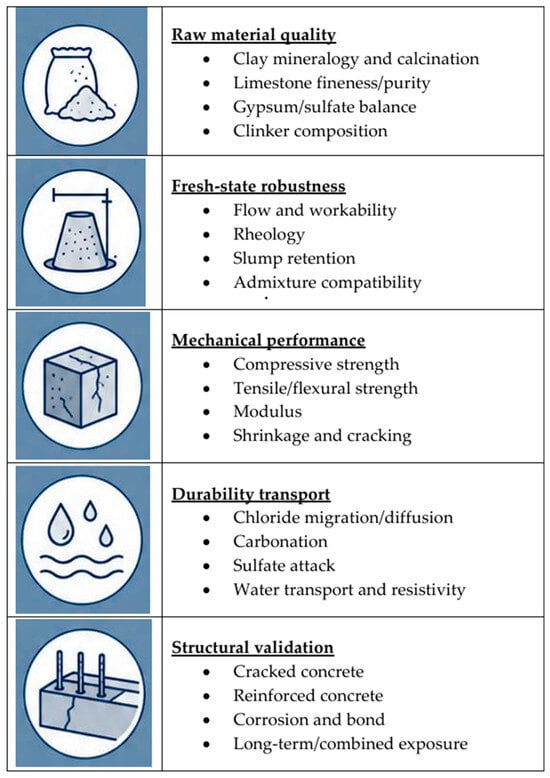
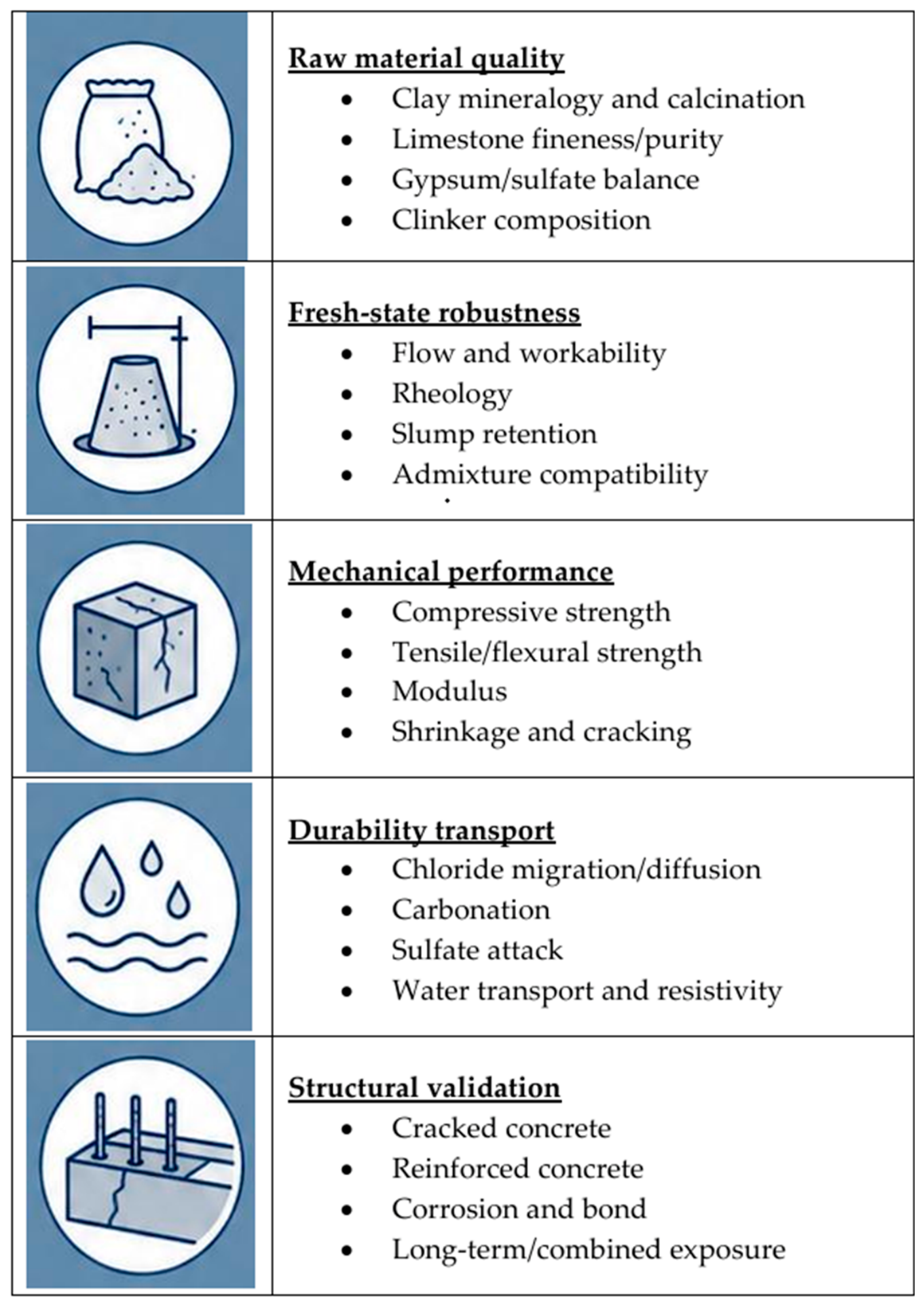
For structural LC3 concrete, the question is not only whether carbonation depth is higher or lower, but how much cover, curing quality, binder composition, w/b ratio and exposure class are needed to keep reinforcement passive for the intended design life. This is why carbonation should be presented as a remaining design challenge rather than a reason to reject LC3 [6,12,19]. It is good to mention that a reliable LC3 concrete design has to consider and connect different factors such as raw-material characterization, fresh-state robustness, mechanical performance, durability, transport assessment and reinforced concrete validation. Figure 1 emphasizes that good paste chemistry or high cube strength alone is not sufficient for structural application; LC3 mixtures must also remain workable, control cracking, resist aggressive transport and protect steel reinforcement under realistic exposure conditions.
Figure 1.
Practical pathway for a reliable LC3 concrete.
8. Sulfate Attack, ASR, Freeze–Thaw and Other Durability Indicators
Sulfate resistance of LC3 is generally promising because lower portlandite content [3], refined pores and altered AFm (monosulfate)/Aft (ettringite) phase assemblages can reduce harmful ingress and expansive reactions. However, magnesium sulfate, external sulfate combined with carbonation, and long-term transformations of carboaluminates require more systematic work [6,7,19,21].
ASR mitigation is another promising durability area. LC3 can reduce alkali availability, refine pores and modify pore solution chemistry, and experimental work has shown reduced expansion in reactive aggregate systems. Still, the degree of mitigation depends on replacement level, clay reactivity, alkalis, aggregate reactivity and test method [6,19,24,54].
Freeze–thaw durability and elevated-temperature performance are much less developed than chloride resistance. Available reviews report favorable or potentially favorable behavior in some cases, but the data remain insufficient across air-void systems, scaling salts, saturation levels, thermal cycles, high-temperature phase changes and post-fire residual properties [6,7,16,24].
Water absorption, capillary absorption/sorptivity and permeability generally decrease when LC3 produces effective pore refinement and lower pore connectivity. However, these transport indicators are strongly influenced by curing quality, water-to-binder ratio, aggregate grading, compaction and testing age. Therefore, they should not be interpreted as isolated durability results but should be evaluated together with mechanical performance and microstructural evidence. Therefore, transport tests should be interpreted together with mechanical results and microstructural evidence [4,11,30,32,35]. Table 2 summarizes how strongly different durability properties are currently supported in the LC3 concrete literature and highlights the main cautions that should be considered when interpreting the available evidence.
Table 2.
Relative maturity of durability evidence in LC3 concrete.
9. Comparison of LC3 with Other Types of Concrete
Compared with OPC, the main advantage of LC3 is that it preserves Portland-cement-type handling and hydration while reducing clinker content and improving some transport properties. Compared with PPC or fly ash cement, LC3 can show faster early strength and less dependence on coal fly ash availability, but it may require more careful workability and sulfate control [1,4,6,19,30].
Compared with geopolymer or alkali-activated concrete, LC3 is usually more compatible with existing cement standards, production lines and field practice because it remains a Portland-clinker-based blended cement. Geopolymers may offer major CO2 reductions in some contexts, but their activator chemistry, curing conditions, standardization and field robustness differ strongly from LC3 [1,7,24,25].
For the present review topic, the OPC/PPC/geopolymer comparison should remain short and functional. The central paper should not become a broad comparative binder review; it should use the comparison only to clarify why LC3 is attractive and where its mechanical-durability risks differ from those of OPC and other low-carbon binders [6,19,24].
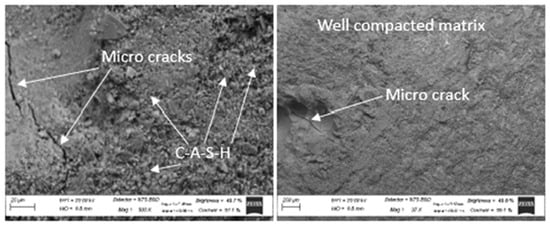
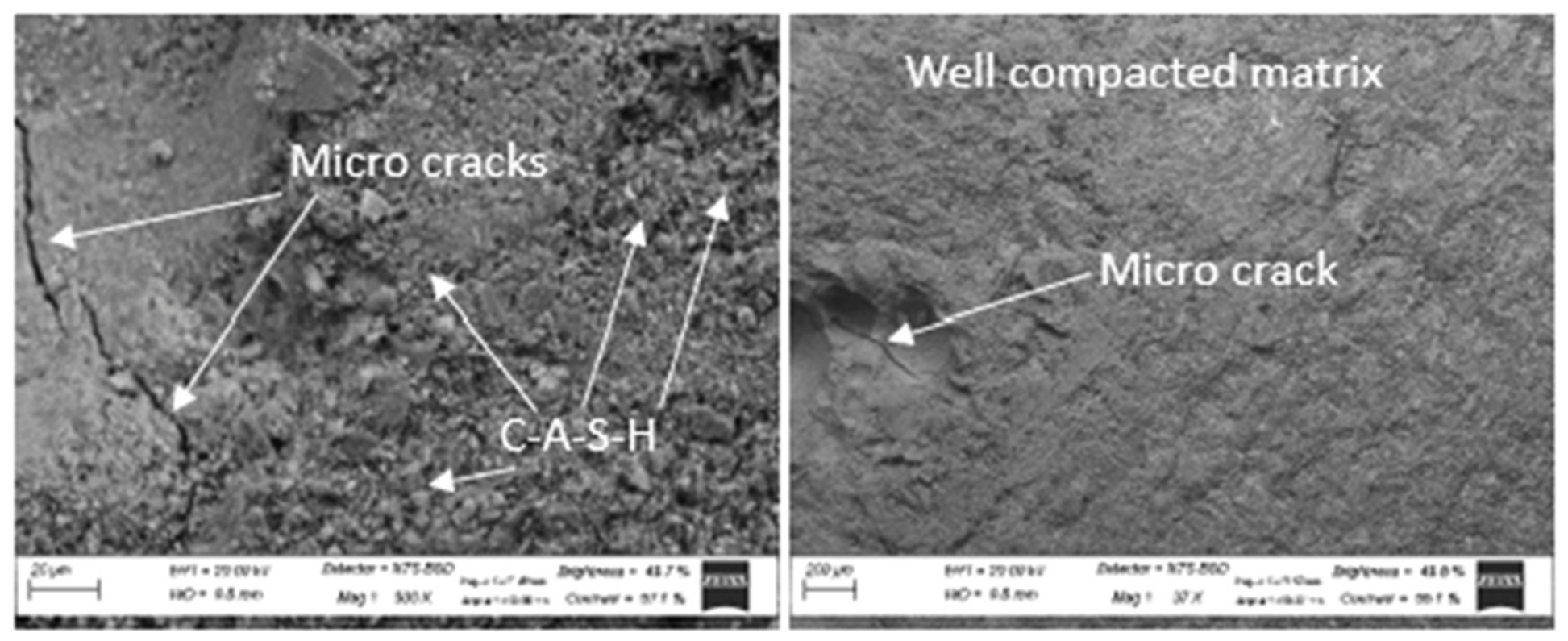
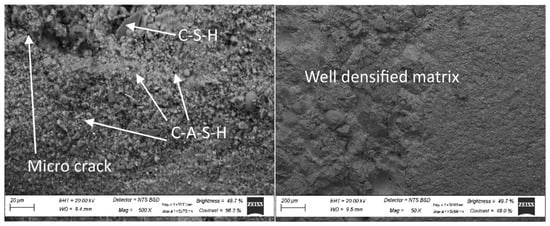
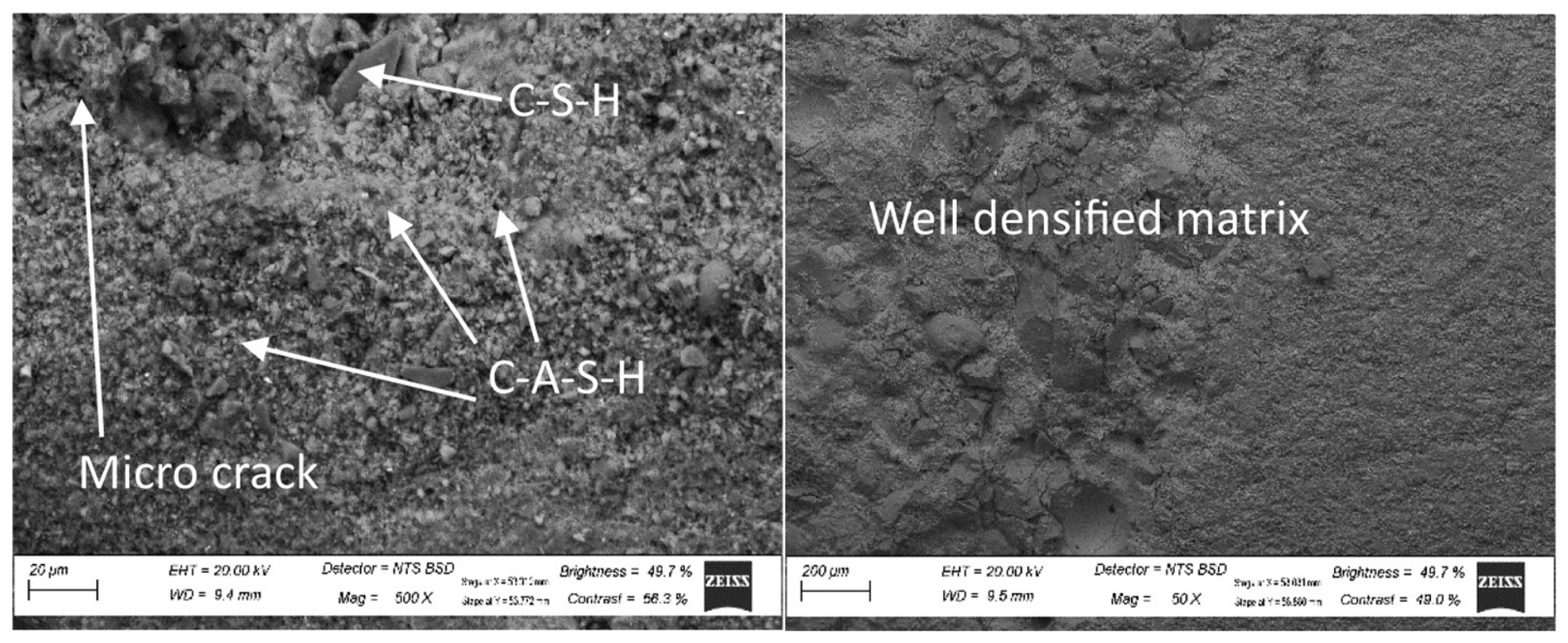
This comparison is also supported by concrete-scale microstructural observations. Mhene and Babafemi [55] examined PC and LC3 concretes after 28 days of water curing using SEM–EDS. The PC concrete showed a dense and relatively well-compacted matrix with limited microcracking Figure 2. The reported microcracks were attributed to early-age moisture loss, plastic-shrinkage stresses and locally incomplete hydration. In comparison, the LC3 concrete showed a densified matrix containing hydration products consistent with C–S–H, C–A–S–H, ettringite and carboaluminate phases Figure 3. These observations support the role of LC3 hydration in matrix densification and pore refinement. However, the SEM images provide qualitative local evidence only and should not be interpreted as a quantitative comparison of the total porosity of PC and LC3 concretes.
Figure 2.
SEM images of PC concrete after 28 days of water curing, adapted from Mhene and Babafemi [55] (Figure 24).
Figure 3.
SEM images of LC3 concrete after 28 days of water curing, adapted from Mhene and Babafemi [55] (Figure 25).
10. What Has Been Done and What Remains Insufficiently Resolved
The literature has moved beyond proving that LC3 can hydrate and gain strength. Strong evidence now exists for clinker reduction, carboaluminate formation, pore refinement, OPC-comparable compressive strength in optimized mixes and improved chloride resistance. The remaining challenge is to define robust performance envelopes for different raw materials, climates, exposure classes and structural applications [1,4,6,16,19].
The largest imbalance in the literature is between compressive strength/chloride resistance and the rest of structural durability. Tensile strength, flexural strength, elastic modulus, creep, shrinkage, bond, fracture, cracking, carbonation-induced corrosion, combined chloride-carbonation exposure, freeze–thaw, fire and field exposure remain substantially less mature [6,35,41,42,51].
Another issue that remains insufficiently resolved is quality control. R3 and other reactivity tests are useful for calcined clays, but they do not directly guarantee concrete strength, workability, carbonation resistance or long-term durability. Industrial LC3 needs rapid, reliable and practical quality-control tools that link raw clay properties and calcination degree to concrete-scale performance [6,19,22,23,31].
Evidence Basis for the Identified Research Gaps
The gaps in this review are treated as evidence-supported limitations rather than absolute claims that no study exists. They were derived by triangulating three types of evidence: (i) recent state of the art and bibliometric reviews that identify underdeveloped LC3 themes, (ii) primary experimental studies showing where results are concentrated or limited, and (iii) methodological limitations in commonly used tests. Therefore, the manuscript uses cautious wording such as “limited evidence”, “underexplored”, “not yet fully resolved” and “requires further validation” instead of unsupported statements such as “no research exists” [6,7,16,19,24,25,56].
This evidence table strengthens the manuscript because it shows that the identified gaps are not based on personal opinion. The safer and more defensible interpretation is that LC3 research is advanced in hydration, compressive strength and chloride transport, but remains comparatively less mature in carbonation–corrosion coupling, full mechanical characterization, fresh-state constructability, combined exposure, long-term field data and reinforced concrete validation. This wording is appropriate for a critical review paper and reduces the risk of overclaiming [4,6,16,19,24]. Table 3 shows the evidence-supported justification of the main gap statements used in this paper.
Table 3.
Evidence-supported justification of the main gap statements used in this review.
11. Future Research Direction
Future LC3 concrete research should prioritize concrete-scale and reinforced concrete evidence instead of repeating only paste and mortar optimization. Minimum future test programs should include workability retention, compressive strength, tensile and flexural strength, elastic modulus, shrinkage, creep, chloride diffusion or migration, carbonation depth, resistivity, corrosion initiation and corrosion rate [4,17,38,52,53].
The most urgent durability experiments should study combined exposure: chloride plus carbonation, sulfate plus carbonation, chloride plus wet–dry cycles, freeze–thaw plus deicing salts, and cracked reinforced specimens. These combinations are more realistic than single-ion tests and will determine whether the excellent chloride resistance of LC3 is sufficient to compensate for carbonation-related risks [25,48,52,53,54].
Future mix-design studies should move from one ideal clay and one ideal limestone to regional design frameworks. Such frameworks should connect kaolinite content, amorphous content, clay impurities, calcination conditions, limestone purity, gypsum demand and admixture dosage to target performance classes [2,3,6,23,32,34].
Finally, LC3-specific admixtures and curing strategies should be developed. Water demand, slump loss and thixotropy can reduce field quality, while curing affects hydration, shrinkage and carbonation; therefore, practical recommendations must include mixing sequence, PCE type, PCE dosage, curing duration, early age temperature and finishing/placement constraints [7,16,26,27,29].
12. Conclusions
LC3 concrete is no longer only a laboratory concept; it is a technically credible low-clinker binder system supported by strong evidence on hydration synergy, pore refinement, compressive strength and chloride resistance. The main performance mechanism is the combined action of metakaolin pozzolanic reaction, limestone filler/nucleation effects and carboaluminate formation.
The strongest performance claim that can be made today is that optimized LC3 concrete can achieve OPC-comparable compressive strength and substantially improved resistance to chloride transport, especially when clay reactivity, fineness, sulfate balance, curing and admixture dosage are well controlled.
The most important limitation is carbonation and its interaction with steel corrosion. LC3 can reduce permeability and increase resistivity, but it can also reduce alkaline reserve; therefore, carbonation-induced de-passivation and coupled carbonation–chloride corrosion must remain central research questions before LC3 is used broadly in reinforced concrete exposure classes.
The main novelty of this review is to frame LC3 not only as a low-carbon binder or as a collection of material-related factors, but as a complete mechanical–durability system. Its practical success depends on whether LC3 concrete can provide reliable strength, transport resistance and reinforcement protection under realistic structural conditions. Therefore, future research should move beyond paste, mortar and uncracked concrete specimens and should include long-term concrete-scale studies on cracked LC3 concrete and reinforced LC3 concrete elements. This is particularly important because cracks can accelerate the ingress of chloride ions, CO2, moisture and sulfate (cracks can allow chloride, CO2, water, and sulfate to enter faster), while the presence of steel reinforcement makes corrosion resistance a decisive performance requirement (durability is not only about concrete strength; it is also about whether the steel reinforcement is protected from corrosion). Such studies are needed to translate LC3 hydration chemistry and pore refinement into practical design recommendations for durable reinforced concrete structures.
Author Contributions
Writing—original draft preparation, S.B. and S.S.; writing—review and editing, S.S., S.B., I.F.H.A. and M.M.A.A.; supervision, S.S. All authors have read and agreed to the published version of the manuscript.
Funding
The authors acknowledge the support of the Central Europe Leuven Strategic Alliance (grant number: CELSA/25/10).
Institutional Review Board Statement
Not applicable.
Informed Consent Statement
Not applicable.
Data Availability Statement
The original contributions presented in this study are included in the article. Further inquiries can be directed to the corresponding author.
Acknowledgments
During the preparation of this manuscript/study, the authors used Copilot Chat (https://copilot.cloud.microsoft, accessed on 7 October 2026) for the purposes of writing correct English grammar and sentences, spelling, punctuation error, comparison of sentences and similar matters. The authors have reviewed and edited the output and take full responsibility for the content of this publication.
Conflicts of Interest
Authors Ibrahim Fuad Hasan Abuawwad and Mohammad Mahmoud Ahmad Alzaidanin were employed by the company Cementra-Jordan. The remaining authors declare that the research was conducted in the absence of any commercial or financial relationships that could be construed as a potential conflict of interest.
References
- Scrivener, K.; Martirena, F.; Bishnoi, S.; Maity, S. Calcined clay limestone cements (LC3). Cem. Concr. Res. 2018, 114, 49–56. [Google Scholar] [CrossRef] [Scilit]
- Avet, F.; Scrivener, K. Investigation of the calcined kaolinite content on the hydration of Limestone Calcined Clay Cement (LC3). Cem. Concr. Res. 2018, 107, 124–135. [Google Scholar] [CrossRef] [Scilit]
- Baradarandilmaghani, S.; Sólyom, S. From clay mineralogy to functional additives: A systematic review of material factors governing the mechanical properties of LC3 based cementitious systems. Concr. Struct. 2026, 27, 40–57. [Google Scholar] [CrossRef]
- Dhandapani, Y.; Sakthivel, T.; Santhanam, M.; Gettu, R.; Pillai, R.G. Mechanical properties and durability performance of concretes with Limestone Calcined Clay Cement (LC3). Cem. Concr. Res. 2018, 107, 136–151. [Google Scholar] [CrossRef] [Scilit]
- Antoni, M.; Rossen, J.; Martirena, F.; Scrivener, K. Cement substitution by a combination of metakaolin and limestone. Cem. Concr. Res. 2012, 42, 1579–1589. [Google Scholar] [CrossRef] [Scilit]
- Hosen, K.; Chen, B. Limestone calcined clay cement (LC3): A review of materials, properties, production and environmental impact. J. Build. Eng. 2025, 112, 113672. [Google Scholar] [CrossRef] [Scilit]
- Ghazy, M.F.; Maaty, E.S.A.; Elaty, M.A.; Alrwashdeh, A.A. A comprehensive review of limestone calcined clay cement (LC3): Environmental and properties benefits, challenges, opportunities, and future directions. Results Eng. 2025, 28, 108319. [Google Scholar] [CrossRef] [Scilit]
- Vizcaíno Andrés, L.M.; Antoni, M.; Alujas Díaz, A.; Martirena Hernández, J.F.; Scrivener, K.L. Effect of fineness in clinker-calcined clays-limestone cements. Adv. Cem. Res. 2015, 27, 546–556. [Google Scholar] [CrossRef] [Scilit]
- Zunino, F.; Scrivener, K. The reaction between metakaolin and limestone and its effect in porosity refinement and mechanical properties. Cem. Concr. Res. 2021, 140, 106307. [Google Scholar] [CrossRef] [Scilit]
- Maraghechi, H.; Avet, F.; Wong, H.; Kamyab, H.; Scrivener, K. Performance of Limestone Calcined Clay Cement (LC3) with various kaolinite contents with respect to chloride transport. Mater. Struct. Constr. 2018, 51, 125. [Google Scholar] [CrossRef] [Scilit]
- Dhandapani, Y.; Santhanam, M. Assessment of pore structure evolution in the limestone calcined clay cementitious system and its implications for performance. Cem. Concr. Compos. 2017, 84, 36–47. [Google Scholar] [CrossRef] [Scilit]
- Pillai, R.G.; Gettu, R.; Santhanam, M.; Rengaraju, S.; Dhandapani, Y.; Rathnarajan, S.; Basavaraj, A.S. Service life and life cycle assessment of reinforced concrete systems with limestone calcined clay cement (LC3). Cem. Concr. Res. 2019, 118, 111–119. [Google Scholar] [CrossRef] [Scilit]
- Nguyen, Q.D.; Afroz, S.; Castel, A. Influence of clay calcination method on the mechanical properties and chloride diffusion resistance of limestone calcined clay cement (LC3) concrete. J. Mar. Sci. Eng. 2020, 8, 301. [Google Scholar] [CrossRef] [Scilit]
- Shao, J.; Guo, S.; Wang, H. A Review of the Performance, Sustainable Applications, and Research Challenges of Limestone-Calcined Clay-Cement (LC3) Systems. Coatings 2025, 15, 611. [Google Scholar] [CrossRef] [Scilit]
- Prashar, R.; Kishor, R.; Jee, A.A. LC3 systems: A review of chemistry, performance, durability, and sustainability toward market adoption. Innov. Infrastruct. Solut. 2026, 11, 246. [Google Scholar] [CrossRef] [Scilit]
- Al Kindi, H.; Abdel-Gawwad, H.A.; Meddah, M.S.; Al Jabri, K.; Mohamedzein, Y. An overview of the critical influential parameters on the performance of limestone calcined clay cement paste, mortar, and concrete. Constr. Build. Mater. 2024, 444, 137615. [Google Scholar] [CrossRef] [Scilit]
- Shah, V.; Parashar, A.; Mishra, G.; Medepalli, S.; Krishnan, S.; Bishnoi, S. Influence of cement replacement by limestone calcined clay pozzolan on the engineering properties of mortar and concrete. Adv. Cem. Res. 2020, 32, 101–111. [Google Scholar] [CrossRef] [Scilit]
- Bernal, I.M.R.; Shirani, S.; Cuesta, A.; Santacruz, I.; Aranda, M.A.G. Phase and microstructure evolutions in LC3 binders by multi-technique approach including synchrotron microtomography. Constr. Build. Mater. 2021, 300, 124054. [Google Scholar] [CrossRef] [Scilit]
- Sharma, M.; Bishnoi, S.; Martirena, F.; Scrivener, K. Limestone calcined clay cement and concrete: A state-of-the-art review. Cem. Concr. Res. 2021, 149, 106564. [Google Scholar] [CrossRef] [Scilit]
- Zunino, F.; Scrivener, K. The influence of the filler effect on the sulfate requirement of blended cements. Cem. Concr. Res. 2019, 126, 105918. [Google Scholar] [CrossRef] [Scilit]
- da Silva, M.R.C.; Andrade Neto, J.S.; Walkley, B.; Kirchheim, A.P. Exploring sulfate optimization techniques in Limestone Calcined Clay Cements (LC3): Limitations and insights. Cem. Concr. Res. 2024, 175, 107375. [Google Scholar] [CrossRef] [Scilit]
- Avet, F.; Snellings, R.; Alujas Diaz, A.; Ben Haha, M.; Scrivener, K. Development of a new rapid, relevant and reliable (R3) test method to evaluate the pozzolanic reactivity of calcined kaolinitic clays. Cem. Concr. Res. 2016, 85, 1–11. [Google Scholar] [CrossRef] [Scilit]
- Ferreiro, S.; Canut, M.M.C.; Lund, J.; Herfort, D. Influence of fineness of raw clay and calcination temperature on the performance of calcined clay-limestone blended cements. Appl. Clay Sci. 2019, 169, 81–90. [Google Scholar] [CrossRef] [Scilit]
- Barbhuiya, S.; Nepal, J.; Das, B.B. Properties, compatibility, environmental benefits and future directions of limestone calcined clay cement (LC3) concrete: A review. J. Build. Eng. 2023, 79, 107794. [Google Scholar] [CrossRef] [Scilit]
- Mañosa, J.; Calderón, A.; Salgado-Pizarro, R.; Maldonado-Alameda, A.; Chimenos, J.M. Research evolution of limestone calcined clay cement (LC3), a promising low-carbon binder—A comprehensive overview. Heliyon 2024, 10, e25117. [Google Scholar] [CrossRef] [Scilit] [PubMed]
- Muzenda, T.R.; Hou, P.; Kawashima, S.; Sui, T.; Cheng, X. The role of limestone and calcined clay on the rheological properties of LC3. Cem. Concr. Compos. 2020, 107, 103516. [Google Scholar] [CrossRef] [Scilit]
- Nair, N.; Mohammed Haneefa, K.; Santhanam, M.; Gettu, R. A study on fresh properties of limestone calcined clay blended cementitious systems. Constr. Build. Mater. 2020, 254, 119326. [Google Scholar] [CrossRef] [Scilit]
- Ibrahim, K.A.; Van Zijl, G.P.A.G.; Babafemi, A.J. Influence of limestone calcined clay cement on properties of 3D printed concrete for sustainable construction. J. Build. Eng. 2023, 69, 106186. [Google Scholar] [CrossRef] [Scilit]
- Zunino, F.; Scrivener, K. Assessing the effect of alkanolamine grinding aids in limestone calcined clay cements hydration. Constr. Build. Mater. 2021, 266, 121293. [Google Scholar] [CrossRef] [Scilit]
- Purushotham Reddy, K.; Chandra Mohan Rao, B.D.V.; Janardhan Yadav, M.; Swamy Naga Ratna Giri, P. Comparative studies on LC3 based concrete with OPC & PPC based concretes. Mater. Today Proc. 2021, 43, 2368–2372. [Google Scholar] [CrossRef] [Scilit]
- Alujas Diaz, A.; Almenares Reyes, R.S.; Hanein, T.; Irassar, E.F.; Juenger, M.; Kanavaris, F.; Maier, M.; Marsh, A.T.; Sui, T.; Thienel, K.-C.; et al. Properties and occurrence of clay resources for use as supplementary cementitious materials: A paper of RILEM TC 282-CCL. Mater. Struct. 2022, 55, 139. [Google Scholar] [CrossRef] [Scilit]
- Ram, K.; Flegar, M.; Serdar, M.; Scrivener, K. Influence of Low- to Medium-Kaolinite Clay on the Durability of Limestone Calcined Clay Cement (LC3) Concrete. Materials 2023, 16, 374. [Google Scholar] [CrossRef] [Scilit] [PubMed]
- Abdulqader, M.; Khalid, H.R.; Ibrahim, M.; Adekunle, S.K.; Al-Osta, M.A.; Ahmad, S.; Sajid, M. Physicochemical properties of limestone calcined clay cement (LC3) concrete made using Saudi clays. J. Mater. Res. Technol. 2023, 25, 2769–2783. [Google Scholar] [CrossRef] [Scilit]
- Hu, Y.; Xiong, L.; Yan, Y.; Geng, G. Performance of limestone calcined clay cement (LC3) incorporating low-grade marine clay. Case Stud. Constr. Mater. 2024, 20, e03283. [Google Scholar] [CrossRef] [Scilit]
- Guo, M.; Gong, G.; Yue, Y.; Xing, F.; Zhou, Y.; Hu, B. Performance evaluation of recycled aggregate concrete incorporating limestone calcined clay cement (LC3). J. Clean. Prod. 2022, 366, 132820. [Google Scholar] [CrossRef] [Scilit]
- Zhang, D.; Jaworska, B.; Zhu, H.; Dahlquist, K.; Li, V.C. Engineered Cementitious Composites (ECC) with limestone calcined clay cement (LC3). Cem. Concr. Compos. 2020, 114, 103766. [Google Scholar] [CrossRef] [Scilit]
- Zhou, Y.; Gong, G.; Xi, B.; Guo, M.; Xing, F.; Chen, C. Sustainable lightweight engineered cementitious composites using limestone calcined clay cement (LC3). Compos. Part B Eng. 2022, 243, 110183. [Google Scholar] [CrossRef] [Scilit]
- Hou, M.; Li, V.C. Tailoring crack width control of LC3-based engineered cementitious composites (ECC) via fiber hybridization: From micromechanics design to macro investigation. Mater. Des. 2023, 235, 112433. [Google Scholar] [CrossRef] [Scilit]
- Al-Fakih, A.; Al-Shugaa, M.A.; Al-Osta, M.A.; Thomas, B.S. Mechanical, environmental, and economic performance of engineered cementitious composite incorporated limestone calcined clay cement: A review. J. Build. Eng. 2023, 79, 107901. [Google Scholar] [CrossRef] [Scilit]
- Hou, M.; Zhang, D.; Li, V.C. Crack width control and mechanical properties of low carbon engineered cementitious composites (ECC). Constr. Build. Mater. 2022, 348, 128692. [Google Scholar] [CrossRef] [Scilit]
- Hay, R.; Li, L.; Celik, K. Shrinkage, hydration, and strength development of limestone calcined clay cement (LC3) with different sulfation levels. Cem. Concr. Compos. 2022, 127, 104403. [Google Scholar] [CrossRef] [Scilit]
- Nguyen, Q.D.; Afroz, S.; Zhang, Y.; Kim, T.; Li, W.; Castel, A. Autogenous and total shrinkage of limestone calcined clay cement (LC3) concretes. Constr. Build. Mater. 2022, 314, 125720. [Google Scholar] [CrossRef] [Scilit]
- Krishnan, S.; Bishnoi, S. A numerical approach for designing composite cements with calcined clay and limestone. Cem. Concr. Res. 2020, 138, 106232. [Google Scholar] [CrossRef] [Scilit]
- Krishnan, S.; Emmanuel, A.C.; Bishnoi, S. Hydration and phase assemblage of ternary cements with calcined clay and limestone. Constr. Build. Mater. 2019, 222, 64–72. [Google Scholar] [CrossRef] [Scilit]
- Zunino, F.; Scrivener, K. Microstructural developments of limestone calcined clay cement (LC3) pastes after long-term (3 years) hydration. Cem. Concr. Res. 2022, 153, 106693. [Google Scholar] [CrossRef] [Scilit]
- Avet, F.; Scrivener, K. Influence of pH on the chloride binding capacity of Limestone Calcined Clay Cements (LC3). Cem. Concr. Res. 2020, 131, 106031. [Google Scholar] [CrossRef] [Scilit]
- Sui, S.; Georget, F.; Maraghechi, H.; Sun, W.; Scrivener, K. Towards a generic approach to durability: Factors affecting chloride transport in binary and ternary cementitious materials. Cem. Concr. Res. 2019, 124, 105783. [Google Scholar] [CrossRef] [Scilit]
- ASTM C1202; Standard Test Method for Electrical Indication of Concrete’s Ability to Resist Chloride Ion Penetration. ASTM International: West Conshohocken, PA, USA, 2022.
- ASTM C1556; Standard Test Method for Determining the Apparent Chloride Diffusion Coefficient of Cementitious Mixtures by Bulk Diffusion. ASTM International: West Conshohocken, PA, USA, 2017.
- Nguyen, Q.D.; Castel, A. Reinforcement corrosion in limestone flash calcined clay cement-based concrete. Cem. Concr. Res. 2020, 132, 106051. [Google Scholar] [CrossRef] [Scilit]
- Wang, Y.; Xu, Z.; Mi, T.; Yu, J.; Xing, F.; Li, W. Corrosion mechanism of reinforcement in LC3 cement pastes under coupled carbonation and chloride attack. Cem. Concr. Compos. 2023, 140, 105080. [Google Scholar] [CrossRef] [Scilit]
- Li, Y.; Miao, L.; Dong, Z.; Jin, Y.; Liu, W.; Gao, F.; Li, Y. Carbonation and Chloride Resistance Characteristics of Self-Developed Limestone Calcined Clay Cement (LC3) Derived from Excavated Spoil. Materials 2025, 18, 2546. [Google Scholar] [CrossRef] [Scilit] [PubMed]
- Salazar-Mayorga, L.F.; Lizarazo-Marriaga, J.; Arango-L, J.F. Depassivation of reinforcing steel due to accelerated-carbonation in limestone calcined clay cement concretes. Mater. Struct. 2025, 58, 5. [Google Scholar] [CrossRef] [Scilit]
- Nguyen, Q.D.; Kim, T.; Castel, A. Mitigation of alkali-silica reaction by limestone calcined clay cement (LC3). Cem. Concr. Res. 2020, 137, 106176. [Google Scholar] [CrossRef] [Scilit]
- Mhene, T.M.; Babafemi, A.J. Quasi-static strength and long-term characterisation of LC3 concrete: Effect of recycled fine aggregate and polypropylene fibre. Constr. Build. Mater. 2025, 492, 143071. [Google Scholar] [CrossRef] [Scilit]
- Miranda De Souza, A.; Franco De Carvalho, J.M.; Silva, G.M.; Pedroti, L.G.; Silva, G.J.B.; Peixoto, R.A.F. Mapping the research landscape of calcined clay and LC3: A bibliometric perspective on emerging challenges and opportunities. Appl. Clay Sci. 2025, 277, 107952. [Google Scholar] [CrossRef] [Scilit]

Disclaimer/Publisher’s Note: The statements, opinions and data contained in all publications are solely those of the individual author(s) and contributor(s) and not of MDPI and/or the editor(s). MDPI and/or the editor(s) disclaim responsibility for any injury to people or property resulting from any ideas, methods, instructions or products referred to in the content. |
© 2026 by the authors. Licensee MDPI, Basel, Switzerland. This article is an open access article distributed under the terms and conditions of the Creative Commons Attribution (CC BY) license.