


Abstract
Concrete production is a major source of greenhouse gas emissions, making low-CO2 mix design optimisation a key challenge for the construction sector. Any reduction strategy must maintain workability, durability, and long-term performance. The Austrian ‘White Tank’ concept, regulated by the ÖBV-guideline (concrete standard code ‘BS1’), has proven its reliability over decades through optimised concrete compositions that reduce the heat of hydration, limit cracking, and ensure durability. ‘Concretes with Reduced Early-Age Cracking Tendency’ (2023) introduced the concrete standard code ‘BS2’. Both ‘BS1’ and ‘BS2’ enable significant CO2 reductions through the use of clinker-reduced binders and alternative aggregates while maintaining validated performance and durability.
1. Introduction
Adopted in 2019, the European Green Deal aims to make Europe more sustainable by transforming its economy, energy supply, transport and industry [1]. For the construction sector, which plays a key role due to its high resource and energy consumption, this brings specific new regulations closely linked to the Green Deal. These include the EU Energy Performance of Buildings Directive [2], the EU Construction Products Regulation [3] and the EU Taxonomy Regulation [4]. The overarching goal of the European Green Deal is to achieve climate neutrality (net-zero greenhouse gas emissions) by 2050 [5].
Concrete construction, in particular, contributes significantly to global greenhouse gas emissions during the manufacturing process. It is the most widely used manufactured material on the planet, with 14 billion cubic metres produced each year—equivalent to 32 billion tonnes [6]. This is due, firstly, to the enormous volume of concrete produced as the world’s leading construction material and, secondly, to process-related CO2 emissions from cement production. The high temperatures required for clinker production are responsible for a large proportion of these emissions, as are the chemical conversion processes (calcination of limestone).
In this context, the Austrian concrete standard codes ‘BS1’ and ‘BS2’ represent a promising approach, as they enable significant reductions in embodied CO2 emissions without compromising technical performance compared to conventional concrete standards as specified in ÖNORM B 4710-1:2018 [7]. The objective of this study is to present the possibilities and benefits of these concrete standard codes and to assess their environmental advantages. The paper first introduces the principles and requirements of these ÖBV-guidelines in which the concrete standard codes ‘BS1’ and ‘BS2’ are defined. Subsequently, the applied life cycle assessment methodology and the considered system boundaries are described. Finally, the average Global Warming Potential (GWP-total) of the concrete standard code BS2 concretes is evaluated and compared with concretes according to conventional concrete standards.
2. Current Situation—Reducing the CO2 Footprint of Concrete
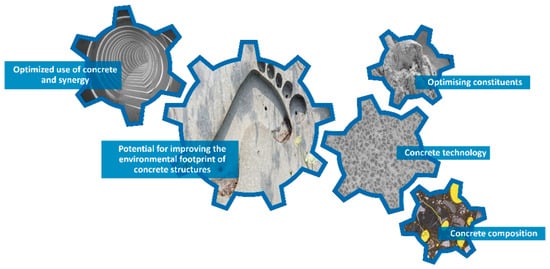
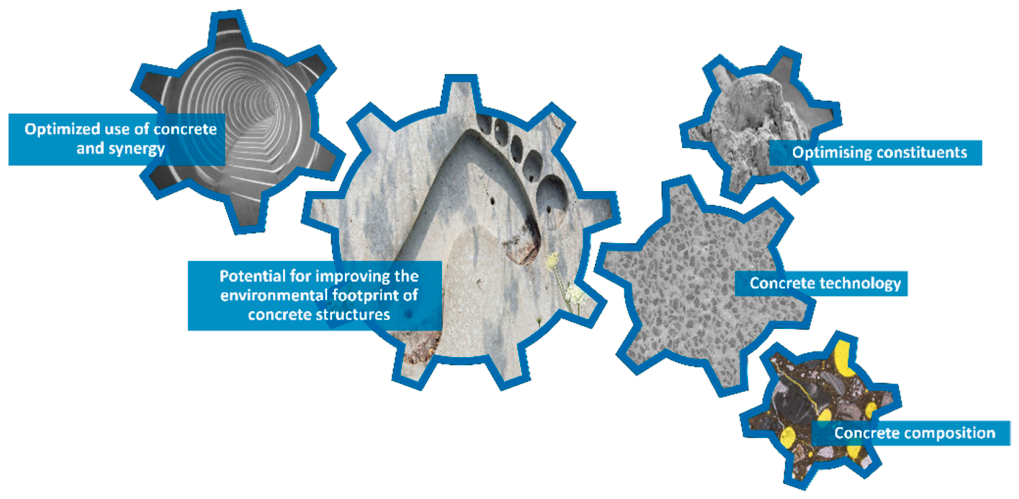
Due to the significant CO2 emissions produced by the manufacture of cement and concrete, it is crucial to consider potential savings in the production and operation of concrete structures. There are numerous effective measures available to improve the environmental footprint of concrete structures (see Figure 1). In addition to optimised concrete use (e.g., optimised load-bearing structures and logistics), other synergy effects (e.g., thermal component activation) and the potential for concrete to act as a CO2-sink (through carbonation), designing a concrete mix with the lowest possible environmental footprint is a key approach.
Figure 1.
Measures to reduce CO2 emissions from concrete.
The current focus of reducing the CO2 footprint of concrete is on producing and using low-carbon binders. For example, CEM II/C-M cements, which are widely available in Austria, contain up to 50 percent less clinker than CEM I cements according to EN 197-5:2021 [8]. In some applications, new types of additives (e.g., tempered clays) or entirely new types of binders (e.g., geopolymers) may also play a significant role in the future.
Furthermore, the focus is increasingly on optimising the overall concrete mix design, i.e., selecting and combining constituents for a specific usage. Functionality, suitability for use and durability are ensured by complying with the mixture composition (descriptive system). Tests on hardened concrete are now used to demonstrate individual performance requirements, as a derogation from this. The European standard in accordance with EN 206:2021 [9] for concrete production provides basic requirements for such performance concepts for concrete or binders.
The need to ensure that the concrete remains fit for purpose and that its service life is at least equivalent to that of existing systems is underlined by all these considerations. This is because reducing CO2 emissions during the manufacturing phase, at the expense of durability, usually results in a massive increase in emissions when viewed over typical service lives, particularly in the case of infrastructure projects.
For this reason, among others, it appears reasonable, at least in the short term, to fall back on tried-and-tested approaches that already incorporate testing of hardened concrete. This also happens with the concrete standard codes ‘BS1’ and ‘BS2’, for which comprehensive guidelines covering everything from design and production to construction have been in place for decades. These guidelines consider the specific characteristics of these concrete standard codes. Another guideline, derived from concrete for white tanks from a concrete technology perspective, concerns concrete with a reduced tendency for early-age cracking. This can be used for a wide range of applications in the infrastructure sector, not just watertight structures. The two guidelines are described in more detail below, followed by an environmental comparison between concretes with reduced early-age cracking tendency and conventional concrete standards. The requirements for conventional concrete standards are regulated in Austria by ÖNORM B 4710-1:2018 [7].
3. Concrete Standard Code ‘BS1’ in Accordance with the ÖBV-Guideline ‘Watertight Concrete Structures—White Tank Systems’ [10]
The construction method known as the ‘white tank (watertight concrete structures)’ in accordance with the ÖBV-guideline ‘Watertight Concrete Structures—White Tank Systems’ [10], has proven itself over several decades as a reliable solution in structural concrete construction in Austria. By optimising the concrete mix, mainly by reducing the heat of hydration, and limiting the temperature of the fresh concrete, the maximum temperature increase in the structural element during the curing phase can be significantly reduced. This results in lower thermally induced stresses and, consequently, a reduced potential for cracking. This forms the basis for durable constructions.
The foundations of the technology behind watertight concrete structures can be traced back to ancient times. As far back as the Roman Empire, additives were used in concrete to build well-known structures, some of which still stand today, such as the Pantheon in Rome and the water basins at Hadrian’s Villa east of Rome [11]. These additives are comparable to those used in contemporary construction. In the modern era, the infrastructure boom of the 1980s and 1990s, with its faster design cycles and resulting need for grade-separated junctions, led to the first guidelines for calculating, designing and constructing watertight transport infrastructure in Austria. These so-called ‘white tank systems’ are defined as watertight structures in which the reinforced concrete structure fulfils both load-bearing and watertighting functions. This principle essentially relies on the impermeability of the concrete structure, which is achieved by adhering to the concrete standards outlined in the guidelines, preventing cracks, distributing cracks through suitable reinforcement and subsequently sealing them where necessary.
The composition of the concrete is essential for the performance of white tanks. It must ensure good workability and a dense structure with low bleeding while minimising thermal and shrinkage stresses. Due to the requirement for the heat of hydration during hardening to be as low as possible, low-heat-generating cements are used for concrete standard code ‘BS1’. Furthermore, the smallest possible quantities of binder and water should be used. To reduce the clinker content, which is primarily responsible for heat generation, part of the binder is replaced by ‘type II additives’. ‘Type II additives’ primarily include granulated blast furnace slag and fly ash, the latter of which is now scarcely available in Austria.
4. Concrete Standard Code ‘BS2’ in Accordance with the ÖBV-Guideline ‘Concretes with Reduced Early-Age Cracking Tendency’ [12]
To harness these positive effects in structures where waterproofing is not required, a separate ÖBV-guideline for concrete with reduced susceptibility to early-age cracking was developed and published in January 2023. The use of clinker-reduced binders and alternative aggregates (e.g., ‘type II additives’) also reduces the tendency for early-age cracking. This enhances the robustness of the structure and extends its service life, while significantly reducing CO2 emissions.
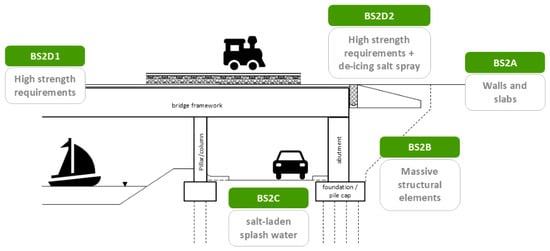
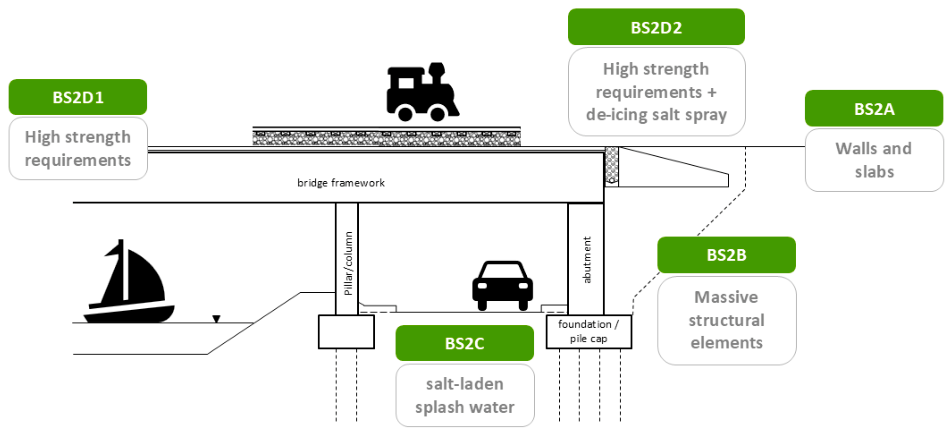
Introducing concrete standard codes for specific structural components makes it easier for everyone involved in the design, production and construction processes to identify the appropriate grade, thereby standardising the industry. The ÖBV-guideline ‘Concretes with Reduced Early-Age Cracking Tendency’ defines specific standard concrete types within the BS2 concrete standard code that are tailored to the varying requirements of individual structural components (see Figure 2):
Figure 2.
Concrete standard code ‘BS2’ in accordance with the ÖBV-guideline, along with their typical applications.
- BS2A—for walls and slabs;
- BS2B—for massive structural elements;
- BS2C—for structural elements in areas exposed to salt-laden splash water;
- BS2D1—for structural elements with high strength requirements;
- BS2D2—for structural elements with high strength requirements and exposure to de-icing salt spray.
The requirements for standard concrete grades vary depending on their respective exposure class. Consequently, the specified minimum binder content and maximum water/binder ratio vary accordingly.
5. Global Warming Potential Analysis of Concrete Standard Code ‘BS2’
The unit of construction management and tunnelling at the University of Innsbruck was commissioned by ÖBB-Infrastruktur AG to conduct a life cycle assessment (LCA) of different ‘standard concrete code mixes’. To evaluate their performance, five of these concrete formulations are subsequently compared with standard concrete types. The selection of these specific mixtures was dictated by the availability of sufficient comparative data. The study aims to assess the climate-related impacts of concrete production by evaluating the Global Warming Potential total (GWP-total).
5.1. General
Life cycle assessment (LCA) systematically analyses the environmental aspects and potential impacts of a product throughout its life cycle [13,14]. In accordance with ISO 14040 [13] and ISO 14044 [15], an LCA comprises goal and scope definition, life cycle inventory analysis, impact assessment, and interpretation. For construction products and civil engineering works, this study follows EN 15804 [16] and EN 17472 [17].
The goal of this study is to evaluate the GWP of the ‘standard concrete code mixes’ at the product stage. The declared unit is defined as 1 m3 of unreinforced fresh concrete. The system boundary is defined as cradle-to-gate and is declared as on aggregated module A1–3 (A1, raw extraction and processing; A2, transport to the manufacturer; and A3, manufacturing) [16].
5.2. Life Cycle Inventory
The life cycle inventory (LCI) quantifies all relevant material and energy flows within the defined system boundary. Data are assigned to the respective process modules and scaled to the reference flow of the declared unit [13,14].
The background data of the concrete mixes were collected from Austrian companies using a questionnaire provided by the GVTB (Güteverband Transportbeton). LCA data for ‘type II additives’, cement, clinker, limestone, and limestone powder were taken from Austrian Environmental Product Declarations (EPDs) [18,19,20]. With regard to the composition of the cements, the maximum amount of composite material and a 5% share of minor components (5% anhydrite, of which 1% was REA gypsum) were used [21].
In consultation with GVTB, the transport distances were assigned for the constituents [18]. The LCA data for the manufacturing process (electricity consumption, thermal energy, etc.) were obtained from the Average Cement EPD [19] and the VÖZ (Vereinigung der österreichischen Zementindustrie) study [18,20].
5.3. Impact Assessment
The life cycle impact assessment (LCIA) links the LCI results to impact indicators to evaluate potential environmental impacts [13]. In this study, the Global Warming Potential total (GWP-total) is reported in kg CO2-eq. The analysis identified the minimum, maximum and average values of the GWP-total; the following section only refers to the average values.
5.4. CO2-Analysis Results
The results for five different types of concrete standard codes ‘BS2’ are shown below as examples (see Table 1). These are average values derived from various concrete designs.
Table 1.
GWP-total results for 1 m3 fresh concrete, A1–3.
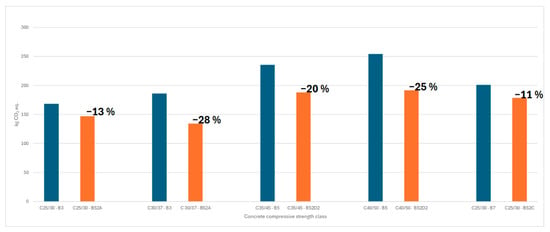
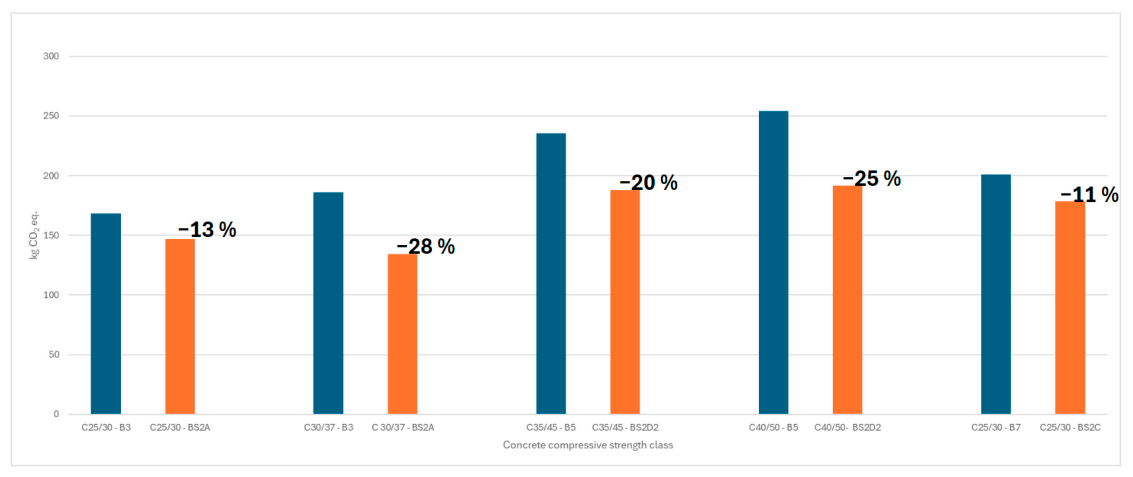
Analysing the GWP results for the life cycle phase modules A1–3 shows that significant savings can be achieved with the concrete standard code BS2 compared to conventional concrete standards according to ÖNORM B 4710-1 [7,18], for comparable exposure requirements (see Figure 3). The most significant reduction of 28% is achieved with C30/37 BS2A: the conventional concrete standard results in 186.10 kg CO2-eq for the production phase, whereas the BS2A variant results in 134.12 kg CO2-eq.
Figure 3.
A comparison of the GWP-total results of concrete standard code ‘BS2’ with conventional concrete standards.
The analysis was carried out on the basis of the specified mix designs (see Section 5.2). The results show that the GWP values are significantly influenced by the respective compressive strength and exposure classes. In particular, the choice of binder and the proportion of cement clinker it contains have a significant influence on the level of the GWP values.
6. Conclusions
This study analyses the ‘cradle-to-gate’ life cycle, covering modules A1–3. The downstream life cycle phases (A4–C) and module D were not considered. The results show that BS2 has significant reductions relative to the conventional concrete standards as specified in ÖNORM B 4710-1 [7]. Furthermore, the concrete standard code BS2 has no disadvantages in terms of service life compared to conventional concrete standards, demonstrating comparable resistance and durability to standard concrete mixes. However, when evaluating a construction project holistically, the entire life cycle must always be taken into account. Due to their inherent durability, concrete structures can deliver significant advantages over their extended service lives [22]. In addition to life cycle assessment, broader indicators of holistic and circular sustainability should therefore also be considered.
The integration of the Austrian concrete standard BS2 into guidelines and technical regulations is a key prerequisite for the practical application of this concept in construction practice. It establishes the basis for the systematic and quality-assured use of temperature- and CO2-reduced concretes in transport infrastructure construction.
The reduction in CO2 emissions in the production phase, while maintaining the same resistance and unchanged durability, represents one of the key challenges of clinker-reduced concrete mixes. In this context, particular attention must be paid to high execution quality and adequate curing of young concrete surfaces. The consistent implementation of appropriate curing measures is an essential factor for the long-term performance of CO2-reduced concretes in infrastructure construction.
Author Contributions
Conceptualization, R.H. and A.H.; methodology, R.H., A.H., S.M. and F.G.; data curation, F.G.; writing—original draft preparation, A.H. and R.H.; writing—review and editing, A.H., R.H., S.M. and F.G.; visualization, A.H. and R.H.; supervision, F.G. and S.M.; project administration, R.H. All authors have read and agreed to the published version of the manuscript.
Funding
This research received no external funding.
Institutional Review Board Statement
Not applicable.
Informed Consent Statement
Not applicable.
Data Availability Statement
The data presented in this study are available upon request from the corresponding author.
Conflicts of Interest
Author Rainer Hausenberger was employed by the company ÖBB-Infrastruktur AG; Author Stefan Marchtrenker was employed by the company Smart Minerals. The remaining authors declare that the research was conducted in the absence of any commercial or financial relationships that could be construed as a potential conflict of interest.
Abbreviations
The following abbreviations are used in this manuscript:
| EPD | Environmental Product Declaration |
| GVTB | Güteverband Transportbeton |
| GWP | Global Warming Potential |
| LCA | Life Cycle Assessment |
| LCI | Life Cycle Inventory |
| LCIA | Life Cycle Impact Assessment |
| VÖZ | Vereinigung der österreichischen Zementindustrie |
References
- Europäische Kommission. Der Europäische Grüne Deal: Erster Klimaneutraler Kontinent Werden. Available online: https://commission.europa.eu/strategy-and-policy/priorities-2019-2024/european-green-deal_de (accessed on 2 June 2026).
- Directive (EU) 2024/1275 of the European Parliament and of the Council of 24 April 2024 on the Energy Performance of Buildings. 2024. Available online: http://data.europa.eu/eli/dir/2024/1275/oj (accessed on 2 June 2026).
- Regulation (EU) 2024/3110 of the European Parliament and of the Council of 27 November 2024 Laying Down Harmonised Rules for the Marketing of Construction Products and Repealing Regulation (EU) No 305/2011: Construction Products Regulation. 2024. Available online: http://data.europa.eu/eli/reg/2024/3110/oj (accessed on 2 June 2026).
- Regulation (EU) 2020/852 of the European Parliament and of the Council of 18 June 2020 on the Establishment of a Framework to Facilitate Sustainable Investment, and Amending Regulation (EU) 2019/2088: Taxonomy Regulation. 2020. Available online: http://data.europa.eu/eli/reg/2020/852/oj (accessed on 2 June 2026).
- Regulation (EU) 2021/1119 of the European Parliament and of the Council of 30 June 2021 Establishing the Framework for Achieving Climate Neutrality and Amending Regulations (EC) No 401/2009 and (EU) 2018/1999 (‘European Climate Law’): European Climate Law. 2021. Available online: https://eur-lex.europa.eu/eli/reg/2021/1119/oj/eng (accessed on 2 June 2026).
- WWF Deutschland. Klimaschutz in der Beton- und Zementindustrie: Hintergrund und Handlungsoptionen. Available online: https://www.wwf.de/fileadmin/fm-wwf/Publikationen-PDF/WWF_Klimaschutz_in_der_Beton-_und_Zementindustrie_WEB.pdf (accessed on 2 June 2026).
- ÖNORM B 4710-1: 2018 01 01; Beton—Festlegung, Eigenschaften, Herstellung, Verwendung und Konformität: Teil 1: Regeln zur Umsetzung der ÖNORM EN 206 für Normal- und Schwerbeton. Austrian Standards International: Wien, Austria, 2018.
- ÖNORM EN 197-5: 2021 06 15; Zement—Teil 5: Portlandkompositzement CEM II/C-M und Kompositzement CEM VI. Austrian Standards International: Wien, Austria, 2021.
- ÖNORM EN 206: 2021 07 01; Beton—Festlegung, Eigenschaften, Herstellung und Konformität. Austrian Standards International: Wien, Austria, 2021.
- Österreichische Bautechnik Vereinigung. Richtlinie—“Wasserundurchlässige Betonbauwerke: Weiße Wanne”; Österreichische Bautechnik Vereinigung: Wien, Austria, 2018. [Google Scholar]
- UNSESO. World Heritage Centre 1992–2026, Villa Adriana (Tivoli). Available online: https://whc.unesco.org/en/list/907/documents/ (accessed on 2 June 2026).
- Österreichische Bautechnik Vereinigung. Richtlinie—“Betone mit Reduzierter Frührissneigung”; Österreichische Bautechnik Vereinigung: Wien, Austria, 2018. [Google Scholar]
- ÖNORM EN ISO 14040: 2021 03 01; Umweltmanagement—Ökobilanz—Grundsätze und Rahmenbedingungen. Austrian Standards International: Wien, Austria, 2021.
- Klöpffer, W.; Grahl, B. Ökobilanz (LCA): Ein Leitfaden für Ausbildung und Beruf; WILEY-VCH: Weinheim, Germany, 2007. [Google Scholar]
- ÖNORM EN ISO 14044: 2021 03 01; Umweltmanagement—Ökobilanz—Anforderungen und Anleitungen. Austrian Standards International: Wien, Austria, 2021.
- ÖNORM EN 15804: 2022 02 15; Nachhaltigkeit von Bauwerken—Umweltproduktdeklarationen—Grundregeln für die Produktkategorie Bauprodukte. Austrian Standards International: Wien, Austria, 2022.
- ÖNORM EN 17472: 2022 08 15; Nachhaltigkeit von Bauwerken—Bewertung der Nachhaltigkeit von Ingenieurbauwerken—Rechenverfahren. Austrian Standard International: Wien, Austria, 2022.
- Hausberger, L.; Ressler, C.; Cordes, T.; Gschösser, F. Detaillierte Ökobilanzdaten für Spezifische Betonsorten Hergestellt in Österreich. Beton Stahlbetonbau 2024, 120, 263–270. [Google Scholar] [CrossRef] [Scilit]
- Vereinigung der Österreichischen Zementindustrie (VÖZ). Umwelt-Produktdeklaration nach ISO 14025 und EN 15804+A2 für Österreichischen Durchschnittszement im Jahr 2017. Available online: https://zement.at/wp-content/uploads/EPD_Zement_Oesterreich_VOEZ_2020_2025.pdf (accessed on 2 June 2026).
- Gschösser, F. Ökologische Potentiale vs. Baubetriebliche Mehrkosten bei der Anwendung von GWP-Optimierten Zementen im Hochbau; Vereinigung der Österreichischen Zementindustrie (VÖZ): Wien, Austria, 2021. [Google Scholar]
- ÖNORM EN 197-1: 2018 12 01; Zement—Teil 1: Zusammensetzung, Anforderungen und Konformitätskriterien von Normalzement. Austrian Standards International: Wien, Austria, 2018.
- Häberlein, A.; Hausberger, L.; Kaipel, C.; Geschösser, F. Lebenszyklusbasierte Treibhausgasanalyse von Brückenbauwerken: Klimarelevante Bewertung von Konstruktionsvarianten einer Fußgänger- und Radfahrerbrücke/Life cycle-based greenhouse gas analysis of bridge structures: Climate-relevant assessment of construction variants of a pedestrian and cyclist bridge. Bauingenieur 2025, 100, 101–110. [Google Scholar] [CrossRef] [Scilit]

Disclaimer/Publisher’s Note: The statements, opinions and data contained in all publications are solely those of the individual author(s) and contributor(s) and not of MDPI and/or the editor(s). MDPI and/or the editor(s) disclaim responsibility for any injury to people or property resulting from any ideas, methods, instructions or products referred to in the content. |
© 2026 by the authors. Licensee MDPI, Basel, Switzerland. This article is an open access article distributed under the terms and conditions of the Creative Commons Attribution (CC BY) license.