


Abstract
This study presents a full-scale explosion test of a prototype mobile reinforced concrete protective panel developed for critical infrastructure protection. The panel was tested according to NATO STANAG 2280 under a 40 kg TNT charge, while the total explosive charge during the military exercise reached 68 kg TNT, representing the largest peacetime explosion involving a structural specimen in Croatia. Non-destructive testing, including ultrasonic pulse velocity measurements before and after the explosion, confirmed the excellent quality of the concrete and enabled assessment of internal damage. The results identify key aspects of the structural response and provide guidance for future optimisation of explosion-resistant protective systems.
1. Introduction
Protective concrete barriers are increasingly used to safeguard critical infrastructure, including military facilities, bridges, border crossings, and strategic civil assets. Full-scale experimental investigations remain essential for validating their behavior under extreme loading [1,2]. Previous studies have demonstrated that the blast resistance of reinforced concrete structures depends not only on material properties but also on structural configuration, reinforcement detailing, and energy dissipation mechanisms. Although numerous experimental and numerical investigations have been conducted on blast-resistant concrete elements, full-scale tests on mobile protective barriers remain scarce due to their high cost and logistical complexity [3,4,5,6,7].
This study investigates a prototype mobile anti-ballistic concrete panel developed as an innovative protective system. Rather than assessing a commercial product, the research evaluates a development prototype under intentionally severe loading conditions. The adopted configuration represents a conservative scenario in which an explosive-laden vehicle reaches the minimum practical stand-off distance. The objective was to evaluate the structural response of the prototype while confirming the quality of the concrete using non-destructive testing.
A key contribution of this research is the combination of full-scale explosion testing and pre- and post-explosion non-destructive evaluation. Particular emphasis is placed on ultrasonic pulse velocity measurements, which confirmed that the concrete exhibited excellent quality before testing and retained favourable material properties after the explosion. The results provide valuable experimental data for the validation and further optimisation of mobile protective concrete systems.
2. Materials and Experimental Program
2.1. Protective Panel Prototype
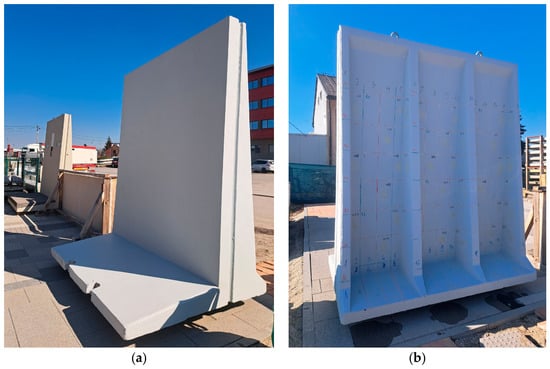
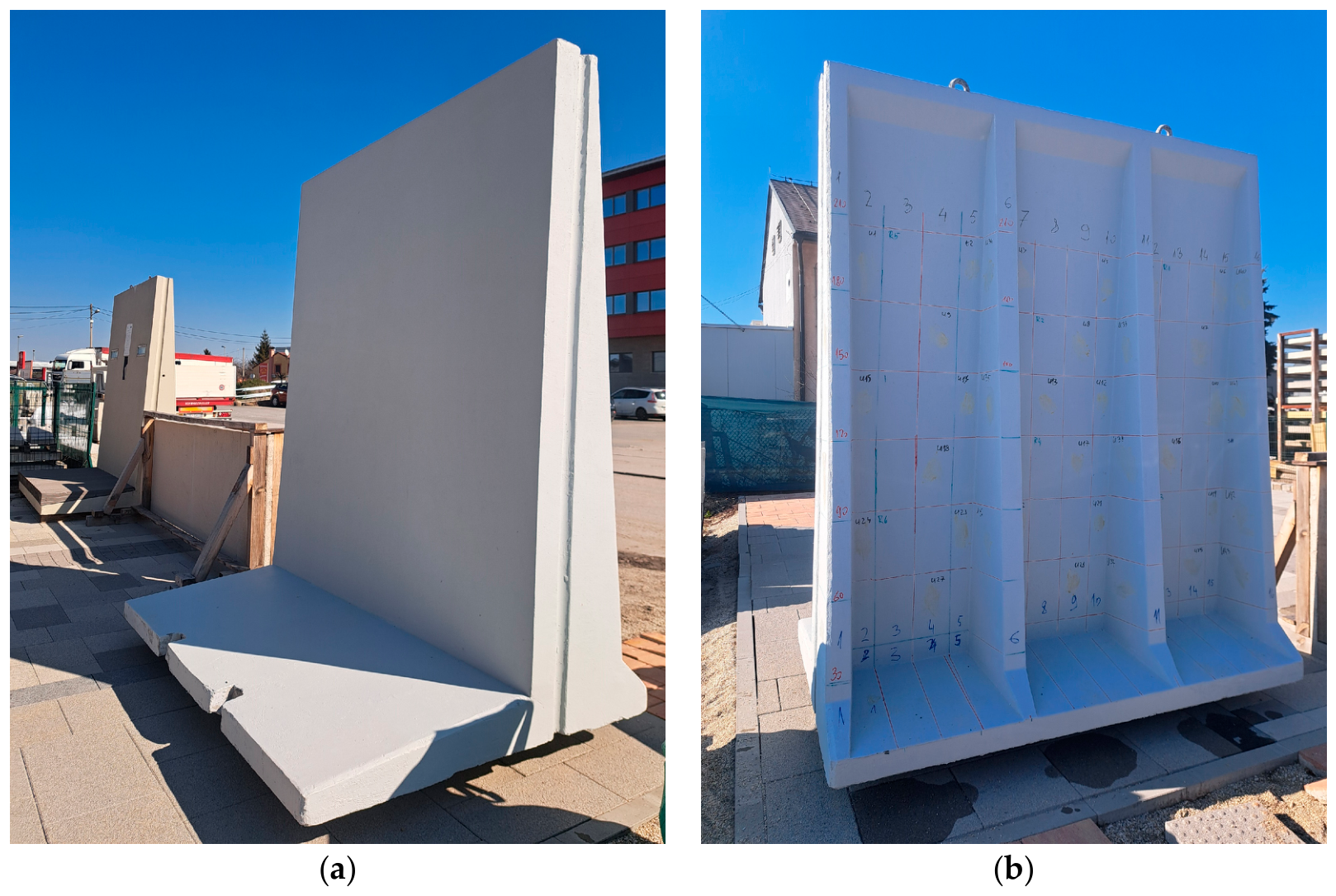
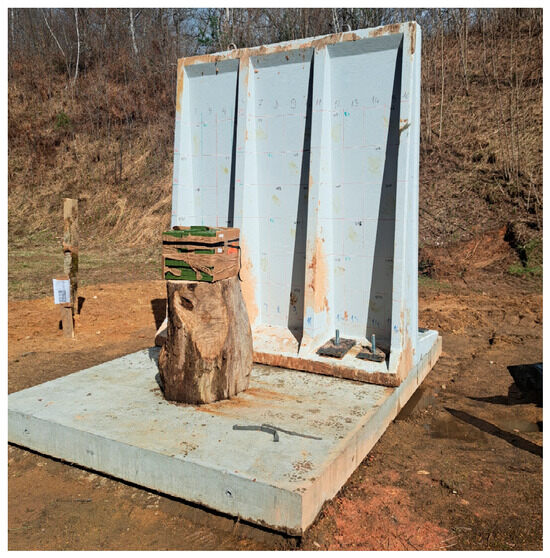
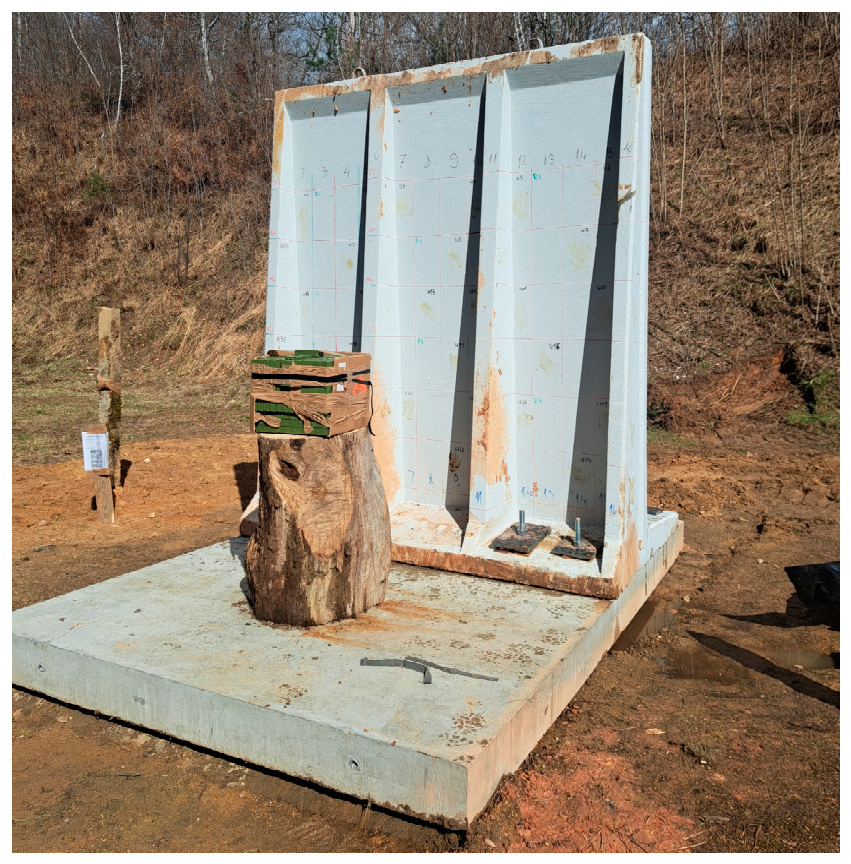
The investigated anti-ballistic protective panel (Figure 1) was developed by Beton Lučko Ltd., Croatia, by adapting an existing precast concrete system originally used for silo construction [8]. The prototype was conceived as a rapidly deployable mobile protective element intended for the protection of critical infrastructure, military facilities, border crossings, transportation corridors, bridges, and other strategically important assets exposed to potential blast threats.
Figure 1.
Anti-ballistic reinforced concrete panel: (a) back side and (b) front side with marked testing locations.
The panel was manufactured as a precast reinforced concrete element under controlled industrial conditions. Although the detailed concrete composition and reinforcement arrangement remain proprietary due to ongoing product development and intellectual property protection, the prototype incorporates a high-performance concrete mixture enhanced with steel fibers and conventional reinforcement. The concrete was specifically designed for protective applications requiring high durability and resistance to extreme loading conditions.
The overall dimensions of the panel were approximately 2.70 m in height and 2.25 m in width. The front face of the panel consisted of three segments separated by vertical ribs, while the total thickness of the element, including the supporting base, was approximately 1.60 m. The tested specimen had a total mass of approximately 4.75 tonnes, requiring specialized transportation and lifting equipment during installation.
2.2. Blast Test Site and Experimental Setup
The experimental program was conducted at the Cerovac military training area in Croatia. The selected location provided adequate safety distances and controlled conditions for full-scale explosive testing. The blast experiment was conducted as part of a military engineering training exercise involving military engineering cadets, under strictly controlled conditions and in accordance with established military safety protocols [9,10,11,12,13].
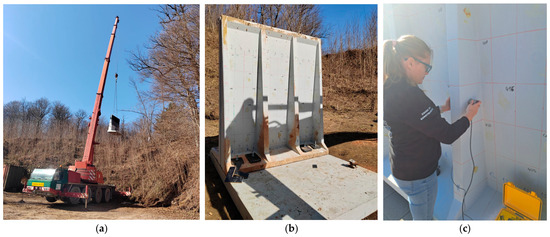
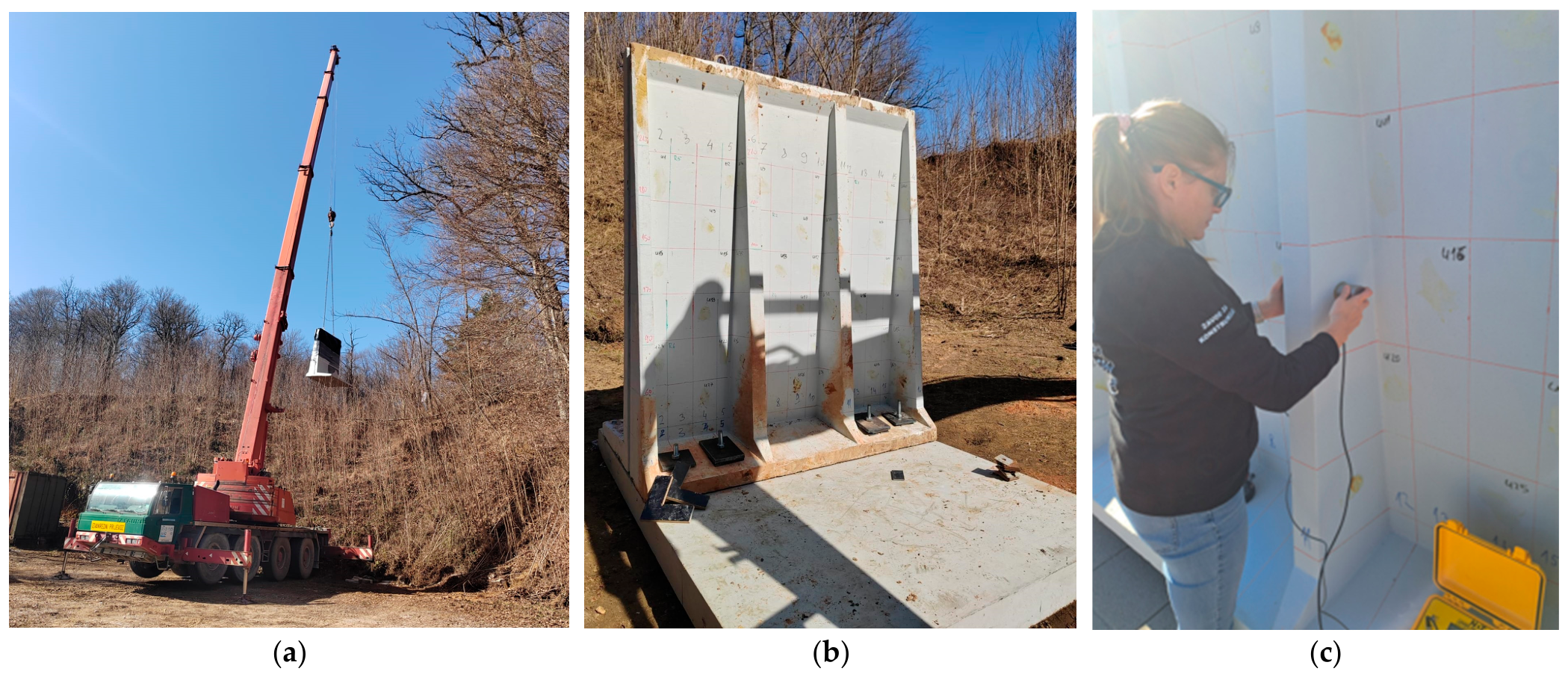
The protective panel was manufactured at the Beton Lučko production facility in Zagreb and subsequently transported to the testing site using a heavy-duty transport vehicle. Due to the size and weight of the specimen, installation was performed using a FAUN ATF 60-4 mobile crane (Figure 2a). Special attention was given to the positioning and stabilization of the prototype to ensure repeatable testing conditions and to prevent excessive movement during the blast event (Figure 2b). Considering the soft ground conditions at the test site, the panel was mounted on a dedicated reinforced concrete support base and anchored at multiple locations. This arrangement ensured the structural stability of the specimen throughout the testing program while allowing realistic interaction between the blast load and the protective element.
Figure 2.
(a) Transport of panels by truck crane to the amphitheater for explosive testing; (b) detail of anchoring the panel to the RC slab; (c) non-destructive testing before explosion.
The installation procedure was completed several days before the explosion, enabling the execution of all planned inspections and measurements. Non-destructive testing was carried out both before and after the blast event to assess the condition of the concrete and identify any changes in material properties (Figure 2c).
2.3. Blast Loading Configuration
Blast testing was performed in accordance with the principles of NATO STANAG 2280 [9,10], which classifies explosive threats according to equivalent TNT charge mass and expected structural effects. The investigated scenario corresponded to Category D (High Explosive), Severity Level 6 (D6), representing explosive charges up to 50 kg TNT equivalent. As NATO STANAG 2280 does not explicitly specify the stand-off distance between the explosive charge and the protective structure, this parameter was defined as part of the experimental setup.
For the purposes of this study, a charge of 40 kg TNT was selected in consultation with military engineering personnel and prototype developers. Unlike conventional laboratory blast tests, the adopted configuration was intentionally conservative andworst-case scenario in which a vehicle carrying an explosive comes as close as possible to the panel. The explosive charge was positioned at a stand-off distance of 1 m from the panel and elevated approximately 1 m above the ground surface.
The explosive charge was assembled from individual 200 g TNT blocks arranged into a compact concentrated configuration (Figure 3). The geometry of the charge was designed to comply with STANAG recommendations regarding charge shape and dimensional proportions, thereby ensuring a representative and reproducible blast loading condition.
Figure 3.
Final explosive charge configuration prepared for blast testing.
An additional characteristic of the experimental campaign was the overall scale of the military exercise. While the investigated panel was subjected to a 40 kg TNT charge, the complete demolition exercise involved a total of 68 kg TNT connected within a single detonation sequence. To the best of the authors’ knowledge, this represents the largest explosion conducted in Croatia in peacetime involving full-scale structural elements.
2.4. Non-Destructive Testing Programme
A comprehensive non-destructive testing (NDT) program was implemented to evaluate the quality of the concrete before the blast event and to assess its condition afterwards [14,15]. The testing program included (Figure 2c): visual inspection, Schmidt hammer testing, ultrasonic pulse velocity (UPV) measurements and surface electrical resistivity measurements. The testing procedures were carried out in accordance with the relevant European Standards (EN) and internationally accepted recommendations for non-destructive testing of concrete structures [16,17,18].
Visual inspection was used to document the general condition of the specimen and identify suitable measurement locations. Rebound hammer testing provided an indication of surface hardness and uniformity of concrete properties. Surface electrical resistivity measurements were used to assess concrete durability characteristics and the potential susceptibility of reinforcement to corrosion processes.
Particular emphasis was placed on ultrasonic pulse velocity (UPV) measurements. UPV testing was selected as the primary evaluation method because of its ability to detect changes in the internal structure of concrete, including cracking, voids, and reductions in material homogeneity [17]. Measurements were performed at multiple locations distributed across both the wall panels and stiffening ribs.
The pre-blast results consistently indicated excellent concrete quality, with measured ultrasonic velocities corresponding to dense and homogeneous concrete. Following the blast event, additional UPV measurements were conducted to assess the influence of the explosion on the remaining concrete sections. The comparison of pre- and post-blast measurements provided valuable information regarding the structural integrity of the material and its suitability for protective applications under extreme loading conditions.
3. Results and Discussion
The full-scale blast test was successfully conducted under controlled field conditions at the Cerovac military training area. The anti-ballistic concrete panel prototype was subjected to a 40 kg TNT equivalent charge positioned 1 m from the panel surface and 1 m above the ground. This configuration represented an intentionally conservative and highly demanding loading scenario corresponding to STANAG 2280 Level D6.
3.1. Visual Observations After the Blast
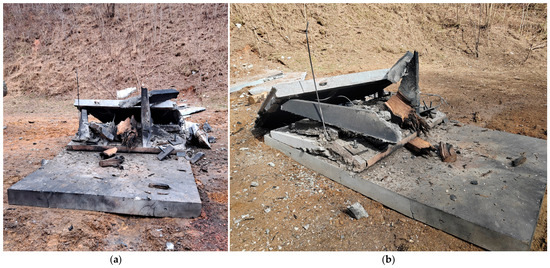
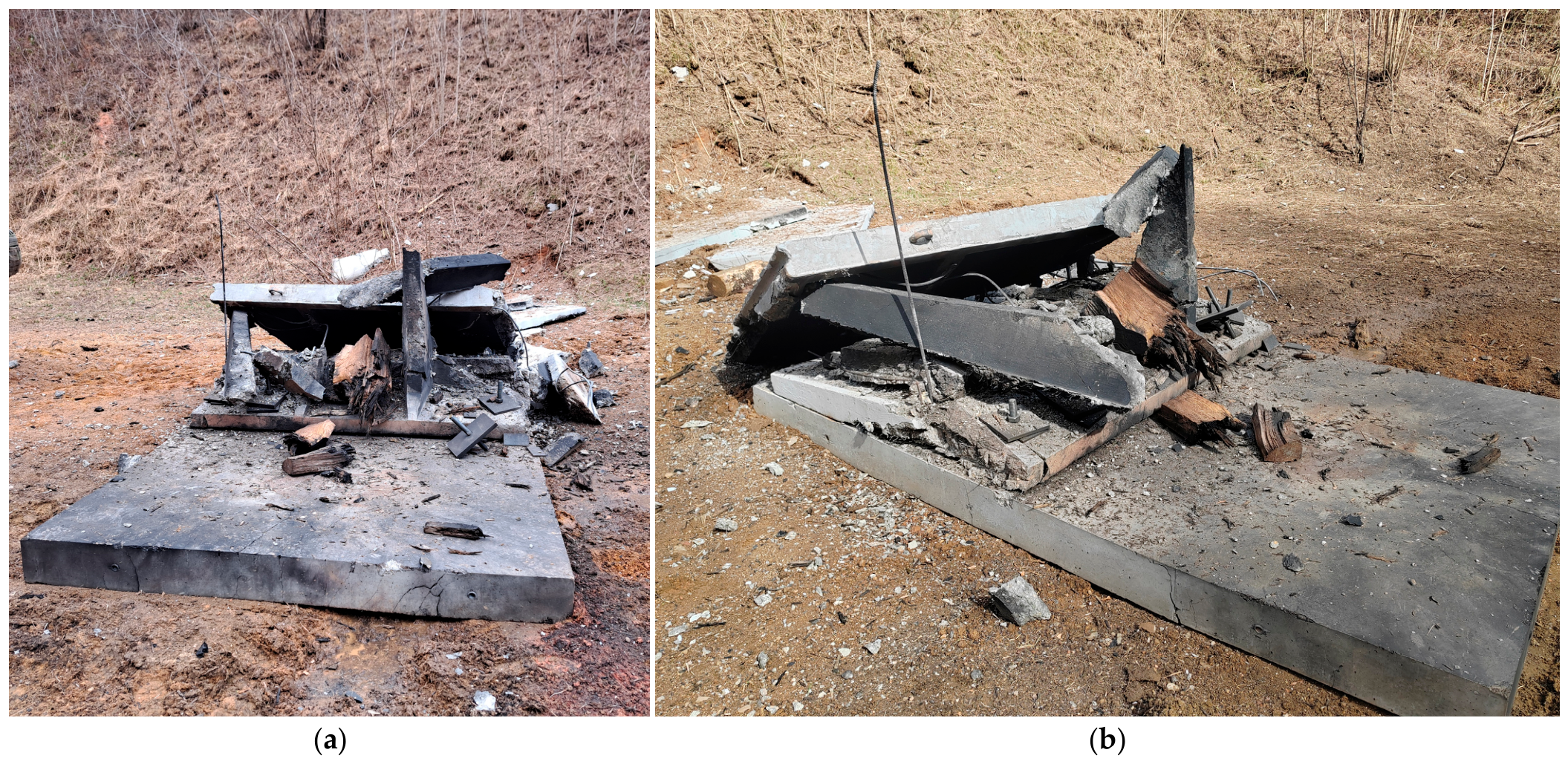
Visual inspection performed after detonation confirmed that the panel experienced significant local structural damage as a consequence of the severe blast loading (Figure 4). The most pronounced damage was observed in the lower central region of the exposed wall section, particularly in the vicinity of the stiffening ribs.
Figure 4.
Condition of the panel after detonation: (a) front view; (b) side view.
Despite the intensity of the explosion, the panel remained anchored to its support base and no overturning or substantial displacement of the entire element was observed. This confirms that the anchoring system and support arrangement performed satisfactorily during the blast event and ensured the overall stability of the specimen throughout the test.
Local separation between the reinforced concrete wall components was observed after detonation, indicating that the applied blast load exceeded the resistance capacity of the current prototype configuration. These observations provide valuable information regarding the structural response of the prototype under extreme loading conditions and contribute to the ongoing development and optimization of future protective panel configurations.
It is important to emphasize that the objective of this experimental program was not product certification, but rather the evaluation of prototype behavior under an exceptionally severe blast scenario. The adopted configuration represents a conservative worst-case condition in which a large explosive charge detonates at a very short stand-off distance from the protective barrier.
3.2. Non-Destructive Testing Results
A comprehensive non-destructive testing (NDT) program was performed before the explosion, including ultrasonic pulse velocity (UPV), rebound hammer testing, and surface electrical resistivity measurements. Following the explosion, only UPV measurements could be repeated because the condition of the specimen did not allow reliable application of the remaining methods.
Table 1 presents representative NDT results obtained before and after the explosion at four characteristic locations: the outer rib, the inner rib, the wall near the edge, and the wall at the center. For each location, the mean value and standard deviation (SD) are reported. Only representative results are presented here, while the complete dataset is omitted for brevity.
Table 1.
Representative NDT results obtained before and after the explosion.
Among all applied NDT methods, UPV proved to be the most informative parameter for evaluating the effects of the explosion in previous research [14]; hence, it was measured both before and after detonation. Unlike visual inspection, which is limited to surface damage, ultrasonic testing provides information on the internal condition of the concrete and is highly sensitive to microcracking, internal discontinuities, and changes in material homogeneity.
As shown in Table 1, the UPV values decreased at all investigated locations after the explosion. The largest reductions were observed in the rib regions, where the average velocity decreased from approximately 5969 to 4010 m/s at the outer rib and from 4666 to 3967 m/s at the inner rib. The wall sections also exhibited lower post-explosion velocities, although the reduction was less pronounced. This behavior indicates that the ribs experienced the highest level of internal damage, which is consistent with their greater exposure to reflected explosion pressures and stress concentrations.
A comparison of the standard deviations further indicates that the explosion produced a more heterogeneous internal concrete structure. While the pre-explosion measurements exhibited relatively low variability, the increased SD values after detonation suggest localized cracking and non-uniform damage distribution. Nevertheless, the remaining UPV values were still close to or above 4000 m/s at most measurement locations, corresponding to good-quality concrete according to commonly accepted UPV classification criteria. These results demonstrate that, despite severe structural damage, the concrete itself retained favorable material characteristics after the explosion.
Surface electrical resistivity measurements also indicated favorable durability characteristics and a low susceptibility to reinforcement corrosion during service life. The observed variability between individual measuring locations is considered to be primarily a consequence of differences in moisture saturation, as the specimen had been exposed to rainfall prior to testing. Since the tested panel was newly manufactured, electrical resistivity was of limited significance for evaluating structural performance under explosion loading and was therefore considered only as a supplementary indicator of concrete quality and durability.
Rebound hammer measurements provided additional information regarding the uniformity of the concrete surface. Since these measurements were performed only 28 days after casting, they were considered supplementary and were not used for direct estimation of compressive strength. Nevertheless, the measured rebound values exhibited low standard deviations and were consistent with the designed concrete strength class C30/37, confirming the high quality and uniformity of the concrete. It should also be noted that previous research [14] conducted by the authors demonstrated that compressive strength alone is not the governing parameter controlling the explosion resistance of reinforced concrete protective elements. Consequently, the rebound hammer results served primarily as a quality-control indicator rather than as a measure of explosion performance.
Overall, the NDT results confirmed that the prototype was manufactured using concrete of excellent quality. The observed reduction in UPV after the explosion reflects internal structural damage caused by the extreme loading rather than inadequate material properties, making UPV the key parameter for evaluating the structural effects of the explosion.
3.3. Discussion of Structural Response
The combined visual observations and NDT results indicate that the prototype reached the structural resistance limits of its current configuration under the exceptionally severe explosion loading. The reduction in UPV demonstrated that internal damage occurred throughout the concrete, while the remaining high wave velocities confirmed that the concrete itself largely preserved its intrinsic material quality. Consequently, the observed failure should be attributed primarily to the structural behavior of the prototype rather than to deficiencies in the concrete material.
Visual inspection revealed local separation between the reinforced concrete wall components following detonation, suggesting that the connection system between the two reinforced concrete layers was subjected to extremely high dynamic forces. This behavior was expected, as the first investigated prototype was executed as a two-layer prefabricated system due to technical issues but also to evaluate the feasibility of modular assembly. Such a concept offers important practical advantages, particularly for military engineering units, as individual components can be transported more easily due to their reduced weight and assembled directly on site to rapidly establish protective barriers. The present experiment therefore assessed not only the blast resistance of the prototype but also the viability of this construction approach. However, under the exceptionally severe explosion loading applied in this study, the connection system proved to be the critical structural component, resulting in separation of the two concrete layers. Based on these findings, future prototype generations will adopt a monolithic single-layer wall configuration to improve structural integrity under extreme blast loading. These observations indicate that the interaction between the wall panels and their connecting elements significantly influenced the global structural response. Since this interpretation is based solely on experimental observations, further analytical and numerical investigations are required to fully explain the failure mechanism.
The geometry of the exposed face may also have contributed to the observed damage distribution. The ribbed surface forms recessed zones where blast pressures may locally increase due to wave reflection and pressure concentration. Although detailed pressure measurements and numerical simulations were outside the scope of the present study, these observations suggest that external geometry should be considered carefully during future design optimization.
Overall, the experimental program successfully identified the performance limits of the current prototype under a severe explosion scenario while simultaneously demonstrating the excellent quality and durability of the concrete material. The results provide valuable experimental data for the validation and optimization of future mobile protective concrete systems intended for critical infrastructure protection.
Future research should include additional full-scale explosion tests, numerical modelling of blast-wave interaction, and evaluation of alternative structural configurations to further improve the performance of subsequent prototype generations.
4. Conclusions
A full-scale explosion test was successfully conducted on a prototype mobile reinforced concrete protective developed by adapting an existing precast silo element. The panel was subjected to an intentionally severe blast scenario involving to a 40 kg TNT charge at a short stand-off distance. The study demonstrated the feasibility of combining full-scale explosion testing with non-destructive evaluation to assess both structural performance and material integrity.
The results confirmed the favourable quality of the concrete mixture, as demonstrated by non-destructive testing before and after the explosion. Despite significant structural damage, the remaining concrete retained good material properties. The anchoring system also performed effectively, preventing overturning and significant displacement of the panel.
The main structural weakness was identified in the connection between the two precast wall layers, which separated during the explosion. Therefore, a monolithic wall configuration is recommended for the next generation. Additionally, rotating the panel by 180°, with the flat surface facing the blast and the stiffening ribs on the protected side, may reduce local blast-wave pressure concentration while maintaining structural stiffness.
The results suggest that the prototype could potentially meet STANAG 2280 Category D5, while achieving Category D6 would require further structural improvements and verification. Future research should include numerical simulations, structural optimisation, and additional testing against other weapon categories, particularly Category A (Projectiles) and Category C (Indirect Fire Munitions), to provide a more comprehensive assessment of the panel’s protective performance.
The paper primarily provides information on concrete panels that can be used for the protection of infrastructure against extreme loading, including blast loading, addressing the relevant ethical considerations.
5. Patents
The knowledge gained through the present experimental investigation establishes a basis for the development of improved protective panel solutions. The proposed design concepts demonstrate sufficient novelty to warrant consideration for future intellectual property protection following additional research, optimization, and validation.
Author Contributions
Conceptualization, M.K.M., M.S., S.H. and M.Š.; methodology, M.K.M., M.S., S.H., M.Š., D.B. and M.P.; formal analysis, M.K.M., M.S., S.H., M.Š., D.B. and M.P.; investigation, M.K.M., M.S., S.H., M.Š., D.B. and M.P.; resources M.K.M., M.S., S.H., M.Š., D.B. and M.P.; data curation, M.K.M., M.S., S.H., M.Š., D.B. and M.P.; writing—original draft preparation, M.K.M.; writing—review and editing, M.S. and S.H.; visualization, M.P.; supervision, M.K.M.; project administration, M.K.M.; funding acquisition, M.K.M., S.H. and M.Š. All authors have read and agreed to the published version of the manuscript.
Funding
This research received no external funding.
Institutional Review Board Statement
Not applicable.
Informed Consent Statement
Not applicable.
Data Availability Statement
The data supporting the findings of this study are not publicly available due to confidentiality requirements associated with ongoing product development and military-related restrictions.
DURC Statement
The present research focuses on the experimental assessment of reinforced concrete panels subjected to blast loading, with the primary aim of improving the protection and resilience of infrastructure against extreme loading conditions. The research provides information relevant to the design and assessment of concrete protective elements for civilian infrastructure. The authors acknowledge the potential dual-use implications of research involving blast-resistant structures and confirm their commitment to the responsible use and communication of the findings. The research is conducted in accordance with applicable national and international laws and ethical principles, with due consideration given to potential misuse and national security implications.
Acknowledgments
The authors gratefully acknowledge the Croatian Armed Forces, Dr. Franjo Tuđman Croatian Military Academy and Dr Franjo Tuđman Defense And Security University for providing the facilities, logistical support, and technical assistance necessary for the successful execution of the full-scale blast experiment. The authors also thank Beton Lučko Ltd. for providing the prototype reinforced concrete panel used in this research.
Conflicts of Interest
Author Suzana Hozmec was employed by the Beton Lučko Ltd. The remaining authors declare that the research was conducted in the absence of any commercial or financial relationships that could be construed as a potential conflict of interest.
Abbreviations
The following abbreviations are used in this manuscript:
| TNT | TriNitroToluene |
| NDT | Non-Destructive Testing |
| UPV | Ultrasonic Pulse Velocity |
| STANAG | NATO Standardization Agreement |
| NATO | North Atlantic Treaty Organization |
| SD | Standard Deviation |
References
- Vučković, P.; Bartolac, D.; Horvat, V.; Fusić, M.; Vojvoda, A. Engineering Support of Combat Operations; Croatian Military Academy: Zagreb, Croatia, 1997; p. 6. (In Croatian)
- Šimić, M. HESCO Fortification System; Ministry of Defence of the Republic of Croatia, Croatian Armed Forces, Croatian Military Academy “Petar Zrinski”: Zagreb, Croatia, 2013. (In Croatian)
- Ngo, T.; Mendis, P.; Gupta, A.; Ramsay, J. Blast Loading and Blast Effects on Structures—An Overview. Electron. J. Struct. Eng. 2007, 7, 76–91. [Google Scholar] [CrossRef] [Scilit]
- Luccioni, B.M.; Ambrosini, R.D.; Danesi, R.F. Analysis of Building Collapse under Blast Loads. Eng. Struct. 2004, 26, 63–71. [Google Scholar] [CrossRef] [Scilit]
- Remennikov, A.M. A Review of Methods for Predicting Bomb Blast Effects on Buildings. J. Battlef. Technol. 2003, 6, 5–10. [Google Scholar]
- Draganić, H.; Gazić, G.; Varevac, D. Experimental Investigation of Design and Retrofit Methods for Blast Load Mitigation—A State-of-the-Art Review. Eng. Struct. 2019, 190, 189–209. [Google Scholar] [CrossRef] [Scilit]
- Draganić, H.; Jeleč, M.; Gazić, G.; Lukić, S. Numerical Investigations of Reinforced Concrete Slabs Subjected to Contact Explosions. Buildings 2025, 15, 1063. [Google Scholar] [CrossRef] [Scilit]
- Beton Lučko d.d. Semi-Prefabricated Construction Systems. Available online: https://www.betonlucko.hr/polumontazni-sistemi-gradjenja.html (accessed on 29 April 2025). (In Croatian)
- NATO. STANAG 2280: Test Procedures and Classification of the Effects of Weapons on Structures; Edition 2; NATO: Brussels, Belgium, 2016. [Google Scholar]
- NATO. ATP-3.12.1.8: Test Procedures and Classification of the Effects of Weapons on Structures; Edition A, Version 1; NATO: Brussels, Belgium, 2016. [Google Scholar]
- Horvat, V. Demolition of Structural Elements and Materials; Croatian Military Academy “Petar Zrinski”: Zagreb, Croatia, 2020. (In Croatian)
- Horvat, V. Explosive Charges; Croatian Military Academy “Petar Zrinski”: Zagreb, Croatia, 2020. (In Croatian)
- Piškor, M. Effects of Explosions on Protective Reinforced Concrete Elements. Master’s Thesis, University of Zagreb, Zagreb, Croatia, 2025. [Google Scholar]
- Kušter Marić, M.; Ivanović, A.; Fusić, M.; Srbić, M.; Vlašić, A. Experimental Investigation of the Explosion Effects on Reinforced Concrete Slabs with Fibers. Buildings 2024, 14, 1080. [Google Scholar] [CrossRef] [Scilit]
- Kušter Marić, M.; Mandić Ivanković, A.; Vlašić, A.; Bleiziffer, J.; Srbić, M.; Skokandić, D. Assessment of Reinforcement Corrosion and Concrete Damage on Bridges Using Non-Destructive Testing. Građevinar 2019, 71, 843–862. [Google Scholar] [CrossRef] [Scilit]
- EN 12504-2:2021; Testing Concrete in Structures—Part 2: Non-Destructive Testing—Determination of Rebound Number. European Committee for Standardization (CEN): Brussels, Belgium, 2021.
- EN 12504-4:2021; Testing Concrete in Structures—Part 4: Determination of Ultrasonic Pulse Velocity. European Committee for Standardization (CEN): Brussels, Belgium, 2021.
- EN 13791:2019; Assessment of In-Situ Compressive Strength in Structures and Precast Concrete Components. European Committee for Standardization (CEN): Brussels, Belgium, 2019.

Disclaimer/Publisher’s Note: The statements, opinions and data contained in all publications are solely those of the individual author(s) and contributor(s) and not of MDPI and/or the editor(s). MDPI and/or the editor(s) disclaim responsibility for any injury to people or property resulting from any ideas, methods, instructions or products referred to in the content. |
© 2026 by the authors. Licensee MDPI, Basel, Switzerland. This article is an open access article distributed under the terms and conditions of the Creative Commons Attribution (CC BY) license.