


Abstract
The growing number of decommissioned wind turbine blades (dWTBs), made of fiberglass composites, poses a major waste challenge. This study investigates using raw-crushed dWTBs as a partial replacement for coarse aggregates in C35/45 structural concrete. Three mixes were tested, replacing 5%, 10%, and 15% of coarse aggregate by weight with crushed dWTBs. Experts evaluated their compressive strength, splitting tensile strength, and modulus of elasticity. All mixes maintained the required strength class. Incorporating dWTBs improved splitting tensile strength but reduced the modulus of elasticity and slightly lowered concrete density. Overall, crushed turbine blades can be successfully recycled in concrete, offering environmental and structural benefits.
1. Introduction
The service life of fiber-reinforced polymer (FRP) wind turbine blades (WTBs) is typically limited to 20 years due to continuous exposure to harsh environmental conditions. Furthermore, the modern trend of “repowering” wind farms—replacing older assets with larger, more efficient turbines—significantly accelerates decommissioning rates. Consequently, the management of thousands of decommissioned wind turbine blades (dWTBs) has emerged as a critical waste management challenge.
While landfill disposal is increasingly restricted, conventional recycling methods often degrade the material. In this context, structural recycling represents a highly promising end-of-life (EoL) alternative. This approach preserves the inherent structural integrity of the composite and requires minimal reprocessing energy by directly reusing blade segments as large-scale construction components [1,2].
However, to accommodate the vast volume of dWTB waste, high-capacity material recovery pathways must also be established. A novel and scalable solution involves the mechanical processing of dWTBs into raw-crushed aggregates for concrete production. By replacing a portion of conventional coarse aggregates with raw-crushed FRP laminates, this method transforms dWTB waste into a valuable resource for structural concrete, effectively aligning waste management with sustainable construction.
Looking for the most cost-effective and low-energy waste management strategy for decommissioned wind turbine blades (dWTBs) has led to a growing interest in non-selective, raw mechanical recycling. Processing dWTB waste without complex prior selection or separation represents the fastest, cheapest, and least energy-intensive end-of-life solution available. In this context, utilizing these raw-crushed blade fragments as a partial substitution for coarse aggregates in conventional C35/45 concrete—the most widely used strength class in infrastructure construction—presents a highly practical bulk-upcycling pathway.
However, recent literature emphasizes that the performance of such eco-concretes is highly dependent on the composition of the waste; while raw-crushed wind-turbine blades inevitably introduce heterogeneous, lightweight elements like balsa wood and polyurethane that can alter the matrix porosity [3], employing more advanced, selectively crushed alternatives for WTBs yields cleaner GFRP fibers with superior fiber-to-matrix adhesion [4]. To better understand the boundaries of the most economical approach, this study aims to evaluate how a completely non-selective dWTB aggregate substitution influences both the fresh mix workability and the key mechanical properties of the hardened C35/45 concrete.
2. Materials and Methods
2.1. Recycled Materials from Decommissioned Wind Turbine Blades
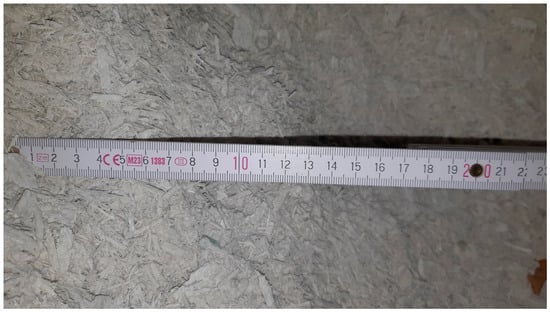
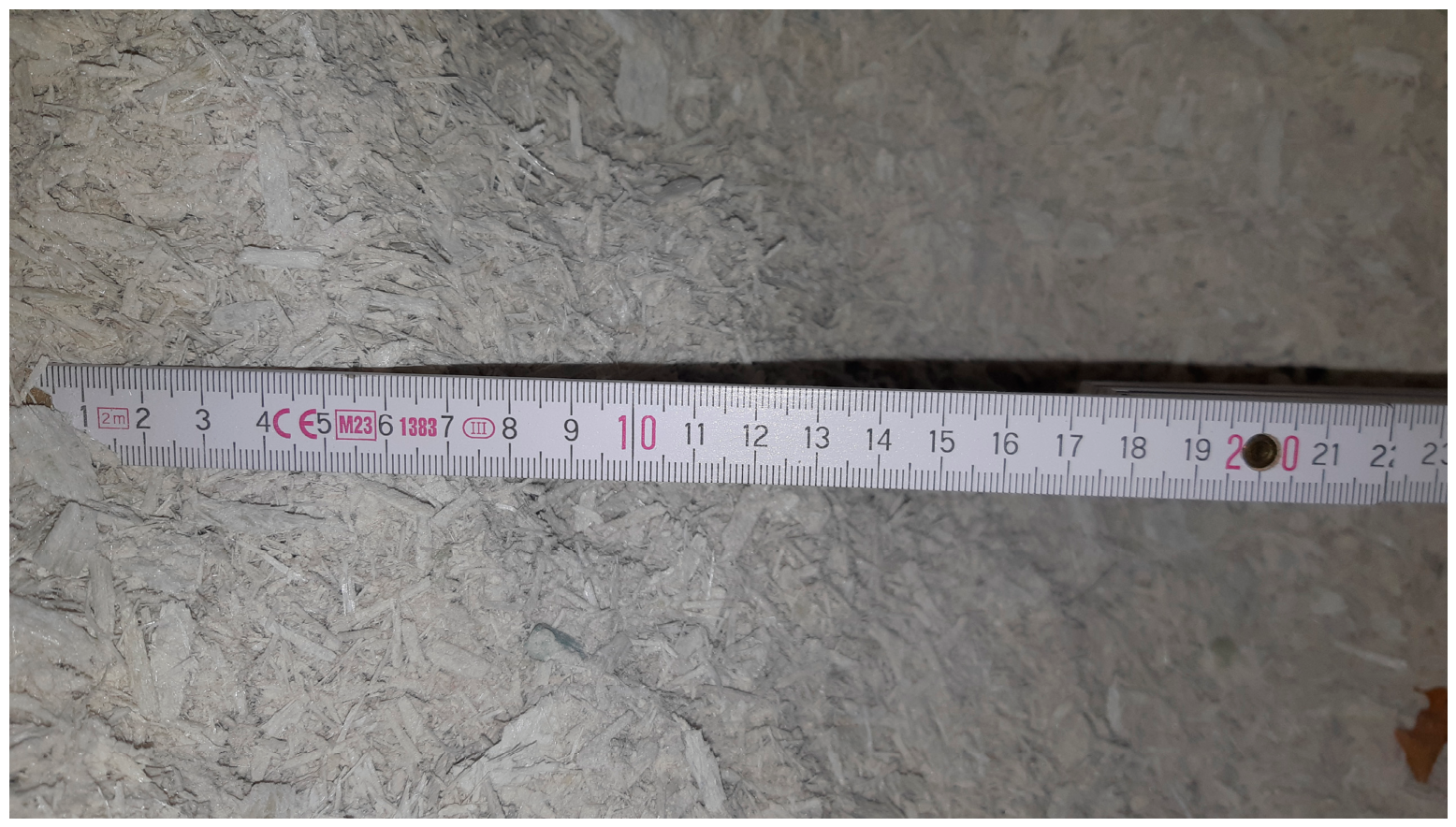
The coarse composite aggregate used in this study was produced using a straightforward, non-selective mechanical process. Initially, the decommissioned wind turbine blades (dWTBs) were cut into smaller, manageable sections using a mechanical jigsaw. Subsequently, these fragments—without any prior separation of the composite shell, structural balsa wood, or polyurethane core foams—were raw-crushed and sieved using an industrial knife mill, operating similarly to machines standardly employed for shredding plastic containers. This non-selective processing approach yielded an aggregate with a maximum fraction size of up to 3 cm (see Figure 1).
Figure 1.
Resulting material from the crushed wind turbine blade.
2.2. Concrete with the Crushed Wind Turbine Blade
A standard concrete mix design, calculated to achieve the target structural characteristics of strength class C35/45 according to EN 206 [5], was adopted as the reference baseline and designated as M0. This specific strength grade was selected because it represents one of the most widely utilized concrete formulations in modern infrastructure and civil engineering applications. The comprehensive, detailed material proportions and baseline components of the M0 control mix are systematically presented in Table 1.
Table 1.
Concrete mix recipe.
Three additional concrete mixes were prepared with the incorporation of cut and crushed wind turbine blade material. The modification of the mix design involved replacing 5%, 10%, or 15% by weight of the 8/16 mm coarse aggregate with raw-crushed wind turbine blade, while keeping the quantities of all other ingredients of the reference mix unchanged at this stage; the resulting mixes were designated as M5, M10, and M15, respectively. All batches were produced on the same day in the following chronological order: M0, M10, M15, and M5.
2.3. Test Methods
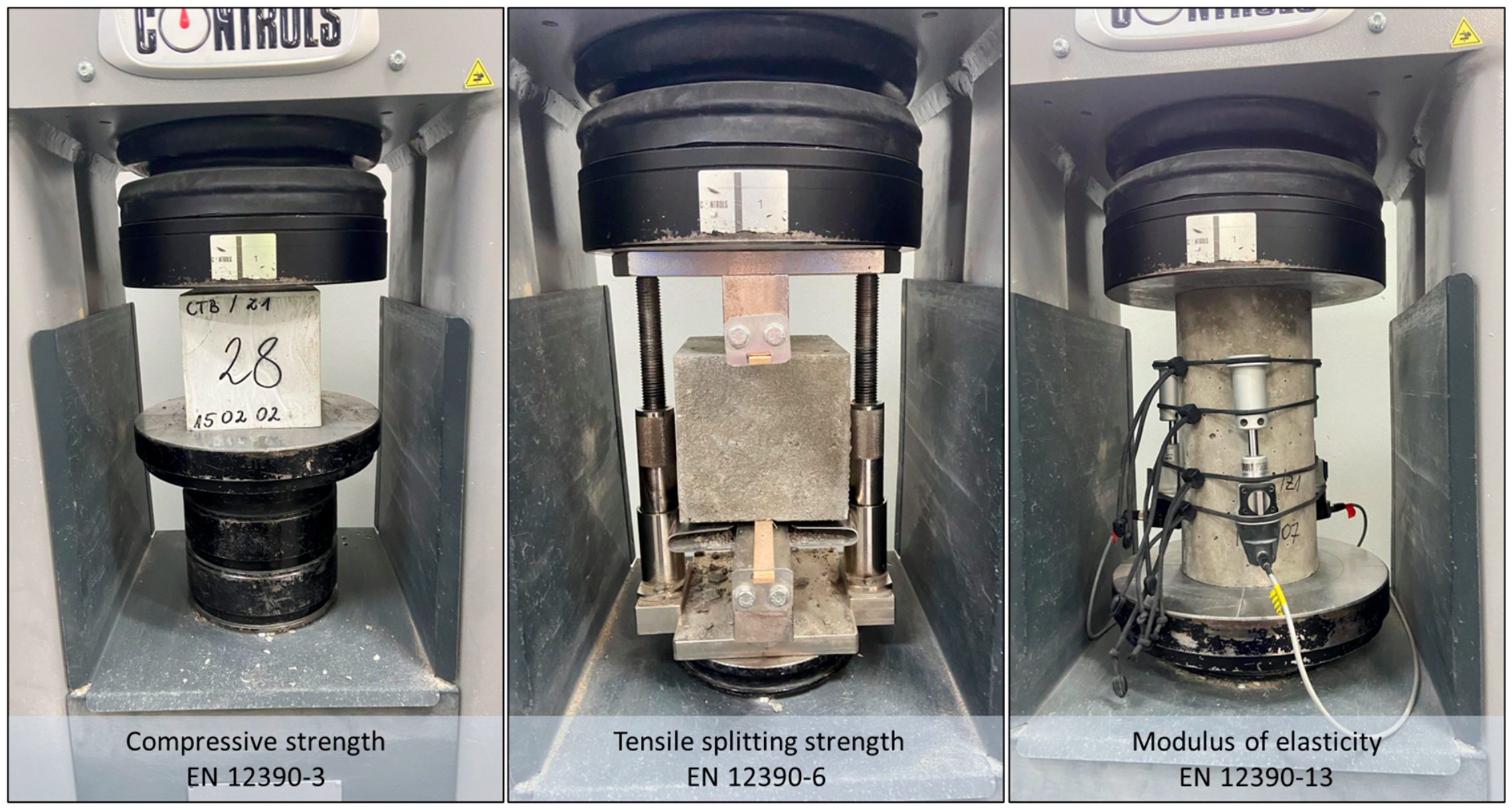
For each concrete mix, the consistence was evaluated using the slump test according to EN 12350-2 [6], and the air content of the fresh mixture was determined in accordance with EN 12350-7 [7]. From each batch, three cubic specimens were prepared for compressive strength testing according to EN 12390-3 [8], three cubic specimens for splitting tensile strength testing according to EN 12390-6 [9], and one cylindrical specimen for the determination of the modulus of elasticity according to EN 12390-13 [10] (Figure 2).
Figure 2.
Tests of hardened concrete.
In total, 28 specimens were fabricated and tested. The specimens were prepared and cured in compliance with EN 12390-2 [11] and subjected to testing after 28 days. Additionally, the hardened concrete density was determined according to EN 12390-7 [12].
3. Results
The test results for all prepared concrete mixes, including the slump values along with the corresponding consistency classes according to [5] and the air content, are presented in Table 2.
Table 2.
Fresh concretes’ properties.
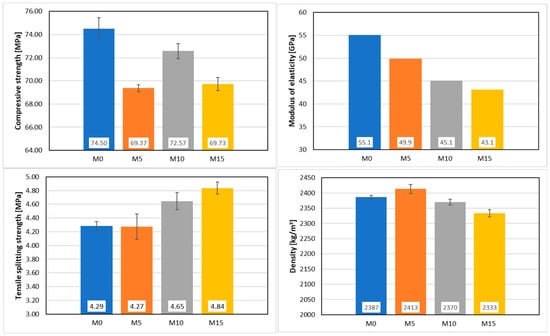
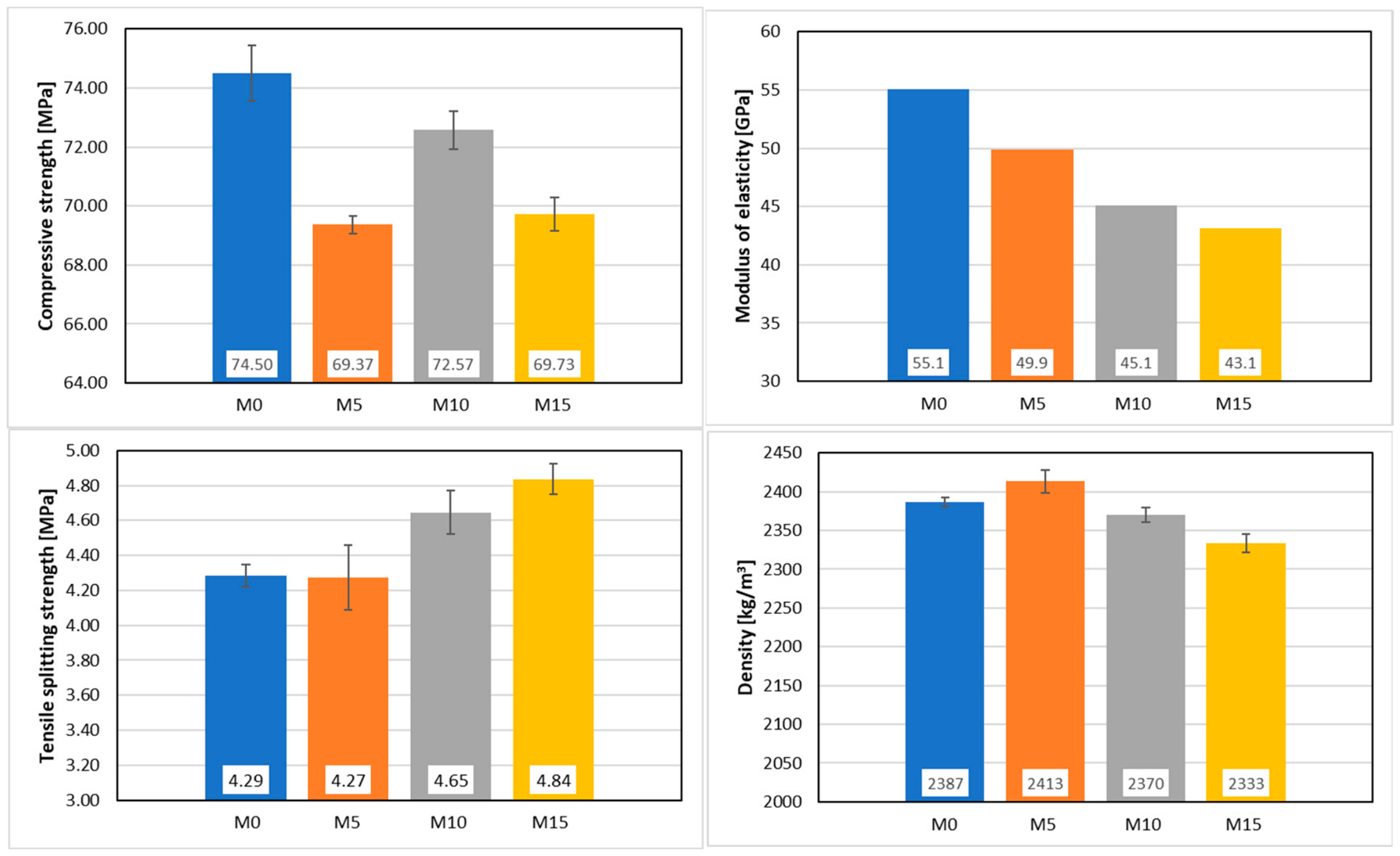
The test results for the hardened concrete are presented in Figure 3 and Table 3. To provide a clearer understanding of the direct impact of dWTB aggregate inclusion, Table 3 additionally quantifies the exact percentage variation of each evaluated parameter relative to the control reference concrete (M0).
Figure 3.
Results of hardened concrete tests.
Table 3.
Hardened concretes’ properties.
4. Discussion
It can be observed that at dWTB aggregate substitution levels above 5%, the fresh mix exhibited lower workability. Specifically, at 10% replacement, the consistency class dropped to S1, while at 15%, it reached the S0 class.
Regarding compressive strength, a decrease was observed with the increasing substitution of the aggregate, with a maximum reduction of approximately 7%. The most significant drop was recorded for the M5 batch. Since this batch was produced last, this anomaly might be attributed to a higher concentration of dusty fractions settling at the bottom of the dWTB aggregate container. It is worth noting, however, that despite this reduction in strength, all mixes successfully met the requirements for the C35/45 strength class.
In terms of splitting tensile strength, a beneficial effect of dWTB substitution was observed for the M10 and M15 series, which showed increases of +8.4% and +12.8%, respectively. Conversely, the M5 series exhibited a negligible reduction in tensile strength of −0.4%.
As for the modulus of elasticity, increasing the dWTB content led to a progressive decline in values, resulting in reductions of 10.9%, 18.1%, and 21.8% for the M5, M10, and M15 mixes, respectively. No significant changes were recorded for hardened concrete density, with variations ranging strictly between −2.3% and +1.1%.
An inverse effect of dWTB substitution compared to the other batches was distinctively observed for the M5 series across compressive strength, splitting tensile strength, and density. This discrepancy further supports the hypothesis that since this batch was mixed last, a higher accumulation of fine, dusty fractions from the bottom of the dWTB container was incorporated into the mix.
5. Conclusions
Based on the experimental results, the following conclusions can be drawn:
- Fresh Mix Properties: Replacing coarse aggregate with dWTB material above 5% significantly reduces concrete workability, dropping the consistency class to S1 (at 10%) and S0 (at 15%).
- Mechanical Strength: Compressive strength decreased slightly (up to ~7%) with higher dWTB content; however, all mixes successfully met the requirements for the C35/45 strength class. Conversely, dWTB substitution improved splitting tensile strength by up to +12.8% due to the bridging effect of the glass fibers.
- Elastic Modulus and Density: The modulus of elasticity decreased progressively (up to 21.8% for M15), while the concrete density remained stable with negligible variations (−2.3% to +1.1%).
- Processing Recommendation: Anomalies observed in the M5 batch suggest that fine, dusty fractions settling at the bottom of the dWTB container can alter concrete performance. Proper homogenization of the crushed material is critical before mixing.
In summary, raw-crushed decommissioned wind turbine blades can be successfully utilized as a partial replacement for coarse aggregate, offering a viable circular economy solution for structural concrete.
Author Contributions
Conceptualization, A.W. and M.R.; methodology, A.W. and T.S.; formal analysis, A.W.; investigation, A.W. and M.R.; resources, A.W.; data curation, A.W.; writing—original draft preparation, A.W. and M.R.; writing—review and editing, T.S.; visualization, A.W. and M.R.; supervision, T.S.; project administration, M.R.; funding acquisition, M.R. All authors have read and agreed to the published version of the manuscript.
Funding
The research was performed within the following R&D projects: WTBridge: “Hybrid girder made of recycled wind turbine blades and unconventional concrete for the construction and modernization of bridge structures, equipped with fibre-optic sensors for structure monitoring” funded by the National Centre for Research and Development (Poland) within the framework of the LIDER Program (project no. LIDER13/0031/2022) and “Regional Center of Excellence in Engineering for Quality of Life and Technology Development” co-financed by the Minister of Science and Higher Education within the framework of the “REGIONAL EXCELLENCE INITIATIVE” Program (project no. RID/SP/0032/2024/01).
Institutional Review Board Statement
Not applicable.
Informed Consent Statement
Not applicable.
Data Availability Statement
The data presented in this study are available on request from the corresponding author.
Conflicts of Interest
The authors declare no conflicts of interest. The funders had no role in the design of the study; in the collection, analyses, or interpretation of data; in the writing of the manuscript; or in the decision to publish the results.
Abbreviations
The following abbreviations are used in this manuscript:
| FRP | Fibre-Reinforced Polymer |
| dWTB | Decommissioned Wind Turbine Blade |
| EoL | End of Life |
References
- Beauson, J.; Brøndsted, P. Wind turbine blades: An end-of-life perspective. In MAREWINT: New Materials and Reliability in Offshore Wind Turbine Technology; Ostachowicz, W., McGugan, M., Schroder-Hinrichs, J.U., Luczak, M., Eds.; Springer: Dordrecht, The Netherlands, 2016; pp. 421–432. [Google Scholar]
- Jensen, J.P.; Skelton, K. Wind turbine blade recycling: Experiences, challenges and possibilities in a circular economy. Renew. Sustain. Energy Rev. 2018, 97, 165–176. [Google Scholar] [CrossRef] [Scilit]
- Revilla-Cuesta, V.; Skaf, M.; Ortega-López, V.; Manso, J.M. Raw-crushed wind-turbine blade: Waste characterization and suitability for use in concrete production. Resour. Conserv. Recycl. 2023, 198, 107160. [Google Scholar] [CrossRef] [Scilit]
- Revilla-Cuesta, V.; Espinosa, A.B.; Serrano-López, R.; Skaf, M.; Manso, J.M. Mechanical Properties of Concrete Mixes with Selectively Crushed Wind Turbine Blade: Comparison with Raw-Crushing. Materials 2024, 17, 6299. [Google Scholar] [CrossRef] [Scilit] [PubMed]
- EN 206:2013+A1:2016; Concrete—Specification, Performance, Production and Conformity. European Committee for Standardization (CEN): Brussels, Belgium, 2016.
- EN 12350-2:2019; Testing Fresh Concrete—Part 2: Slump Test. European Committee for Standardization (CEN): Brussels, Belgium, 2019.
- EN 12350-7:2019; Testing Fresh Concrete—Part 7: Air Content—Pressure Method. European Committee for Standardization (CEN): Brussels, Belgium, 2019.
- EN 12390-3:2019; Testing Hardened Concrete—Part 3: Compressive Strength of Test Specimens. European Committee for Standardization (CEN): Brussels, Belgium, 2019.
- EN 12390-6:2019; Testing Hardened Concrete—Part 6: Tensile Splitting Strength of Test Specimens. European Committee for Standardization (CEN): Brussels, Belgium, 2019.
- EN 12390-13:2019; Testing Hardened Concrete—Part 13: Determination of Secant Modulus of Elasticity in Compression. European Committee for Standardization (CEN): Brussels, Belgium, 2019.
- EN 12390-2:2019; Testing Hardened Concrete—Part 2: Making and Curing Specimens for Strength Tests. European Committee for Standardization (CEN): Brussels, Belgium, 2019.
- EN 12390-7:2019; Testing Hardened Concrete—Part 7: Air Content—Pressure Method. European Committee for Standardization (CEN): Brussels, Belgium, 2019.

Disclaimer/Publisher’s Note: The statements, opinions and data contained in all publications are solely those of the individual author(s) and contributor(s) and not of MDPI and/or the editor(s). MDPI and/or the editor(s) disclaim responsibility for any injury to people or property resulting from any ideas, methods, instructions or products referred to in the content. |
© 2026 by the authors. Licensee MDPI, Basel, Switzerland. This article is an open access article distributed under the terms and conditions of the Creative Commons Attribution (CC BY) license.