


Abstract
Accurate net vapor generation prediction in narrow rectangular channels is crucial for advanced thermal systems. This study evaluates 17 existing net vapor generation (NVG) correlations against experimental data for boiling steam–water flow in such geometries. Most show poor performance. A new NVG correlation is developed based on the unique characteristics of narrow rectangular channels. The proposed correlation predicts the thermodynamic equilibrium quality at the NVG point with a mean relative error of 0.294 (120 data points), providing a critical input for void fraction determination downstream of the NVG point.
1. Introduction
Narrow rectangular channels are critical components in advanced thermal systems, such as compact heat exchangers, plate-type fuel reactors, spallation neutron source targets, and high-power electronics cooling, due to their superior heat transfer performance derived from a large fluid-wall contact area within a compact volume. Flow boiling is often employed to further enhance heat removal in these confined geometries. However, compared to conventional channels (e.g., circular tubes or rod bundles), the narrow rectangular shape profoundly alters bubble dynamics, flow pattern transitions, and void fraction distribution. These differences directly impact thermal–hydraulic performance, system stability, and safety margins. Therefore, accurate prediction of void fraction in boiling steam–water two-phase flow within vertical narrow rectangular channels is essential for reliable design and safety analysis of associated industrial and energy systems.
The drift-flux model by Zuber and Findlay [1] is widely used for void fraction prediction:
where <α>, <jf>, <jg>, C0 and <<vgj>> denote the void fraction, the superficial liquid velocity, the superficial gas velocity, the distribution parameter, and the drift velocity, respectively. The mathematical symbols of <> and <<>> represent the area-averaged quantity and the void fraction weighted mean quantity, respectively. For boiling flows:
where G, ρf, ρg, and x are the mass flux, the liquid density, the gas density, and the flow quality, respectively. A major challenge is subcooled boiling non-equilibrium: the actual quality x differs from thermodynamic equilibrium quality:
At the net vapor generation (NVG) point, vapor begins to contribute significantly to void fraction. The Saha and Zuber model [2] relates x to xe downstream of NVG:
Thus, the xe,NVG is a key input for Equation (2). However, most existing xe,NVG correlations were developed using data from conventional geometries (e.g., circular tubes) with little validation against narrow rectangular channel data. Some recent models rely on small or mixed datasets (e.g., air–water instead of steam–water). New experimental data now enable systematic evaluation. This study aims to develop an accurate xe,NVG prediction model for vertical narrow rectangular channels. A dedicated database is compiled to evaluate 17 existing correlations and then develop a new one.
2. Assessment of Existing Representative xe,NVG Correlations
2.1. Collected Experimental Data on xe,NVG
A dedicated experimental database for xe,NVG is compiled for boiling steam–water flow in vertical narrow rectangular channels (gap < 6.35 mm, aspect ratio > 2). The data, spanning 1957–2024, include 120 points from six studies (Egen et al. [3], Maurer [4], Costa (No.1 and 2) [5], Martin [6], Wang et al. [7], Yang and Xiong [8]). The parameter ranges are: pressure 0.174–14.2 MPa, heat flux 0.0641–4.20 MW/m2, mass flux 151–7500 kg/(m2·s), gap 2.00–3.60 mm, width 25.4–70.0 mm, and hydraulic diameter 3.80–6.58 mm. The measurement uncertainty of xe,NVG is consistently reported as 20%.
2.2. Existing Representative xe,NVG Correlations
Representative correlations fall into three mechanistic groups: (1) bubble departure (Bowring [9], Levy [10]), (2) bubble ejection (Dix [11]), and (3) thermal/hydrodynamic (Griffith et al. [12], Thom et al. [13], Saha and Zuber [2], Ünal [14], Sekoguchi et al. [15], Kataoka et al. [16], Kalitvianski [17], Sun et al. [18], SRL (Chung et al.) [19], Wang et al. [7], Ha et al. [20], Lee and Jeong [21], Wisudhaputra et al. [22], Jeong et al. [23]).
2.3. Prediction Performance of Reviewed Correlations
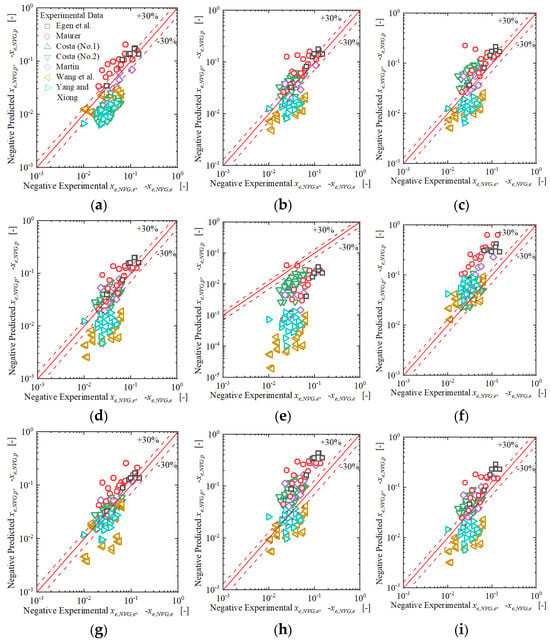
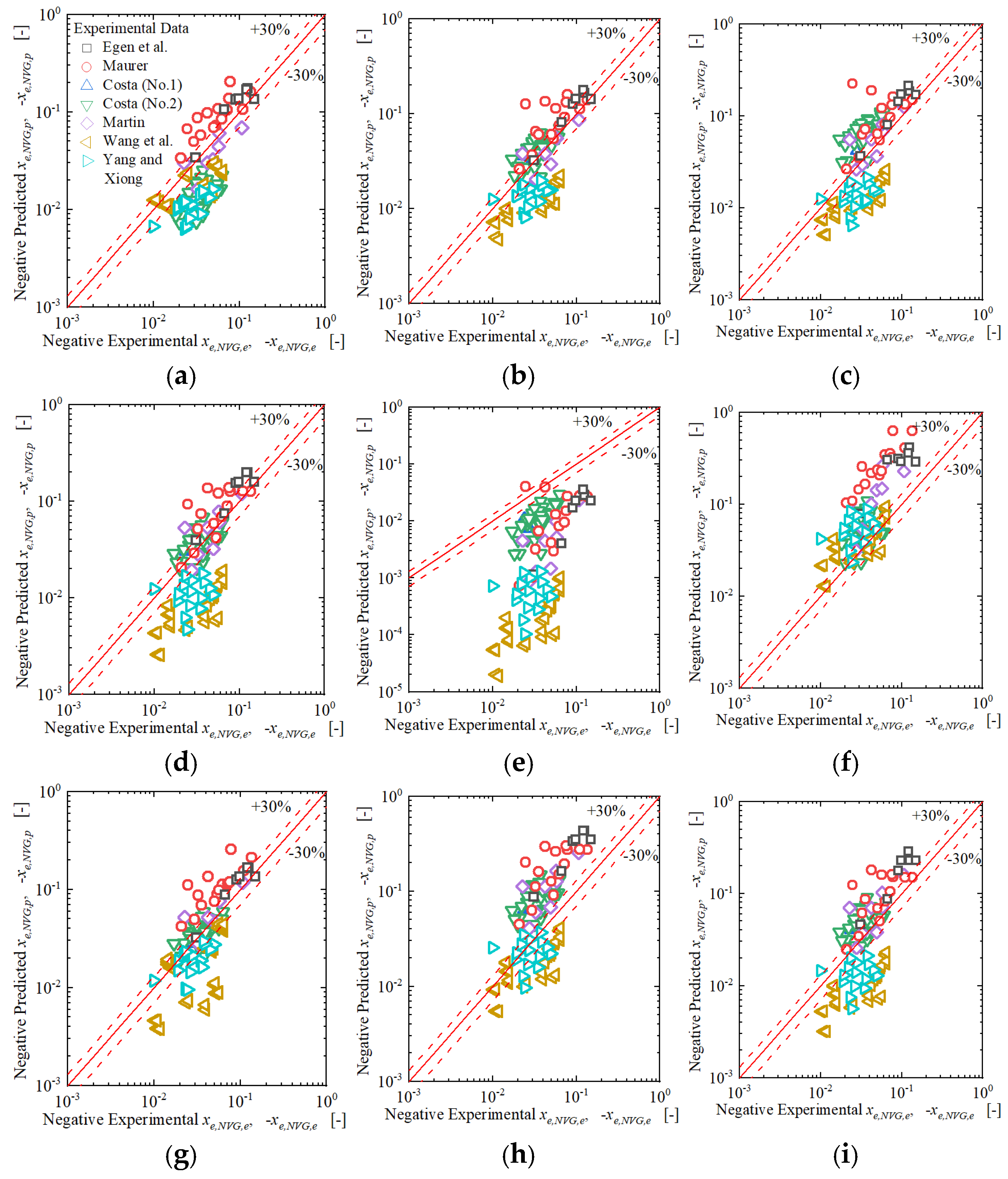
Performance is evaluated using the mean relative error (MRE, mrel). An MRE below 0.4 indicates good prediction. As shown in Figure 1, most correlations perform poorly for narrow rectangular channels. Saha and Zuber gives an MRE of 0.506; its Peclet transition criterion (70,000) does not suit these geometries. Thom (0.858), Sekoguchi (1.10), Bowring (0.539), Levy (0.459), and Dix (0.787) show high errors due to mechanistic inconsistencies or lack of validation.
Figure 1.
Evaluation of xe,NVG correlations with experimental data. (a) Egen et al. [3], Maurer [4], Costa (No.1 and 2) [5], Martin [6], Wang et al. [7], Yang and Xiong [8], Bowring [9]. (b) Levy [10]. (c) Dix [11]. (d) Saha and Zuber [2]. (e) Kataoka et al. [16]. (f) Kalitvianski [17]. (g) Ha et al. [20]. (h) Wang et al. [7]. (i) Lee and Jeong [21].
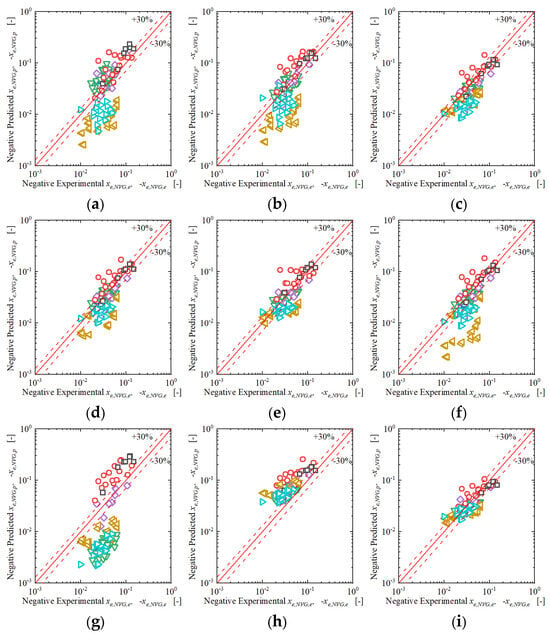
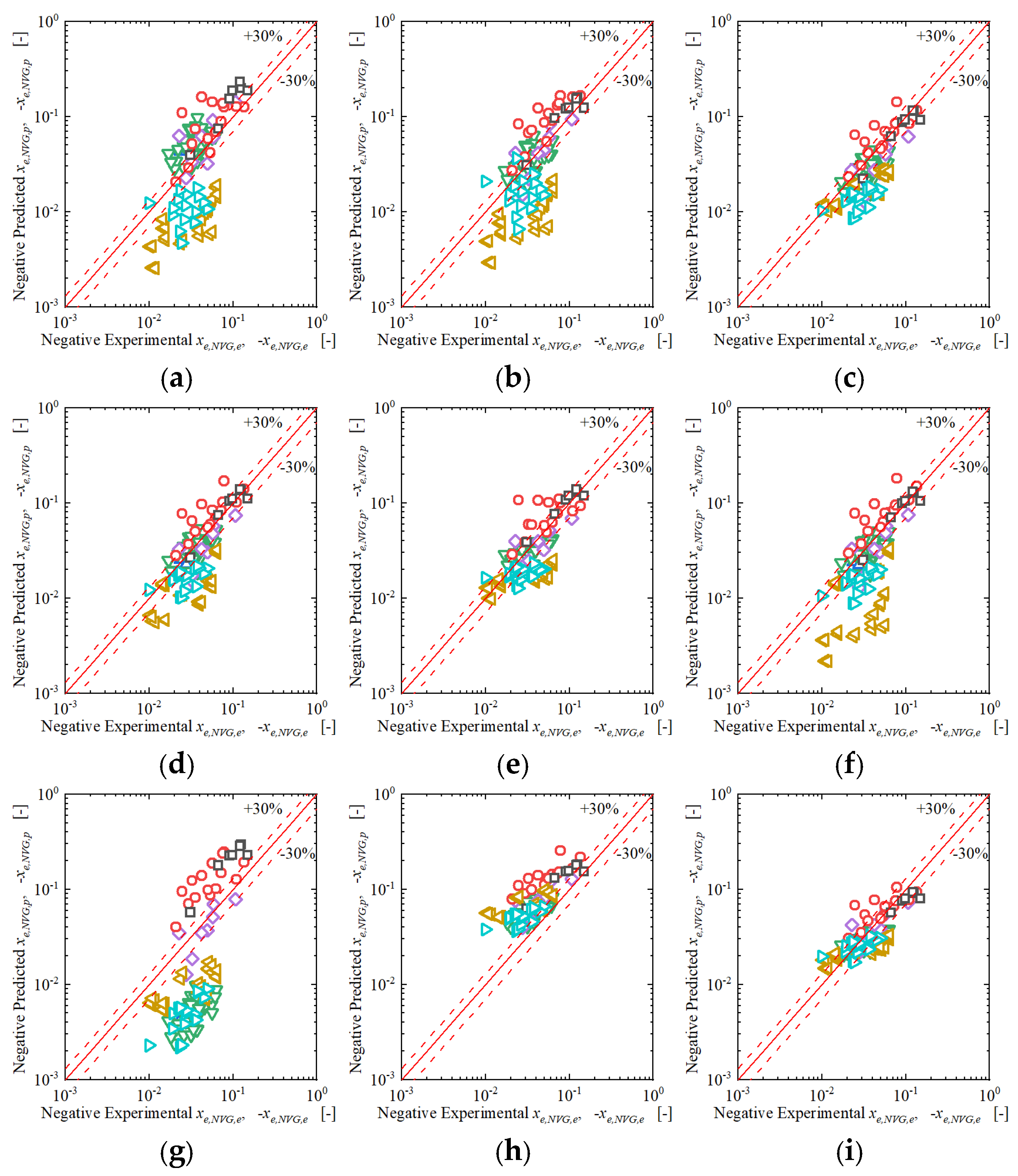
Four thermal/hydrodynamic correlations show relatively better performance: Sun et al. [18] (MRE 0.339), Griffith et al. [12] (0.347), Ünal [14] (0.374), and Jeong et al. [23] (0.401). However, none maintain MRE < 0.4 across all individual datasets. For example, Sun et al. [18] gives 0.647 for Maurer [4] and 0.435 for Wang et al. [7]; Griffith et al. [12] gives 0.429 and 0.481; Ünal [14] gives 0.568, 0.537, and 0.404; and Jeong et al. [23] gives 0.585, 0.625, and 0.432. As none were specifically developed for narrow rectangular channels, consistent reliability is lacking. These results clearly demonstrate the need for a new dedicated correlation for narrow rectangular channels.
3. Development and Evaluation of a New xe,NVG Correlation
To improve prediction accuracy for narrow rectangular channels, a new xe,NVG correlation is developed by modifying the best-performing existing model (Sun et al. [18]), which is based on the thermal/hydrodynamic mechanism. The modification accounts for unique thermal–hydraulic features of narrow rectangular channels.
At the NVG point, vapor generation on the heated wall is balanced by bubble condensation in the subcooled bulk flow. The wall heat flux is expressed as
Over a differential length, heat used for vapor generation (dQg,NVG) and heat released by condensation (dQc,NVG) are:
dQc,NVG = ai,NVGhi,NVG(ts − tf,NVG)AFdz,
From heat balance (dQc,NVG = dQg,NVG), and assuming tf,NVG ≈ tNVG, the subcooling at NVG is:
Thus,
Two unknown interfacial parameters must be modeled.
(1) Interfacial area concentration at NVG (ai,NVG): Assuming spherical bubbles in a square arrangement on the heated surface:
(2) Interfacial heat transfer coefficient at NVG (hi,NVG): For narrow rectangular channels, the Nusselt number depends on Reynolds, Prandtl, density ratio, and channel geometry (gap s, width w):
Substituting yields:
Finally, the new correlation is:
Five adjustment factors (C3, C4, C5, C6, C9) are calibrated using the 120-point database. The recommended values are 0.252, −0.382, 0.526, 0.360, and 0.101, respectively. Figure 2 compares the predicted values with measured data, showing good agreement and no obvious systematic deviation. The overall mean relative error (MRE) reaches 0.294 across all 120 points. It is worth noting that, since the empirical coefficients in the new correlation are derived from fitting to experimental data, its applicability should be strictly confined to the range of experimental conditions covered in Section 2.1.
Figure 2.
Evaluation of xe,NVG correlations with experimental data (continued). (a) SRL [19]. (b) Wisudhaputra et al. [22]. (c) Griffith et al. [12]. (d) Ünal [14]. (e) Sun et al. [18]. (f) Jeong et al. [23]. (g) Thom et al. [13]. (h) Sekoguchi et al. [15]. (i) Newly proposed.
4. Conclusions
This study developed a new xe,NVG correlation for boiling steam–water flow in vertical narrow rectangular channels. Evaluation of 17 existing correlations against a dedicated 120-point database revealed that most, including widely used models, exhibit poor predictive performance (MRE > 0.4). Only a few thermal/hydrodynamic-based correlations showed moderate capability, but with inconsistent accuracy. The proposed correlation refines the heat balance and achieves a mean relative error of 0.294.
Author Contributions
Conceptualization, X.H.; methodology, X.H. and S.H.; software, X.H. and S.H.; validation, X.H., S.H. and M.W.; formal analysis, X.H.; investigation, X.H.; resources, M.W. and J.W.; data curation, X.H.; writing—original draft preparation, X.H.; writing—review and editing, M.W. and J.W.; visualization, X.H.; supervision, M.W. and J.W.; project administration, X.H.; funding acquisition, X.H. All authors have read and agreed to the published version of the manuscript.
Funding
This research was funded by the National Natural Science Foundation of China, grant number 12405199.
Institutional Review Board Statement
Not applicable.
Informed Consent Statement
Not applicable.
Data Availability Statement
The original contributions presented in this study are included in the article.
Acknowledgments
The authors also extend sincere thanks to Yiang Yang, Hongyu Yang, Hanyu Wang, Wenhai Qu and Tingting Liu for their support during this research.
Conflicts of Interest
The authors declare no conflicts of interest.
References
- Zuber, N.; Findlay, J.A. Average volumetric concentration in two-phase flow systems. J. Heat Transf. 1965, 87, 453–468. [Google Scholar] [CrossRef] [Scilit]
- Saha, P.; Zuber, N. Point of net vapor generation and vapor void fraction in subcooled boiling. In Proceedings of the International Heat Transfer Conference 5; International Heat Transfer Conference Digital Library; Begel House Inc.: Danbury, CT, USA, 1974. [Google Scholar] [CrossRef] [Scilit]
- Egen, R.; Dingee, D.; Chastain, J. Vapor Formation and Behavior in Boiling Heat Transfer; Battelle Memorial Institute: Columbus, OH, USA, 1957. [Google Scholar]
- Maurer, G. A Method of Predicting Steady-State Boiling Vapor Fractions in Reactor Coolant Channels; WAPD-BT-19; Westinghouse Electric Corp., Atomic Power Division: Cranberry Township, PA, USA, 1960. [Google Scholar]
- Costa, J. Measurement of the acceleration pressure drop: Study of the appearance of vapour and void fraction in sub-cooled boiling at low pressure. In Proceedings of the European Two-Phase Group Meeting, Winfrith, UK, 14–16 June 1967. [Google Scholar]
- Martin, R. Measurement of the local void fraction at high pressure in a heating channel. Nucl. Sci. Eng. 1972, 48, 125–138. [Google Scholar] [CrossRef] [Scilit]
- Wang, J.; Huang, Y.; Wang, Y. Visualized study on specific points on demand curves and flow patterns in a single-side heated narrow rectangular channel. Int. J. Heat Mass Transf. 2011, 32, 982–992. [Google Scholar] [CrossRef] [Scilit]
- Yang, Y.; Xiong, J. Experimental investigation on steam-water flow patterns in a vertical narrow rectangular channel utilizing conductance scanning measurement. Int. J. Heat Mass Transf. 2024, 223, 125236. [Google Scholar] [CrossRef] [Scilit]
- Bowring, R. Physical Model, Based on Bubble Detachment, and Calculation of Steam Voidage in He Sub-Cooled Region of a Heated Channel; OECD Halden Reaktor Prosjekt; Institutt for Atomenergi: Kjeller, Norway, 1962.
- Levy, S. Forced convection subcooled boiling-prediction of vapor volumetric fraction. Int. J. Heat Mass Transf. 1967, 10, 951–965. [Google Scholar] [CrossRef] [Scilit]
- Dix, G. Vapor Void Fractions for Forced Convection with Subcooled Boiling at Low Flow Rates; UC: Berkeley, CA, USA, 1971. [Google Scholar]
- Griffith, P.; Clark, J.; Rohsenow, W. Void volumes in subcooled boiling systems. In Proceedings of the National Heat Transfer Conference, Chicago, IL, USA, 18–21 August 1958. [Google Scholar]
- Thom, J.; Walker, W.; Fallon, T.; Reising, G. Boiling in subcooled water during flow up heated tubes or annuli. Proc. Inst. Mech. Eng. 1965, 180, 226–246. [Google Scholar] [CrossRef] [Scilit]
- Ünal, H. Determination of the initial point of net vapor generation in flow boiling systems. Int. J. Heat Mass Transf. 1975, 18, 1095–1099. [Google Scholar] [CrossRef] [Scilit]
- Sekoguchi, K.; Tanaka, O.; Esaki, S.; Imasaka, T. Prediction of void fraction in subcooled and low quality boiling regions. Bull. JSME 1980, 23, 1475–1482. [Google Scholar] [CrossRef] [Scilit]
- Kataoka, I.; Kodama, S.; Tomiyama, A.; Serizawa, A. Study on analytical prediction of forced convective CHF based on multi-fluid model. Nucl. Eng. Des. 1997, 175, 107–117. [Google Scholar] [CrossRef] [Scilit]
- Kalitvianski, V. Qualification of CATHARE 2 V1. 5 Rev. 6 on Subcooled Boiling Experiments (KIT Tests); CEA: Grenoble, France, 2000.
- Sun, Q.; Yang, R.; Zhao, H. Predictive study of the incipient point of net vapor generation in low-flow subcooled boiling. Nucl. Eng. Des. 2003, 225, 249–256. [Google Scholar] [CrossRef] [Scilit]
- Chung, B.; Kim, K.; Bae, S.; Jeong, J.; Lee, S.; Hwang, M.; Yoon, C. MARS Code Manual Volume I: Code Structure, System Models, and Solution Methods; Korea Advanced Energy Research Institute (KAERI): Daejeon, Republic of Korea, 2009.
- Ha, T.; Yun, B.; Jeong, J. Improvement of the subcooled boiling model for thermal–hydraulic system codes. Nucl. Eng. Des. 2020, 364, 110641. [Google Scholar] [CrossRef] [Scilit]
- Lee, T.; Jeong, Y. Improvement of the subcooled boiling model using a new net vapor generation correlation inferred from artificial neural networks to predict the void fraction profiles in the vertical channel. Nucl. Eng. Des. 2022, 54, 4776–4797. [Google Scholar] [CrossRef] [Scilit]
- Wisudhaputra, A.; Seo, M.; Yun, B.; Jeong, J. Improvement of the subcooled boiling model for the prediction of the onset of flow instability in an upward rectangular channel. Nucl. Eng. Des. 2022, 54, 1126–1135. [Google Scholar] [CrossRef] [Scilit]
- Jeong, H.; Kim, O.; Shim, W. A correlation for onset of significant void (OSV) in forced convective subcooled flow boiling. Int. J. Heat Mass Transf. 2025, 246, 127067. [Google Scholar] [CrossRef] [Scilit]
Disclaimer/Publisher’s Note: The statements, opinions and data contained in all publications are solely those of the individual author(s) and contributor(s) and not of MDPI and/or the editor(s). MDPI and/or the editor(s) disclaim responsibility for any injury to people or property resulting from any ideas, methods, instructions or products referred to in the content. |
© 2026 by the authors. Licensee MDPI, Basel, Switzerland. This article is an open access article distributed under the terms and conditions of the Creative Commons Attribution (CC BY) license.