


Abstract
The growing interest in hydrogen as an alternative fuel for advanced aviation engines highlights the need for simplified combustion mechanisms suitable for modeling complex hydrodynamic, flame propagation, and detonation processes. A thermodynamic analysis method, accounting for both thermodynamic and kinetic factors, was applied to identify the most significant reactions in the detailed hydrogen combustion scheme (68 reactions). This analysis highlighted eight key reactions, for which rate constants were refined by matching the calculated combustion kinetics of a stoichiometric H2 + O2 mixture to experimental data. The resulting reduced mechanism M-I (12 reversible reactions) shows only minor deviation from the experimental ignition limits. Further exclusion of the two least contributing reactions (mechanism M-II) leads to significant errors in the upper ignition limit at pressures above 10 mmHg. The proposed thermodynamic approach enables effective reduction of the hydrogen combustion mechanism while maintaining sufficient accuracy for applied modeling tasks.
1. Introduction
Several methods have been proposed for reducing detailed mechanisms. One approach involves determining the relative significance of reactions by using the values of ∂yi/∂kj or ∂lnyi/∂lnkj, which characterize the sensitivity of the concentration yi of the i-th component to the uncertainty of the rate constant kj of the j-th reaction. For the rapid calculation of these values, nonlinear Fourier analysis [1] and Green’s function methods [2] have been suggested. However, due to their high complexity and low efficiency, this approach has not gained widespread application. The work [3] proposes a method for reducing the dimensionality of the kinetic scheme based on identifying slowly changing manifolds of certain combinations of variables corresponding to the eigenvalues of the Jacobian matrix of the kinetic scheme with the smallest negative real parts. Specifically, all linear manifolds corresponding to zero eigenvalues, i.e., conservation laws, are identified.
Nevertheless, there are no documented examples in the literature of the consistent application of any method for reducing the kinetic scheme of hydrogen combustion and comparing it with experimental data under various conditions.
The present work aims to extract a simplified mechanism from the comprehensive hydrogen combustion mechanism, consisting of as few reactions as possible, while still adequately describing the experimental data. The experimental data selected include Koval’sky’s kinetic experiment [4], and the ignition limits determined by Lewis and von Elbe [5] and by Egerton and Warren [6].
2. Methods
The oxidation reaction of hydrogen has been investigated both experimentally and theoretically [5,7]. The maximum mechanism, defined for the hydrogen–oxygen system with a set of species including H2, O2, OH, H, O, HO2, H2O, and H2O2, consists of all possible linearly independent reactions and includes 30 reversible reactions [8].
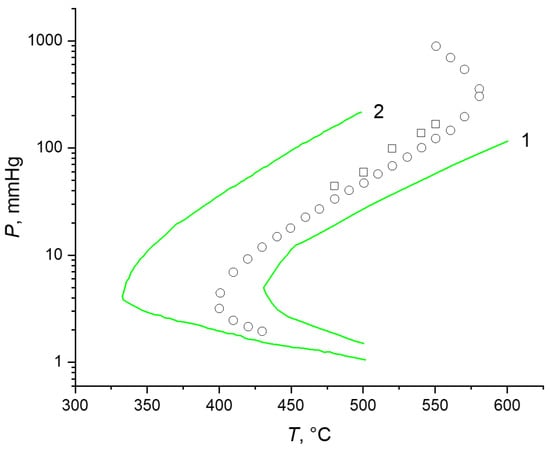
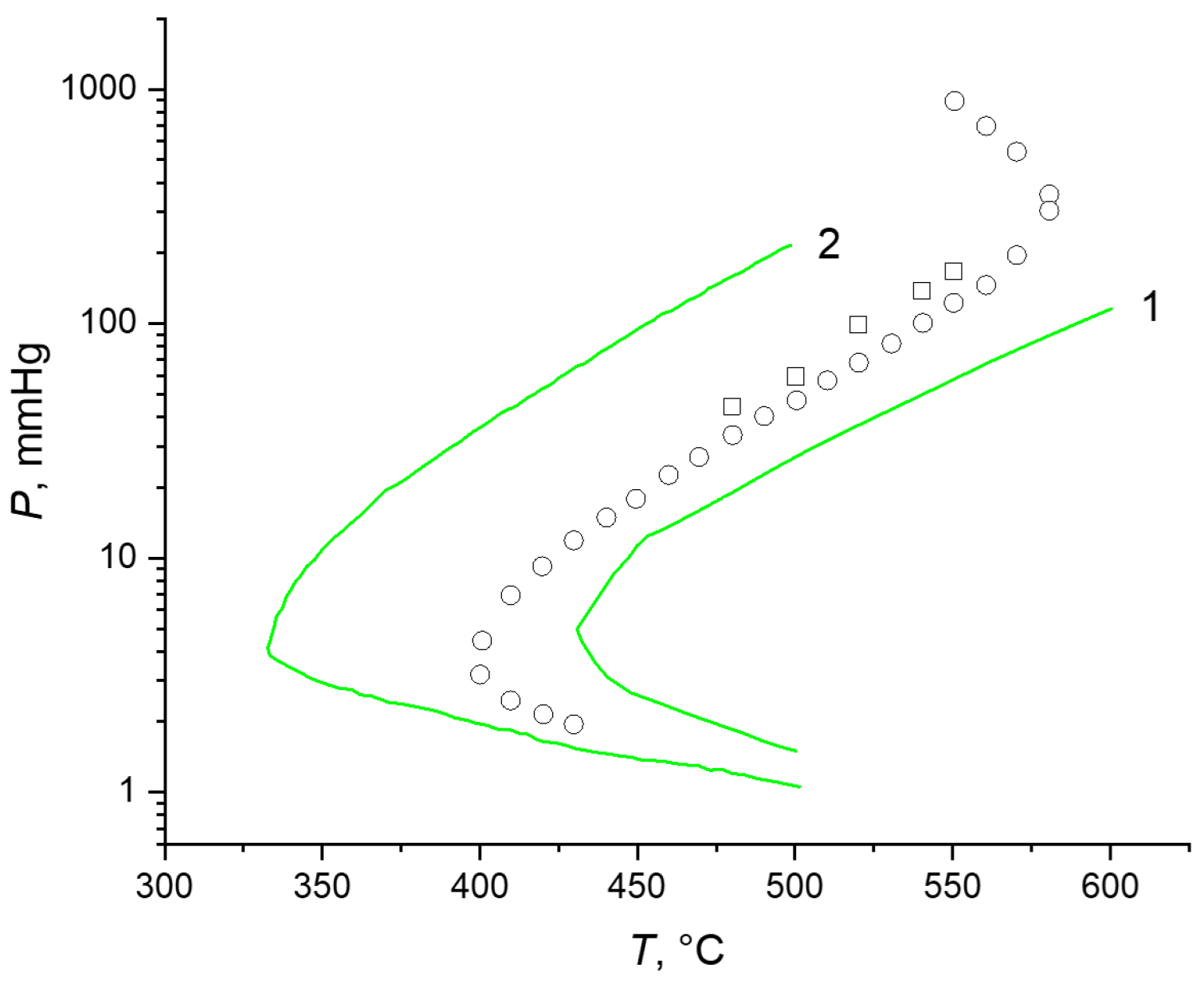
Using the maximum hydrogen combustion scheme (30 reversible reactions + 4 reactions involving radical-wall interactions), the upper and lower values of the ignition limits were obtained based on the data from [8]. A comparison of the results with the experimental data of Lewis and von Elbe [5] and Egerton and Warren [6] is presented in Figure 1. The observed variation in the ignition limits calculated using the maximum mechanism is attributed to the relatively low accuracy in determining the parameters of the elementary reactions within this mechanism. The use of the maximum mechanism [8] does not allow for a precise representation of the experimental data [5,6] and requires substantial computational resources, further highlighting the relevance of the present work.
Figure 1.
Ignition limits of a stoichiometric mixture of H2 and O2. Lines—calculation by the maximum mechanism [8]: curve 1—upper values of the rate constants; curve 2—lower values; ○—experimental data [5]; and □—experimental data [6].
The application of thermodynamic analysis methods [9] allows for the assessment of the thermodynamic contribution of each elementary stage of the maximum mechanism of hydrogen combustion with oxygen. This is achieved using the formula:
where qj is the non-equilibrium thermodynamic characteristic representing the thermodynamic contribution of the j-th stage and the j-th stage consists of both the forward and reverse reactions, with rates denoted as and , respectively.
For the selection of elementary reactions, this quantity proved to be more representative than those mentioned earlier in the article, as it accounts for both the thermodynamic factor ln(/), which describes the deviation of the reacting system from equilibrium, and the kinetic factor ( − ), which characterizes the rate of approach to equilibrium.
The computed thermodynamic contributions of all reactions as functions of time for the maximum mechanism allow for conclusions regarding the role of specific reactions at different moments. Let us consider reactions 1, 18, 22, and 23, along with reaction 9 (from the maximum mechanism [8]), which can be regarded as initiating reactions. For the experimental conditions outlined in [4], the kinetic calculations of the combustion of a stoichiometric mixture at a temperature of 430 °C and 5 mmHg, along with the thermodynamic contributions of these reactions, indicated that reaction 1 undoubtedly plays a significant role at the onset of the process and serves as the primary initiating reaction.
3. Results and Discussion
Through thermodynamic analysis of the maximum mechanism [8], reactions were selected whose contribution within a certain time interval is at least 0.4, resulting in a reduced reaction scheme consisting of eight reactions (numbers 1, 2, 3, 4, 8, 11, 16, 32 according to [8]).
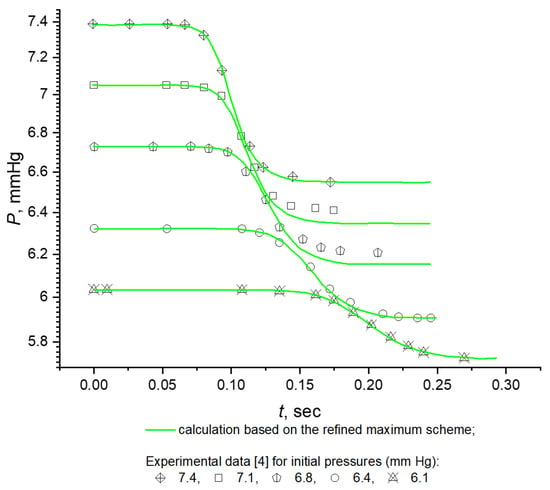
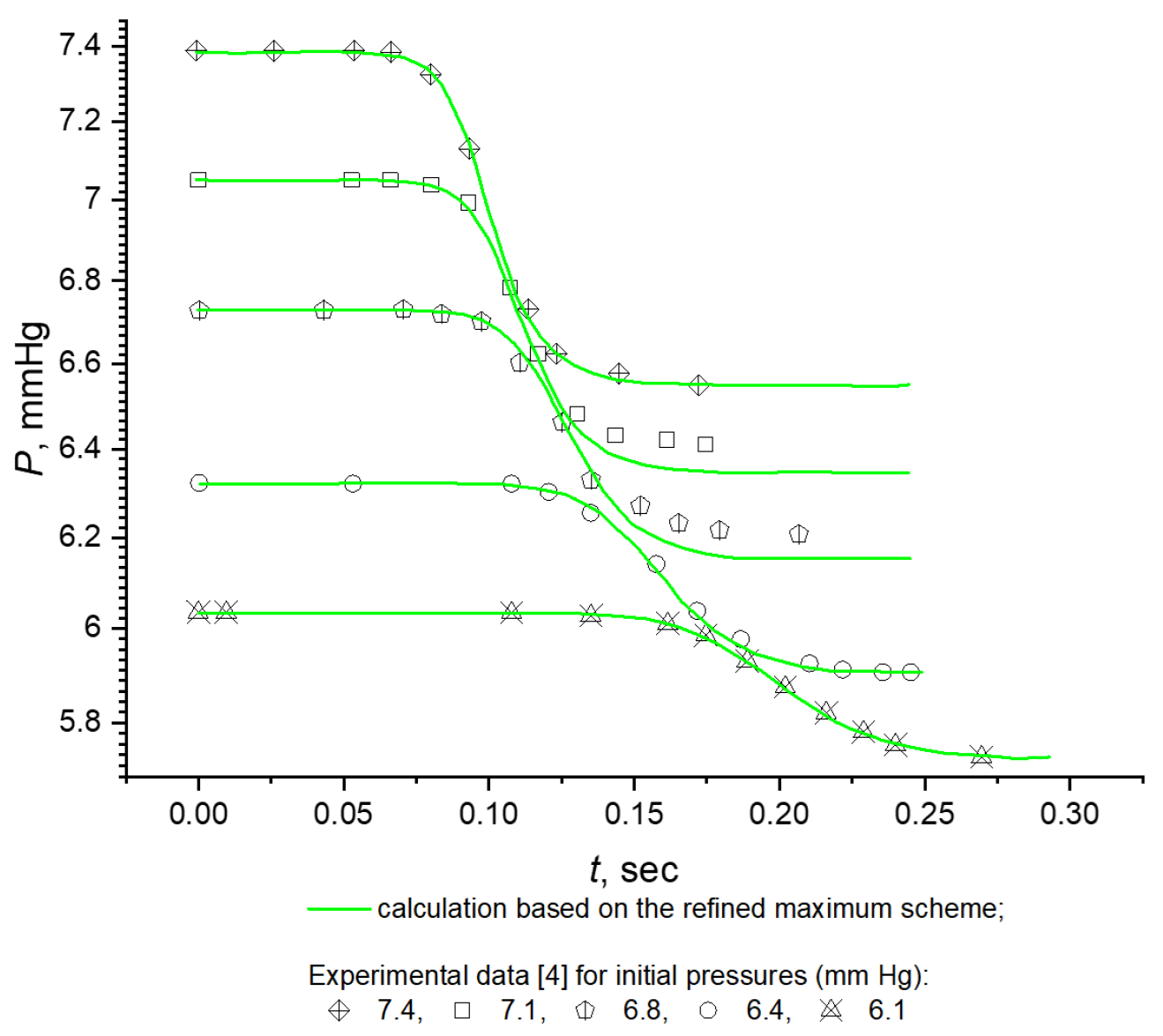
The parameters of the eight reactions describing the kinetics of hydrogen combustion were refined. All refined rate constants for the forward and reverse reactions are consistent with the thermodynamic equilibrium constants. By substituting the refined parameters of the eight hydrogen combustion reactions into the maximum mechanism, the refined maximum hydrogen combustion scheme [8] was obtained, which provides a good description of the experimental data [4] (Figure 2).
Figure 2.
Kinetic curves of combustion of a stoichiometric oxygen–hydrogen mixture: lines—calculation by the refined maximum scheme and symbols—experimental data [4] for initial pressures of 7.4, 7.1, 6.8, 6.4 and 6.1 mmHg.
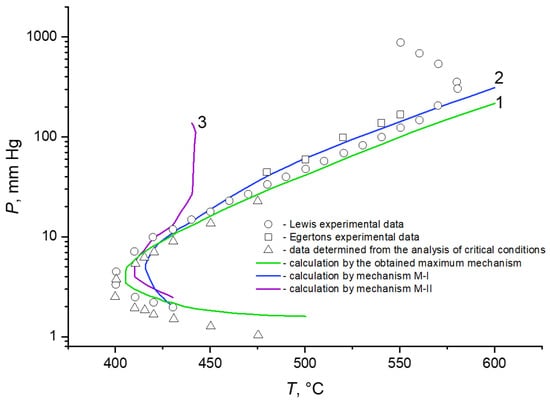
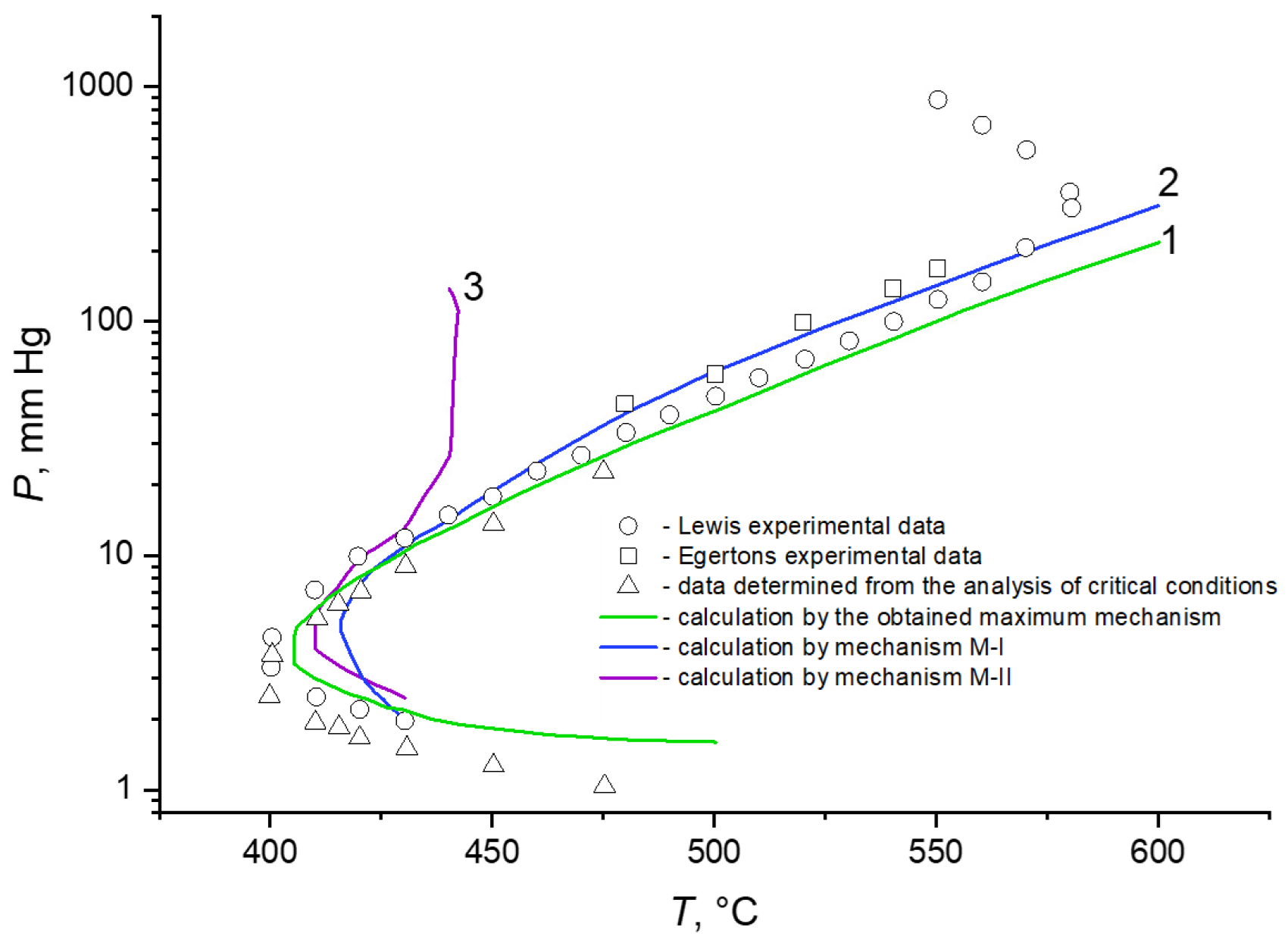
The results of calculating the ignition limits using the refined maximum mechanism and the reduced mechanisms M-I and M-II, as well as the ignition limit values obtained from the critical conditions analysis, are presented in Figure 3 in comparison with the experimental data of Lewis and von Elbe [5] and Egerton and Warren [6]. Reducing the scheme from 34 to 12 reversible reactions (mechanism M-I) results in a relatively small deviation from the experimentally established ignition limits. However, the exclusion of reactions 18 and 33 (mechanism M-II), which have the smallest contributions among the remaining reactions, leads to a significant deviation of the upper ignition limit at pressures above 10 mmHg (Figure 3, curve 3).
Figure 3.
Ignition limits of a stoichiometric mixture of H2 and O2: ○—experimental data [5]; □—experimental data [6]; △—ignition limits determined from the analysis of critical conditions; and lines—calculation by the refined maximum mechanism (curve 1), by mechanism M-I (curve 2) and by mechanism M-II (curve 3).
4. Conclusions
The thermodynamic analysis conducted in this work on the maximum hydrogen combustion scheme (which includes 68 reactions) allowed for the identification of the eight most significant reactions. The use of the refined constants of these reactions in the maximum scheme enables the description of all experimental kinetic curves of Koval’sky [4] using a single set of reactions, thereby confirming the reliability of their determination. By excluding the reactions with a lower thermodynamic fraction, the M-I mechanism was obtained, which includes 12 reactions and allows a reliable description of the experimental data on ignition limits and kinetic curves of oxidation.
Author Contributions
Conceptualization, A.A.M. and L.S.Y.; methodology, A.A.M. and V.G.M.; software, V.G.M. and N.A.P.; validation, Q.A. and Y.L.; formal analysis, A.A.M.; investigation, A.A.M., Q.A. and Y.L.; writing—original draft preparation, A.A.M. and V.G.M.; writing—review and editing, A.A.M., W.Z., Q.A., Y.L., V.G.M., N.A.P. and L.S.Y.; supervision, W.Z.; project administration, W.Z.; funding acquisition, W.Z. and L.S.Y. All authors have read and agreed to the published version of the manuscript.
Funding
This research was funded by the National Key R&D Program of China (grant number 2022YFE0204100) and by the major scientific project “Fundamental studies of combustion and detonation processes in advanced power engineering and engine building” (Agreement No. 075-15-2024-543 of 24 April 2024 between the Ministry of Education and Science and the Kutateladze Institute of Thermophysics of the Siberian Branch of the Russian Academy of Sciences).
Institutional Review Board Statement
Not applicable.
Informed Consent Statement
Not applicable.
Data Availability Statement
The data presented in this study are available on request from the corresponding author.
Conflicts of Interest
The authors declare no conflicts of interest. The funders had no role in the design of the study; in the collection, analyses, or interpretation of data; in the writing of the manuscript; or in the decision to publish the results.
References
- Pianosi, F.; Beven, K.; Freer, J.; Hall, J.W.; Rougier, J.; Stephenson, D.B.; Wagener, T. Sensitivity analysis of environmental models: A systematic review with practical workflow. Environ. Model. Softw. 2016, 79, 214–232. [Google Scholar] [CrossRef] [Scilit]
- Nikolaev, E.V.; Atlas, J.C.; Shuler, M.L. Sensitivity and control analysis of periodically forced reaction networks using the Green’s function method. J. Theor. Biol. 2007, 247, 442–461. [Google Scholar] [CrossRef] [Scilit] [PubMed]
- Maas, U.; Pope, S.B. Simplifying chemical kinetics: Intrinsic low-dimensional manifolds in composition space. Combust. Flame 1992, 88, 239–264. [Google Scholar] [CrossRef] [Scilit]
- Kovalski, A.A. Physikalische Zeitschrift der Sowjetunion; Гoстехиздат: Charkow, USSR, 1933; Volume 4, p. 723. (In German) [Google Scholar]
- Lewis, B.; von Elbe, G. Combustion, Flames and Explosions of Gases, 2nd ed.; Russian translation. Mir: Moscow, USSR, 1968; 592p; Academic Press: New York, NY, USA, 1961. [Google Scholar]
- Egerton, A.; Warren, D.R. Kinetics of the hydrogen/oxygen reaction. I. The explosion region in boric acid-coated vessels. Proc. R. Soc. Lond. A 1951, 204, 465–476. [Google Scholar] [CrossRef] [Scilit]
- Sánchez, A.L.; Williams, F.A. Recent advances in understanding of flammability characteristics of hydrogen. Prog. Energy Combust. Sci. 2014, 41, 1–55, Erratum in Prog. Energy Combust. Sci. 2016, 54, 93–94. [Google Scholar] [CrossRef] [Scilit]
- Yablonskii, G.S.; Bykov, V.I.; Gorban’, A.N.; Elokhin, V.I. Comprehensive Chemical Kinetics. In Kinetic Models of Catalytic Reactions; Elsevier: Amsterdam, The Netherlands, 1991; Volume 32. [Google Scholar]
- Gorban, A.N. Equilibrium Encircling: Equations of Chemical Kinetics and Their Thermodynamic Analysis; Nauka: Novosibirsk, USSR, 1984; 226p. (In Russian) [Google Scholar]
Disclaimer/Publisher’s Note: The statements, opinions and data contained in all publications are solely those of the individual author(s) and contributor(s) and not of MDPI and/or the editor(s). MDPI and/or the editor(s) disclaim responsibility for any injury to people or property resulting from any ideas, methods, instructions or products referred to in the content. |
© 2026 by the authors. Licensee MDPI, Basel, Switzerland. This article is an open access article distributed under the terms and conditions of the Creative Commons Attribution (CC BY) license.