


Abstract
Systematic inconsistencies between evaluated nuclear data libraries and experimental measurements may reflect structured, non-stochastic deviations rather than random error. This study develops a residual-learning framework for the neutron total cross-sections of Cr-50, Cr-53, and Cr-54 using TENDL and EXFOR data. Logarithmic and percentage residuals are modeled using a nonlinear analytical basis with weighted regularization. The analysis reveals heavy-tailed, skewed residual structures and persistent mid-energy underestimation. Residual corrections are strongly regime-dependent, while cross-isotopic transfer remains only partially conserved. Overall, the framework provides an interpretable approach to systematic bias decomposition and physically consistent correction of evaluated nuclear cross-section data.
1. Introduction
Accurate neutron cross-sections are essential to nuclear science and engineering, but evaluated libraries can show persistent discrepancies from experimental measurements [1,2,3]. These deviations may arise from systematic, energy-dependent effects related to model assumptions, resonance treatment, and parameterization [4,5,6]. Reliable assessment therefore requires an analysis of the residual structure beyond aggregate error metrics [7].
Chromium isotopes provide a useful test case because of their complex energy-dependent behavior and sufficient experimental coverage [8]. The evaluated-to-experimental differences can be treated as a structured residual field governed by physical and mathematical constraints [9], while conventional validation methods may obscure this structure and limit cross-isotopic generalization [10].
This study develops an analytical residual-learning framework for Cr-50, Cr-53, and Cr-54 using TENDL and EXFOR data [11]. Residuals are represented through an energy-dependent feature space and nonlinear analytical basis with weighted regularization to characterize systematic bias and its energy-resolved topology [12].
The main contributions of this study are as follows:
- An analytical residual-learning formulation is introduced to characterize evaluated-to-experimental discrepancies while retaining an interpretable representation of systematic bias.
- Energy-resolved residuals exhibit pronounced skewness and heavy-tailed behavior, supporting the presence of systematic and non-Gaussian deviation patterns.
- A persistent mid-energy underestimation regime is identified across the investigated chromium isotopes, indicating a shared region of disagreement between evaluated and experimental data.
- Cross-isotopic transfer analysis indicates that the residual structure is only partially conserved across neighboring chromium isotopes, limiting direct generalization.
- The residual formulation provides an interpretable pathway for bias decomposition and physically consistent multiplicative correction while allowing for comparison with nonlinear regression models.
Collectively, these observations motivate an explicitly energy-resolved treatment of discrepancies in evaluated neutron cross-sections and provide a framework for examining their structure, learnability, and transferability.
2. Methodology
This study compares TENDL and EXFOR neutron total cross-sections for Cr-50, Cr-53, and Cr-54 over their common energy ranges [13]. TENDL energies were converted to MeV, duplicate points were averaged, and non-physical values with an E ≤ 0 or σ ≤ 0 were removed.
where Et(a) and Ex(a) are the TENDL and EXFOR energy values, respectively, and Ω(a) is their common interval. The TENDL cross-section was interpolated onto the EXFOR energy grid as
where σ̃t(a) is the interpolated TENDL cross-section, and denotes linear interpolation. The evaluated-to-experimental mismatch was formulated as
where σx(a) and σt(a) denote the EXFOR and TENDL cross-sections, respectively, and (a) is the residual correction. The logarithmic residual was defined as
where ri(a) is the logarithmic residual at energy Ei. The corresponding percentage residual was calculated as
where pi(a) is the percentage residual. Residual learning used the transformed feature vector
where A, Z, and N are the mass number, atomic number, and neutron number, respectively. A nonlinear basis expansion Φ(x) was used to capture curvature and interaction effects, giving
where β* denotes the optimized coefficient vector, wi denotes the observation weight, λ denotes the regularization parameter, and i indexes the observations.
where wi is the observation weight, and λ is the regularization parameter. The corrected cross-section was then reconstructed as
where σ̂c denotes the corrected cross-section, and r̂ denotes the estimated residual. This formulation preserves positivity and multiplicative consistency. Thepooled chromium dataset was split into 80% training and 20% test sets. Transferability was evaluated by training on Cr-50 and Cr-53 and testing on unseen Cr-54. Performance was assessed using RMSE, MAE, MAPE, bias, bounded-error coverage, skewness, and kurtosis.
Ω(a) = [max(min Et(a), min Ex(a)), min(max Et(a), max Ex(a))]
σ̃t(a)(Ei) = [σt(a)](Ei), Ei ∈ Ω(a)
σx(a)(E) = σt(a)(E) exp((a)(E))
ri(a) = log σx(a) (Ei) − log σ̃t(a) (Ei)
pi(a) = 100 [σ̃t(a)(Ei) − σx(a)(Ei)]/σx(a)(Ei)
xi(a) = [log Ei, log σ̃t(a)(Ei), ∂log σ̃t(a) / ∂log E, A, Z, N]
r̂i(a) = Φ(xi(a))ᵀβ
β* = arg minβ {Σi wi[ri − Φ(xi)ᵀβ]2 + λ‖β‖22}, wi = (1 + |ri|)−1
σ̂c = σ̃t exp(r̂)
3. Results and Discussion
The TENDL–EXFOR discrepancies for the chromium isotopes form a structured, energy-dependent residual field rather than random scatter. As shown in Table 1, Cr-53 provides the closest agreement with the experimental data, with the lowest RMSE of 1.590 b, MAE of 1.092 b, and MAPE of 20.91%. Cr-50 and Cr-54 show larger deviations.
Table 1.
Global residual statistics for TENDL relative to EXFOR across chromium isotopes.
Cr-53 shows better agreement, with a narrower residual envelope, lower variance, and higher bounded-error coverage. In contrast, Cr-50 and Cr-54 show broader dispersion and larger residual excursions, indicating stronger disagreement with the experimental data.
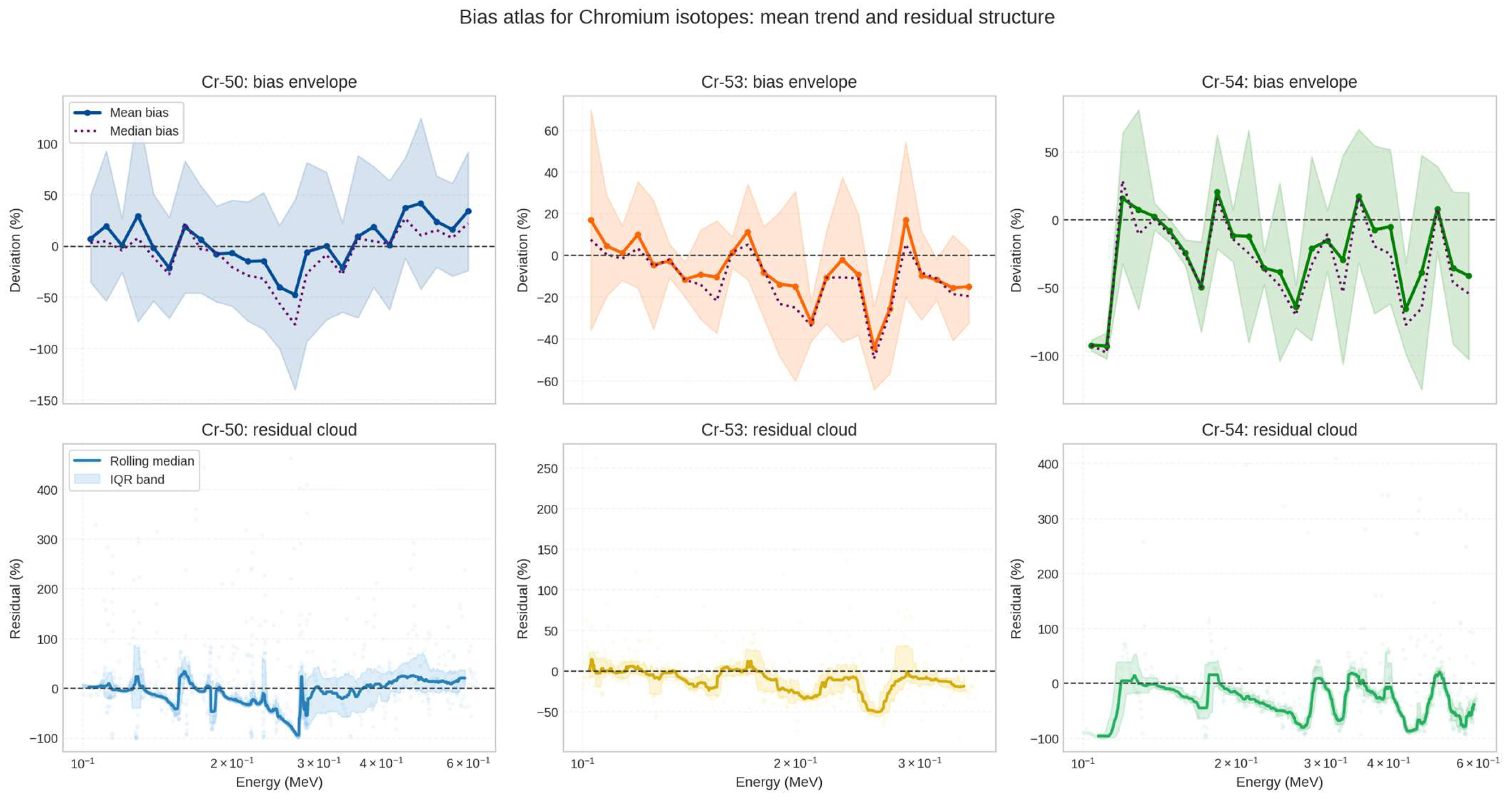
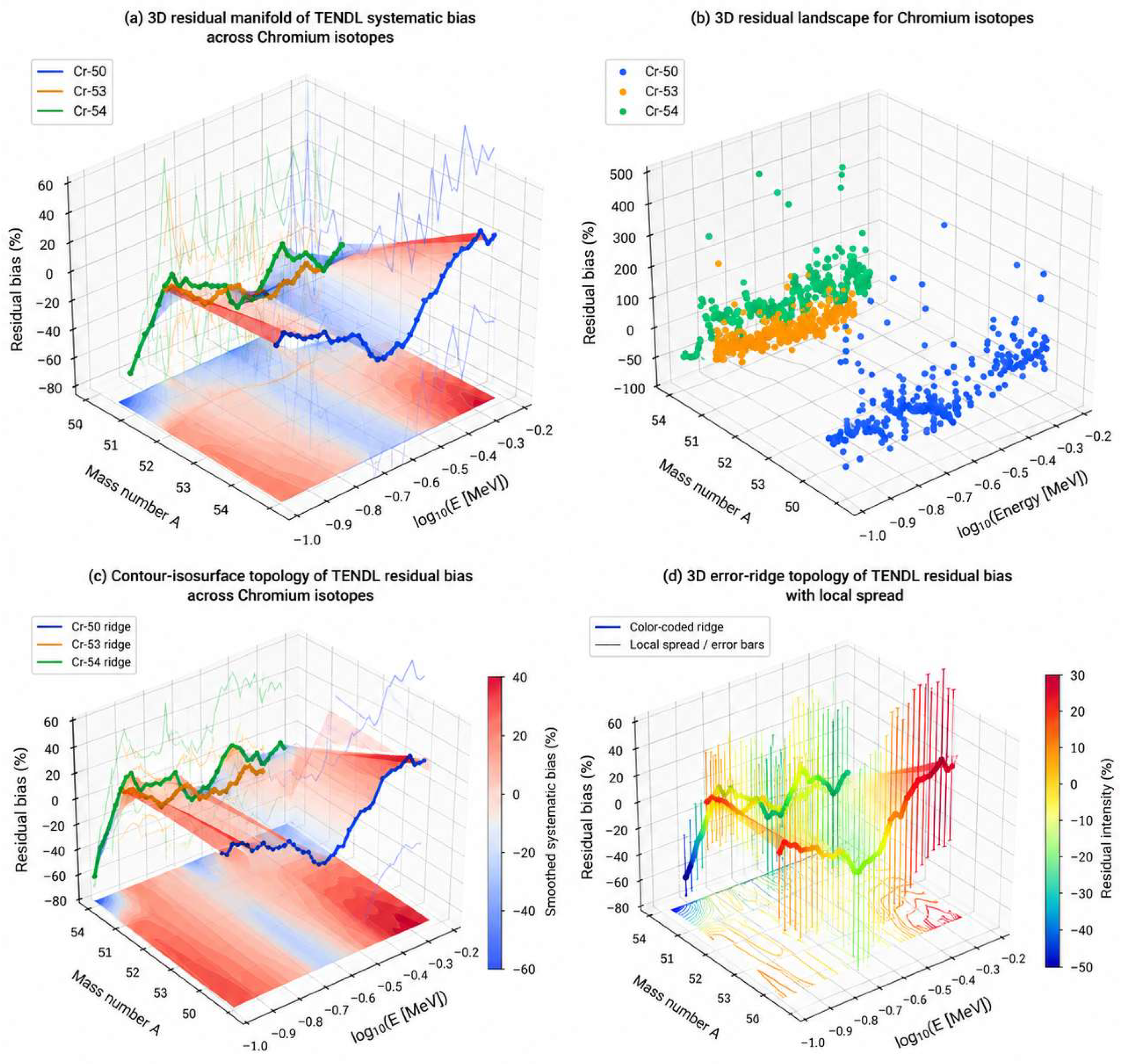
The discrepancy is strongly energy-dependent. As shown in Table 2, the largest deviation occurs at 0.249–0.269 MeV, where the mean bias reaches −60.61%, the mean T/E ratio falls to 0.394, and only 1.5% of points remain within the 20% error threshold. Lower-energy regions are comparatively more stable. Figure 1 shows the energy-dependent residual envelopes and residual-cloud structures across the three chromium isotopeThe energy–mass residual topology in Figure 2 reveals ridge-like, low-dimensional structures across the investigated isotopes. The residuals follow organized pathways rather than arbitrary dispersion, suggesting a shared structural component in the evaluated data. This alignment is the most evident in the mid-energy region, where the strongest underestimation occurs.
Table 2.
Representative energy-resolved residual behavior for Cr-50.
Figure 1.
Bias atlas showing mean and median residual envelopes with uncertainty bands and residual-cloud structure across chromium isotopes.
Figure 2.
Energy–mass residual topology illustrating ridge-like manifold structures of systematic bias across chromium isotopes.
The pooled held-out results in Table 3 confirm that the residual field is learnable. Random Forest performs the best, with R2 = 0.872, RMSE = 1.794 b, MAE = 0.733 b, and MAPE = 21.06%. XGBoost also performs competitively with R2 = 0.849, while Gradient Boosting and SVR are less effective. Broader validation across isotopes and reaction channels is still needed.
Table 3.
Residual-learning model performance on the pooled held-out test subset after correction.
Overall, the TENDL–EXFOR discrepancies form a coherent residual manifold characterized by regime-dependent bias, heavy-tailed asymmetry, and partial cross-isotopic consistency. These patterns indicate that the deviations are systematic, interpretable, and suitable for physics-informed correction.
4. Conclusions
This study shows that TENDL–EXFOR discrepancies in chromium cross-sections form a coherent, energy-dependent residual manifold rather than random variability. Mid-energy underestimation is accompanied by asymmetric, heavy-tailed residuals, while stable bias envelopes and ridge-like energy–mass structures indicate that these deviations are systematic and partly shared across isotopes.
Ensemble-based residual learning further shows that the bias field is learnable and correctable. Random Forest achieved the best performance with R2 = 0.872 on the pooled held-out test subset. Overall, the results support a systematic, regime-dependent interpretation of evaluated nuclear data discrepancies. Future work will examine broader isotopic chains and additional reaction channels.
Author Contributions
Conceptualization, M.K.O.; methodology, M.K.O.; software, M.K.O.; formal analysis, M.K.O.; investigation, M.K.O.; data curation, M.K.O.; visualization, M.K.O.; writing—original draft preparation, M.K.O.; validation, M.K.O., M.U.H.M., M.S.S., K.H.N., S.I.M., M.T.I., S.B. and K.M.M.U.; writing—review and editing, M.K.O., M.U.H.M., M.S.S., K.H.N., S.I.M., M.T.I., S.B. and K.M.M.U.; supervision, M.K.O.; project administration, M.K.O. All authors have read and agreed to the published version of the manuscript.
Funding
This research was supported by the Institute of Research and Training (IRT), Southeast University, Dhaka, Bangladesh, under Office order No. SEU/0245/IRT/0867. The funding institution had no role in the study design; data collection, analysis, or interpretation; manuscript preparation; or the decision to submit the manuscript for publication.
Institutional Review Board Statement
Not applicable.
Informed Consent Statement
Not applicable.
Data Availability Statement
The TENDL and EXFOR data analyzed in this study are publicly available from their respective nuclear data repositories.
Conflicts of Interest
The authors declare no conflicts of interest.
References
- Otuka, N.; Dupont, E.; Semkova, V.; Pritychenko, B.; Blokhin, A.I.; Aikawa, M.; Babykina, S.; Bossant, M.; Chen, G.; Dunaeva, S.; et al. Towards a more complete and accurate experimental nuclear reaction data library (EXFOR): International collaboration between nuclear reaction data centres (NRDC). Nucl. Data Sheets 2014, 120, 272–276. [Google Scholar] [CrossRef] [Scilit]
- Qaim, S.M. Nuclear data for medical applications: An overview. Radiochim. Acta 2001, 89, 189–196. [Google Scholar] [CrossRef] [Scilit]
- Rahman, A.K.M.R.; Happy, T.H.; Ovi, M.K.; Awal, A.; Bromuela, M.A.; Akhand, M.J.R.; Chakraborty, S.R.; Meaze, A.K.M.M.H. Neutron induced 55Mn reaction in the energy range 0.001 MeV to 40 MeV. Malays. J. Sci. 2023, 42, 65–74. [Google Scholar] [CrossRef] [Scilit]
- Feshbach, H.; Weisskopf, V.F. A schematic theory of nuclear cross sections. Phys. Rev. 1949, 76, 1550–1560. [Google Scholar] [CrossRef] [Scilit]
- Thielemann, F.-K.; Argast, D.; Brachwitz, F.; Hix, W.R.; Höflich, P.; Liebendörfer, M.; Martinez-Pinedo, G.; Mezzacappa, A.; Panov, I.; Rauscher, T. Nuclear cross sections, nuclear structure and stellar nucleosynthesis. Nucl. Phys. A 2003, 718, 139–146. [Google Scholar] [CrossRef] [Scilit]
- Rahman, A.K.M.R.; Babu, M.H.; Ovi, M.K.; Zilani, M.M.; Eithu, I.S.; Chakraborty, A. Actinium-225 in targeted alpha therapy. J. Med. Phys. 2024, 49, 137–147. [Google Scholar] [CrossRef] [Scilit]
- Ericson, T.E.O. On probability distributions of nuclear cross sections. Phys. Lett. 1963, 4, 258–259. [Google Scholar] [CrossRef] [Scilit]
- Hemalatha, M. Nuclear charge radii of 46–62Cr isotopes and reaction cross sections for p-Cr. Phys. Rev. C 2022, 106, 054607. [Google Scholar] [CrossRef] [Scilit]
- Wooten, A.L.; Lewis, B.C.; Lapi, S.E. Cross-sections for (p,x) reactions on natural chromium for the production of 52Mn, 52ᵐMn, and 54Mn radioisotopes. Appl. Radiat. Isot. 2015, 96, 154–161. [Google Scholar] [CrossRef] [Scilit]
- Nabi, J.-U.; Böyükata, M.; Ullah, A.; Riaz, M. Nuclear structure properties of even-even chromium isotopes and the effect of deformation on calculated electron capture cross sections. Nucl. Phys. A 2020, 1002, 121985. [Google Scholar] [CrossRef] [Scilit]
- Sublet, J.-C.; Koning, A.; Rochman, D. Multifaceted coded nuclear data libraries assemblage: TENDL-2025. In Proceedings of the 2025 International Conference on Accelerator Applications (AccApp’25), Washington, DC, USA, 9–12 November 2025; pp. 49–52. [Google Scholar]
- Maljovec, D.; Wang, B.; Rosen, P.; Alfonsi, A.; Pastore, G.; Rabiti, C.; Pascucci, V. Rethinking sensitivity analysis of nuclear simulations with topology. In Proceedings of the 2016 IEEE Pacific Visualization Symposium (PacificVis), Taipei, Taiwan, 19–22 April 2016; pp. 64–71. [Google Scholar] [CrossRef] [Scilit]
- Koning, A.J.; Rochman, D.; Sublet, J.-C.; Dzysiuk, N.; Fleming, M.; van der Marck, S. TENDL: Complete nuclear data library for innovative nuclear science and technology. Nucl. Data Sheets 2019, 155, 1–55. [Google Scholar] [CrossRef] [Scilit]

Disclaimer/Publisher’s Note: The statements, opinions and data contained in all publications are solely those of the individual author(s) and contributor(s) and not of MDPI and/or the editor(s). MDPI and/or the editor(s) disclaim responsibility for any injury to people or property resulting from any ideas, methods, instructions or products referred to in the content. |
© 2026 by the authors. Licensee MDPI, Basel, Switzerland. This article is an open access article distributed under the terms and conditions of the Creative Commons Attribution (CC BY) license.