


Abstract
As a core subsystem of the fuel cycle, the Tritium Extraction System (TES) is responsible for the critical functions of separating, extracting, and purifying tritium from the breeding blanket. To quantify the influence of key design parameters on tritium inventory characteristics and loss mechanisms, this study, based on the helium-cooled solid breeder blanket TES designed by the China Academy of Engineering Physics, adopts an established, refined TES model and develops a numerical solver named TRAP (Tritium Retention and Analysis Program). By solving multi-component mass balance differential equations, the dynamic inventories of various species in the TES are quantitatively characterized, and systematic sensitivity analyses are conducted on parameters such as the Permeation Reduction Factor (PRF), inlet hydrogen concentration, and key component temperatures. The results of this study can provide a reference for parameter optimization and engineering design of tritium extraction systems for fusion reactors.
1. Introduction
In controlled nuclear fusion, the deuterium–tritium (D-T) reaction is the most promising path to practical fusion energy due to its high cross-section and low ignition threshold. Continuous operation of a fusion reactor requires tritium self-sufficiency, i.e., the tritium produced in the breeding blanket must compensate for core consumption and transport losses (decay, permeation, etc.). Tritium has a low natural abundance and a half-life of only 12.3 years [1,2]; it cannot be produced or stored in large quantities. Therefore, efficient recovery and purification of tritium fuel is a core engineering challenge.
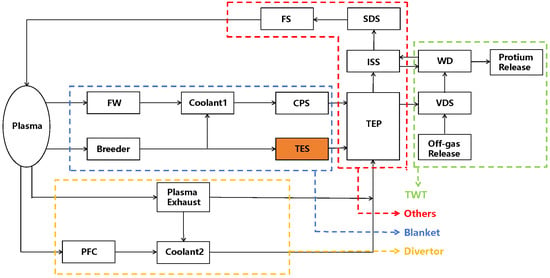
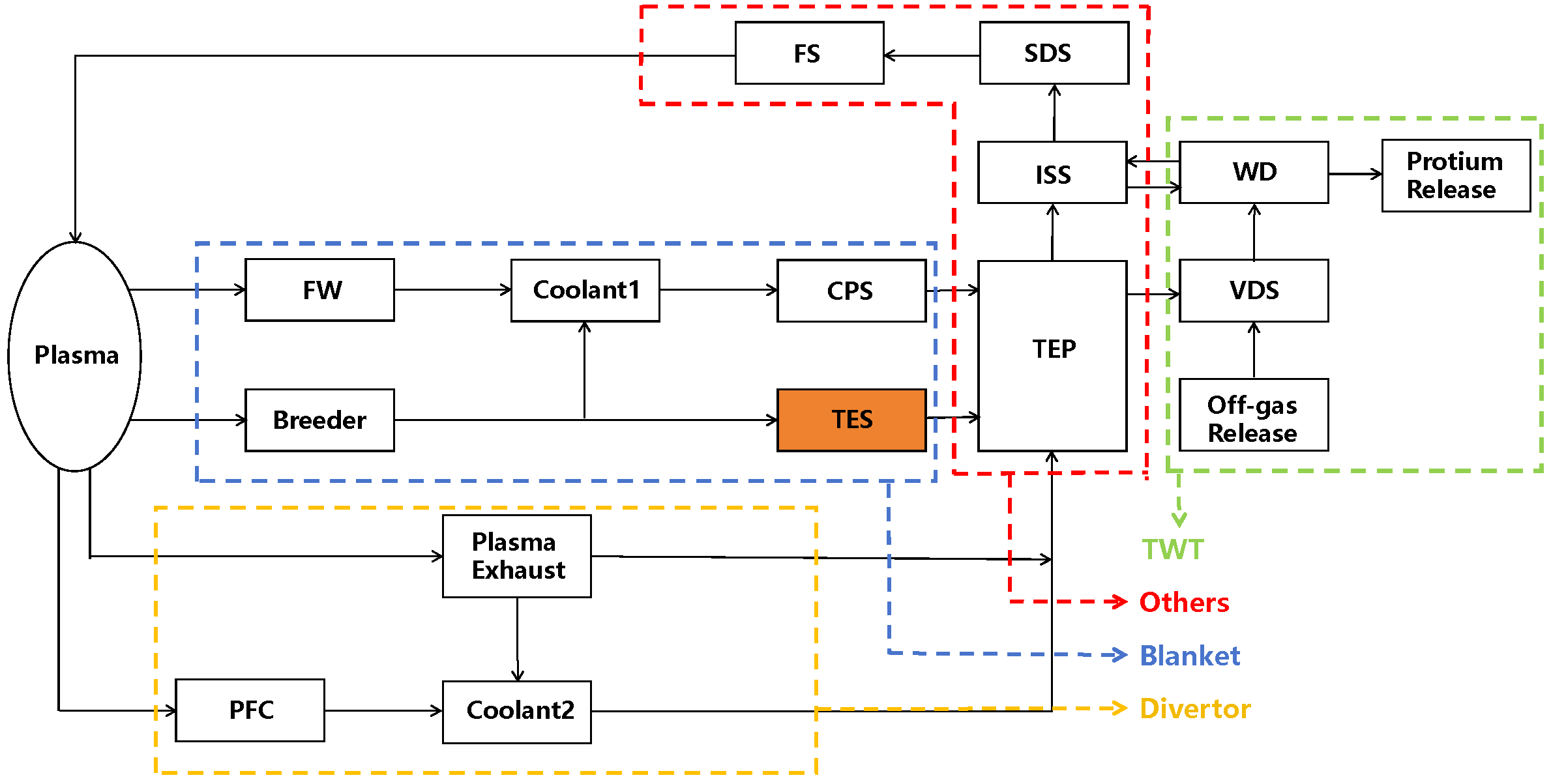
As shown in Figure 1, the tritium plant ensures tritium self-sufficiency and consists of three subsystems: the inner cycle, the outer cycle, and the safety confinement system [3,4,5]. The Tritium Extraction System (TES) in the outer cycle is responsible for separating, extracting, and purifying tritium from the breeding blanket. It uses a purge gas to carry tritium out, performs initial purification, and then sends it to the Isotope Separation System (ISS). As the first subsystem that tritium enters, the performance of the TES directly affects the processing efficiency of the entire tritium plant and the tritium economy.
Figure 1.
Simplified block diagram of the tritium plant model.
Engineering conceptual designs for the TES have been proposed internationally. For the ITER Helium-Cooled Pebble Bed (HCPB) blanket, Albrecht et al. [6] proposed a stepwise tritium extraction scheme. China developed the Helium-Cooled Solid Breeder Test Blanket Module (CH-HCSB TBM) and its associated tritium system [7] and performed computational analyses to obtain tritium inventory and loss data. Lei Pan et al. [8] developed an HCPB blanket tritium cycle model and analyzed the influence of parameters such as PRF, extraction efficiency, and coolant ratio. Wei Shi et al. [9] established a more detailed TES model for the Helium-Cooled Solid Breeder (HCSB) blanket, considering permeation, leakage, and HT/HTO chemical equilibrium, and conducted a sensitivity analysis on PRF.
Based on the solid breeder blanket TES designed by the China Academy of Engineering Physics [10], this paper adopts the existing TES model [9] to further conduct sensitivity analyses on the Permeation Reduction Factor (PRF), inlet hydrogen concentration, and key component temperatures, providing a reference for TES parameter optimization and engineering design.
2. Tritium Extraction System Model and Numerical Method
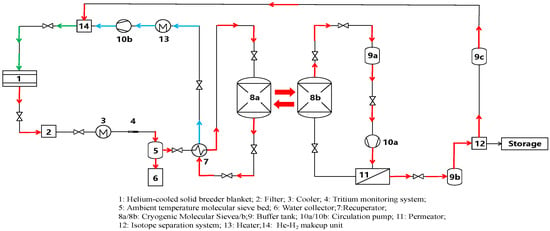
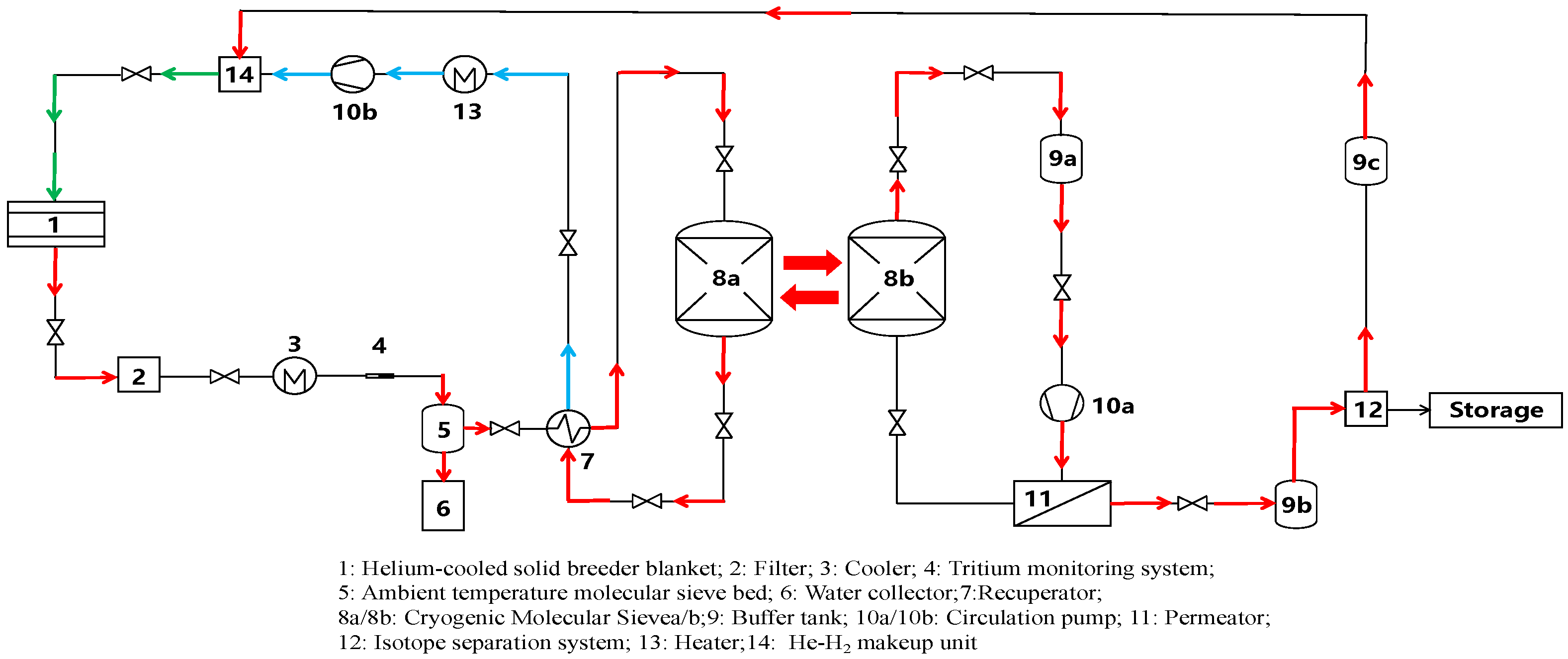
As shown in Figure 2, the TES for the Helium-Cooled Solid Breeder (HCSB) blanket uses a hydrogen-doped helium purge gas circuit, divided into primary extraction and secondary separation/purification circuits. In the primary circuit, helium with 0.1% H2 purges the blanket, carrying HT and HTO via isotope exchange [11]. The gas is filtered, cooled, and passed through an ambient-temperature molecular sieve bed (AMSB) to capture H2O and HTO. After drying, it is cooled to 103 K and enters a cryogenic molecular sieve bed to adsorb hydrogen isotopes (Q2). In the secondary circuit, two alternating cryogenic beds are heated to 123 K for desorption. The desorbed gas is buffered, pressurized, and sent to a palladium membrane diffuser, where high-purity Q2 permeates to the ISS for isotope separation. Unadsorbed Q2 and He are reheated, mixed with return gas from the ISS, and replenished with H2 to 0.1% before returning to the blanket.
Figure 2.
Helium-Cooled Solid Breeder blanket Tritium Extraction System model.
To model tritium transport, mass balance differential equations for each species in each component are established using the mean residence time method [12], a diffusion-limited permeation model, and chemical equilibrium equations.
For any gas component j, the mass balance equation in component i can be expressed as:
where is the inventory (mol) in component i, j can represent H2, HT, H2O, HTO, τi is the mean residence time (h), and is the total loss rate (mol/h) of the gas, including direct leakage, permeation leakage, and tritium decay.
Permeation loss of Q2 follows:
where is the permeation rate (mol/h) of hydrogen isotope Q2 in component i,Ai is the permeable area (m2), Pei is the material permeability coefficient (mol·m−1·h−1·Pa−0.5), thi is the component wall thickness (m), Ti is the component temperature (K), is the inventory of hydrogen isotope Q2 (mol), and Vi is the component volume (m3).
Furthermore, when the purge gas flows through components with significant temperature changes, the reversible reaction H2 + HTO ⇌ HT + H2O within the purge gas must be considered. Let the forward reaction rate be ∆HT. Then, the flow rate changes in each component must satisfy the following equilibrium relationship:
where Keqp is the chemical equilibrium constant at the corresponding temperature, and F represents the inflow rate (mol/h).
Based on the above refined TES design model and tritium transport calculation method, a system of differential equations in the form of Equation (1) is established for all components in the TES flow sheet shown in Figure 2. A numerical solver program named Tritium Retention and Analysis Program (TRAP) was developed to solve the system of mass balance differential equations for multiple components and multiple species, thereby quantitatively characterizing the dynamic inventory of each species in the TES.
3. Sensitivity Analysis
3.1. Steady-State Inventory Distribution of Main Species
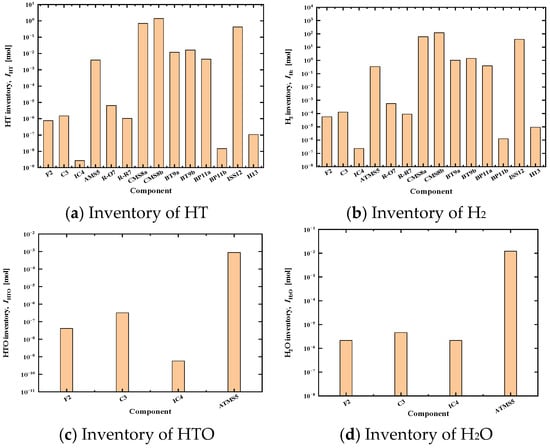
Based on solving the above differential equation system with the TRAP program, the steady-state inventory distribution of the main species in each TES component was obtained, as shown in Figure 3. It can be observed from Figure 3 that HTO and H2O exist only in the ambient-temperature molecular sieve bed and components upstream of it, while no inventory of these two species was detected in downstream components. Furthermore, the inventory of HT in the cryogenic molecular sieve bed and the hydrogen isotope separation device is much higher than that in other components, and far exceeds the inventory of HTO in each component.
Figure 3.
Steady-state inventory distribution of main species in TES components under baseline conditions.
3.2. Sensitivity Analysis of Key Parameters
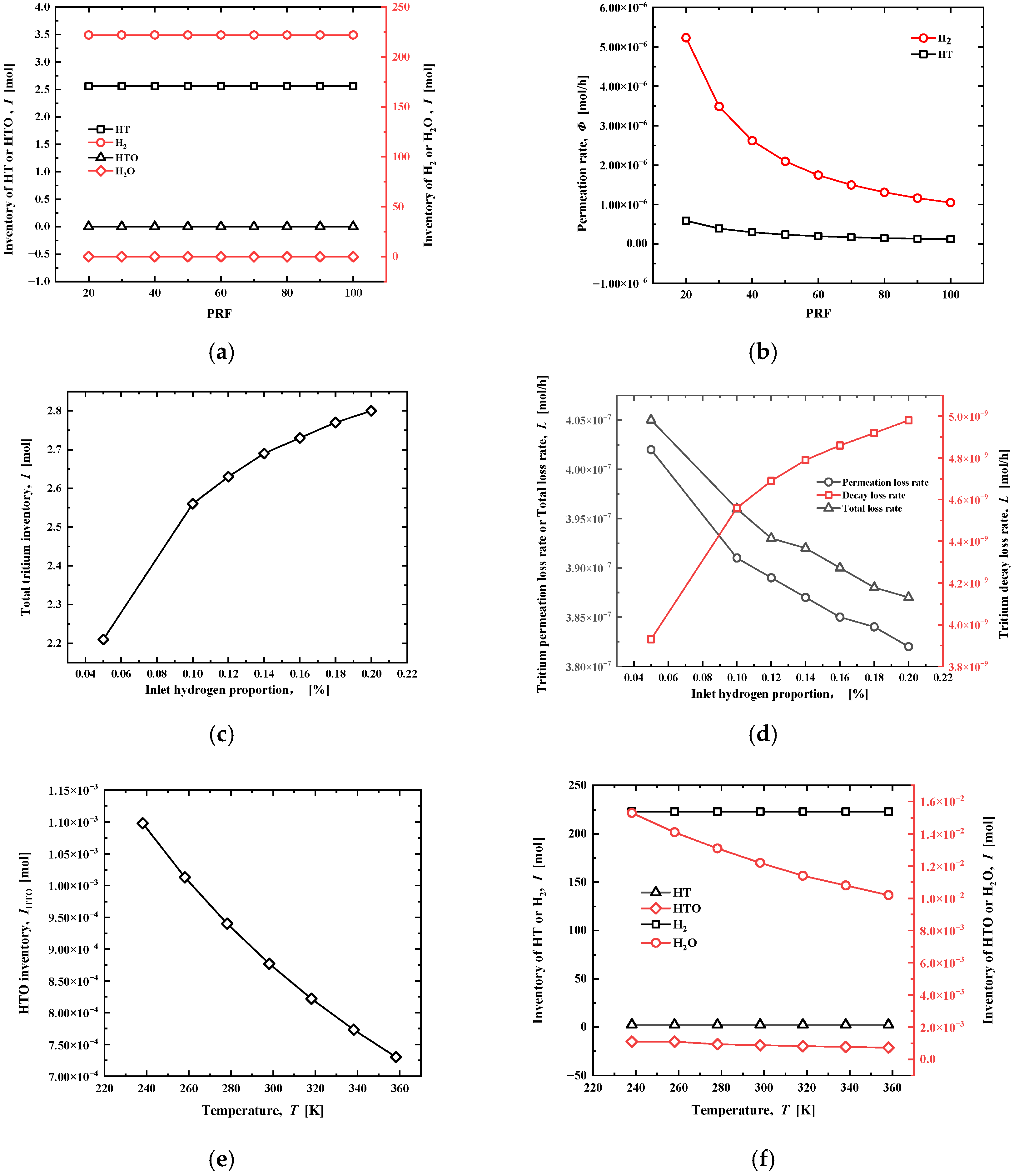
Sensitivity analyses were conducted on key parameters in the TES, including the Permeation Reduction Factor (PRF), inlet hydrogen concentration, and key component temperatures. The results are shown in Figure 4. As PRF increases from 20 to 100, the steady-state inventories of HT, H2, HTO, and H2O remain essentially unchanged. The permeation rates of both HT and H2 decrease monotonically with increasing PRF, and at the same PRF value, the permeation rate of H2 is always higher than that of HT. As the inlet hydrogen concentration increases from 0.05% to 0.20%, the total tritium inventory increases monotonically; permeation loss decreases, decay loss increases slightly, and the total loss decreases from 4.05 × 10⁻⁷ mol/h to 3.87 × 10⁻⁷ mol/h. With increasing temperature of the ambient-temperature molecular sieve bed, the inventories of HT and H2 remain unchanged, while the inventories of HTO and H2O decrease significantly.
Figure 4.
Sensitivity analysis of key parameters in the TES. (a) Variation in inventories with PRF; (b) Variation in permeation with PRF; (c) Variation in total tritium inventory with inlet hydrogen proportion; (d) Variation in tritium loss with inlet hydrogen proportion; (e) Variation in HTO inventory with the temperature of the AMSB; (f) Variation in substance inventory with the temperature of the AMSB.
4. Conclusions
In this study, a numerical solver named TRAP was developed for the Tritium Extraction System (TES) of a helium-cooled solid breeder blanket. Through evaluation of three key design parameters—the Permeation Reduction Factor, the inlet hydrogen concentration, and the temperature of the ambient-temperature molecular sieve bed—it was found that varying PRF in the range of 20–100 has a negligible effect on the steady-state inventories of HT, H2, HTO, and H2O, while the permeation rates of both HT and H2 decrease monotonically with increasing PRF, and the permeation rate of H2 is consistently higher than that of HT. Increasing the inlet hydrogen concentration from 0.05% to 0.20% reduces the total loss by only about 4.4%, but increases the total tritium inventory by approximately 18%. Raising the temperature of the ambient-temperature molecular sieve bed reduces the inventories of HTO and H2O without affecting those of HT and H2. The TRAP program enables quantitative characterization of dynamic tritium inventories, providing a valuable reference for parameter optimization and engineering design of the TES.
Author Contributions
Conceptualization, Z.W.; methodology, Z.W., Q.D. and W.S.; software, Z.W. and Q.D.; validation, C.L.; formal analysis, Z.W. and X.Y.; investigation, X.Y.; resources, W.S.; data curation, X.Y.; writing—original draft preparation, Z.W.; writing—review and editing, T.L., M.W. and J.W.; visualization, Q.D.; supervision, T.L.; project administration, M.W. and J.W.; funding acquisition, M.W. and J.W. All authors have read and agreed to the published version of the manuscript.
Funding
This research was supported by the Harbin Engineering University 2025 University-Level General Innovation Training Project under the Student Innovation and Entrepreneurship Training Program (grant number: 2025153101), and by the Key Laboratory of Advanced Nuclear Energy Design and Safety, Ministry of Education, grant number KLANETDS-KF-202509.
Institutional Review Board Statement
Not applicable.
Informed Consent Statement
Not applicable.
Data Availability Statement
No new data were created or analyzed in this study. Data sharing is not applicable to this article.
Acknowledgments
The authors would like to express their sincere gratitude to Xu Han and all others who provided help for this project.
Conflicts of Interest
The authors declare no conflicts of interest.
References
- Glugla, M.; Lässer, R.; Le, T.L.; Penzhorn, R.-D.; Simon, K. Experience gained during the modification of the Caprice system to Caper. Fusion Eng. Des. 2000, 49, 811–816. [Google Scholar] [CrossRef] [Scilit]
- Demange, D.; Glugla, M.; Günther, K.; Le, T.L.; Simon, K.H.; Wagner, R.; Welte, S. Counter-current isotope swamping in a membrane reactor: The PERMCAT process and its applications in fusion technology. Catal. Today 2010, 156, 140–145. [Google Scholar] [CrossRef] [Scilit]
- Koonce, J.; Yoshida, H.; Kveton, O.; Horikiri, H.; Haange, R. Design of ITER plasma exhaust processing systems. Fusion Technol. 1995, 28, 630–635. [Google Scholar] [CrossRef] [Scilit]
- Abdou, M.A.; Vold, E.L.; Gung, C.Y.; Youssef, M.Z.; Shin, K. Deuterium-tritium fuel self-sufficiency in fusion reactors. Fusion Sci. Technol. 1986, 9, 250–285. [Google Scholar] [CrossRef] [Scilit]
- Cristescu, I.R.; Dörr, L.; Busigin, A.; Murdoch, D. ITER dynamic tritium inventory modeling code. Fusion Sci. Technol. 2005, 48, 343–348. [Google Scholar] [CrossRef] [Scilit]
- Chen, H.; Pan, L.; Lv, Z.; Li, W.; Zeng, Q. Tritium fuel cycle modeling and tritium breeding analysis for CFETR. Fusion Eng. Des. 2016, 106, 17–20. [Google Scholar] [CrossRef] [Scilit]
- Pan, L. Study on Tritium Cycle Model and Tritium Self-Sufficiency for CFETR. Master’s Thesis, University of Science and Technology of China, Hefei, China, 2017. (In Chinese) [Google Scholar]
- Zhao, Z.; Hu, S.; Ye, Y. Recent Advances on Palladium Alloy Membranes for Hydrogen Purification. Nucl. Sci. Technol. 2017, 5, 142. [Google Scholar]
- Fort, D.; Farr, J.P.G.; Harris, I.R. A comparison of palladium-silver and palladium-yttrium alloys as hydrogen separation membranes. J. Less-Common Met. 1975, 39, 293–308. [Google Scholar] [CrossRef] [Scilit]
- Shi, W.; Zeng, Q.; Wang, S.; Chen, H. Tritium transportation modeling and analysis for tritium extraction system of HCSB blanket. Fusion Eng. Des. 2019, 143, 159–163. [Google Scholar] [CrossRef] [Scilit]
- Shi, W. Analysis of Tritium Transport in Key Subsystems of Tritium Plant and Development of Core Databasefor Tritium Plant. Master’s Thesis, University of Science and Technology of China, Hefei, China, 2020. (In Chinese) [Google Scholar]
- Peng, S.; Wang, H. Tritium Chemistry and Technology; National Defense Industry Press: Beijing, China, 2015. (In Chinese) [Google Scholar]
Disclaimer/Publisher’s Note: The statements, opinions and data contained in all publications are solely those of the individual author(s) and contributor(s) and not of MDPI and/or the editor(s). MDPI and/or the editor(s) disclaim responsibility for any injury to people or property resulting from any ideas, methods, instructions or products referred to in the content. |
© 2026 by the authors. Licensee MDPI, Basel, Switzerland. This article is an open access article distributed under the terms and conditions of the Creative Commons Attribution (CC BY) license.