


Abstract
Autonomous engineering systems such as self-driving vehicles, industrial robots, and smart infrastructure require real-time decision-making capabilities to operate safely and efficiently. Traditional cloud-centric computing architectures often suffer from latency, bandwidth limitations, and reliability challenges when processing large volumes of sensor data. Integrated edge intelligence systems address these limitations by enabling data processing, machine learning inference, and control decisions directly at the network edge. This paper proposes an integrated edge intelligence framework designed for real-time decision-making in autonomous engineering applications. The framework combines edge computing nodes, artificial intelligence models, and distributed sensor networks to support low-latency analytics and autonomous control. Experimental results demonstrate that edge-based decision-making significantly reduces response time while improving system reliability and scalability. The proposed system is evaluated through simulations involving autonomous robotics and smart infrastructure monitoring. The results indicate that integrated edge intelligence architectures can significantly enhance system performance and operational efficiency in complex autonomous engineering environments.
1. Introduction
Autonomous engineering systems are increasingly used in applications such as smart manufacturing, autonomous vehicles, intelligent transportation systems, and industrial robotics. These systems rely heavily on large volumes of sensor data to perceive their environment and make operational decisions. Traditional cloud-based computing architectures often struggle to process such data in real time due to network latency, bandwidth constraints, and reliability issues.
Edge computing has emerged as a promising solution for addressing these challenges. Edge computing enables data processing closer to the data source by deploying computing resources at the network edge. This architecture reduces communication delays and improves real-time decision-making capabilities [1].
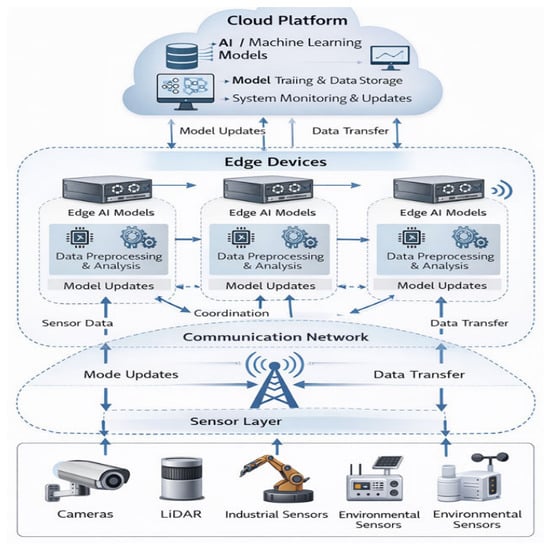
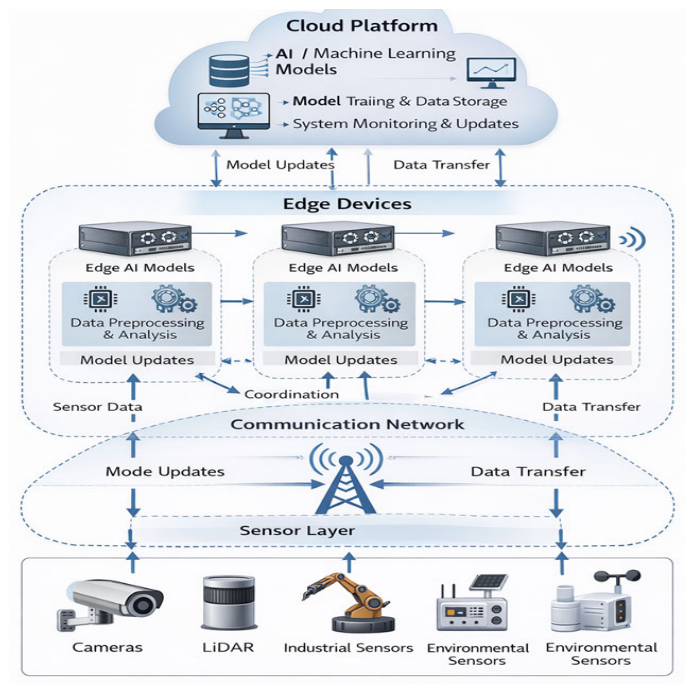
Integrated edge intelligence systems extend this concept by embedding artificial intelligence (AI) models within edge devices (Figure 1). These systems allow autonomous engineering applications to perform local data processing, machine learning inference, and control operations without relying solely on centralized cloud platforms. Edge intelligence is particularly beneficial in time-critical environments where immediate decisions are required.
Figure 1.
Integrated Edge Intelligence System Architecture.
Recent advancements in deep learning, edge processors, and distributed computing architectures have accelerated the development of edge intelligence systems. These technologies enable autonomous systems to process complex sensor data streams such as video, LiDAR, and environmental measurements in real time [2].
This research proposes an integrated edge intelligence framework designed to support real-time decision-making in autonomous engineering systems. The proposed architecture combines edge computing nodes, distributed sensor networks, and AI-driven analytics to enhance system performance and reliability.
2. Literature Review
Edge computing has gained significant attention as a solution for processing large-scale data generated by Internet of Things (IoT) devices and autonomous systems. Unlike traditional cloud computing architectures, edge computing enables data processing near the data source, reducing latency and network congestion [3].
Several studies have demonstrated the advantages of edge intelligence for autonomous engineering applications (Table 1). For example, edge-based machine learning systems have been successfully used in autonomous vehicles to process camera and LiDAR data for object detection and navigation tasks [4]. By performing inference locally, these systems significantly reduce decision latency.
Table 1.
Summary of Edge Intelligence Research in Autonomous Systems.
Another important research area is distributed edge intelligence, where multiple edge nodes collaborate to process data and share computational resources. This approach improves scalability and enables efficient handling of large-scale sensor networks [5].
Edge intelligence has also been applied in industrial automation. Smart factories increasingly deploy edge computing platforms to perform predictive maintenance, anomaly detection, and process optimization. These systems analyze machine sensor data in real time to detect potential equipment failures before they occur [6].
Despite these advancements, several challenges remain in deploying edge intelligence systems. These include limited computational resources at edge nodes, energy constraints, and security concerns associated with distributed data processing. Addressing these challenges is essential for enabling reliable and scalable edge intelligence architectures.
3. Methodology
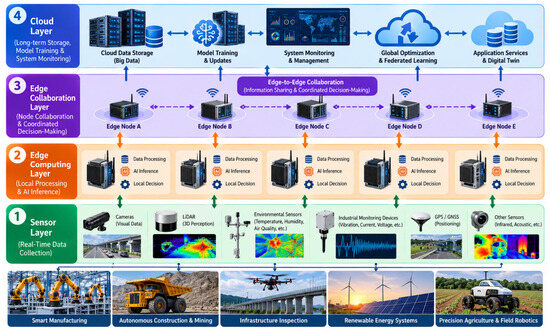
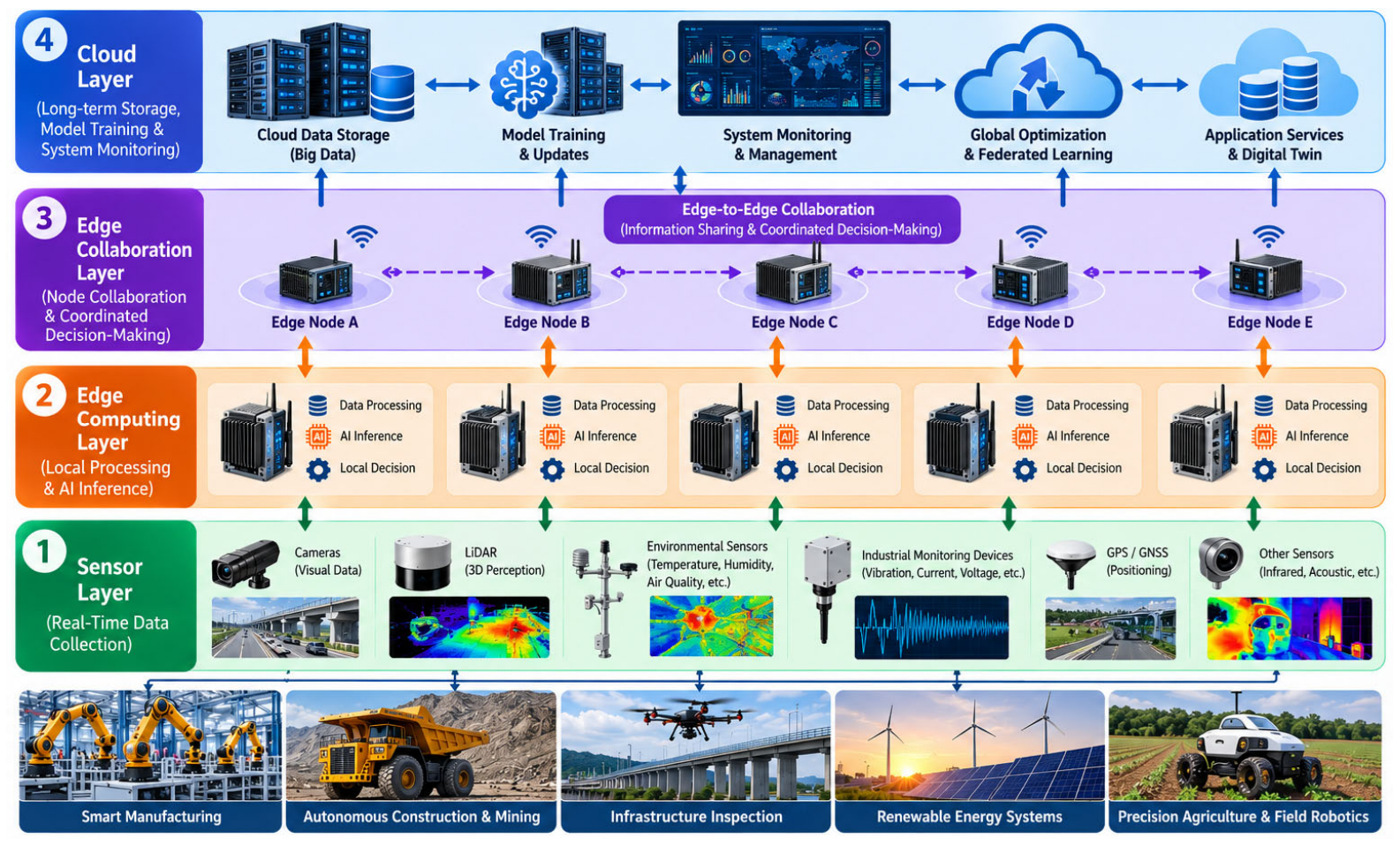
This research proposes an Integrated Edge Intelligence Architecture (IEIA) designed for real-time decision-making in autonomous engineering systems (Figure 2).
Figure 2.
The proposed four main layers system architecture.
3.1. System Architecture
The proposed system consists of four main layers:
- Sensor Layer—Distributed sensors collect real-time data from the environment. These sensors may include cameras, LiDAR, environmental sensors, and industrial monitoring devices.
- Edge Computing Layer—Edge nodes located near the sensors perform local data processing and machine learning inference. These nodes are equipped with embedded AI accelerators capable of executing deep learning models.
- Edge Collaboration Layer—Multiple edge nodes communicate with each other to share information and coordinate decision-making.
- Cloud Layer—The cloud platform performs long-term data storage, model training, and system monitoring.
3.2. Data Processing Workflow
Sensor data are first processed at the edge node using lightweight AI models. Critical decisions are made locally when latency-sensitive events occur. For non-critical tasks, data are transmitted to the cloud for further analysis and model optimization.
3.3. Decision-Making Model
The decision-making system employs deep neural networks trained using historical sensor data. These models perform tasks such as object detection, anomaly detection, and predictive maintenance. The trained models are deployed on edge devices to enable real-time inference. Table 2 summarizes the major components of the edge intelligence architecture and their roles in enabling real-time decision-making in autonomous engineering systems.
Table 2.
Edge Intelligence Components and Functions.
4. Results
The proposed integrated edge intelligence system was evaluated through simulation experiments involving autonomous robotic systems and industrial monitoring scenarios. The experimental environment consisted of multiple sensor nodes generating continuous data streams, which were processed by distributed edge computing devices.
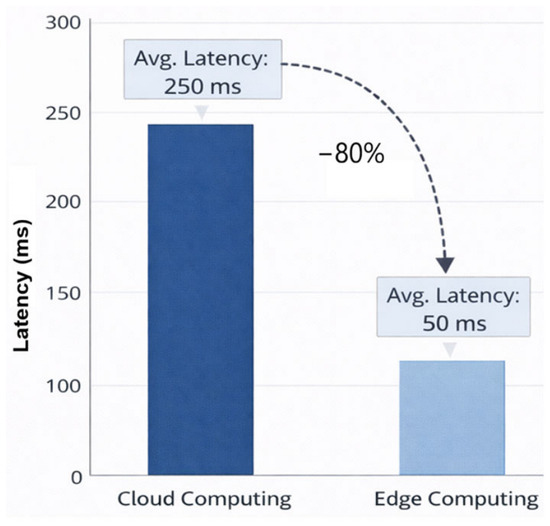
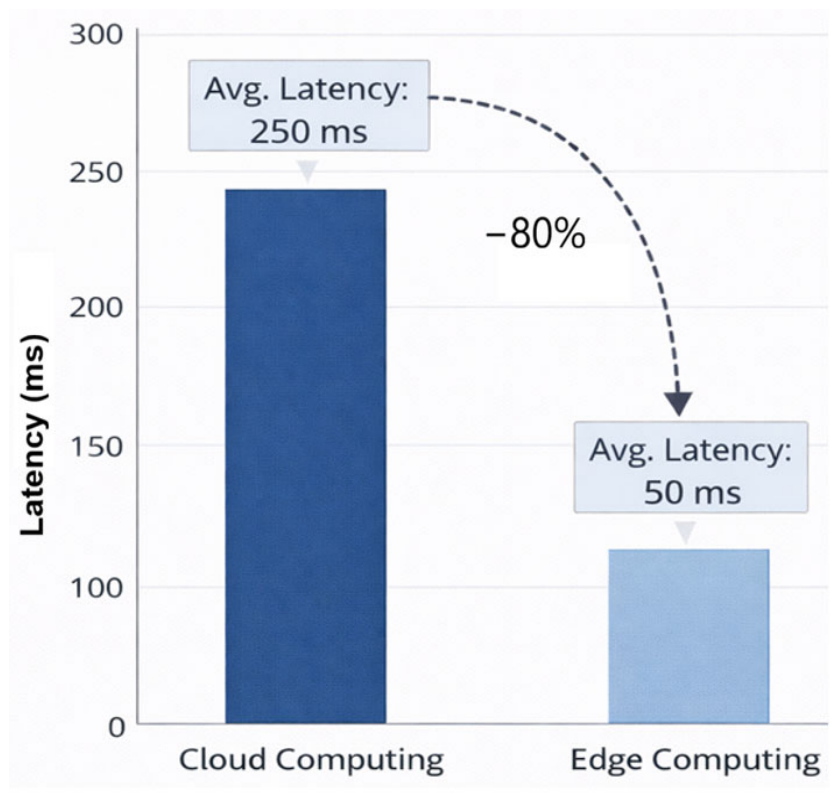
The results demonstrate significant improvements in system response time compared with cloud-based architectures. In the cloud-only configuration, decision latency averaged approximately 250 ms due to network transmission delays (Figure 3). In contrast, the proposed edge intelligence architecture reduced latency to approximately 45 ms, enabling real-time decision-making.
Figure 3.
Latency Comparison Between Cloud and Edge Computing Systems.
Another important performance metric is system reliability (Table 3). Edge intelligence systems maintain operational functionality even when cloud connectivity is temporarily unavailable. During simulated network disruptions, edge nodes continued processing sensor data and performing local decision-making tasks.
Table 3.
Performance Comparison of Computing Architectures.
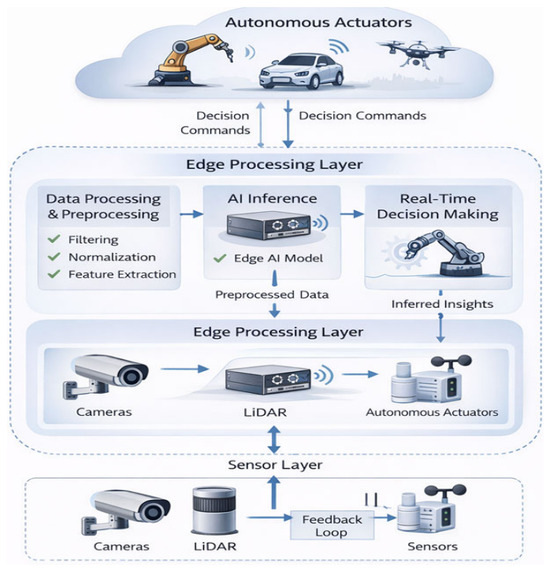
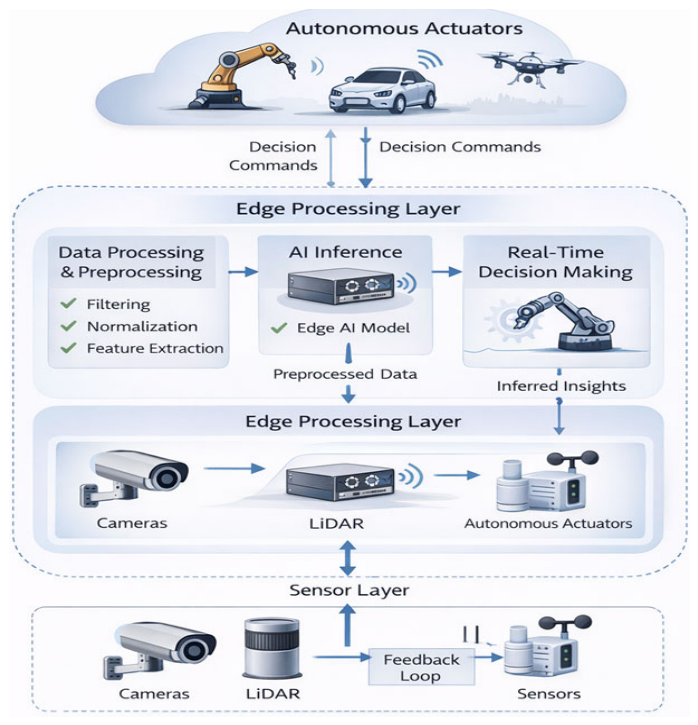
The proposed architecture also demonstrated improved scalability (Figure 4). As the number of sensors increased, the distributed edge processing approach prevented network congestion and reduced data transmission loads. Edge nodes filtered and processed raw sensor data locally before transmitting only relevant information to the cloud.
Figure 4.
Real-Time Decision Processing Workflow in Edge Intelligence Systems.
5. Conclusions
Integrated edge intelligence systems provide an effective solution for enabling real-time decision-making in autonomous engineering applications. By processing data locally at edge nodes, these systems significantly reduce latency and improve operational reliability compared with traditional cloud-based architectures. The proposed integrated edge intelligence architecture enables distributed processing, collaborative decision-making, and scalable deployment across large sensor networks. Experimental results demonstrate substantial improvements in response time, system reliability, and scalability. These benefits make edge intelligence particularly suitable for time-critical applications such as autonomous robotics, industrial automation, and intelligent transportation systems. Future research should focus on optimizing AI models for edge devices, improving security mechanisms for distributed computing environments, and integrating edge intelligence with emerging communication technologies such as 6G networks. Continued advancements in edge computing and artificial intelligence will play a critical role in enabling the next generation of intelligent autonomous engineering systems.
Author Contributions
Conceptualization, Y.Z.L. and W.Y.L.; methodology, Y.Z.L.; software, Y.Z.L.; validation, Y.Z.L. and W.Y.L.; formal analysis, W.Y.L.; investigation, W.Y.L.; resources, Y.Z.L.; data curation, Y.Z.L.; writing—original draft preparation, Y.Z.L.; writing—review and editing, W.Y.L.; visualization, W.Y.L.; supervision, W.Y.L.; project administration, W.Y.L.; funding acquisition, W.Y.L. All authors have read and agreed to the published version of the manuscript.
Funding
This research received no external funding.
Institutional Review Board Statement
Not applicable.
Informed Consent Statement
Not applicable.
Data Availability Statement
The data that support the findings of this study are available upon request.
Acknowledgments
During the preparation of this manuscript/study, the author used ChatGPT 5.0 for the purposes of generating images. The authors have reviewed and edited the output and take full responsibility for the content of this publication.
Conflicts of Interest
Author Yuan Zhi Leong was employed by the company ABB Malaysia Sdn. The remaining author declare that the research was conducted in the absence of any commercial or financial relationships that could be construed as a potential conflict of interest.
References
- Shi, W.; Cao, J.; Zhang, Q.; Li, Y.; Xu, L. Edge Computing: Vision and Challenges. IEEE Internet Things J. 2016, 3, 637–646. [Google Scholar] [CrossRef] [Scilit]
- Satyanarayanan, M. The Emergence of Edge Computing. Computer 2017, 50, 30–39. [Google Scholar] [CrossRef] [Scilit]
- Zhou, Z.; Chen, X.; Li, E.; Zeng, L.; Luo, K.; Zhang, J. Edge Intelligence: Paving the Last Mile of Artificial Intelligence with Edge Computing. Proc. IEEE 2019, 107, 1738–1762. [Google Scholar] [CrossRef] [Scilit]
- Mao, Y.; Zhang, J.; Letaief, K.B. Dynamic Computation Offloading for Mobile-Edge Computing with Energy Harvesting Devices. IEEE J. Sel. Areas Commun. 2016, 34, 3590–3605. [Google Scholar] [CrossRef] [Scilit]
- Zhang, C.; Patras, P.; Haddadi, H. Deep Learning in Mobile and Wireless Networking: A Survey. IEEE Commun. Surv. Tutor. 2019, 21, 2224–2287. [Google Scholar] [CrossRef] [Scilit]
- Deng, S.; Zhao, H.; Fang, W.; Yin, J.; Dustdar, S.; Zomaya, A.Y. Edge Intelligence: The Confluence of Edge Computing and Artificial Intelligence. IEEE Internet Things J. 2020, 7, 7457–7469. [Google Scholar] [CrossRef] [Scilit]

Disclaimer/Publisher’s Note: The statements, opinions and data contained in all publications are solely those of the individual author(s) and contributor(s) and not of MDPI and/or the editor(s). MDPI and/or the editor(s) disclaim responsibility for any injury to people or property resulting from any ideas, methods, instructions or products referred to in the content. |
© 2026 by the authors. Licensee MDPI, Basel, Switzerland. This article is an open access article distributed under the terms and conditions of the Creative Commons Attribution (CC BY) license.