


Abstract
This study presents an assessment of naturally occurring radioactive materials (NORM) in the Zuunbayan and Toson-Uul oil fields of Mongolia. Soil and reservoir-rock samples were collected and analysed by high-resolution gamma-ray spectrometry with a high-purity germanium (HPGe) detector in order to determine the activity concentrations of 226Ra, 232Th, 40K and 137Cs. The oil-bearing reservoir rocks consist primarily of sand, sandstone, argillaceous shale, and carbonate rocks, with specific activities of 226Ra(238U) ranging from 10 to 44 Bq/kg (average 25.75 Bq/kg), 232Th from 7 to 48 Bq/kg (average 25 Bq/kg), and 40K from 90 to 700 Bq/kg. These findings provide essential baseline data for environmental radiation monitoring and highlight the importance of NORM assessment in petroleum exploration and production in Mongolia.
1. Introduction
Within the territory of Mongolia, 31 prospective petroleum exploration blocks have been identified. To date, 19 contractors have established Production Sharing Agreements for 23 of these blocks, all of which have been approved by the Government. At present, “PetroChina Daqing Tamsag” LLC carries out extraction and production operations in the Toson-Uul XIX and Tamsag XXI blocks, while “Dongsheng Petroleum (Mongolia)” LLC operates in the PSA-97 block.
In the late 1940s and the first half of the 1950s, petroleum exploration intensified in southern and eastern Mongolia. Approximately 100 positive structures were identified in the Nyalga, Dornogovi, Choibalsan, Tamsag and Dundgovi basins, and exploratory wells were drilled in 24 of these structures.
As a result of these efforts, two small oil fields were discovered in the Dornogovi basin: the Zuunbayan field, with reserves estimated at that time at 2.7 million tonnes, and the Tsagaan Els field (3.5 million tonnes), giving a total of more than 6 million tonnes. In addition, approximately ten oil occurrences were identified across the Tamsag, Choibalsan, Nyalga and Dornogovi basins.
Exploration and reserve estimation for the Zuunbayan field in the Dornogovi basin were completed, and production was carried out between 1950 and 1969, during which a total of 550,000 tonnes of oil was extracted.
In 1994, the American company “Nescor Energy” began exploration drilling at the Tsagaan Els field and, in 1995, Soco Corporation initiated exploration in the Tamsag XIX block.
Notably, in Block XIX the Canadian-invested company “SOTAMO” LLC drilled well 19-3 in May 1997, which produced an oil gusher. In February 1998 the well was transferred to pilot production, marking the beginning of extraction activities at the Toson-Uul field. During that period, an average of approximately 5000 barrels of crude oil per day was produced from 90 wells [1].
To date, systematic work to establish the natural radiation background levels around the oil fields of Mongolia has not been carried out in full.
2. Radioactive Compounds in Petroleum, Their Distribution, and Patterns
Petroleum contains radioactive elements at concentrations of the order of 10−8–10−7 g/t [2]. Radioactive isotopes in and around oil basins and deposits have been studied increasingly in recent years because they play a key role in the identification of ecological problems.
Table 1 summarises the geological setting, the oil-bearing sediments and the rock characteristics of the Zuunbayan and Toson-Uul fields, where oil is currently being extracted in Mongolia.
Table 1.
Comparison of the petroleum basins and deposits of Mongolia [3].
The oil in these deposits occurs in situ within the lacustrine (lake-derived) sediments of the Tsagaantsav and Zuunbayan formations, which act as bitumen-bearing carbonaceous source rocks. These deposits date from the Late Jurassic and Early Cretaceous and were not transported over long distances. The crude oils of the Zuunbayan and Toson-Uul fields belong to a single “Tsagaantsav–Zuunbayan” genetic type, which indicates a large contribution of organic matter derived from terrestrial higher plants [3].
Based on these data, the oil-bearing sediments of both deposits consist of sandstone, conglomerate, shale and mudstone. The thickness of the oil-bearing sedimentary sequence is 1200 m in the Zuunbayan field and 3000 m in the Toson-Uul field.
3. Materials and Methods
Within the scope of this study, soil samples were collected in the vicinity of the Toson-Uul field in the Tamsag basin and of the Zuunbayan field in the Dornogovi basin. The activity concentrations of the radionuclides were determined by gamma-ray spectrometry at the Nuclear Research Centre of the National University of Mongolia (NUM).
A gamma-ray spectrometer equipped with a high-resolution HPGe semiconductor detector and a 4096-channel “Canberra” analyser was used for the measurements. The detector had an active volume of 52 cm3 and an energy resolution of 2.0 keV at the 1332.5 keV spectral line. The spectra obtained were processed by computer.
Surface soil samples, including the associated vegetation, were collected from an area of 15 cm × 15 cm to a depth of 5 cm. Each sample was placed in a Marinelli beaker with a volume of 700 cm3 and measured on the detector for 1 h.
3.1. Specific Activity of the Radionuclides (A)
Equation (1) was used to determine the specific activity of the radionuclides in the soil from the net area of the full-energy peak:
where A is the specific activity of the radionuclide (Bq/kg); N(Ei) is the net area of the full-energy peak at energy Ei (counts); kγ is the gamma-ray emission probability (yield) of the corresponding transition (dimensionless); ε(Ei) is the absolute full-energy peak detection efficiency, determined for water (ρ = 1 g/cm3); k is the correction factor for gamma-ray self-absorption in the sample, determined experimentally (dimensionless); m is the mass of the sample (kg); and t is the measurement time (s) [4].
3.2. Absorbed Gamma Dose Rate in Air (P)
From the specific activities of the natural radionuclides in the soil, the absorbed gamma dose rate in air at a height of 1 m above the ground was calculated using Equation (2):
where P is the absorbed gamma dose rate in air (nGy/h); AU, ATh and AK are the specific activities (Bq/kg) of 226Ra(238U), 232Th and 40K, respectively; and 0.427, 0.662 and 0.043 are the corresponding dose conversion coefficients, expressed in (nGy/h) per (Bq/kg) [5].
P = 0.427AU + 0.662ATh + 0.043AK
3.3. Annual Effective Dose from Gamma Radiation (D)
The annual effective dose received by the population from the gamma radiation of the natural radionuclides in the soil was calculated using Equation (3), applying an outdoor occupancy factor of 0.2 and a conversion coefficient of 0.7 Sv/Gy from absorbed dose in air to effective dose for the average gamma-ray energy at the height of the human respiratory tract [5]:
where D is the annual effective dose (μSv/y); P is the absorbed gamma dose rate in air (nGy/h); 0.2 is the outdoor occupancy factor (dimensionless); 0.7 Sv/Gy is the conversion coefficient from absorbed dose in air to effective dose; 8760 h/year is the number of hours in one year; and 10−3 is the unit conversion factor from nSv to μSv.
D(μSv) = 0.2·P(nGy/h)·0.7(Sv/Gy)·8760(h/year)
4. Results and Discussion
4.1. Activity Concentrations of the Radionuclides in the Soil
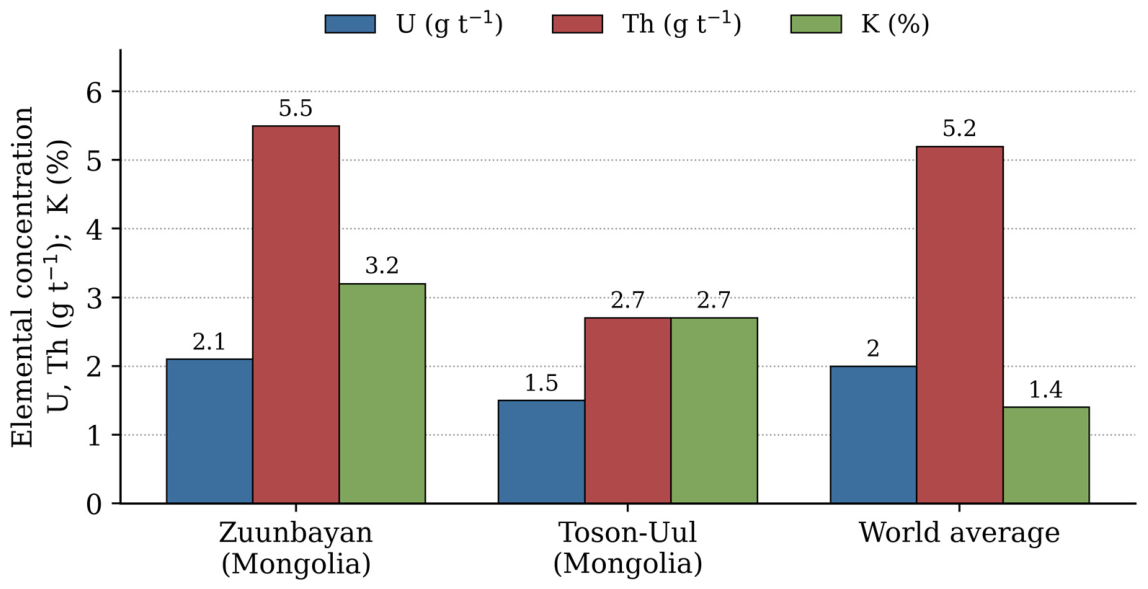
Table 2 compares the mean activity concentrations measured in the soils of the Zuunbayan and Toson-Uul fields with the values reported for other countries and with the world average. Table 3 presents the corresponding elemental concentrations of U, Th and K together with the calculated absorbed dose rates and annual effective doses.
Table 2.
Specific activities of the radionuclides in soil, compared with values reported for other countries and with the world average.
Table 3.
Elemental concentrations of U, Th and K, absorbed dose rate and annual effective dose, compared with the world average.
For 226Ra, the mean specific activity in the Zuunbayan field is approximately 25 Bq/kg, which is close to the world average, whereas in the Toson-Uul field it is 17.9 Bq/kg, that is, 1.4 times lower than the world average.
For 232Th, the mean specific activity in the Zuunbayan field is approximately 23 Bq/kg, again close to the world average, whereas in the Toson-Uul field it is 18.9 Bq/kg, that is, 1.3 times lower than the world average.
For 40K, the mean specific activity in the Zuunbayan field is 964 Bq/kg, that is, 2.6 times higher than the world average, and in the Toson-Uul field it is 795.6 Bq/kg, that is, 2.1 times higher than the world average.
For the anthropogenic radionuclide 137Cs, the mean activity concentration is 17 Bq/kg in the Zuunbayan field (1.5 times lower than the world average) and 12 Bq/kg in the Toson-Uul field (2.3 times lower than the world average). The fact that the 137Cs levels are below the world average suggests that the surface soil has been affected by erosion or degradation.
4.2. Absorbed Dose Rate and Annual Effective Dose
The absorbed gamma dose rate calculated at the height of the human respiratory tract reached a maximum of 66 (nGy/h) in the Zuunbayan field, that is, 1.5 times the world average. For the Toson-Uul field the corresponding value was 52.8 (nGy/h), that is, 1.2 times the world average.
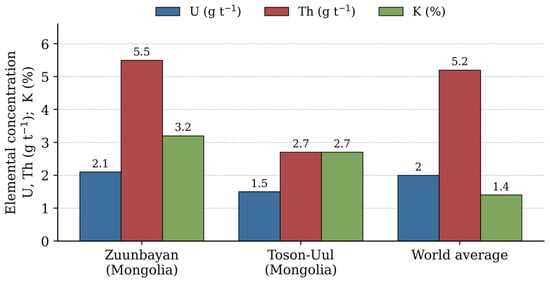
The annual effective dose for the population of these exploration areas was calculated to be 539 μSv/y for the Zuunbayan field (1.1 times higher than the world average) and 421 μSv/y for the Toson-Uul field (1.1 times lower than the world average). The elemental concentrations of U, Th and K in the two fields are compared with the world averages in Figure 1.
Figure 1.
Comparison of the elemental concentrations of U (g/t), Th (g/t) and K (%) in the soils of the Zuunbayan and Toson-Uul fields with the corresponding world averages.
4.3. Physical and Chemical Properties of the Crude Oil
The paraffin, resin and asphaltene contents of the crude oils from the Zuunbayan and Toson-Uul fields are presented in Table 4.
Table 4.
Comparison of the physical and chemical properties of the crude oils from the Zuunbayan and Toson-Uul fields [3].
As shown in Table 4, the specific gravity at 20 °C of the Toson-Uul crude oil ranges from 0.8268 to 0.8596 g/cm3, whereas that of the Zuunbayan crude oil lies between 0.8800 and 0.9170 g/cm3.
The solid-paraffin content of the Toson-Uul crude oil ranges from 10.6 to 33.1% (by weight), with a mean value of 21.85% (by weight).
The asphaltene content ranges from 1.6 to 3.6% (by weight) for the Zuunbayan crude oil and from 0.12 to 2.1% (by weight) for the Toson-Uul crude oil, whereas the resin content is 15.7–31.2% and 3.1–11.5% (by weight), respectively.
Because both the density and the contents of asphaltenes and resinous substances are comparatively low in the Toson-Uul field, it is likely that the concentration of radioactive elements in that field is correspondingly low [4,16].
5. Conclusions
- On the basis of the measured activity concentrations of the natural radionuclides, the absorbed gamma dose rate calculated at the height of the human respiratory tract (1 m above the ground) reached a maximum of 66 (nGy/h) in the Zuunbayan field, that is, 1.5 times the world average. For the Toson-Uul field, the dose rate was 52.8 (nGy/h), that is, 1.2 times the world average.
- A comparison of the petroleum properties of the two fields shows that the crude oil of the Zuunbayan field has a higher density and a considerably higher content of asphaltenes and resinous substances. In line with general scientific trends, the concentration of the associated radioactive elements may therefore be higher than in the Toson-Uul field. Furthermore, the Zuunbayan field was operated from 1950 to 1969, then suspended and resumed in the 1990s, and it remains in operation today, whereas exploration and extraction at the Toson-Uul field began only in 1994. The differences in radioactivity levels between the two fields may therefore also be related to the duration of field exploitation.
- The oil-bearing reservoir rocks consist mainly of sand, sandstone, argillaceous shale (clay shale) and carbonate rocks. In these rock types, the specific activity of 226Ra (238U) ranges from 10 to 44 Bq/kg (mean 25.75 Bq/kg), that of 232Th from 7 to 48 Bq/kg (mean 25 Bq/kg) and that of 40K from 90 to 700 Bq/kg. The background radiation level in the vicinity of the oil fields depends on the specific type of reservoir rock, which may give rise to elevated radiation exposure.
Author Contributions
Conceptualization, E.M. and A.V.; methodology, E.M.; formal analysis, E.M. and D.C.; investigation, E.M., A.V. and P.N.; resources, A.V.; data curation, P.N.; writing—original draft preparation, E.M.; writing—review and editing, A.V. and D.C.; visualization, D.C.; supervision, A.V. All authors have read and agreed to the published version of the manuscript.
Funding
This research received no external funding.
Institutional Review Board Statement
Not applicable.
Informed Consent Statement
Not applicable.
Data Availability Statement
The data presented in this study are available on request from the corresponding authors.
Acknowledgments
The authors thank the Nuclear Research Centre of the National University of Mongolia for providing access to the gamma-ray spectrometry facilities.
Conflicts of Interest
The authors declare no conflicts of interest.
Abbreviations
The following abbreviations are used in this manuscript:
| NORM | Naturally occurring radioactive material |
| HPGe | High-purity germanium |
| NUM | National University of Mongolia |
| PSA | Production Sharing Agreement |
| UNSCEAR | United Nations Scientific Committee on the Effects of Atomic Radiation |
References
- Byamba, D.; Mironov, Y.B.; Jamsrandorj, G. Geodynamics and the Relationship of Uranium Metallogeny in Mongolia; Soyombo Printing: Ulaanbaatar, Mongolia, 2025; pp. 9–18. [Google Scholar]
- International Atomic Energy Agency. Radiation Protection and the Management of Radioactive Waste in the Oil and Gas Industry; Safety Reports Series No. 34; IAEA: Vienna, Austria, 2003. [Google Scholar]
- Alimaa, V. Influence of Depth-Related Factors on Crude Oil Properties (Case Study of the Toson-Uul and Zuunbayan Fields); Mongolian University of Science and Technology: Ulaanbaatar, Mongolia, 2008. [Google Scholar]
- Erdenetuya, M.; Alimaa, V.; Jamba, T. Radioactive isotopes of Toson-Ula basin of Mongolia. AIP Conf. Proc. 2018, 2051, 020075. [Google Scholar] [CrossRef] [Scilit]
- United Nations Scientific Committee on the Effects of Atomic Radiation. Sources and Effects of Ionizing Radiation, UNSCEAR 2000 Report to the General Assembly, Volume I: Sources, Annex B; United Nations: New York, NY, USA, 2000. [Google Scholar]
- Guidotti, L.; Carini, F.; Rossi, R.; Gatti, M.; Cenci, R.M.; Beone, G.M. Gamma-spectrometric measurement of radioactivity in agricultural soils of the Lombardia region, northern Italy. J. Environ. Radioact. 2015, 142, 36–44. [Google Scholar] [CrossRef] [Scilit]
- Alshahri, F.; El-Taher, A. Investigation of natural radioactivity levels and evaluation of radiation hazards in residential-area soil near a Ras Tanura refinery, Saudi Arabia. Pol. J. Environ. Stud. 2019, 28, 25–34. [Google Scholar] [CrossRef] [Scilit]
- El Samad, O.; Baydoun, R.; Nsouli, B.; Darwish, T. Determination of natural and artificial radioactivity in soil at North Lebanon province. J. Environ. Radioact. 2013, 125, 36–39. [Google Scholar] [CrossRef] [Scilit]
- Abd El-Mageed, A.I.; El-Kamel, A.H.; Abbady, A.; Harb, S.; Youssef, A.M.M.; Saleh, I.I. Assessment of natural and anthropogenic radioactivity levels in rocks and soils in the environments of Juban town in Yemen. Radiat. Phys. Chem. 2011, 80, 710–715. [Google Scholar] [CrossRef] [Scilit]
- Al-Masri, M.S.; Amin, Y.; Hassan, M.; Ibrahim, S.; Khalili, H.S. External gamma-radiation dose to Syrian population based on the measurement of gamma-emitters in soils. J. Radioanal. Nucl. Chem. 2006, 267, 337–343. [Google Scholar] [CrossRef] [Scilit]
- Mostafa, A.M.A.; Uosif, M.A.M.; Elsaman, R.; Alrowaili, Z.A.; Moustafa, E. The dependence of natural radioactivity levels and its radiological hazards on the texture of agricultural soil in Upper Egypt. Environ. Earth Sci. 2020, 79, 228. [Google Scholar] [CrossRef] [Scilit]
- Dizman, S.; Korkmaz Görür, F.; Keser, R.; Görür, O. The assessment of radioactivity and radiological hazards in soils of Bolu province, Turkey. Environ. Forensics 2019, 20, 211–218. [Google Scholar] [CrossRef] [Scilit]
- Taşkın, H.; Yeşilkanat, C.M.; Kobya, Y.; Çevik, U. Evaluation and mapping of radionuclides in the terrestrial environment and health hazard due to soil radioactivity in Artvin, Turkey. Arab. J. Geosci. 2018, 11, 729. [Google Scholar] [CrossRef] [Scilit]
- Ivanić, M.; Fiket, Ž.; Medunić, G.; Furdek Turk, M.; Marović, G.; Senčar, J.; Kniewald, G. Multi-element composition of soil, mosses and mushrooms and assessment of natural and artificial radioactivity of a pristine temperate rainforest system (Slavonia, Croatia). Chemosphere 2019, 215, 668–677. [Google Scholar] [CrossRef] [Scilit]
- Kadiri, S.; Dizman, S.; Yeşilkanat, C.M.; Aliu, H.; Hodolli, G. Radioactivity in soils of Kosovo and radiological implications. Appl. Sci. 2022, 12, 9520. [Google Scholar] [CrossRef] [Scilit]
- Erdenetuya, M.; Alimaa, V.; Norov, N. Natural radiation background in some petroleum fields of Mongolia. In Proceedings of the 11th International Forum on Strategic Technology (IFOST 2016), Novosibirsk, Russia, 1–3 June 2016. [Google Scholar]

Disclaimer/Publisher’s Note: The statements, opinions and data contained in all publications are solely those of the individual author(s) and contributor(s) and not of MDPI and/or the editor(s). MDPI and/or the editor(s) disclaim responsibility for any injury to people or property resulting from any ideas, methods, instructions or products referred to in the content. |
© 2026 by the authors. Licensee MDPI, Basel, Switzerland. This article is an open access article distributed under the terms and conditions of the Creative Commons Attribution (CC BY) license.