


Abstract
This paper uses the LOCUST program to perform simulation calculations on the steady-state operating conditions of the primary loop and steam generator of the Qinshan Nuclear Power Plant. By comparing the simulation results with the actual operating parameters, the accuracy and reliability of the LOCUST program in simulating the primary loop of the nuclear reactor are verified. In this study, the focus is mainly on the simulation accuracy of the LOCUST program for parameters such as pressure and temperature in the primary loop. The simulation results show that the LOCUST program can accurately simulate and calculate all processes and operating parameters of the primary loop of the nuclear reactor and the steam generator under steady-state operation.
1. Introduction
The primary reactor loop and steam generator are key components of the thermal cycle in a nuclear reactor. Heat generated by the reactor core is transferred to the coolant of the primary loop, then transmitted to the secondary side through the heat transfer tubes of the steam generator, and finally converted into electrical energy in the steam turbine. In the process of simulation, people often focus on the changes in thermohydraulic parameters of the primary loop and steam generator.
At present, there are many system simulation programs available on the market. For instance, RELAP5 is an excellent program that has undergone numerous validations and is now widely used in various fields. For example, the simulation of steam generators with different structures and strategies using RELAP5 provides schemes and data for improving the heat exchange performance of steam generators [1]. Meanwhile, there have also been optimizations made to the calculation of the RELAP5 program for specific or important physical phenomena, enabling it to yield more accurate calculation results under special operating conditions [2]. With the development of Generation IV reactors, RELAP5 is also being developed and researched for different coolant working fluids [3].
LOCUST is a system simulation program developed by the China General Nuclear Power Group. Compared with RELAP5, the LOCUST simulation program has a relatively late start. At present, LOCUST has simulated some accident conditions and passed verification by several institutions [4]. This paper conducts simulation calculations on the primary loop and steam generator of the Qinshan Nuclear Power Plant, and verifies the accuracy and reliability of the LOCUST program further by comparing the calculation results with the actual operation data.
2. Modeling and Design Parameters
The commonly used components of LOCUST can be divided into the following categories: hydraulic components for simulating coolant flow, thermal components for simulating heat transfer surfaces, and signal modules for simulating reactor control signals. Among these, the two-fluid model is adopted in hydraulic components to calculate the mass, momentum and energy conservation of the two phases.
The conservation equations used in the software calculation are as follows:
Mass conservation equation:
In the formula, the subscript p represents the gas phase g or the liquid phase l; is the cross-sectional fraction of the gas phase or liquid phase; is the density; is the velocity; is the area of the control volume; and is the generation rate per unit volume of the gas phase or liquid phase.
Momentum conservation equation:
In the formula, P represents pressure; B represents the volume force term; and are the friction coefficients between the wall and the interface; is the velocity difference between the interface and the interface; is the velocity difference between the gas and liquid phases; C is the virtual mass force coefficient; is the mixed density; and is the additional force caused by translation and rotation.
Energy conservation equation:
In the formula, U represents internal energy; and are the heat transfer rates between the wall and the phase; and are the phase velocity rates of the main flow and the near-wall region respectively. and represent the heat transfer terms related to phase change; represents the energy dissipation caused by wall friction and pump operation.
2.1. Model Simplification and Node Division
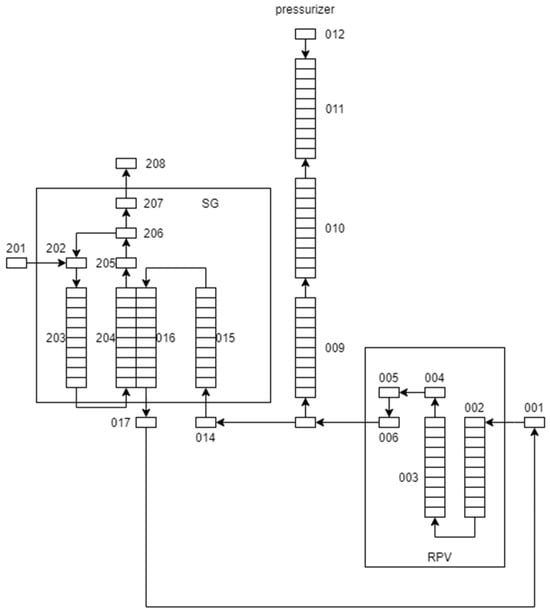
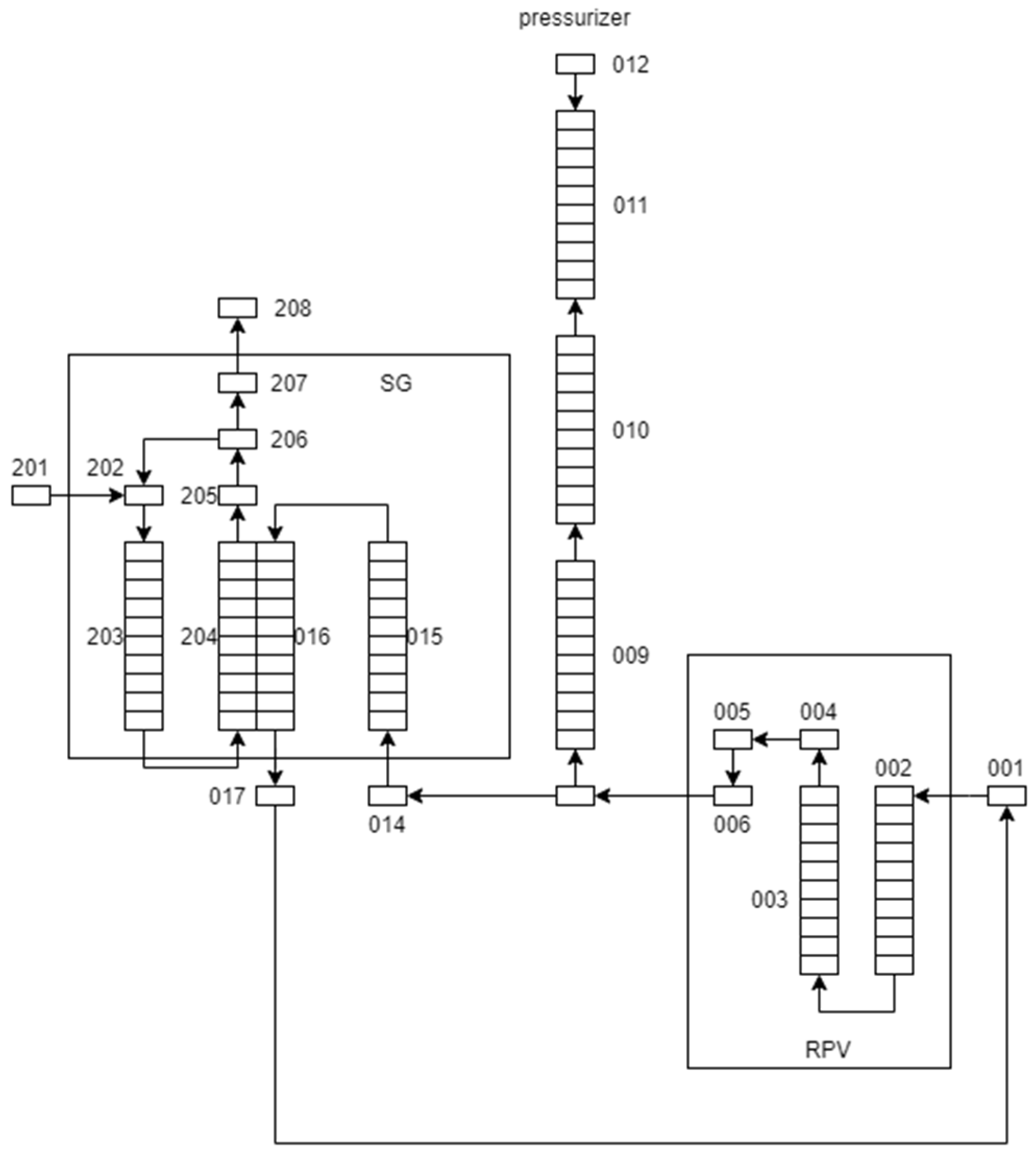
During the simulation of the primary loop and steam generator of the Qinshan Nuclear Power Plant using the LOCUST program, a total of three loops were modeled, consisting of the following components: reactor core, primary loop coolant pipes, primary loop pressurizer, primary loop coolant pumps, and steam generators. The node schematic diagram of the overall model is shown in Figure 1.
Figure 1.
Schematic diagram of nodes in the primary circuit and steam generator.
The control volume division and flow process of the reactor core are as follows: starting from control volume No. 001, the coolant enters the reactor pressure vessel, flows through the 002 downcomer annulus between the reactor core and the pressure vessel, then passes through the 003 fuel rod region of the reactor core where it is heated and rises, and finally flows out of the reactor core region. In the process of dividing the control volumes, the bypass flow passing through the top of the reactor pressure vessel and the leakage flow were omitted. This part of the flow accounts for 6.5% of the total reactor core flow rate. To reduce this error, it was considered that the bypass flow at the top of the pressure vessel accounts for the largest proportion of this flow. After passing through the top of the pressure vessel, this bypass flow mixes with the coolant flowing through the fuel rods before flowing out of the reactor pressure vessel. Therefore, this part of the bypass flow was incorporated into the flow rate passing through the fuel rod region, thereby making the outlet temperature of the reactor pressure vessel closer to the actual temperature.
The reactor pressurizer was simulated using the following control volumes: 009 pressurizer bottom heating zone, 010 pressurizer shell, and 011 pressurizer upper saturated steam and spray zone.
The steam generator was divided into two parts in total. One part was the primary loop zone, which was simulated with the following control volumes: 014 primary-side inlet of the steam generator lower head, 015 U-tube riser section, 016 U-tube downcomer section, and 017 primary-side outlet of the lower head. As for the secondary loop, cold makeup water entered the steam generator through 201 and mixed with the water separated by the steam-water separator at 202 and 206. The mixture then flowed into 203 steam generator downcomer channel, reached the bottom, and rose upward through the U-tube bundle zone in the middle, where heat exchange took place with the primary loop coolant through the U-tubes. After being heated up, steam was generated and reached 205 steam-water mixing space, and then passed through the 206 steam-water separator. The steam fraction entered the main steam system 208 via 207 saturated steam space, while the remaining saturated water mixed with the makeup water at 202.
Detailed data of the reactor modeling are presented in Table 1.
Table 1.
Main parameters of Qinshan Nuclear Power Plant primary circuit and steam generator.
2.2. Simulation Operation and Model Improvement
The above parameters and model control volume division information were input into the program via the input file. The program was run for a certain period until the parameters stabilized, after which the data results were exported and compared with the actual operating parameters. The following aspects were respectively verified:
- Whether the division of model control volumes is reasonable and can simulate well the structure and working principle of the entire primary reactor loop and steam generator;
- Whether the program can perform stable and accurate simulation for steady-state operating conditions;
- Whether different initial parameters will affect the simulation results of the program.
During the simulation with LOCUST, it was found that the steam-water separator of the steam generator is actually a two-stage structure in practice, but the entire process can be realized by simplifying it into a single-stage steam-water separator in the simulation. In contrast to the scheme of setting two steam-water separators with a virtual space between them, which also requires adjusting the height imbalance caused by the virtual space in the circulation loop, simplifying it into a single-stage steam-water separator can reduce the amount of code and program running time on the premise of ensuring the accuracy of results.
3. Simulation Results and Analysis
The same simulation results were obtained when conducting simulations with different initial temperatures of 290 °C, 300 °C, 310 °C, and 320 °C. The simulation results of LOCUST are shown in Table 2 below.
Table 2.
Comparison between simulation results and actual results.
It can be seen that the overall simulation results have a small deviation from the actual design values, with all errors within 1%.
4. Conclusions
In summary, the LOCUST system simulation program can accurately simulate the steady-state operating conditions of the primary coolant circuit and steam generator of the Qinshan Nuclear Power Plant. Moreover, the simulation results are not affected by the initial temperature assignment of the program. There are two directions for future work: on the one hand, the model can be further refined to reduce the simulation error; on the other hand, attempts can be made to introduce standard accident sequences, and through accident simulation, verify whether LOCUST can accurately simulate the changes in important parameters such as temperature and pressure in the reactor primary coolant circuit and steam generator throughout the accident conditions.
Author Contributions
Conceptualization, H.W. and P.G.; methodology, H.W.; software; validation, H.W., P.G.; formal analysis, H.W. and P.G.; investigation, H.W.; resources, H.W.; data curation, H.W.; writing—original draft preparation, H.W.; writing—review and editing, H.W.; visualization, H.W.; supervision, P.G.; project administration, P.G.; funding acquisition, P.G. All authors have read and agreed to the published version of the manuscript.
Funding
This research received no external funding.
Institutional Review Board Statement
Not applicable.
Informed Consent Statement
Not applicable.
Data Availability Statement
The dataset is available upon request from the authors.
Conflicts of Interest
The authors declare no conflicts of interest.
References
- Huang, Z.; Wang, X.; Li, Z.; Liu, H.; Chen, D. Analysis of Heat Transfer Characteristics of Steam Generator with Axial Economizer Based on RELAP5. Nucl. Power Eng. 2025, 46, 118–124. [Google Scholar] [CrossRef]
- Wang, X.; Zhao, P.; Ye, T.; Xiong, Y.; Tan, C.; Chen, Y. Research on Correction Method of Pressure Spike at Gas-Liquid Interface Crossing Cells Based on RELAP5. Nucl. Power Eng. 2024, 45, 34–40. [Google Scholar] [CrossRef]
- Song, S.; Cheng, M.; Lin, M.; Dai, Z. Development and application of multi-scale thermal fluid coupling program for molten salt cooled fast reactor based on RELAP5 and sub-channel program. Nucl. Tech. 2022, 45, 070602. [Google Scholar]
- Li, J.; Wang, T.; Lu, H.; Zhu, Y.; Cai, L.; Yuan, H.; Wang, C.; Chen, Z.; Yang, Y.; Zhu, Y. Decelopment and Progress of the PWR Core Design and Safety Analysis Software Package: NATENE. Nucl. Power Eng. 2026, 47, 1–16. [Google Scholar] [CrossRef]

Disclaimer/Publisher’s Note: The statements, opinions and data contained in all publications are solely those of the individual author(s) and contributor(s) and not of MDPI and/or the editor(s). MDPI and/or the editor(s) disclaim responsibility for any injury to people or property resulting from any ideas, methods, instructions or products referred to in the content. |
© 2026 by the authors. Licensee MDPI, Basel, Switzerland. This article is an open access article distributed under the terms and conditions of the Creative Commons Attribution (CC BY) license.