


Abstract
Chronic kidney disease (CKD) necessitates ongoing dietary self-management; nevertheless, numerous patients have challenges in comprehending and implementing nutritional guidelines in their daily routines. This research introduces a mobile tutoring prototype utilizing a hybrid computational intelligence framework for dietary recommendations and health literacy assistance in CKD. The suggested methodology adheres to a Knowledge Discovery in Databases pipeline that includes data selection, preprocessing, transformation, data mining, evaluation, and software integration. The predictive core integrates a long short-term memory (LSTM) model with a neutrosophic adjustment layer to simultaneously tackle temporal dynamics and uncertainty in patient-related data. The system employs clinically pertinent nutritional and health metrics, encompassing salt and potassium consumption, body mass, hydration status, blood pressure, creatinine levels, glomerular filtration rate, and urinary protein. In the initial assessment, the hybrid model surpassed independent methods, attaining 92% precision, whereas the separate LSTM and neutrosophic methods achieved 87 and 78%, respectively. The model was incorporated into a mobile-centric architecture utilizing Fast Application Programming Interface, TensorFlow, Numerical Python, Structured Query Language + Alchemy to produce customized dietary recommendations. The results of this study contribute a proof-of-concept intelligent recommender for chronic kidney disease self-care, integrating sequential modeling and uncertainty management within a unified framework. The results are regarded as preliminary due to the evaluation being conducted in a simulated environment.
1. Introduction
Chronic kidney disease (CKD) is a relevant public health problem that demands long-term treatment adherence and strict dietary control. In this context, patient self-care is strongly influenced by the ability to understand clinical instructions, interpret nutritional restrictions, and make appropriate daily decisions. However, low health literacy and limited access to personalized technological support often reduce the effectiveness of dietary guidance in chronic conditions [1,2].
The difficulty is particularly significant in CKD as dietary control directly influences disease progression and the incidence of complications. Renal patients typically need to manage salt, potassium, protein consumption, hydration, and associated physiological parameters. In Ecuador, CKD is acknowledged as a significant health issue due to its prevalence, death rate, and related healthcare expenses [3,4]. These circumstances necessitate the creation of accessible digital tools that facilitate teaching and decision-making beyond the therapeutic interaction.
In this research, a hybrid computational intelligence architecture was developed by incorporating a mobile instructor for CKD dietary self-management. The system integrates an LSTM model, appropriate for sequential data [5,6], with a neutrosophic adjustment technique that explicitly incorporates indeterminacy and uncertainty into the ultimate recommendation. The developed architecture presents the Knowledge Discovery in Database (KDD)-based development pipeline for a dietary recommendation system in CKD. Second, it proposes a hybrid LSTM–neutrosophic model that combines temporal learning with uncertainty-aware adjustment. Third, it integrates the predictive model into a mobile tutoring prototype that produces personalized dietary recommendations for self-care support.
2. Materials and Methods
2.1. KDD-Based Methodology
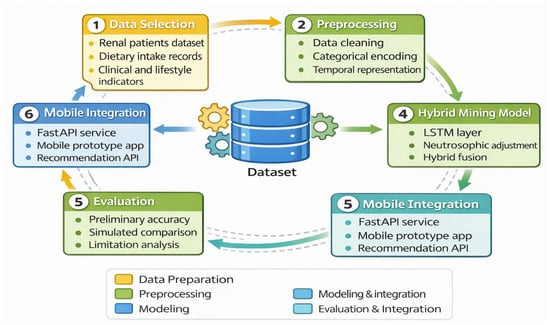
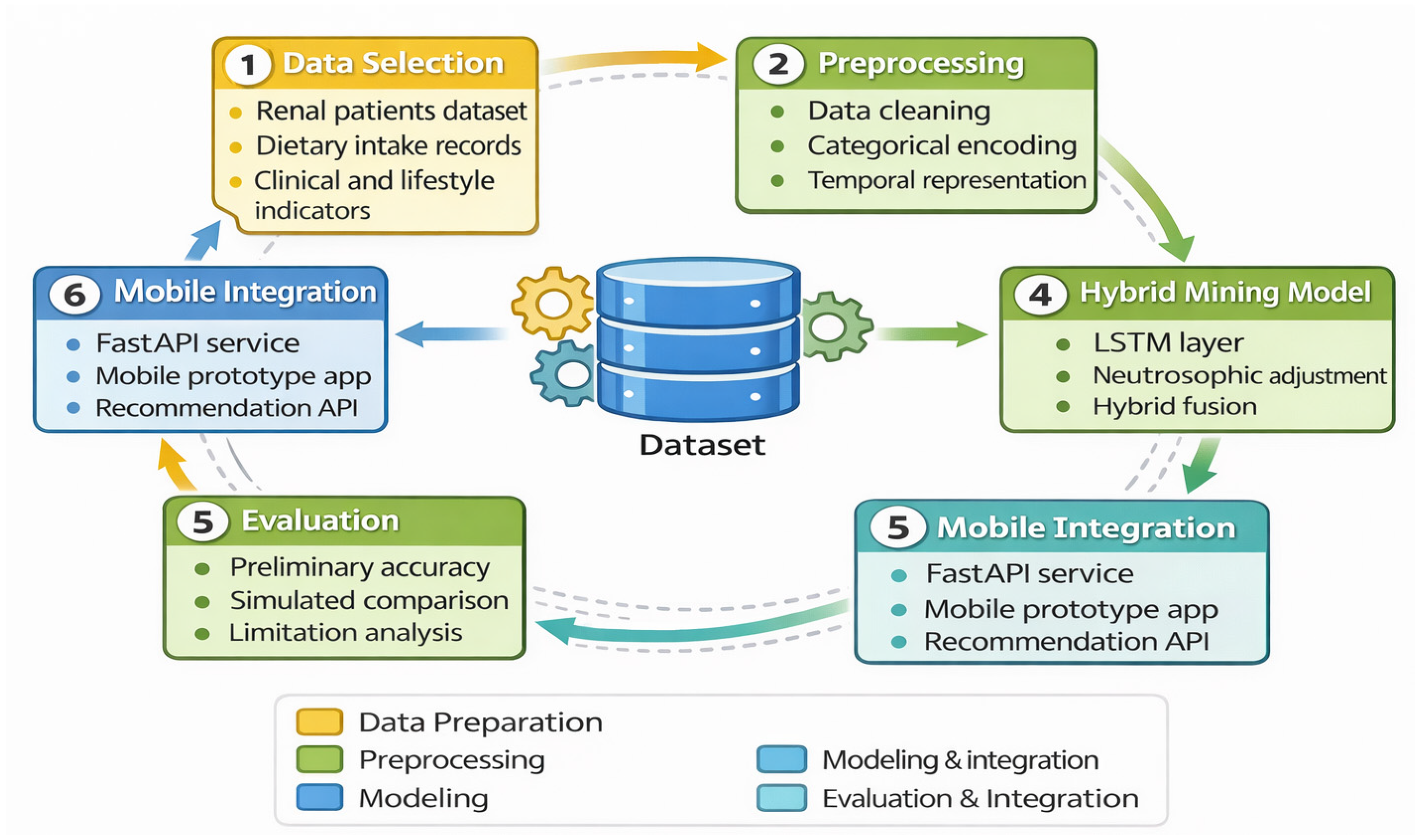
The development process was structured according to the KDD methodology (Figure 1), which provides an iterative framework for knowledge discovery from data [7]. In this study, the process was adapted into five main stages: data selection, preprocessing, transformation, data mining, and interpretation/evaluation, followed by integration into the mobile prototype.
Figure 1.
KDD-based methodology of the developed architecture framework: data selection, preprocessing, transformation, hybrid mining model, evaluation, and mobile integration. Dashed connectors indicate schematic links between the illustrated stages.
In the data selection stage, a custom dataset was built from variables considered relevant for dietary self-care and renal monitoring. The selection logic was implemented through Structured Query Language + Alchemy (SQLAlchemy) queries over patient-detail records. The goal of this stage was to construct a structured input that reflected the nutritional and physiological state of the user.
2.2. Dataset and Variables
The system was designed to analyze clinically pertinent characteristics related to renal dietary control and self-care. The input comprised food indicators including sodium and potassium intake, physiological factors such as body weight and blood pressure, and kidney function markers including creatinine, glomerular filtration rate, and urine protein. Supplementary encoded contextual variables were utilized at the implementation layer. The variables are presented in Table 1 to conform to the compact structure mandated by a conference paper.
Table 1.
Variables of the recommendation framework.
2.3. Preprocessing and Temporal Representation
The preprocessing stage involved data cleaning, categorical encoding, and normalization of numerical values. Categorical variables such as hydration level, dietary protein level, and physical activity were mapped into numerical values to allow model ingestion. Numerical variables were scaled into a consistent range to improve computational stability. Because the LSTM model expects a temporal input, the implementation organized the patient data into a 3D tensor with shape (1, 5, N), where 1 represents a single patient, 5 is the sequence length, and N is the number of features. In the prototype, when fewer than five observations were available for a patient, the implementation replicated the available record five times to satisfy the expected input format. This design allowed the model to run under constrained data availability, but it must be interpreted as an implementation decision rather than a true longitudinal sequence. Accordingly, it is one of the main limitations of the present work.
2.4. Hybrid Predictive Module
The predictive module combines two complementary components: an LSTM model and a neutrosophic adjustment layer. The LSTM model was selected because recurrent neural networks with memory cells are effective for sequential data and for capturing dependencies across time steps [5,6]. LSTM processes the patient sequence and outputs an initial probability associated with health deterioration risk or recommendation urgency.
The second component is neutrosophic. Its role is to refine the initial output by considering truth, falsity, indeterminacy, and uncertainty [8]. In the implementation, indeterminacy is estimated from the variability of the temporal sequence, particularly from differences across observations such as creatinine variation. Uncertainty is estimated from external factors such as hydration and sodium intake. The adjusted probability is computed as
where P is the original model probability, I is indeterminacy, F is falsity, and U is uncertainty.
Padj = P × (1 − I) × (1 − F) × (1 − U),
This fusion strategy is used to preserve the temporal discrimination of LSTM, reducing overconfidence when the input data are ambiguous or unstable. From an application perspective, the hybrid design is intended to make the recommendation layer more robust in heterogeneous clinical scenarios.
2.5. Mobile Prototype Integration
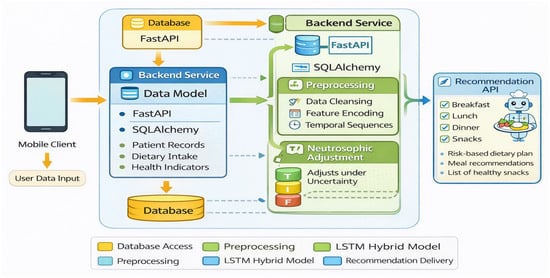
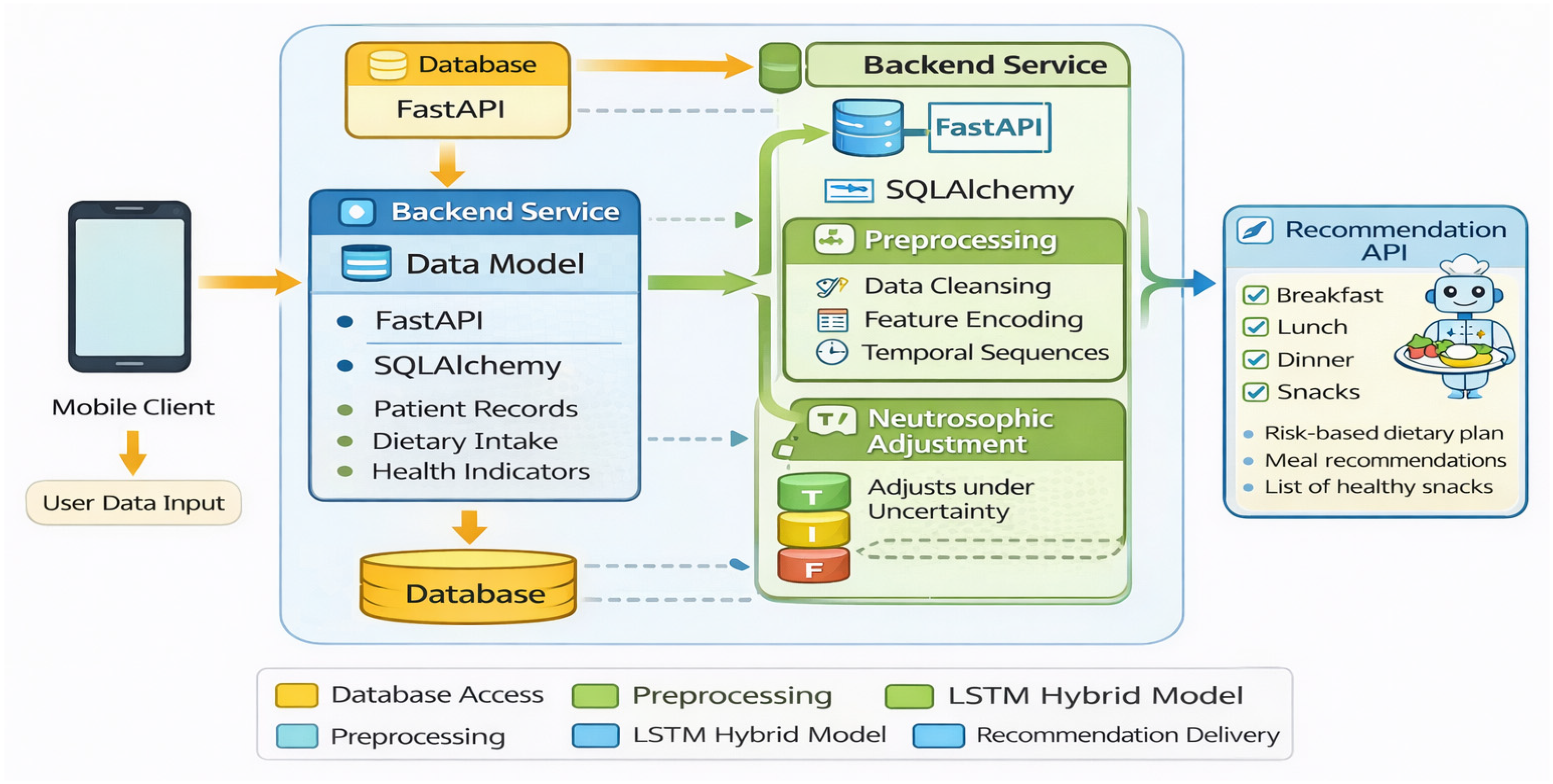
After evaluation, the model was integrated into a software architecture intended for a mobile tutoring application (Figure 2). The implementation imports Fast Application Programming Interface (FastAPI 0.142.4), TensorFlow 2.21.0, Numerical Python (NumPy 2.5.3), and SQLAlchemy 2.1.4, and the domain models required to retrieve patient records and store recommendations. The trained deep learning model is loaded from a serialized .keras file, while SQLAlchemy is used to query patient details and prepare them for inference. A service class named RecommendationsService orchestrates the following process: retrieving user data, converting categorical values, reshaping the input tensor, computing neutrosophic factors, and generating a dietary recommendation. The output logic maps adjusted risk levels to recommendation plans for breakfast, lunch, dinner, and snacks.
Figure 2.
Software architecture of the mobile dietary recommendation prototype, including database access, preprocessing, LSTM inference, neutrosophic adjustment, and recommendation delivery. Dashed connectors denote schematic relationships among the illustrated software components and processing steps.
The interface was designed as an accessible mobile-oriented environment where users can enter their data, view results, and receive personalized dietary guidance.
3. Results
The preliminary evaluation was conducted by comparing a standalone LSTM model, a standalone neutrosophic method, and the proposed hybrid model, with the comparison focusing on precision, sensitivity, and specificity (Table 2).
Table 2.
Reported model performance in the preliminary simulated evaluation. Hybrid metrics were recalculated from the counts reported in Figure 3; the standalone metrics are retained as reported.
The hybrid model showed the best overall performance, surpassing LSTM and neutrosophic baselines in precision, sensitivity, and specificity, indicating stronger discrimination between positive and negative cases in the preliminary evaluation. A confusion matrix was generated for the hybrid model using a simulated evaluation scenario. The reported outcomes were 85 true positives, 97 true negatives, 8 false positives, and 10 false negatives. From these values, the derived metrics were approximately 91.4% precision, 89.5% sensitivity, and 92.4% specificity, which are consistent with the rounded comparison table above.
Figure 3.
Original confusion matrix for the hybrid model in the simulated evaluation (n = 200): TN = 97, FP = 8, FN = 10, and TP = 85. The full image is displayed without cropping.
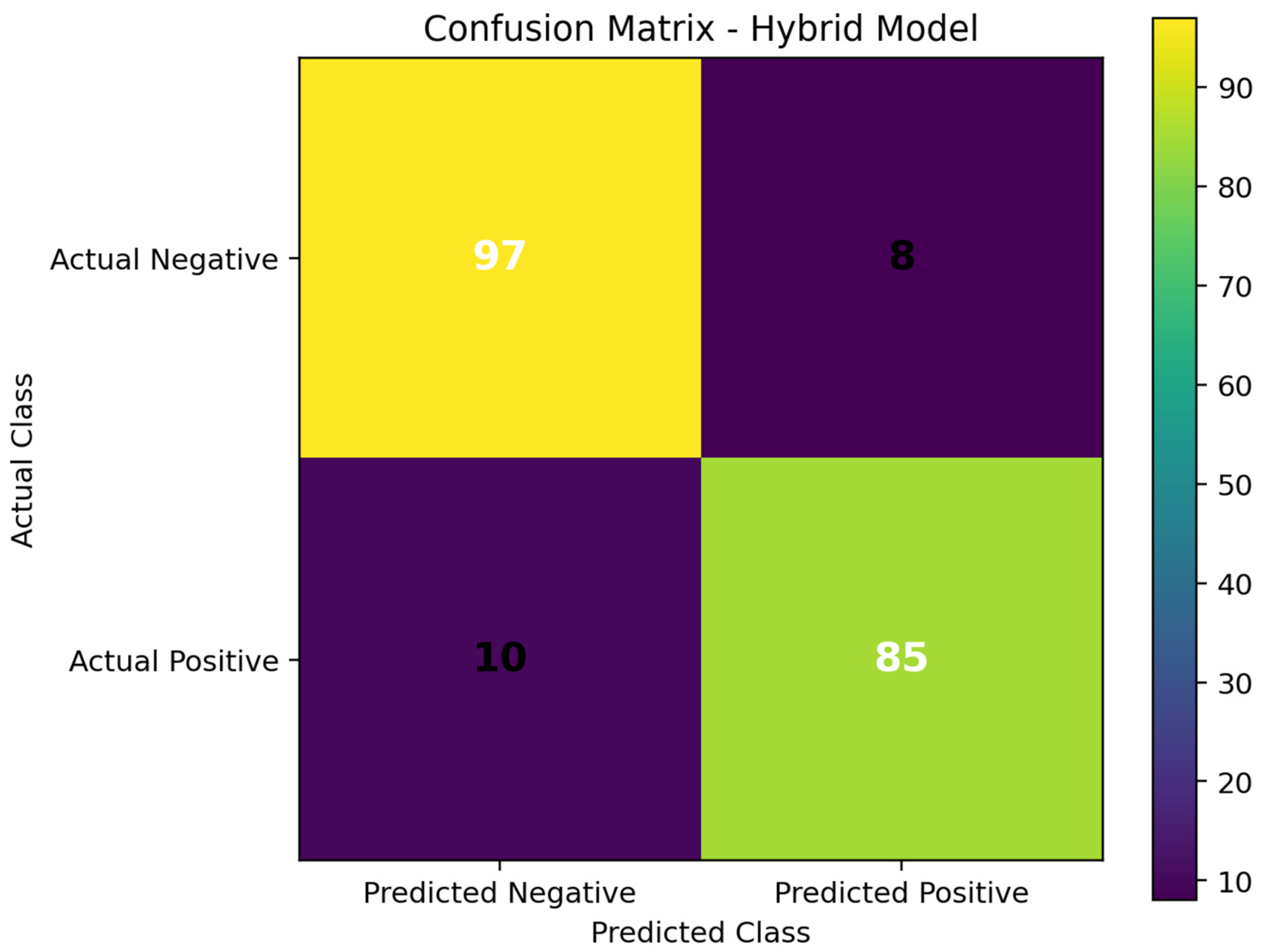
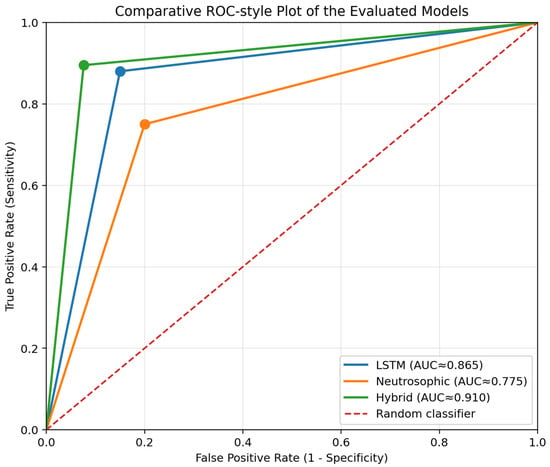
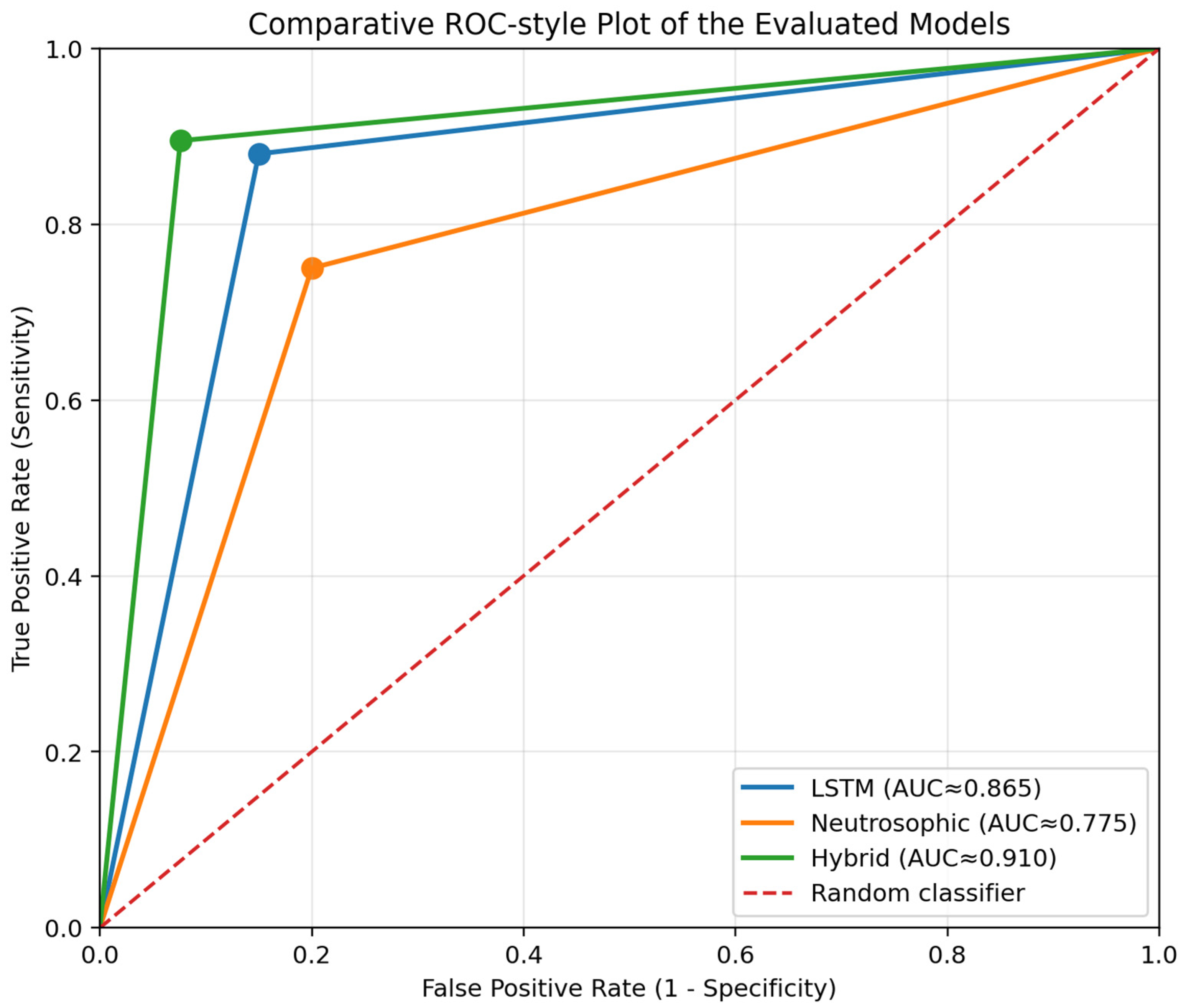
Figure 4 shows the receiver operating characteristic (ROC)–style plot of the evaluated models. The hybrid LSTM–neutrosophic model demonstrated the best balance between sensitivity (true positive rate, TPR) and false positive rate (FPR). It achieved a TPR of 0.895, an FPR of 0.076, and the highest approximate discrimination capacity, expressed as the area under the curve (AUC = 0.910). The standalone LSTM performed well but was lower (AUC = 0.865), whereas the neutrosophic model showed the weakest performance (AUC = 0.775). This reconstructed ROC-style plot is a comparative approximation rather than a full empirical ROC analysis.
Figure 4.
Original illustrative ROC comparison. The approximate AUC labels refer to the illustrated curves; the dashed diagonal represents random classification. The plot is retained as an illustration of the reported comparison.
4. Discussion
By combining LSTM-based temporal modeling with neutrosophic adjustment, the behavior of a dietary recommendation system improves for CKD self-care under uncertain conditions. LSTM contributes sequence-sensitive pattern recognition, whereas the neutrosophic layer moderates the output when the data show variability or ambiguity. This division of roles explains why the hybrid model achieved stronger overall performance than either component used independently.
From a computational intelligence perspective, the developed method does not rely on a purely deterministic interpretation of patient data. Health-related variables are often noisy, incomplete, or context-dependent, particularly in self-reported or partially observed environments. In such cases, a hybrid framework may be more suitable than a single-model design. This is especially relevant for mobile health systems, where data availability can vary significantly across users.
From an engineering perspective, integrating the predictive model into a service-oriented prototype represents an important contribution. The use of FastAPI, TensorFlow, NumPy, and SQLAlchemy shows that the method can be embedded within a practical software pipeline rather than remaining a purely theoretical construct. This enhances the translational value of the work and supports its potential deployment in future digital health applications. In such cases, a hybrid framework may be more suitable than a single-model design [9].
5. Conclusions
We developed a hybrid LSTM–neutrosophic framework integrated into a mobile tutor for dietary recommendation and health literacy support in chronic kidney disease. The work was structured under a KDD-based pipeline and combined clinically relevant variables, sequential modeling, uncertainty-aware adjustment, and software-level deployment in a mobile-oriented architecture. In the preliminary evaluation, the hybrid model outperformed the standalone LSTM and neutrosophic approaches, achieving the best precision, sensitivity, and specificity. Using the developed method, temporal learning and uncertainty management can be combined in a practical recommender for renal self-care support. Even so, the present study presents a limitation. Therefore, it is required to incorporate real longitudinal patient datasets, external validation, user-centered testing, and stronger clinical evaluation protocols. Additional improvements may include richer temporal histories, explainability modules, and security mechanisms for sensitive health data.
Author Contributions
All the authors have contributed to the work presented in this paper. L.V.-C.; L.C.-T.; R.C.-Q.; R.T.-B.; F.P.-B.: conceptualization, methodology, validation, and investigation. All authors have read and agreed to the published version of the manuscript.
Funding
This research was supported in part by Universidad de Guayaquil under Project FCI-21 021-2024, in part by Universidad Bolivariana del Ecuador under PROY-UBE-2024-019.
Institutional Review Board Statement
Not applicable to the simulated computational evaluation reported in this article.
Informed Consent Statement
Not applicable to the simulated evaluation reported in this article; no identifiable individual information is presented.
Data Availability Statement
The aggregate results of the simulated evaluation are included in this article, including the confusion-matrix counts in Figure 3. No case-level dataset or executable implementation is distributed with the article.
Conflicts of Interest
The authors declare no conflicts of interest.
References
- Shah, M.; Ramsbotham, J.; Seib, C.; Muir, R.; Bonner, A. A scoping review of the role of health literacy in chronic kidney disease self-management. J. Ren. Care 2021, 47, 221–233. [Google Scholar] [CrossRef] [Scilit] [PubMed]
- Suetsugu-Ishizawa, R.; Sakuma, H.; Matsuki, M.; Itano, S.; Nagasu, H.; Morinaga, H.; Uchida, H.A.; Kuwabara, T.; Imasawa, T.; Yamada, K.; et al. Efficacy of a mobile health application on self-management among Japanese patients with chronic kidney disease. Clin. Exp. Nephrol. 2025, 29, 1354–1362. [Google Scholar] [CrossRef] [Scilit] [PubMed]
- Kidney Disease: Improving Global Outcomes (KDIGO) CKD Work Group. KDIGO 2024 Clinical Practice Guideline for the Evaluation and Management of Chronic Kidney Disease. Kidney Int. 2024, 105, S117–S314. [CrossRef] [Scilit] [PubMed]
- Parrales-Bravo, F.; Ortiz-Aguilar, W.; Cevallos-Torres, L.; Barzola-Monteses, J.; Caicedo-Quiroz, R. Current situation of serious games to support Ecuadorian health. In Proceedings of the 2025 IEEE 38th International Symposium on Computer-Based Medical Systems (CBMS), Madrid, Spain, 18–20 June 2025; pp. 908–911. [Google Scholar]
- Hochreiter, S.; Schmidhuber, J. Long Short-Term Memory. Neural Comput. 1997, 9, 1735–1780. [Google Scholar] [CrossRef] [Scilit] [PubMed]
- Parrales-Bravo, F.; Caicedo-Quiroz, R.; Tolozano-Benites, E.; Vasquez-Cevallos, L.; Cevallos-Torres, L. STOP: Studying Time-series Of Preeclamptic Emergencies. IEEE Access 2025, 13, 65672–65689. [Google Scholar] [CrossRef] [Scilit]
- Birjandi, S.M.; Khasteh, S.H. A survey on data mining techniques used in medicine. J. Diabetes Metab. Disord. 2021, 20, 2055–2071. [Google Scholar] [CrossRef] [Scilit] [PubMed]
- Ghandehari, M.; Edalatpanah, S.A. The Neutrosophic Approach in Health Crisis Management: Optimal Decision-Making Under Uncertainty and Conflicting Data. Ann. Healthc. Syst. Eng. 2024, 1, 61–71. [Google Scholar] [CrossRef]
- Cevallos-Torres, L.; Núñez-Gaibor, J.; Leyva-Vasquez, M.; Gómez-Rodríguez, V.; Parrales-Bravo, F.; Hechavarría-Hernández, J. NCC: Neutrosophic Control Charts, a didactic way to detect cardiac arrhythmias from reading electrocardiograms. Neutrosophic Sets Syst. 2024, 74, 441–456. Available online: https://fs.unm.edu/nss8/index.php/111/article/view/5520 (accessed on 30 September 2026).

Disclaimer/Publisher’s Note: The statements, opinions and data contained in all publications are solely those of the individual author(s) and contributor(s) and not of MDPI and/or the editor(s). MDPI and/or the editor(s) disclaim responsibility for any injury to people or property resulting from any ideas, methods, instructions or products referred to in the content. |
© 2026 by the authors. Licensee MDPI, Basel, Switzerland. This article is an open access article distributed under the terms and conditions of the Creative Commons Attribution (CC BY) license.