


Abstract
Embodied AI concerns intelligent agents that must perceive, reason, and act in physical environments while reconciling uncertain observations with task-dependent behavioral requirements. In autonomous driving, this challenge appears as the need to integrate probabilistic vehicle dynamics with human-centered driving constraints such as smooth steering, stable lane transitions, and bounded control variation. This study aims to develop a fuzzy-probabilistic factor-graph-based vehicle control method that formulates these two sources of knowledge within a common factorized representation. In the method, probabilistic factors describe predictive consistency of vehicle motion, whereas fuzzy factors encode subjective driving requirements on tracking error, steering behavior, and throttle variation. Based on this representation, control-sequence optimization is performed through particle-based inference, where candidate control sequences are propagated, evaluated, and refined according to the combined influence of probabilistic and fuzzy factors. The developed method is validated in an autonomous-driving simulator under curved-road and lane-change scenarios. Experimental results showed that the method produced smoother steering behavior and yielded more controlled lane-change responses than a proportional–integral–derivative baseline. These results show that the proposed factor-graph-based formulation provides an effective and interpretable approach to autonomous vehicle control. Although this study focuses on autonomous driving, the same formulation can be extended to other embodied AI systems in future work.
1. Introduction
Embodied AI concerns agents that must perceive, reason, and act in physical environments. In autonomous driving, this requirement appears as a control problem that must reconcile two different sources of information: probabilistic vehicle dynamics derived from system modeling and sensing, and human-centered driving requirements such as smooth steering, stable lane transitions, and bounded control variation. In many practical systems, these two aspects are used separately, with probabilistic models used for prediction and tracking, and heuristic rules used to regulate driving behavior. Such a separation often makes the controller difficult to interpret and less robust under uncertainty [1,2,3,4].
In this study, we developed a fuzzy-probabilistic factor graph (FPFG)-based vehicle control method that places vehicle dynamics and driving constraints within a common factorized representation. In the method, probabilistic factors describe predictive consistency of vehicle motion, and fuzzy factors encode subjective driving requirements on tracking error, steering behavior, and throttle variation [5,6,7,8,9]. By expressing both types of knowledge as factors in a unified graph, the control problem can be interpreted as inference over candidate control sequences rather than as the isolated tuning of separate prediction and constraint modules.
To solve this inference problem, we adopt a particle-based method in which each particle represents a candidate control sequence over a finite horizon. The particles are propagated through the vehicle model and evaluated according to the joint influence of probabilistic and fuzzy factors, so that the selected action sequence reflects both dynamic feasibility and driving preference [10,11,12]. This design provides a practical way to perform approximate inference in a nonlinear control setting while preserving a clear interpretation of how different factors shape the final control decision. To develop the method, we formulate vehicle control as a factor-graph inference problem and perform control-sequence optimization through particle-based inference. The method was validated in an autonomous-driving simulator, and the results showed improved steering smoothness and lane-change behavior compared with a proportional–integral–derivative (PID) baseline. Focusing on autonomous driving, the same formulation can be extended to other embodied AI systems, such as robotic manipulators.
The remainder of this article is organized as follows. Section 2 introduces the theoretical foundation of the proposed formulation. Section 3 presents the FPFG-based vehicle control method, including its factorized representation and particle-based inference process. Section 4 reports the autonomous-driving experiments and results. Finally, Section 5 concludes the paper and discusses future work.
2. FPFG for Vehicle Control
A factor graph provides a compact way to represent a complex decision problem as a product of local factors defined on subsets of variables [1,2]. In autonomous vehicle control, this representation is useful because vehicle motion, control inputs, and driving constraints are naturally coupled but not fully dense. Let X denote the variables associated with vehicle states, control variables, and relevant driving quantities. A factorized model is expressed as:
where each factor depends only on a subset . This structure allows heterogeneous sources of information to be described within a common graphical model.
In the proposed formulation, the local factors are divided into two types. The first type is formed by fuzzy constraint factors, which represent subjective driving requirements such as small tracking error, smooth steering adjustment, and limited throttle variation. A fuzzy constraint on a variable subset is represented by a membership function
where larger values indicate better satisfaction of the corresponding driving requirement [5,6,7,8]. These factors provide an interpretable way to encode soft driving preferences without imposing rigid binary constraints.
The second type is formed by probabilistic factors, which describe the objective consistency of vehicle motion under uncertainty. These factors are associated with the predictive vehicle model and related stochastic dependencies, and can be written in factorized form as:
where denotes a nonnegative probabilistic factor and is a normalization constant [3,4]. In the present study, these probabilistic factors are used to characterize vehicle dynamics and prediction consistency over a finite control horizon.
Using the equations, vehicle control is conducted using inference on a unified fuzzy-probabilistic factor graph. Fuzzy factors characterize the extent to which vehicle behavior satisfies driving requirements, whereas probabilistic factors capture what is dynamically plausible within the vehicle model. Together, these complementary representations establish a unified, factorized framework for selecting control sequences by jointly accounting for driving constraints and vehicle dynamics.
3. FPFG-Based Vehicle Control Method
3.1. Factorized Representation of Vehicle Dynamics and Driving Constraints
The developed method in this study formulates autonomous vehicle control within FPFG, where vehicle dynamics and driving constraints are represented as different types of factors in a common model.
Here, denotes the vehicle state at time step , and denotes the control input and denotes a candidate control sequence over a finite horizon of length . The predictive vehicle dynamics are described by probabilistic factors associated with the state transition model that characterizes the dynamic consistency of the predicted vehicle motion. These probabilistic factors express whether a candidate control sequence produces plausible state evolution under the vehicle model.
Driving requirements are represented by fuzzy constraint factors. In this study, the driving-related variables are defined as:
where is the cross-track error, is the velocity error, is the steering angle, is the steering-angle variation, is the throttle command, and is the throttle variation. For each driving variable , a fuzzy membership function is used to describe the degree to which the corresponding driving constraint is satisfied.
For variables preferred to remain close to zero, a Gaussian form is adopted:
where controls the tolerance of the constraint.
For the th driving constraint at prediction step , the satisfaction score is written as
The overall fuzzy satisfaction of a candidate control sequence is defined as
where is the weight of the th constraint and .
To preserve path-following performance, a tracking term is introduced:
where and are weighting coefficients. Based on the fuzzy and probabilistic factors, the control-sequence score is defined as
where and balance driving-constraint satisfaction and tracking accuracy.
Using the equations, probabilistic factors characterize whether the predicted motion is dynamically consistent, whereas fuzzy factors characterize whether the resulting maneuver satisfies the desired driving behavior. Vehicle control is therefore represented as factorized evaluation over candidate control sequences rather than as the isolated treatment of dynamics and constraints.
3.2. Particle-Based Inference for Control-Sequence Optimization
The control problem is solved through particle-based inference on the factorized model. At time step , a set of candidate particles is generated as
where each particle represents a candidate control sequence over the prediction horizon. Each particle is propagated through the vehicle model according to
The resulting predicted trajectory is then evaluated by the factorized score:
Based on these scores, the normalized importance weight of particle is defined as
where is a scaling coefficient. Particles with larger weights correspond to control sequences that better satisfy both dynamic consistency and driving constraints.
After weighting, resampling is applied to concentrate the search on promising candidates. To maintain diversity, Gaussian perturbation is introduced:
where is a zero-mean random perturbation. Through repeated propagation, evaluation, weighting, and resampling, the particle set progressively shifts toward better control-sequence candidates. After the prescribed iterations, the optimal control sequence is selected as:
Following the receding-horizon principle, only the first control input is applied:
This inference procedure provides a practical way to solve the proposed FPFG-based vehicle control problem in a nonlinear setting. Because each particle corresponds to a candidate control sequence, the method can directly evaluate how vehicle dynamics and fuzzy driving constraints jointly influence the final control decision.
4. Results
We evaluated the FPFG-based vehicle control method in an autonomous-driving simulator. The experiments were conducted on steering smoothness and lane-change behavior, with a PID controller used as the baseline for comparison.
4.1. Simulation Environment
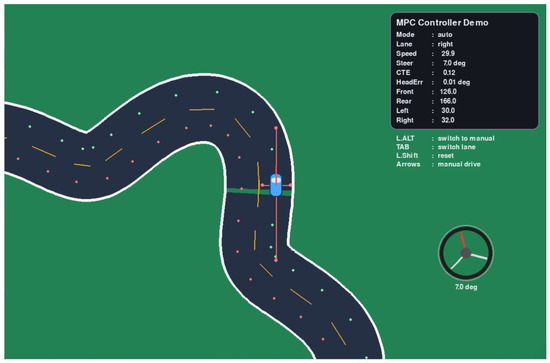
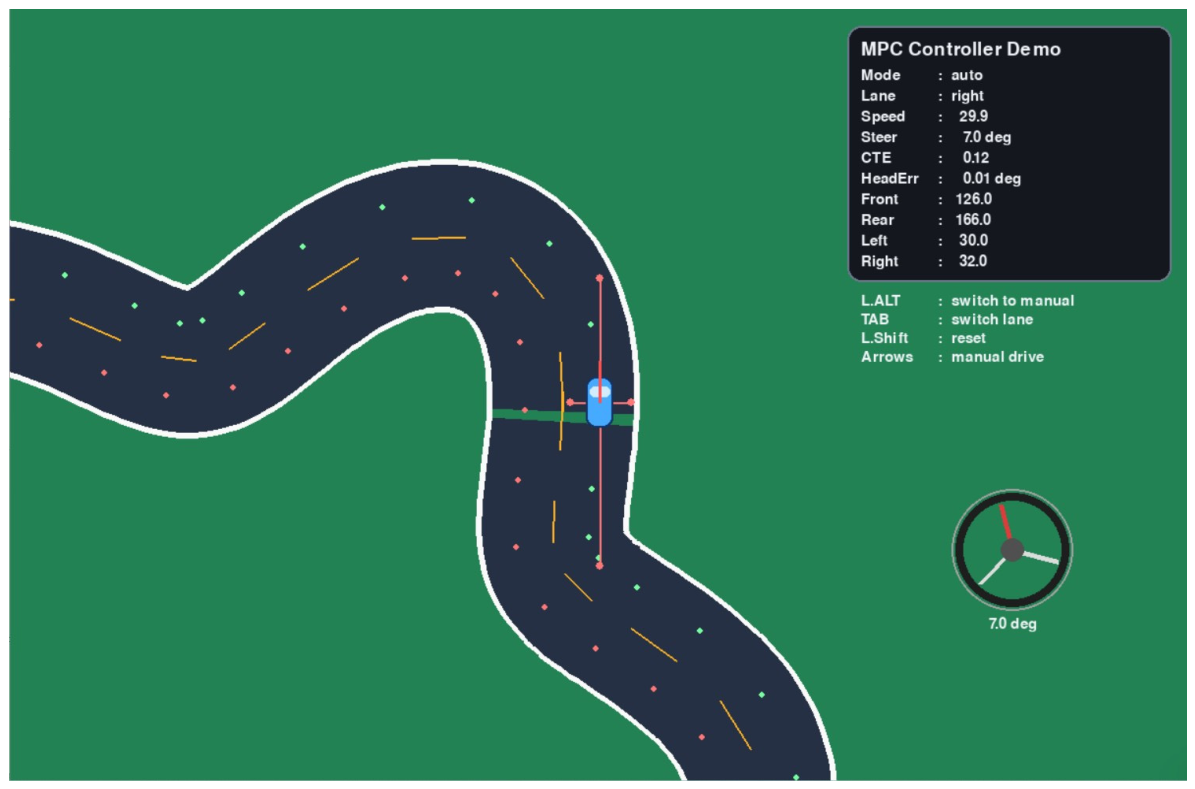
The simulation platform was developed for a curved two-lane road scenario. It provides real-time visualization of vehicle motion and control-related variables, including vehicle speed, steering angle, cross-track error, heading error, and distance to lane boundaries. The proposed controller is implemented using the factorized vehicle-control formulation introduced in Section 3, and its behavior is compared with that of a PID controller under the same driving conditions. Figure 1 shows the simulation interface. The ego vehicle is guided along a curved road segment while the relevant control variables are updated online. This platform is used to examine whether the proposed method can generate smoother and more stable control behavior than the PID baseline.
Figure 1.
Graphical user interface of the developed autonomous-driving simulator. The interface provides real-time visualization of the road geometry, vehicle pose, lane structure, and control-related variables used in the experiments. The white solid lines indicate the road boundaries, the orange dashed lines indicate the lane divider, and the red and green dots represent the reference trajectory points for the left and right lanes, respectively.
4.2. Steering Smoothness Analysis
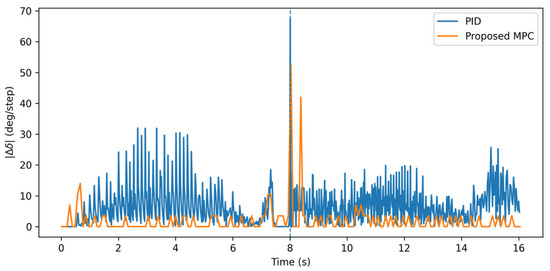
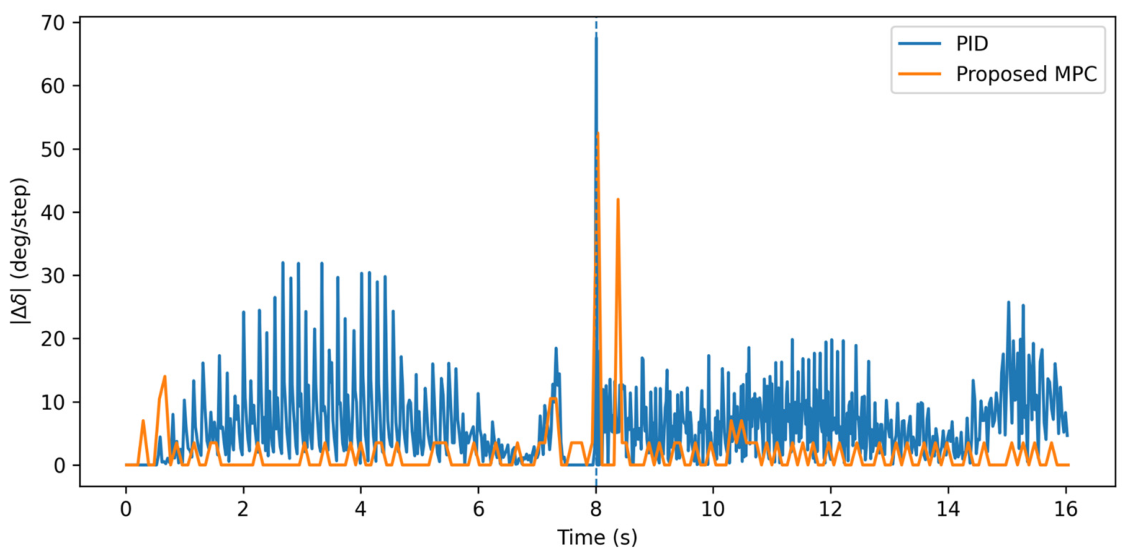
One of the main objectives of the proposed method is to reduce unnecessary steering oscillation during path-following. To evaluate this property, the steering variation in the proposed controller is compared with that of the PID controller. Steering variation is measured by the absolute steering-angle change between consecutive control steps, denoted by . Smaller values of indicate smoother steering behavior.
In the simulation results, the PID controller exhibits more frequent and larger steering fluctuations throughout the curved-road driving process. In contrast, the developed method maintains smaller steering variations over most of the driving interval, except near transient maneuver adjustments. This behavior is consistent with the role of the fuzzy driving constraints, which explicitly favor smoother steering evolution while maintaining path-following performance.
Figure 2 shows that the developed controller produces a smoother steering profile than the PID baseline over most of the simulation period. This result indicates that the factorized integration of fuzzy driving constraints and probabilistic vehicle dynamics can effectively regularize control behavior.
Figure 2.
Comparison of steering variation between the PID controller and the proposed controller. The quantity denotes the absolute steering-angle change between consecutive control steps. The dashed blue and orange lines represent the PID controller and the proposed controller, respectively.
4.3. Lane-Change Response
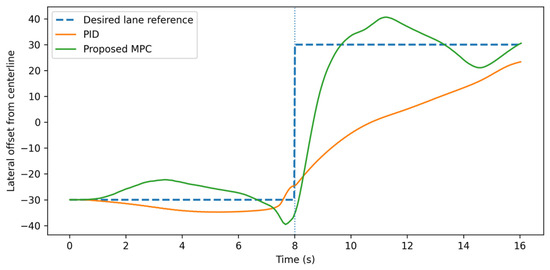
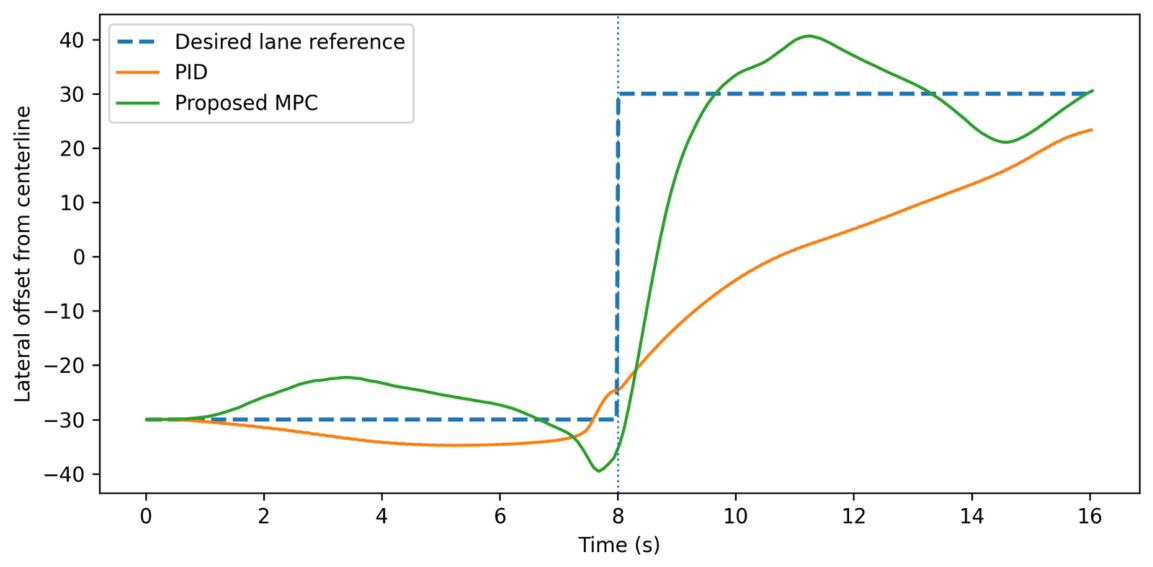
To evaluate maneuver-transition behavior, a lane-change experiment is conducted by switching the desired lane reference during the simulation. After the reference changes, both controllers attempt to guide the vehicle toward the target lane. The proposed method yields a more regulated transition and a less oscillatory response during the maneuver. This result shows that the proposed factor-graph-based control formulation can improve transition smoothness while preserving tracking performance. In particular, the fuzzy constraint factors help suppress abrupt control variation, while the probabilistic vehicle model maintains dynamic consistency during the lane-change process.
Figure 3 shows that both controllers follow the lane-reference change, but the proposed method exhibits a smoother transition with less oscillatory behavior. Together with the steering results in Figure 2, this indicates that the proposed method achieves a better balance between path-following accuracy and driving smoothness.
Figure 3.
Lane-change responses of the PID controller and the proposed controller. The dashed line denotes the desired lane reference, while the solid curves denote the actual vehicle responses.
4.4. Discussion
The developed method reduces steering oscillation compared with the PID baseline. Second, it produces a more stable lane-change response under the same reference-switching condition. Third, the control behavior remains interpretable because the contributions of probabilistic vehicle dynamics and fuzzy driving conditions are explicitly represented within the same factorized framework. Although the present evaluation is primarily qualitative, the results consistently show that the proposed FPFG-based vehicle control method improves steering smoothness and lane-change behavior in the tested driving scenario. These findings support the effectiveness of representing vehicle dynamics and driving constraints within a unified factor-graph formulation and solving the resulting control problem through particle-based inference.
5. Conclusions
We developed an FPFG-based vehicle control method that unifies probabilistic vehicle dynamics and fuzzy driving constraints within a common factor-graph formulation. In the proposed method, probabilistic factors describe the dynamic consistency of predicted vehicle motion, while fuzzy factors represent driving requirements such as smooth steering, stable lane transitions, and bounded control variation. Based on this representation, vehicle control is formulated as inference over candidate control sequences. To solve the resulting control problem, we adopted a particle-based inference procedure in which candidate control sequences are propagated, evaluated, and refined according to the combined influence of probabilistic and fuzzy factors. This formulation provides an interpretable way to connect vehicle dynamics with human-centered driving preferences in a single control framework. The simulation results showed that the method presented smoother steering behavior and more regulated lane-change responses than a PID baseline in the tested driving scenario. These results support the effectiveness of the created formulation for autonomous vehicle control and indicate that the integration of fuzzy and probabilistic factors can improve both control quality and interpretability.
Although this study focused on autonomous driving, the same formulation can be applied to other embodied AI systems in future work. Possible directions include more quantitative evaluation under diverse traffic conditions, richer fuzzy constraint design, and adaptation of the proposed factor-graph formulation to other robotic platforms such as manipulators.
Author Contributions
Conceptualization, R.-A.L., H.-Y.C. and Y.-Y.C.; methodology, R.-A.L. and Y.-Y.C.; validation, R.-A.L. and Y.-Y.C.; writing—original draft preparation, R.-A.L. and Y.-Y.C.; writing—review and editing, H.-Y.C.; supervision, H.-Y.C. and Y.-Y.C. All authors have read and agreed to the published version of the manuscript.
Funding
This research received no external funding.
Institutional Review Board Statement
Not applicable.
Informed Consent Statement
Not applicable.
Data Availability Statement
The data presented in this study are available on request from the corresponding author.
Conflicts of Interest
The authors declare no conflict of interest.
References
- Kschischang, F.R.; Frey, B.J.; Loeliger, H.A. Factor Graphs and the Sum-Product Algorithm. IEEE Trans. Inf. Theory 2001, 47, 498–519. [Google Scholar] [CrossRef] [Scilit]
- Pearl, J. Probabilistic Reasoning in Intelligent Systems: Networks of Plausible Inference; Morgan Kaufmann: Burlington, MA, USA, 1988. [Google Scholar]
- Bishop, C.M. Pattern Recognition and Machine Learning; Springer: New York, NY, USA, 2006. [Google Scholar]
- Murphy, K.P. Machine Learning: A Probabilistic Perspective; MIT Press: Cambridge, MA, USA, 2012. [Google Scholar]
- Zadeh, L.A. Fuzzy Sets. Inf. Control 1965, 8, 338–353. [Google Scholar] [CrossRef] [Scilit]
- Bellman, R.E.; Zadeh, L.A. Decision-Making in a Fuzzy Environment. Manag. Sci. 1970, 17, B141–B164. [Google Scholar] [CrossRef] [Scilit]
- Sousa, J.M.C.; Kaymak, U. Fuzzy Decision Making in Modeling and Control; World Scientific: Singapore, 2002. [Google Scholar]
- Mendonça, L.F.; Sousa, J.M.; Sá da Costa, J.M. Fuzzy Objective Functions in Multivariable Predictive Control. Proc. IFAC Proc. Vol. 2002, 35, 103–108. [Google Scholar] [CrossRef] [Scilit]
- Falcone, P.; Borrelli, F.; Asgari, J.; Tseng, H.E.; Hrovat, D. Predictive Active Steering Control for Autonomous Vehicle Systems. IEEE Trans. Control Syst. Technol. 2007, 15, 566–580. [Google Scholar] [CrossRef] [Scilit]
- Doucet, A.; de Freitas, N.; Gordon, N. (Eds.) Sequential Monte Carlo Methods in Practice; Springer: New York, NY, USA, 2001. [Google Scholar]
- Arulampalam, M.S.; Maskell, S.; Gordon, N.; Clapp, T. A Tutorial on Particle Filters for Online Nonlinear/Non-Gaussian Bayesian Tracking. IEEE Trans. Signal Process. 2002, 50, 174–188. [Google Scholar] [CrossRef] [Scilit]
- Gordon, N.J.; Salmond, D.J.; Smith, A.F.M. Novel Approach to Nonlinear/Non-Gaussian Bayesian State Estimation. IEE Proc. F Radar Signal Process. 1993, 140, 107–113. [Google Scholar] [CrossRef] [Scilit]
Disclaimer/Publisher’s Note: The statements, opinions and data contained in all publications are solely those of the individual author(s) and contributor(s) and not of MDPI and/or the editor(s). MDPI and/or the editor(s) disclaim responsibility for any injury to people or property resulting from any ideas, methods, instructions or products referred to in the content. |
© 2026 by the authors. Licensee MDPI, Basel, Switzerland. This article is an open access article distributed under the terms and conditions of the Creative Commons Attribution (CC BY) license.