


Abstract
Improving spectral efficiency while maintaining reliability remains a fundamental challenge in modern digital communication systems, particularly under constrained signal-to-noise ratio (SNR) conditions. In this work, a non-uniform 8-PSK (8-NUPSK) modulation scheme is proposed, in which the angular positions of the constellation symbols are systematically optimized to enhance the achievable information rate under a bit-interleaved coded modulation (BICM) framework. Unlike conventional uniform PSK, the proposed approach introduces controlled angular perturbations that preserve the constant-envelope property while enabling a more efficient exploitation of the channel capacity. The optimization is performed through an iterative angular adjustment strategy that maximizes the BICM capacity under additive white Gaussian noise (AWGN) conditions. Simulation results indicate an SNR-dependent BICM-capacity improvement of the optimized 8-NUPSK constellation over conventional 8-PSK in the low-to-moderate range. This improvement is accompanied by a small detector-level bit error rate (BER) penalty at very low , while the BER performances of both constellations become nearly identical from approximately dB onward. These results reveal a capacity–BER trade-off and highlight the role of constellation geometry in determining achievable information rates. Therefore, non-uniform modulation constitutes a low-complexity alternative for obtaining a modest capacity improvement while preserving the constant-envelope property and introducing only a limited reliability penalty at very low . Furthermore, the proposed framework provides a foundation for extending constellation optimization toward higher-order MPSK schemes and adaptive physical-layer designs, thereby providing greater flexibility for next-generation wireless communication systems.
1. Introduction
Phase-Shift Keying (PSK) is attractive for wireless and satellite links because its constant envelope is compatible with nonlinear power amplifiers [1,2,3]. However, uniformly spaced PSK symbols do not necessarily maximize the achievable information rate in the presence of Additive White Gaussian Noise (AWGN), particularly at low to moderate Signal-to-Noise Ratio (SNR) [4,5]. This limitation is relevant to Bit-Interleaved Coded Modulation (BICM), whose rate depends on constellation geometry and bit labeling [6,7].
That is why we optimize a Non-Uniform MPSK (NU-MPSK) constellation with alternating angular increments and (angular separation between symbols) while preserving constant envelope and symbol energy (for this study, normalized). As a constellation for testing and validation, it is proposed to work with 8-PSK. For 8-PSK, the angles are selected for each SNR by maximizing BICM capacity in AWGN. Achievable rate and BER are then compared with conventional 8-PSK using minimum distance detection.
Geometric shaping is particularly relevant when the signaling alphabet is fixed. Probabilistic shaping changes the probability of the occurrence of the symbols and may require distribution matching, whereas the present method keeps equiprobable signaling and modifies only the phase (similar to the work of NUQAM) [8]. By keeping the symbols equally probable, the maximum capacity is still maintained. It can therefore retain the principal implementation advantages of PSK, including a fixed radius and compatibility with phase-based modulation and detection. The constrained geometry also makes the optimization easier to interpret: the resulting angle directly indicates how far the preferred constellation departs from uniform 8-PSK at each operating SNR.
The main contributions are threefold:
- An increase in capacity is demonstrated between 8-PSK and 8-NUPSK;
- The increase in capacity does not significantly affect the Bit Error Rate (BER);
- The optimization methodology used means that to optimize 8-NUPSK, only one parameter () is needed.
The remainder of this paper is organized as follows. Section 2 reviews the theoretical foundations of AWGN channel capacity, BICM frameworks, and classical PSK modulation. Section 3 describes the proposed NU-MPSK design methodology and angular optimization strategy. Section 4 presents performance evaluations and comparative results, and Section 5 concludes the paper with final remarks and future research directions.
2. Theoretical Background
Modern digital communication systems must approach Shannon’s theoretical capacity while maintaining practical complexity and power efficiency. For an AWGN channel of bandwidth B, the maximum reliable data rate is given by Shannon’s formula (see Equation (1)) [4]
where C is capacity in bit per second, B is channel bandwidth in Hz, is the average symbol energy, and is the noise power spectral density. In practice, coded modulation schemes combine forward error correction coding with high-order constellations to approach this limit.
For a fixed constellation and bit mapping, capacity is evaluated through the mutual information between transmitted symbols and received samples Y [9]. BICM combines practical bit-wise processing with robust coded performance. For an MPSK system, its capacity is [6].
Mutual information measures the reduction in uncertainty about the transmitted variable after observing the channel output. In coded modulation, maximizing this quantity provides an achievable-rate criterion that accounts for the complete received-sample distribution rather than only the nearest-neighbor distance. Under BICM, the binary labeling partitions the constellation into the subsets and associated with the value of bit position k. Consequently, two constellations with identical energy and modulation order can produce different BICM capacities when their geometry changes the conditional densities of those subsets.
where
and
where is the density of the received symbol, is conditioned on bit b at position k, and is the variance of either real noise component. Specifically, for , the independent components satisfy and . Thus, the complex-noise variance is .
For an M-ary modulation carrying bits per symbol, the symbol energy and bit energy are related by . Consequently, , or, in decibels, . The bit energy is used to obtain the BER curves as a function of , whereas the symbol energy, expressed through , is considered for the capacity curves.
The summation of k accumulates the information carried by the binary labeling positions . For equiprobable signaling, each conditional density is an equally weighted mixture of the Gaussian densities centered at the constellation points whose label contains the specified bit. This formulation incorporates geometry and labeling in the same performance measure and is therefore used as the optimization objective throughout this work.
Finally, PSK constellations place symbols uniformly on the unit circle
where is the position of each symbol in the complex plane (constellation—phase and quadrature) and A is the constant envelope of the circle.
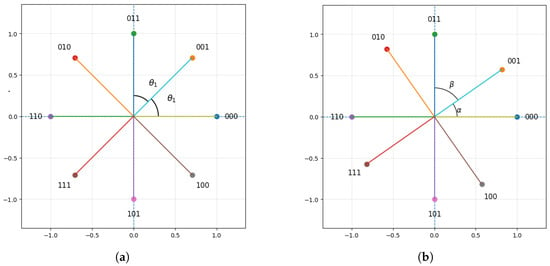
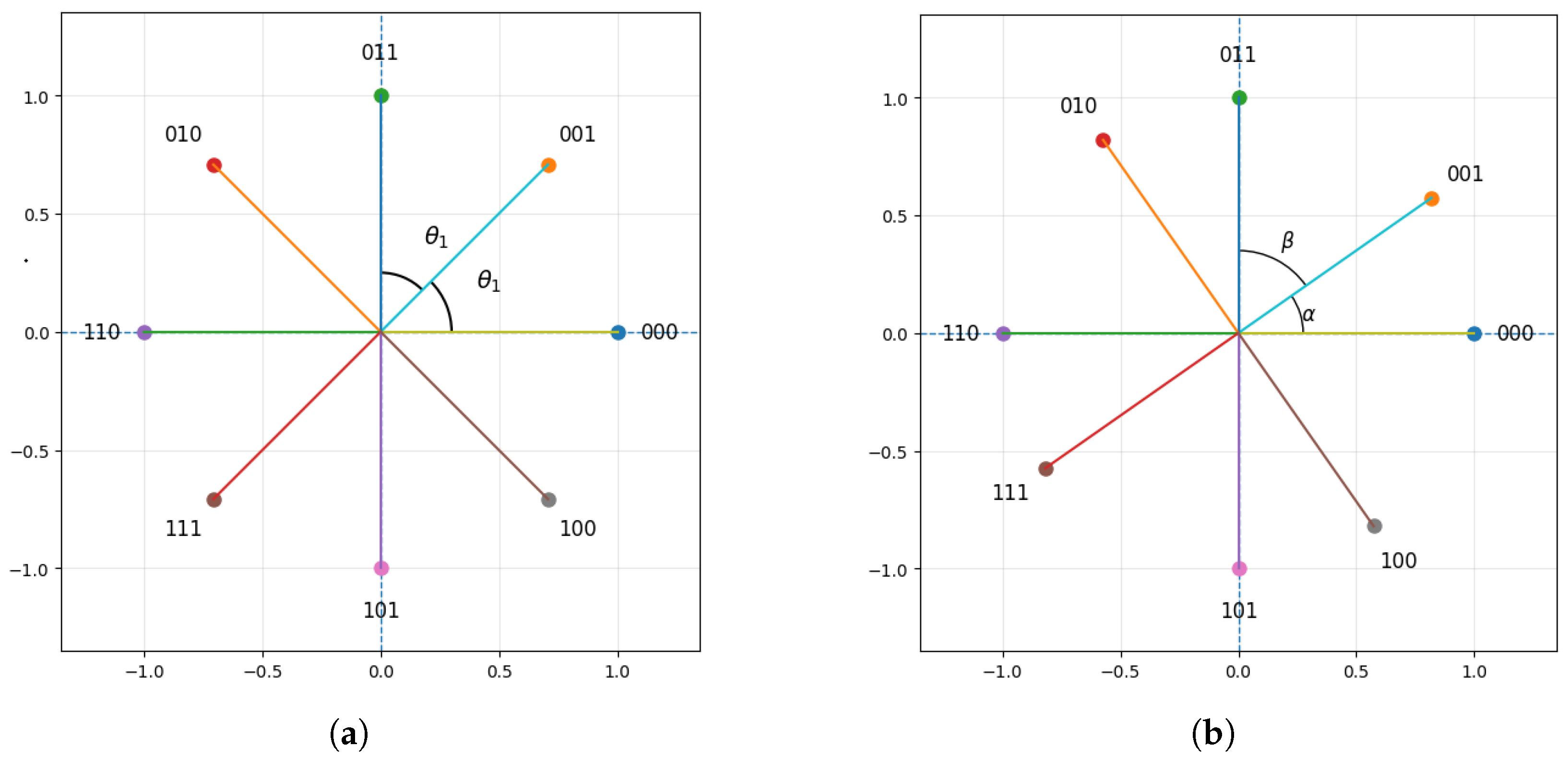
Uniform MPSK changes phase at constant amplitude, resulting in favorable Peak to Average Power Ratio (PAPR) behavior [10]. NU-MPSK instead alternates the phase increments and while retaining the same radius (see Figure 1); for the proposed symmetric construction, .
Figure 1.
Modulation constellation diagrams: (a) uniform MPSK (MPSK with ) and (b) non-uniform MPSK (NU-MPSK with ).
The constant-sum condition closes the constellation around the unit circle and prevents the angular modification from accumulating a phase error. It also preserves the rotational pattern used to generate the complete alphabet from the optimized points. When , the construction reduces to conventional uniform MPSK; unequal values produce the non-uniform alternative. Uniform 8-PSK is thus contained in the search space and provides a natural reference rather than a separately parameterized scheme.
3. Materials and Methods
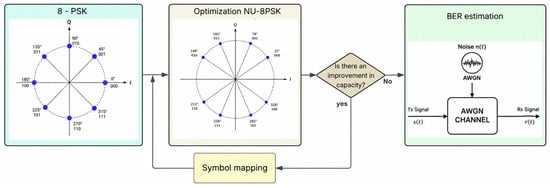
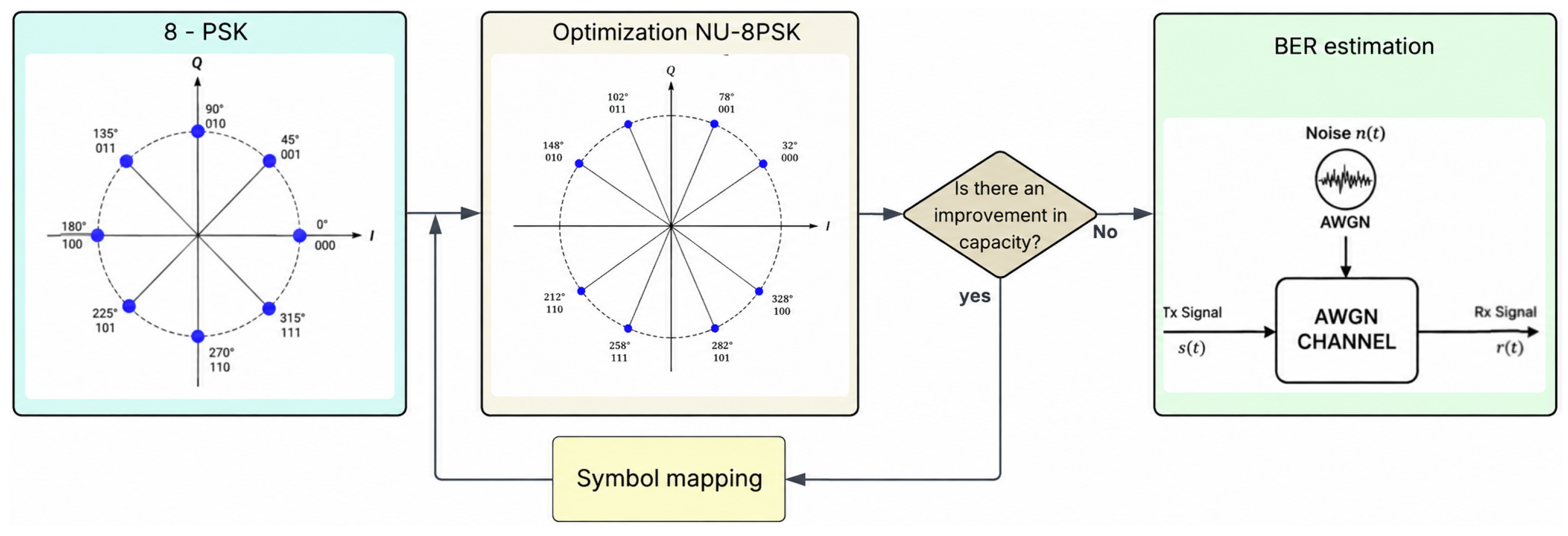
The symbol phases are modified to maximize simulated BICM capacity. Starting from Gray-labeled uniform 8-PSK [11], is varied while remains constant. Capacity is evaluated after each adjustment until no further increase is obtained. The optimized constellation at each SNR is then used in an AWGN simulation to estimate BER (see Figure 2).
Figure 2.
Proposed methodology for optimization and evaluation of PSK.
3.1. Optimization
Optimization begins with the conventional unit-energy 8-PSK constellation and Gray labeling. Because all symbols remain on the unit circle, the search changes phase only and preserves the average symbol energy . The angle of is changed by degrees, with rotational symmetry imposing corresponding changes on , , and . The remaining points provide the reference axes of the constellation. This constrained parameterization reduces the search to one angular variable and avoids an unconstrained optimization of eight independent complex coordinates.
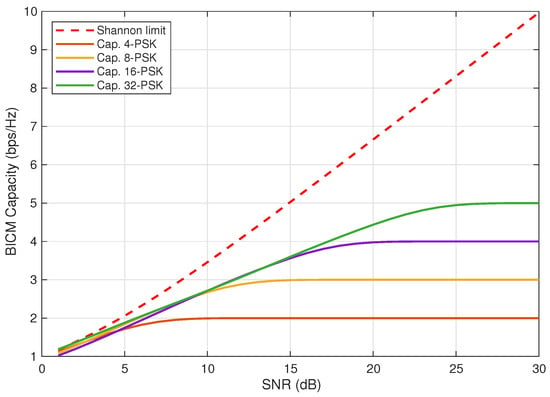
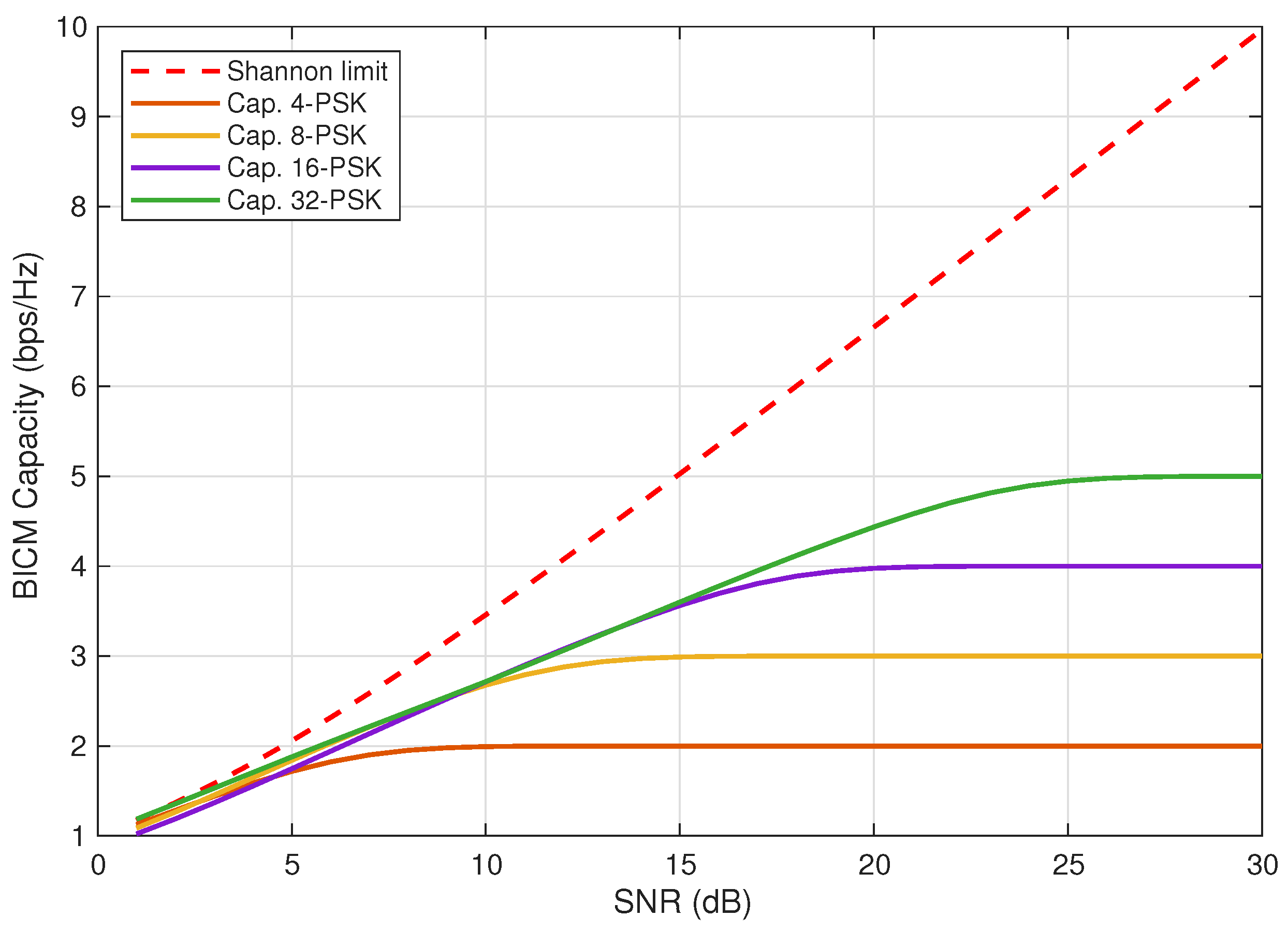
At each SNR, the BICM capacity of a candidate constellation is evaluated with the same energy normalization, labeling, and noise statistics used for the uniform reference. A candidate is retained when increases; otherwise, the preceding position is taken as optimal. The complementary angle follows from the constant-sum constraint, so every accepted value of defines the complete constellation. The normalized baseline in Figure 3 is used to quantify the capacity difference without attributing gains to additional transmitted energy.
Figure 3.
BICM capacity for different M-PSK modulation orders (4, 8, 16, 32) relative to the Shannon limit.
The search is repeated independently for every SNR value because the optimum geometry is not assumed to be universal. Initialization at uniform 8-PSK also provides a direct stopping reference: if the first perturbation does not improve capacity, the conventional angle is retained. The step controls the angular resolution of the search. A smaller step can locate the maximum more precisely at the cost of additional capacity evaluations, while the symmetry constraint keeps this cost substantially below that of a multidimensional constellation search.
3.2. BER Simulation and Estimation
For each SNR point, one million symbols from the uniform and optimized constellations are transmitted through AWGN. Both schemes use the same symbol energy, Gray labeling, number of trials, and SNR grid. Minimum-distance detection maps each observation to the nearest constellation point, after which the corresponding labels are compared with the transmitted bits to estimate BER. This paired configuration isolates the effect of angular geometry from differences in power, detector complexity, or simulation length.
One million transmitted symbols provide sufficient observations to compare the curves over the reported SNR range while using an identical Monte Carlo budget for both schemes. The receiver is assumed to know the constellation selected for the current SNR. The uncoded BER experiment provides a direct detector-level validation of the optimized constellations under matched minimum-distance detection. Together with the BICM achievable-rate analysis, it characterizes the capacity–reliability tradeoff induced by angular shaping. These results are therefore interpreted at the detector level, while coded-system performance remains a relevant direction for future evaluation.
AWGN Channel Modeling
To emulate real-world impairments, each transmitted symbol X is corrupted by complex additive white Gaussian noise, , where .
The real and imaginary components are independent and each has variance . For the unit-energy constellation, let denote the linear symbol-energy-to-noise ratio. The variance used to generate each real noise component is then
This symbol-energy-based convention does not introduce a modulation-order factor in the variance. The same independent component variance, noise realization, and detector settings are used for both constellations at each SNR, providing a direct comparison of the two geometries.
4. Results
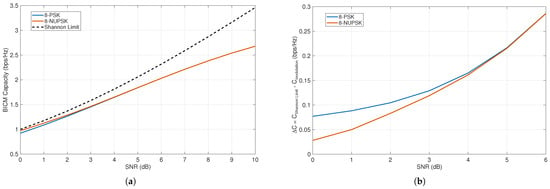
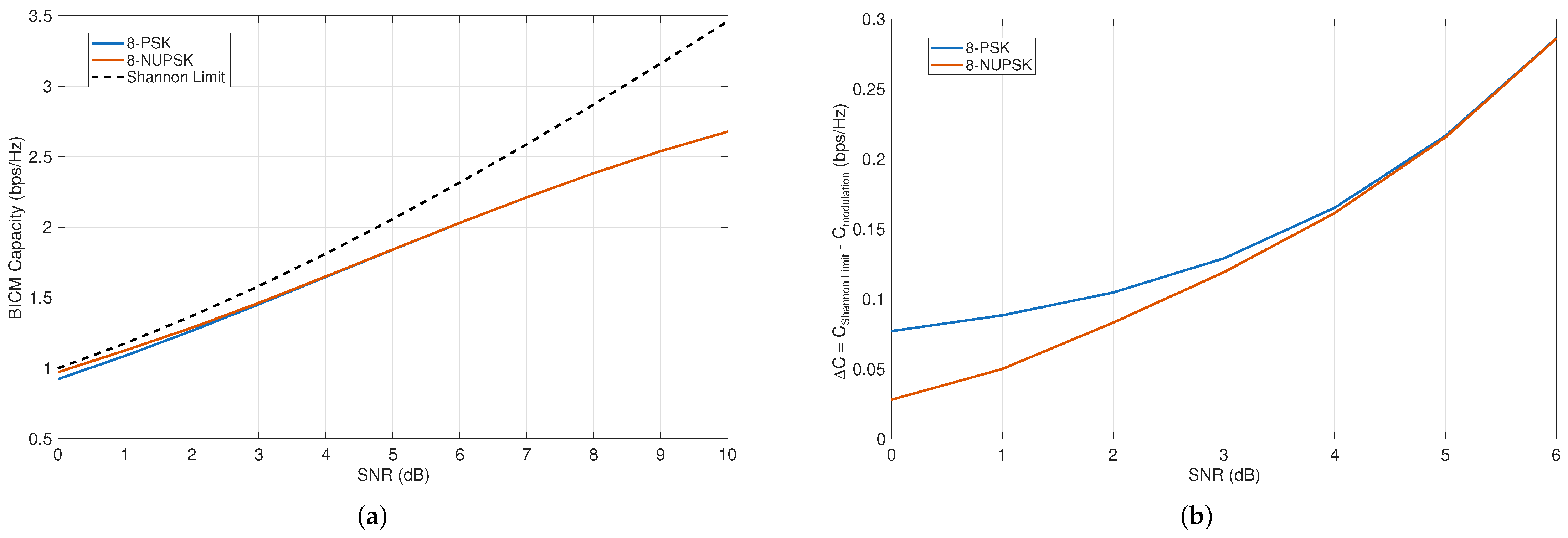
Figure 4a compares the BICM capacities of conventional 8-PSK and optimized 8-NUPSK with the Shannon limit. From 0 to approximately 5 dB, the curves exhibit an SNR-dependent capacity difference. This is the operating region in which received samples overlap most strongly, and the bit-wise information rate is especially sensitive to constellation geometry.
Figure 4.
BICM capacity performance: (a) 8-PSK versus 8-NUPSK capability curve and (b) channel capacity gap: Shannon limit and modulation capacity.
Figure 4b shows the gap between the Shannon limit and the BICM capacity of each modulation, defined as . Therefore, for 8PSK the gap is , and for 8-NUPSK the gap is .
At higher SNR, both discrete constellations approach their common maximum rate and their capacities become practically equal. The result therefore represents a region-dependent difference rather than a uniform vertical displacement of the capacity curve. Since both schemes have unit average energy and all their points remain on the same circle, the difference is attributable to angular placement rather than increased power or a change in envelope characteristics.
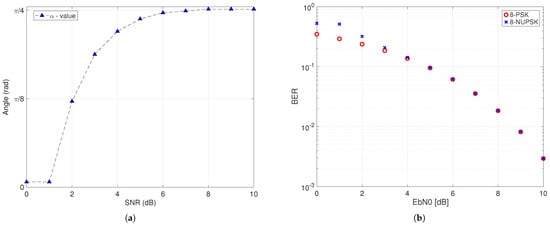
The optimal depends on channel conditions (see Figure 5a). It differs most from the uniform reference between 0 and 2 dB, indicating that severe noise favors a visibly non-uniform arrangement. As SNR increases, the optimized angle grows progressively and the perturbation decreases. From approximately 6 dB onward, converges to , recovering the angular spacing of conventional 8-PSK. This convergence is consistent with the capacity curves: once noise is sufficiently small, reshaping offers little additional bit-wise information and the uniform geometry becomes effectively optimal.
Figure 5.
Optimization parameter and BER results: (a) optimized angle versus SNR and (b) BER performance comparison between conventional 8-PSK and optimized 8-NUPSK in the AWGN channel.
Figure 5b shows a slightly higher 8-NUPSK BER between 0 and 2 dB. Although the optimization improves BICM capacity, moving the diagonal points changes the Euclidean distances between particular nearest neighbors; the smallest of these distances governs uncoded minimum-distance decisions under severe noise. The capacity and BER objectives are therefore related but not identical. Nevertheless, the curves rapidly converge and are nearly indistinguishable from approximately 3 dB onward. The proposed scheme consequently trades a small very-low-SNR BER penalty for an achievable-rate improvement while avoiding a meaningful reliability loss under moderate or favorable conditions.
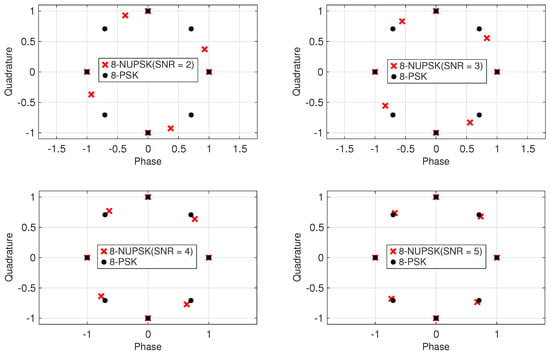
The constellations for 2 dB to 5 dB (see Figure 6) remain on the unit circle, directly verifying that the optimization preserves constant envelope. At 2 dB, the diagonal symbols show the largest displacement relative to conventional 8-PSK, whereas symbols on the main in-phase and quadrature axes retain their reference positions. The displacement decreases at 3 and 4 dB and is small at 5 dB. These diagrams visually connect the optimized angle with the capacity results and confirm that the method adapts geometry primarily where noise makes the uniform arrangement less efficient.
Figure 6.
Conventional 8-PSK and optimized 8-NUPSK constellation diagrams at SNR values from 2 to 5 dB.
5. Conclusions
The proposed 8-NUPSK scheme adjusts angular spacing while preserving the unit-energy, constant-envelope property of conventional PSK. The reported BICM-capacity difference is SNR-dependent and is most visible at low-to-moderate SNR, where constellation geometry strongly affects the bit-wise information rate. As SNR increases, the optimized angle converges toward uniform 8-PSK and the capacity difference becomes small.
The BER comparison clarifies the associated tradeoff. Non-uniform spacing produces a small penalty at very low because some neighbor distances are reduced, but the two schemes are nearly identical from approximately 3 dB onward. Thus, the proposed method improves the achievable rate in its target region without additional transmitted energy, envelope variation, or detector complexity. Its principal limitation is that the gain depends on SNR and requires the selection of the appropriate angular configuration.
Future work should evaluate higher-order NU-MPSK, coded transmission, fading and time-varying 3GPP channels, and adaptive selection using channel-state information. More general searches, including heuristic or metaheuristic methods, may be useful when the number of angular variables increases. Joint optimization of constellation geometry and bit mapping may further increase generalized mutual information in practical 5G-Advanced and 6G systems.
Author Contributions
Conceptualization, F.L., M.S. and R.M.V.; methodology, F.L. and M.S.; software, F.L.; validation, F.L., R.M.V., M.S., R.L.-C. and G.O.; formal analysis, F.L. and R.M.V.; investigation, F.L., R.M.V. and M.S.; resources, R.L.-C., G.O. and F.L.; data curation, R.L.-C. and F.L.; writing—original draft preparation, F.L. and R.L.-C.; writing—review and editing, F.L., R.M.V., M.S., R.L.-C. and G.O.; visualization, F.L. and R.M.V.; supervision, F.L., R.L.-C. and G.O.; project administration, F.L.; funding acquisition, G.O., R.L.-C. and F.L. All authors have read and agreed to the published version of the manuscript.
Funding
This work was supported in part by the Universidad de las Fuerzas Armadas ESPE under Research Grants 2013-PIT-014, 2016-EXT-038 and ESPE-CSE-DEEL-RES-2021-016.
Data Availability Statement
The data and simulation results presented in this study are available on request from the corresponding author.
Conflicts of Interest
The authors declare no conflicts of interest.
Abbreviations
| AWGN | Additive White Gaussian Noise | NU-MPSK | Non-Uniform Phase-Shift Keying |
| BICM | Bit-Interleaved Coded Modulation | PAPR | Peak-to-Average Power Ratio |
| BER | Bit Error Rate | SNR | Signal-to-Noise Ratio |
| MPSK | Phase-Shift Keying |
References
- Benedetto, S.; Poggiolini, P. Theory of polarization shift keying modulation. IEEE Trans. Commun. 2002, 40, 708–721. [Google Scholar]
- Proakis, J.G.; Salehi, M. Digital Communications, 5th ed.; McGraw-Hill: New York, NY, USA, 2008. [Google Scholar]
- Proakis, J.G.; Salehi, M. Digital Communications; McGraw-Hill: New York, NY, USA, 2001; Volume 4. [Google Scholar]
- Shannon, C.E. A mathematical theory of communication. Bell Syst. Tech. J. 1948, 27, 379–423. [Google Scholar]
- Gursoy, M.C. On the low-SNR capacity of phase-shift keying with hard-decision detection. In Proceedings of the 2007 IEEE International Symposium on Information Theory; IEEE: Piscataway, NJ, USA, 2007; pp. 166–170. [Google Scholar]
- Martinez, A.; i Fabregas, A.G.; Caire, G.; Willems, F.M. Bit-interleaved coded modulation in the wideband regime. IEEE Trans. Inf. Theory 2008, 54, 5447–5455. [Google Scholar] [CrossRef] [Scilit]
- Caire, G.; Taricco, G.; Biglieri, E. Bit-interleaved coded modulation. IEEE Trans. Inf. Theory 1998, 44, 927–946. [Google Scholar] [CrossRef] [Scilit]
- Lara, F.; Castillo, M.; Olmedo, G. M-NUQAM Modulations with Constant Symbol Mean Energy. In Proceedings of the Recent Advances in Electrical Engineering, Electronics and Energy; Botto Tobar, M., Cruz, H., Díaz Cadena, A., Eds.; IEEE: Cham, Switzerland, 2021; pp. 137–148. [Google Scholar]
- Le Ruyet, D.; Pischella, M. Digital Communications 1: Source and Channel Coding; John Wiley & Sons: Hoboken, NJ, USA, 2015; Volume 1. [Google Scholar]
- Bomfin, R.; Chafii, M.; Fettweis, G. A novel modulation for IoT: PSK-LoRa. In Proceedings of the 2019 IEEE 89th Vehicular Technology Conference (VTC2019-Spring); IEEE: Piscataway, NJ, USA, 2019; pp. 1–5. [Google Scholar]
- Ludman, J. Gray code generation for MPSK signals. IEEE Trans. Commun. 1981, 29, 1519–1522. [Google Scholar] [CrossRef] [Scilit]
Disclaimer/Publisher’s Note: The statements, opinions and data contained in all publications are solely those of the individual author(s) and contributor(s) and not of MDPI and/or the editor(s). MDPI and/or the editor(s) disclaim responsibility for any injury to people or property resulting from any ideas, methods, instructions or products referred to in the content. |
© 2026 by the authors. Licensee MDPI, Basel, Switzerland. This article is an open access article distributed under the terms and conditions of the Creative Commons Attribution (CC BY) license.