


Abstract
Active structural control remains limited by its complexity, cost, and energy requirements, while most hybrid strategies employ a single control law throughout the entire seismic event. This paper proposes a dual-control strategy for an SDOF structure that combines complementary controllers according to the earthquake phase, using nonlinear transitions to ensure smooth switching. The proposed schemes were evaluated in MATLAB 2026a using the IAE, ISCO, and maximum displacement indices. Results demonstrate that the dual-control philosophy effectively balances vibration attenuation and control effort, with the nonlinear transition schemes reducing switching-induced spikes while maintaining performance comparable to the best individual controller. Among the evaluated approaches, the scheduled and SIGM implementations achieved the most favorable trade-off between damping and control effort.
1. Introduction
Seismic activity endangers people’s well-being by threatening the structural integrity of residential and workplace structures, particularly in countries located above active tectonic faults, such as Japan, the USA, and several South American nations, including Ecuador. Passive anti-seismic methods have been widely adopted as safety measures in these countries [1], while active structural control systems, despite considerable research attention, have not yet achieved widespread practical adoption due to their higher complexity, cost, and power requirements [2]. Various control methods have already been discussed in the literature; recent state-of-the-art reviews identify fuzzy logic, LQR/LQG optimal, sliding mode, and neural network-based controllers as some of the most extensively investigated strategies [3]. Combining two or more of these methods into hybrid schemes has also become an active research topic; for example, a hybrid PID-LQR optimal controller was shown to improve the damping capacity of structural systems [4].
Nevertheless, evident research gaps remain: few studies evaluate control performance using indices such as ISCO and IAE, which, despite being secondary from a civil engineering perspective, provide valuable and largely overlooked information on controller efficiency and control effort. Moreover, most hybrid strategies combine two or more controllers into a single universal control law that operates throughout the entire seismic event, while adaptive approaches based on neural networks and intelligent control have been limited to fine-tuning gains and other parameters. In a previous study [5], the controllers PD, FOPD, and NPD were evaluated for an SDOF structure subjected to simulated seismic excitation. Although the three controllers achieved comparable displacement attenuation during the transient phases, they required markedly different control efforts, indicating that some controllers remained unnecessarily aggressive outside the critical stage of the earthquake. This observation motivates the proposed dual-control strategy, which employs a low-effort controller during non-critical phases and switches to a more aggressive controller only during peak excitation. Accordingly, this paper investigates whether such a strategy can effectively combine the advantages of both controllers within a MATLAB simulation framework.
2. Materials and Methods
2.1. Structural Model and Seismic Excitation
An SDOF structural model was adopted to capture the dominant dynamic behavior of the first vibration mode and serve as a benchmark system for evaluating the proposed dual control strategy. The same mathematical model and simulation framework presented in [5] were employed to ensure a direct comparison with the previous evaluation of the individual controllers. The dynamic behavior of the controlled structure subjected to seismic excitation is described by
where m is the equivalent structural mass, c is the viscous damping coefficient, k is the lateral stiffness, is the relative structural displacement, is the ground acceleration, and denotes the control force generated by the active controller.
For simulation purposes, the model is expressed in normalized form as
where and represent the natural circular frequency and the damping ratio of the structure, respectively. Furthermore, the seismic disturbance was represented by the synthetic non-stationary excitation as:
which reproduces the transient behavior of an earthquake by introducing both time-varying amplitude and frequency. The parameters adopted throughout the simulations are summarized in Table 1.
Table 1.
Structural and seismic excitation parameters used in simulations.
2.2. The Dual Scheme
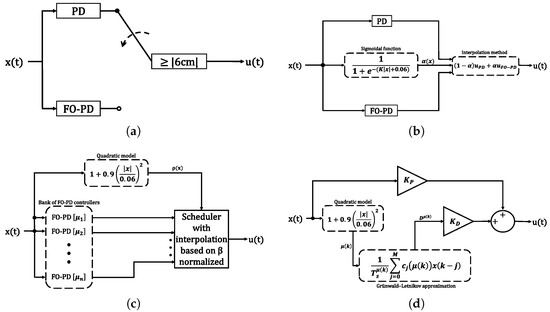
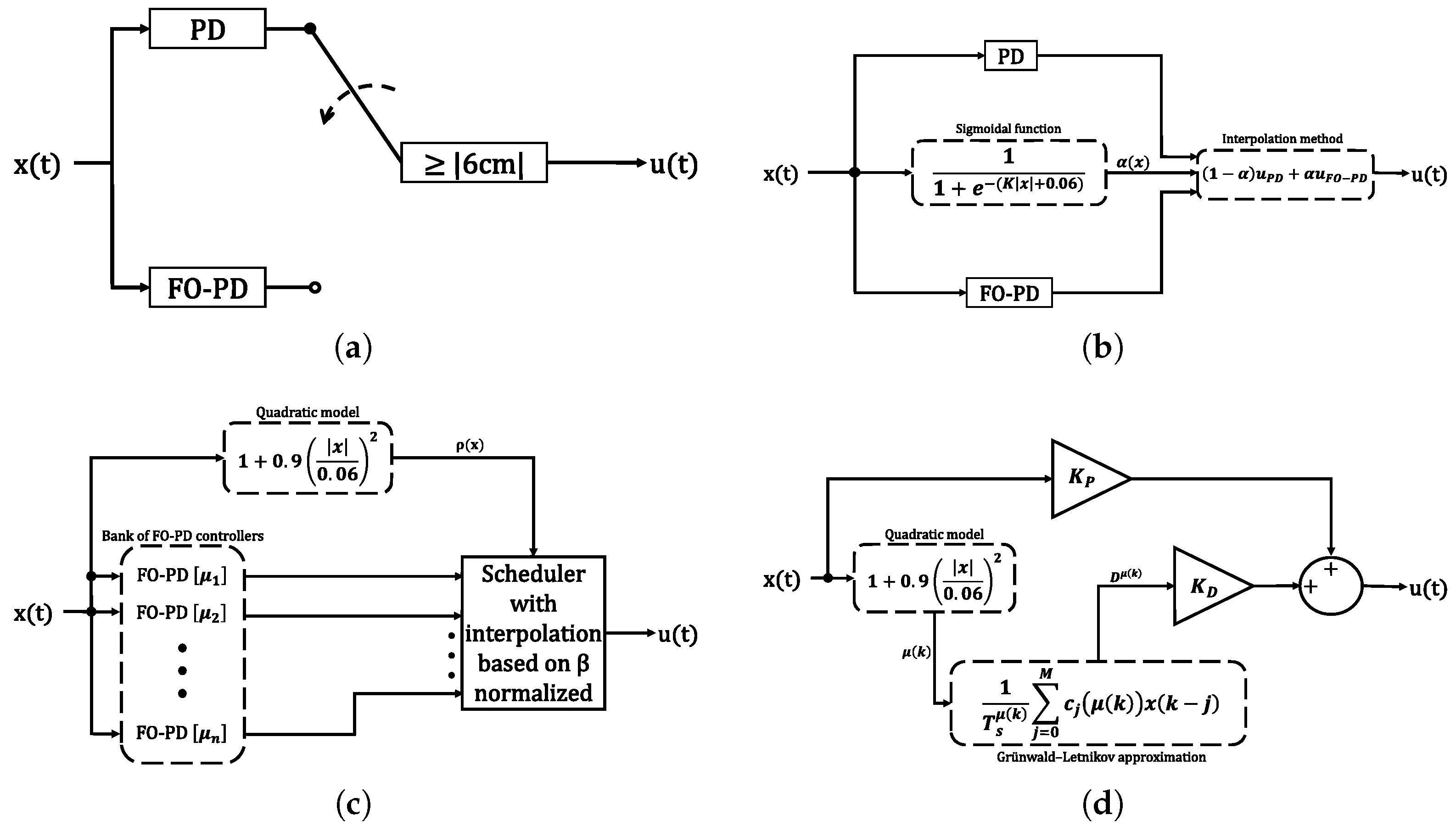
The dual scheme implements two single control methods within the same law: each controller receives the closed-loop feedback individually and simultaneously, while a logical switch selects which output reaches the plant, segmenting the control law into two threshold-defined regions of action. This threshold () value is usually taken from the feedback error, although other sources may be used if required. This scheme employs a PD–FOPD configuration in which the threshold is based on a maximum displacement of 6 cm (Figure 1a), which also previews the nonlinear transition schemes discussed later in this section.
Figure 1.
Block diagrams of the dual control schemes: (a) Switch-based PD–FOPD scheme. (b) Sigmoidal interpolation scheme. (c) Scheduled fractional-term transition scheme. (d) GL approximation scheme.
2.3. Threshold Calculation Method
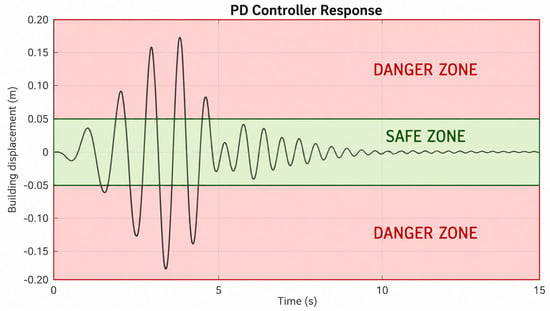
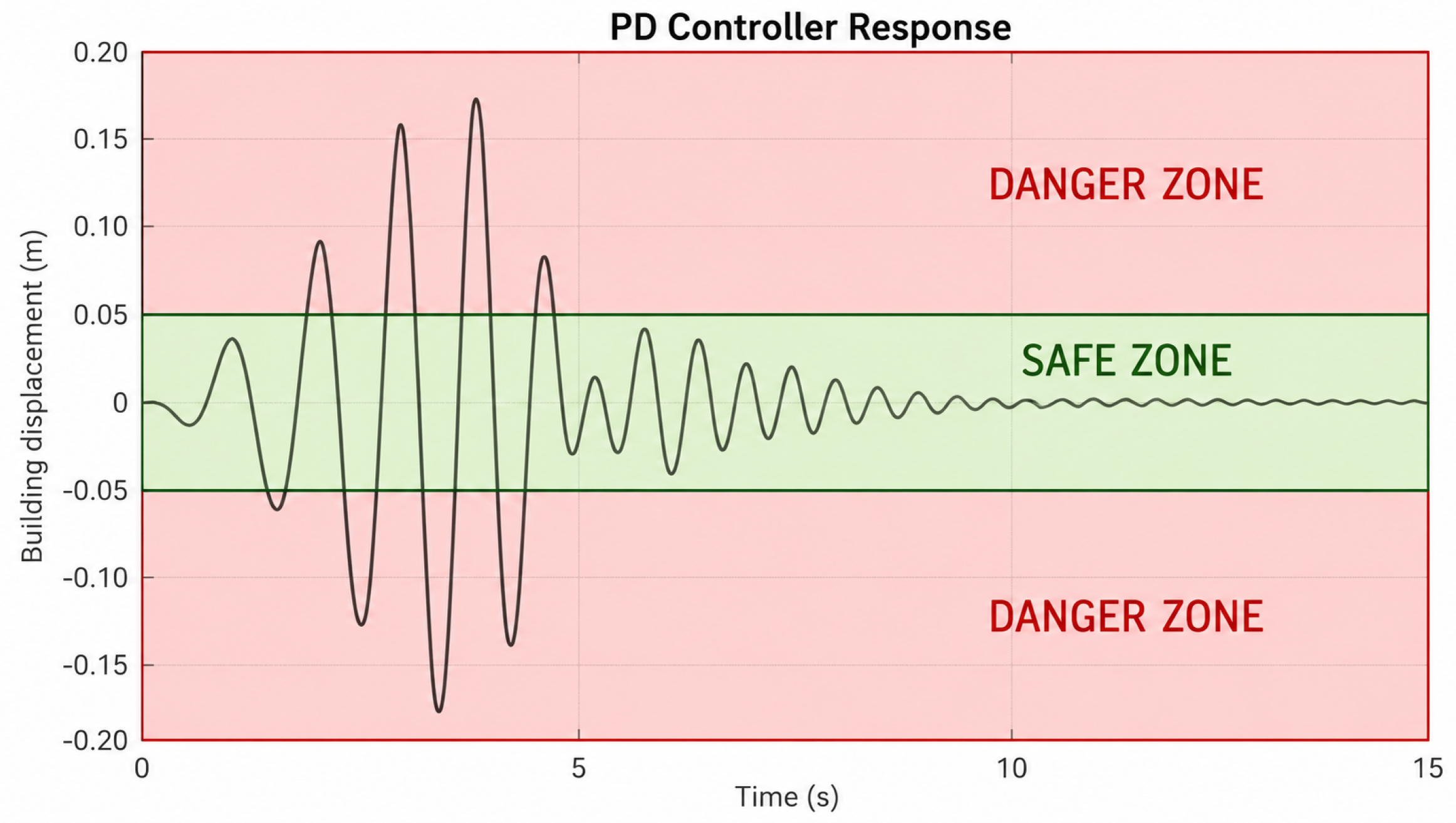
Selecting the maximum displacement of the structure as the source of simplifies the procedure, as it is only necessary to analyze the effective movement of the structure, rather than the earthquake itself or its duration, whose fundamental parameters are difficult to predict or deduce. The procedure for obtaining the correct commutation value was fundamentally empirical, starting with the PD displacement response as the baseline to improve damping capacity. In Figure 2, this response is segmented by color into two regions: red “danger zones,” covering displacement ranges with the potential to damage the structure and where the FOPD makes the greatest difference, and a green “safe zone,” covering the transient stages of the seismic activity that the PD already controls well.
Figure 2.
PD control displacement output, segmented into a “DANGER ZONE” (red) and a “SAFE ZONE” (green).
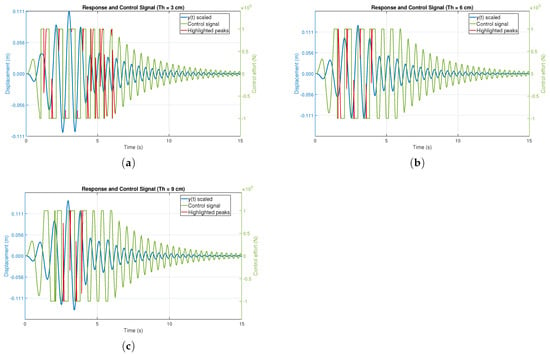
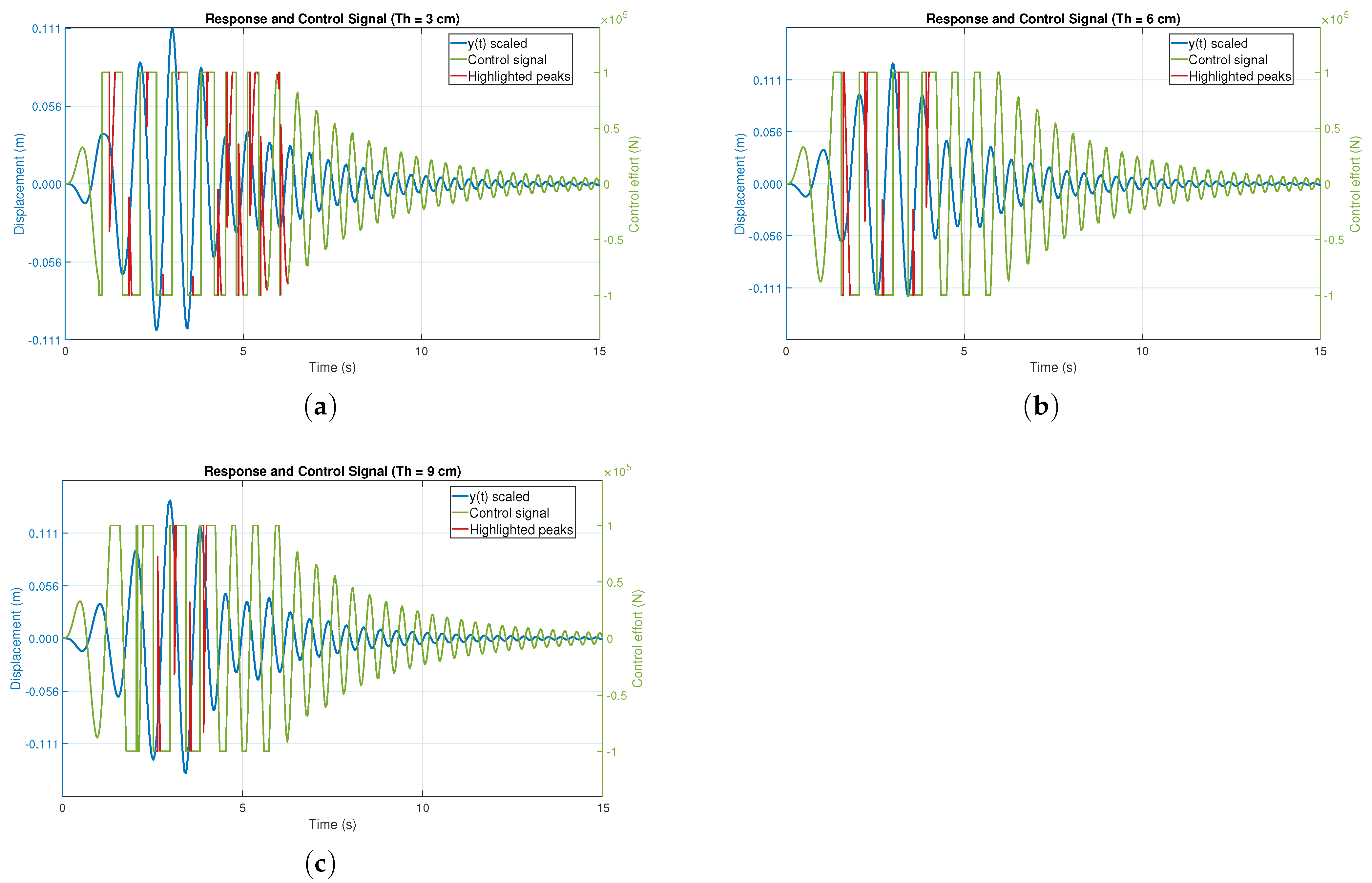
An unwanted characteristic of the dual scheme is that sudden logical-switch commutations generate Dirac-delta-like peaks in the control signal, risking a malfunction of the actuator’s mechanical system. To address this, a sweep between 3 and 9 cm (step of 0.5 cm) was performed using the dual PD-FOPD scheme to find the value that best commutes the switch while minimizing these peaks.
Three representative values of provided the main insights (Figure 3). A low threshold (3 cm, Figure 3a) generates excessive chattering with peaks of varying and potentially unsafe amplitude, whereas a high threshold (9 cm, Figure 3c) reduces the number of peaks at the expense of more aggressive control actions. In contrast, cm (Figure 3b) achieves the best compromise, producing only the intended commutations with lower peak amplitudes. Although this threshold was selected empirically rather than from a structural analysis relating it to structural properties such as stiffness, the 6 cm threshold provided the best compromise between switching behavior and displacement response.
Figure 3.
Control signal and rescaled displacement output for the three most significant values of the sweep. Peaks in the control signal are highlighted in red. (a) cm. (b) cm. (c) cm.
2.4. Nonlinear Methods for Dual Scheme Implementation
The major downside of the dual scheme is the occurrence of spikes during commutation events, caused by the switch’s discontinuous transition:
where K is the region of interest. Even with an appropriate threshold, the trade-off between spike appearance and magnitude undermines the overall system improvement, making the scheme risky for a physical actuator and not clearly superior to the original controllers. Therefore, three nonlinear methods following the dual philosophy were proposed to soften the transition and reduce these spikes.
2.4.1. Interpolation Based on a Sigmoidal Function
The following alternative directly replaces the logical switching with a continuous interpolation method based on the following equation:
where u is the control signal for the displacement of the structure at any given time, and are their individual control signals, and is the defined output of the transition method. The sigmoidal function, known in control theory for smooth transitions, was found to be best suited for this case; with the help of GenAI, its final implementation form is presented as follows.
where k is a dimensional parameter that dictates how fast and abrupt the transition should be, and the 0.03 value represents the middle point of the sigmoidal transition in meters, so the function reaches its limit at 0.06 m.
2.4.2. Scheduled Fractional Term Transition
The original control law for implementing an FOPD is the following.
Here, the integral term is eliminated, so alone determines the operator D (setting the fractional terms to 1 recovers the original PD [6], letting FOPD be regarded as an evolution of PD driven by a single, increasingly aggressive parameter . This reduces the problem to a switch with the following behavior:
This opens the door to an internal smooth transition for , using a quadratic function chosen to allow a slow transition at lower displacement values (favoring PD) and a fast one near the threshold:
where is defined as
However, this transition could not be implemented through the original FOPD block, as the FOMCON [6] implementation does not accept functions as arguments. The solution was a scheduled scheme: a bank of nine FOPD FOMCON controllers was built, with ranging from 1 to 1.9 in steps of 0.1, and an interpolation system was designed to smoothly weight between adjacent bands using the quadratic result as input, following
which is applied as
with the final control output bounded as
Figure 1c illustrates how this system should be implemented.
2.4.3. Grünwald–Letnikov Approximation
This scheme pursues the same purpose as the latter but uses a known fractional-order approximation to calculate the operator. The Grünwald–Letnikov (GL) approximation was chosen (with GenAI assistance) for its purely algebraic formulation, which avoids pole calculations that could create conflicts during simulation.
The corresponding diagram is a direct replacement for the FOMCON block in the FOPD logic, as shown in Figure 1d. The function-block codes (developed with GenAI assistance) for all implemented schemes are available in the GitHub repository cited in the Data Availability Statement.
The proposed dual-control strategies were evaluated under identical simulation conditions to ensure a fair comparison. The analysis first focuses on the control signals to assess the effectiveness of the different transition methods in mitigating switching-induced peaks. The overall closed-loop performance is then evaluated using the IAE, ISCO, and maximum displacement indices.
2.5. Control Signal Analysis
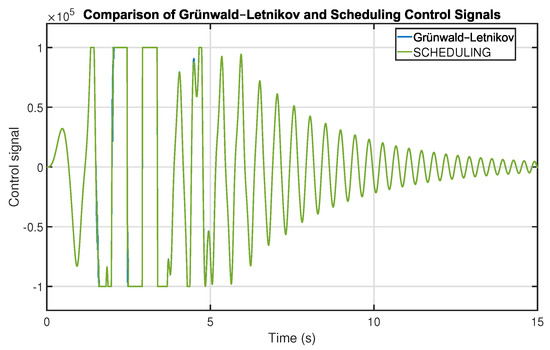
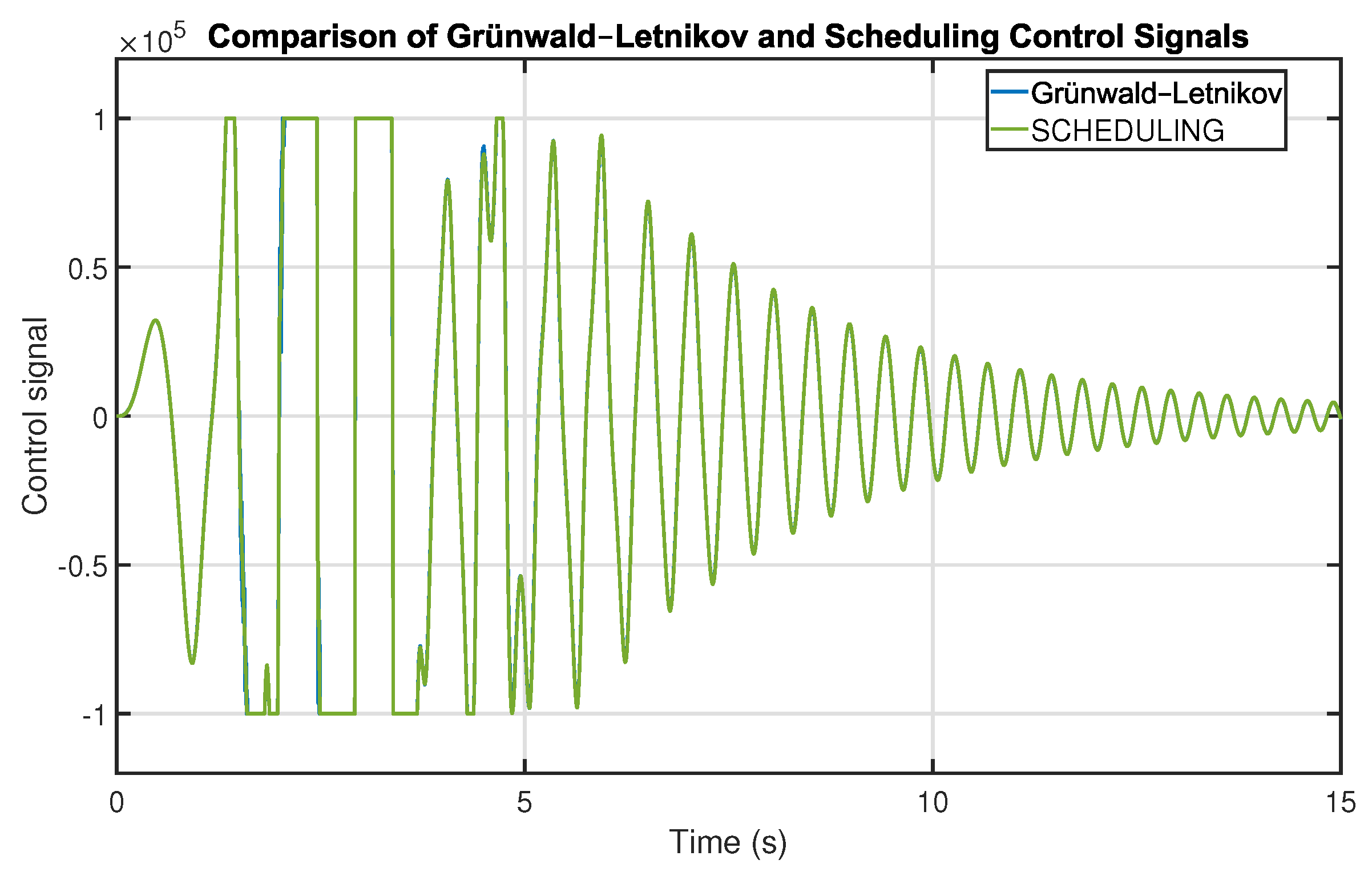
A direct GL approximation was expected to outperform the scheduled interpolation method. However, Figure 4 shows comparable damping and control effort, while the GL approach exhibits noticeable chattering between 1 and 3 s. Since this additional complexity provides no practical performance benefit, the GL implementation was excluded from the subsequent analysis.
Figure 4.
Control signal comparison between the GL approximation and scheduled schemes.
The remaining nonlinear transition methods were therefore compared with the FOPD controller to evaluate their ability to smooth the switching process without compromising damping performance.
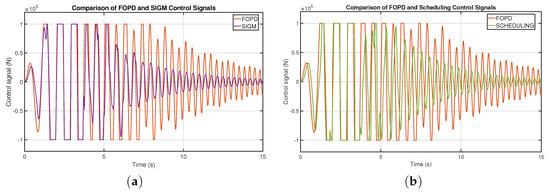
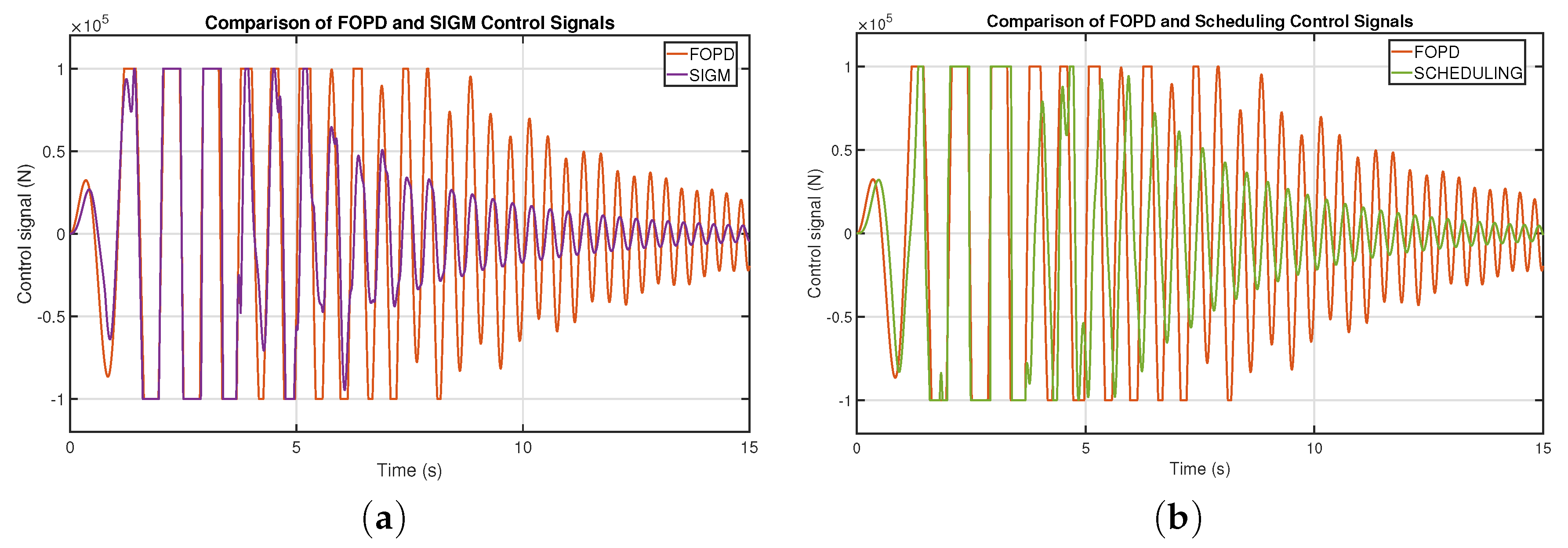
Both nonlinear transition strategies substantially reduced the switching-induced peaks observed in the original dual scheme (Figure 3b), although they achieved this objective through different mechanisms. As shown in Figure 5a, the SIGM approach closely follows the FOPD control signal while introducing a smoother PD–FOPD transition that completely eliminates the spikes. In contrast, the scheduled strategy slightly departs from the FOPD response but replaces the sharp Dirac-delta-like peaks with wider, smoother control actions, reducing actuator stress and shortening the time spent at saturation limits. These characteristics make both approaches more suitable for practical implementation than the original switch-based scheme.
Figure 5.
Control signal comparison between each nonlinear transition scheme and FOPD. (a) SIGM vs. FOPD. (b) Scheduled scheme vs. FOPD.
2.6. Closed-Loop Performance Comparison
Control performance was evaluated using the ISCO and IAE indices, which quantify control effort and cumulative displacement error, respectively:
where denotes the structural displacement.
where is the control signal and is the simulation time.
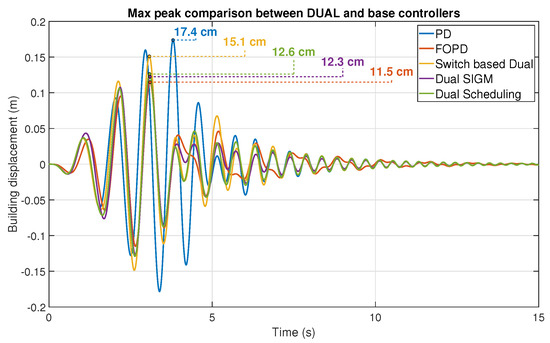
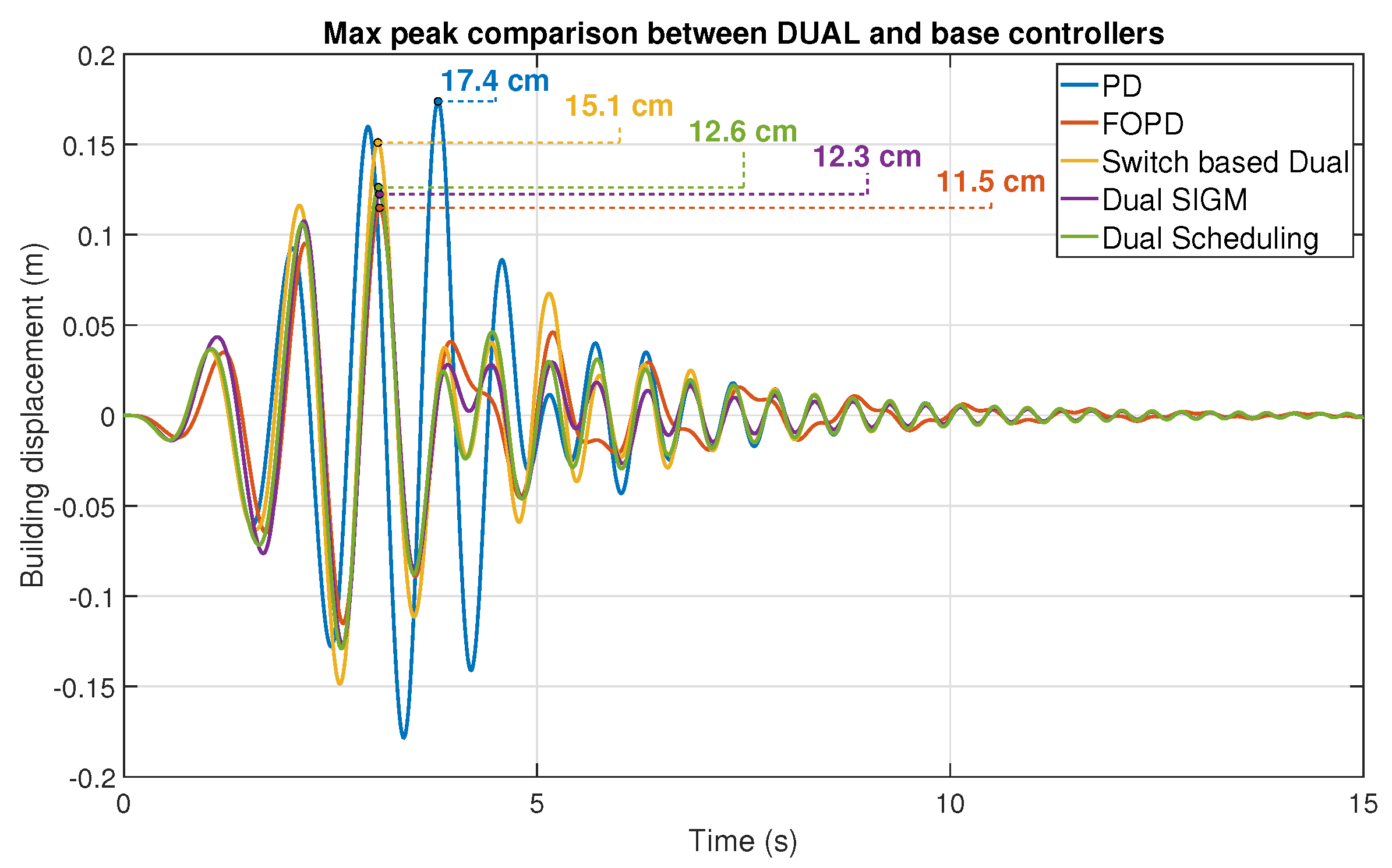
Table 2 and Figure 6 show that the switch-based dual strategy cannot match the damping capability of the nonlinear implementations. In seismic applications, where rapid response is essential, discontinuous switching produces larger transition peaks and limits the controller’s overall effectiveness. Nevertheless, the dual philosophy still improves control efficiency, reducing the ISCO by approximately 30% with respect to the FOPD controller while decreasing the maximum displacement by 2.3 cm relative to the PD controller. Both nonlinear approaches further improve this trade-off, achieving peak displacements close to that of the FOPD controller while requiring less control effort. Among them, SIGM achieves the lowest ISCO, reducing control effort by approximately 43.3% relative to FOPD, while maintaining a maximum displacement of 12.3 cm. The scheduled implementation also provides a substantial reduction in control effort, with an ISCO improvement of 38.1% relative to FOPD and a maximum displacement of 12.6 cm. Overall, both nonlinear implementations provide a favorable compromise between vibration attenuation and control effort, with SIGM achieving the lowest control effort among the evaluated strategies.
Table 2.
Performance comparison among the evaluated control schemes.
Figure 6.
Comparison of the maximum displacement peak and output response among all evaluated control schemes.
3. Conclusions
This paper introduced a dual-control philosophy for mitigating seismic vibrations by combining two complementary control schemes during different phases of the earthquake response. The results show that the proposed strategy provides a better compromise between vibration attenuation and control effort than individual controllers. Among the evaluated implementations, the nonlinear transition methods consistently outperform the switch-based approach by ensuring smoother controller transitions and reducing control signal spikes. Although neither the SIGM nor the scheduled implementation is universally superior, SIGM achieved the lowest control effort and slightly better maximum-displacement attenuation, whereas the scheduled implementation provided a smoother control signal with only a modest compromise in the remaining performance indices.
Author Contributions
Conceptualization, J.R., L.C., P.T.-R., F.Y., D.B. and O.C.; methodology, J.R., L.C., P.T.-R., F.Y., D.B. and O.C.; validation, J.R., L.C., P.T.-R., F.Y., D.B. and O.C.; investigation, J.R., L.C., P.T.-R., F.Y., D.B. and O.C.; writing—original draft preparation, J.R., L.C., P.T.-R., F.Y., D.B. and O.C.; writing—review and editing, J.R., L.C., P.T.-R., F.Y., D.B. and O.C.; supervision, L.C., P.T.-R., F.Y., D.B. and O.C. All authors have read and agreed to the published version of the manuscript.
Funding
This work was supported by the Universidad San Francisco de Quito through the Poli-Grants Program under Grants No. 41983 and 42995.
Institutional Review Board Statement
Not applicable.
Informed Consent Statement
Not applicable.
Data Availability Statement
The MATLAB function for the scheme’s simulations may be found on a GitHub repository at https://github.com/JuanRhor/Dual_based_PID_Development.git (accessed on 23 September 2026). Further data may be requested directly from the authors.
Conflicts of Interest
The authors declare no conflict of interest.
References
- Al-Janabi, M.A.Q.; Al-Jeznawi, D.; Yang, T.Y.; Bernardo, L.F.A.; Andrade, J.M.A. Enhancing Structural Resilience for Sustainable Infrastructure: A Global Review of Seismic Isolation and Energy Dissipation Practices. Sustainability 2025, 17, 7314. [Google Scholar] [CrossRef] [Scilit]
- Xu, G.; Guo, T.; Li, A.; Zhang, H.; Wang, K.; Xu, J.; Dang, L. Seismic Resilience Enhancement for structure Structures: A Comprehensive Review and Outlook. Structures 2024, 59, 105738. [Google Scholar] [CrossRef] [Scilit]
- Dharmajan, N.B.; AlHamaydeh, M. State-of-the-Art Review of Structural Vibration Control: Overview and Research Gaps. Appl. Sci. 2025, 15, 7966. [Google Scholar] [CrossRef] [Scilit]
- Baygi, S.M.H.; Karsaz, A. A Hybrid Optimal PID-LQR Control of Structural System: A Case Study of Salp Swarm Optimization. In Proceedings of the 2018 3rd Conference on Swarm Intelligence and Evolutionary Computation (CSIEC), Bam, Iran, 6–8 March 2018; pp. 1–6. [Google Scholar] [CrossRef] [Scilit]
- Caiza, L.; Yepez, F.; Torres-Rodas, P.; Perez-Perez, N.; Benitez, D.S.; Camacho, O. Comparative Analysis of PID-Based Controllers for Seismic Active Structural Control. In Proceedings of 2026 IEEE Tenth Ecuador Technical Chapters Meeting (ETCM), Guayaquil, Ecuador, 22–24 October 2026; IEEE: Piscataway, NJ, USA, 2026; pp. 1–6. [Google Scholar]
- Tepljakov, A.; Petlenkov, E.; Belikov, J.; Finajev, J. Fractional-Order Controller Design and Digital Implementation Using FOMCON Toolbox for MATLAB. In Proceedings of the 2013 IEEE Conference on Computer Aided Control System Design (CACSD), Hyderabad, India, 28–30 August 2013; pp. 340–345. [Google Scholar] [CrossRef] [Scilit]

Disclaimer/Publisher’s Note: The statements, opinions and data contained in all publications are solely those of the individual author(s) and contributor(s) and not of MDPI and/or the editor(s). MDPI and/or the editor(s) disclaim responsibility for any injury to people or property resulting from any ideas, methods, instructions or products referred to in the content. |
© 2026 by the authors. Licensee MDPI, Basel, Switzerland. This article is an open access article distributed under the terms and conditions of the Creative Commons Attribution (CC BY) license.