


Abstract
Modern vehicles generate extensive sensor and communication data describing driver inputs and vehicle dynamics. This study introduces a simulation framework that uses measured vehicle data to reconstruct and replay real driving maneuvers, reducing the need for repeated physical tests. Data are acquired from the vehicle Controller Area Network (CAN) through a contactless measurement method, decoded, and processed in MATLAB/Simulink before being used to rebuild scenarios in IPG CarMaker. Recorded steering, acceleration, and braking inputs are replayed in a virtual vehicle model to reproduce real maneuvers under controlled, repeatable conditions. An avoidance maneuver demonstrates the method’s applicability. Results show that the timing and functional behavior of the recorded driver inputs can be reproduced sufficiently for scenario-level maneuver reconstruction and functional analysis. Despite model-related discrepancies, the framework offers a non-intrusive, cost-effective approach for post-event analysis, virtual validation, and driver assistance system evaluation.
1. Introduction
Modern vehicles continuously generate large volumes of sensor, control, and communication data that describe both driver inputs and vehicle dynamics. These data are increasingly important for road safety analysis, accident investigation, post-event evaluation, and the validation of advanced driver assistance functions. Parameters such as vehicle speed, braking activity, steering angle, acceleration, and safety-system operation can provide a detailed description of the events preceding and following a critical driving situation [1,2]. In most vehicles, these signals are exchanged through the Controller Area Network (CAN), which provides a robust communication interface between electronic control units and enables efficient access to operational vehicle data [3]. The relevance of such data has further increased with the introduction of mandatory Event Data Recorder (EDR) systems in new passenger and light commercial vehicles in the European Union from July 2024, supporting more consistent post-event data availability and analysis [4,5].
The increasing availability of vehicle data has also strengthened the role of simulation-based methods in automotive testing and validation. Real or recorded vehicle signals can be integrated into simulation environments to reproduce driving scenarios, evaluate vehicle behavior, and reduce the need for repeated physical testing [6]. Software environments such as IPG CarMaker, MATLAB/Simulink, and related vehicle simulation platforms make it possible to reconstruct maneuvers in a controlled virtual setting, where different vehicle responses can be examined under repeatable conditions [7]. In this context, simulation-supported workflows combining measured or recorded vehicle signals with virtual vehicle models have been applied to hardware-in-the-loop testing, vehicle-dynamics model validation, and the evaluation of vehicle control systems [6,7,8].
Recent studies have shown the value of combining measured data, vehicle models, and numerical simulation for analyzing vehicle behavior. Full-vehicle dynamic models, railway and road-vehicle interaction models, and coupled vehicle-structure simulations have demonstrated that experimentally supported modeling can improve the interpretation of motion behavior and system response under different operating conditions [9,10,11]. Hybrid approaches that combine experimental measurements with numerical models further indicate that simulation can improve repeatability and reduce the need for extensive real-world testing, while still preserving important characteristics of measured vehicle behavior [8]. These developments show a clear tendency toward data-driven and simulation-supported validation workflows.
Accident reconstruction has been widely studied using mathematical calculations, uncertainty analysis, optimization procedures, and virtual reconstruction methods [12,13,14,15,16]. These approaches are effective for estimating accident parameters, evaluating reconstruction uncertainty, and analyzing complex collision scenarios. However, many existing methods focus primarily on collision mechanics or high-fidelity dynamic reconstruction, while fewer studies address the practical replay of real driver inputs obtained directly from vehicle communication data. In contrast, the present work focuses on the reconstruction of real driving maneuvers by replaying measured CAN-derived steering, acceleration, and braking signals in a simulation environment. The aim is not exact vehicle parameter identification, but a repeatable and practical workflow for reproducing the temporal and functional behavior of recorded maneuvers.
The CAN bus is particularly suitable for this purpose because it is one of the most widely used in-vehicle communication systems. Because of this widespread use, CAN communication has also become an important research topic in relation to anomaly detection, interface design, vehicle applications, and robustness or security aspects in distributed control networks [17,18,19,20]. In conventional vehicle architectures, CAN replaced many point-to-point wiring solutions by enabling several electronic control units to communicate over a shared two-wire network, reducing wiring complexity, weight, and cost. CAN messages are transmitted digitally and require transceiver circuits for voltage-level conversion and reliable communication between the electronic control units and the bus [21]. Message arbitration enables prioritized access to the shared bus and helps avoid data collisions during communication [3,19]. These properties make CAN a practical source of vehicle operation data for measurement, logging, and replay-based analysis.
In addition to its widespread use, CAN communication has been extensively examined from the perspectives of network modeling, digital twin development, security, and system reliability. Previous studies have addressed CAN transceiver behavior, real-world in-vehicle network representation, scalable security protocols, and communication reliability in automotive and machine applications [21,22,23,24]. Since CAN operates at relatively low voltage levels and relies on a physical bus structure, signal integrity must also be considered. Termination resistors are commonly used at the ends of the bus line to reduce signal reflections and maintain reliable data transmission. The maximum communication speed of classical CAN can reach 1 Mbit/s over shorter cable lengths, while longer bus lengths require reduced bit rates to maintain stable transmission [25]. Standard and extended CAN frame formats define different identifier lengths, with 11-bit identifiers used in the standard format and 29-bit identifiers used in the extended format [26].
Based on these considerations, this study presents a data-driven simulation framework for reconstructing real driving maneuvers using non-contact CAN data acquisition and simulation replay. The proposed workflow acquires CAN data without direct electrical intervention in the vehicle network, decodes the relevant driver input signals, processes them in MATLAB/Simulink, and replays them in IPG CarMaker. The method is demonstrated through an avoidance maneuver, where recorded steering, accelerator, and braking inputs are used to reproduce the maneuver in a virtual vehicle model. The main contribution of the study is a practical, repeatable, and non-intrusive workflow that supports post-event analysis, scenario-level reconstruction, and virtual validation using measured vehicle data.
2. Materials and Methods
2.1. Data Acquisition from the Vehicle and Definition of the Measurement Scenario
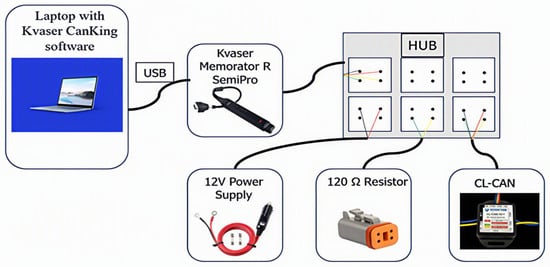
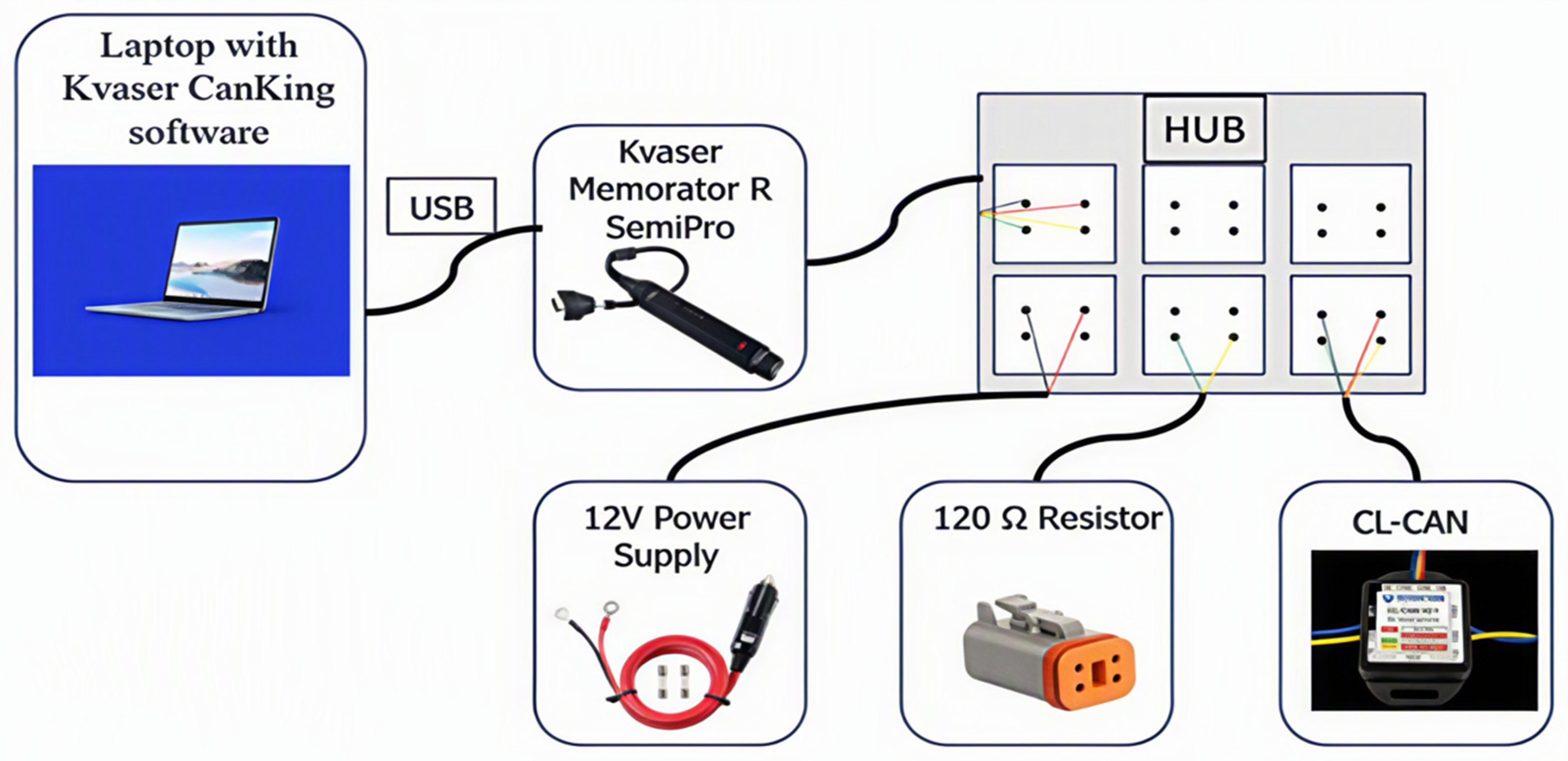
A nondestructive data acquisition method was used to extract data from the vehicle while avoiding interference with or modification of the vehicle’s CAN bus network. For this purpose, a CL-CAN contactless reader (Inventure Automotive Electronics R&D, Plc., Budapest, Hungary) was used, which allowed data to be retrieved from the CAN bus without direct physical connection or intervention. The monitoring of network-transmitted data required a measurement system composed of several interconnected components, as illustrated in Figure 1.
Figure 1.
Measurement system used in this study.
A central element of the setup was the HUB, which provided serial interconnection between the various units. The CL-CAN contactless reader established the interface with the vehicle’s CAN, enabling safe and interference-free data extraction. Although the contactless measurement approach inherently eliminates reflection-related effects, 120 Ω termination resistors were applied to the CAN lines to ensure proper signal integrity.
Power for the measurement system was supplied through the vehicle’s 12 V outlet. For data monitoring and logging, a Kvaser Memorator R SemiPro interface (Kvaser AB, Mölndal, Sweden) was used for CAN data logging and transfer to the monitoring computer. Real-time data visualization was enabled by the Kvaser CANKing software, version 6.25.575 (Kvaser AB, Mölndal, Sweden), which offers full compatibility with the selected hardware and provides the necessary functionality for reliable data handling.
The implemented configuration enabled the acquisition of the vehicle’s raw CAN data, which was recorded in *.txt format for subsequent processing. Since the raw binary sequences could not be directly interpreted, the data were decoded to extract the parameters required for simulation input. The decoding process was limited to the essential variables relevant to the simulation model, namely the steering angle, accelerator pedal position, and brake pedal activity. A *.dbc (CAN database) file created in CANdb++ version 3.1.25 (SP3) (Vector Informatik GmbH, Stuttgart, Germany), was used to decode the required signals (Table 1). The decoded data were validated using VCDS diagnostic software, version 26.3.0 (Ross-Tech LLC, Lansdale, PA, USA). All signals used in the present study were acquired from the CAN communication channel accessible at the EPS ECU connection point. The selected messages were CAN IDs 0x25, 0x226, and 0x245, corresponding to the steering-wheel angle, brake activity, and accelerator-pedal position, respectively, as listed in Table 1. The steering-angle signal represents the steering-wheel angle measured by the steering-angle sensor at the steering column and not the road-wheel steering angle.
Table 1.
Parameters used to create the DBC file.
The CAN bus operated at 500 kbit/s, while the messages containing the steering-wheel-angle, brake-activity, and accelerator-pedal-position signals were transmitted by the vehicle at an update rate of 100 Hz. The recorded signals remained complete and continuous throughout the measurement, so data-loss compensation was unnecessary. During acquisition, all data were recorded in raw form. MATLAB post-processing consisted only of selecting CAN messages with IDs 0x25, 0x226, and 0x245 and decoding the corresponding signals; no numerical signal filtering was applied. Since all signals originated from the same CAN, no additional time synchronization was required, ensuring that the dataset accurately represented the vehicle’s dynamics.
Data collection was carried out on a straight test section, where an avoidance maneuver was performed. During the test, the vehicle accelerated to 50 km/h, bypassed a stationary obstacle representing another passenger vehicle, and then came to a complete stop.
After decoding the recorded CAN messages, the dataset enabled a scenario-level virtual reconstruction of the recorded maneuver, which was subsequently analyzed using the developed simulation model. The following section describes the structure of the simulation environment and the integration of the recorded data into the model.
2.2. Processing of Measurement Data
The recorded CAN data were processed within the MATLAB/Simulink (R2020a) environment (The MathWorks, Inc., Natick, MA, USA), and the reconstructed driving scenario was subsequently reproduced in IPG CarMaker simulation platform, version 11.0 (IPG Automotive GmbH, Karlsruhe, Germany). Since files in *.txt format cannot be directly interpreted by Simulink as CAN messages, conversion to *.mat format was required to obtain a compatible data structure. The conversion was carried out using a custom MATLAB script.
A blank simulation model was prepared in Simulink to enable playback of the recorded data. Using predefined functional blocks, the vehicle CAN messages were retrospectively replayed. Model configuration relied on the Vehicle Network Toolbox, which provides all necessary modules for the construction of automotive communication networks. A virtual CAN configuration was defined, specifying the bus speed (500 kbit/s) and the data transmission channel.
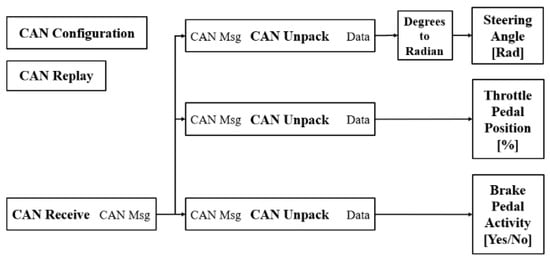
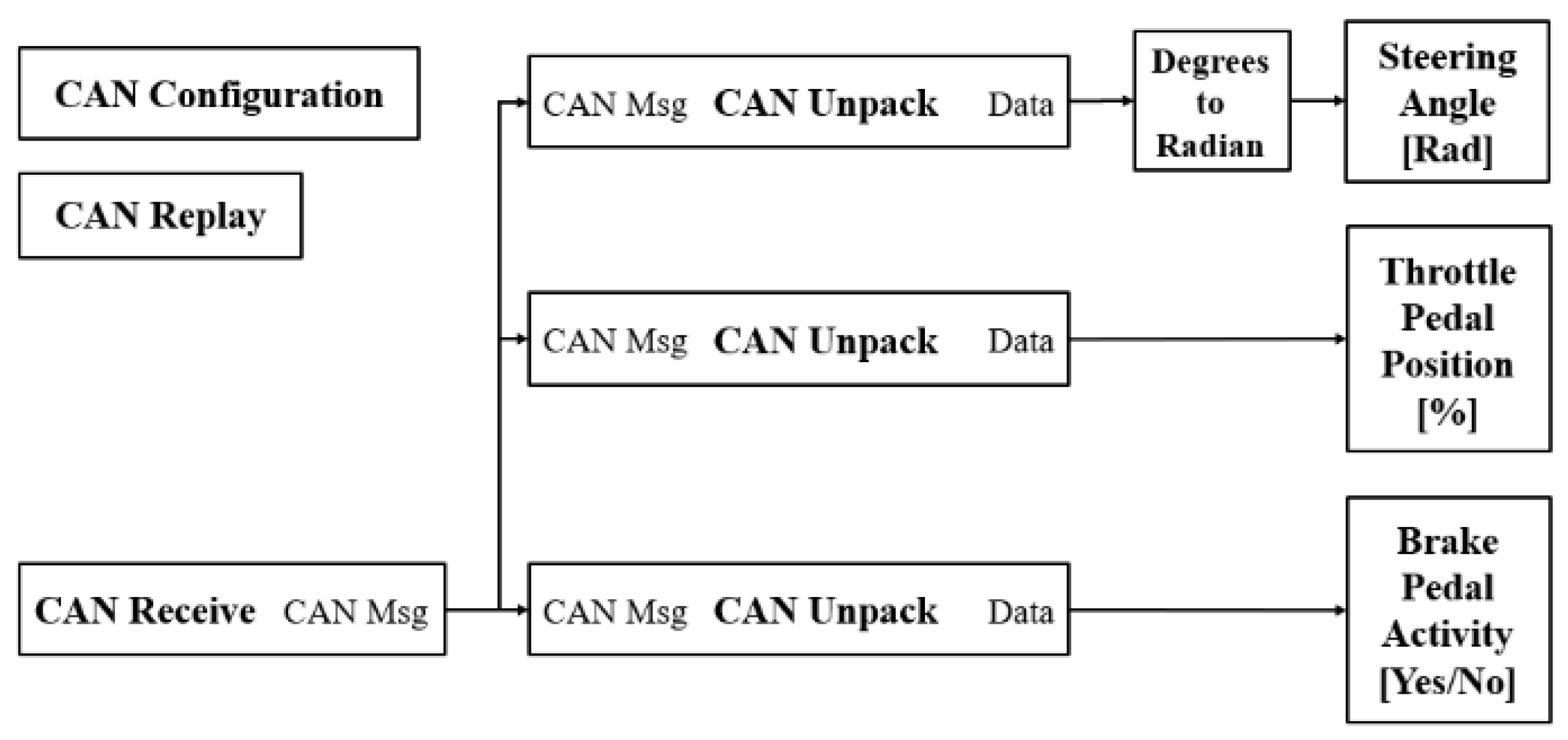
To replay the converted *.mat file, a CAN Replay block was applied. Because the simulation model required structured input signals, each decoded CAN message was converted into a compatible parameter format for replay. During simulation, message reception and decoding were handled by CAN Receive and CAN Unpack blocks, respectively. The final model structure is illustrated in Figure 2.
Figure 2.
Blank model used for data replay.
The steering wheel angle signal were converted from degrees to radians to match the simulation input requirements. The decoded, time-synchronized CAN signals, including steering, accelerator, and braking inputs, were then fed into IPG CarMaker via the MATLAB/Simulink DrivMan interface, which maps the processed commands to the corresponding driver actuation channels. As a result, the steering, braking, and accelerator inputs could be replayed in the virtual vehicle in a repeatable manner while preserving the temporal sequence and functional effects of the recorded driver inputs.
3. Results and Discussion
3.1. Simulation Scenario Definition and Replay Setup
Using the finalized simulation model, the CAN data acquired through the non-contact method were post-processed in a virtual environment. Before running the simulation in IPG CarMaker, the required vehicle and route parameters were defined. Since the real measurements were performed on a straight road section, a comparable two-lane road was created to evaluate the avoidance maneuver.
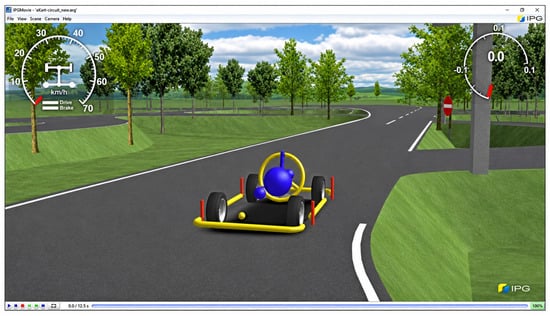
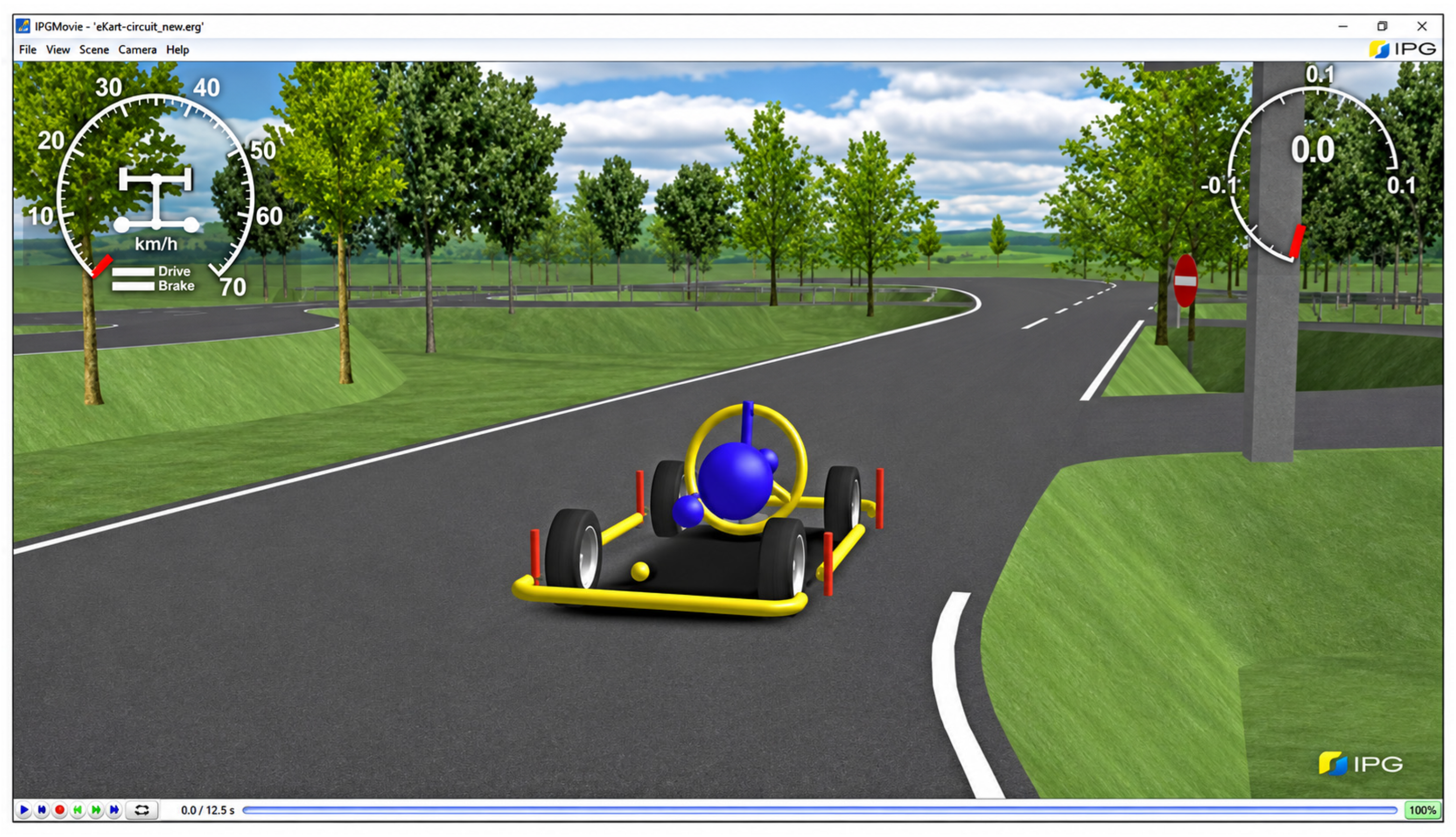
A simplified, preconfigured Volkswagen Golf internal-combustion-engine model was selected because a vehicle-specific VW e-Golf model was not available in the applied CarMaker environment. The mechanical, powertrain, braking, and tire parameters of the vehicle model were left unchanged; only the road scenario, initial vehicle position, and driver-input interfaces were configured. Although the drivetrain differed from that of the measured vehicle, the selected model belonged to the same vehicle family and provided compatible steering-wheel, accelerator-pedal, and brake-pedal input interfaces. Because the primary objective was to demonstrate the functional processing and replay of CAN-derived driver inputs rather than to reproduce the complete vehicle dynamics with high accuracy, the available model was considered sufficient for the proof-of-concept evaluation. External geometry and secondary vehicle attributes were therefore not considered essential. The recorded accelerator-pedal, steering-wheel-angle, and brake signals were mapped to the corresponding longitudinal, lateral, and braking control channels of the simulated vehicle. To recreate the scenario, the vehicle’s initial position was aligned with the right-hand lane of the straight test section, as shown in Figure 3.
Figure 3.
Simulation environment and parameterized vehicle model.
3.2. Simulation Results and Quantitative Comparison
During the simulation, differences were observed between the measured and simulated velocity and braking behavior; therefore, selected input and velocity parameters were compared quantitatively where corresponding measurement data were available. The replayed steering-wheel-angle input produced the expected directional response in the simulation: leftward steering inputs resulted in leftward vehicle motion, while rightward steering inputs resulted in rightward vehicle motion. The acceleration and braking phases also followed the expected temporal sequence observed in the recorded CAN signals, indicating that the driver inputs were correctly interpreted and transferred to the simulation environment. No independent position-based ground-truth measurement was used; therefore, the geometric accuracy of the reconstructed trajectory was not evaluated in the present study.
During the real-world test, a velocity of approximately 50 km/h was maintained with an accelerator pedal position of 6%. In the simulation, the same accelerator input applied to a generic Volkswagen Golf internal combustion engine model resulted in an average velocity of approximately 53 km/h, corresponding to a deviation of +3 km/h, or about +6%. This difference can be explained by variations in drivetrain characteristics, mass distribution, and powertrain response between the measured VW e-Golf and the simulated combustion-engine vehicle model.
The avoidance maneuver was initiated with a steering-wheel angle of 48°, and the same input was reproduced in the simulation. Because the real-world trajectory was not measured using an independent positioning system, the lateral trajectory error could not be quantified. In the recorded CAN data, brake activity was detected at approximately 5% pedal position, and the same input value was applied in the simulation. However, the difference in stopping distance could not be evaluated quantitatively because the real-vehicle stopping distance was not measured using an external reference system. Differences in braking response are nevertheless expected because the measured vehicle was electric, whereas the simulation used an internal-combustion-engine model without regenerative braking. Accordingly, the resulting velocity and braking responses were interpreted as model-dependent outcomes of the replayed inputs rather than as a quantitative validation of the VW e-Golf dynamics.
Table 2 summarizes the recorded input values, the corresponding simulation inputs, and the velocity comparison. Although the input signals were identical, the resulting dynamic response differed because of model parameterization and powertrain differences. Because no independent trajectory ground truth was available, no quantitative conclusion was drawn regarding geometric trajectory accuracy. The results show that the temporal behavior and functional effects of steering, accelerator, and braking inputs were successfully reproduced. Therefore, the proposed framework achieved its primary objective of demonstrating the feasibility of replaying non-contact CAN-derived driver inputs in a simulation environment.
Table 2.
Key parameters and deviations identified during the comparison.
4. Conclusions
The primary objective of this study was to demonstrate the feasibility of retrospectively replaying real vehicle maneuvers in a simulation environment using signals acquired through a non-contact CAN data extraction method. Compared with traditional reconstruction approaches based mainly on mathematical models or synthetic simulation inputs, the proposed method provides a practical data-driven workflow based on real CAN-derived driver inputs. The results confirm that steering, acceleration, and braking inputs recorded during real driving can be successfully decoded, transferred, and functionally reproduced within a virtual vehicle model.
Measurable differences were identified between the measured electric vehicle and the applied combustion-engine-based simulation model; therefore, selected parameters were compared quantitatively to evaluate the magnitude and possible causes of these deviations. The observed differences were mainly attributable to variations in drivetrain configuration, braking characteristics, and vehicle parameterization. However, dynamic equivalence was not the primary goal of the study. Instead, the focus was on establishing a reliable and repeatable workflow for integrating experimentally recorded CAN signals into a structured simulation replay framework.
The presented method enables a parameter-based representation of traffic events in a controlled virtual environment and supports reproducible functional analysis, post-event evaluation, driver assistance system validation, and cost-effective safety investigations. Although the use of a generic vehicle model limited the dynamic accuracy of the simulation, the temporal sequence and functional effects of the recorded driver inputs were successfully reproduced. In particular, the replayed steering-wheel-angle signal produced the expected directional vehicle response, with leftward and rightward steering inputs resulting in the corresponding lateral motion in the simulation. However, because no independent position-based ground-truth measurement was used, the geometric accuracy of the reconstructed trajectory was not evaluated.
Future work will focus on vehicle-specific model calibration, independent trajectory validation using differential GPS or an equivalent positioning system, improved dynamic accuracy, and the extension of the framework to more complex maneuvers and operating conditions. These developments may further increase the applicability of the method for advanced accident reconstruction and virtual validation tasks.
Author Contributions
Conceptualization, methodology, investigation, writing—original draft preparation, writing—review and editing, B.B.; simulation, writing—review and editing, M.I. All authors have read and agreed to the published version of the manuscript.
Funding
This research received no external funding.
Institutional Review Board Statement
Not applicable.
Informed Consent Statement
Not applicable.
Data Availability Statement
The original contributions presented in this study are included in the article. Further inquiries can be directed to the corresponding author.
Conflicts of Interest
The authors declare no conflicts of interest.
References
- Bortles, W.; Biever, W.; Carter, N.; Smith, C. A compendium of passenger vehicle event data recorder literature and analysis of validation studies. In Proceedings of the SAE 2016 World Congress and Exhibition, Detroit, MI, USA, 12–14 April 2016. [Google Scholar] [CrossRef] [Scilit]
- Iyoda, M.; Trisdale, T.; Sherony, R.; Mikat, D.; Rose, W. Event data recorder (EDR) developed by Toyota Motor Corporation. SAE Int. J. Transp. Saf. 2016, 4, 187–201. [Google Scholar] [CrossRef] [Scilit]
- Navet, N.; Song, Y.Q.; Simonot-Lion, F.; Wilwert, C. Trends in automotive communication systems. Proc. IEEE 2005, 93, 1204–1223. [Google Scholar] [CrossRef] [Scilit]
- Böhm, K.; Kubjatko, T.; Paula, D.; Schweiger, H.G. New developments on EDR (Event Data Recorder) for automated vehicles. Open Eng. 2020, 10, 140–146. [Google Scholar] [CrossRef] [Scilit]
- Vida, G.; Török, Á. Effects of developing data recording technologies on the reliability of accident reconstruction and liability determination. Eur. Transp. Res. Rev. 2025, 17, 34. [Google Scholar] [CrossRef] [Scilit]
- Chen, Y.; Chen, S.; Zhang, T.; Zhang, S.; Zheng, N. Autonomous vehicle testing and validation platform: Integrated simulation system with hardware in the loop. In Proceedings of the 2018 IEEE Intelligent Vehicles Symposium (IV), Changshu, China, 26–30 June 2018. [Google Scholar] [CrossRef] [Scilit]
- Ziegler, S.; Höpler, R. Extending the IPG CarMaker by FMI compliant units. In Proceedings of the 8th International Modelica Conference, Dresden, Germany, 20–22 March 2011. [Google Scholar] [CrossRef] [Scilit][Green Version]
- Widner, A.; Tihanyi, V.; Tettamanti, T. Framework for vehicle dynamics model validation. IEEE Access 2022, 10, 35422–35436. [Google Scholar] [CrossRef] [Scilit]
- Henning, K.-U.; Sawodny, O. Vehicle dynamics modelling and validation for online applications and controller synthesis. Mechatronics 2016, 39, 113–126. [Google Scholar] [CrossRef] [Scilit]
- Yildirim, M.; Catalbas, M.C.; Gulten, A.; Kurum, H. Computation of the speed of four in-wheel motors of an electric vehicle using a radial basis neural network. Eng. Technol. Appl. Sci. Res. 2016, 6, 1288–1293. [Google Scholar] [CrossRef] [Scilit]
- Koç, M.A.; Esen, İ. Modelling and analysis of vehicle-structure-road coupled interaction considering structural flexibility, vehicle parameters and road roughness. J. Mech. Sci. Technol. 2017, 31, 2057–2074. [Google Scholar] [CrossRef] [Scilit]
- Evtiukov, S.; Kurakina, E.; Lukinskiy, V.; Ushakov, A. Methods of accident reconstruction and investigation given the parameters of vehicle condition and road environment. Transp. Res. Procedia 2017, 20, 185–192. [Google Scholar] [CrossRef] [Scilit]
- Guzek, M.; Lozia, Z. Computing methods in the analysis of road accident reconstruction uncertainty. Arch. Comput. Methods Eng. 2021, 28, 2459–2476. [Google Scholar] [CrossRef] [Scilit]
- Chen, Y.; Zhang, Q.; Yu, F. Transforming traffic accident investigations: A virtual-real-fusion framework for intelligent 3D traffic accident reconstruction. Complex Intell. Syst. 2025, 11, 76. [Google Scholar] [CrossRef] [Scilit]
- Liu, Y.; Wan, X.; Xu, W.; Shi, L.; Deng, G.; Bai, Z. An intelligent method for accident reconstruction involving car and e-bike coupling automatic simulation and multi-objective optimizations. Accid. Anal. Prev. 2022, 164, 106476. [Google Scholar] [CrossRef] [Scilit] [PubMed]
- Cai, M.; Zou, T.; Luo, P.; Li, J. Evaluation of simulation uncertainty in accident reconstruction via combining response surface methodology and Monte Carlo method. Transp. Res. Part C Emerg. Technol. 2014, 48, 241–255. [Google Scholar] [CrossRef] [Scilit]
- Qin, H.; Yan, M.; Ji, H. Application of controller area network (CAN) bus anomaly detection based on time series prediction. Veh. Commun. 2021, 27, 100291. [Google Scholar] [CrossRef] [Scilit]
- Spencer, G.; Mateus, F.; Torres, P.; Dionísio, R.; Martins, R. Design of CAN bus communication interfaces for forestry machines. Computers 2021, 10, 144. [Google Scholar] [CrossRef] [Scilit]
- Johansson, K.H.; Törngren, M.; Nielsen, L. Vehicle applications of Controller Area Network. In Handbook of Networked and Embedded Control Systems; Hristu-Varsakelis, D., Levine, W.S., Eds.; Birkhäuser: Boston, MA, USA, 2005; pp. 741–765. [Google Scholar] [CrossRef] [Scilit] [PubMed]
- Han, K.; Mun, H.; Balakrishnan, M.; Yeun, C.Y. Enhancing security and robustness of Cyphal on Controller Area Network in unmanned aerial vehicle environments. Comput. Secur. 2023, 135, 103481. [Google Scholar] [CrossRef] [Scilit]
- Prodanov, W.; Valle, M.; Buzas, R. A Controller Area Network bus transceiver behavioral model for network design and simulation. IEEE Trans. Ind. Electron. 2009, 56, 3762–3771. [Google Scholar] [CrossRef]
- Popa, L.; Berdich, A.; Groza, B. CarTwin—Development of a digital twin for a real-world in-vehicle CAN network. Appl. Sci. 2023, 13, 445. [Google Scholar] [CrossRef] [Scilit]
- Zhao, Z.A.; Sun, Y.; Li, D.; Cui, J.; Guan, Z.; Liu, J. A scalable security protocol for intravehicular Controller Area Network. Secur. Commun. Netw. 2021, 2021, 2314520. [Google Scholar] [CrossRef] [Scilit]
- Kubis, M.; Gutten, M.; Korenciak, D.; Danko, M. Communication of cluster using CAN bus. Communications 2019, 21, 69–74. [Google Scholar] [CrossRef] [Scilit]
- Kim, D.-S.; Tran-Dang, H. Communication Using Controller Area Network Protocol. In Industrial Sensors and Controls in Communication Networks; Springer: Cham, Switzerland, 2019; pp. 31–41. [Google Scholar] [CrossRef] [Scilit]
- Funes, G.; Siller, M.; Horta, J. Modelling, simulation, and performance analysis of intra-vehicular heterogeneous networks. Wirel. Pers. Commun. 2023, 133, 1693–1747. [Google Scholar] [CrossRef] [Scilit]

Disclaimer/Publisher’s Note: The statements, opinions and data contained in all publications are solely those of the individual author(s) and contributor(s) and not of MDPI and/or the editor(s). MDPI and/or the editor(s) disclaim responsibility for any injury to people or property resulting from any ideas, methods, instructions or products referred to in the content. |
© 2026 by the authors. Licensee MDPI, Basel, Switzerland. This article is an open access article distributed under the terms and conditions of the Creative Commons Attribution (CC BY) license.