


Abstract
The Box Compression Test (BCT) values of corrugated board boxes are traditionally determined under perpendicular loading; however, inclined, non-perpendicularly stacked unit loads in the supply chain frequently cause damage. In our research, we investigated the load-bearing capacity of two boxes of the same material quality (3-ply, type 21B) but with different slenderness ratios (SA = 0.323, SB = 0.356) at inclination angles ranging from 0° to 3.576°. Our results highlighted an interesting discrepancy: while the load-bearing capacity of the smaller, squatter box decreased, even under slight inclination, the more slender, larger box remained more stable, successfully retaining its original load-bearing capacity without any statistically significant loss within the critical angle range. In this study, we propose extending the McKee formula with an inclination-dependent correction factor to facilitate the determination of more accurate safety factors during packaging design.
1. Introduction
In modern logistics and supply chain systems, corrugated board packaging plays a critical role in product protection, transportation safety, and warehousing efficiency. The stacking stability and load-bearing capacity of corrugated boxes are therefore fundamental aspects of packaging engineering and transport optimization. The compressive resistance of corrugated containers is commonly evaluated using the Box Compression Test (BCT), which remains one of the most important indicators for predicting stacking performance during storage and transportation [1,2,3,4,5].
The classical McKee formula remains one of the most widely used industrial methods for estimating box compression strength based on board properties and box geometry [1]. Standardized BCT measurements, such as those performed according to the ISO 12048 and ASTM D642 standards [2,3], are typically conducted with the corrugated box positioned perfectly vertically while under compressive load. However, this ideal assumption is rarely met during actual transport and storage operations.
The mechanical behaviour of corrugated board packaging has been extensively investigated in the literature, particularly regarding compressive strength, geometric stiffness, buckling behaviour, and the influence of structural design parameters. Biancolini and Brutti [4] demonstrated that the structural response of corrugated packaging strongly depends on panel deformation and instability mechanisms, while Biancolini [5] highlighted the importance of equivalent stiffness properties in determining package performance. More recent studies have also shown that crease geometry, vent hole design, and local structural modifications may significantly influence the compressive resistance of corrugated boxes [6,7,8,9].
During handling and distribution processes, pallet misalignment, forklift tilting, floor irregularities, and transport-induced vibrations may introduce eccentric or inclined loading conditions that substantially alter the stress distribution within the box structure [10,11]. Previous investigations have further shown that geometric proportions significantly influence the deformation and failure mechanisms of corrugated packaging. The slenderness ratio of the box affects the transition between global panel buckling and localized edge-dominated instability phenomena. Nevertheless, despite the industrial relevance of transport-induced inclinations and asymmetric loading conditions, the combined influence of inclination angle and geometric slenderness on BCT performance has received relatively limited attention in the available literature.
In our previous research [12], the creep behaviour and mechanical performance of corrugated paperboard packaging used in poultry logistics applications were investigated. Building upon this research direction, the present study examines the effect of inclined loading on the compressive behaviour of corrugated boxes manufactured from identical 3-ply 21B corrugated board but possessing different geometric slenderness ratios.
The objective of this research is to demonstrate that the reduction in load-bearing capacity caused by inclination is governed not only by material quality but also by box geometry and structural slenderness. The BCT values determined through the experiment are compared with the predictions of the classical McKee theory, and then the introduction of an angle-dependent correction factor is proposed to improve the accuracy of estimating the compressive strength of the boxes under real-world loading conditions.
2. The Role of the Slenderness Ratio
The slenderness ratio is of key importance for load-bearing capacity, as it determines at what point the box wall becomes prone to buckling instead of pure compression. In the case of corrugated board boxes, slenderness is not interpreted as a single value, but rather in the context of box height and perimeter. In the literature, slenderness is most commonly expressed by the following ratio:
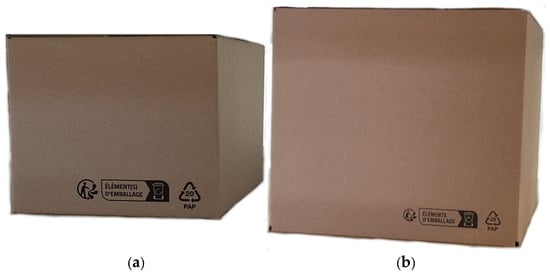
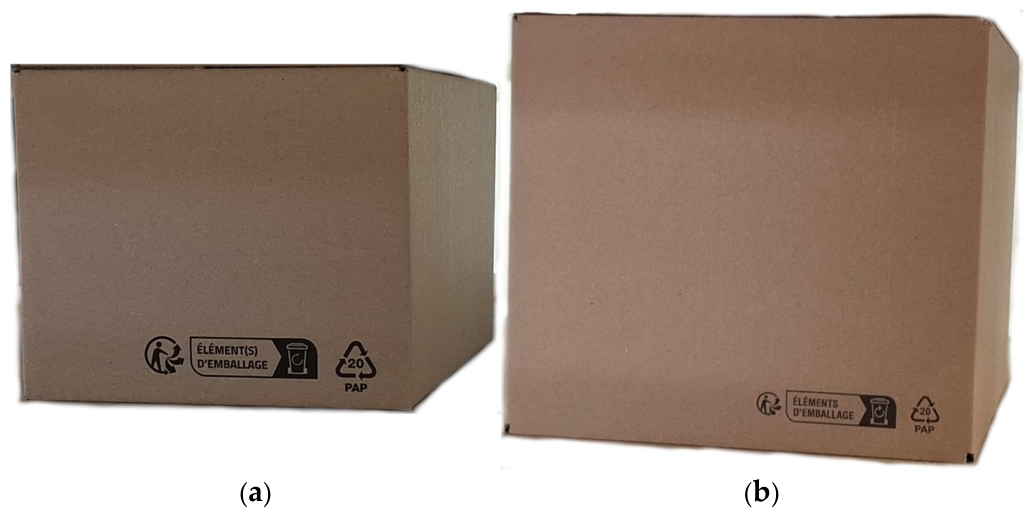
where H is the box height (mm) and Z is the box perimeter (mm). The geometric parameters of the tested samples are summarized in Table 1. Figure 1 shows the tested Box “A” and Box “B” samples.
Table 1.
Geometric parameters and slenderness ratios of the tested boxes.
Figure 1.
Tested box samples. (a) Box “A” with dimensions 280 × 200 × 310; (b) Box “B” with dimensions 340 × 250 × 420.
3. Materials and Methods
3.1. Materials and Sample Preparation
For the tests, we used two boxes with different geometries but identical material quality (3-ply, type 21B corrugated board, Reményi Csomagolástechnika Kft., Győr, Hungary). The main geometric parameters and the calculated slenderness ratios (S = H/Z) of samples “A” and “B” are presented in Table 1 (see above). The samples were conditioned under standard laboratory conditions for 24 h prior to measurement. Five replicate measurements were performed for each angle of inclination to ensure statistical reliability, and five control boxes were also measured.
3.2. Experimental Setup and Tilt Angle Calculation
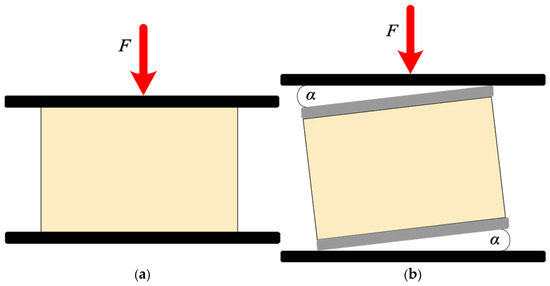
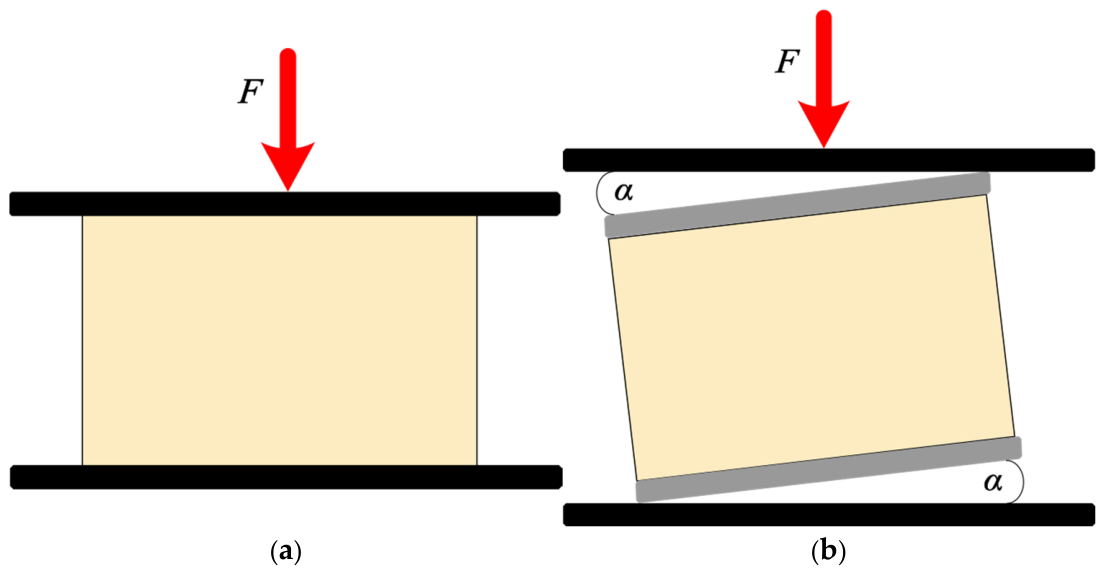
The measurements were performed using a BCT testing machine equipped with a pressure plate operating at a constant speed of 12.7 mm/min. The angles of inclination were set using precision wedges placed at the bottom of the box, thereby ensuring the reproducibility of the experiments. The angle of inclination (α) was determined based on the height of the wedge (hw) and the corresponding width of the box (w) using the following trigonometric relationship:
With this setup, a precise control of the load eccentricity was possible. Because of the inclined angle, the stress distribution along the edges of the box becomes asymmetric. As a result of this, local stress concentrations occur at the critical points. Figure 2a shows the standard BCT setup used for the control samples, while Figure 2b depicts the BCT setup with different angles of inclination used in the study.
Figure 2.
Box Compression Test (BCT) setup. (a) Standard BCT setup; (b) BCT setup with inclination angle.
4. Results and Discussion
4.1. Analysis of Stability Loss
The measurement results (Table 2) clearly show the fundamental differences between the two box geometries.
Table 2.
Absolute load-bearing capacity (BCT) of the tested boxes at various inclination angles. Data are presented as mean ± standard deviation, with p-values indicating statistical significance compared with the control group (0°).
For the evaluation, the loss of stability (ΔBCT%) was defined as the percentage deviation relative to the ideal 0° control box using the following equation:
To better compare the behavior of the stocky and slender boxes, the calculated relative changes in stability for the tested tilt angles are summarized in Table 3.
Table 3.
Relative change in load-bearing capacity (ΔBCT%) as a function of the inclination angle.
As the data in Table 3 demonstrates, the relative change in load-bearing capacity reveals a stark contrast between the two box geometries under inclined conditions.
Performance of Box “A”: Even at the first inclination angle (1.34°), it lost more than a quarter of its load-bearing capacity (−25.77%), which proved to be a statistically significant drop (p = 0.001). This indicates that the squatter shape is highly sensitive to even the slightest misalignment.
Anomalous behavior of Box “B”: Although it experienced an initial strength reduction at 1.34°, its load-bearing capacity fully recovered at larger angles. Specifically, at 2.68°, the change was minimal (−0.01%), and at the maximum inclination (3.576°) it showed a nominal variation of +2.22%. However, statistical analysis (independent t-test, p > 0.05) revealed that these variations for Box “B” were not statistically significant compared with the vertical control. This means that despite the inclination, Box “B” successfully retained its structural integrity and load-bearing capacity, behaving completely differently from Box “A”. This statistically confirms the presence of the slenderness anomaly.
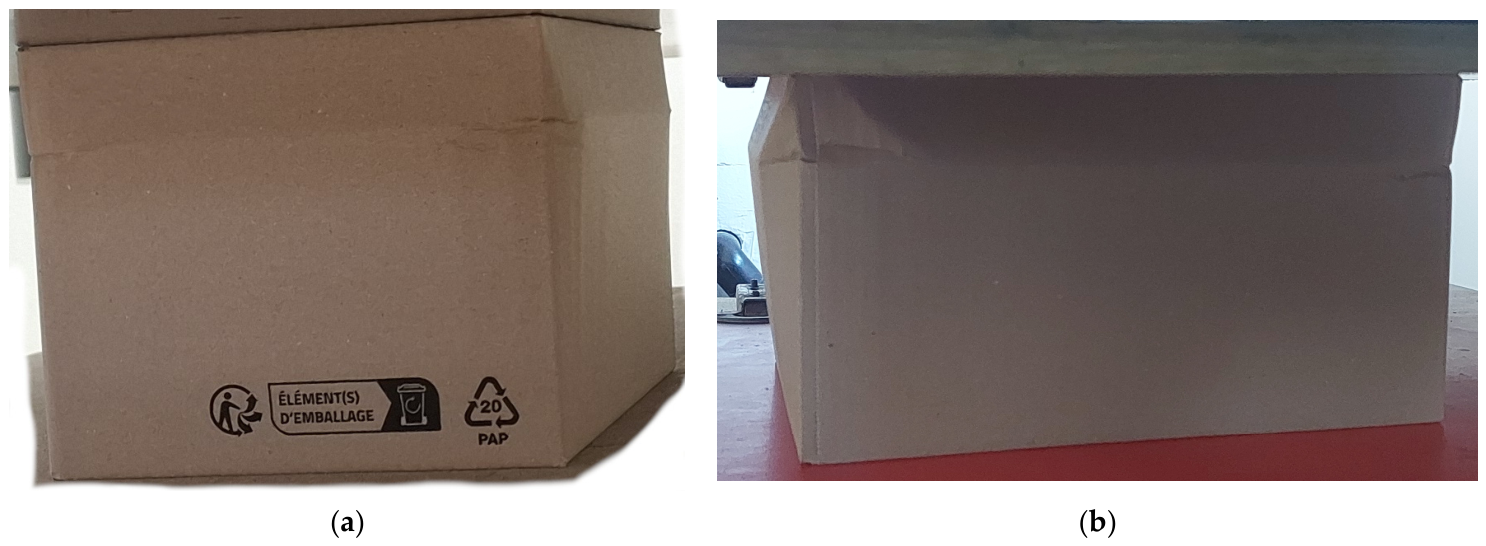
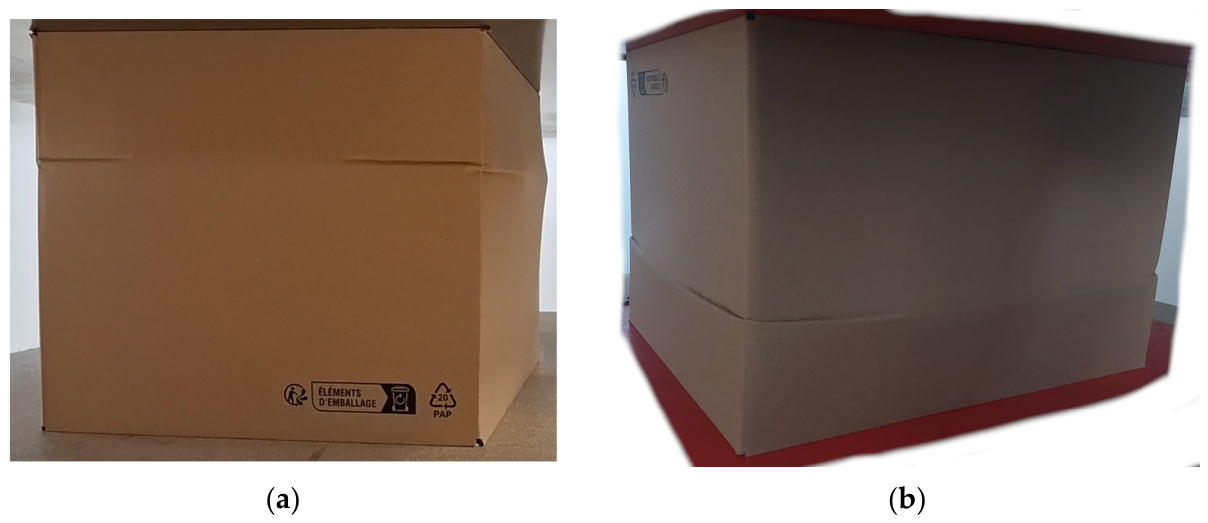
Figure 3a illustrates the damage observed on the Box “A” control sample and Figure 3b shows the damage that occurred on the Box “A” with δ = 3.576° inclination angle. Figure 4a presents the damage observed on the Box “B” control sample, while Figure 4b illustrates the damage observed on the Box “B” sample with the δ = 3.576° inclination angle.
Figure 3.
Damages of Box “A”. (a) Control sample with 0° inclination angle; (b) BCT with δ = 3.576° inclination angle.
Figure 4.
Damages of Box “B”. (a) Control sample with 0° inclination angle; (b) BCT with δ = 3.576° inclination angle.
4.2. Scientific Explanation of the Slenderness Anomaly
The contrasting behavior of the two boxes under inclined loading reveals a fundamental difference in their structural response. In the case of the stocky Box “A” (SA = 0.323), the inclined load immediately results in a high reduction in load-bearing capacity, which reaches its lowest point at an angle of α (1.34°), where the box loses more than 25% of its strength. The stress peak quickly exceeds the buckling limit of the smaller panels, as they offer less surface area for energy absorption.
In contrast, the slender Box “B” (SB = 0.356) exhibits a distinct performance trend, demonstrating an inherent self-regulating mechanism. While there is an initial strength reduction at the α (1.34°) angle, statistical analysis shows that the load-bearing capacity fully recovers and stabilizes at larger inclination angles (γ and δ). The scientific rationale behind this is the “corner effect”. Due to the higher slenderness and greater absolute dimensions of Box “B”, the eccentric loading vector shifts the stress concentrations predominantly toward the vertical edges (corners), which are the most rigid structural elements of a corrugated box. The larger panel dimensions allow for a more elastic redistribution of stress, successfully compensating for the geometric instability caused by the inclination, thereby preventing any statistically significant loss in overall compression strength.
4.3. Proposal for a Modified McKee-Model
The traditional McKee formula calculates the Box Compression Test (BCT) value under the assumption of perfect, perpendicular loading. To account for the realities of the supply chain, we propose extending the model with a dimensionless, inclination- and slenderness-dependent correction factor, denoted as k(α,S). The modified formula is expressed as:
Based on our empirical data, k can be calculated as the ratio of the inclined BCT to the standard vertical BCT. As shown in Table 4, the correction factor clearly quantifies the slenderness anomaly. In the case of Box “A”, the kA value reflects a significant reduction in structural performance, which decreases to 0.742 at an angle of α (a 25.8% reduction in load-bearing capacity). In contrast, the kB value shows significant stability, fully recovering at the γ angle (kB = 1.000). While it reaches a nominal value of 1.022 at the maximum tested inclination angle (δ), statistical analysis confirms that this does not represent a significant increase. Instead, it demonstrates that Box “B” effectively maintains its original strength (kB ≈ 1.000) without any statistically significant loss despite the severe tilt.
Table 4.
Calculated k correction factors as a function of inclination angle and geometric slenderness.
Due to the highly non-linear relationship between slenderness and inclination, we propose that currently, k(α,S) should be integrated into packaging design software as an empirically derived matrix. Establishing a universal mathematical function for k requires further extensive testing across a wider spectrum of slenderness ratios.
5. Conclusions
Under real-world logistics conditions, stacking corrugated boxes perfectly vertically is merely a theoretical ideal, not a practical reality. In this study, we examined the effect of the tilt angle of corrugated cardboard boxes on their load-bearing capacity. Based on the results, the decrease in box strength is primarily determined by the box’s geometric slenderness, and not solely by the quality of the material.
The results revealed a slenderness anomaly: while the stocky boxes (Box “A”) suffer a statistically significant loss of strength even at small angles of inclination (up to a 25.8% loss), the slimmer boxes (Box “B”) exhibit remarkable flexibility and resilience. Instead of weakening, Box “B” successfully retained its structural integrity at larger angles, with statistical analysis confirming no significant loss in load-bearing capacity (despite a nominal variation of +2.2%). Thus, an increase in the tilt angle does not cause a strictly linear reduction in the BCT value. Above a critical angle, the load-bearing capacity stagnates and stabilizes, thanks to the favorable redistribution of stress to the rigid vertical edges.
Consequently, relying solely on the classic McKee formula and general safety factors during packaging design is insufficient and potentially economically wasteful. For stocky boxes, significantly higher safety factors are required to compensate for the instability caused by the angle of inclination. For slender boxes, overdesign is not necessarily required due to the smaller angles of inclination. We proposed a modified McKee model incorporating an empirical k(α,S) correction factor to bridge this gap. Future research should focus on mapping this correction factor across a continuous spectrum of box geometries to optimize sustainable and safe packaging design.
Despite utilizing a standard 3-ply corrugated board (HPL), structural stability can be maintained even under slight logistical tilts, provided the box geometry is appropriately optimized. This highlights that over-packaging with thicker materials is not always necessary if the slenderness ratio is favorable.
Author Contributions
Conceptualization, R.P. and L.F.; formal analysis, R.P. and L.F.; funding acquisition, R.P.; investigation, R.P., L.F.; methodology, R.P. and L.F.; supervision, R.P.; visualization, R.P. and L.F.; writing—original draft, R.P.; writing—review and editing, L.F. and R.P. All authors have read and agreed to the published version of the manuscript.
Funding
This research received no external funding.
Institutional Review Board Statement
Not applicable.
Informed Consent Statement
Not applicable.
Data Availability Statement
The data published in this research are available on request from the first author and corresponding authors.
Acknowledgments
We would like to acknowledge Reményi Csomagolástechnika Kft., which made the samples for measurements available free of charge for this study.
Conflicts of Interest
The authors declare no conflicts of interest.
References
- McKee, R.C.; Gander, J.W.; Wachuta, J.R. Compression strength formula for corrugated boxes. Paperboard Packag. 1963, 48, 149–159. [Google Scholar]
- ISO 12048; Packaging—Complete, Filled Transport Packages—Compression and Stacking Tests Using a Compression Tester. International Organization for Standardization: Geneva, Switzerland, 2000.
- ASTM D642-20; Standard Test Method for Determining Compressive Resistance of Shipping Containers, Components, and Unit Loads. ASTM International: West Conshohocken, PA, USA, 2020. [CrossRef] [Scilit]
- Biancolini, M.E.; Brutti, C. Numerical and experimental investigation of the strength of corrugated board packages. Packag. Technol. Sci. 2003, 16, 47–60. [Google Scholar] [CrossRef] [Scilit]
- Biancolini, M.E. Evaluation of equivalent stiffness properties of corrugated board. Compos. Struct. 2005, 69, 322–328. [Google Scholar] [CrossRef] [Scilit]
- Fadiji, T.; Coetzee, C.J.; Opara, U.L. Compression strength of ventilated corrugated paperboard packages: Numerical modelling, experimental validation and effects of vent geometric design. Biosyst. Eng. 2016, 151, 231–247. [Google Scholar] [CrossRef] [Scilit]
- Fadiji, T.; Berry, T.M.; Coetzee, C.J.; Opara, U.L. Mechanical design and performance testing of corrugated paperboard packaging for the postharvest handling of horticultural produce. Biosyst. Eng. 2018, 171, 220–244. [Google Scholar] [CrossRef] [Scilit]
- Garbowski, T.; Gajewski, T.; Knitter-Piątkowska, A. Influence of analog and digital crease lines on mechanical parameters of corrugated board and packaging. Sensors 2022, 22, 4800. [Google Scholar] [CrossRef] [Scilit] [PubMed]
- Mrówczyński, D.; Garbowski, T.; Knitter-Piątkowska, A. Estimation of the compressive strength of corrugated board boxes with shifted creases on the flaps. Materials 2021, 14, 5181. [Google Scholar] [CrossRef] [Scilit] [PubMed]
- Böröcz, P.; Singh, S.P. Measurement and analysis of delivery van vibration levels to simulate package testing for parcel delivery in Hungary. Packag. Technol. Sci. 2017, 31, 342–352. [Google Scholar] [CrossRef] [Scilit]
- Böröcz, P. Vibration and acceleration levels of multimodal container shipping physical environment. Packag. Technol. Sci. 2019, 32, 269–277. [Google Scholar] [CrossRef] [Scilit]
- Fehér, L.; Pidl, R.; Böröcz, P. Creep behaviour of day-old chicken corrugated paperboard packaging under different uniaxial compression loads—An experimental study. Packag. Technol. Sci. 2024, 37, 51–63. [Google Scholar] [CrossRef] [Scilit]

Disclaimer/Publisher’s Note: The statements, opinions and data contained in all publications are solely those of the individual author(s) and contributor(s) and not of MDPI and/or the editor(s). MDPI and/or the editor(s) disclaim responsibility for any injury to people or property resulting from any ideas, methods, instructions or products referred to in the content. |
© 2026 by the authors. Licensee MDPI, Basel, Switzerland. This article is an open access article distributed under the terms and conditions of the Creative Commons Attribution (CC BY) license.