Communication Failures in UAV-Based Wildfire Monitoring: Causes, Cascading Effects, and Resilience Strategies †

Abstract
1. Introduction
2. Communication Architectures of Systems for Unmanned Aerial Vehicles (UAVs)
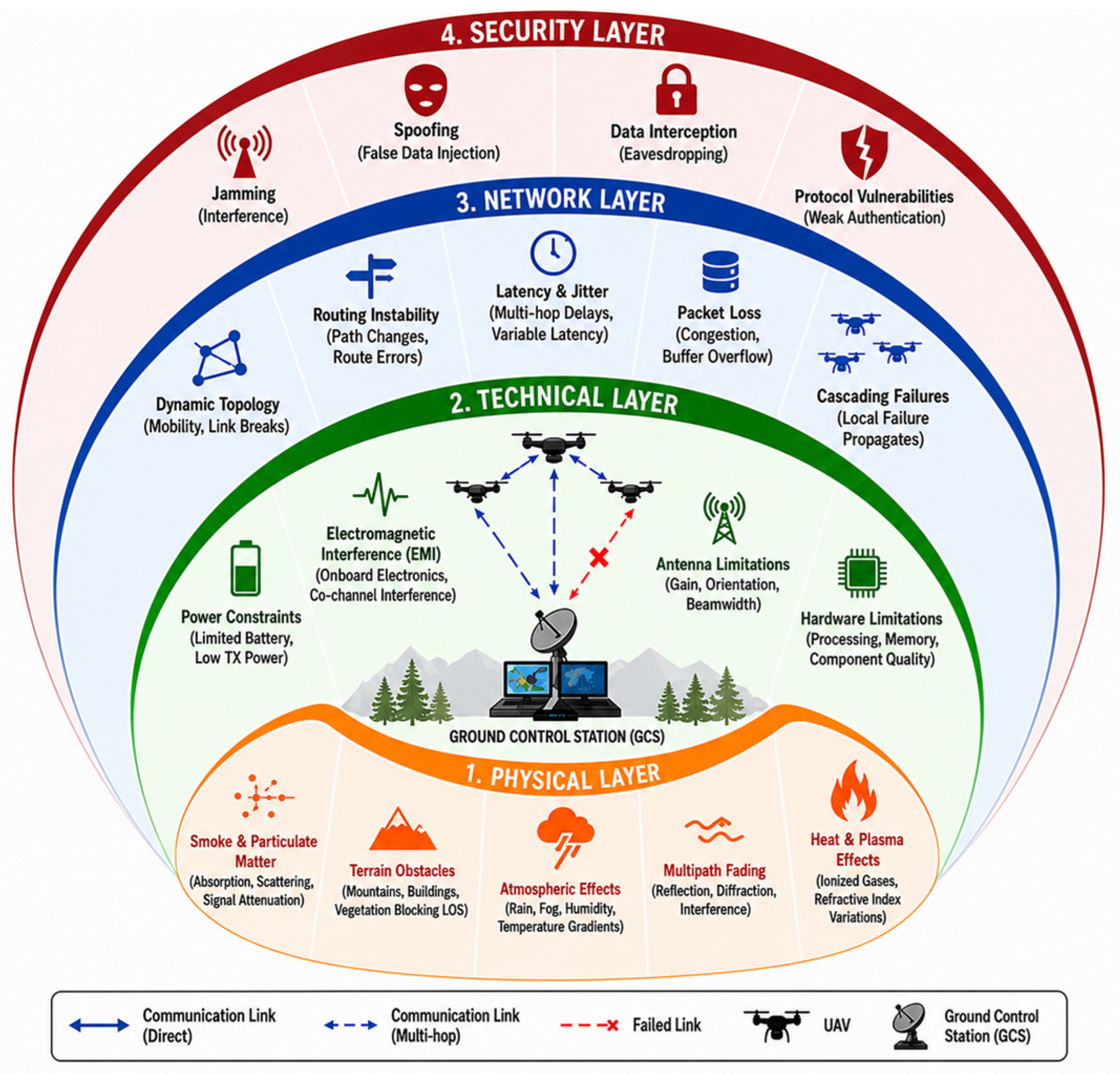
3. Systematic Analysis of Communication Failure Causes: Multi-Layered Framework
3.1. Fundamental Limitations at the Physical Layer
3.2. Technical-Layer Factors
3.3. Network-Layer Factors
3.4. Security-Layer Factors
3.5. Cross-Layer Interactions and Failure Cascades
3.6. Formalization of Failure Propagation
3.7. Comparative Analysis of Failure Factors Across Layers
3.8. Integrated Cross-Layer Perspective
- Adaptive modulation and coding schemes can be activated by physical-layer degradation (low SNR);
- Dynamic routing can help to reduce network-layer congestion;
- Anomaly-based monitoring can be used to detect security threats.
4. The Implications of Failed Communication
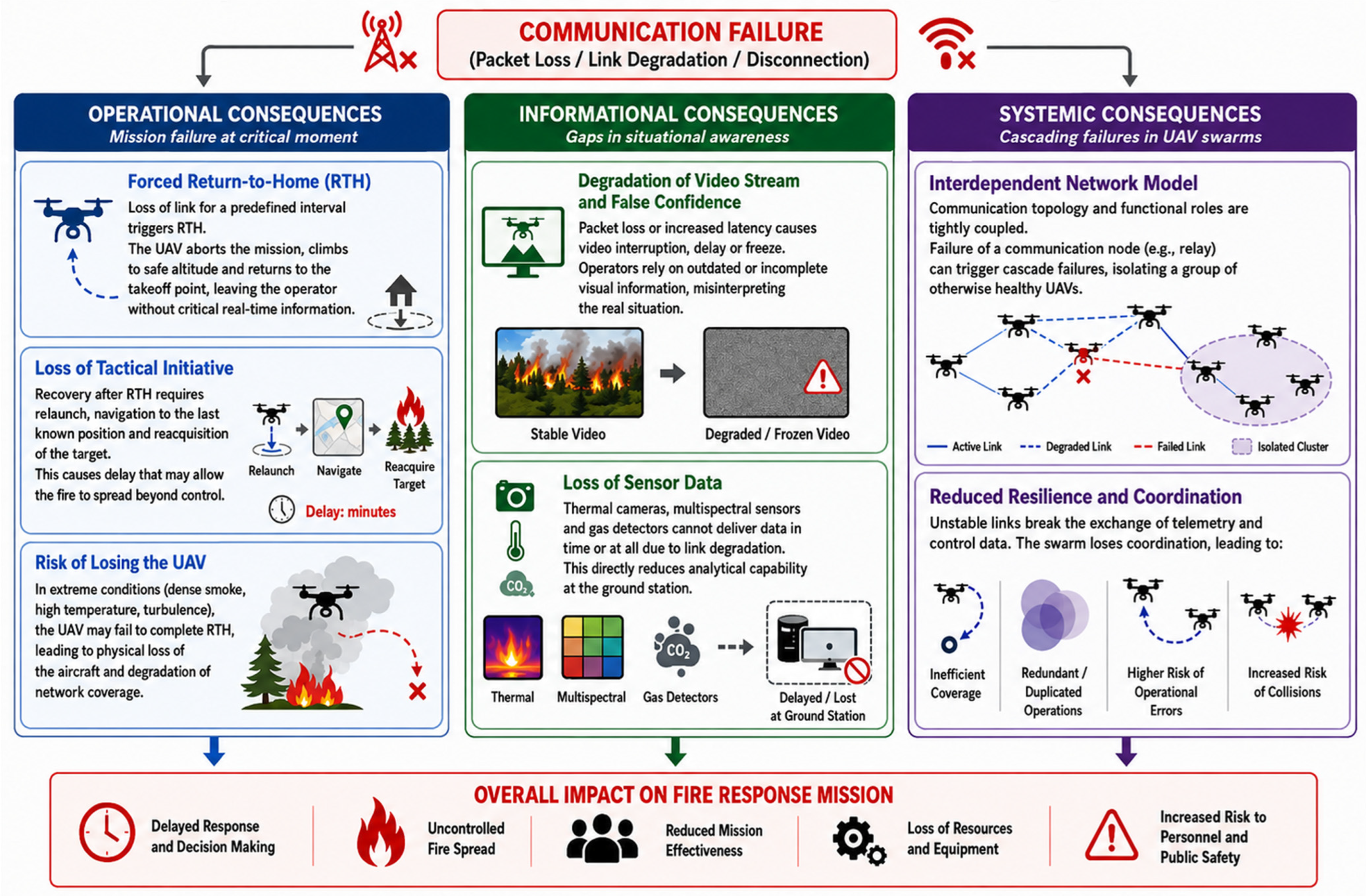
4.1. Operational Consequences—Mission Failure at Critical Junctures
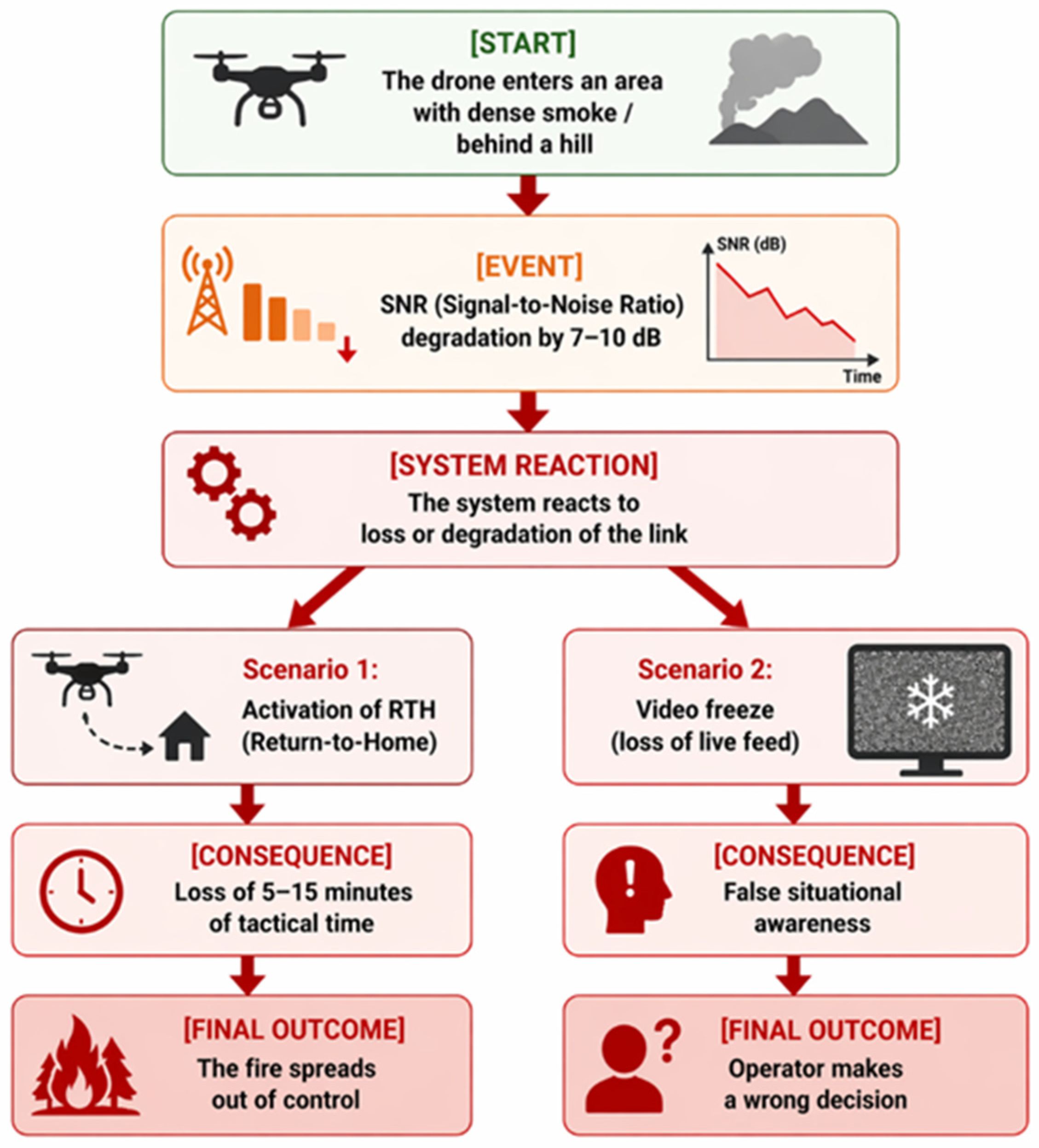
- Mandatory Return-to-Home (RTH—Return-to-Home). The onboard flight controller triggers RTH functionality when a connection to the ground station is lost, usually after a predetermined time interval (a few seconds). When activated, the drone abandons its mission, enters a fail-safe flight mode, and flies back to its starting point. In a situation of firefighting operations, this implies that the UAV may leave a high-value-information area at a critical point in surveillance, leaving the operator without critical situational awareness. Figure 4 shows the cause-and-effect chain by which signal degradation (SNR reduction) in a challenging environment triggers a reaction, including Return-to-Home (RTH) activation or video stream degradation.
- The cascade model in Figure 4 shows and explains the sequential propagation of communication failures in UAV-based fire-monitoring systems. It also explains and highlights how a low-level communication issue escalates into a high-impact issue with operational consequences. This process begins to occur when the UAV enters an extremely difficult environment characterized by dense smoke or terrain obstructions, leading to degradation of the signal-to-noise ratio (SNR). This interferes with the physical layer and directly affects the quality of the communication, which triggers system-level responses designed to preserve the platform, like fail-safe mechanisms or adaptive communication strategies. Two main scenarios of system operation have been identified. In the first scenario, the system activates a Return-to-Home (RTH) procedure, resulting in mission interruption and loss of critical observation time. In the second scenario, the operator cannot assess the exact situation due to deteriorating communication, which, in turn, disrupts the video stream, leading to freezing, delays, or worse. Ultimately, communication failure leads to high-level operational consequences in both scenarios. The loss of real-time situational awareness may lead to delayed or incorrect decision-making. Mission interruptions may allow the fire to spread beyond the control of the fire teams, making it unstoppable, unpredictable, and hard to monitor and making it difficult to gather information on its spread. This model demonstrates how failures in communication in UAV systems are serious and should not be treated as isolated technical issues but rather as a likely cascading process that propagates across system layers and directly affects mission effectiveness.
- Loss of Tactical Initiative. The process of mission recovery following an RTH activation entails a series of time-consuming steps: re-launching the aircraft, transiting back to the last known coordinates, and re-establishing either visual or sensory contact with the target area. This introduces a significant tactical lag, the impact of which depends on the operational environment. In the specific case of rapidly evolving wildfires, such a delay can be catastrophic, allowing the fire front to propagate unimpeded beyond the window of effective containment.
- Risk of Asset Attrition. Operation under extreme conditions is a hard task for anyone. Specifically, when navigating through dense smoke plumes, intense thermal radiation, and turbulent updrafts, there is a small, even tiny, probability that the UAV may fail to execute its recovery sequence effectively. Even outside these scenarios, a brief loss of communication can also escalate into a loss of physical network contact with the aircraft or drone. Events of this type not only result in hardware loss. Several instances of degradation of overall network coverage put the reliability of the remaining communication infrastructure at risk.
4.2. Informational Repercussions and Eroded Situational Awareness
- Video stream deterioration and false confidence. Packet loss and jitter often result in video feeds that are intermittent, delayed, or “frozen.” Such distortions introduce a dangerous risk of misinterpretation; the operator may inadvertently base tactical decisions on outdated or fragmented visual cues while the fire’s actual dynamics continue to shift rapidly.
- Sensor data loss. Modern fire-surveillance UAVs are equipped with sophisticated arrays, including thermal imaging, multispectral sensors, and gas detectors. When there is degradation of the communication channel, telemetry fails to reach ground-based analytical systems or arrives with an unacceptable delay, resulting in latency. [11]. This is particularly detrimental, as drones frequently serve as aerial communication gateways, bridging the gap between the physical and network layers. Any disruption to this bridging function results in a direct collapse of the team’s overall analytical capacity.
4.3. Systemic Consequences and Cascading Failures in Drone Swarms
- Interdependent network model. Modern research has introduced the framework of interdependent information–communication networks, in which the communication topology and the functional roles of drones are highly connected [12]. A failure within the communication layer of a single drone does not simply remove it from the network; it can trigger a communication failure between devices, which can cascade throughout the entire network. In such a scenario, the loss of a pivotal relay node results in the stochastic isolation of an entire subgroup of drones, regardless of their individual physical integrity [13].
- Degraded swarm resilience and coordination. Under unstable link conditions, the swarm loses its capacity for emergent coordinated behavior. The algorithms that handle task distribution, such as collision avoidance and synchronization, are fundamentally dependent on these continuous occurrences in some situations and on high-level telemetry accuracy. Any disruption to this data flow degrades the swarm’s collective intelligence. Therefore, this breakdown results in inefficient spatial coverage, operational redundancy, and a high risk of catastrophic errors, one of which is mid-air collision.
5. Modern Risk Mitigation Approaches and Resilience Assurance
5.1. Physical- and Data-Link-Layer Methodologies
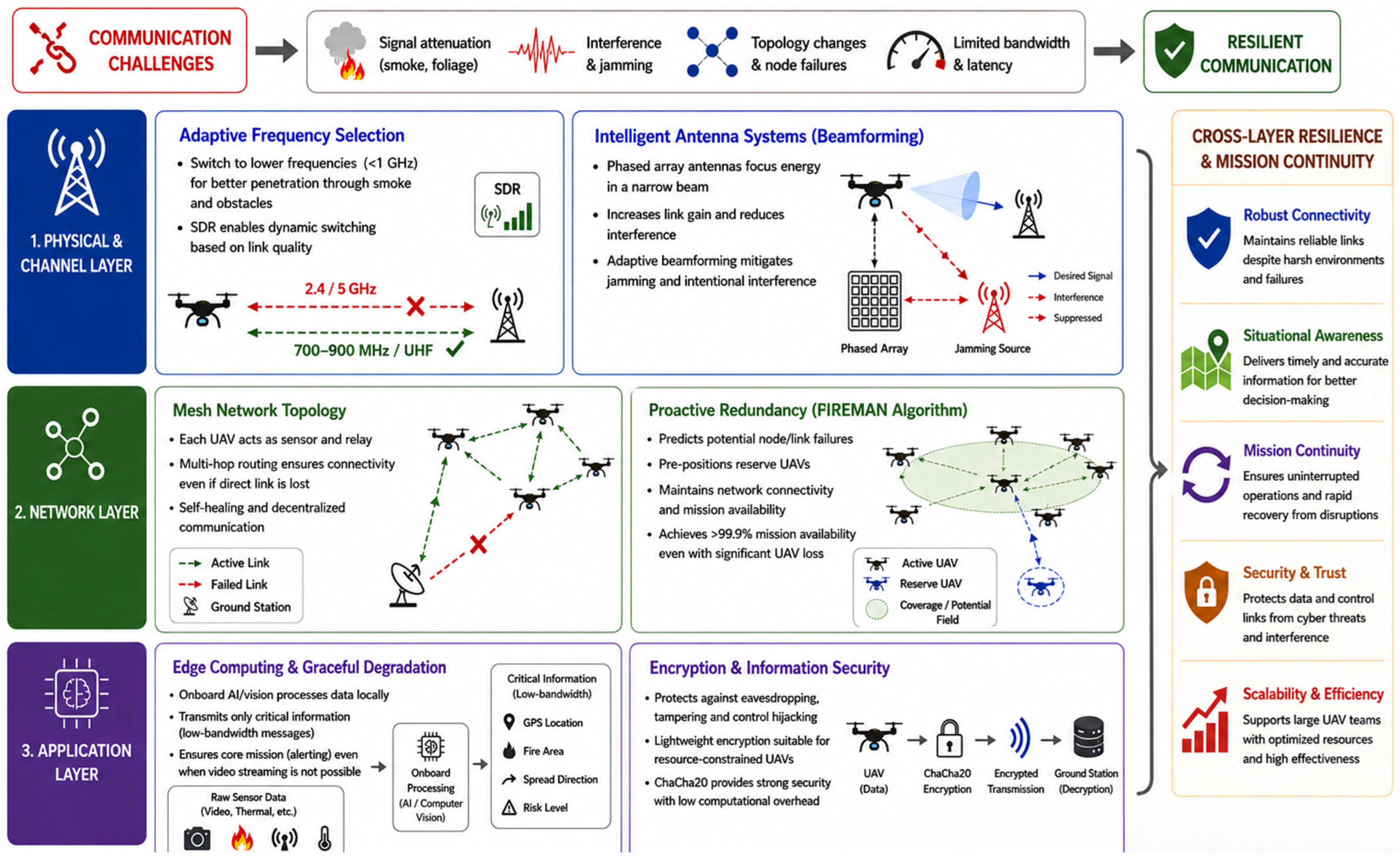
- Adaptive Frequency Selection. Transitioning to lower-frequency bands remains one of the most potent strategies for mitigating signal attenuation caused by smoke and flames. When aircraft use the standard 2.4 GHz and 5 GHz bands, they are highly susceptible to atmospheric absorption and scattering due to the characteristics of these bands. The use of frequencies below 1 GHz (e.g., 700–900 MHz or specialized UHF channels) provides better, and even excellent, penetration through obstacles and ionized environments at lower frequencies. Modern Software-Defined Radio (SDR) modules enable UAVs to dynamically hop between frequency bands based on real-time link quality metrics.
- Intelligent Antenna Systems (Beamforming). This technique, which uses smart antennas and spatial filtering, significantly increases signal gain while reducing the impact of external interference. Instead of relying on commonly used omnidirectional radiation patterns, UAVs can be equipped with additional antennas, such as phased antenna arrays that concentrate signal energy into a narrow beam directed toward the ground station or a neighboring node in the swarm. Research in communication security indicates that adaptive beamforming techniques can effectively neutralize even intentional jamming attempts.
5.2. Network-Layer Approaches for Resilient Architectures
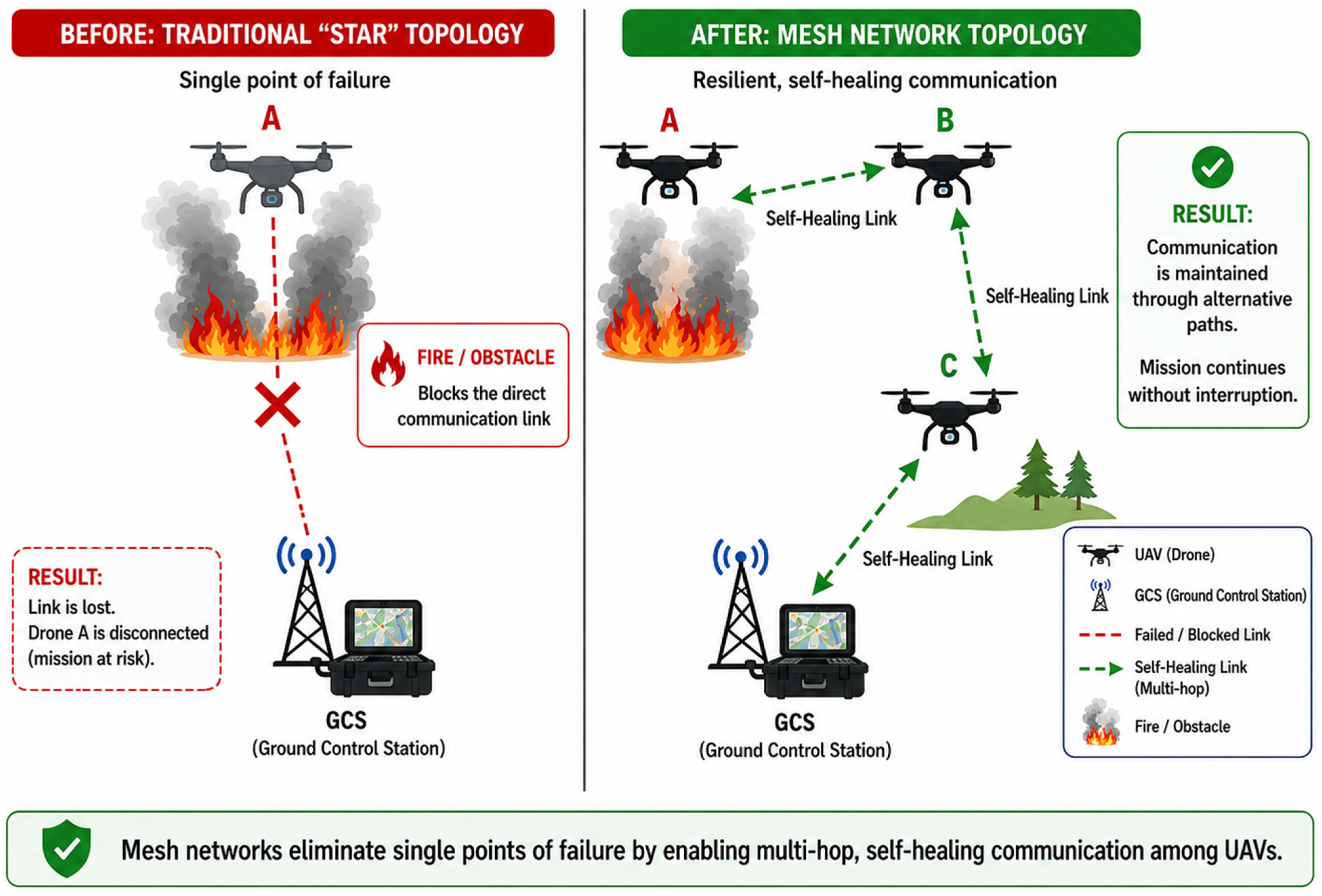
- Self-organizing mesh networks (Mesh Networks). The most promising strategy for ensuring robustness in high-risk environments is to implement self-organizing mesh topologies. In this architectural paradigm, every UAV serves as both an active sensor and a relay node, providing additional alternative network paths. Should the direct link between “Drone A” and the base station be severed, the system autonomously reroutes data packets through “Drone B” and “Drone C” to maintain connectivity, keeping all devices communicating at all times and leading to high performance. As researchers emphasize, this decentralized communication framework is indispensable when traditional, centralized infrastructure is compromised.
- Proactive redundancy and spatial coordination (Proactive Redundancy). To mitigate the threat of cascading failures, advanced algorithms for proactive redundancy are being developed. The Adaptive algorithms developed provide information about the positions of devices (nodes) in the network, not only to support but also to enhance coordination between them. The aims of these protocols are to help maintain the swarm’s structural robustness, mitigate connectivity gaps, and ensure seamless network cohesion under adverse conditions. For example, the FIREMAN algorithm (Physics-Informed Robust Employment of Multi-Agent Networks) utilizes physics-inspired potential fields to generate a network geometry that preserves structural integrity even after the loss of a significant number of constituent drones [14].
5.3. Application-Layer Approaches for Intelligence and Security
- Edge Computing and Graceful Degradation. To circumvent the reliance on bandwidth-intensive raw video transmission—which is inherently vulnerable to link instability—UAVs can be outfitted with onboard processing units for localized data analysis. When using machine vision algorithms, the drone can detect, identify, and classify potential internal fire hotspots and transmit only high-priority metadata, such as GPS coordinates, burn area dimensions, and likely spread vectors (e.g., wind direction). This “edge computing” strategy significantly minimizes network traffic and enables the system to maintain operational functionality even under severely restricted connectivity [15].
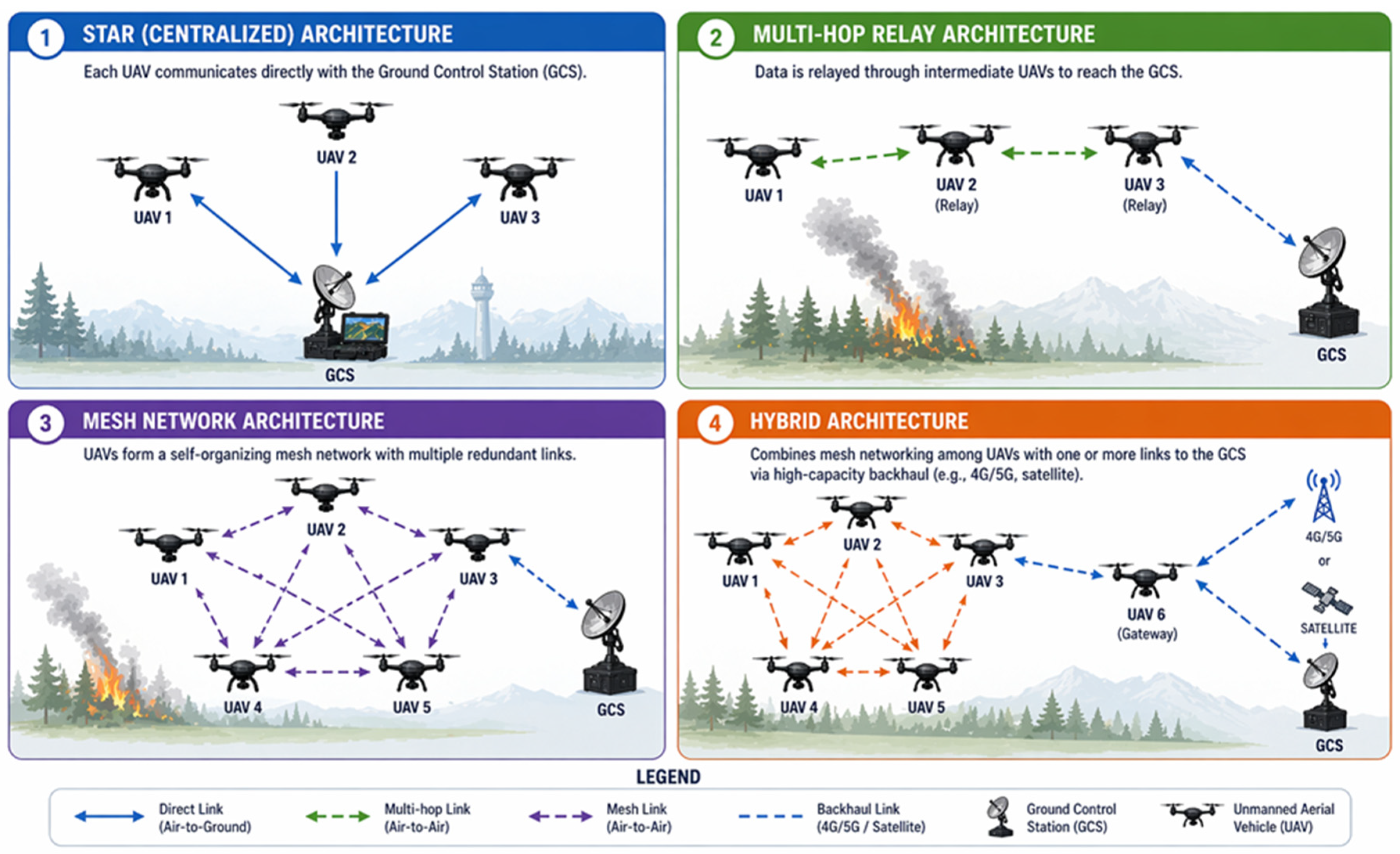
- Encryption and Information Security. Unsecured control channels are susceptible to cyber-attacks that can compromise data integrity or even facilitate unauthorized hijacking of the platform. Therefore, current research focuses on integrating robust security frameworks into UAVs using lightweight cryptographic algorithms designed and suitable for resource-constrained systems. One of the choices is a stream cipher solution, such as ChaCha20, which is highly valued for providing sufficient security with minimal computational overhead, making the proposed solution ideal for securing telemetry and command data in UAV networks. Figure 6 presents a conceptual comparison between a traditional star-based communication architecture and a resilient mesh topology within UAV-based fire-surveillance systems. The illustration highlights how communication reliability is significantly enhanced through distributed, multi-hop connectivity.
6. Conclusions
Author Contributions
Funding
Institutional Review Board Statement
Informed Consent Statement
Data Availability Statement
Conflicts of Interest
References
- Mishra, L.J.; Kaabouch, N. Multi-Parameter Optimization Using Metaheuristic Algorithms to Improve Uncrewed Aerial Vehicles’ Wireless Communications: A Performance Analysis. IEEE Access 2025, 13, 98374–98398. [Google Scholar] [CrossRef] [Scilit]
- Khan, M.F.; Yau, K.-L.A.; Noor, R.M.; Imran, M.A. Routing Schemes in FANETs: A Survey. Sensors 2020, 20, 38. [Google Scholar] [CrossRef] [Scilit] [PubMed]
- Abbas, S.; Abu Talib, M.; Ahmed, I.; Belal, O. Integration of UAVs and FANETs in Disaster Management: A Review on Applications, Challenges and Future Directions. Trans. Emerg. Telecommun. Technol. 2024, 35, e70023. [Google Scholar] [CrossRef] [Scilit]
- Chandran, I.; Vipin, K. Multi-UAV Networks for Disaster Monitoring: Challenges and Opportunities from a Network Perspective. Drone Syst. Appl. 2024, 12, 1–28. [Google Scholar] [CrossRef] [Scilit]
- Tsvetanov, F.; Tsvetanov, K.A.; Ivanova, E.; Georgieva, I. Modelling and Simulation of Communication Efficiency in Low-Speed Networks. In Proceedings of the 22nd Telecommunications Forum (TELFOR 2014), Belgrade, Serbia, 25–27 November 2014; pp. 178–182. [Google Scholar]
- López-Villegas, I.; Martínez-Ríos, E.A.; Izquierdo-Reyes, J.; Bustamante-Bello, R.; Falcone, F. A Systematic Literature Review of Emergency Communications Assisted by Unmanned Aerial Vehicles. Ad. Hoc. Netw. 2025, 182, 104063. [Google Scholar] [CrossRef] [Scilit]
- Alam, M.M.; Arafat, M.Y.; Moh, S.; Shen, J. Topology Control Algorithms in Multi-Unmanned Aerial Vehicle Networks: An Extensive Survey. J. Netw. Comput. Appl. 2022, 207, 103495. [Google Scholar] [CrossRef] [Scilit]
- Trinh, M.L.; Nguyen, D.T.; Dinh, L.Q.; Nguyen, M.D.; Setiadi, D.R.I.M.; Nguyen, M.T. Unmanned Aerial Vehicles (UAV) Networking Algorithms: Communication, Control, and AI-Based Approaches. Algorithms 2025, 18, 244. [Google Scholar] [CrossRef] [Scilit]
- Tsvetanov, F.A.; Pandurski, M.N. Selection of Protocols for Integration of Sensory Data Networks in Cloud Structures. Int. J. Online Biomed. Eng. 2022, 18, 29–40. [Google Scholar] [CrossRef] [Scilit]
- Visa, S.B.; Sunday, C.G.; Abdulkadir, A. A Novel Clustering-Based Scheme for Wildfire Monitoring in Flying Ad Hoc Networks. J. Multidiscip. Sci. 2025, 3, 111–124. [Google Scholar] [CrossRef] [Scilit]
- Tsvetanov, F. Hardware Challenges in AI Sensors and Innovative Approaches to Overcome Them. Eng. Proc. 2025, 104, 19. [Google Scholar] [CrossRef] [Scilit]
- Buldyrev, S.V.; Parshani, R.; Paul, G.; Stanley, H.E.; Havlin, S. Catastrophic Cascade of Failures in Interdependent Networks. Nature 2010, 464, 1025–1028. [Google Scholar] [CrossRef] [Scilit] [PubMed]
- Bekmezci, I.; Sahingoz, O.K.; Temel, S. Flying Ad-Hoc Networks (FANETs): A Survey. Ad. Hoc. Netw. 2013, 11, 1254–1270. [Google Scholar] [CrossRef] [Scilit]
- Muslimov, T. Particle Swarm Optimization for Target Encirclement by a UAV Formation. Eng. Proc. 2023, 33, 15. [Google Scholar] [CrossRef] [Scilit]
- Alam, M.; Moh, S. AI-Enabled Edge Computing for UAV-Based Remote Sensing. Remote Sens. 2023, 15, 1873. [Google Scholar] [CrossRef] [Scilit]



| Study | Main Research Focus | UAV/FANET Communication | Disaster/ Wildfire Context | Cross- Layer Perspective | Cascading Failure Analysis | Positioning of the Proposed Framework |
|---|---|---|---|---|---|---|
| Khan et al. [2] | FANET routing schemes | Yes | Partial | Limited | No | It presents a comprehensive review of FANET routing approaches, and the current work focuses on communication outages in forest fire-monitoring scenarios and the propagation of communication failures in wildfire-monitoring scenarios. |
| Abbas et al. [3] | UAVs and FANETs in disaster management | Yes | Yes | Partial | No | It discusses UAV/FANET applications and challenges in disaster management, while the present work systematizes the causes, consequences, and cascading effects of communication failures. |
| Chandran and Vipin [4,5] | Multi-UAV networks for disaster monitoring | Yes | Yes | Partial | Limited | It focuses on network-level challenges and opportunities in multi-UAV disaster monitoring and introduces a structured physical–technical–network–security framework. |
| López-Villegas et al. [6] | UAV-assisted emergency communications | Yes | Yes | Partial | Limited | It reviews UAV-assisted emergency communication systems, while the present work analyzes degradation chains and failure propagation in wildfire environments. |
| Alam et al. [7] | Topology control in multi-UAV networks | Yes | Partial | Network-oriented | No | It focuses on topology control and connectivity maintenance, while the present work links topology instability with operational, informational, and systemic consequences. |
| Trinh et al. [8] | UAV networking algorithms and AI-based approaches | Yes | Partial | Partial | No | It reviews communication, control, and AI-based UAV networking approaches, while the present work focuses specifically on failure mechanisms, cascading effects, and resilience strategies. |
| Proposed framework | Communication failures in UAV-based wildfire monitoring | Yes | Yes | Yes | Yes | It integrates physical, technical, network, and security factors into a unified cross-layer framework for cascading failure analysis and resilience planning. |
| Metric | Meaning in UAV Wildfire Monitoring | Relation to Failure Propagation | Operational Impact |
|---|---|---|---|
| SNR | Indicates the quality of the received signal under smoke, terrain obstruction, and interference conditions | Low SNR increases the probability of bit errors and unstable links | May trigger video degradation, retransmissions, or loss of control link |
| BER | Measures the probability of incorrectly received bits | High BER results from poor signal quality and increases packet corruption | Reduces the reliability of telemetry, sensor data, and command transmission |
| Packet loss | Represents missing or dropped packets during data transmission | May occur due to congestion, interference, or unstable routing | Leads to incomplete video, missing sensor data, and reduced situational awareness |
| Latency | Describes the end-to-end delay of data delivery | Accumulates in multi-hop and relay-based architectures | Delays fire-front assessment, decision-making, and operator response |
| Throughput | Represents the useful data rate available for transmission | Decreases under link degradation, retransmissions, and congestion | Limits real-time video, thermal imagery, and multispectral data transfer |
| Link availability | Indicates the percentage of time during which the communication link remains usable | Reduced by NLOS conditions, terrain, smoke, jamming, or node mobility | Determines whether the UAV can maintain continuous mission support |
| Recovery time | Time required to restore communication after a disruption | Depends on routing adaptation, fail-safe mechanisms, and network redundancy | Affects mission continuity and the ability to regain tactical awareness |
| Layer | Key Causes | Effects on Communication | Impact on Mission | Typical Mitigation |
|---|---|---|---|---|
| Physical | Smoke, soot, obstacles, thermal gradients | SNR degradation, attenuation, multipath fading | Link instability, signal loss | Frequency selection, adaptive power control |
| Technical | Power constraints, EMI, thermal stress, hardware limits | Reduced transmission range, increased errors | Reduced reliability, intermittent links | Shielding, energy optimization, robust hardware |
| Network | Dynamic topology, routing instability, congestion | Packet loss, latency, jitter | Delayed response, loss of situational awareness | Mesh routing, redundancy, QoS mechanisms |
| Security | Jamming, spoofing, interception | Signal disruption, false data injection | Incorrect decisions, system compromise | Encryption, authentication, anti-jamming techniques |
Disclaimer/Publisher’s Note: The statements, opinions and data contained in all publications are solely those of the individual author(s) and contributor(s) and not of MDPI and/or the editor(s). MDPI and/or the editor(s) disclaim responsibility for any injury to people or property resulting from any ideas, methods, instructions or products referred to in the content. |
© 2026 by the authors. Licensee MDPI, Basel, Switzerland. This article is an open access article distributed under the terms and conditions of the Creative Commons Attribution (CC BY) license.
Share and Cite
Tsvetanov, F.; Ivanov, I. Communication Failures in UAV-Based Wildfire Monitoring: Causes, Cascading Effects, and Resilience Strategies. Eng. Proc. 2026, 154, 32. https://doi.org/10.3390/engproc2026154032
Tsvetanov F, Ivanov I. Communication Failures in UAV-Based Wildfire Monitoring: Causes, Cascading Effects, and Resilience Strategies. Engineering Proceedings. 2026; 154(1):32. https://doi.org/10.3390/engproc2026154032
Chicago/Turabian StyleTsvetanov, Filip, and Ivan Ivanov. 2026. "Communication Failures in UAV-Based Wildfire Monitoring: Causes, Cascading Effects, and Resilience Strategies" Engineering Proceedings 154, no. 1: 32. https://doi.org/10.3390/engproc2026154032
APA StyleTsvetanov, F., & Ivanov, I. (2026). Communication Failures in UAV-Based Wildfire Monitoring: Causes, Cascading Effects, and Resilience Strategies. Engineering Proceedings, 154(1), 32. https://doi.org/10.3390/engproc2026154032