


Abstract
Artificial intelligence (AI) assistants such as ChatGPT (GPT-4o, OpenAI, San Francisco, CA, USA), GitHub Copilot (GitHub Inc., San Francisco, CA, USA), and other large language models (LLMs) are increasingly being incorporated into programming education, thereby influencing how university students approach code comprehension, code generation, debugging, and problem-solving activities. This systematic literature review synthesizes empirical evidence regarding the use of AI assistants in higher education programming contexts; accordingly, the study followed the PRISMA 2020 guidelines and the framework proposed by Kitchenham and Charters, while the search process was conducted across Scopus, ACM Digital Library, IEEE Xplore, ScienceDirect, and Google Scholar. Furthermore, the review protocol was preregistered in the Open Science Framework (OSF), methodological quality was assessed through an adapted Joanna Briggs Institute checklist, and the selection process resulted in a final corpus of 72 empirical studies published between 2022 and 2026. The synthesized evidence indicates that ChatGPT and GitHub Copilot are the most frequently investigated AI assistants in programming education; moreover, the reviewed studies commonly associate these tools with improved task completion efficiency, enhanced support for novice programmers, faster debugging processes, and increased learner confidence. Nevertheless, the literature also reports concerns related to technological dependency, superficial engagement with programming concepts, academic integrity challenges, reduced critical reasoning, and variability in AI-generated outputs; additionally, the findings reveal substantial heterogeneity in evaluation approaches, given that most studies emphasize short-term performance and perception metrics rather than long-term learning outcomes. Overall, the available evidence suggests that AI assistants can provide valuable educational support when integrated within appropriate pedagogical frameworks; however, their long-term implications for programming autonomy, critical thinking, and knowledge retention remain insufficiently understood, thereby highlighting the need for more longitudinal, theoretically grounded, and methodologically rigorous research.
1. Introduction
In recent years, artificial intelligence (AI) has rapidly transformed educational processes, particularly programming instruction in higher education [1,2,3]. AI assistants that can interpret natural language and generate code in multiple programming languages have driven this transformation. University students increasingly use tools such as ChatGPT, GitHub Copilot, and other large language models to support conceptual understanding, problem-solving, and software development tasks [4,5]. Their integration into educational settings has created new learning opportunities [6], allowing students to access immediate explanations, coding suggestions, and support for detecting and correcting programming errors [7,8,9], which may improve learning outcomes and reduce difficulties commonly faced by novice programmers.
Despite the reported benefits in conceptual understanding and academic productivity [10], important concerns remain regarding technological dependency, reduced cognitive engagement, and superficial learning processes [1,11,12,13]. Furthermore, the increasing integration of generative AI systems into educational environments has raised additional concerns related to cybersecurity, data privacy, and the protection of intellectual property, particularly when students interact with cloud-based platforms capable of processing source code and sensitive information. Recent studies have highlighted the growing importance of establishing secure and ethically responsible frameworks for the adoption of advanced AI technologies in academic and professional contexts.
To address these challenges, the present study conducts a systematic literature review (SLR) on the use of AI assistants for code comprehension and code generation among university students. Following the PRISMA 2020 guidelines and established methodologies in software engineering research [14,15,16,17,18], the review seeks to consolidate the fragmented body of evidence concerning the adoption, educational implications, and evaluation of AI assistants in higher education programming contexts; in addition, it synthesizes empirical findings, examines methodological trends, and identifies research gaps that continue to shape the field. Accordingly, the following research questions (RQs) guide the study:
RQ1: How have AI assistants been adopted and utilized in higher education programming contexts for code comprehension and code generation activities?
RQ2: What empirical evidence has been reported regarding the educational benefits, challenges, and learning implications associated with the use of AI assistants in programming education?
RQ3: What methodological approaches, evaluation frameworks, and outcome measures have been employed to assess the impact of AI assistants on programming-related learning processes and performance?
RQ4: What research gaps, methodological limitations, and future directions emerge from the current body of literature on AI-assisted programming education?
2. Related Work
The growing adoption of generative artificial intelligence in higher education has motivated several review studies examining its educational applications, benefits, challenges, and implications for teaching and learning. Recent evidence syntheses have explored the use of AI systems across diverse academic contexts, including programming education, academic writing, personalized learning, and student support; however, important differences remain regarding their scope, methodological focus, and treatment of code comprehension and code generation activities.
To contextualize the contribution of the present study, Table 1 summarizes representative review studies published between 2024 and 2026 and compares their objectives with those of the proposed systematic literature review.
Table 1.
Comparison of recent review studies and the present research.
Although previous reviews have examined generative AI and large language models in educational settings, most have focused on broad higher education applications, specific platforms, or general learning outcomes. In contrast, the present study concentrates specifically on AI assistants used for code comprehension and code generation among university students, integrates evidence from multiple educational and technological contexts, analyzes evaluation methodologies and outcome measures, and identifies emerging research gaps and future directions. Consequently, this review provides a more focused synthesis of the evidence related to programming education and AI-assisted software development learning processes.
3. Materials and Methods
This study employed a systematic literature review (SLR) approach and followed PRISMA guidelines [19], thereby enhancing methodological transparency and reproducibility in identifying and selecting scientific evidence related to the use of artificial intelligence (AI) assistants in higher education. To further strengthen methodological transparency and replicability, the review protocol was preregistered in the OSF Registries repository (DOI: 10.17605/OSF.IO/BUVXF).
3.1. Search Strategy and Databases
The bibliographic search was conducted in March 2026 across five major academic sources: Scopus, ACM Digital Library, IEEE Xplore, ScienceDirect, and Google Scholar. These databases were selected because of their complementary coverage, enabling the retrieval of high-impact journal articles and conference proceedings in computing education [1,2]. Search strings were constructed in both English and Spanish using Boolean operators (AND, OR) to optimize the identification of studies linking AI assistants with programming education.
The search strategy was designed following a concept-oriented approach rather than a platform-oriented approach; consequently, generic descriptors such as “AI assistant”, “generative AI”, and “large language model (LLM)” were combined with selected examples of widely recognized AI technologies, including ChatGPT and GitHub Copilot. This design sought to maximize retrieval sensitivity while maintaining relevance to programming education, thereby reducing the risk of excluding studies indexed under broader conceptual terminology rather than specific product names. As a result, studies involving alternative AI systems remained eligible whenever they satisfied the predefined inclusion criteria and were retrieved through the conceptual search terms.
The main search combinations included:
- (“Generative AI” OR “ChatGPT” OR “LLMs”) AND (“Programming Education” OR “CS1”) AND (“Higher Education” OR “University”)
- (“GitHub Copilot” OR “AI Assistants”) AND (“Code Generation” OR “Debugging”) AND (“Students”)
- Spanish-language variants including terms such as “Inteligencia Artificial Generativa” (Generative AI), “Enseñanza de la Programación” (Programming Education), “Educación Superior” (Higher Education), and “Asistentes de Código” (Code Assistants).
Table 2 summarizes the search strategies employed in each database together with the number of records identified before and after intrasource deduplication.
Table 2.
Database search strategies and the number of records identified before and after intrasource deduplication.
Cross-database deduplication removed 7 additional records, resulting in 243 unique records for screening; furthermore, the explicit inclusion of ChatGPT and GitHub Copilot in selected search strings does not imply the exclusion of alternative AI assistants. Because the review incorporated broad conceptual descriptors, studies examining other generative AI systems and large language models remained eligible whenever they satisfied the predefined inclusion criteria and were retrieved through the conceptual search terms.
3.2. Eligibility Criteria
To ensure the validity and relevance of the selected sample, eligibility criteria were established based on the PICOC strategy (Population, Intervention, Comparison, Outcomes, and Context). These criteria enabled differentiation between empirical studies and purely theoretical discussions. The inclusion criteria applied during the study selection process are summarized in Table 3, whereas the corresponding exclusion criteria are presented in Table 4.
Table 3.
Inclusion criteria and their descriptions.
Table 4.
Exclusion criteria and their descriptions.
3.3. Study Selection and Preliminary PRISMA Flow Synthesis
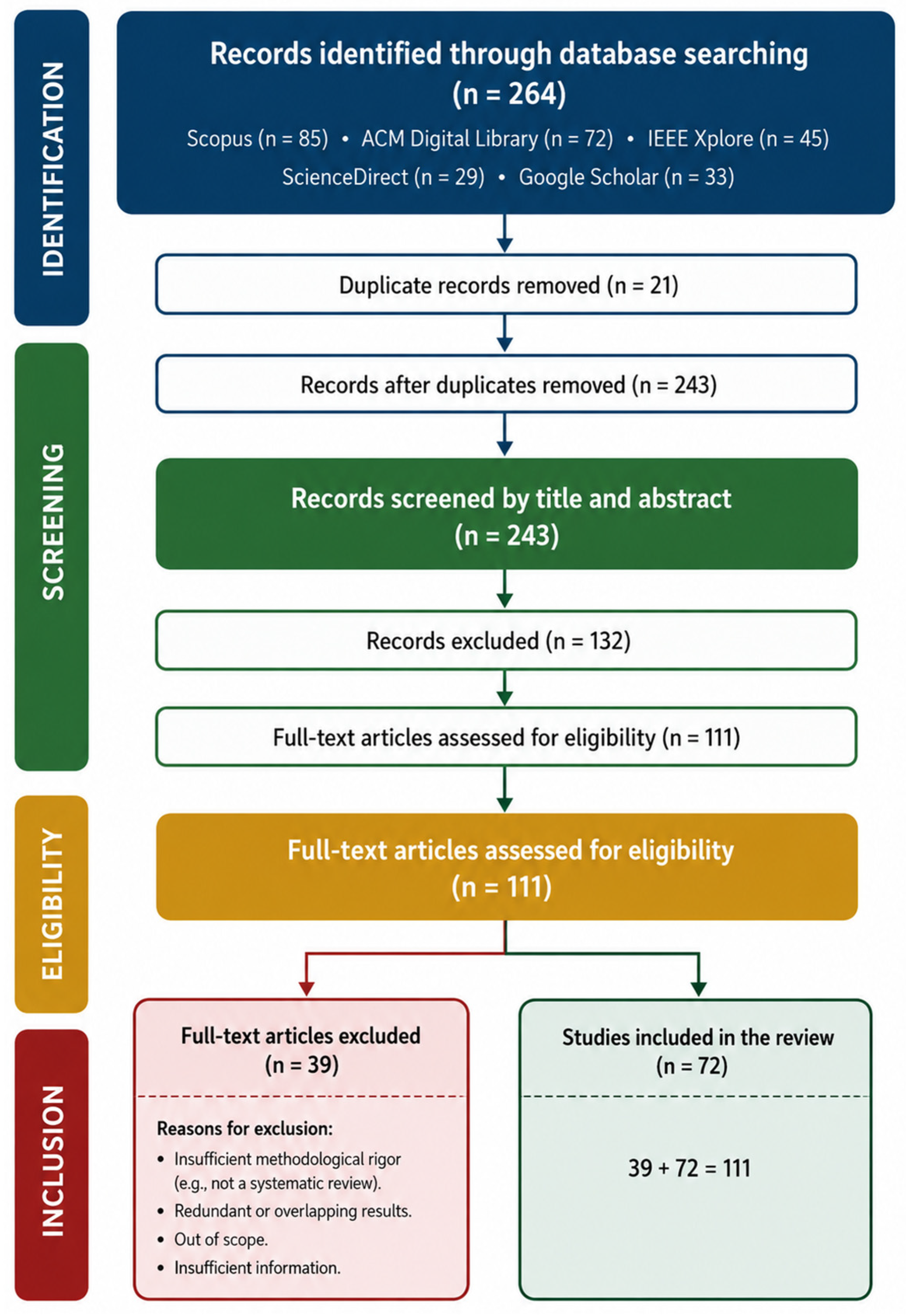
The article selection process followed the four phases of the PRISMA flow diagram (Identification, Screening, Eligibility, and Inclusion), ensuring a transparent selection procedure.
Identification: In the initial phase, 264 records were retrieved from the five databases. After automated deduplication using Zotero (Version 6.0; Corporation for Digital Scholarship, Vienna, VA, USA) to remove internal duplicates, 250 records remained. A subsequent cross-database check removed 7 additional duplicates, resulting in 243 unique records.
Screening: Titles and abstracts of the 243 records were independently screened by the authors according to the inclusion and exclusion criteria. A total of 132 records were excluded for not presenting empirical data, being outside the scope of higher education, or not focusing on generative AI.
Eligibility: The remaining 111 records were assessed through full-text review. At this stage, 39 articles were excluded due to insufficient methodological rigor or overlapping/redundant findings.
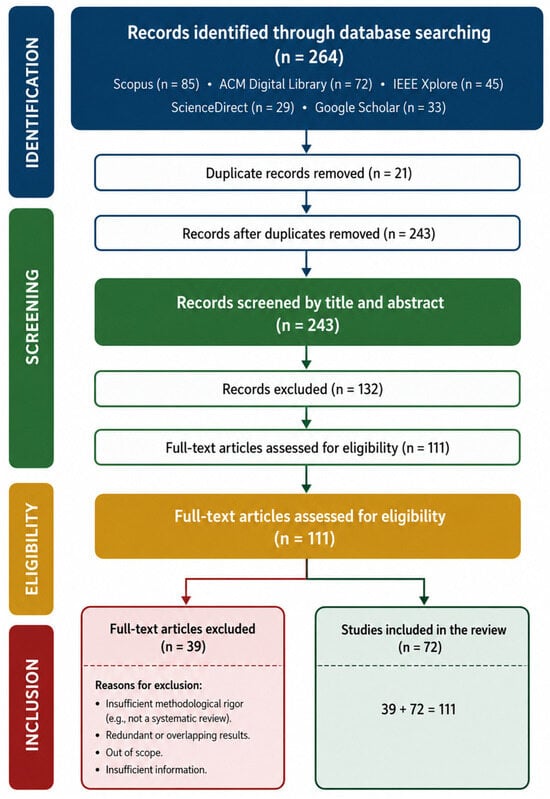
Inclusion: Finally, 72 studies met all eligibility and quality criteria and were included in the review. This final corpus forms the basis for the qualitative synthesis and analysis of results [2,10]. A summary of the records retained and excluded during each phase of the PRISMA selection process is presented in Table 5, while the complete PRISMA flow diagram illustrating the study selection process is shown in Figure 1.
Table 5.
PRISMA Analysis.
Figure 1.
PRISMA flow diagram of the study selection process.
3.4. Analysis Tools and Pipeline
To ensure the validity of the findings in this systematic review, a critical appraisal of the methodological quality of all 72 included studies was conducted. An adapted Joanna Briggs Institute (JBI) checklist for cross-sectional and quasi-experimental studies was used, supplemented with additional items specific to research on AI tools in education. The assessment rubric comprised seven items, each scored as “Met” (1 point), “Partially met” (0.5 points), or “Not met” (0 points). The quality assessment criteria applied to all included studies are summarized in Table 6.
Table 6.
Quality Assessment (QA) Criteria.
Assessment Process
The assessment was conducted independently by two authors (J.O. and S.L.) across all 72 articles. Prior to formal evaluation, the reviewers were trained using a pilot sample of five articles not included in the final dataset. Cohen’s kappa coefficient was used to measure inter-rater agreement beyond chance. In a random subsample of 20% of the studies (n = 14), κ = 0.84 (95% CI: 0.76–0.92), indicating almost perfect agreement [20]. Discrepancies identified in nine articles (12.5% of the total) were resolved through discussion with a third author (J.N.), who acted as a mediator.
3.5. Data Extraction and Bibliographic Management
3.5.1. Management Tool
Bibliographic management and record deduplication were performed using Zotero (version 6.0), an open-source reference manager that supports bulk import from multiple databases, automatic duplicate detection based on DOI and title/author similarity, and export to standardized formats (CSV, BibTeX, and RIS). The workflow consisted of four steps: (1) importing records from each database in RIS format, (2) automated deduplication using an 85% similarity threshold, (3) manual verification of potential duplicates, and (4) exporting the 243 unique records to a spreadsheet for screening.
3.5.2. Data Extraction Matrix
An evidence matrix was designed in Microsoft Excel (Microsoft Excel 365, Microsoft Corporation, Redmond, WA, USA) comprising 21 columns to systematically capture the characteristics of each study. The matrix was piloted using 10 articles and refined prior to full-scale application. Extracted variables were organized into the following categories: study identification, methodological characteristics, intervention (AI tool), outcomes and metrics, quality assessment, and additional variables (conflict of interest, funding, and ethical approval).
3.6. Thematic Analysis and Qualitative Synthesis
The analysis of the extracted data followed a thematic synthesis approach [21], combining inductive (data-driven) and deductive (research-question–driven) approaches. The process was conducted in three phases, independently performed by two authors with weekly consensus meetings.
- Phase 1—Open coding: Each article was fully reviewed, and relevant passages related to benefits, limitations, and metrics were identified and assigned initial codes. This phase resulted in 143 unique codes.
- Phase 2—Category development: The 143 codes were grouped into thematic categories based on semantic similarity.
- Phase 3—RQ mapping: The 18 resulting categories were mapped to the research questions: 3 for RQ1 (tools), 11 for RQ2 (6 benefits and 5 limitations), and 4 for RQ3 (metrics).
Thematic saturation was achieved after analyzing 60 articles (83% of the corpus), at which point no new categories emerged. The remaining 12 articles confirmed the previously identified themes.
Coding Examples
To illustrate the thematic analysis process, representative coding examples are presented in Table 7, demonstrating how empirical evidence extracted from the selected studies was interpreted, organized into thematic dimensions, and subsequently mapped to the corresponding research questions as part of the qualitative synthesis.
Table 7.
Coding Matrix and Linkage to Research Questions.
3.7. Characteristics of the Included Studies
Table 8 summarizes the main characteristics of the 72 studies included in this systematic review. For representational purposes, nine studies are presented in the main manuscript, while the complete dataset is available in the Supplementary Materials.
The reviewed studies were published between 2022 and 2026, with most studies published during 2024–2025 [22]; furthermore, quantitative methodologies were the most frequently employed (62%), followed by mixed-methods (25%) and qualitative approaches (13%). According to the adapted JBI quality assessment criteria, 33% of the studies were classified as high quality, 53% as moderate quality, and 14% as low quality.
Table 8.
Representative studies included in the systematic review: AI tools, reported benefits, and identified limitations.
To further examine the representation of AI assistants within the reviewed literature, the AI systems investigated across the 72 included studies were categorized according to the primary assistant analyzed. The results indicate that ChatGPT was the most frequently studied system, followed by GitHub Copilot, while other generative AI technologies—including Gemini (Google LLC, Mountain View, CA, USA), Claude (Anthropic PBC, San Francisco, CA, USA), DeepSeek (DeepSeek AI, Hangzhou, China), Codeium (Codeium Inc., Mountain View, CA, USA), Mistral (Mistral AI, Paris, France), GPT-4 (OpenAI, San Francisco, CA, USA), and general-purpose large language models—were also represented in the final corpus. This distribution reflects publication trends observed during the 2022–2026 period rather than restrictions imposed by the review protocol. Because the search strategy incorporated broad conceptual descriptors such as “AI assistant”, “generative AI”, and “large language model (LLM)”, studies involving alternative AI systems remained eligible throughout the selection process whenever they satisfied the predefined inclusion criteria; Table 9 provides a detailed overview of the AI assistants represented in the included studies, together with the frequency of their occurrence across the reviewed literature.
Table 9.
Distribution of AI assistants represented in the included studies.
The presence of multiple AI assistants within the final corpus supports the concept-oriented nature of the search strategy and reduces the likelihood of systematic bias toward a single AI provider. Nevertheless, the predominance of ChatGPT and GitHub Copilot should be interpreted as a reflection of publication trends within the available literature during the review period.
4. Results Analysis
RQ1: Which AI assistants are most widely used in programming instruction?
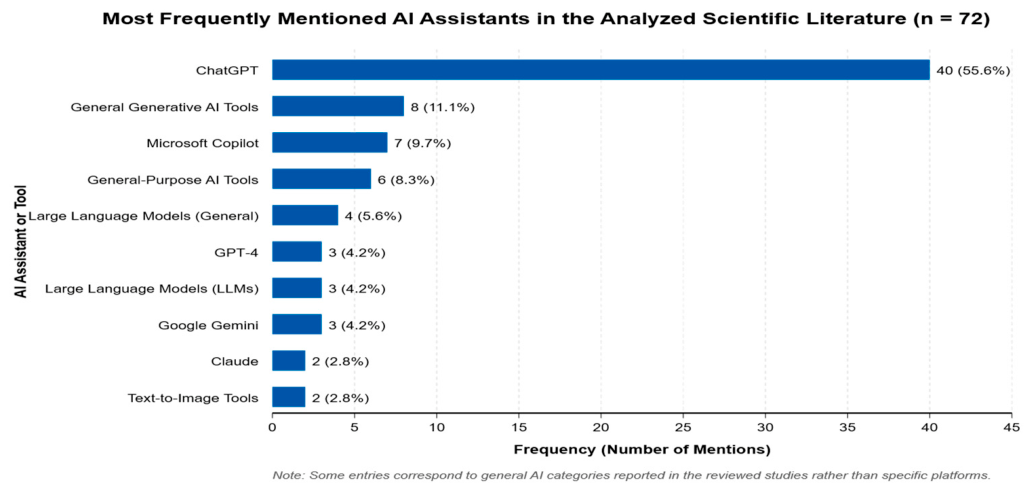
The review findings reveal a clear predominance of ChatGPT as the principal AI assistant within the analyzed literature, substantially surpassing other AI assistants [28,31,32]. In parallel, several studies adopt broader concepts such as generative AI to describe the phenomenon from a generalized perspective [28,31,33,34]. Development-oriented assistants such as GitHub Copilot also appear frequently, indicating that current research is largely centered on accessible and widely adopted AI-based programming support tools [35,36,37,38].
Regarding application domains, the literature shows a strong concentration on introductory and general programming education, particularly in courses involving languages such as Python and Java [26,29,39,40]. These findings suggest that AI-assisted learning is currently investigated mainly as pedagogical support in foundational educational contexts, while advanced and specialized programming domains remain comparatively underrepresented.
Figure 2 illustrates the frequency distribution of the principal AI assistants identified across the reviewed studies, highlighting the predominance of ChatGPT and the relative representation of the remaining AI systems.
Figure 2.
Frequency distribution of the principal AI assistants reported in the reviewed studies (Top 10; n = 72).
RQ2: What are the reported benefits and limitations?
Across the 72 studies analyzed, the reported benefits of AI assistants in programming education are mainly associated with improvements in task efficiency and workflow performance. The literature highlights improvements in productivity, accelerated problem-solving, reduced learning barriers for novice programmers, and continuous assistance through explanations, debugging support, and formative feedback [24,27,41,42,43,44,45,46,47,48]. In addition, Atta et al. reported statistically significant improvements in C# programming skills through a ChatGPT-based mobile learning application [49].
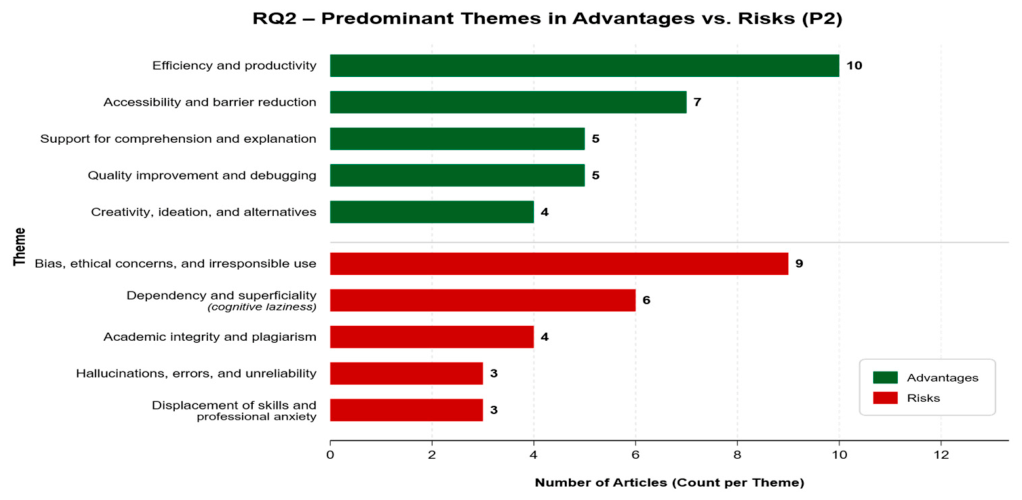
However, the reviewed evidence also identifies important ethical, pedagogical, and cognitive concerns. Several studies report risks related to technological dependency, superficial learning, plagiarism, reduced critical reasoning, algorithmic bias, and insufficient regulatory frameworks [50,51,52,53,54,55,56,57]. Although AI-assisted programming is generally perceived positively, its educational effectiveness appears to depend strongly on pedagogical strategies that guide and contextualize AI use, promoting verification and encouraging reflective learning processes [58,59]. Figure 3 summarizes the main thematic categories identified in the reviewed literature, comparing the most frequently reported educational benefits and the principal risks associated with the use of AI assistants in programming education.
Figure 3.
Thematic distribution of the principal benefits and risks associated with the use of AI assistants in programming education (RQ2).
RQ3: What metrics are used to evaluate the impact of AI assistants?
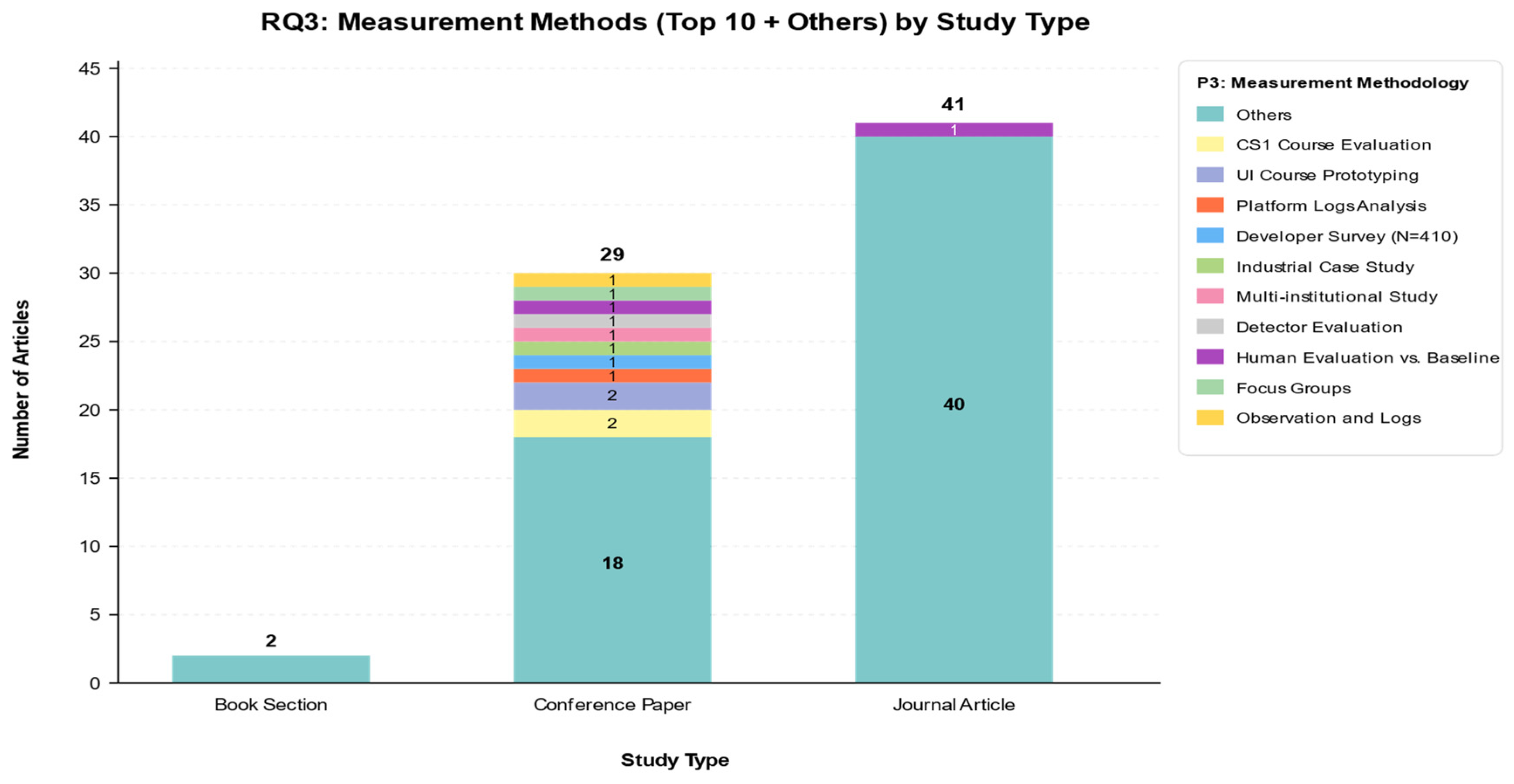
The evaluation of the educational impact of AI assistant use is characterized by considerable methodological variation and a predominantly indirect evaluation approach [60,61]. The reviewed literature examines this dimension through a wide range of indicators, including objective performance measures (task completion, programming accuracy, solution quality) and psychological or behavioral constructs (confidence, anxiety, perceived usefulness, prompt formulation effectiveness). Conference papers generally report more application-oriented evaluation strategies—such as assessments in introductory programming courses, interaction log analysis, experimental prototyping, and focus groups [62,63,64]—whereas journal articles tend to exhibit broader analytical perspectives and less standardized methodological frameworks.
Overall, the findings reveal the absence of a unified evaluation model for assessing the educational impact of AI assistants in programming instruction. Instead, the current literature reflects an emerging, methodologically fragmented research landscape in which evaluation approaches remain strongly dependent on the pedagogical, technological, and institutional contexts under investigation.
Table 10 summarizes the principal performance metrics identified in the reviewed studies for evaluating the educational impact of AI assistants in programming education. The taxonomy includes objective performance indicators as well as psychological and behavioral measures commonly adopted in empirical research.
Table 10.
Taxonomy of performance metrics used to evaluate the impact of AI assistants in programming education.
Figure 4 complements the taxonomy presented in Table 10 by illustrating the distribution of the methodological approaches used to evaluate AI assistants according to publication type. This visualization highlights the predominance of specific evaluation methods across conference papers and journal articles, thereby providing a clearer overview of current assessment practices in programming education.
Figure 4.
Methodological approaches identified in the reviewed studies according to publication type (RQ3).
RQ4: What research gaps, methodological limitations, and future directions emerge from the current body of literature on AI-assisted programming education?
The reviewed literature reveals several research gaps and methodological limitations that should be considered when interpreting the current evidence on AI-assisted programming education. Although the available studies are heavily concentrated on ChatGPT and, to a lesser extent, GitHub Copilot, alternative AI assistants such as Gemini, Claude, DeepSeek, Codeium, and Mistral remain comparatively underrepresented, thereby limiting the generalizability of findings across the broader ecosystem of generative AI technologies; moreover, most studies focus on short-term outcomes, including task completion efficiency, perceived usefulness, satisfaction, and immediate programming performance, whereas comparatively little attention has been devoted to long-term educational outcomes, such as knowledge retention, programming autonomy, transfer of learning, and the development of critical thinking skills.
In addition, substantial methodological heterogeneity was identified across the reviewed studies, as differences in research designs, sample characteristics, educational settings, assessment instruments, and outcome measures complicate direct comparisons and hinder the accumulation of standardized evidence; consequently, the literature highlights the need for more longitudinal, theory-driven, and methodologically rigorous investigations capable of evaluating the sustained educational impact of AI assistants. Future research should expand the analysis beyond the most frequently studied platforms and further explore the pedagogical conditions that facilitate effective and responsible AI-assisted learning.
Table 11 summarizes the principal research gaps, methodological limitations, and future research directions identified across the reviewed studies. These findings provide an overview of the areas that require further investigation to strengthen the evidence base on AI-assisted programming education and support the development of more robust pedagogical frameworks.
Table 11.
Principal research gaps and future directions identified in the reviewed literature.
5. Discussion
The analysis of the 72 reviewed studies reveals a clear predominance of ChatGPT as the most widely adopted AI assistant in programming education, followed by GitHub Copilot and broader generative AI categories. This predominance appears to stem from its accessibility, low adoption barriers, and perceived effectiveness for code explanation, debugging, and solution generation, aligned with programming course demands [1,4]. Across the literature, AI assistants commonly function as conversational tutors, debugging aids, code generators, and explanatory support systems [23,25,69], addressing recurrent learning difficulties related to problem interpretation, error correction, and continuity during programming tasks.
Despite these advantages, the findings reveal a persistent productivity paradox. While AI assistants are associated with increased efficiency, faster error resolution, and higher student confidence [70], they are simultaneously linked to risks such as technological dependency, superficial learning, reduced critical reasoning, and academic misconduct [30]. The evidence indicates that generative AI can help students produce functional solutions without necessarily strengthening the cognitive processes required for deep conceptual understanding and durable knowledge retention [71]. Consequently, producing executable code and understanding the underlying computational logic remain distinct cognitive processes within programming education.
At the same time, the reviewed evidence does not support a uniformly negative interpretation of AI-assisted learning. While several studies associate extensive AI use with reduced cognitive engagement and overreliance, other investigations report improvements in programming performance, self-efficacy, and learning outcomes when AI assistants are integrated within structured instructional environments. These contrasting findings suggest that the educational impact of AI systems may depend less on the technology itself and more on the pedagogical conditions under which it is implemented, including assessment design, instructor guidance, and opportunities for reflective practice. Consequently, the available evidence suggests that the debate may be more productively framed in terms of how educational institutions can maximize the instructional value of AI assistants while mitigating their associated risks.
The reviewed studies further indicate that these challenges are reinforced by traditional assessment models that prioritize final outputs over reasoning processes. In response, the literature emphasizes the need for intentional pedagogical scaffolding strategies focused on explanation, justification, algorithmic reasoning, and reflective evaluation of AI-generated solutions, positioning AI systems as learning supports rather than replacements for cognitive engagement [72,73]. Nevertheless, the evidence remains methodologically heterogeneous, particularly regarding long-term learning outcomes, highlighting the need for more longitudinal and standardized research on the educational implications of AI-assisted programming instruction.
6. Conclusions
This systematic literature review synthesized evidence from 72 empirical studies published between 2022 and 2026 on the use of artificial intelligence assistants for code comprehension and code generation in higher education programming contexts. The findings reveal a clear predominance of ChatGPT and GitHub Copilot within the literature, while alternative AI assistants remain comparatively underrepresented. Overall, the reviewed studies associate AI assistants with improvements in programming efficiency, debugging support, task completion, and learner confidence, although concerns related to technological dependency, superficial learning, academic integrity, and reduced critical reasoning persist.
The reviewed evidence further indicates considerable methodological heterogeneity. Most studies rely on short-term indicators such as productivity, performance, and user perceptions, whereas comparatively limited attention has been devoted to long-term learning outcomes, knowledge retention, programming autonomy, and higher-order cognitive skills. Consequently, the current evidence base remains fragmented and lacks standardized evaluation frameworks capable of supporting robust comparisons across studies.
Several research gaps emerged from the literature, including the concentration of evidence on a small number of AI assistants, the scarcity of longitudinal investigations, and the limited understanding of the long-term educational implications of AI-assisted programming learning. Future research should therefore prioritize theory-driven and longitudinal approaches, adopt more consistent evaluation methodologies, and expand the analysis to emerging AI technologies beyond the most frequently studied platforms.
This review contributes to the literature by providing a focused synthesis of empirical evidence on AI assistants for code comprehension and code generation among university students. Overall, the findings suggest that the educational impact of AI assistants depends not only on their technological capabilities but also on the pedagogical conditions under which they are implemented. Ensuring that these technologies support meaningful and sustainable learning outcomes remains a central challenge for higher education and is an important direction for future research.
Review Limitations
Several limitations of this systematic review should be considered when interpreting the findings.
- Publication bias: Studies reporting positive outcomes may be disproportionately represented within the published literature, whereas investigations presenting negative, neutral, or inconclusive findings may remain underreported.
- Language restrictions: The review included only studies published in English and Spanish, potentially excluding relevant evidence available in other languages.
- Temporal scope: Although the review covered the 2022–2026 period, the literature search was conducted in March 2026. Given the rapid evolution of generative AI technologies, some findings may become partially outdated within relatively short timeframes.
- Methodological heterogeneity: The substantial diversity in research designs, evaluation metrics, educational contexts, and analytical approaches prevented the execution of a formal quantitative meta-analysis.
- Lack of metric standardization: The absence of unified academic performance indicators across studies limited direct comparability and constrained the aggregation of evidence.
Supplementary Materials
The following supporting information can be downloaded at: https://www.mdpi.com/article/10.3390/engproc2026153034/s1, Supplementary File S1. Complete evidence extraction matrix of the 72 studies included in the systematic literature review.
Author Contributions
Conceptualization, J.O. and S.L.; methodology, J.O. and S.L.; formal analysis, J.O., J.N. and S.L.; investigation, J.O., J.N., F.R., F.Q. and S.L.; data curation, J.O. and S.L.; writing—original draft preparation, J.O. and S.L.; writing—review and editing, J.N., F.Q. and F.R.; supervision, S.L. All authors have read and agreed to the published version of the manuscript.
Funding
This research received no external or project-specific funding, and although the Universidad Politécnica Estatal del Carchi (UPEC), Ecuador, provides institutional support for publication costs as a benefit for its academic staff, this support was not applied to the present manuscript, therefore no grant or funding number is associated with this work.
Institutional Review Board Statement
Not applicable.
Informed Consent Statement
Not applicable.
Data Availability Statement
The complete evidence matrix, including all 72 reviewed studies and extracted variables, is publicly available in the OSF repository (DOI: 10.17605/OSF.IO/BUVXF).
Acknowledgments
During the preparation of this manuscript, the authors used ChatGPT-4.0 to assist with grammatical revision, linguistic refinement, and formatting adjustments for tables and references in accordance with the journal guidelines. Following the use of this tool, all content was critically reviewed and edited by the authors, who assume full responsibility for the final version of the manuscript.
Conflicts of Interest
The authors declare no conflicts of interest.
Abbreviations
The following abbreviations are used in this manuscript:
| AI | Artificial Intelligence |
| CI | Inclusion Criterion |
| CE | Exclusion Criterion |
| CS1 | Introduction to Computer Science Course |
| GenAI | Generative Artificial Intelligence |
| IDE | Integrated Development Environment |
| JBI | Joanna Briggs Institute |
| LLM | Large Language Model |
| OSF | Open Science Framework |
| PICOC | Population, Intervention, Comparison, Outcomes, and Context |
| PRISMA | Preferred Reporting Items for Systematic Reviews and Meta-Analyses |
| QA | Quality Assessment |
| RQ | Research Question |
| SLR | Systematic Literature Review |
References
- Lau, S.; Guo, P. From “Ban It Till We Understand It” to “Resistance Is Futile”: How University Programming Instructors Plan to Adapt as More Students Use AI Code Generation and Explanation Tools. In Proceedings of the 2023 ACM Conference on International Computing Education Research (ICER’23), Kagawa, Japan, 8–11 August 2023; ACM: New York, NY, USA, 2023; Volume 1, pp. 106–121. [Google Scholar] [CrossRef] [Scilit]
- Akçapınar, G.; Sidan, E. AI chatbots in programming education: Guiding success or encouraging plagiarism. Discov. Artif. Intell. 2024, 4, 87. [Google Scholar] [CrossRef] [Scilit]
- Finnie-Ansley, J.; Denny, P.; Becker, B.A.; Luxton-Reilly, A.; Prather, J. The robots are coming: Exploring the implications of OpenAI Codex on introductory programming. In Proceedings of the 24th Australasian Computing Education Conference, Melbourne, Australia, 14–17 February 2022; ACM: New York, NY, USA, 2022; pp. 10–19. [Google Scholar] [CrossRef] [Scilit]
- Almanasra, M.; Suwais, N. The impact of artificial intelligence on programming education: A systematic review. Educ. Inf. Technol. 2025, 30, 6307–6345. [Google Scholar]
- Stanojević, J.; Milenković, I.; Minović, M.; Maričić, M. Educational platform in higher education with LLM-driven chatbot for computer networks and telecommunications course. Comput. Appl. Eng. Educ. 2026, 34, e70105. [Google Scholar] [CrossRef] [Scilit]
- Flores González, M.E.; Del Valle, J.A.; Hernández Morales, E.R.; Salvador Rico, F.; Rivera Machado, M.E. Artificial intelligence as a mediating tool for training in a phenomenological experience of higher education for engineering. In Computer Supported Qualitative Research; Lecture Notes in Networks and Systems; Springer: Cham, Switzerland, 2026; Volume 1595, pp. 133–148. [Google Scholar] [CrossRef] [Scilit]
- Haindl, P.; Weinberger, G. Students’ experiences of using ChatGPT in an undergraduate programming course. IEEE Access 2024, 12, 43519–43529. [Google Scholar] [CrossRef] [Scilit]
- Leinonen, J.; Hellas, A.; Sarsa, S.; Reeves, B.; Denny, P.; Prather, J.; Becker, B.A. Using large language models to enhance programming error messages. In Proceedings of the 54th ACM Technical Symposium on Computer Science Education, Toronto, ON, Canada, 15–18 March 2023; ACM: New York, NY, USA, 2023; Volume 1, pp. 563–569. [Google Scholar] [CrossRef] [Scilit]
- MacNeil, S.; Tran, A.; Hellas, A.; Kim, J.; Sarsa, S.; Denny, P.; Bernstein, S.; Leinonen, J. Experiences from using code explanations generated by large language models in a web software development e-book. In Proceedings of the 54th ACM Technical Symposium on Computer Science Education, Toronto, ON, Canada, 15–18 March 2023; ACM: New York, NY, USA, 2023; Volume 1, pp. 931–937. [Google Scholar] [CrossRef] [Scilit]
- Albrant, L.; Suhag, J.; Ureel, L., II; Jarvie-Eggart, M. Engaging Students with AI for Code Comprehension, Critique, and Explanation; IntechOpen: Rijeka, Croatia, 2025; pp. 1–17. [Google Scholar] [CrossRef] [Scilit]
- Khodadad, D. ChatGPT in engineering education: A breakthrough or a challenge? Phys. Educ. 2025, 60, 4. [Google Scholar] [CrossRef] [Scilit]
- Oedingen, M.; Engelhardt, R.C.; Denz, R.; Hammer, M.; Konen, W. ChatGPT code detection: Techniques for uncovering the source of code. AI 2024, 5, 1066–1094. [Google Scholar] [CrossRef] [Scilit]
- Becker, B.A.; Denny, P.; Finnie-Ansley, J.; Luxton-Reilly, A.; Prather, J.; Santos, E.A. Programming is hard—Or at least it used to be: Educational opportunities and challenges of AI code generation. In Proceedings of the 54th ACM Technical Symposium on Computer Science Education, Toronto, ON, Canada, 15–18 March 2023; ACM: New York, NY, USA, 2023; Volume 1, pp. 500–506. [Google Scholar] [CrossRef] [Scilit]
- Qiao, Y.; Shihab, M.I.H.; Hundhausen, C. A systematic literature review of the use of GenAI assistants for code comprehension. ACM Trans. Comput. Educ. 2026, 26, 24. [Google Scholar] [CrossRef] [Scilit]
- Kitchenham, B.; Charters, S. Guidelines for Performing Systematic Literature Reviews in Software Engineering, version 2.3; EBSE Technical Report; Keele University: Keele, UK, 2007. [Google Scholar]
- Aruleba, K.; Oyelere, S.S.; Obaido, G.R.; Sanusi, I.T. A scoping review of student and educator engagement with large language models in introductory programming education. In Proceedings of the 2025 Conference on UK and Ireland Computing Education Research (UKICER’25), Glasgow, UK, 4–5 September 2025; ACM: New York, NY, USA, 2025; pp. 1–8. [Google Scholar] [CrossRef] [Scilit]
- Raihan, N.; Siddiq, M.L.; Santos, J.C.S.; Zampieri, M. Large Language Models in Computer Science Education: A Systematic Literature Review. In Proceedings of the 56th ACM Technical Symposium on Computer Science Education (SIGCSE TS 2025), Pittsburgh, PA, USA, 26 February–1 March 2025; ACM: New York, NY, USA, 2025; pp. 938–944. [Google Scholar]
- Pleshakova, E.; Osipov, A.; Gataullin, S.; Gataullin, T.; Vasilakos, A. Next-generation cybersecurity paradigm towards artificial general intelligence: Russian market challenges and future global technology trends. J. Comput. Virol. Hacking Tech. 2024, 20, 429–440. [Google Scholar] [CrossRef] [Scilit]
- Page, M.J.; McKenzie, J.E.; Bossuyt, P.M.; Boutron, I.; Hoffmann, T.C.; Mulrow, C.D.; Shamseer, L.; Tetzlaff, J.M.; Akl, E.A.; Brennan, S.E.; et al. The PRISMA 2020 statement: An updated guideline for reporting systematic reviews. BMJ 2021, 372, n71. [Google Scholar] [CrossRef] [Scilit] [PubMed]
- Landis, J.R.; Koch, G.G. The measurement of observer agreement for categorical data. Biometrics 1977, 33, 159–174. [Google Scholar] [CrossRef] [Scilit]
- Thomas, J.; Harden, A. Methods for the thematic synthesis of qualitative research in systematic reviews. BMC Med. Res. Methodol. 2008, 8, 45. [Google Scholar] [CrossRef] [Scilit] [PubMed]
- Padiyath, A.; Hou, X.; Pang, A.; Viramontes Vargas, D.; Gu, X.; Nelson-Fromm, T.; Wu, Z.; Guzdial, M.; Ericson, B. Insights from social shaping theory: The appropriation of large language models in an undergraduate programming course. In Proceedings of the 2024 ACM Conference on International Computing Education Research (ICER’24), Melbourne, VIC, Australia, 12–15 August 2024; ACM: New York, NY, USA, 2024; Volume 1, pp. 114–130. [Google Scholar] [CrossRef] [Scilit]
- Prather, J.; Reeves, B.N.; Denny, P.; Becker, B.A.; Leinonen, J.; Luxton-Reilly, A.; Powell, G.; Finnie-Ansley, J.; Santos, E.A. “It’s weird that it knows what I want”: Usability and interactions with Copilot for novice programmers. ACM Trans. Comput.-Hum. Interact. 2023, 31, 4. [Google Scholar] [CrossRef] [Scilit]
- Kazemitabaar, M.; Chow, J.; Ka To Ma, C.; Ericson, B.J.; Weintrop, D.; Grossman, T. Studying the effect of AI code generators on supporting novice learners in introductory programming. In Proceedings of the 2023 CHI Conference on Human Factors in Computing Systems; ACM: New York, NY, USA, 2023; pp. 1–23. [Google Scholar] [CrossRef] [Scilit]
- Denny, P.; Prather, J.; Becker, B.A.; Finnie-Ansley, J.; Hellas, A.; Leinonen, J.; Luxton-Reilly, A.; Reeves, B.N.; Santos, E.A.; Sarsa, S. Computing education in the era of generative AI. Commun. ACM 2024, 67, 56–67. [Google Scholar] [CrossRef] [Scilit]
- Tan, C.W.; Khan, M.A.M.; Yu, P.-D. AI-assisted programming and AI literacy in computer science education. In Effective Practices in AI Literacy Education: Case Studies and Reflections; O’Dea, X., Ng, D.T.K., Eds.; Emerald Group Publishing: Bingley, UK, 2024; pp. 189–198. [Google Scholar] [CrossRef] [Scilit]
- Park, A.; Kim, T. Code suggestions and explanations in programming learning: Use of ChatGPT and performance. Int. J. Manag. Educ. 2025, 23, 101119. [Google Scholar] [CrossRef] [Scilit]
- El Otmani, S. From code generation to learning: Investigating AI-assisted programming in computing education. In Proceedings of the 57th ACM Technical Symposium on Computer Science Education (SIGCSE TS 2026); ACM: New York, NY, USA, 2026; Volume 2, p. 1743. [Google Scholar] [CrossRef] [Scilit]
- Cipriano, B.P.; Alves, P. GPT-3 vs. object-oriented programming assignments: An experience report. In Proceedings of the 2023 Conference on Innovation and Technology in Computer Science Education; ACM: New York, NY, USA, 2023; Volume 1, pp. 61–67. [Google Scholar] [CrossRef] [Scilit]
- Alquran, H.; Banitaan, S. Human–AI collaboration in programming education: Student perspectives on LLM-based coding assistants. Computers 2026, 15, 154. [Google Scholar] [CrossRef] [Scilit]
- Nikolic, S.; Sandison, C.; Haque, R.; Daniel, S.; Grundy, S.; Belkina, M.; Lyden, S.; Hassan, G.M.; Neal, P. ChatGPT, Copilot, Gemini, SciSpace and Wolfram versus higher education assessments. Australas. J. Eng. Educ. 2024, 29, 126–153. [Google Scholar] [CrossRef] [Scilit]
- Sarsa, S.; Denny, P.; Hellas, A.; Leinonen, J. Automatic generation of programming exercises and code explanations using large language models. In Proceedings of the 2022 ACM Conference on International Computing Education Research, Lugano and Virtual Event, Switzerland, 8–11 August 2022; ACM: New York, NY, USA, 2022; Volume 1, pp. 27–43. [Google Scholar] [CrossRef] [Scilit]
- Zhao, S.; Zhu, A.; Mozannar, H.; Sontag, D.; Talwalkar, A.; Chen, V. CodingGenie: A proactive LLM-powered programming assistant. In Proceedings of the 33rd ACM International Conference on the Foundations of Software Engineering; ACM: New York, NY, USA, 2025; pp. 1168–1172. [Google Scholar] [CrossRef] [Scilit]
- Zhong, M.; Sun, X.; Lv, F.; Wang, L.; Geng, H.; Qiu, L.; Cui, H.; Feng, X. BePilot: An AI programming assistant for compiler backend development. ACM Trans. Softw. Eng. Methodol. 2025, 35, 151. [Google Scholar] [CrossRef] [Scilit]
- Liang, J.T.; Yang, C.; Myers, B.A. A large-scale survey on the usability of AI programming assistants: Successes and challenges. In Proceedings of the IEEE/ACM 46th International Conference on Software Engineering (ICSE’24); IEEE: New York, NY, USA, 2024; pp. 1–13. [Google Scholar] [CrossRef] [Scilit]
- Roy, N.; Horielko, O.; Omojokun, O. Benchmarking of generative AI tools in software engineering education: Formative insights for curriculum integration. In Proceedings of the 2025 ACM Conference on International Computing Education Research (ICER’25); ACM: New York, NY, USA, 2025; Volume 2, p. 3. [Google Scholar] [CrossRef] [Scilit]
- Wermelinger, M. Using GitHub Copilot to solve simple programming problems. In Proceedings of the 54th ACM Technical Symposium on Computer Science Education, Toronto, ON, Canada, 15–18 March 2023; ACM: New York, NY, USA, 2023; Volume 1, pp. 172–178. [Google Scholar] [CrossRef] [Scilit]
- Nizamudeen, F.; Gatti, L.; Bouali, N.; Ahmed, F. Investigating the impact of code generation tools (ChatGPT and GitHub Copilot) on programming education. In Proceedings of the 16th International Conference on Computer Supported Education (CSEDU 2024); SciTePress: Setúbal, Portugal, 2024; Volume 2, pp. 221–229. [Google Scholar]
- Borela, R.; Liding, Z.; McDaniel, M. Enhancing CS1 education through experiential learning with robotics projects. In Proceedings of the ACM Technical Symposium on Computer Science Education; ACM: New York, NY, USA, 2025; Volume 1, pp. 144–150. [Google Scholar] [CrossRef] [Scilit]
- Jayaraman, S.; Mills, C. CS1 in the AI era: Boundaries, practice, and conceptual mastery. In Proceedings of the 57th ACM Technical Symposium on Computer Science Education (SIGCSE TS 2026); ACM: New York, NY, USA, 2026; Volume 2, pp. 1379–1380. [Google Scholar] [CrossRef] [Scilit]
- Andleeb, S.; Kantorski, B.; Carver, J. ChatGPT in introductory programming: Counterbalanced evaluation of code quality, conceptual learning, and student perceptions. In Proceedings of the 26th ACM Annual Conference on Cybersecurity and Information Technology Education (SIGCITE’25); ACM: New York, NY, USA, 2025; pp. 180–186. [Google Scholar] [CrossRef] [Scilit]
- Smith, C.E.; Shiekh, K.; Cooreman, H.; Rahman, S.; Zhu, Y.; Siam, M.K.; Ivanitskiy, M.; Ahmed, A.M.; Hallinan, M.; Grisak, A.; et al. Student Perspectives on Generative Artificial Intelligence in Computing Education. In Proceedings of the 2024 Conference on Innovation and Technology in Computer Science Education V. 1 (ITiCSE 2024), Milan, Italy, 8–10 July 2024; Association for Computing Machinery: New York, NY, USA, 2024; pp. 1–7. [Google Scholar]
- Mori, M.; Tsukamoto, Y.; Ogawa, S. Educational effects of pair programming with generative AI for novice learners. In New Perspectives in Science Education International Conference Proceedings; Pixel Associazione: Florence, Italy, 2026. [Google Scholar]
- Baek, C.; Tate, T.; Warschauer, M. “ChatGPT seems too good to be true”: College students’ use and perceptions of generative AI. Comput. Educ. Artif. Intell. 2024, 7, 100294. [Google Scholar] [CrossRef] [Scilit]
- Pankiewicz, M.; Baker, R.S. Enhancing student focus and problem-solving with real-time LLM feedback on compiler errors. In Two Decades of TEL. From Lessons Learnt to Challenges Ahead; Lecture Notes in Computer Science; Springer: Cham, Switzerland, 2026; Volume 16063, pp. 412–426. [Google Scholar] [CrossRef] [Scilit]
- Boudia, C.; Krismadinata, K. Early insights into SLA with ChatGPT: Navigating CS teachers and student perspectives in an opinion-based exploration. Edelweiss Appl. Sci. Technol. 2024, 8, 648–661. [Google Scholar] [CrossRef] [Scilit]
- Huesca, G.; Martínez-Treviño, Y.; Molina-Espinosa, J.M.; Sanromán-Calleros, A.R.; Martínez-Román, R.; Cendejas-Castro, E.A.; Bustos, R. Effectiveness of using ChatGPT as a tool to strengthen benefits of the flipped learning strategy. Educ. Sci. 2024, 14, 660. [Google Scholar] [CrossRef] [Scilit]
- Van Mullem, T.; Mesuere, B.; Dawyndt, P. Are LLMs good at answering student questions in CS1 courses? In Proceedings of the Annual Conference on Innovation and Technology in Computer Science Education (ITiCSE); ACM: New York, NY, USA, 2025; Volume 2, p. 780. [Google Scholar] [CrossRef] [Scilit]
- Atta, A.; Esmat, M.; Amasha, N.; Elayat, E.; Elsaid, W.K. A smart ChatGPT mobile application for improving C# programming skills for students in educational institutions. Qubahan Acad. J. 2025, 5, 49–62. [Google Scholar] [CrossRef] [Scilit]
- Amaro, I.; Barra, P.; Greca, A.D.; Francese, R.; Tucci, C. Believe in artificial intelligence? A user study on the ChatGPT’s fake information impact. IEEE Trans. Comput. Soc. Syst. 2024, 11, 5168–5177. [Google Scholar] [CrossRef] [Scilit]
- Aruleba, K.; Sanusi, I.T.; Obaido, G.; Ogbuokiri, B.; Mienye, I.D. Beyond the Prompt: Student Strategies, Ethical Reflections, and Learning with ChatGPT in Computer Science. Technol. Knowl. Learn. 2025, 30, 1–21. [Google Scholar] [CrossRef] [Scilit]
- Smolansky, A.; Cram, A.; Raduescu, C.; Zeivots, S.; Huber, E.; Kizilcec, R.F. Educator and student perspectives on the impact of generative AI on assessments in higher education. In Proceedings of the Tenth ACM Conference on Learning @ Scale (L@S’23); ACM: New York, NY, USA, 2023; pp. 378–382. [Google Scholar] [CrossRef] [Scilit]
- Groothuijsen, S.; van den Beemt, A.; Remmers, J.C.; van Meeuwen, L.W. AI chatbots in programming education: Students’ use in a scientific computing course and consequences for learning. Comput. Educ. Artif. Intell. 2024, 7, 100290. [Google Scholar] [CrossRef] [Scilit]
- Jošt, G.; Taneski, V.; Karakatič, S. The impact of large language models on programming education and student learning outcomes. Appl. Sci. 2024, 14, 4115. [Google Scholar] [CrossRef] [Scilit]
- Humble, N.; Boustedt, J.; Holmgren, H.; Milutinovic, G.; Seipel, S.; Östberg, A.S. Cheaters or AI-enhanced learners: Consequences of ChatGPT for programming education. Electron. J. E-Learn. 2024, 22, 16–29. [Google Scholar] [CrossRef] [Scilit]
- Pan, W.H.; Chok, M.J.; Wong, J.L.S.; Shin, Y.X.; Poon, Y.S.; Yang, Z.; Chong, C.Y.; Lo, D.; Lim, M.K. Assessing AI detectors in identifying AI-generated code: Implications for education. In Proceedings of the 46th International Conference on Software Engineering: Software Engineering Education and Training (ICSE-SEET’24); IEEE: New York, NY, USA, 2024; pp. 1–11. [Google Scholar] [CrossRef] [Scilit]
- Silva, C.A.G.D.; Ramos, F.N.; De Moraes, R.V.; Santos, E.L.D. ChatGPT: Challenges and benefits in software programming for higher education. Sustainability 2024, 16, 1245. [Google Scholar] [CrossRef] [Scilit]
- Oyelere, S.S.; Aruleba, K. A comparative study of student perceptions on generative AI in programming education across Sub-Saharan Africa. Comput. Educ. Open 2025, 8, 100245. [Google Scholar] [CrossRef] [Scilit]
- Waqas, M.; Hasan, S.; Ali, A. Effectiveness of generative AI tools in computer science and engineering education. Int. J. Artif. Intell. Educ. 2025, 35, 4002–4033. [Google Scholar] [CrossRef] [Scilit]
- Fenu, G.; Galici, R.; Marras, M.; Reforgiato, D. Exploring student interactions with AI in programming training. In Adjunct Proceedings of the 32nd ACM Conference on User Modeling, Adaptation and Personalization (UMAP Adjunct’24); ACM: New York, NY, USA, 2024; pp. 555–560. [Google Scholar] [CrossRef] [Scilit]
- Mohamed, S.; Ismail, N.; Hernandez, K.A.; Parvin, A.; Oliver, M.; Parra, E. Design of an eye-tracking study towards assessing the impact of generative AI use on code summarization. In Proceedings of the Symposium on Eye Tracking Research and Applications (ETRA); ACM: New York, NY, USA, 2025. [Google Scholar] [CrossRef] [Scilit]
- Doughty, J.; Wan, Z.; Bompelli, A.; Qayum, J.; Wang, T.; Zhang, J.; Zheng, Y.; Doyle, A.; Sridhar, P.; Agarwal, A.; et al. A comparative study of AI-generated (GPT-4) and human-crafted MCQs in programming education. In Proceedings of the 26th Australasian Computing Education Conference (ACE’24); ACM: New York, NY, USA, 2024; pp. 114–123. [Google Scholar] [CrossRef] [Scilit]
- Ouh, E.L.; Tan, K.W.; Lo, S.L.; Gan, B.K.S. Evaluating ChatGPT to answer multi-modal exercises in computer science education. In Proceedings of the Annual Conference on Innovation and Technology in Computer Science Education (ITiCSE); ACM: New York, NY, USA, 2025; Volume 1, pp. 58–64. [Google Scholar] [CrossRef] [Scilit]
- Zambach, S. AI-enhanced learning: Comparing outcomes in introductory and advanced programming courses. In Proceedings of the ACM Symposium on Applied Computing; ACM: New York, NY, USA, 2025; pp. 104–105. [Google Scholar] [CrossRef] [Scilit]
- Grandel, S.; Schmidt, D.C.; Leach, K. Applying large language models to enhance the assessment of Java programming assignments. In Proceedings of the ACM SIGSOFT Symposium on the Foundations of Software Engineering; ACM: New York, NY, USA, 2025; pp. 789–799. [Google Scholar] [CrossRef] [Scilit]
- Nagakalyani, G.; Chaudhary, S.; Apte, V.; Ramakrishnan, G.; Tamilselvam, S. Design and evaluation of an AI-assisted grading tool for introductory programming assignments: An experience report. In Proceedings of the 56th ACM Technical Symposium on Computer Science Education (SIGCSE TS 2025); ACM: New York, NY, USA, 2025; pp. 805–811. [Google Scholar] [CrossRef] [Scilit]
- Valverde-Rebaza, J.; González, A.; Navarro-Hinojosa, O.; Noguez, J. Advanced large language models and visualization tools for data analytics learning. Front. Educ. 2024, 9, 1418006. [Google Scholar] [CrossRef] [Scilit]
- Zhang, S.; Meshram, P.S.; Ganapathy Prasad, P.; Israel, M.; Bhat, S. An LLM-based framework for simulating, classifying, and correcting students’ programming knowledge with the SOLO taxonomy. In Proceedings of the ACM Technical Symposium on Computer Science Education; ACM: New York, NY, USA, 2025; Volume 2, pp. 1681–1682. [Google Scholar] [CrossRef] [Scilit]
- Shah, A.; Rexin, T.; Tomson, E.; Griswold, W.G.; Porter, L.; Soosai Raj, A.G. Evolution of programmers’ trust in generative AI programming assistants. In Proceedings of the 25th Koli Calling International Conference on Computing Education Research; ACM: New York, NY, USA, 2025; pp. 1–11. [Google Scholar] [CrossRef] [Scilit]
- Lyu, W.; Wang, Y.; Sun, Y.; Zhang, Y. Will your next pair programming partner be human? An empirical evaluation of generative AI as a collaborative teammate in a semester-long classroom setting. In Proceedings of the Twelfth ACM Conference on Learning @ Scale (L@S’25); ACM: New York, NY, USA, 2025; pp. 83–94. [Google Scholar] [CrossRef] [Scilit]
- Dawson, M.G.; Deer, R.; Boguslawski, S. Cognitive dissonance in programming education: A qualitative exploration of the impact of generative AI on application-directed learning. Comput. Hum. Behav. Rep. 2025, 19, 100724. [Google Scholar] [CrossRef] [Scilit]
- Göhler, V. Critical or confident? AI literacy and student–AI collaboration in higher education. In Proceedings of the ACM Annual Conference on Cybersecurity and Information Technology Education; ACM: New York, NY, USA, 2025; pp. 119–126. [Google Scholar] [CrossRef] [Scilit]
- Sedrakyan, G.; Borsci, S.; Machado, M.; Rogetzer, P.; Mes, M. Design implications for integrating AI chatbot technology with learning management systems: A study-based analysis on perceived benefits and challenges in higher education. In Proceedings of the 2024 International Conference on Artificial Intelligence and Teacher Education (ICAITE’24); ACM: New York, NY, USA, 2024; pp. 1–8. [Google Scholar] [CrossRef] [Scilit]

Disclaimer/Publisher’s Note: The statements, opinions and data contained in all publications are solely those of the individual author(s) and contributor(s) and not of MDPI and/or the editor(s). MDPI and/or the editor(s) disclaim responsibility for any injury to people or property resulting from any ideas, methods, instructions or products referred to in the content. |
© 2026 by the authors. Licensee MDPI, Basel, Switzerland. This article is an open access article distributed under the terms and conditions of the Creative Commons Attribution (CC BY) license.