


Abstract
This paper presents a comprehensive review of innovation management tools and methods. It is based on the analysis of a specific segment of available specialized and research bibliographies, i.e., current international standards for innovation management systems that have been published as the ISO 56000 series since 2019. The innovation management tools and methods presented in this paper are related to innovation partnerships, intellectual property management, strategic intelligence management, managing innovation opportunities and ideas, and innovation operation measurements. The innovation management tools and methods are aligned with the clauses of ISO 56001. The findings present opportunities for industrial organizations to implement specific tools and methods and to realize value from innovation processes, activities, and initiatives. The conclusions summarize the results of the analysis and highlight directions for further development and improvement of existing innovation management systems in the industry.
1. Introduction
Innovation management drives progress and adds value to the products and services offered by any organization. The science of innovation management may not be new but international standards for innovation management systems known as the ISO 56000 series of standards started being published in 2019 [1]. Until then, there were some national standards for innovation management but they failed to be globally recognized. To some extent, this slow implementation rate is due to the misconception that innovation is stifled by standards that presumably limit creativity and originality.
Two very different skillsets are required at different stages of the innovation process. Creativity plays a significant role in idea generation that usually happens at the initial stages, defined in ISO 56001:2024 “Identify opportunities” and “Create concepts” [2]. The more advanced stages, “Validate concepts”, “Develop solutions”, and “Deploy solutions”, require a more practical and results-oriented approach to innovation management.
The purpose of this paper is to classify innovation management tools and to align them to the requirements of ISO 56001 and industrial applications.
2. Chronology of ISO Standards for Innovation Management
In less than a decade, the family of innovation management standards has deservedly established itself as a best practice for continual improvement. Initially, innovation was mentioned not as a requirement but as a note in Clause 10 of ISO 9001:2015 as one of the examples for improvement [3]. Innovation got more attention in the standard that guides organizations to achieve sustained success, i.e., ISO 9004:2018 [4]. In this standard, innovation is also considered as an element of improvement and is explained in more detail in Clause 11.4 Innovation, which includes general guidelines, application of innovations, timing, and risk.
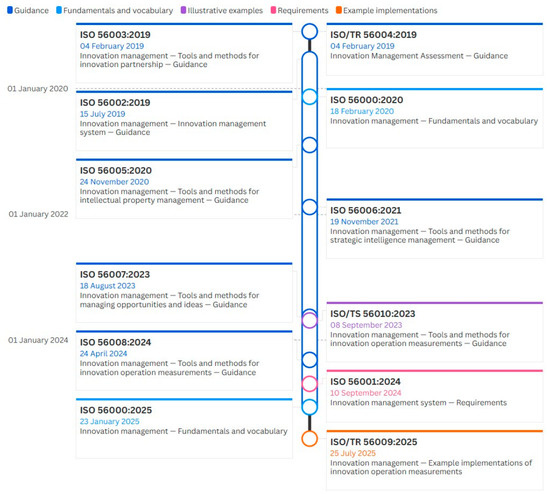
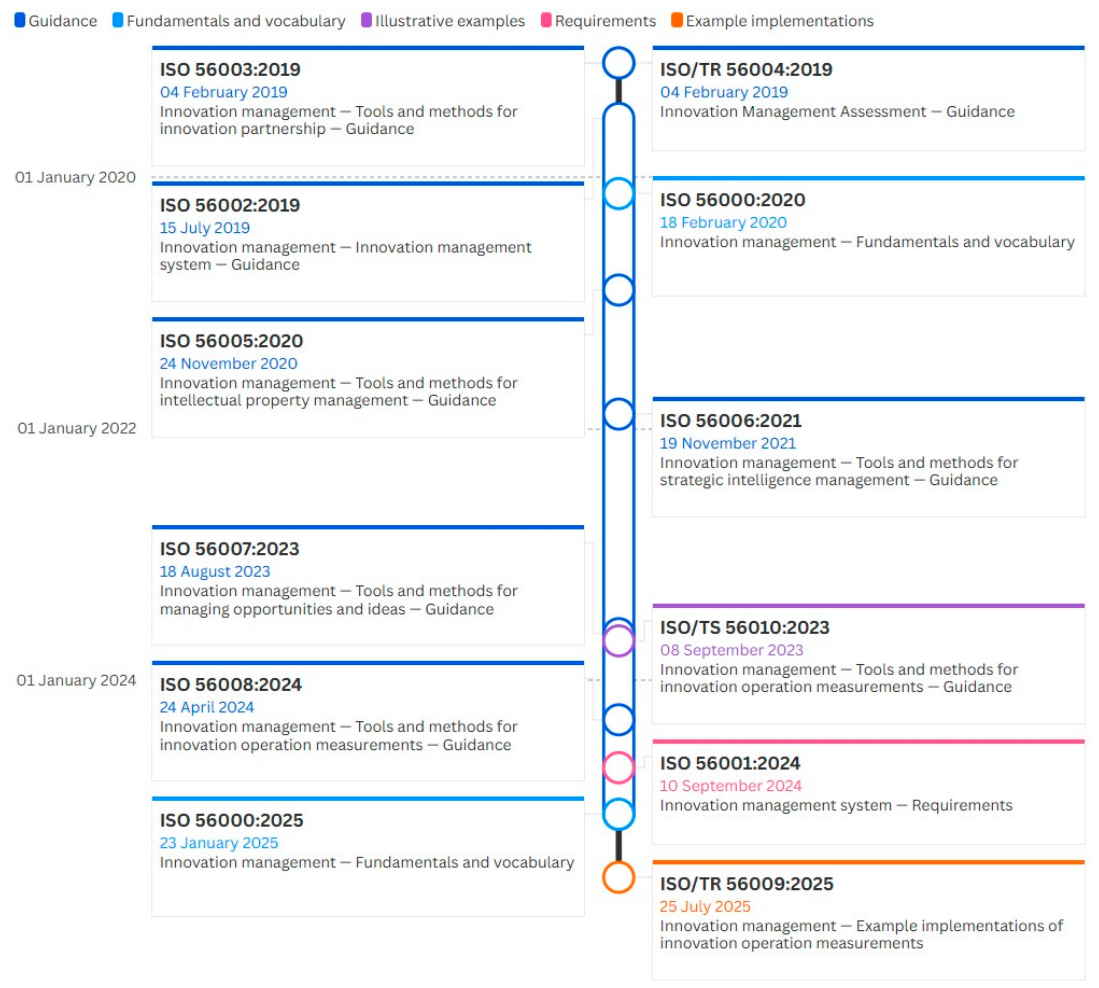
In 2015, when the fifth edition was published, the ISO Technical Committee ISO/TC 279 “Innovation management” approved a new project that would later become ISO 56002:2019 “Innovation management—Innovation management system—Guidance” [5]. Thus, the beginning of the chronology of the ISO 56000 series of standards can be traced back to 16 February 2015. The actual publication of the first three standards happened in 2019, and since then, 11 standards have become integral elements of the ISO 56000 family of standards (see Figure 1).
Figure 1.
A timeline of the ISO 56000 series of standards for innovation management.
As of March 2026, three additional innovation management standards are being developed and are at different stages of readiness:
- ISO/CD 56011 “Competency framework for innovation management [1];
- ISO/AWI 56012 “Innovation management—Innovation Ecosystem Management—Guidance” [1];
- ISO/AWI 56013 “Innovation management—Innovation Portfolio Management—Guidance” [1].
ISO 56002 and ISO/TS 56010 are being revised to maintain alignment with ISO 56001.
3. Requirements and Guidance for Innovation Management Tools and Methods
The purpose of this section is to present an overview of the innovation management tools and methods, starting from requirements (ISO 56001), continuing with general guidance (ISO 56002), and providing details for innovation partnerships, intellectual property management, strategic intelligence management, managing innovation opportunities and ideas, and innovation operation measurements (ISO 56003 to ISO 56008) [6,7,8,9,10,11].
3.1. ISO 56001 “Innovation Management System—Requirements”
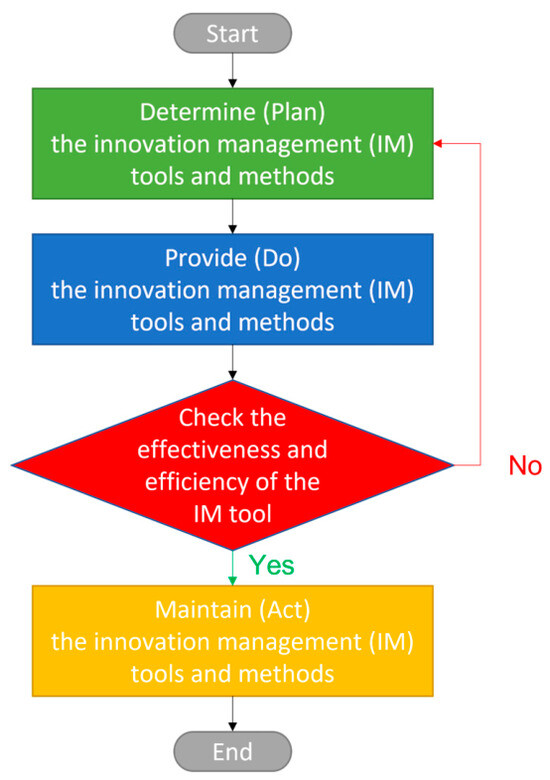
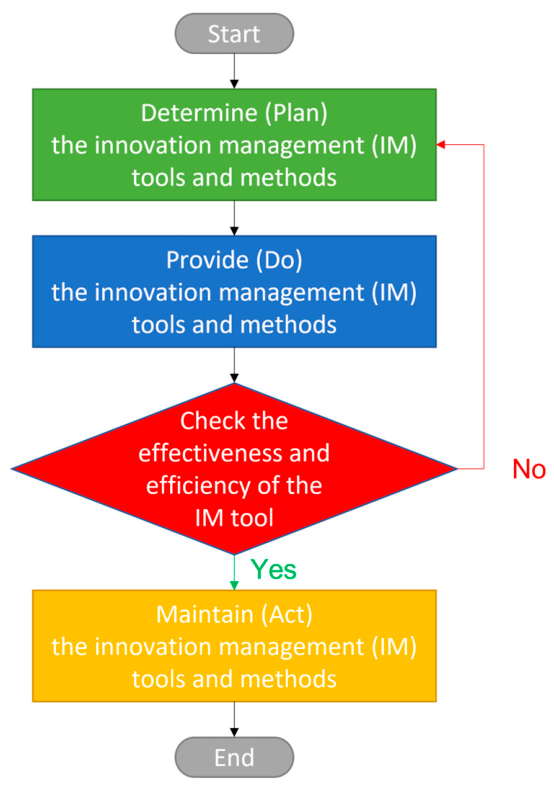
The requirements for innovation management tools and methods are specified in Clause 7.1.8 of this standard. These requirements follow the sequence of the stages of the Plan-Do-Check-Act (PDCA) cycle (see Figure 2). The PDCA cycle is explained in Clause 0.3 “Innovation management system”, subclause 0.3.1 “General” [2], and applies to most of the ISO management systems standards.
Figure 2.
A flowchart of ISO 56001 requirements for tools and methods for innovation management.
The requirements of ISO 56001 are only three and are presented as rectangles on the flowchart (determine, provide, and maintain). In order to complete the PDCA cycle, a “Check” is added, and it fulfils the need of verifying that the innovation management methods and tools are effective and efficient [12]. In case of a negative answer, the logical flow directs to the selection and implementation of new innovation management tools and methods. They have to be appropriate to the concrete type of innovation. One should not underestimate the importance of creating awareness and providing training to people whose organizational roles, responsibilities and authorities are related to the implementation of innovation management tools and methods.
The tools and methods suggested in ISO 56001 include: “back casting, ethnographic research, scenario planning, foresight, brainstorming, strategic intelligence, design thinking, TRIZ, road mapping, customer surveys and/or business model templates” [2].
Appendix A to this paper provides a detailed matrix that aligns innovation management tools and methods to the standards of the ISO 56000 series and different aspects and stages of the innovation management process in an organization of any size and industry.
3.2. ISO 56002 “Innovation Management—Innovation Management System—Guidance”
Before the publication of ISO 56001, this standard served as the basis for developing, implementing, and improving an innovation management system in an organization [5]. Its current edition presents guidance for innovation management tools and methods in Clause 7.6. What stands out when comparing the text of this clause to Clause 7.1.8 of [2] is the recommendation to organizations to “share, re-use and collaborate in the use of tools and methods.” [5]. Furthermore, this standard provides similar innovation management tools and methods to ISO 56001 and classifies them as: “descriptive, provocative, participative, challenging, analytical, and communicative”.
3.3. ISO 56003 “Innovation Management—Tools and Methods for Innovation Partnership—Guidance”
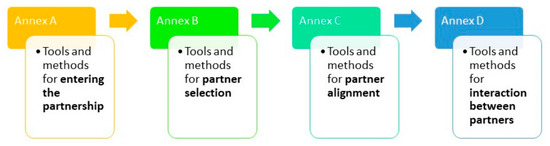
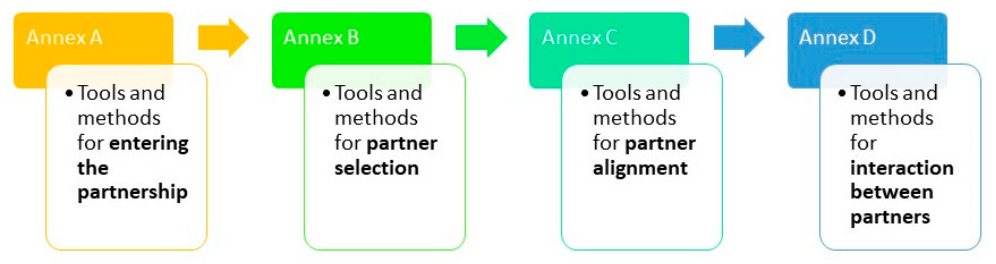
The innovation is rarely the outcome of the efforts and skills of an individual person. The innovations are richer and have higher perceived value when they are the result of a team’s innovation initiatives, activities, and processes. The innovation partnerships can be implemented both internally and externally to the organization. ISO 56003:2019 “provides recommendations for engaging in external partnerships to realize innovation” [6]. The typical lifecycle of an innovation partnership is presented in Figure 3 below.
Figure 3.
Process flow of ISO 56003 tools and methods for innovation partnership.
The different tools are suggested in the core text of the standards and presented in more detail in the annexes of ISO 56003 as follows:
- Annex A “Tools and methods for entering the partnership”—follows the guidance of Clause 5.2 “Deciding whether or not to enter an innovation partnership”. The suggested innovation management tools are: gap analysis, scorecards, SWOT analysis, Product Lifecycle Management (PLM), experience curve concepts, industrial analysis, value chain analysis, strategic planning, and benchmarking.
- Annex B “Tools and methods for partner selection”—recommendations are given in Clause 6.4 “Partner selection decision”. Weighting, multivariate data analysis, and scorecards are considered appropriate tools and methods for this purpose.
- Annex C “Tools and methods for partner alignment”—guidance is presented in Clause 7 “Partner alignment” in the form of a memorandum of understanding or a letter of intent.
- Annex D “Tools and methods for interaction between partners: sample innovation partnership agreement”—referred to in Clause 8 “Interactions between the partners”.
3.4. ISO/TR 56004 “Innovation Management Assessment—Guidance”
The title of this standard does not contain the phrase “tools and methods” [7]. And yet, tools such as online or off-line questionnaires, surveys, and interviews are proposed for data (qualitative and quantitative) collection and data analysis as elements of the innovation management assessment (IMA). The standard emphasizes the need for increased automation as long as this is suitable and adapted to the context of the organization. This may require the use of internal and external resources for performing the IMA.
3.5. ISO 56005 “Innovation Management—Tools and Methods for Intellectual Property Management—Guidance”
“Realization of value” is the first of eight innovation management principles, also shared by the intellectual property management principles, described in Clause 0.2 of ISO 56005:2020 [8]. Value from innovations may be financial or non-financial, long-term or short-term, explicit or implicit. Organizations can preserve the value of inventions and innovations by using tools and methods for intellectual property management and protection of their intellectual property rights (IPR). Some of the well-known and widely used forms of IPR include patents, utility models, trademarks or trade secrets, service marks, industrial designs, geographical indications, plant variety protection, copyright, etc.
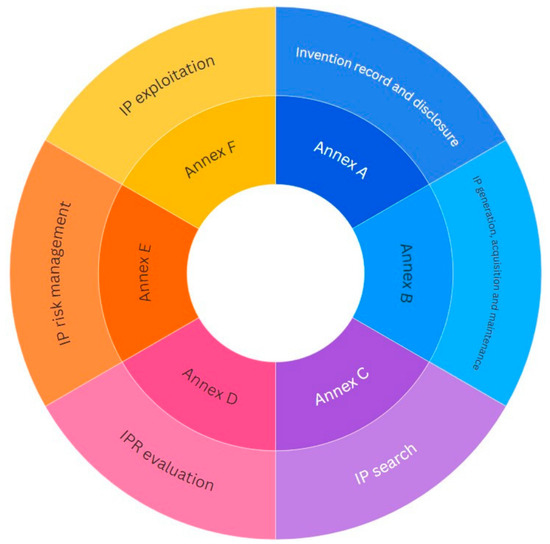
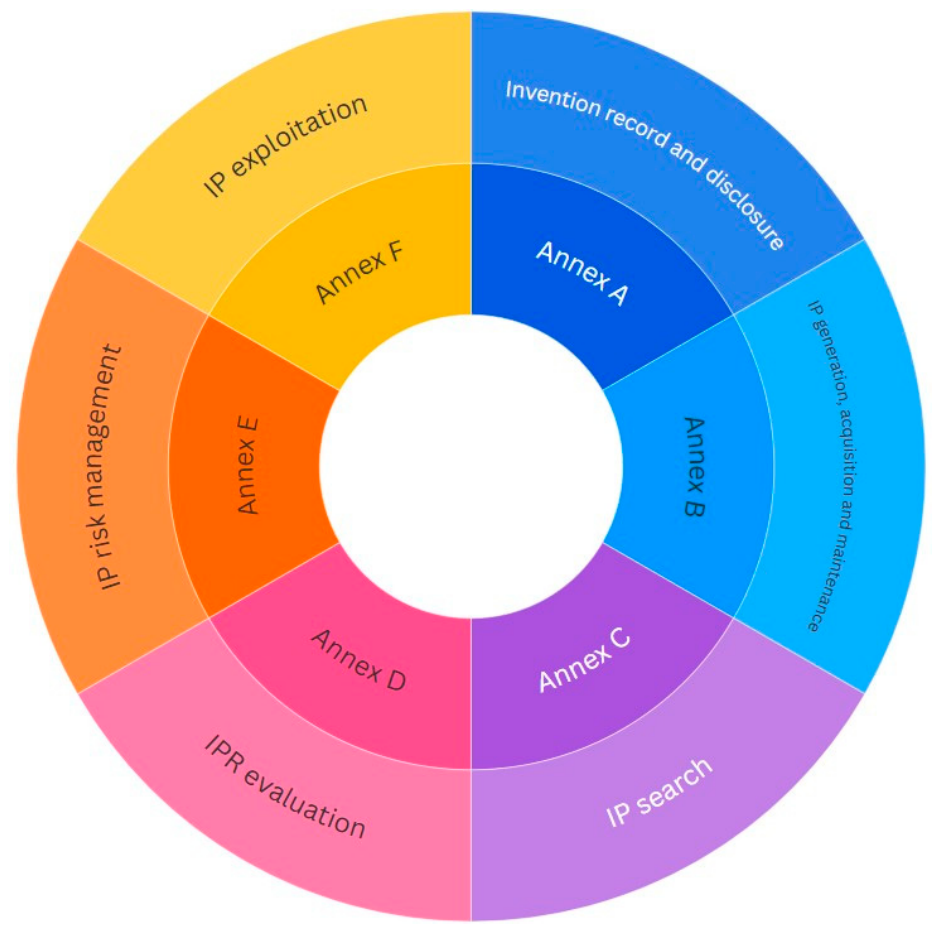
The importance of IPR for the realization of value from innovations justifies the rich variety of tools and methods used in the entire intellectual property management cycle (see Figure 4).
Figure 4.
Classification of ISO 56005 tools and methods for intellectual property management.
The annexes of [8] contain details about the following tools and methods:
- Annex A “Tools and methods for invention record and disclosure”—the records normally include: “laboratory notebook, work journal, through design mock-ups, storyboards, or in an electronic archive”. To protect its know-how from the onset of the innovation management process, an organization usually concludes Non-Disclosure Agreements (NDAs) or Confidentiality Agreements with key stakeholders.
- Annex B “Tools and methods for IP generation, acquisition and maintenance”—the tools used for these steps of the IPR management lifecycle include IP filing, IP protection, IP audit, IP valuation, etc.
- Annex C “Tools and methods for IP search”—in the past, IPR searches used to require painstaking efforts and huge amounts of time to flip through thousands of pages of the IPR bulletins issued in print by international and national patent offices. The trend of digitalization has enabled more error-proof methods for filing, updating, and searching information related to IPR. Depending on the strategy, ambition, and financial interests of the organization, it may choose to register its IPR globally, with the World Intellectual Property Organization (WIPO); regionally, with the European Patent Office (EPO) or the European Intellectual Property Office (EUIPO); or at the national level, which in this case would be the Patent Office of the Republic of Bulgaria.
- Annex D “Tools and methods for IPR evaluation”—three methods are proposed: cash-flow, market, and cost-related method.
- Annex E “Tools and methods for IP risk management”—a presentation of the process for implementing the Freedom to Operate (FTO) analysis method, as well as specific tools and methods for IP risk mitigation.
- Annex F “Tools and methods for IP exploitation”—a list of ways to benefit from IPR, such as direct exploitation, licensing, collaboration, spin-off, assignment of IP, and investment.
3.6. ISO 56006 “Innovation Management—Tools and Methods for Strategic Intelligence Management—Guidance”
There are two terms and definitions in ISO 56006:2021 that clarify the meaning of strategic intelligence [9]. When combined, the resulting joint definition is: “intelligence (result of gathering, analysing and interpreting data, information and knowledge) directed to top management with recommendations to make decisions impacting the vision, strategy, policy, and objectives, as well as innovation activities of the organization”. This means that the management of strategic intelligence facilitates the top management reviews in Clause 9.3 of [2].
A plethora of tools and methods are at the core of the strategic intelligence process known as the DIKI (Data–Information–Knowledge–Intelligence) model. Some of them include: “data mining, analytics, artificial intelligence (AI), machine learning (ML), prediction techniques, environmental scanning, technology watching, ethnographic research”.
The outcome of the data analysis is based on automated (statistical tools or software, data mining, mapping and visualization tools, classification, taxonomy, semantic analysis) and/or human-based analysis techniques (SWOT, PESTEL, Porter’s Five Forces).
3.7. ISO 56007 “Innovation Management—Tools and Methods for Managing Opportunities and Ideas—Guidance”
This standard should be the starting point for any innovation management process or initiative [10]. Unless a sufficient number of innovation opportunities are identified and viable innovation ideas and concepts are created, the remainder of the innovation management toolbox would be rendered obsolete. Thus, it is not surprising that the vast majority of innovation management tools and methods are concentrated in ISO 56007 [10]. Most of them are listed in Annex A “Preparing for managing opportunities and ideas”, A.5 “Innovation management methods and tools”. This standard allocates the tools and methods in the following categories:
- Linear methods (A.6.1);
- Non-linear methods (A.6.2);
- Funnel methods (A.6.3);
- Online collaboration methods (A.6.4);
- Scope and scale methods (A.6.5);
- Bottom-up and top-down methods (A.6.6);
- Organizational set-up methods (A.6.7);
- Gamification methods (A.6.8).
The example descriptions of all innovation management tools and methods are based on renowned publications that are listed as bibliographical sources in [10].
3.8. ISO 56008 “Innovation Management—Tools and Methods for Innovation Operation Measurements—Guidance”
So far, this standard is the largest one in the ISO 56000 series in terms of the number of pages [11]. This is expected when considering its utmost importance, i.e., to establish how well the innovation management system operates. The measurements refer to the entirety of Clause 8, including 8.2 “Innovation initiatives” and 8.3 “Innovation processes” in [2]. It also expands the scope of measurements to include the innovation portfolio.
Among the tools and methods considered in [11] are: matrix of the importance and potential influence of interested parties, innovation portfolio constituent analysis (IPCA) matrix and map, and innovation portfolio review scorecard (IPRS).
3.9. Analysis of the Innovation Management Tools and Methods in the ISO 56000 Series of Standards
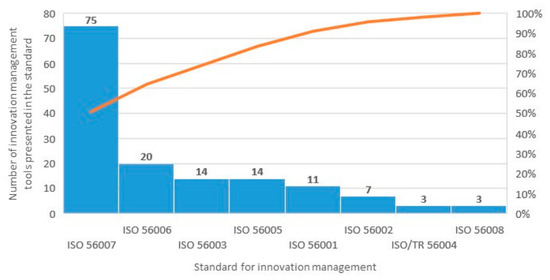
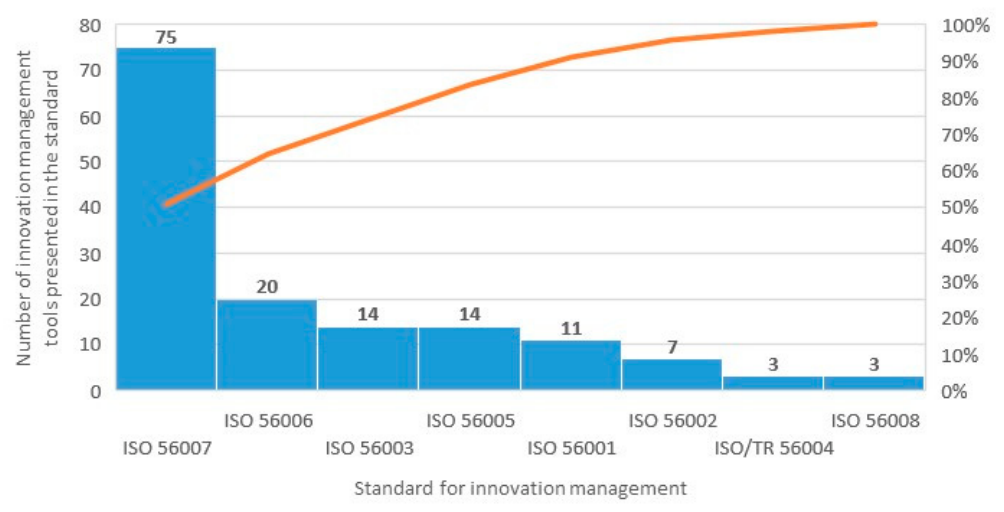
In summary of the tools and methods presented in the ISO 56000 series of standards, the authors of this paper have developed a detailed matrix. It contains a total of 133 different tools and methods that are aligned to the eight innovation management standards discussed in this section of the paper. Figure 5 benefits from the application of a well-known quality tool, the Pareto diagram, to highlight the standards that offer the highest number of innovation management tools and methods. The orange line represents the cumulative percentage for each consecutive standard of the ISO 56000 series [13].
Figure 5.
Pareto chart of the tools and methods in the ISO 56000 series of standards.
More than half of all innovation management tools and methods, i.e., 56.4%, are encountered in ISO 56007, which deals with innovation opportunities and ideas. It is followed by ISO 56006 with 20 tools and methods for strategic intelligence management (15% of the total), and two standards, each of which has 14 tools and methods (ISO 56003 for innovation partnership and ISO 56005 for intellectual property management). Only 10 tools and methods are used in more than one standard, and 4 tools have 3 standards that recommend their use. These tools are: brainstorming, ethnographic research, scenario planning, and SWOT analysis.
When cross-referenced to ISO 56001 clauses, the standards with innovation management tools and methods can be used as guidance as follows:
- ISO 56003: Clause 8.3 “Innovation processes”;
- ISO/TR 56004: Clause 9 “Performance evaluation”;
- ISO 56005: Clause 7.1.7 “Intellectual property”;
- ISO 56006: Clause 9.3 “Management review”;
- ISO 56007: Clause 6.1 “Actions to address risks and opportunities”;
- ISO 58008: Clause 9.1 “Monitoring, measurement, analysis and evaluation”.
4. Industrial Applications of Innovation Management Tools
Innovations can be related to “a product, service, process, model, method, etc.” [13]. This diversity in application becomes even richer when different industrial sectors are considered: automotive, healthcare, forestry, education, etc.
One of the most widely used innovation management tools, the SWOT analysis, has been creatively applied in the forestry industry innovation by Štěrbová et al. [14]. The reversal of SWOT analysis as a TOWS matrix uncovers perspectives that would not be evident using the traditional approach, resulting in combinations that define whether the innovation strategy should be defensive or attacking. An advanced application of the SWOT analysis “by giving different importance, effect, ratio and probability values to each factor” in the automotive industry, is given in [15]. Another innovation model visualizes the degrees of overlap across digital innovation execution models in healthcare [16].
A self-assessment questionnaire is used as a tool to self-assess the innovation management system of a company in [17]. The application of this tool, which uses a scoring system, has allowed a justified definition of the maturity level of innovation management systems of commercial enterprises and public-sector organizations.
The use of artificial intelligence as a tool for strategic intelligence in automotive companies is discussed by Aschbacher et al. in [18]. It is enriched by an innovation capability assessment model and process landscape based on the ISO 56000 series of standards.
Fernandez and Swart take an unorthodox approach to the application of a competence system in the knowledge industry in [19]. They link AI to a number of innovation management methods and tools. A unique feature of this paper is the suggestion to adapt the Six Sigma belt system and propose six levels for progressive certification of people dealing with innovation management systems (IMSs):
- Level 1—IMS Foundations (Yellow Belt): Building the Foundation;
- Level 2—IMS Practitioner (Orange Belt): Leading Innovation Teams;
- Level 3—IMS Designer Implementer (Black Belt): Architecting Innovation Systems;
- Level 4—IMS Lead Auditor (Black Belt): Ensuring System Integrity and Maturity;
- Level 5—IMSMaster (Master Black Belt): Demonstrating Excellence Through Practice;
- Level 6—IMS Executive Champion (Silver Belt): Strategic Leadership for Innovation.
Numerous examples from many other industries and case studies are presented in the following books written by experienced innovators and standardization experts:
- “Managing Innovative Projects and Programs: Using the ISO 56000 Standards for Guidance and Implementation [20].
- “ISO 56000 Building an Innovation Management System. Bring Creativity and Curiosity to Your QMS” [21].
- “Innovation Management in Practice: Understanding and Acting with ISO 56001” [22].
5. Conclusions
This paper presents a comprehensive overview of the ISO 56000 series of standards for innovation management with a focus on the tools and methods that are applicable to innovation initiatives, actions, processes, and systems. The chronology helps gain a better understanding of the factors that have shaped the current status of these standards, and the analysis of the tools and methods in each of these standards enables professionals to navigate with confidence and precision the complex and dynamic innovation context.
The industrial applications highlight some best practices that can serve as the basis for the improvement of existing management systems in organisations of any size and sector.
Author Contributions
Conceptualization, T.G. and K.T.; methodology, T.G.; software, K.T.; validation, T.G., K.T., and K.L.; formal analysis, T.G.; investigation, K.L.; resources, K.L.; data curation, K.T.; writing—original draft preparation, T.G.; writing—review and editing, K.T.; visualization, T.G.; supervision, T.G.; project administration, T.G.; funding acquisition, K.L. All authors have read and agreed to the published version of the manuscript.
Funding
This research was funded by the European Regional Development Fund within the OP “Research, Innovation and Digitalization Programme for Intelligent Transformation 2021–2027”, Project No. BG16RFPR002-1.014-0005 Center of competence “Smart Mechatronics, Eco- and Energy Saving Systems and Technologies”. This research was funded by the European Regional Development Fund within the OP “Research, Innovation and Digitalization Programme for Intelligent Transformation 2021–2027”, Project No. BG16RFPR002-1.014-0006 National Center of Excellence Mechatronics and Clean Technologies.
Institutional Review Board Statement
Not applicable.
Informed Consent Statement
Not applicable.
Data Availability Statement
Data will be available on request.
Acknowledgments
The authors would like to thank the Research and Development Sector at the Technical University of Sofia for the financial support.
Conflicts of Interest
The authors declare no conflicts of interest.
Appendix A
Table A1.
Innovation management tools and methods matched against the ISO 56000 series of standards.
References
- Standards by ISO/TC 279 “Innovation Management”. Available online: https://www.iso.org/committee/4587737/x/catalogue/p/0/u/1/w/0/d/0 (accessed on 13 March 2026).
- ISO 56001:2024; Innovation Management System—Requirements. ISO: Geneva, Switzerland, 2024.
- ISO 9001:2015; Quality Management Systems—Requirements. ISO: Geneva, Switzerland, 2015.
- ISO 9004:2018; Quality Management—Quality of an Organization—Guidance to Achieve Sustained Success. ISO: Geneva, Switzerland, 2018.
- ISO 56002:2019; Innovation management—Innovation management system—Guidance. ISO: Geneva, Switzerland, 2019.
- ISO 56003:2019; Innovation Management—Tools and Methods for Innovation Partnership—Guidance. ISO: Geneva, Switzerland, 2019.
- ISO/TR 56004:2019; Innovation Management Assessment—Guidance. ISO: Geneva, Switzerland, 2019.
- ISO 56005:2020; Innovation Management—Tools and Methods for Intellectual Property Management—Guidance. ISO: Geneva, Switzerland, 2020.
- ISO 56006:2021; Innovation Management—Tools and Methods for Strategic Intelligence Management—Guidance. ISO: Geneva, Switzerland, 2021.
- ISO 56007:2023; Innovation Management—Tools and Methods for Managing Opportunities and Ideas—Guidance. ISO: Geneva, Switzerland, 2023.
- ISO 56008:2024; Innovation Management—Tools and Methods for Innovation Operation Measurements—Guidance. ISO: Geneva, Switzerland, 2024.
- Gueorguiev, T. The PDCA Cycle in Innovation Management Systems Based on ISO 56001:2024, UNITECH—Selected Papers—2024. Available online: http://www.doi.org/10.70456/UIFI9691 (accessed on 13 March 2026). [CrossRef] [Scilit]
- ISO 56000:2025; Innovation Management—Fundamentals and Vocabulary. ISO: Geneva, Switzerland, 2025.
- Štěrbová, M.; Loučanová, E.; Paluš, H.; Ivan, Ľ.; Šálka, J. Innovation Strategy in Slovak Forest Contractor Firms—A SWOT Analysis. Forests 2016, 7, 118. [Google Scholar] [CrossRef] [Scilit]
- Kurt, Z.B.; Yıldız, A. Determination of Innovation Strategies using Advanced SWOT Analysis. Acad. Perspect. Procedia 2022, 5, 34–41. [Google Scholar] [CrossRef] [Scilit]
- Denicolai, S.; Previtali, P. Innovation strategy and digital transformation execution in healthcare: The role of the general manager. Technovation 2023, 121, 102555. [Google Scholar] [CrossRef] [Scilit]
- Danylenko, Y.; Yurchyshyn, O.; Hrinchenko, H. Self-Assessment of the Company Innovation Management System. Sci. Innov. 2025, 21, 104–115. [Google Scholar] [CrossRef] [Scilit]
- Aschbacher, L.; Zelmenis, M.; Messnarz, R.; Ekert, D. Strategic Intelligence Management (ISO 56006)—Using AI by the Innovation Agent Task Force in the Automotive Skills Alliance (ASA). J. Softw. Evol. Process 2025, 37, e70038. [Google Scholar] [CrossRef] [Scilit]
- Fernandez, R.; Swart, W. The New ISO 56000 Family of Standards for Innovation Management. Standards 2025, 5, 34. [Google Scholar] [CrossRef] [Scilit]
- Harrington, H.J.; Benraouane, S.A. Managing Innovative Projects and Programs: Using the ISO 56000 Standards for Guidance and Implementation, 1st ed.; CRC Press: New York, NY, USA, 2022; ISBN 9781000615487. [Google Scholar]
- Merrill, P. ISO 56000 Building an Innovation Management System. Bring Creativity and Curiosity to Your QMS; Quality Press: Milwaukee, WI, USA, 2020; ISBN 9781951058289. [Google Scholar]
- Sauzet, F. Innovation Management in Practice: Understanding and Acting with ISO 56001; CRC Press: New York, NY, USA, 2025; ISBN 9781040441138. [Google Scholar]
Disclaimer/Publisher’s Note: The statements, opinions and data contained in all publications are solely those of the individual author(s) and contributor(s) and not of MDPI and/or the editor(s). MDPI and/or the editor(s) disclaim responsibility for any injury to people or property resulting from any ideas, methods, instructions or products referred to in the content. |
© 2026 by the authors. Licensee MDPI, Basel, Switzerland. This article is an open access article distributed under the terms and conditions of the Creative Commons Attribution (CC BY) license.