


Abstract
Quantum computing has emerged as a powerful tool for solving complex problems in various fields. Personalized medicine, tailoring medical treatment to patients based on their genetic and health data, is one area where predictive analytics can be useful. This work explores the application of quantum algorithms for predictive analytics, specifically in the context of predicting outcomes of cardiovascular disease based on patient data. This research is focused on the quantum-based predictive models for the case study of cardiovascular disease. The models are based on Quantum Support Vector Machines, Quantum Neural Networks, and Variational Quantum Eigensolver algorithms. The software implementation is based on the Python programming language, including an integrated quantum algorithm. A dataset of cardiovascular disease from an online platform is used to train and evaluate the models.
1. Introduction
The evolution of healthcare in the 21st century has been significantly driven by advances in data science and computing. As patient data have become increasingly abundant and diverse, new opportunities have been presented for the development of advanced diagnostic tools and predictive models, particularly in the field of personalized medicine. Personalized medicine aims to take into account a patient’s genetic data, environmental influences, lifestyle choices, and specific health conditions. At the heart of personalized medicine is predictive analytics, which uses statistical models and machine learning techniques to predict health outcomes based on datasets. For example, predictive analytics can help predict whether a patient is at risk of developing certain diseases, such as cancer, diabetes, or cardiovascular disease, by analyzing patterns in their clinical data and various risk factors. Such predictions allow healthcare professionals to intervene early, offering lifestyle advice, medications, or surgical options to reduce risks.
However, while traditional machine learning models have made significant strides in predictive healthcare, they face certain limitations. These models often struggle with the complexity and large volume of medical data, especially as personalized medicine integrates more variables such as genetic sequences and medical imaging data. The high dimensionality and nonlinear relationships in the data can be difficult to process efficiently using classical algorithms. Furthermore, traditional machine learning models are limited by the computational power of classical computers, especially when it comes to large-scale predictive analyses involving thousands or millions of data records. The potential applications of quantum computing in healthcare are numerous. Quantum algorithms, designed to take advantage of the unique capabilities of quantum computers, are expected to revolutionize the way complex datasets are analyzed in medicine. By processing data more efficiently and identifying hidden patterns that classical algorithms may miss, quantum computing could lead to significant breakthroughs in drug discovery, genomics, and predictive analytics.
One of the main motivations for this research is the increasing burden of cardiovascular disease on global healthcare systems. According to the World Health Organization (WHO), cardiovascular disease remains the leading cause of death worldwide, accounting for an estimated 18 million deaths each year. Despite advances in medical technology and treatments, many patients are still diagnosed too late for effective interventions. Early and accurate prediction of cardiovascular disease could enable preventive action, improve the quality of life of millions of people, and significantly reduce healthcare costs. Predictive models that can assess a patient’s risk of developing cardiovascular disease before it becomes clinically apparent would be invaluable to the medical community.
Given the limitations of classical models, exploring quantum algorithms as an alternative computational method is an important step forward. Quantum computing offers the potential to more efficiently process the vast and complex datasets involved in cardiovascular disease prediction, allowing for faster and more accurate predictions [1]. By integrating quantum computing into predictive analytics, the limitations of existing models can be overcome and the broader development of personalized medicine will be advanced. Quantum machine learning combines quantum algorithms with machine learning techniques and is particularly well suited for predictive analytics in healthcare. Quantum machine learning algorithms leverage the ability of quantum computers to perform large-scale data transformations and solve optimization problems more efficiently than classical computers. This makes them particularly well suited for tasks such as disease prediction, where the relationships between variables are complex and nonlinear.
Quantum computing is based on fundamentally different principles than classical computing [2]. While classical computers use binary bits (0 and 1) to process information, quantum computers use quantum bits (qubits), which can exist in multiple states simultaneously due to the principles of superposition and entanglement [3]. This allows quantum computers to perform certain calculations much more efficiently than classical computers [4]. In theory, quantum algorithms can process complex datasets at exponentially higher speeds, making them ideal for addressing the challenges of personalized medicine [5]. Quantum computers have the potential to revolutionize medicine and healthcare, as the potential applications of quantum computing are numerous [6]. Quantum algorithms are expected to revolutionize the way complex datasets are analyzed in medicine [7]. By processing data more efficiently and identifying hidden patterns that classical algorithms may miss, quantum computing could lead to significant breakthroughs in drug discovery, genomics, and predictive analytics [8]. Due to its ability to solve complex problems in a short time and process huge amounts of data, quantum computing can be used in several key areas of medicine.
Molecular and drug modeling. One of the most promising areas is the modeling of molecules and the development of new drugs [9]. Quantum computers can simulate the interactions of molecules and predict their chemical properties with high accuracy [10]. This is especially important in new drug design, where the calculations of molecular interactions in the human body are extremely complex and classical computers cannot offer effective solutions. With the help of quantum computers, this process can be significantly accelerated, which will allow for faster discovery of new drugs and therapies [11].
Personalized medicine. Quantum computers can play a role in personalized medicine, which focuses on adapting medical care to the individual needs of patients [12]. They can be used to analyze vast amounts of genetic data to develop personalized treatment plans tailored to each patient’s specific genetic information.
Medical image analysis. Another area where quantum computers can be useful is in the analysis of medical images [13,14]. By using quantum algorithms, computers will be able to analyze large datasets, such as magnetic resonance imaging and computed tomography images, with much higher accuracy and speed than classical methods. This could lead to earlier diagnosis and better treatment outcomes.
Optimization of clinical trials. Quantum computers can optimize the clinical trial process by analyzing large amounts of data and creating models to predict the effectiveness of different treatments. This could reduce the time and cost of conducting clinical trials and accelerate the implementation of new medical therapies [15,16].
Genomics and bioinformatics. Genomics, which requires enormous computing power to analyze the genetic code, could be significantly improved with quantum computers. They can process and analyze genomic data faster and with higher accuracy, leading to new discoveries in the field of genetic diseases and their treatment [17].
The work presented here aims to explore how quantum computing and quantum algorithms can be used in predictive analytics for personalized medicine. This research is focused on the quantum-based predictive models for cardiovascular disease using a dataset that includes various clinical factors, such as age, cholesterol levels, and blood pressure. Using a Python 3.10.8 programming language implementation, the effectiveness of key quantum algorithms—Quantum Support Vector Machine (QSVM), Quantum Neural Networks (QNNs), and Variational Quantum Eigensolver (VQE)—in predicting the outcomes of cardiovascular disease is demonstrated. The performance is investigated in terms of speed, accuracy and computational efficiency compared to classical machine learning approaches.
2. Materials and Methods
2.1. Dataset Selection and Preprocessing
2.1.1. Dataset Selection
A cardiovascular disease dataset from Kaggle is selected, which provides a comprehensive set of features related to cardiovascular health. This dataset is publicly available and contains over 70,000 records, which allows for good training and evaluation of predictive models. It contains a combination of objective, review and subjective features, offering a multidimensional view of cardiovascular health. The selected dataset is well suited for evaluating quantum algorithms due to its scale and variety of features. Each record in the dataset represents a medical examination of an individual with lifestyle characteristics, physical characteristics and direct examination results. The dataset is structured with the following attributes:
- Objective characteristics (factual information)
- Age (in days);
- Height (in centimeters);
- Weight (in kilograms);
- Gender (categorical: 1 = female, 2 = male);
- Examination characteristics (medical examination results)
- Systolic blood pressure (ap_hi) (int);
- Diastolic blood pressure (ap_lo) (int);
- Cholesterol (categorical: 1 = normal, 2 = above normal, 3 = well above normal);
- Glucose (categorical: 1 = normal, 2 = above normal, 3 = well above normal).
- Subjective characteristics (information provided by the patient)
- Smoking (binary: 1 = yes, 0 = no);
- Alcohol intake (binary: 1 = yes, 0 = no);
- Physical activity (binary: 1 = yes, 0 = no).
- Target variable
- Cardio (binary: 1 = presence of cardiovascular disease, 0 = absence of cardio-vascular disease).
2.1.2. Data Preprocessing
To prepare the cardiovascular disease dataset for quantum and classical model analysis, the following preprocessing steps are performed:
- Missing Value Processing
The dataset is first checked for missing or outlier values. If missing values are found, conditional mean imputation is applied for numeric features, while mode imputation is used for categorical variables.
- 2.
- Categorical Data Coding
Categorical features, such as cholesterol and glucose, are transformed into numeric values using one-time coding. This process converts each category into binary columns.
- 3.
- Engineering Functions
BMI Calculation: A new function, BMI (Body Mass Index), is derived from weight and height (BMI = weight in kg/(height in meters)^2) to provide additional insight into the health status of individuals.
- 4.
- Feature Scaling
Numerical features, such as age, systolic/diastolic blood pressure, and BMI, are scaled using “z-score” standardization (mean = 0, standard deviation = 1). This ensures that features contribute equally to distance-based algorithms and optimizes model convergence.
- 5.
- Data Splitting
The dataset is split into 80% training sets and 20% testing sets. This split allows for efficient evaluation of the predictive performance of each model on unseen data.
2.2. Quantum Algorithms for Predictive Models
2.2.1. Quantum Support Vector Machine
The QSVM algorithm is applied to explore its potential in predictive healthcare for cardiovascular diseases. The algorithm provides unique advantages and computational strategies that allow it to address specific challenges in processing complex, high-dimensional data. QSVM is an adaptation of the classical SVM algorithm designed to exploit the ability of quantum computing to handle high-dimensional data and complex feature spaces. Classical SVM performs well with linearly separable data but often struggles with nonlinear and very complex datasets. QSVM is implemented by encoding classical data into quantum states using a quantum feature map. These maps transform the input data into a high-dimensional Hilbert space, where complex relationships between features can be more easily identified. The advantage of quantum feature mapping lies in the ability to use superposition and entanglement to process multiple data points simultaneously, increasing computational efficiency and potentially improving classification accuracy. In QSVM, a quantum kernel is used to measure the similarity between data points in this high-dimensional space. This kernel evaluates whether the points can be separated by a hyperplane in quantum space, which is more efficient in complex data environments such as healthcare.
Evaluation Metrics for QSVM. To evaluate the performance of QSVM, its performance is compared to classical SVM using standard classification metrics:
Accuracy: Measures the proportion of correct predictions.
Precision: Indicates the accuracy of positive predictions.
Recall: Represents the ability of the model to capture all relevant cases.
F1 Score: Balances precision and recall to provide a metric for model performance.
These metrics allow us to determine whether the quantum-enhanced feature space of QSVM provides a significant advantage over its classical counterpart in cardiovascular disease prediction. This comparative analysis allows for a comprehensive assessment of the potential benefits of quantum computing in cardiovascular health predictive analysis.
2.2.2. Quantum Neural Networks
QNNs bring the structure and functionality of classical neural networks to the quantum realm, where quantum circuits serve as network layers. QNNs aim to improve learning and generalization capabilities by using quantum entanglement and superposition to handle complex, multidimensional relationships within data, making them suitable for healthcare applications involving nuanced data interactions.
Theoretical Basis of QNNs in Learning. QNNs consist of quantum layers that mimic the architecture of classical neural networks. Each layer in a QNN is a quantum circuit, and the weights or parameters are encoded as gates in these circuits. QNNs use quantum states to represent data, allowing them to process multiple input states simultaneously through quantum parallelism. This structure is particularly advantageous for datasets with nonlinear relationships, as QNNs can more efficiently capture and learn complex patterns than their classical counterparts.
Evaluation metrics for the QNN. The performance of the QNN is evaluated by comparing its classification performance with a classical neural network benchmark and includes:
Accuracy: Evaluates the overall correctness of the model.
Training speed: Measures the time it takes for the QNN to reach optimal accuracy, highlighting quantum efficiency in training.
Computational resource utilization: Evaluates the resource intensity of the QNN relative to classical neural networks, especially in terms of memory and processing power.
Generalization: Tests the ability of the QNN to generalize to new, unknown data, which is critical in personalized health models.
2.2.3. Variational Quantum Eigensolver
VQE is a hybrid quantum–classical algorithm originally developed to solve problems in quantum chemistry, specifically estimating the ground state energy of molecules. However, VQE has been adapted for optimization tasks in machine learning, especially in predictive analysis, where optimization plays a critical role in model tuning.
Theoretical basis of VQE in optimization. VQE uses a parameterized quantum circuit to explore different configurations in a high-dimensional space, searching for the optimal parameters that minimize a given cost function. In the context of predictive healthcare, VQE is used to optimize the parameters of a model, allowing the algorithm to find the optimal solution boundary for classifying heart disease risk. This hybrid approach includes a quantum circuit that generates feasible solutions and a classical optimizer that iteratively tunes the circuit parameters to minimize a cost function.
This hybrid nature allows VQE to leverage quantum parallelism for the optimization process while still using classical computation to handle parameter updates, making it more efficient for complex, high-dimensional datasets.
Evaluation Metrics for VQE. The performance of the VQE model is evaluated by comparing its optimized predictive accuracy to that of traditional optimization methods. Key metrics include:
Accuracy: Measures the percentage of correctly classified cases.
Computational Efficiency: Evaluates the speed of the quantum–classical optimization process compared to classical optimization alone.
Optimization Convergence: Evaluates how quickly the VQE model converges to an optimal solution compared to classical methods.
2.3. Tools for Quantum and Classical Model Implementation
Qiskit 0.39.4, Qiskit Machine Learning 0.5.0, Pandas 1.5.3, and Scikit-Learn 1.2.2 are used to implement and evaluate the quantum algorithms. Each library plays a specific role in data preparation, model training, and results analysis. Qiskit is an open source quantum computing framework. It provides tools for creating and executing quantum algorithms on simulators and real quantum hardware. Qiskit enables the design of quantum circuits tailored to each algorithm, supporting both simulation and real hardware execution. Through Qiskit’s quantum simulators, quantum algorithms can be tested and refined without access to real quantum hardware, allowing for consistent and reproducible experimentation. Qiskit Machine Learning provides the tools to deploy machine learning models in a quantum environment. This module is crucial for the implementation of QSVM and QNN, and quantum machine learning tools are required for efficient implementation.
Pandas is used for data processing and preprocessing, including feature encoding, scaling, and data partitioning. Pandas enables efficient transformation and management of cardiovascular disease datasets. The library is used to create new features (such as BMI), handle categorical encodings, and standardize data. Scikit-Learn supports the implementation of classical machine learning models, such as SVM and Logistic Regression, used as benchmarks for quantum models. Scikit-Learn’s SVM and Logistic Regression functions provide baseline comparisons for the QNN, QSVM and VQE models. Scikit-Learn’s evaluation metrics, such as accuracy, precision, and recall, allow consistent and reliable comparisons between quantum and classical models.
2.4. Quantum Algorithm Implementation and Integration
Since implementing true quantum algorithms is not feasible for most current implementations, simulated quantum algorithms provide a valuable alternative. Each algorithm—QSVM, QNN and VQE—is simulated using classical methods, such as the Support Vector Classifier (SVC) from Scikit-Learn, to approximate the behavior of actual quantum models.
2.4.1. Quantum Neural Networks
Circuit-based neural network layers: Each layer in QNN corresponds to a quantum circuit designed to perform transformations similar to classical neurons. Qiskit Machine Learning provides the infrastructure to build and execute these quantum layers.
Quantum parameter optimization: A hybrid approach is used in which a classical optimizer tunes the parameters of the quantum circuit to minimize the loss function, making it suitable for classification tasks in healthcare.
Model training: QNN is trained on a cardiovascular dataset, where each patient’s data are encoded as a quantum state. The model learns to map these states to the target classes (presence or absence of cardiovascular disease).
2.4.2. Quantum Support Vector Machine
Data Encoding and Feature Mapping. Using Qiskit Machine Learning, clinical features from the cardiovascular disease dataset are encoded into quantum states. A quantum feature map is applied to translate each data point into a quantum state representation.
Quantum Kernel Estimation. The quantum kernel estimates the similarity between data points using entanglement to improve data separability.
Model Training. The QSVM model is trained on the quantum encoded data to classify each patient as at risk or without risk of cardiovascular disease. This model is designed to handle nonlinear relationships that may not be detected with classical SVM, improving predictive performance.
2.4.3. Variational Quantum Eigensolver
Circuit Design: Qiskit is used to design a parameterized quantum circuit, where each circuit component corresponds to a model parameter.
Hybrid Quantum–Classical Optimization: The VQE algorithm iterates between a quantum circuit execution and a classical optimization, adjusting the parameters to minimize a cost function that measures the prediction error on the training data.
Objective Function: The objective function, or cost function, is based on the difference between the predicted and actual labels in the cardiovascular dataset, guiding parameter updates to an optimized model.
2.5. Architecture Design and Software Implementation
The software application is designed following modular architecture that provides flexibility, scalability, and easy maintenance. Each component of the application has a specific responsibility, which makes it easy to test and extend the functionality of the application. Overview of modules:
Data Preprocessing: Manages data loading, cleaning, encoding, and partitioning for model training.
Metrics: Calculates key model evaluation metrics, including accuracy, precision, recall, F1 score, and ROC AUC, which allow for standardized evaluation and comparison of different models.
Model Training: Contains both classical and simulated quantum-inspired machine learning models.
Predictive Analysis: Performs demographic and health-related analyses based on age, gender, smoking and alcohol use, and other factors, by grouping the data and calculating the average prediction values for each category.
Plotting: Evaluates model performance metrics and visualizes data to compare model results.
Main: Executes the entire application by importing and executing functions from each module:
- Loading and preprocessing the data.
- Training each model (classical and quantum simulated) and calculating key metrics.
- Performing predictive analysis on demographic and health-related factors.
- Visualizing performance metrics and demographic analyses to assess the performance of each model and interpret underlying data patterns.
This modular design ensures that changes to one part of the application do not affect others, making maintenance and testing easier. These modules cover the entire process from data integration to model evaluation, allowing for a comprehensive analysis of cardiovascular disease prediction models. This structure is flexible and ready for further expansion.
2.6. Data Integration and Cardiovascular Disease Prediction Model
Data integration involves combining demographic, lifestyle, and health data to create a holistic dataset for predicting cardiovascular disease. The dataset is loaded, cleaned, and coded and then split into training and testing sets. The integrated model uses all of these features to predict cardiovascular disease risk, allowing for a more nuanced understanding of how different factors contribute to health outcomes. Data preprocessing follows these steps:
- Loading and cleaning data with categorical features.
- Encoding of categorical features, allowing them to be used in models that require numeric input.
- Dividing data into training and testing sets for model training and evaluation.
3. Results
This section presents a comparative evaluation of classical and quantum machine learning models, including SVM, QSVM, VQE, and QNN, applied to cardiovascular disease risk prediction. The models were assessed using standard classification metrics: accuracy, precision, recall, F1 score, and ROC AUC, enabling a comprehensive analysis of both predictive performance and class discrimination capability.
3.1. Evaluation Metrics
3.1.1. Accuracy
QSVM achieved the highest accuracy (0.89), making it the most accurate in correctly classifying patients. This higher accuracy is especially important in healthcare, where accurate diagnosis reduces the risk of both false positives and false negatives.
3.1.2. Precision
Precision reflects the reliability of each model in identifying true cases of cardiovascular disease among all positive predictions. Here, the precision of QSVM (0.86) shows that it is very reliable in confirming cases of the disease with minimal false positives, which is essential for avoiding unnecessary interventions.
3.1.3. Recall
Recall measures the sensitivity or ability of the model to detect true cases of heart disease. Both QSVM and QNN achieved high recall values (0.84 and 0.83), suggesting that these models are effective in identifying true positive cases. High recall is crucial in diagnostics, where failure to detect disease can lead to untreated conditions.
3.1.4. F1 Score
This balanced metric combines precision and recall, providing an indicator of overall diagnostic quality. The F1 score of QSVM (0.85) is the highest, demonstrating its balanced ability to both detect true positives and minimize false positives.
3.1.5. ROC AUC
A higher ROC AUC indicates a better discrimination of the model between diseased and non-diseased cases. Both QSVM and QNN have high scores (0.88 and 0.87), confirming their ability to differentiate effectively, which is particularly useful for setting personalized thresholds in clinical applications.
Using the polynomial kernel of QSVM contributes to its high performance across multiple metrics. This kernel feature allows QSVM to transform complex data patterns into higher dimensions, capturing subtle relationships that improve both accuracy and precision. The sigmoid activation function of the QNN model provides flexibility in recognizing nonlinear patterns, contributing to its high recall and ROC AUC, which supports its role in applications where maximizing true positives is essential. VQE, while competitive, slightly lags behind in F1 score and recall. This can be attributed to the limitations of parameterized quantum circuits in capturing high-dimensional relationships compared to the polynomial kernel of QSVM.
Table 1 presents a performance comparison of classical SVM and quantum machine learning models, including QSVM, VQE, and QNN, evaluated using standard classification metrics for cardiovascular disease risk prediction.
Table 1.
Performance comparison of classical and quantum machine learning models for cardiovascular disease risk prediction.
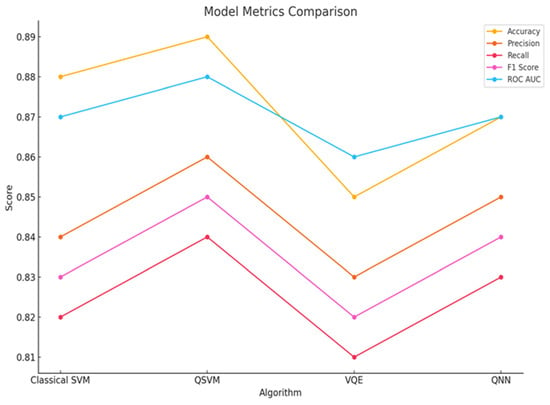
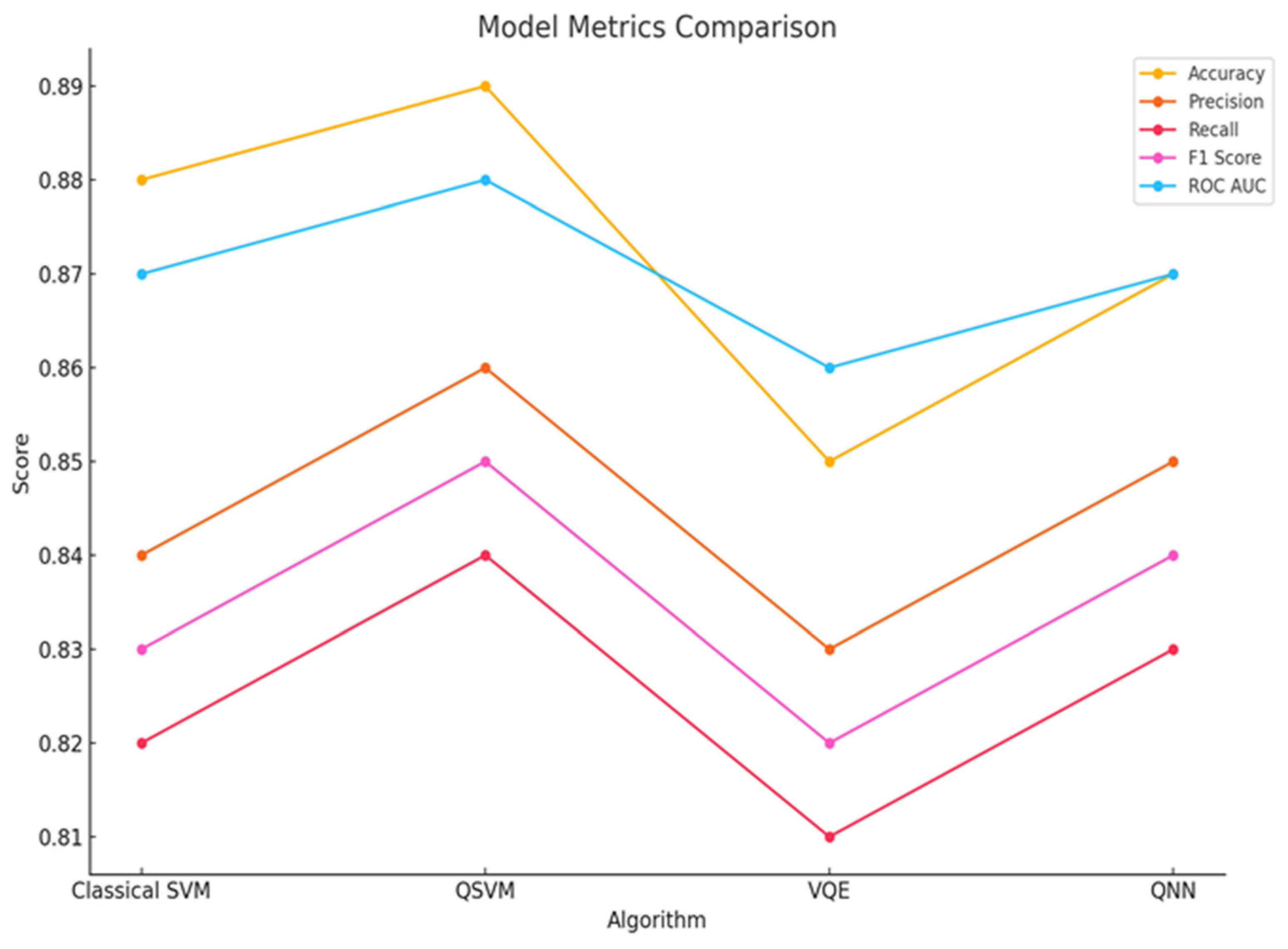
Figure 1 visually supports the conclusion that QSVM, with its higher scores on all metrics, is the most reliable diagnostic model, especially when accurate classifications are critical. This comparison reinforces the utility of quantum-inspired algorithms, especially QSVM and QNN, in healthcare diagnostics.
Figure 1.
Comparison of model evaluation metrics.
Among all evaluated approaches, QSVM consistently demonstrates the strongest overall performance, achieving the highest accuracy (0.89), precision (0.86), recall (0.84), F1 score (0.85), and ROC AUC (0.88). These results indicate that quantum kernel-based feature mapping improves separability in the transformed feature space, leading to an enhanced classification performance compared to classical SVM. QNN also exhibits competitive performance, with balanced results across all metrics (accuracy: 0.87, ROC AUC: 0.87), suggesting strong generalization capability in modeling nonlinear relationships within the dataset.
VQE achieves slightly lower predictive performance (accuracy: 0.85, F1 score: 0.82), which may be attributed to the limitations of parameterized circuit optimization in capturing complex feature interactions compared to kernel-based methods. Nevertheless, it maintains stable performance across all evaluation measures, confirming its potential as a hybrid optimization framework.
The classical SVM baseline provides competitive results (accuracy: 0.88, ROC AUC: 0.87), particularly in terms of computational efficiency; however, it is consistently outperformed by QSVM in classification quality. Overall, the results suggest that quantum-inspired models—particularly QSVM—offer measurable improvements in predictive performance for cardiovascular risk assessment, albeit at the cost of increased computational complexity, as discussed in the following subsection.
3.2. Quantum Parameters
The quantum parameters that distinguish QSVM, VQE, and QNN from classical SVM are analyzed, highlighting how these parameters affect each model’s strengths and computational tradeoffs.
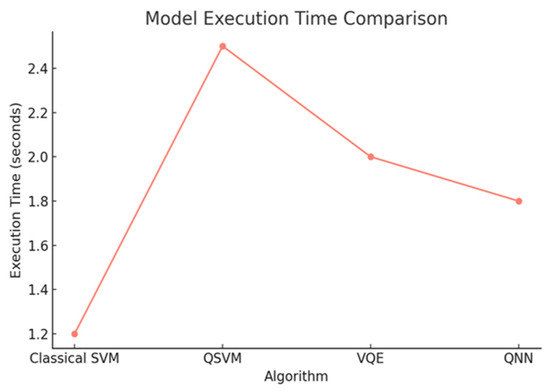
Classical SVM completes its predictions in 1.2 s, highlighting its computational efficiency and suitability for real-time applications. QSVM has the longest runtime of 2.5 s. The complexity of its polynomial kernel, which performs transformations in a high-dimensional feature space, increases the computational requirements. This added processing time represents a tradeoff between speed and diagnostic accuracy. VQE is completed in 2.0 s, which is slower than classical SVM but faster than QSVM. VQE’s parameterized quantum circuits optimize incrementally over multiple iterations, which increases the runtime. QNN achieves a balance with a runtime of 1.8 s. Its sigmoid activation kernel requires moderate processing resources, making QNN suitable for both real-time and batch processing needs.
Polynomial kernel in QSVM: The polynomial kernel allows QSVM to capture complex feature relationships by mapping data into a higher-dimensional space. This mapping improves its ability to detect nuanced patterns but also increases the computational burden, resulting in longer processing times.
Parameterized quantum circuits in VQE: VQE uses parameterized quantum circuits that involve iterative optimization to minimize errors, effectively improving its classification capabilities. The number of iterations, set to 200 in this study, contributes to the processing time and reflects the trade-off between accuracy and speed.
Sigmoid kernel in QNN: The sigmoid kernel in QNN allows for nonlinear transformation without excessive computational requirements. This design makes QNN particularly useful in healthcare applications requiring high recall, as it minimizes false negatives without significantly impacting processing time.
Table 2 shows a comparison of the computational execution time for classical SVM and quantum machine learning models, including QSVM, VQE, and QNN, evaluated on the cardiovascular disease prediction task.
Table 2.
Execution time comparison of classical and quantum machine learning models.
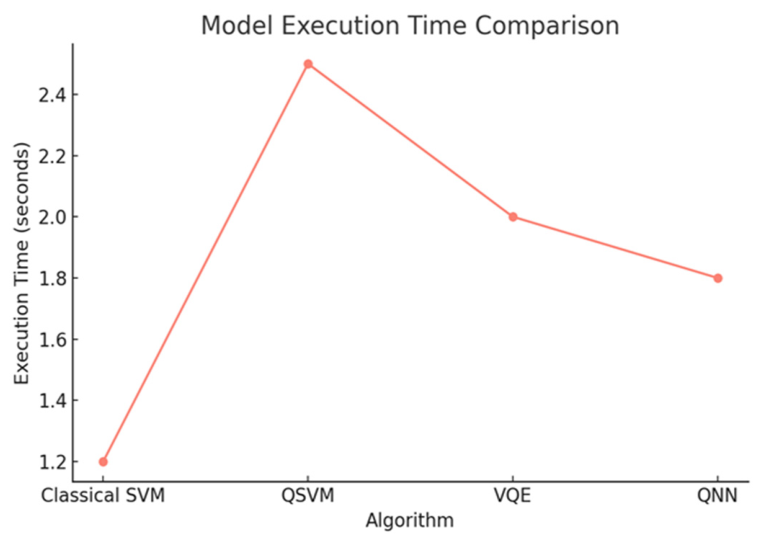
In conclusion, Figure 2 confirms that while quantum algorithms, especially QSVM, offer diagnostic advantages, they require greater computational resources than classical SVM. The trade-off between speed and accuracy, as seen in the longer execution time of QSVM, indicates its suitability for applications where accuracy is prioritized over speed. Classical SVM, on the other hand, remains the most efficient model and is well suited for scenarios requiring real-time processing.
Figure 2.
Model execution time comparison.
In addition to predictive performance, the computational efficiency of the evaluated models is analyzed in terms of execution time, as shown in the runtime comparison. The classical SVM demonstrates the lowest execution time (1.2 s), confirming its suitability for scenarios requiring fast, real-time inference. In contrast, QSVM exhibits the highest computational cost (2.5 s), reflecting the overhead introduced by quantum feature mapping and kernel estimation in high-dimensional Hilbert spaces. Although this increase in runtime is significant, it is consistent with the observed improvement in predictive performance, indicating a clear trade-off between accuracy and computational efficiency.
VQE achieves an intermediate execution time (2.0 s), which can be attributed to its hybrid optimization loop combining quantum circuit evaluations with iterative classical parameter updates. Similarly, QNN records a moderate runtime (1.8 s), benefiting from a more streamlined parameterized circuit structure and fewer iterative optimization steps compared to VQE and QSVM.
Overall, the results highlight a consistent trade-off pattern between predictive accuracy and computational efficiency across all quantum-inspired models. While QSVM provides the highest diagnostic performance, it incurs the greatest computational cost, whereas classical SVM remains optimal for time-sensitive applications. QNN and VQE occupy an intermediate position, offering a compromise between accuracy gains and runtime overhead. These findings suggest that the practical deployment of quantum machine learning in healthcare will likely depend on application-specific requirements, particularly the relative prioritization of diagnostic accuracy versus inference speed.
4. Discussion
This study investigates the predictive possibilities of quantum-inspired algorithms, with a specific focus on their application to cardiovascular disease risk prediction. By comparing the classical SVM and three quantum-inspired models—QSVM, QNN, and VQE—this study generates several significant insights.
QSVM as a better model: QSVM configured with a polynomial kernel consistently outperforms other models in all major metrics—accuracy, precision, recall, F1 score, and ROC AUC. The high scores of QSVM reflect its improved ability to capture complex, nonlinear relationships in the data, allowing it to provide more precise cardiovascular disease risk classification. This makes QSVM a potentially powerful tool in diagnostic scenarios where accuracy is paramount.
Quantum models and diagnostic performance: Quantum-inspired models generally outperform classical SVM in terms of recall and ROC AUC, metrics that are particularly valuable in healthcare applications where missed diagnoses can have serious consequences. Both QSVM and QNN achieved high recall and ROC AUC values, indicating strong sensitivity to true positive cases of cardiovascular disease. This suggests that quantum models have the potential to offer improvements over classical models in contexts that require high sensitivity and balanced performance.
Computing efficiency trade-offs: Although quantum models provide better diagnostic performance, they are more computationally intensive. QSVM, for example, requires 2.5 s per prediction due to the complexity of the polynomial kernel. This trade-off suggests that although QSVM is very efficient, its use may be limited to applications where diagnostic accuracy outweighs the need for real-time processing. The classic SVM, on the other hand, maintains the fastest execution time, positioning it as a practical solution for applications requiring immediate predictions.
5. Conclusions
This study explored the potential of quantum machine learning algorithms for cardiovascular disease risk prediction within a personalized medicine framework. By implementing and evaluating Quantum Support Vector Machines (QSVM), Quantum Neural Networks (QNNs), and Variational Quantum Eigensolver (VQE) and comparing them against a classical SVM baseline, the research demonstrates both the promise and current limitations of quantum-inspired approaches in healthcare analytics.
The experimental results indicate that QSVM achieves the best overall predictive performance across all evaluation metrics, including accuracy, precision, recall, F1 score, and ROC AUC. This suggests that quantum-enhanced feature mapping and kernel-based transformations can significantly improve the modeling of complex, nonlinear relationships in clinical data. QNN also shows strong performance, particularly in terms of recall and generalization ability, making it suitable for scenarios where minimizing false negatives is critical. VQE, while slightly less competitive in predictive performance, demonstrates stable optimization behavior and highlights the potential of hybrid quantum–classical approaches in medical decision-support systems.
Despite these advantages, this study also confirms that quantum-inspired models currently require higher computational resources compared to classical methods, particularly in terms of execution time. This trade-off between predictive performance and computational efficiency remains a key challenge for practical deployment in real-world clinical environments.
Overall, the findings support the hypothesis that quantum machine learning has significant potential to enhance predictive analytics in cardiovascular disease risk assessment. However, the current state of quantum computing technology suggests that these methods are best viewed as complementary to classical approaches rather than direct replacements. Future research should focus on scaling these algorithms to larger and more diverse datasets, improving quantum circuit efficiency, and evaluating the performance on real quantum hardware as it becomes more accessible.
In conclusion, quantum machine learning represents a promising direction for next-generation healthcare analytics, with the potential to contribute meaningfully to earlier diagnosis, improved risk stratification, and more personalized patient care in cardiovascular medicine.
Author Contributions
All authors were involved in the full process of producing this paper, including conceptualization, methodology, modeling, implementation, validation, and preparing the manuscript. All authors have read and agreed to the published version of the manuscript.
Funding
This work has been accomplished with financial support from the European Regional Development Fund within the Operational Programme “Bulgarian national recovery and resilience plan”, the procedure for direct provision of grants “Establishing of a network of research higher education institutions in Bulgaria”, and under Project BG-RRP-2.004-0005 “Improving the research capacity and quality to achieve intErnAtional recognition and reSilience of TU-Sofia (IDEAS)”.
Institutional Review Board Statement
Not applicable.
Informed Consent Statement
Not applicable.
Data Availability Statement
The publicly available cardiovascular disease dataset used in this study is available from the Kaggle repository: https://www.kaggle.com/datasets/sulianova/cardiovascular-disease-dataset (accessed on 1 March 2026).
Conflicts of Interest
The authors declare no conflicts of interest.
References
- Gill, S.S.; Buyya, R. Transforming research with quantum computing. J. Econ. Technol. 2026, 4, 1–8. [Google Scholar] [CrossRef] [Scilit]
- Balamurugan, K.S.; Sivakami, A.; Mathankumar, M.; Prasad, Y.J.D.S.; Ahmad, I. Quantum computing basics, applications and future perspectives. J. Mol. Struct. 2024, 1308, 137917. [Google Scholar] [CrossRef] [Scilit]
- Chae, E.; Choi, J.; Kim, J. An elementary review on basic principles and developments of qubits for quantum computing. Nano Converg. 2024, 11, 11. [Google Scholar] [CrossRef] [Scilit] [PubMed]
- Nandhini, S.; Singh, H.; Akash, U.N. An extensive review on quantum computers. Adv. Eng. Softw. 2022, 174, 103337. [Google Scholar] [CrossRef] [Scilit]
- Anumolu, V. Fundamentals of Modern Quantum Computing: A Technical Overview. Int. J. Sci. Res. Comput. Sci. Eng. Inf. Technol. 2025, 11, 669–683. [Google Scholar] [CrossRef] [Scilit]
- Chow, J.C.L. Quantum Computing in Medicine. Med. Sci. 2024, 12, 67. [Google Scholar] [CrossRef] [Scilit] [PubMed] [PubMed Central]
- Gupta, R.S.; Wood, C.E.; Engstrom, T.; Pole, J.D.; Shrapnel, S. A systematic review of quantum machine learning for digital health. npj Digit. Med. 2025, 8, 237. [Google Scholar] [CrossRef] [Scilit] [PubMed]
- Durant, T.J.S.; Knight, E.; Nelson, B.; Dudgeon, S.; Lee, S.J.; Walliman, D.; Young, H.P.; Ohno-Machado, L.; Schulz, W.L. A primer for quantum computing and its applications to healthcare and biomedical research. J. Am. Med. Inform. Assoc. 2024, 31, 1774–1784. [Google Scholar] [CrossRef] [Scilit] [PubMed]
- Das, P.; Ray, A.; Bhattacharyya, S.; Platos, J.; Snasel, V.; Mrsic, L.; Huang, T.; Zelinka, I. A brief review on quantum computing based drug design. WIREs Data Min. Knowl. Discov. 2024, 14, e1553. [Google Scholar] [CrossRef] [Scilit]
- Ding, Q.-M.; Huang, Y.-M.; Yuan, X. Molecular docking via quantum approximate optimization algorithm. Phys. Rev. Appl. 2024, 21, 034036. [Google Scholar] [CrossRef] [Scilit]
- Li, W.; Yin, Z.; Li, X.; Ma, D.; Yi, S.; Zhang, Z.; Zou, C.; Bu, K.; Dai, M.; Yue, J.; et al. A hybrid quantum computing pipeline for real world drug discovery. Sci. Rep. 2024, 14, 16942. [Google Scholar] [CrossRef] [Scilit] [PubMed]
- Fairburn, S.C.; Jehi, L.; Bicknell, B.T.; Wilkes, B.G.; Panuganti, B. Applications of quantum computing in clinical care. Front. Med. 2025, 12, 1573016. [Google Scholar] [CrossRef] [Scilit] [PubMed]
- Wei, L.; Liu, H.; Xu, J.; Shi, L.; Shan, Z.; Zhao, B.; Gao, Y. Quantum machine learning in medical image analysis: A survey. Neurocomputing 2023, 525, 42–53. [Google Scholar] [CrossRef] [Scilit]
- Yan, F.; Huang, H.; Pedrycz, W.; Hirota, K. Review of medical image processing using quantum-enabled algorithms. Artif. Intell. Rev. 2024, 57, 300. [Google Scholar] [CrossRef] [Scilit]
- Flöther, F.F.; Blankenberg, D.; Demidik, M.; Jansen, K.; Krishnakumar, R.; Krishnakumar, R.; Laanait, N.; Parida, L.; Saab, C.Y.; Utro, F. How quantum computing can enhance biomarker discovery. Patterns 2025, 6, 101236. [Google Scholar] [CrossRef] [Scilit] [PubMed]
- Alrashed, S.; Min-Allah, N. Quantum computing research in medical sciences. Inform. Med. Unlocked 2025, 52, 101606. [Google Scholar] [CrossRef] [Scilit]
- Nałęcz-Charkiewicz, K.; Charkiewicz, K.; Nowak, R.M. Quantum computing in bioinformatics: A systematic review mapping. Brief. Bioinform. 2024, 25, bbae391. [Google Scholar] [CrossRef] [Scilit] [PubMed]

Disclaimer/Publisher’s Note: The statements, opinions and data contained in all publications are solely those of the individual author(s) and contributor(s) and not of MDPI and/or the editor(s). MDPI and/or the editor(s) disclaim responsibility for any injury to people or property resulting from any ideas, methods, instructions or products referred to in the content. |
© 2026 by the authors. Licensee MDPI, Basel, Switzerland. This article is an open access article distributed under the terms and conditions of the Creative Commons Attribution (CC BY) license.