


Abstract
Considering the various applications where detection is required—whether for industrial or medical purposes—providing cost-efficient, stable, and highly selective solutions remains challenging. Different industries require hydrogen detectors, because this gas has the potential to serve as a clean and versatile energy carrier; therefore, precise monitoring and feedback in such systems are of enormous importance. Simultaneously, the medical field is developing new therapeutic methods using hydrogen as a medical gas, while also utilizing it as a biomarker in exhaled breath for various gastric diseases. In this paper, a ZnO-based gas sensor, doped with Ag nanoparticles produced via the Solution Chemical Synthesis (SCS) method, was coated with a thin polymer film of poly(1,3,5,7-tetravinyl-1,3,5,7-tetramethylcyclotetrasiloxane) PV4D4 via initiated Chemical Vapor Deposition (iCVD). The results are promising: at a relatively high operating temperature of 350 °C, the sensor showed its highest registered response to H2 gas (up to 23%). Compared to other gases studied at the same temperature, the sensor also showed potential for detecting 2-propanol, n-butanol, and ethanol, albeit with lower responses. Based on the dynamic response analysis, the fastest reaction time was also recorded at the highest operating temperature, thus showing versatile possibilities for using the specified detector.
1. Introduction
Hydrogen, recognized as an environmental component used in various industries, requires monitoring across multiple fields, including oil-immersed transformers, household, hospital, and energy-related niches [1,2,3,4,5]. It has gained vital importance due to its significant applications, such as its use as a therapeutic and preventive gas [6,7,8,9,10,11], in energy applications and fuel cells [7,12,13,14], and in hydrogen-powered vehicles [15,16,17]. However, if hydrogen concentrations exceed 4% in the air, there is a risk of explosion [18,19,20]; therefore, battery rooms, for example, should be ventilated to avoid such risks [2].
As straightforward as it may seem, gas detectors are required to address these specific needs. There is significant interest in this field regarding gas sensors based on metal oxides that are tuned through various technologies. Previous research [21,22,23] has shown that ZnO has the potential to be used as such a solution. Hydrogen sensors are obtained through various methods and materials; for instance, the hydrothermal method is used to synthesize ZnO nanowires [24]. The authors demonstrated that different types of treatments allowed them to obtain ZnO nanowires with high performance in detecting various hydrogen concentrations. Another approach to developing hydrogen sensors involves the use of noble metals such as Ag and AgPt [25]. Furthermore, functionalization with Pd nanodots has enabled the development of hydrogen sensors based on copper oxide [25] and ZnO sensors doped with Eu impurities [26]. Additionally, an Al2O3/CuO-based sensor allowed for hydrogen detection even under high humidity conditions. In that case, copper oxide was initially obtained by the Solution Chemical Synthesis (SCS) method, followed by the deposition of aluminum oxide using Atomic Layer Deposition (ALD) [27,28]. Similarly, a selective sensor for hydrogen detection was demonstrated based on copper oxide doped with Ni impurities [29].
Recently, the use of different types of polymers has become particularly important for the development of various gas sensors. For instance, the use of poly(1,3,5-Trivinyl-1,3,5-trimethylcyclotrisiloxane) PV3D3 deposited over CuO/Cu2O/ZnO:Fe structures has made it possible to obtain sensors that are stable at high humidity levels when detecting hydrogen molecules. In their paper, the authors reported that while CuO/Cu2O/ZnO:Fe was initially selective to ethanol molecules, after depositing the PV3D3 polymer, the selectivity shifted toward hydrogen [30]. The poly(1,3,5,7-tetravinyl-1,3,5,7-tetramethylcyclotetrasiloxane) PV4D4 deposited on TiO2 structures treated at different temperatures allowed the development of sensors selective to hydrogen molecules [31,32]. By combining mixed oxides of CuO and ZnO, a sensor selective to hydrogen was obtained [2].
Another type of hydrogen detection sensor is based on MOF structures deposited on copper oxide and doped with Al impurities [33,34,35]. In these papers, the authors demonstrated the development of selective sensors capable of detecting different hydrogen concentrations under various relative humidity levels. This paper presents a hydrogen sensor based on zinc oxide doped with Ag impurities and functionalized with a layer of PV4D4 polymer.
2. Materials and Methods
2.1. Production Method
The Solution Chemical Synthesis (SCS) method was used to obtain ZnO sensors doped with Ag impurities. For this purpose, high-purity (>99.999%) ZnSO4 and NaOH solutions were used. Initially, the ZnSO4 salt was dissolved, then the NaOH was dissolved. The dissolved NaOH solution was gradually added to the dissolved ZnSO4 solution, and after the final solution was obtained, the Ag impurities were also added. After this, the process of depositing Ag-doped ZnO began on a glass substrate measuring 75 × 25 × 1 mm. Throughout the deposition process, the solution was stirred using a magnetic stirrer. After the ZnO was deposited, it was subjected to a hot air flow for 30 s. A more detailed description of this method is provided in previous works [36,37].
Subsequently, the sample with an approximately 25 nm thin polymer layer of PV4D4 was covered on top, as previously reported in [32,38,39,40], using the monomer 1,3,5,7-tetravinyl-1,3,5,7-tetramethylcyclotetrasiloxane (V4D4, abcr, Hadfield, UK, 97%) and the initiator peruorobutanesulfonyluoride (PFBSF, Fluorochem, Karlsruhe, Germany, 95%).
The sensing properties of the sensor upon exposed to various gases (hydrogen, 2-propanol, ethanol, acetone, ammonia) at a concentration of 100 ppm were evaluated using a Keithley 2400 sourcemeter (from Tektronix, Cleveland, OH, USA) connected to a computer with LabView interface software version 17.0f2 (from National Instruments, Austin, TX, USA). The sensor respons S was calculated from the obtained results using the following formula [41,42] where G is the conductivity in different environment (gas or air):
As additional comparison parameters for the sensor’s performance, the response and recovery time were selected and defined as the time required for the response to increase from 10% to 90%, and decrease from 90% to 10%, respectively.
2.2. Morphology
The morphology of deposited films was investigated using scanning electron microscope (SEM) Zeiss Supra 55VP (from Carl Zeiss AG, Oberkochen, Germany). Structural properties have been investigated using Rigaku X-ray diffraction (XRD) (from Rigaku Corporation, Akishima, Japan).
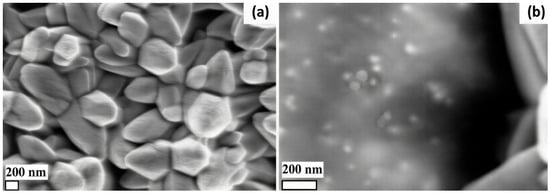
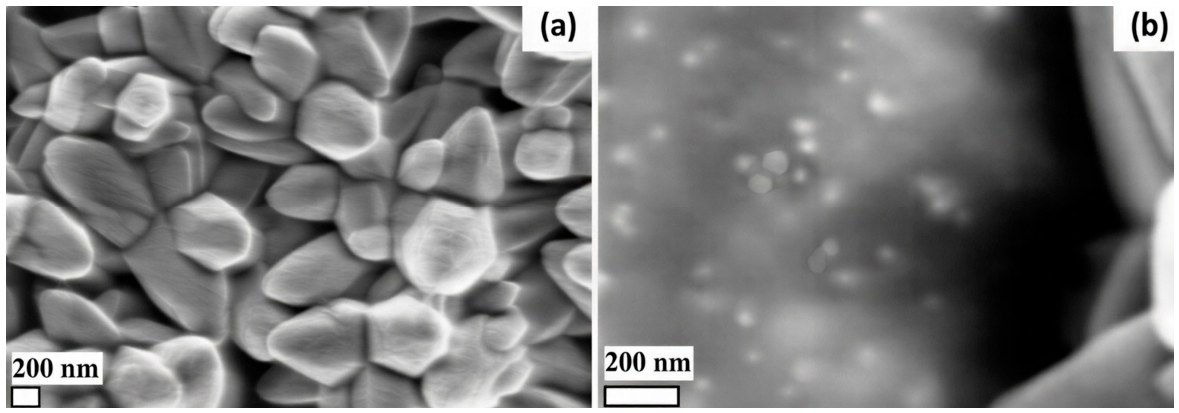
SEM was used to study morphological properties of films, with the results presented in Figure 1. In Figure 1a are presented low-magnification SEM images of ZnO:Ag observing interconnected nanostructures, namely columnar grains of various sizes. At higher magnification (Figure 1b) there were observed nanodots, which are distributed on the surface of the columnar grains. The size of the nanodots was ~20–40 nm, determined using microscope software tools. The nanodots exhibit independence from one another, demonstrating either interconnection or percolation pathways.
Figure 1.
SEM images of ZnO: Ag films at (a) low and (b) high magnification.
Polymer coating was carried out via iCVD, as previously reported in various studies [31,32,39,40,43,44]. V4D4 monomer and a PFBSF (initiator), were introduced into a custom-built reactor in vapor phase. At the heated filament array, pyrolysis, the initiator generates free radicals. These free radicals react with the vinyl groups of the monomer, initiating chain growth polymerization and the incorporation of additional V4D4 molecules into the growing polymer network. Since V4D4 contains four vinyl groups, a highly crosslinked film is obtained after polymerization.
Thus, the fabricated thin-film polymer contributes to enhancing selectivity and sensitivity towards various analytes, which in the case of this paper was hydrogen. Also, previous works demonstrated that it offers protection from a humid atmosphere as well [31,32,45]. This type of polymer growth was selected as it enables a conformal coverage of large-area surfaces and complex geometries.
3. Results
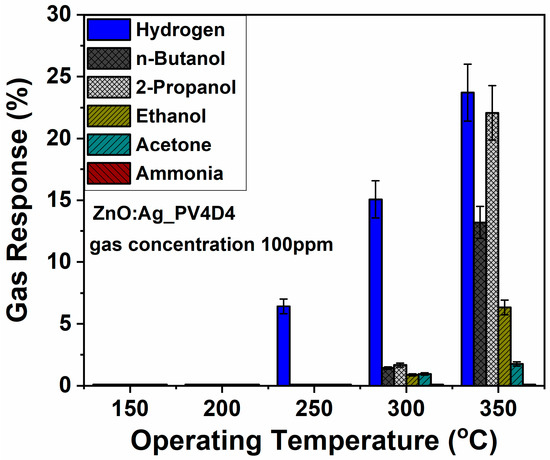
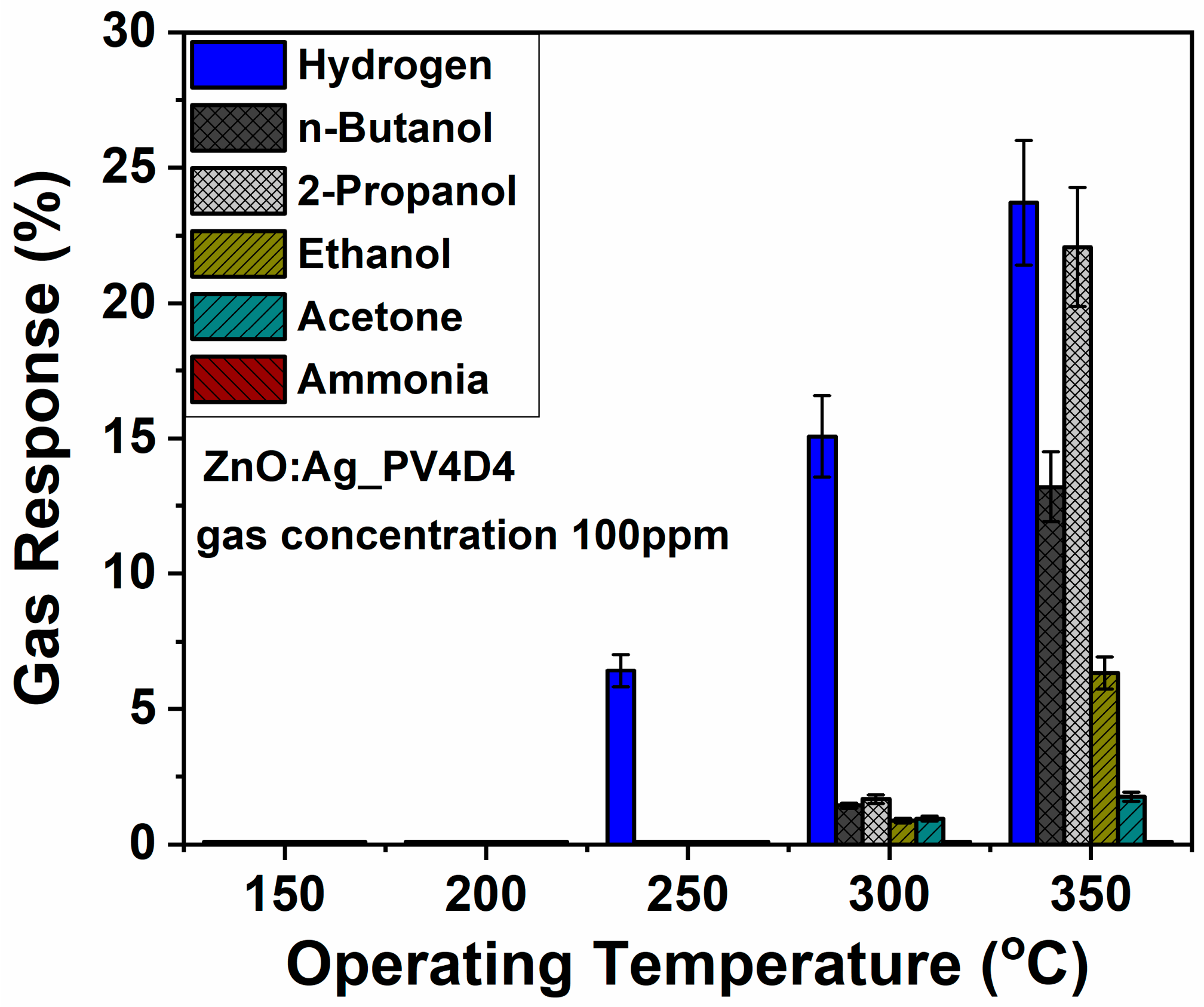
Figure 2 shows the comparison of response limits to 100 ppm of different analytes. As it can be observed, hydrogen is the most predominant in the means of selectivity through all tested operating temperatures. The highest registered response for hydrogen gas is 23% at the operating temperature of 350 °C.
Figure 2.
Sensor response of ZnO:Ag, coated with thin film of PV4D4 polymer on top, to several analytes (hydrogen, 2-propanol, ethanol, acetone, ammonia).
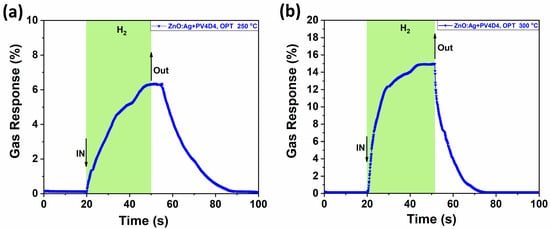
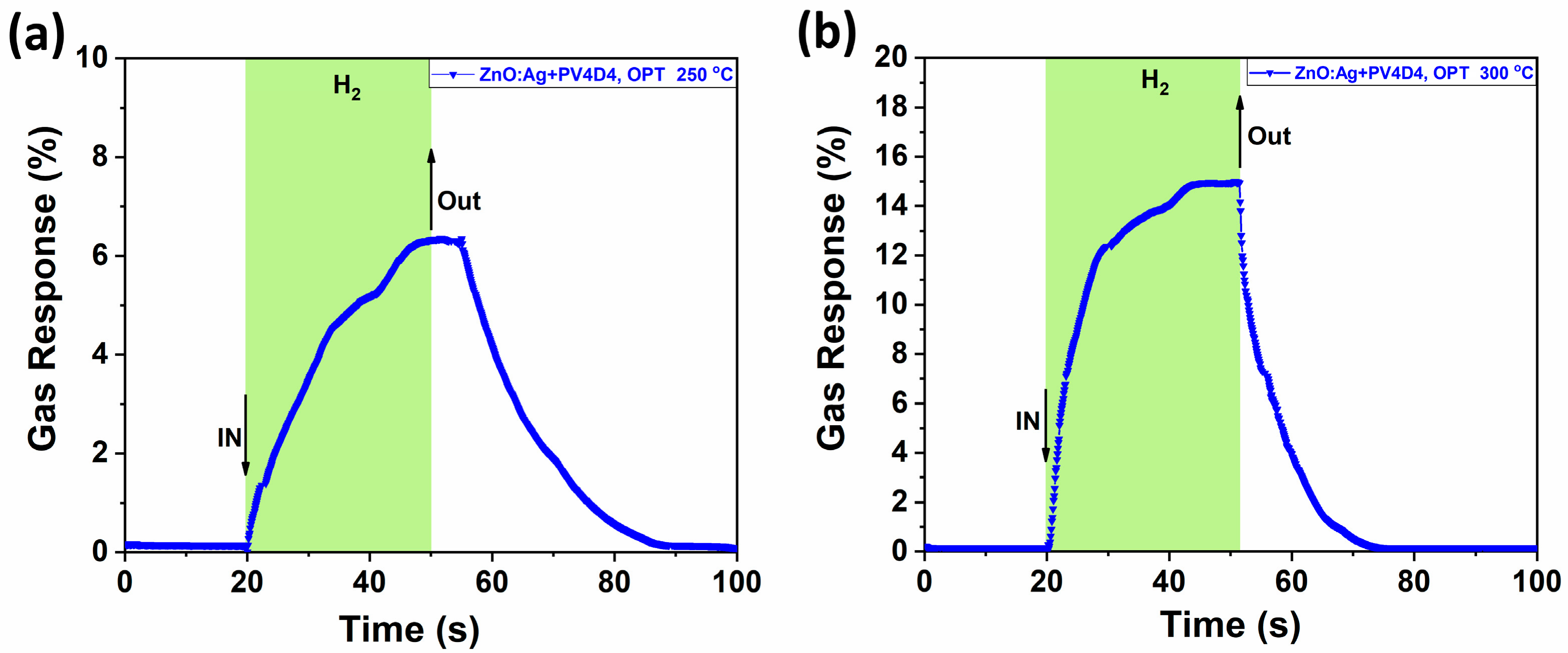
Figure 3a shows the dynamic characteristic of the ZnO:Ag-based sensor coated with a PV4D4 polymer on top with a response to 100 ppm hydrogen gas at operating temperatures of (a) 250 °C and (b) 300 °C, respectively. Thus, it can be observed that the higher the operating temperature, the better the result for H2 gas detection is shown. At 300 °C, the response was S ≈ 14%; and at 250 °C, S ≈ 6%. Another very important property of the sensor structure is its response and recovery times. Comparing Figure 4a with Figure 4b it is observed that at OPT-300 °C the response and recovery times are shorter.
Figure 3.
(a) Dynamic response of ZnO:Ag coated with PV4D4 to H2 gas at OPT of 250 °C. (b) Dynamic response of ZnO:Ag coated with PV4D4 to H2 at OPT of 300 °C.
Figure 4.
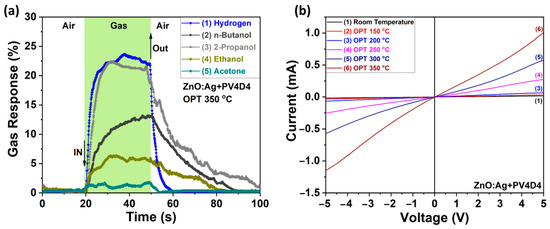
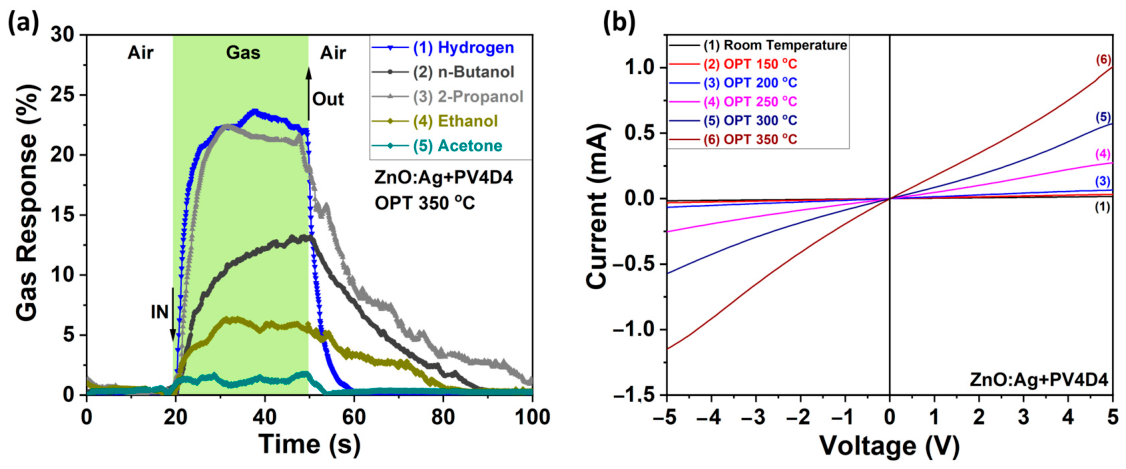
(a) Dynamic characteristics of ZnO:Ag structures coated with a layer of PV4D4 for different gases. (b) Volt-ampere characteristics of ZnO:Ag structures coated with a PV4D4 polymer layer.
Figure 4a shows the dynamic characteristics of ZnO:Ag structures coated with a layer of PV4D4 polymer for different gases (hydrogen, n-butanol, 2-propanol, ethanol, acetone). The figure shows that the shortest response and recovery times are for hydrogen molecules. The figure also shows that the recovery times for the other gases are longer than for hydrogen. Figure 4b shows the volt-ampere characteristics of ZnO:Ag structures coated with a PV4D4 polymer layer. The figure shows that the characteristics obtained are typical of ohmic contact, and the highest current values are observed at an operating temperature of 350 °C.
4. Discussion
For a gas sensor, the gas detection mechanism plays an important role in describing its behavior. In the specialized literature, it is described that adsorbed oxygen species on the sensor surface play a particularly important role in the gas detection mechanism based on ZnO sensors. The following oxygen species are specific for different operating temperatures (O- for the temperature range 100–300 °C and O2− for operating temperatures above 300 °C) [45,46]. This process can be described using the following chemical equations:
When oxygen molecules in the form of O2− interact with hydrogen molecules, H2O molecules are formed, and electrons are released. This process can be described using the following chemical equations [32]:
Thus, by the combination of the proposed mechanism and polymer coating, it can be proposed that such a sensor, in its quality, can be used for further research, as well as for various industrial and medical applications where concentrations of 100 ppm of H2 are used.
5. Conclusions
Following the completion of this work, it can be concluded that the use of cost-effective methods for obtaining gas sensors, followed by the deposition of a top-layer PV4D4 polymer film, successfully yielded a hydrogen-selective sensor structure operating efficiently within a temperature range of 250–350 °C. The sensor structure demonstrated a peak response amplitude of S ≈ 14% and significantly shorter response and recovery times for hydrogen gas compared to other operating temperatures and tested volatile organic compounds. This parameter, rapid kinetic behavior, is one of the most important performance metrics of a gas sensor. These findings underscore the strong potential of this sensor architecture for practical deployment in rapid and efficient hydrogen detection systems.
Author Contributions
Conceptualization, M.B. and O.L.; methodology, C.L.; software, A.B.; validation, O.L., M.B., L.S. and S.S.; formal analysis, L.S.; investigation, C.L. and D.L.; resources, V.C. and N.M.; data curation, N.M. and V.C.; writing—original draft preparation, N.M. and M.B.; writing—review and editing, S.S., N.M. and L.S.; visualization, A.B. and M.B.; supervision, O.L.; project administration, O.L.; funding acquisition, O.L. and N.M. All authors have read and agreed to the published version of the manuscript.
Funding
This work was partially funded by the Young Researchers Project, code: 25.80012.5007.34TC, and supported by the ProMoMo Moldo-German Collaboration Project, “Development of Scaffolds Based on Hybrid Materials”, code: 25.80013.5007.06GER. Both projects were administered by the National Agency for Research and Development of Moldova and the Deutsche Forschungsgemeinschaft (DFG, German Research Foundation)–Project-ID 541212717.
Institutional Review Board Statement
Not applicable.
Informed Consent Statement
Not applicable.
Data Availability Statement
No new data were created or analyzed in this study. Data sharing is not applicable to this article.
Conflicts of Interest
The authors declare no conflicts of interest.
References
- Wu, H.; Zhang, G.; Cui, H.; Deng, X. Atomic-level sensing mechanism of Rh-doped MoS2-WS2 heterojunction towards dissolved H2, C2H2, and C2H4 in transformer oil: A first-principles study. Colloids Surf. A Physicochem. Eng. Asp. 2026, 738, 140006. [Google Scholar] [CrossRef] [Scilit]
- Chakraborty, B.; Litra, D.; Mishra, A.K.; Lupan, C.; Nagpal, R.; Mishra, S.; Qiu, H.; Railean, S.; Lupan, O.; de Leeuw, N.H.; et al. Ultra-selective hydrogen sensors based on CuO—ZnO hetero-structures grown by surface conversion. J. Alloys Compd. 2024, 1002, 175385. [Google Scholar] [CrossRef] [Scilit]
- Dobrovolskii, A.A.; Mikhaylov, A.A.; Prikhodchenko, P.V.; Lev, O.; Zhestsianikau, R.; Platonov, V.B.; Filatova, D.G.; Rumyantseva, M.N. Hydrogen peroxide assisted sol-gel synthesis of 2D SnO2 for H2 detection in low concentration range. Int. J. Hydrogen Energy 2026, 198, 152800. [Google Scholar] [CrossRef] [Scilit]
- Ravotti, M.A.; Caillotto, A.; Canu, P. Detection and control of H2–CH4 flames via ionization, thermal conductivity, and flow measurements. Int. J. Hydrogen Energy 2026, 211, 153613. [Google Scholar] [CrossRef] [Scilit]
- Li, Y.; Pan, Q.; Shi, K.; Liu, Q.; Guo, Y.; Wang, Q. Construction of heterojunction interface between SnO2 nanorods and MOF-derived Co3O4 nanoparticles fabricated via AACVD for H2 sensor. Ceram. Int. 2026, 52, 8112–8121. [Google Scholar] [CrossRef] [Scilit]
- Yuan, T.; Zhao, J.-N.; Bao, N.-R. Hydrogen applications: Advances in the field of medical therapy. Med. Gas Res. 2023, 13, 99–107. [Google Scholar] [CrossRef] [Scilit] [PubMed]
- Jouhara, H.; Kodresko, A.; Alhajeri, A.; Olabi, V.; Ghazal, H. Cutting-edge advances in hydrogen applications for the medical and pharmaceutical industries. Int. J. Hydrogen Energy 2025, 189, 152181. [Google Scholar] [CrossRef] [Scilit]
- Paparella, R.; Panvino, F.; Pucarelli, I.; Tarani, L. Medical Gases as Emerging Regulators of Paediatric Endocrine and Neurodevelopmental Pathways: A Mini-Review. Acta Paediatr. 2026, 115, 791–796. [Google Scholar] [CrossRef] [Scilit] [PubMed]
- Cai, L.; Ru, B.; Ren, H.; Cai, F.; Zeng, L.; Yang, J.; Wang, S.; Zhang, H.; Li, Y.; Zhang, L. Gas therapy: An innovative application for intervertebral disc degeneration. Med. Gas Res. 2026, 16, 293–302. [Google Scholar] [CrossRef] [Scilit] [PubMed]
- Wang, W.; Yang, F.; Geng, B.; Song, H.; Gao, Y.; Shi, J.; Wang, G.; Cui, C. H2 as a potential redox homeostasis modulator: A review of mechanisms targeting key elements of cardiovascular pathogenesis-related pathways. Mol. Cell. Biochem. 2025, 481, 711–737. [Google Scholar] [CrossRef] [Scilit] [PubMed]
- Andrabi, S.M.; Sharma, N.S.; Rather, I.I.G.; Shahriar, S.M.S.; Xie, J. Therapeutic Gases in Biomedicine: Updates on Nitric Oxide and Beyond. Adv. Sci. 2026, 13, e21942. [Google Scholar] [CrossRef] [Scilit] [PubMed]
- Davis, B.; Stuart, D.; Nieves Maldonado, M.; Kamavaram, V.; Cheng, Q.; Veedu, V. Intelligent Hydrogen Gas Monitoring in Natural Gas/Hydrogen Blending. In Offshore Technology Conference; OTC: Houston, TX, USA, 2022. [Google Scholar] [CrossRef] [Scilit]
- Blasius, M.; Pappler, S.; Mader, T.; Mrusek, S.; Rüde, T.; Geißelbrecht, M.; Wasserscheid, P. Upgrading LOHC-based hydrogen through electrochemical hydrogen compression for fuel cell applications. Int. J. Hydrogen Energy 2026, 202, 153039. [Google Scholar] [CrossRef] [Scilit]
- Olawale, O.C.; Beneke, L.W.; Oosthuizen, C.C. Mechanisms of hydrogen embrittlement in metals and alloys used in fuel cell applications. J. Mater. Sci. 2026, 61, 4829–4856. [Google Scholar] [CrossRef] [Scilit]
- Shivam, T.; Jha, R.K. Emerging 2D materials for hydrogen detection: Mechanism, challenges, & opportunities. Coord. Chem. Rev. 2026, 549, 217237. [Google Scholar] [CrossRef] [Scilit]
- Wang, Y.; Witlox, F.; Azadi, H. Investigating the adoption of hydrogen (H2) fuel by individual and industry user groups. Int. J. Hydrogen Energy 2026, 208, 153499. [Google Scholar] [CrossRef] [Scilit]
- Yilmaz, A.C.; Shambilova, A. Closed-loop ppm-level H2 micro-dosing to DOC–DPF–SCR for cold-start: WLTC-resolved low-temperature NOx control without detectable H2 slip or N2O penalty. Int. J. Hydrogen Energy 2026, 203, 153086. [Google Scholar] [CrossRef] [Scilit]
- Ma, Y.; Liang, T.; Qiao, S.; Liu, X.; Lang, Z. Highly Sensitive and Fast Hydrogen Detection Based on Light-Induced Thermoelastic Spectroscopy. Ultrafast Sci. 2023, 3, 217237. [Google Scholar] [CrossRef] [Scilit]
- Zhang, Y.; Qin, J.; Niu, Y.; Huang, Y.; Li, R.; Zhang, X. H2 and corn stalk dust hybrid explosion overpressure and molecular dynamics of reaction analysis. Adv. Powder Technol. 2026, 37, 105209. [Google Scholar] [CrossRef] [Scilit]
- Zhang, Y.; Yang, W.; Zhang, K.; Jiang, B.; Yang, X. Explosion dynamics of hydrogen-blended natural gas perturbed by CO2 injection in a closed duct. Int. J. Hydrogen Energy 2026, 217, 153988. [Google Scholar] [CrossRef] [Scilit]
- Vahl, A.; Lupan, O.; Santos-Carballal, D.; Postica, V.; Hansen, S.; Cavers, H.; Wolff, N.; Terasa, M.-I.M.-I.; Hoppe, M.; Cadi-Essadek, A.; et al. Surface functionalization of ZnO:Ag columnar thin films with AgAu and AgPt bimetallic alloy nanoparticles as an efficient pathway for highly sensitive gas discrimination and early hazard detection in batteries. J. Mater. Chem. A 2020, 8, 16246–16264. [Google Scholar] [CrossRef] [Scilit]
- Postica, V.; Vahl, A.; Magariu, N.; Terasa, M.-I.; Hoppe, M.; Viana, B.; Aschehoug, P.; Pauporté, T.; Tiginyanu, I.; Polonskyi, O.; et al. Enhancement in UV Sensing Properties of ZnO:Ag Nanostructured Films by Surface Functionalization with Noble Metalic and Bimetallic Nanoparticles. J. Eng. Sci. 2018, 3, 41–51. [Google Scholar] [CrossRef]
- Lupan, O.; Viana, B.; Cretu, V.; Postica, V.; Adelung, R.; Pauporté, T. Low temperature preparation of Ag-doped ZnO nanowire arrays for sensor and light-emitting diode applications. In Oxide-Based Materials and Devices VII; Teherani, F.H., Look, D.C., Rogers, D.J., Eds.; SPIE: Bellingham, WA, USA; p. 97490U. [CrossRef] [Scilit]
- Lupan, O.; Magariu, N.; Khaledialidusti, R.; Mishra, A.K.; Hansen, S.; Krüger, H.; Postica, V.; Heinrich, H.; Viana, B.; Ono, L.K.; et al. Comparison of Thermal Annealing versus Hydrothermal Treatment Effects on the Detection Performances of ZnO Nanowires. ACS Appl. Mater. Interfaces 2021, 13, 10537–10552. [Google Scholar] [CrossRef] [Scilit] [PubMed]
- Lupan, O.; Ababii, N.; Santos-Carballal, D.; Terasa, M.-I.M.-I.; Magariu, N.; Zappa, D.; Comini, E.; Pauporté, T.; Siebert, L.; Faupel, F.; et al. Tailoring the selectivity of ultralow-power heterojunction gas sensors by noble metal nanoparticle functionalization. Nano Energy 2021, 88, 106241. [Google Scholar] [CrossRef] [Scilit]
- Lupan, C.; Khaledialidusti, R.; Mishra, A.K.; Postica, V.; Terasa, M.-I.; Magariu, N.; Pauporté, T.; Viana, B.; Drewes, J.; Vahl, A.; et al. Pd-Functionalized ZnO:Eu Columnar Films for Room-Temperature Hydrogen Gas Sensing: A Combined Experimental and Computational Approach. ACS Appl. Mater. Interfaces 2020, 12, 24951–24964. [Google Scholar] [CrossRef] [Scilit] [PubMed]
- Lupan, O.; Ababii, N.; Mishra, A.K.; Bodduluri, M.T.; Magariu, N.; Vahl, A.; Krüger, H.; Wagner, B.; Faupel, F.; Adelung, R.; et al. Heterostructure-based devices with enhanced humidity stability for H2 gas sensing applications in breath tests and portable batteries. Sens. Actuators A Phys. 2021, 329, 112804. [Google Scholar] [CrossRef] [Scilit]
- Lupan, O.; Nagpal, R.; Litra, D.; Brinza, M.; Sugihara, M.; Ameloot, R.; Railean, S.; Ameri, T.; Adelung, R.; Schröder, S.; et al. Hybrid Nanomaterials for Biomedical Sensors. In 7th International Conference on Nanotechnologies and Biomedical Engineering (ICNBME 2025), 134th ed.; Sontea, V., Tiginyanu, I., Railean, S., Eds.; Springer: Cham, Switzerland, 2025; pp. 162–176. [Google Scholar] [CrossRef] [Scilit]
- Litra, D.; Chiriac, M.; Ababii, N.; Zimoch, L.; Trofim, V.; Metlinschi, P.; Darii, E.; Lupan, O. Ni-Doped CuO Sensors with Controlled Selectivity at High Operating Temperatures for Hydrogen Detection. J. Eng. Sci. 2025, 32, 55–63. [Google Scholar] [CrossRef] [Scilit] [PubMed]
- Schröder, S.; Ababii, N.; Lupan, O.; Drewes, J.; Magariu, N.; Krüger, H.; Strunskus, T.; Adelung, R.; Hansen, S.; Faupel, F. Sensing performance of CuO/Cu2O/ZnO:Fe heterostructure coated with thermally stable ultrathin hydrophobic PV3D3 polymer layer for battery application. Mater. Today Chem. 2022, 23, 100642. [Google Scholar] [CrossRef] [Scilit]
- Brinza, M.; Schwäke, L.; Schröder, S.; Lupan, C.; Ababii, N.; Magariu, N.; Chiriac, M.; Faupel, F.; Vahl, A.; Lupan, O. Two-in-One Hybrid Sensor Based on PV4D4/AgAu/TiO2 Structure for Carbon Dioxide and Hydrogen Gas Detection in Biomedical and Industrial Fields. Biosensors 2025, 16, 5. [Google Scholar] [CrossRef] [Scilit] [PubMed]
- Lupan, O.; Brinza, M.; Piehl, J.; Ababii, N.; Magariu, N.; Zimoch, L.; Strunskus, T.; Pauporte, T.; Adelung, R.; Faupel, F.; et al. Influence of Silsesquioxane-Containing Ultra-Thin Polymer Films on Metal Oxide Gas Sensor Performance for the Tunable Detection of Biomarkers. Chemosensors 2024, 12, 76. [Google Scholar] [CrossRef] [Scilit]
- Nagpal, R.; Sugihara, M.; Magariu, N.; Tjardts, T.; Meling-Lizarde, N.; Strunskus, T.; Ameri, T.; Ameloot, R.; Adelung, R.; Lupan, O. Humidity-tolerant selective sensing of hydrogen and n-butanol using ZIF-8 coated CuO:Al film. Mater. Chem. Front. 2025, 9, 3425–3442. [Google Scholar] [CrossRef] [Scilit]
- Nagpal, R.; Sugihara, M.; Lupan, C.; Tjardts, T.; Meling-Lizarde, N.; Strunskus, T.; Qiu, H.; Adelung, R.; Ameloot, R.; Lupan, O. ZIF-71-Coated CuO:Al with Enhanced Gas-Sensing Performance for n-Butanol and Hydrogen. ACS Appl. Electron. Mater. 2025, 7, 10198–10215. [Google Scholar] [CrossRef] [Scilit] [PubMed]
- Nazpal, R.; Chiriac, M.; Sugihara, M.; Litra, D.; Ababii, N.; Magariu, N.; Lupan, C.; Zinicovschi, V.; Ameloot, R.; Lupan, O. Sensory Properties of CuO/Cu2O Nanostructures Coated with Zeolitic Imidazolate Frameworks. In 2024 E-Health and Bioengineering Conference (EHB); IEEE: New York, NY, USA, 2024; pp. 1–4. [Google Scholar] [CrossRef] [Scilit]
- Lupan, O.; Chow, L.; Shishiyanu, S.; Monaico, E.; Shishiyanu, T.; Şontea, V.; Roldan Cuenya, B.; Naitabdi, A.; Park, S.; Schulte, A. Nanostructured zinc oxide films synthesized by successive chemical solution deposition for gas sensor applications. Mater. Res. Bull. 2009, 44, 63–69. [Google Scholar] [CrossRef] [Scilit]
- Lupan, O.; Shishiyanu, S.; Chow, L.; Shishiyanu, T. Nanostructured zinc oxide gas sensors by successive ionic layer adsorption and reaction method and rapid photothermal processing. Thin Solid Films 2008, 516, 3338–3345. [Google Scholar] [CrossRef] [Scilit]
- Brînză, M.; Schwäke, L. Hybrid nanosensors for biomedical applications. In Technical Scientific Conference of Undergraduate, Master and PhD Students, Universitatea Tehnică a Moldovei, 14–16 mai 2025. Chișinău: Tehnica-UTM, 2026; Universitatea Tehnică a Moldovei: Chișinău, Moldova, 2026; Volume 2, pp. 290–294. [Google Scholar]
- Brinza, M.; Schröder, S.; Ababii, N.; Gronenberg, M.; Strunskus, T.; Pauporte, T.; Adelung, R.; Faupel, F.; Lupan, O. Two-in-One Sensor Based on PV4D4-Coated TiO2 Films for Food Spoilage Detection and as a Breath Marker for Several Diseases. Biosensors 2023, 13, 538. [Google Scholar] [CrossRef] [Scilit] [PubMed]
- Lupan, O.; Brînză, M.; Ababii, N.; Strunskus, T.; Magariu, N.; Pauporte, T.; Adelung, R.; Faupel, F.; Schröder, S. Hybrid Nano-Materials for Sensors in Biomedical, Environmental and Industrial Applications. In Electronics, Communications and Computing; Universitatea Tehnică a Moldovei: Chișinău, Moldova, 2024; pp. 32–33. [Google Scholar]
- Lupan, O.; Santos-Carballal, D.; Magariu, N.; Mishra, A.K.; Ababii, N.; Krüger, H.; Wolff, N.; Vahl, A.; Bodduluri, M.T.; Kohlmann, N.; et al. Al2O3/ZnO Heterostructure-Based Sensors for Volatile Organic Compounds in Safety Applications. ACS Appl. Mater. Interfaces 2022, 14, 29331–29344. [Google Scholar] [CrossRef] [Scilit] [PubMed]
- Kutukov, P.; Rumyantseva, M.; Krivetskiy, V.; Filatova, D.; Batuk, M.; Hadermann, J.; Khmelevsky, N.; Aksenenko, A.; Gaskov, A. Influence of Mono- and Bimetallic PtOx, PdOx, PtPdOx Clusters on CO Sensing by SnO2 Based Gas Sensors. Nanomaterials 2018, 8, 917. [Google Scholar] [CrossRef] [Scilit] [PubMed]
- Schröder, S.; Ababii, N.; Brînză, M.; Magariu, N.; Zimoch, L.; Bodduluri, M.T.; Strunskus, T.; Adelung, R.; Faupel, F.; Lupan, O. Tuning the Selectivity of Metal Oxide Gas Sensors with Vapor Phase Deposited Ultrathin Polymer Thin Films. Polymers 2023, 15, 524. [Google Scholar] [CrossRef] [Scilit] [PubMed]
- Lupan, O.; Brinza, M.; Schröder, S.; Ababii, N.; Strunskus, T.; Viana, B.; Pauporté, T.; Adelung, R.; Faupel, F. Sensors Based on Hybrid Materials for Environmental, Industrial and Biomedical Applications. In 2024 IEEE 14th International Conference Nanomaterials: Applications and Properties (NAP); IEEE: New York, NY, USA; pp. 1–4. [CrossRef] [Scilit]
- Anpo, M.; Costentin, G.; Giamello, E.; Lauron-Pernot, H.; Sojka, Z. Characterisation and reactivity of oxygen species at the surface of metal oxides. J. Catal. 2021, 393, 259–280. [Google Scholar] [CrossRef] [Scilit]
- Wang, B.; Zeng, Q.; Chen, S.; Yue, T.; Han, B.; Feng, W.; Yang, D. Preparation and Gas Sensing Performance of Hierarchical Porous ZnO-based Materials with Sunflower Rods as a Biological Template. Chem. Res. Chin. Univ. 2019, 35, 755–761. [Google Scholar] [CrossRef] [Scilit]
Disclaimer/Publisher’s Note: The statements, opinions and data contained in all publications are solely those of the individual author(s) and contributor(s) and not of MDPI and/or the editor(s). MDPI and/or the editor(s) disclaim responsibility for any injury to people or property resulting from any ideas, methods, instructions or products referred to in the content. |
© 2026 by the authors. Licensee MDPI, Basel, Switzerland. This article is an open access article distributed under the terms and conditions of the Creative Commons Attribution (CC BY) license.