


Abstract
Post-combustion amine absorption is the most mature CO2 capture technology, while membrane separation is a promising alternative due to its modularity and operational simplicity. Process intensification through exhaust gas recirculation (EGR) has also gained attention for increasing flue gas CO2 concentration and reducing capture energy demand. However, comprehensive techno-economic comparisons of absorption, membrane, and hybrid systems under EGR-integrated NGCC conditions remain limited. This study presents a techno-economic assessment of multiple CO2 capture configurations for a 450 MW NGCC power plant. Process simulations were performed using Aspen Plus and Aspen Custom Modeler to evaluate absorption, membrane, and hybrid systems integrated with conventional and selective EGR. The analysis considers full steam cycle integration and compares energy consumption, net plant efficiency, levelized cost of electricity (LCOE), and CO2 avoidance cost. The results show that EGR significantly improves carbon capture performance. Among all cases, selective EGR combined with amine absorption delivers the best performance, reducing the energy penalty by more than 30% compared with standalone absorption and by over 70% relative to membrane separation. This configuration achieves an LCOE of approximately 72 USD/MWh and a CO2 avoidance cost of about 39 USD/tCO2, outperforming the selective EGR–membrane system (77 USD/MWh and 51 USD/tCO2). These findings demonstrate that integrating selective EGR with amine absorption is a highly promising strategy for improving the technical and economic feasibility of CCSU in NGCC power plants.
1. Introduction
The global reliance on fossil fuels—coal, oil, and natural gas—stands as the primary driver of climate change [1,2,3]. More than 75% of global greenhouse gas emissions come from those energy sources, with carbon dioxide (CO2) emissions reaching almost 90% [4]. In this context, the global atmospheric concentration of CO2 has reached an alarming level of nearly 427 ppm. If no action is taken to reduce those emissions, by 2100, the concentration of CO2 can hit as much as 1000 ppm based on different scenarios, equivalent to a 4.5 °C increase in the average global temperature, leading to catastrophic consequences in several aspects [5].
As part of that, CO2 emissions from the power sector, so far, are the largest contributor to global energy-based CO2 emissions, over 40% [6]. The rapid electrification of heating and transportation sectors also requires a swift decarbonization of the energy sector to keep pace with the growing demand for clean electricity. Globally, coal-fired power plants remained dominant for electricity generation with a share of about 35% in 2023, while natural gas-fired power stations stayed as the second-largest fossil fuel (23%) in electricity generation [7]. Since natural gas is a relatively clean fuel compared to coal and oil, with specific CO2 emissions of approximately 350–400, 750–800, and 700–850 g/kWh, respectively [8], there has been increasing attention to natural gas-fired power plants, particularly natural gas-fired combined cycle (NGCC) power plants, in the global power generation mix. Apart from that, due to the ease of transportation and the ready availability of natural gas in several parts of the world, NGCC power plants are likely to remain operational in meeting the near-future growing electricity demand. However, NGCC power stations still release a large amount of CO2 into the atmosphere, resulting in the pressing need for their decarbonization to align with global CO2 emission reduction targets.
Decarbonization of the power sector can be achieved either by increasing the share of low-carbon energy sources or by implementing carbon capture, storage, and utilization (CCSU) technologies. Among the available CO2 capture routes, post-combustion carbon capture (PCC) is particularly attractive because it can be retrofitted to existing power plants with minimal infrastructure modifications. Conventional amine absorption remains the most mature and widely deployed PCC technology; however, its application in natural gas combined cycle (NGCC) power plants is challenged by the low CO2 concentration in the flue gas (≈4 vol%) [9,10], resulting in high capture costs and significant energy penalties. Exhaust gas recirculation (EGR) has been proposed to address this limitation by increasing the CO2 concentration to approximately 6.5–7.5 vol%, reducing flue gas flow rates and lowering capital costs. Nevertheless, solvent regeneration still requires substantial energy (typically 3.5–4.5 GJ t−1 CO2), causing an efficiency loss of about 8–12% and limiting the economic viability of absorption-based PCC.
Membrane-based post-combustion carbon capture (PCC) is a promising alternative to conventional amine absorption due to its lower energy demand, modular design, and operational flexibility [11]. However, its application to NGCC power plants is limited by the low CO2 concentration in flue gas. Selective exhaust gas recirculation (SEGR) has been proposed to overcome this challenge by increasing CO2 concentration while maintaining stable combustion, thereby improving the performance of both membrane- and absorption-based capture systems [12]. Previous studies have reported improved capture efficiency, reduced energy consumption, and enhanced techno-economic performance through SEGR and hybrid membrane–absorption configurations.
Recent studies have confirmed the benefits of SEGR for post-combustion CO2 capture. Herraiz et al. [13] reported that SEGR increased the flue gas CO2 concentration to 13–14 vol%, significantly reducing absorber size and reboiler duty while improving net plant efficiency compared with conventional EGR. They also noted that the process is sensitive to pressure losses in the recirculation loop, which can reduce gas turbine output. Qureshi et al. [14] further demonstrated that SEGR maintained its advantages under part-load operation, increasing the flue gas CO2 concentration to as much as 18.23 vol% and reducing the specific reboiler duty by approximately 6–8%. From an exergy perspective, Tang et al. [15] reported that SEGR increased the flue gas CO2 concentration from 3.61 to 6.08 vol%, improving the exergy efficiency of the capture process, while identifying the combustion chamber and absorber as the major sources of exergy destruction. For membrane-based systems, Baker et al. [12] showed that integrating selective recycle membranes can achieve 90% CO2 capture with lower energy consumption and cost than conventional amine absorption.
Techno-economic assessments (TEA) have also evaluated the economic feasibility of carbon capture technologies for NGCC power plants. The IEAGHG benchmark study reported an efficiency penalty of 7.6–7.9% and a CO2 avoidance cost of 76–84 EUR/t for MEA-based capture with and without EGR [16]. Similarly, the NETL baseline reported an efficiency penalty of 6.0% and a CO2 avoidance cost of 80.8 USD/t for an F-class NGCC with solvent-based capture [17], while the addition of EGR reduced the levelized cost of electricity by approximately 2% [18]. Fu et al. [19] reported a CO2 avoidance cost of 49 EUR/t for MEA capture, significantly lower than that of calcium looping. Our previous study [10] found that integrating MEA capture reduced the net plant efficiency from 55.8% to 46.8%, with a solvent regeneration duty of 3.97 GJ/t CO2 and a CO2 capture cost of approximately 61 USD/t.
Despite these advances, several limitations remain. Most studies evaluate only a single capture technology or focus exclusively on either technical or economic performance, making direct comparisons difficult. Moreover, the economic performance of integrated EGR/SEGR with different capture technologies has rarely been assessed within a consistent modelling framework, particularly for Central Asian operating conditions. Therefore, this study presents a comparative techno-economic assessment of absorption-, membrane-, and hybrid-based PCC systems with and without EGR/SEGR for a representative NGCC power plant in Uzbekistan.
2. Methodology
A 450 MW block of the Turakurgan Natural Gas Combined Cycle (NGCC) power plant in Uzbekistan was selected as the case study because of its strategic importance in the country’s decarbonization pathway. The base plant was modelled and validated in Aspen Plus® V11 using the design specifications of the Mitsubishi M701F gas turbine (Mitsubishi Heavy Industries, Ltd., Tokyo, Japan) and available plant operating data. The validated model served as the reference case for integrating different post-combustion carbon capture (PCC) technologies. Detailed process simulation data and model results can be found in the previously published paper [20].
To improve the CO2 concentration in the flue gas, two process intensification strategies were investigated: conventional exhaust gas recirculation (EGR) and selective exhaust gas recirculation (SEGR). Based on the optimization studies, an EGR ratio of 45% and an SEGR ratio of 75% were selected, providing a balance between increased CO2 concentration and stable gas turbine operation. SEGR was modelled using a commercially available polymeric membrane that selectively recycled CO2-rich exhaust gas to the compressor while maintaining sufficient oxygen concentration for combustion.
Two PCC technologies were evaluated. The absorption process was simulated in Aspen Plus using a monoethanolamine (MEA)-based process with the Electrolyte-NRTL thermodynamic model and RadFrac columns for CO2 absorption and solvent regeneration. Membrane separation was modelled in Aspen Custom Modeler (ACM) and integrated into Aspen Plus through a custom membrane module. Commercial membrane characteristics representative of second-generation Polaris™ membranes (2500 GPU permeance and CO2/N2 selectivity of 50) were adopted for the simulations. This development involved applying specific equations, such as Equation (1), to accurately represent the membrane separation process. Once created, this custom module was directly integrated into the base-case Aspen Plus model to enable comprehensive process simulation and analysis (Equation (1)) [17].
where pi is the permeability of the membrane material for the i component, m3/m2·h·bar; —membrane material thickness, m; Pr, Pp—retentate and permit pressures, bar; Fr, Fp—volumetric flowrates of the i component in the retentate and permeate side, m3/h; xi, yi—the concentration of component i on the retentate and permeate side, kmol/kmol; x is the width of the membrane material, m; S is the surface of the membrane module, m2.
Eight process configurations were comparatively assessed: (i) standalone absorption, (ii) standalone membrane separation, (iii) EGR with absorption, (iv) EGR with membrane separation, (v) hybrid membrane–absorption, (vi) hybrid membrane–absorption with EGR, (vii) SEGR with absorption, and (viii) SEGR with membrane separation. This comparison enables evaluation of both conventional and intensified PCC strategies under a consistent modelling framework.
The technical performance of each configuration was assessed using CO2 capture rate, product purity, plant efficiency, energy penalty, and required membrane area. Economic performance was evaluated through total annualized cost (TAC), levelized cost of electricity (LCOE), and CO2 avoidance cost (CAC). Equipment sizing was performed within Aspen Plus, while economic calculations were based on standard chemical engineering cost estimation methods using consistent assumptions for plant lifetime, capacity factor, membrane replacement, and utility costs. Our previously published paper can be referred to for the detailed methodology and assumptions on the techno-economic evaluation [10]. CO2 transport and storage costs were excluded from the analysis.
3. Results and Discussion
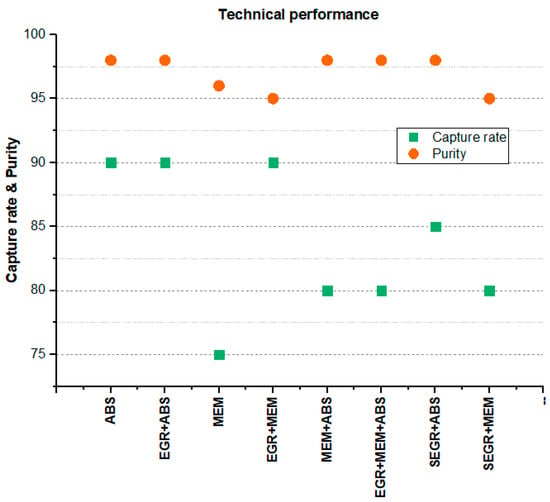
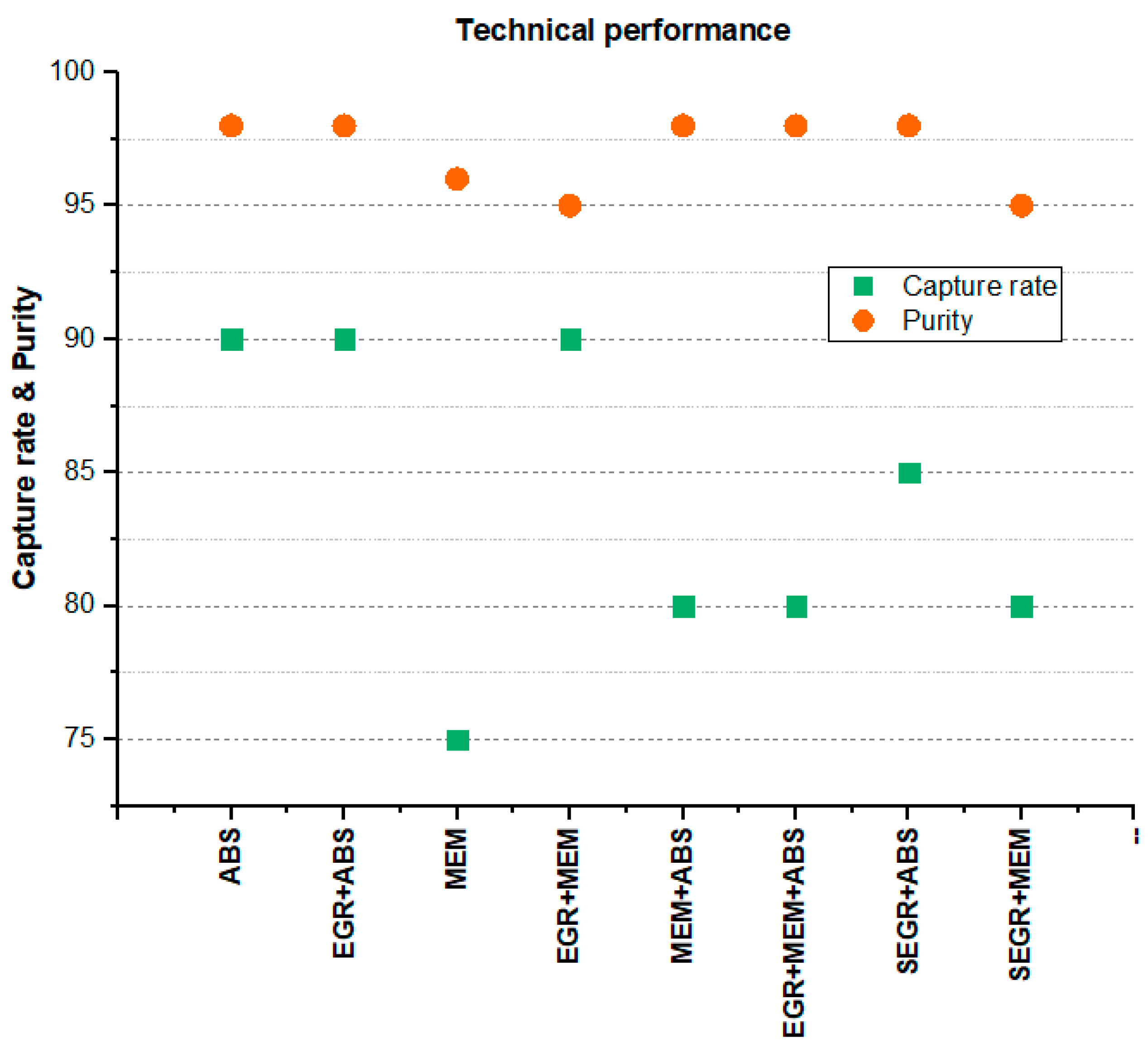
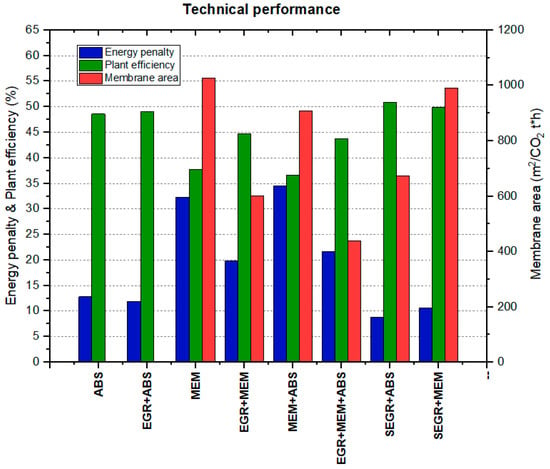
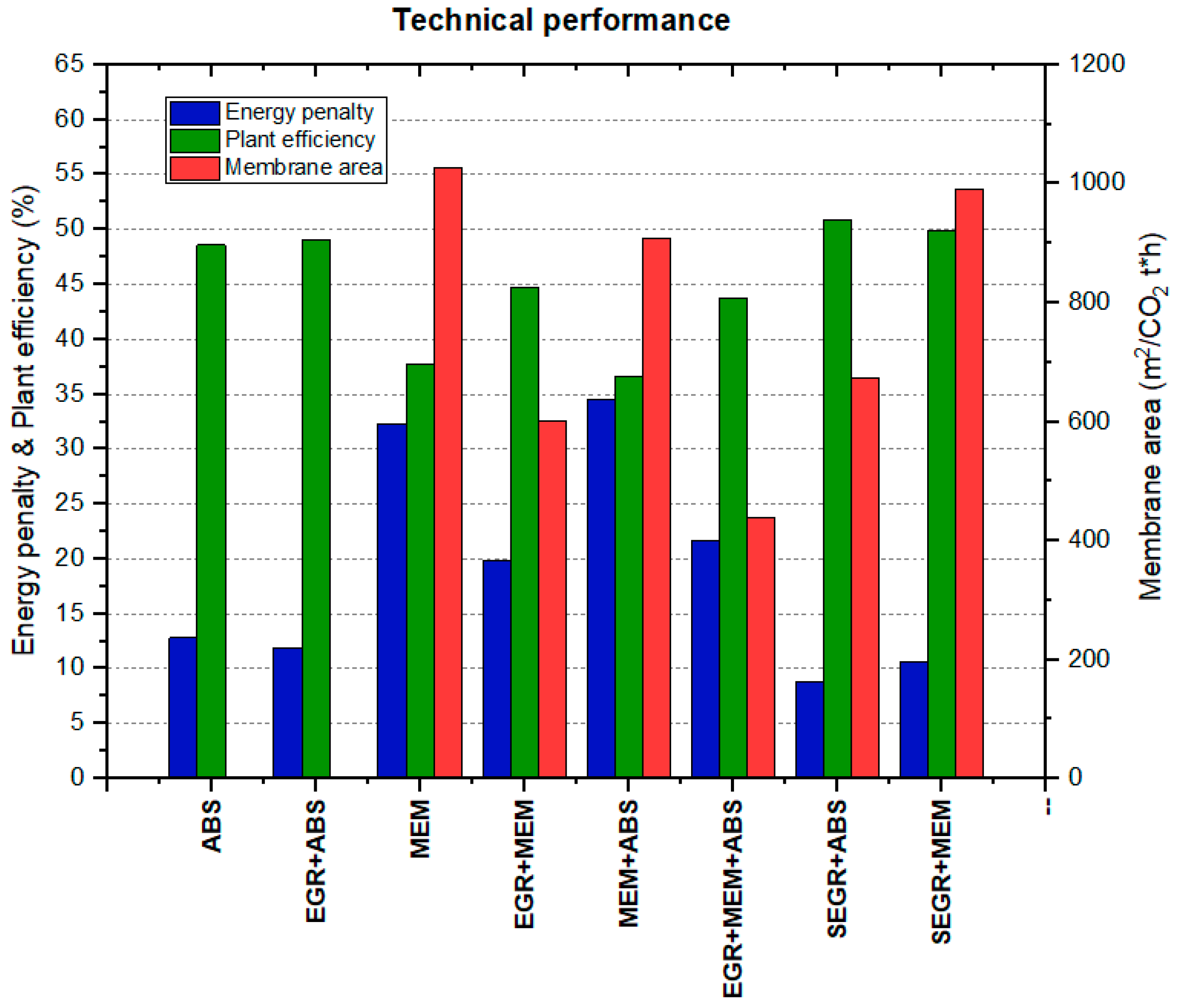
Standalone amine absorption serves as the benchmark for post-combustion CO2 capture, achieving a 90% capture rate with 98% CO2 purity (Figure 1). However, it requires 53.89 MWh of energy, resulting in an efficiency penalty exceeding 7% (Figure 2). The system has a CAPEX of $248.85 million and an annual OPEX of $40.76 million. Although MEA absorption is a mature and reliable technology suitable for retrofitting NGCC plants, its high solvent regeneration energy demand leads to considerable operating costs and limits its long-term competitiveness.
Figure 1.
The technical performance of various carbon capture technologies, focusing on two key metrics: CO2 capture rate and CO2 purity.
Figure 2.
Comparison of energy penalty, plant efficiency, and required membrane area for each case.
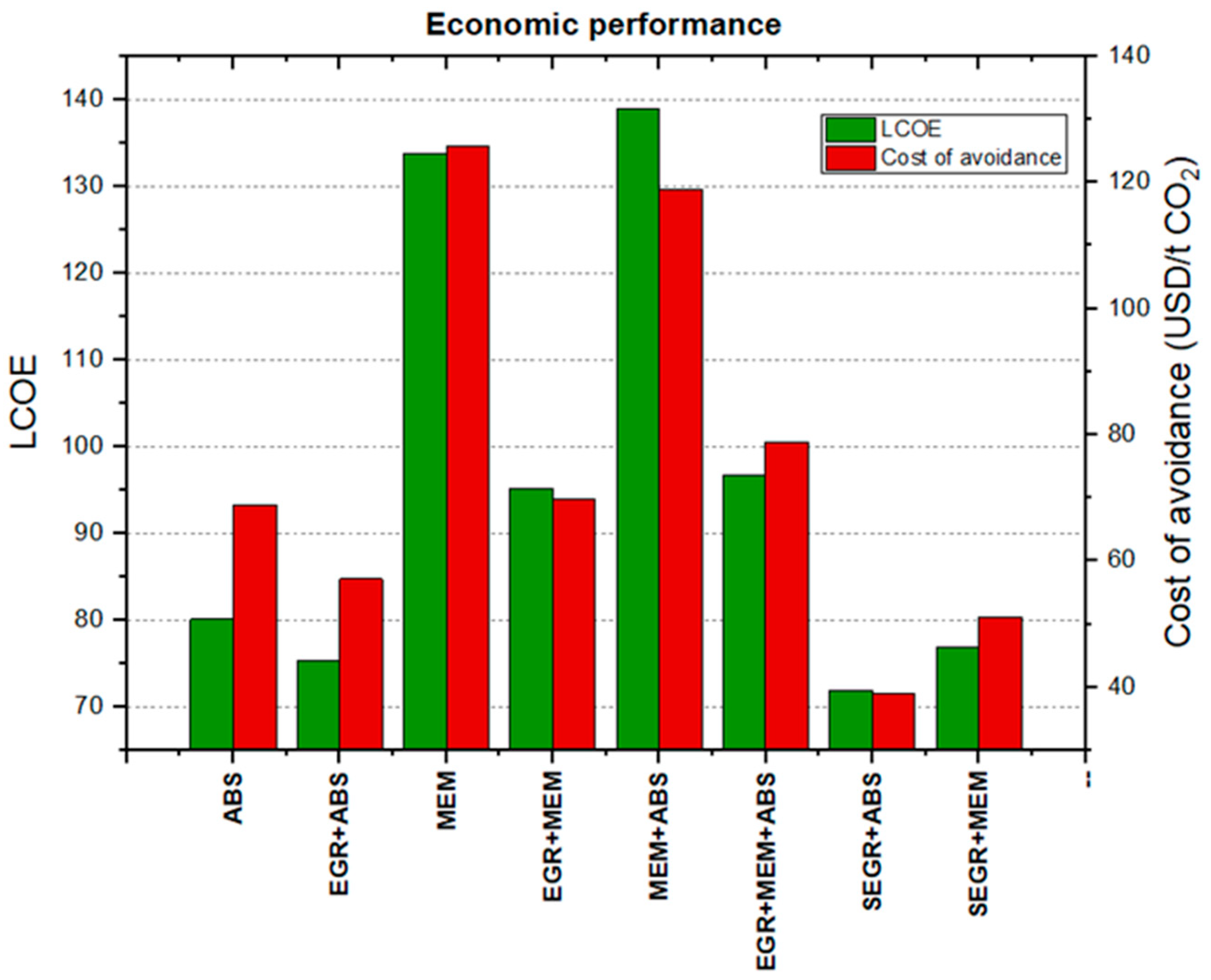
Integrating exhaust gas recirculation (EGR) with amine absorption significantly improves process performance. Energy consumption decreases by approximately 7%, while the efficiency penalty is reduced to 6.66%, maintaining 90% CO2 capture and 98% purity. CAPEX falls to $195.02 million, mainly due to the reduced absorber size resulting from lower flue gas flow, and OPEX decreases by 16% (Figure 3). By increasing the CO2 concentration in the flue gas, EGR lowers solvent regeneration requirements, improving both economic and environmental performance.
Figure 3.
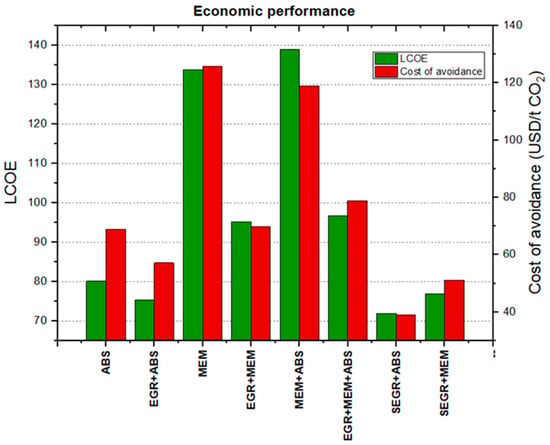
The economic performance of different carbon capture technologies by comparing two critical metrics: levelized cost of electricity (LCOE) in green bars and cost of CO2 avoidance.
Standalone membrane separation exhibits the poorest energy performance, consuming 135.45 MWh with an efficiency penalty of 17.98%, mainly because of the low CO2 concentration in NGCC flue gas. Incorporating EGR substantially enhances membrane performance, reducing energy consumption to 83.23 MWh and the efficiency penalty to 11.05%, while increasing the capture rate from 75% to 90% at 95% CO2 purity. CAPEX decreases by nearly 25%, and annual OPEX falls to $50.66 million. Nevertheless, membrane systems remain less energy-efficient than EGR-assisted MEA absorption because of limitations in membrane selectivity, permeance, and compression energy requirements.
Figure 2 compares the energy penalty, net plant efficiency, and membrane area for all evaluated configurations. Standalone membrane separation requires the largest membrane area (approximately 1000 m2/CO2·t*h) because the low CO2 concentration in NGCC flue gas provides only a limited driving force for membrane permeation. Consequently, substantial gas compression and a large membrane surface are required, resulting in the highest energy penalty and the lowest plant efficiency. The application of EGR increases the CO2 concentration in the flue gas, reducing the required membrane area by approximately 40% and improving plant efficiency through lower compression energy demand. A similar trend is observed for the hybrid membrane–absorption configuration, where EGR decreases the membrane area and improves efficiency by reducing the membrane separation load. The SEGR-assisted absorption process achieves the highest plant efficiency because it eliminates the need for a membrane while simultaneously increasing the CO2 concentration entering the absorber, thereby reducing solvent regeneration energy. Although SEGR also improves membrane performance, the SEGR–membrane configuration still requires a relatively large membrane area, indicating that the energy savings achieved through higher CO2 concentration are partly offset by the energy demand associated with membrane separation.
The hybrid membrane–absorption configuration combines membrane separation with amine absorption to achieve high CO2 purity by partially enriching the flue gas before solvent absorption. This pre-concentration reduces the CO2 load entering the absorber and can decrease solvent circulation and reboiler duty. However, these benefits are partly offset by the additional energy required for membrane operation, including gas compression and the large membrane area needed to achieve the desired separation under the relatively low CO2 partial pressure of NGCC flue gas. Consequently, although EGR improves the hybrid process by increasing the inlet CO2 concentration and reducing membrane area requirements, the energy savings achieved in the absorption unit are insufficient to fully compensate for the membrane-related energy consumption and process complexity. As a result, the hybrid configuration provides only moderate improvements over standalone absorption and remains less attractive than the SEGR-assisted absorption process from both technical and economic perspectives.
Among all evaluated cases, the SEGR-assisted absorption configuration (Case 7) demonstrates the best overall performance. Increasing the flue gas CO2 concentration to approximately 19 vol% significantly enhances the gas–liquid mass transfer driving force by increasing the CO2 partial pressure across the absorber. This promotes faster CO2 absorption kinetics and allows the solvent to achieve a higher CO2 loading, thereby increasing the absorption efficiency. As a result, less MEA circulation is required to achieve the target CO2 capture rate, reducing both solvent pumping requirements and the amount of solvent that must be heated during regeneration. The lower solvent circulation consequently decreases the reboiler steam demand, which is the dominant energy consumer in the MEA absorption process, leading to a substantial reduction in the overall energy penalty. In addition, the higher inlet CO2 concentration reduces the volumetric flue gas flow handled by the absorber, contributing to improved process efficiency and lower equipment requirements. Consequently, the efficiency penalty decreases to only 4.91%, outperforming all other evaluated configurations. These results demonstrate that SEGR effectively intensifies the absorption process by improving mass transfer while simultaneously reducing the thermal energy required for solvent regeneration, making it the most technically and economically attractive configuration among the investigated cases.
In terms of scalability of the results given in this paper, although this study is based on a representative 450 MW NGCC power plant, the comparative trends observed among the evaluated carbon capture configurations are expected to be applicable to other commercial-scale NGCC plants. However, the absolute values of equipment size, capital investment, and CO2 avoidance cost may vary with plant capacity and operating conditions. A detailed assessment of scale effects requires dedicated analyses for different plant capacities and is beyond the scope of this conference proceedings paper.
4. Conclusions
This study presents a techno-economic comparison of eight CCSU integration scenarios for an NGCC power plant, including amine absorption, membrane separation, hybrid systems, and EGR/SEGR-assisted configurations. The assessment considered energy consumption, efficiency penalty, CO2 capture performance, CAPEX, and OPEX. The results show that SEGR-assisted MEA absorption (Case 7) is the most effective configuration, achieving the lowest energy consumption (36.95 MWh), the smallest efficiency penalty (4.91%), and 98% CO2 purity. In contrast, standalone membrane systems exhibit the highest energy demand and efficiency losses, while hybrid configurations provide only moderate improvements. Although the study is limited by the performance of current commercial membrane technologies, the findings suggest that SEGR-assisted absorption is the most promising near-term CCSU option for NGCC plants, while continued membrane development is needed to improve the competitiveness of membrane-based systems.
Author Contributions
Conceptualization, M.F., M.V. and A.N.; methodology, A.K., Z.T. and B.U.; software, J.E., S.R. and K.U.; validation, H.A., A.K. and Y.A.; formal analysis, H.A., A.K. and Z.T.; investigation, Q.S., H.A. and A.K.; resources, Z.T., A.K. and H.A.; data curation, J.E., K.U., S.R. and H.A.; writing—original draft preparation, A.K. and H.A.; writing—review and editing, M.V., M.F., A.N., Y.A. and B.U.; visualization, H.A.; supervision, M.V., M.F. and A.N.; project administration, M.F., M.V., A.K. and B.U.; funding acquisition, B.U. All authors have read and agreed to the published version of the manuscript.
Funding
This research received no external funding.
Institutional Review Board Statement
Not applicable.
Informed Consent Statement
Not applicable.
Data Availability Statement
The data presented in this study are available from the corresponding author upon reasonable request.
Acknowledgments
The authors gratefully acknowledge the cooperation and scientific collaboration among the Department of Chemical and Biochemical Engineering, Slovak University of Technology in Bratislava (Bratislava, Slovakia), the Department of Chemical and Biomolecular Engineering, University of Cantabria (Santander, Spain), the Department of Automation and Digital Control, Tashkent Institute of Chemical Technology (Tashkent, Uzbekistan), and the Faculty of Food Engineering in Shahrisabz, Karshi State Technical University (Shahrisabz, Uzbekistan). The authors sincerely appreciate the support and valuable contributions of these institutions to this research.
Conflicts of Interest
The authors declare no conflicts of interest.
References
- Li, Q.; You, D.; Li, Q.; Wang, F.; Wang, Y.; Yang, Y. Analysis of Sedimentation Behavior and Influencing Factors of Solid Particles in CO2 Fracturing Fluid. Processes 2025, 13, 4049. [Google Scholar] [CrossRef] [Scilit]
- Li, Q.; Li, Q.; Wu, J.; He, K.; Xia, Y.; Liu, J.; Wang, F.; Cheng, Y. Wellhead Stability During Development Process of Hydrate Reservoir in the Northern South China Sea: Sensitivity Analysis. Processes 2025, 13, 1630. [Google Scholar] [CrossRef] [Scilit]
- Li, Q.; Wang, F.; Wu, J.; Li, Q.; Zhang, G. Multivariate Coupling Model and Reservoir Characteristics of Enhanced Geothermal Reservoirs. Energies 2026, 19, 3180. [Google Scholar] [CrossRef] [Scilit]
- United Nations. Causes and Effects of Climate Change. Available online: https://www.un.org/en/climatechange/science/causes-effects-climate-change (accessed on 30 June 2026).
- NASA. Is It Too Late to Prevent Climate Change?—NASA Science; NASA: Washington, DC, USA, 2014. [Google Scholar]
- CO2 Emissions in 2022—Analysis—IEA. Available online: https://www.iea.org/reports/co2-emissions-in-2022 (accessed on 30 June 2026).
- Global Electricity Review 2024|Ember. Available online: https://ember-energy.org/latest-insights/global-electricity-review-2024/global-electricity-trends/ (accessed on 30 June 2026).
- Mletzko, J.; Ehlers, S.; Kather, A. Comparison of Natural Gas Combined Cycle Power Plants with Post Combustion and Oxyfuel Technology at Different CO2 Capture Rates. Energy Procedia 2016, 86, 2–11. [Google Scholar] [CrossRef] [Scilit]
- Kamolov, A.; Turakulov, Z.; Norkobilov, A.; Variny, M.; Fallanza, M. Evaluation of Potential Carbon Dioxide Utilization Pathways in Uzbekistan. Eng. Proc. 2023, 56, 194. [Google Scholar] [CrossRef] [Scilit]
- Kamolov, A.; Turakulov, Z.; Furda, P.; Variny, M.; Norkobilov, A.; Fallanza, M. Techno-Economic Feasibility Analysis of Post-Combustion Carbon Capture in an NGCC Power Plant in Uzbekistan. Clean Technol. 2024, 6, 1357–1388. [Google Scholar] [CrossRef] [Scilit]
- Bhattacharyya, D. Design and Optimization of Hybrid Membrane–Solvent-Processes for Post-Combustion CO2 Capture. Curr. Opin. Chem. Eng. 2022, 36, 100768. [Google Scholar] [CrossRef] [Scilit]
- Baker, R.W.; Freeman, B.; Kniep, J.; Wei, X.; Merkel, T. CO2 Capture from Natural Gas Power Plants Using Selective Exhaust Gas Recycle Membrane Designs. Int. J. Greenh. Gas Control 2017, 66, 35–47. [Google Scholar] [CrossRef] [Scilit]
- Herraiz, L.; Fernández, E.S.; Palfi, E.; Lucquiaud, M. Selective Exhaust Gas Recirculation in Combined Cycle Gas Turbine Power Plants with Post-Combustion CO2 Capture. Int. J. Greenh. Gas Control 2018, 71, 303–321. [Google Scholar] [CrossRef] [Scilit]
- Qureshi, Y.; Ali, U.; Sher, F. Part Load Operation of Natural Gas Fired Power Plant with CO2 Capture System for Selective Exhaust Gas Recirculation. Appl. Therm. Eng. 2021, 190, 116808. [Google Scholar] [CrossRef] [Scilit]
- Tang, Y.; Chong, C.T.; Ng, J.-H.; Herraiz, L.; Li, J.; Ong, H.C.; Lam, S.S.; Tabatabaei, M.; Chong, W.W.F. Thermoexergetic Analysis and Response Optimisation of Selective Exhaust Gas Recirculation with Solvent-Based CO2 Capture in a Natural Gas-Fired Combined Cycle Power Plant. Clean Technol. Environ. Policy 2024, 26, 1643–1667. [Google Scholar] [CrossRef] [Scilit]
- IEAGHG. CO2 Capture at Gas Fired Power Plants; Report 2012/8; IEA Greenhouse Gas R&D Programme: Cheltenham, UK, 2012. [Google Scholar]
- Schmitt, T.; Leptinsky, S.; Turner, M.; Zoelle, A.; Woods, M.; Shultz, T.; James, R.E. Cost and Performance Baseline for Fossil En-ergy Plants, Volume 1: Bituminous Coal and Natural Gas to Electricity; Revision 4a; National Energy Technology Laboratory: Pittsburgh, PA, USA, 2022. [Google Scholar]
- Hackett, G.A.; Cvetic, P.; Buchheit, K.; Kuehn, N.; Zoelle, A.; Woods, M.; Fout, T. Natural Gas Combined Cycle (NGCC) Power Plants with Carbon Capture and Exhaust Gas Recycle; National Energy Technology Laboratory: Pittsburgh, PA, USA, 2024. [Google Scholar]
- Fu, C.; Roussanaly, S.; Jordal, K.; Anantharaman, R. Techno-Economic Analyses of the CaO/CaCO3 Post-Combustion CO2 Capture from NGCC Power Plants. Front. Chem. Eng. 2021, 2, 596417. [Google Scholar] [CrossRef] [Scilit]
- Kamolov, A.; Turakulov, Z.; Norkobilov, A.; Variny, M.; Fallanza, M. Decarbonization Challenges and Opportunities of Power Sector in Uzbekistan: A Simulation of Turakurgan Natural Gas-Fired Combined Cycle Power Plant with Exhaust Gas Recirculation. Eng. Proc. 2023, 37, 24. [Google Scholar] [CrossRef] [Scilit]
Disclaimer/Publisher’s Note: The statements, opinions and data contained in all publications are solely those of the individual author(s) and contributor(s) and not of MDPI and/or the editor(s). MDPI and/or the editor(s) disclaim responsibility for any injury to people or property resulting from any ideas, methods, instructions or products referred to in the content. |
© 2026 by the authors. Licensee MDPI, Basel, Switzerland. This article is an open access article distributed under the terms and conditions of the Creative Commons Attribution (CC BY) license.