


Abstract
This work investigates composite sandwich panels for lightweight applications, focusing on a controlled one-shot vacuum infusion route for extruded polystyrene (XPS)-core structures with epoxy-based skins. Glass-fibre/XPS/epoxy panels manufactured by vacuum-assisted hand lay-up were compared with basalt-fibre/XPS/epoxy panels manufactured by vacuum infusion. The panels were evaluated through thermal, physical and mechanical tests, including differential scanning calorimetry (DSC), density, fibre and void content, hardness, flexural behaviour and dimensional stability. The basalt-fibre/vacuum-infused configuration showed higher hardness, fibre volume fraction and flexural performance. As reinforcement material and the manufacturing route were changed simultaneously, the observed differences are interpreted as the combined response of the two configurations.
1. Introduction
Composite sandwich structures are increasingly used in engineering applications in industries including aerospace, marine, automotive, renewable energy and civil construction, owing to their outstanding strength-to-weight ratio, high stiffness, corrosion resistance and design flexibility [1,2]. Through the integration of lightweight cores with high-performance fibre-reinforced composite facings, sandwich panels achieve greater structural efficiency while minimising weight and material usage. Such features have spurred research into the development of manufacturing technologies that will ensure the production of high-quality composite products with high levels of consistency and at lower costs [3].
Among the available manufacturing techniques, hand lay-up remains one of the most widely adopted methods owing to its simplicity and low production cost [4,5]. Unfortunately, this technique relies heavily on manual operations and results in inconsistencies in laminate quality, poor resin distribution and the presence of voids, which could adversely affect the mechanical properties and longevity of composite products. On the other hand, vacuum infusion offers a great alternative by achieving better fibre impregnation, laminate consolidation, and process consistency, while minimising material wastage [3,6]. This makes vacuum infusion suitable for the industrial manufacturing of composite structures. Nevertheless, the quality of vacuum-infused composites strongly depends on proper process control. Parameters such as vacuum integrity, resin flow, infusion strategy and curing conditions directly influence fibre wet-out, void formation and laminate quality. Therefore, establishing a robust and repeatable manufacturing process is essential for producing high-quality sandwich structures.
At the same time, increased environmental concerns have led to the creation of more environmentally friendly composite materials through the use of alternative reinforcement fibres [7]. Although glass fibre is still widely used in various engineering applications owing to its cost-effectiveness and decent mechanical properties, basalt fibre has gained increasing popularity due to its high mechanical performance, high-temperature stability, corrosion resistance and low environmental impact [8,9,10]. Therefore, selecting the appropriate reinforcement fibre requires careful consideration of both its processing behaviour and its contribution to the overall performance of composite sandwich panels.
Although several studies have investigated reinforcement materials and manufacturing techniques for composite sandwich structures, practical one-shot routes combining face-sheet impregnation, core bonding and curing under controlled conditions remain insufficiently explored. Therefore, this work develops and preliminarily assesses a controlled one-shot vacuum infusion route for extruded polystyrene XPS-core sandwich panels. Two material–process configurations were compared: glass-fibre/XPS/epoxy panels manufactured by vacuum-assisted hand lay-up and basalt-fibre/XPS/epoxy panels manufactured by vacuum infusion. XPS was selected owing to its low density, thermal insulation and compatibility with vacuum infusion. Since reinforcement type and manufacturing route were varied simultaneously, the results are interpreted at the configuration level rather than as the isolated effect of either variable.
2. Materials and Methods
2.1. Materials
The composite sandwich panels investigated in this study were manufactured using extruded polystyrene (XPS) foam (ifoam, IMPERALUM, Montijo, Portugal) as the core material, together with glass fibre (twill fabric 200 g/m2 E-glass, Castro Composites, O Porriño, Spain), basalt fibre (twill fabric 200 g/m2, Castro Composites, Spain) and an epoxy resin system (SikaBiresin CR83 resin with CH83-6 hardener, Sika, Vila Nova de Gaia, Portugal) [8].
2.2. Composite Manufacturing
Two configurations were manufactured: glass-fibre/XPS/epoxy panels by vacuum-assisted hand lay-up and basalt-fibre/XPS/epoxy panels by vacuum infusion. Panels measuring 600 × 400 × 22 mm comprised a 20 mm XPS core and two 200 g m−2 reinforcement plies on each face, arranged at ±45°. Before lay-up, the core surfaces were cleaned and perforated to improve face/core bonding and resin distribution. The SikaBiresin® CR83 resin and CH83-6 hardener were mixed at a weight ratio of 100:30. An absolute pressure of 500 mbar was maintained during processing and the initial 24 h room-temperature cure, followed by post-curing at 70 °C for 10 h.
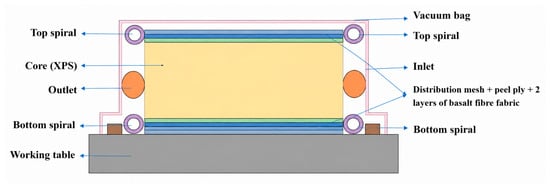
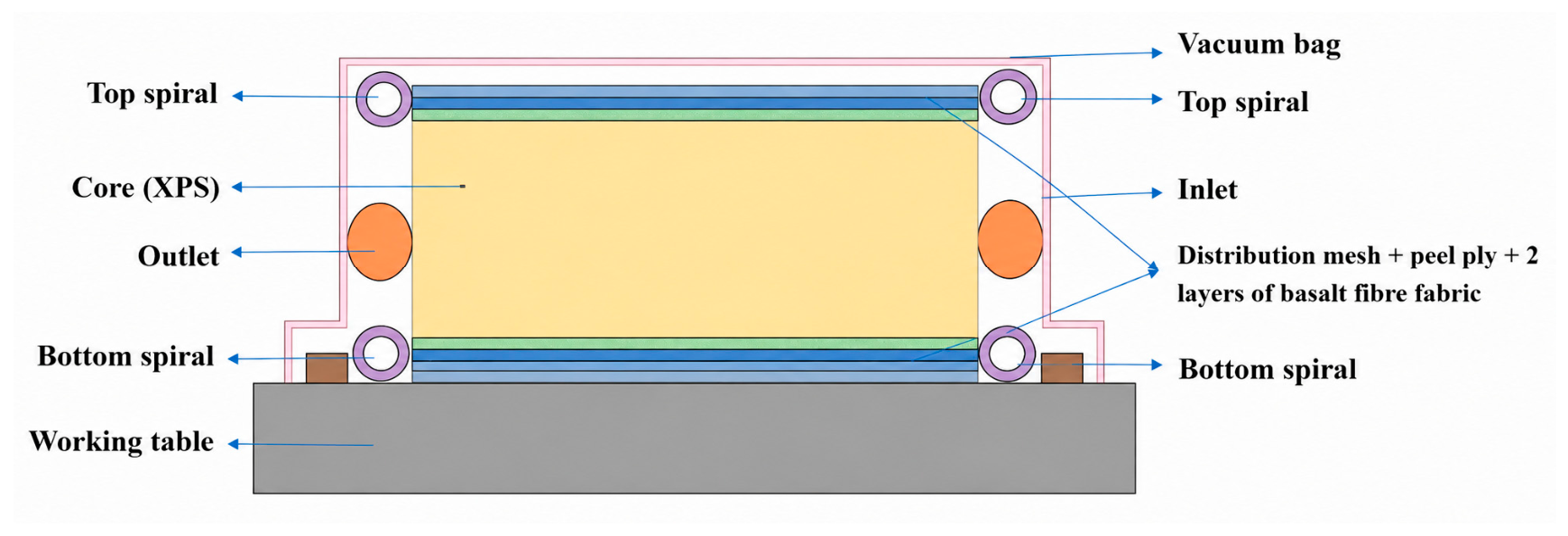
To overcome the limitations of conventional hand lay-up, a customised vacuum infusion process was designed to manufacture composite sandwich panels. The proposed procedure made it possible to produce a complete sandwich structure in one operation. Firstly, the reinforcement layers were positioned onto the core and then placed inside a vacuum bag setup comprising peel ply, distribution media, resin inlet, vacuum outlet and sealing system. During infusion, the pressure differential drew the epoxy resin from the inlet towards the vacuum outlet, promoting controlled resin flow, fibre impregnation and laminate consolidation [3,11].
For each manufacturing configuration, one sandwich panel was produced, from which 3 to 5 specimens were machined for each mechanical and physical characterisation test in accordance with the corresponding ASTM standards. It should be noted that the specimens machined from each panel represent subsamples from a single manufactured panel. Therefore, the reported standard deviations describe specimen-to-specimen variability within the same panel and should not be interpreted as manufacturing repeatability between independent panels. A full assessment of process reproducibility would require independent manufacturing replicates for each configuration.
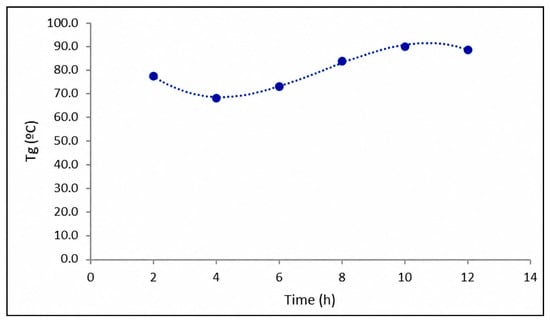
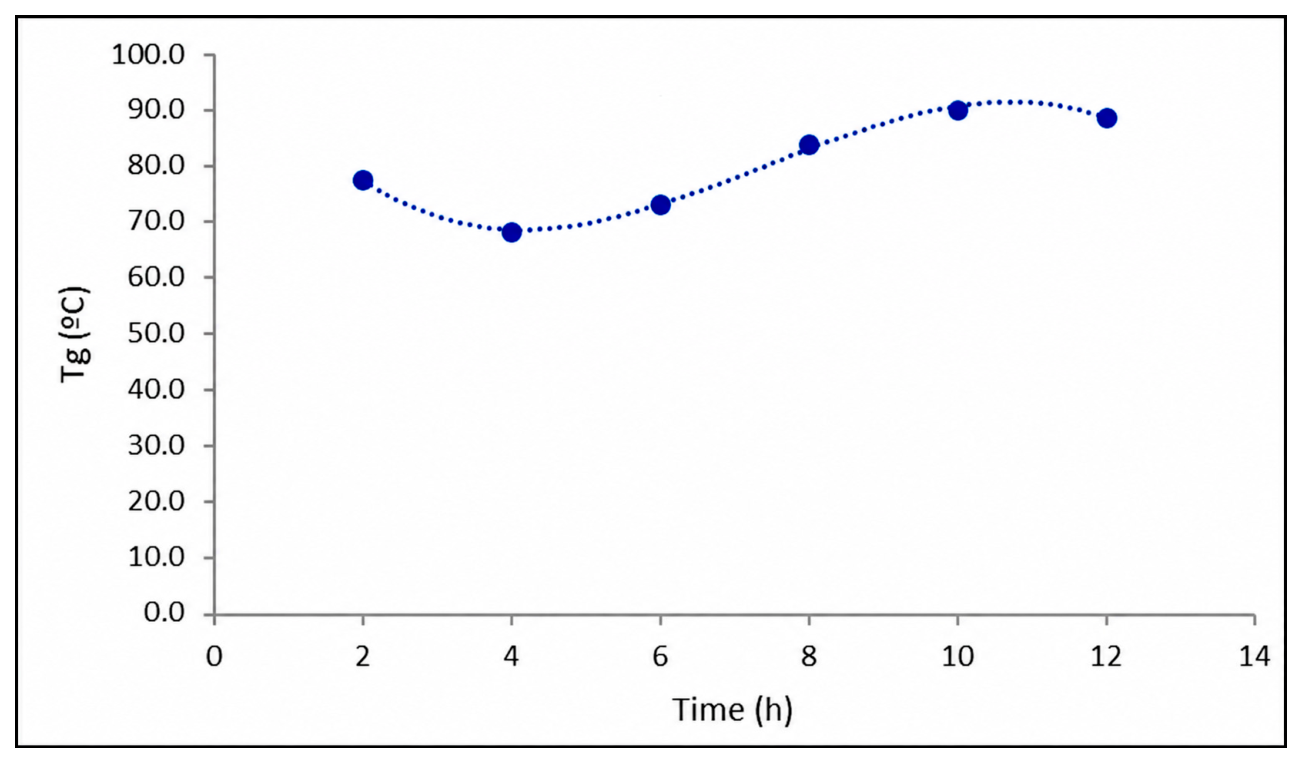
Preliminary qualitative observations of resin flow, vacuum distribution and laminate consolidation supported the definition of the final bagging strategy, inlet/outlet arrangement and curing procedure. The selected conditions produced complete visual impregnation and stable vacuum conditions; however, no quantitative process-optimisation matrix was performed. They should therefore be regarded as a preliminary process-development outcome, requiring further optimisation to quantify the effects of processing parameters on void content, consolidation and panel-to-panel reproducibility [6]. In addition, the post-curing duration was preliminarily selected using Differential Scanning Calorimetry (DSC) in accordance with ASTM D3418. Since the maximum service temperature of the XPS core was limited to 70 °C, different post-curing times (2, 4, 6, 8, 10 and 12 h) at this temperature were evaluated to support the preliminary selection of the post-curing duration. For the DSC analysis, one specimen was tested for each post-curing time. Specimens were taken from neat resin. The glass transition temperature (Tg) was determined from the first heating cycle using a heating rate of 10 °C min−1 under a nitrogen atmosphere. Residual reaction enthalpy was not evaluated in this preliminary study and will be included in future curing-cycle assessments [12]. Based on this preliminary DSC assessment, the curing cycle adopted throughout this work consisted of 24 h at room temperature followed by a 10 h post-curing stage at 70 °C, as shown in Figure 1. A post-curing time of 10 h was selected because longer durations resulted in only marginal increases in Tg, while this curing cycle remained compatible with the maximum service temperature of the XPS core.
Figure 1.
Glass transition temperature (Tg) obtained by differential scanning calorimetry (DSC) for neat-resin specimens post-cured at 70 °C for different durations. One specimen was tested at each post-curing time, and the measured points are connected only as a visual guide.
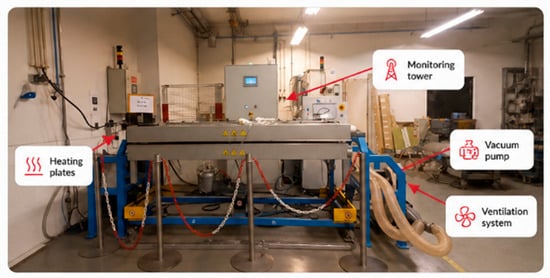
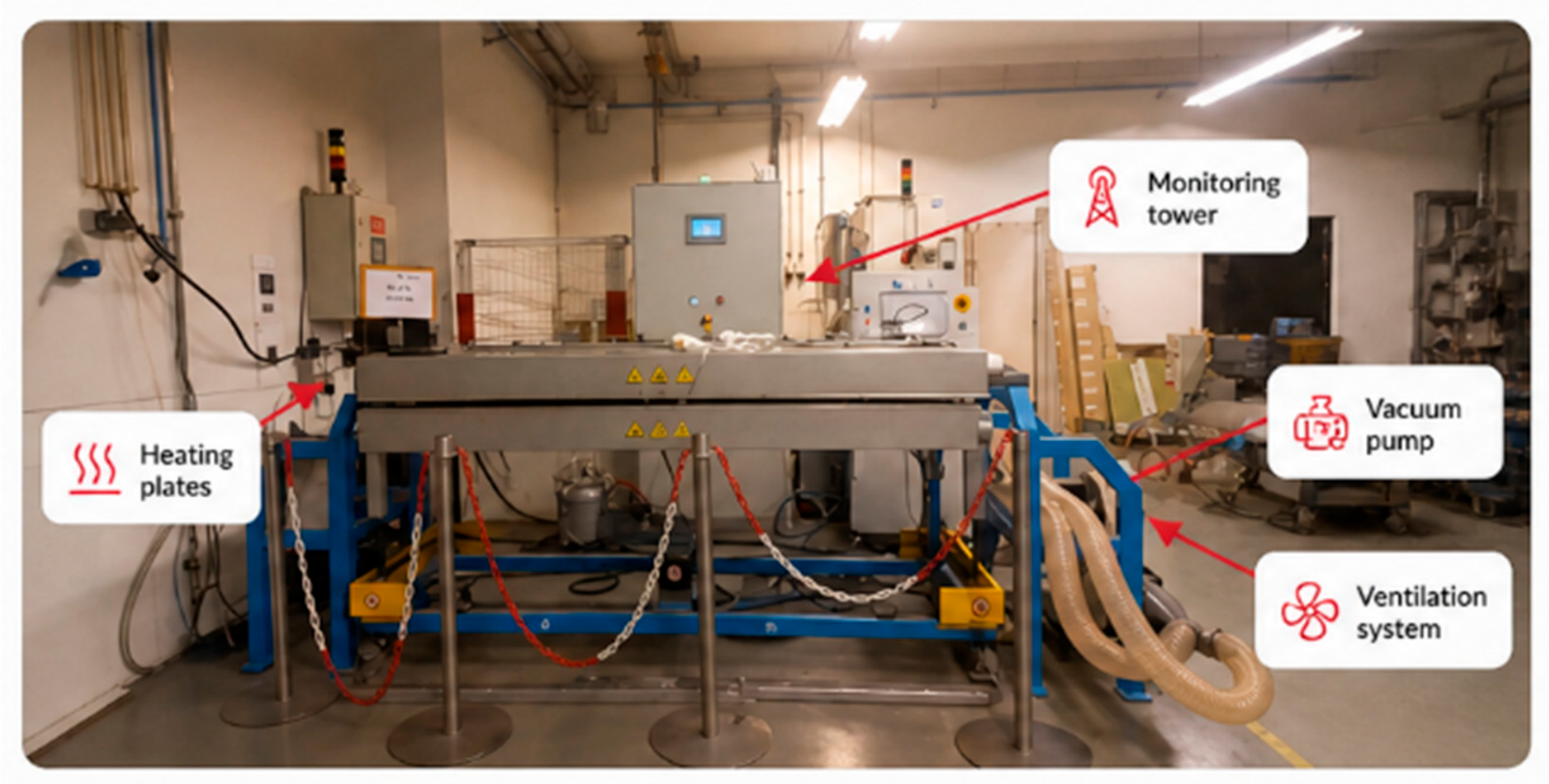
The developed manufacturing system is equipped with two heated plates capable of operating up to 200 °C, providing the optimal conditions for curing the panels during manufacture. To improve thermal uniformity, the machine’s thermal system was split into thermal zones, enabling local temperature regulation on the working plane. In addition, a vertical actuator was installed, ensuring uniform pressure distribution on the working plane, and this configuration contributes to improved laminate consolidation during manufacturing.
The developed manufacturing platform was designed to produce composite sandwich panels with the following size limitations: 1.0 × 2.0 × 0.2 m. Furthermore, the upper heated plate is rotatable, thus providing a working area of 2.0 × 2.0 m and allowing the manufacture of larger composite structures.
After manufacturing one sandwich panel for each configuration, specimens were machined and characterised through physical, thermal and mechanical tests. The comparative assessment enabled the identification of the most promising material–process configuration for subsequent optimisation. Figure 2 and Figure 3 illustrate the developed vacuum infusion equipment and its main functional components, and the corresponding vacuum infusion scheme, respectively.
Figure 2.
Developed vacuum infusion setup.
Figure 3.
Vacuum infusion scheme.
2.3. Material Characterisation
The panels were characterised through physical, thermal and mechanical testing. Density, fibre volume fraction, void content and Barcol hardness were determined to assess laminate consolidation and manufacturing quality. Fibre and void contents were calculated according to ASTM D3171 using the measured composite density and supplier-reported fibre and cured-resin densities [13,14,15]. DSC was used to evaluate curing behaviour and glass transition temperature [12]. Flexural testing followed ASTM C393/C393M, using a 150 mm support span, 75 mm specimen width, 12 mm loading nose and support rollers, and a crosshead speed of 6 mm min−1 [16]. Core shear strength was calculated according to ASTM C393/C393M. The reported flexural strength and apparent flexural modulus were obtained from the experimental load–displacement response and are presented as comparative parameters between the two investigated configurations. Dimensional stability was also evaluated under different temperature conditions [17].
3. Results
3.1. Experimental Characterisation Results
The results obtained are presented in Table 1. The goal was to compare the physical, thermal, and mechanical response of two material–process configurations: glass-fibre/XPS/epoxy panels manufactured by vacuum-assisted hand lay-up and basalt-fibre/XPS/epoxy panels manufactured by vacuum infusion.
Table 1.
Results obtained in the experimental study.
Compared with the glass-fibre/hand-lay-up configuration, the basalt-fibre/vacuum-infused panels showed increases of 3.7% in Tg, 32% in Barcol hardness, 6.5% in laminate density, 12.5% in panel density, 8.4% in fibre volume fraction, 11% in flexural strength and 5.4% in flexural modulus. Core shear strength remained nearly unchanged, suggesting that it was primarily governed by the XPS core, whereas the flexural differences may also reflect face-sheet stiffness, fibre content, laminate thickness or failure mode. The average void content increased from 4.15 ± 3.38% to 5.54 ± 1.78%. At 85 °C, the dimensional changes were 0.38 ± 0.56% and 0.07 ± 0.024% for the glass-fibre/hand-lay-up and basalt-fibre/vacuum infusion configurations, respectively. The large standard deviation of the former indicates substantial within-panel scatter. Both configurations showed negligible changes at −25 °C. These differences must be interpreted cautiously because reinforcement material and manufacturing route were changed simultaneously. Moreover, the Tg difference was small relative to the scatter of the basalt-fibre/vacuum-infused configuration. The lower void-content standard deviation represents only within-panel variability and does not demonstrate manufacturing repeatability, since each configuration was represented by a single panel. Independent manufacturing replicates and factorial comparisons are therefore required to isolate the effects of reinforcement and process and to optimise the infusion strategy [18].
3.2. Preliminary Material Screening
The two investigated material–process configurations were compared in terms of mechanical performance, production cost, fibre-level environmental indicators and manufacturing feasibility. The environmental and cost indicators presented in Table 2 were obtained from supplier data and literature values and should be interpreted as preliminary screening indicators rather than as a complete life-cycle assessment, while Table 3 summarises the overall assessment of the most representative sandwich panel configurations. It should be noted that the values reported in Table 2 refer only to fibre-level indicators and do not represent a full panel-level life-cycle assessment. The system boundaries, geographical representativeness and production datasets may differ between sources.
Table 2.
Preliminary comparison of glass- and basalt-fibre reinforcements.
Table 3.
Overall assessment of the representative sandwich panel configurations.
Table 2 shows that glass fibre presents the lowest production cost, whereas basalt fibre showed lower fibre-level embodied energy and CO2 emission indicators according to the manufacturers’ technical data. The overall material screening (Table 3) compared the two investigated sandwich panel configurations manufactured using glass-fibre or basalt-fibre reinforcement combined with an XPS core and epoxy resin. Among the materials investigated, the basalt-fibre/epoxy/XPS configuration provided the best overall balance between mechanical performance, environmental impact and manufacturing feasibility.
Although the basalt-fibre solution is more expensive than the glass-fibre alternative, its higher mechanical performance, lower reported fibre-level embodied-energy and CO2-emission indicators, and compatibility with the single-step vacuum infusion process make this configuration a promising solution for the investigated sandwich panel configuration, particularly when structural performance is prioritised over minimum material cost. Consequently, this material configuration was selected for the subsequent stages of process optimisation.
4. Discussion
The results highlight the combined influence of reinforcement material and manufacturing route on sandwich-panel performance. Since both variables were changed simultaneously, their individual contributions cannot be isolated. A full factorial design should include glass and basalt fibres manufactured by both vacuum-assisted hand lay-up and vacuum infusion. Nevertheless, the one-shot infusion route provided practical processing advantages by combining face-sheet impregnation, core bonding and curing through controlled resin flow and a dedicated manufacturing platform.
Among the two investigated configurations, the basalt-fibre/vacuum infusion configuration showed the more favourable overall mechanical and dimensional stability response [9,10]. Basalt fibre also presented lower fibre-level embodied-energy and CO2 indicators, although its areal cost was higher than that of glass fibre. However, these are preliminary screening indicators, and a complete panel-level life-cycle assessment is required for a definitive environmental comparison.
The higher mean void content indicates that the infusion strategy still requires optimisation. Although its lower standard deviation indicates reduced specimen-to-specimen variability within the same panel, it does not demonstrate manufacturing repeatability because no independent panel replicates were produced. Future work should therefore include independent manufacturing replicates, optimisation of the processing parameters and assessment of alternative reinforcement fibres, core materials and resin systems, including more sustainable combinations.
5. Conclusions
The present study developed and preliminarily assessed a controlled one-shot vacuum infusion process for the manufacture of XPS-core composite sandwich panels. The proposed approach enables the production of a complete sandwich structure in a single manufacturing step, combining face-sheet impregnation, bonding to the core and curing. However, the present experimental design does not isolate the individual effects of manufacturing route and reinforcement material. Among the experimentally characterised configurations, the basalt-fibre/XPS/epoxy sandwich panel manufactured by vacuum infusion showed the best overall mechanical and dimensional stability performance. These results should be interpreted as the response of the basalt-fibre/vacuum infusion configuration and not as evidence that vacuum infusion alone was responsible for the observed improvements. The preliminary screening indicated that the basalt-fibre/vacuum infusion configuration provided the most favourable balance between mechanical performance, reported fibre-level environmental indicators and manufacturing feasibility among the two investigated configurations.
The results demonstrate that the most suitable sandwich panel configuration depends on the specific requirements of the intended application. Glass-fibre/epoxy/XPS sandwich panels remain an attractive solution for applications where low material cost is the primary requirement. In contrast, basalt-fibre/epoxy/XPS panels are more suitable for structural applications requiring higher mechanical performance.
Overall, the developed one-shot vacuum infusion route shows potential for scalable sandwich-panel manufacturing, but this potential must be confirmed through additional process optimisation, independent manufacturing replicates and larger-scale demonstrator panels. Future work will focus on further assessment and optimisation of the vacuum infusion process and on the experimental evaluation of alternative reinforcement fibres, resin systems and core materials, including more sustainable material combinations.
Author Contributions
Conceptualization, S.P.B.S. and A.A.; methodology, S.P.B.S. and H.T.; validation, S.P.B.S.; formal analysis, S.P.B.S. and H.T.; investigation, H.T. and S.P.B.S.; resources, A.A. and S.P.B.S.; data curation, F.R. and S.P.B.S.; writing—original draft preparation, F.R. and S.P.B.S.; writing—review and editing, F.R. and S.P.B.S.; visualization, F.R., S.P.B.S. and H.T.; supervision, A.A. and S.P.B.S.; project administration, A.A. and S.P.B.S.; funding acquisition, A.A. and S.P.B.S. All authors have read and agreed to the published version of the manuscript.
Funding
This work is supported by the “Alliance for Energy Transition” (56) project co-funded by the PRR—Recovery and Resilience Plan by the European Union.
Data Availability Statement
Publicly available information related to this study can be accessed through the official websites associated with the Alliance for Energy Transition project. The experimental datasets generated during this study are not publicly available.
Conflicts of Interest
The authors declare no conflict of interest.
References
- Manalo, A.; Aravinthan, T.; Fam, A.; Benmokrane, B. State-of-the-art review on FRP sandwich systems for lightweight civil infrastructure. J. Compos. Constr. 2017, 21, 04016068. [Google Scholar] [CrossRef] [Scilit]
- Mohammadabadi, M.; Yadama, V.; Dolan, J.D. Evaluation of wood composite sandwich panels as a promising renewable building material. Materials 2021, 14, 2083. [Google Scholar] [CrossRef] [Scilit] [PubMed]
- Kumar, A.; Kumar, D. Vacuum assisted resin transfer Moulding process review and variability analysis using Taguchi optimization technique. Mater. Today Proc. 2022, 50, 1472–1479. [Google Scholar] [CrossRef] [Scilit]
- Middleton, B. Composites: Manufacture and application. In Design and Manufacture of Plastic Components for Multifunctionality; Elsevier: Amsterdam, The Netherlands, 2015; pp. 53–101. [Google Scholar]
- Chang, C.-Y.; Chen, W.-R. Influence of processing variables on quality of unsaturated polyester/E-glass fiber composites manufactured by double-bag progressive compression method. Adv. Mech. Eng. 2018, 10, 1687814018798531. [Google Scholar] [CrossRef] [Scilit]
- El Bahaoui, J.; Hanafi, I.; Chairi, M.; Favaloro, F.; Borsellino, C.; Di Bella, G. Effect of manufacturing processes on basalt fiber-reinforced composites for marine applications. J. Compos. Sci. 2025, 9, 233. [Google Scholar] [CrossRef] [Scilit]
- Samani, P.; Mendes, A.; Leal, V.; Guedes, J.M.; Correia, N. A sustainability assessment of advanced materials for novel housing solutions. Build. Environ. 2015, 92, 182–191. [Google Scholar] [CrossRef] [Scilit]
- Torres, J.P.; Hoto, R.; Andrés, J.; García-Manrique, J.A. Manufacture of Green-Composite Sandwich Structures with Basalt Fiber and Bioepoxy Resin. Adv. Mater. Sci. Eng. 2013, 2013, 214506. [Google Scholar] [CrossRef] [Scilit]
- Scalici, T.; Fiore, V.; Valenza, A. Experimental assessment of the shield-to-salt-fog properties of basalt and glass fiber reinforced composites in cork core sandwich panels applications. Compos. Part B Eng. 2018, 144, 29–36. [Google Scholar] [CrossRef] [Scilit]
- Taheri, F.; Chowdhury, S.A.; Ghiaskar, A. Comparison of the performance of basalt fiber-reinforced composites incorporating a recyclable and a conventional epoxy resin. Polymers 2025, 17, 1348. [Google Scholar] [CrossRef] [Scilit] [PubMed]
- Chang, S.-H.; Zhilyaev, I.; Shevtsov, S.; Snezhina, N. Modeling the Manufacturing Process of Thin-Walled Composite Parts by Vacuum Infusion Using Controlled External Pressures. J. Compos. Sci. 2025, 9, 268. [Google Scholar] [CrossRef] [Scilit]
- ASTM D3418; Standard Test Method for Transition Temperatures and Enthalpies of Fusion and Crystallization of Polymers by Differential Scanning Calorimetry. ASTM International: West Conshohocken, PA, USA, 2021.
- ASTM D792; Standard Test Methods for Density and Specific Gravity (Relative Density) of Plastics by Displacement. ASTM International: West Conshohocken, PA, USA, 2020.
- ASTM D3171; Standard Test Methods for Constituent Content of Composite Materials. ASTM International: West Conshohocken, PA, USA, 2022.
- ASTM D2583; Standard Test Method for Indentation Hardness of Rigid Plastics by Means of a Barcol Impressor (Withdrawn 2022). ASTM International: West Conshohocken, PA, USA, 2013.
- ASTM C393/C393M; Standard Test Method for Core Shear Properties of Sandwich Constructions by Beam Flexure. ASTM International: West Conshohocken, PA, USA, 2022.
- ISO 2796:1986; Cellular Plastics, Rigid—Test for Dimensional Stability. International Organization for Standardization: Geneva, Switzerland, 1986.
- Sousa, S.P.B.; Teixeira, H.C.; Autretto, G.; Cárdenas, V.V.; Fantucci, S.; Favoino, F.; Voigt, P.; Stelzmann, M.; Böhm, R.; Beltrán, G.; et al. Eco-friendly sandwich panels for energy-efficient facades. Sustainability 2025, 17, 6848. [Google Scholar] [CrossRef] [Scilit]

Disclaimer/Publisher’s Note: The statements, opinions and data contained in all publications are solely those of the individual author(s) and contributor(s) and not of MDPI and/or the editor(s). MDPI and/or the editor(s) disclaim responsibility for any injury to people or property resulting from any ideas, methods, instructions or products referred to in the content. |
© 2026 by the authors. Licensee MDPI, Basel, Switzerland. This article is an open access article distributed under the terms and conditions of the Creative Commons Attribution (CC BY) license.