


Abstract
The rapid integration of Artificial Intelligence (AI) into higher education is creating increasingly demanding computational requirements for teaching, research, administration, and institutional services. At the same time, High-Performance Computing (HPC) has evolved from a specialized resource for scientific computing into a foundational infrastructure for modern AI workloads, including machine learning, large language models, data analytics, simulation, and interdisciplinary research. This systematic review examines the integration of AI and HPC in higher education between 2020 and 2026, focusing on the computational infrastructure, research-computing environments, applications, institutional capabilities, challenges, and emerging directions associated with AI-enabled universities. The review synthesizes literature on AI adoption, generative AI, AI literacy, research computing, GPU-accelerated infrastructure, academic supercomputing, governance, and digital transformation. The findings indicate that AI and HPC should be understood as interconnected components of a broader computational ecosystem rather than as independent technologies. AI applications increasingly depend on GPU acceleration, high-performance storage, high-speed networking, distributed computing, workload scheduling, and specialized technical expertise. These requirements create significant differences in institutional AI readiness, particularly between resource-rich and resource-constrained universities. The review identifies several major opportunities associated with AI-HPC integration, including accelerated research, large-scale data analysis, advanced simulation, personalized learning, research assistance, interdisciplinary collaboration, operational efficiency, and workforce development. At the same time, infrastructure costs, cybersecurity, energy consumption, workforce shortages, data privacy, algorithmic bias, governance, and unequal access remain substantial challenges. An illustrative academic AI-HPC environment further demonstrates the operational importance of GPU clusters, workload scheduling, multi-user resource management, storage, technical support, and sustainability. Based on the synthesis, the paper proposes a systems framework for AI-enabled universities that connects computational infrastructure, AI applications, research computing, institutional capabilities, governance, human expertise, and sustainable resource management. The review argues that successful AI adoption cannot be achieved through access to AI software alone; it requires an integrated computational foundation capable of supporting AI development and deployment at institutional scale. The framework provides a basis for strategic infrastructure planning, equitable access to computational resources, responsible AI governance, workforce development, and the sustainable evolution of higher education computing environments.
1. Introduction
Artificial Intelligence (AI) has rapidly evolved from a specialized research discipline into a general-purpose computational capability influencing teaching, research, student services, administration, and institutional decision-making. Universities increasingly employ machine learning, deep learning, generative AI, and Large Language Models (LLMs) for information retrieval, content generation, programming assistance, data analysis, personalized learning, and academic support. This expansion has transformed AI from an individual software capability into an institutional computing requirement. At the same time, the growing use of AI has created important questions concerning academic integrity, privacy, transparency, accountability, and responsible use, leading higher education institutions to develop governance mechanisms that support innovation while maintaining ethical and regulatory standards [1,2].
The computational characteristics of modern AI systems further distinguish contemporary AI adoption from earlier forms of educational technology. Training advanced deep-learning models and processing large-scale datasets increasingly require Graphics Processing Units (GPUs), high-speed networking, parallel storage architectures, distributed computing platforms, and specialized workload-management environments. Consequently, High-Performance Computing (HPC) has become an important computational foundation for contemporary AI research and development [3,4]. Rather than functioning only as a high-end research resource, HPC increasingly provides the infrastructure through which universities can train, deploy, evaluate, and support computationally intensive AI systems.
Historically, HPC infrastructure was concentrated in scientific and engineering domains such as physics, climate science, computational chemistry, and aerospace research. Its role within higher education has subsequently expanded to engineering, healthcare, life sciences, business, social sciences, and other data-intensive research domains. Universities are increasingly deploying GPU-enabled clusters, dedicated research-computing platforms, and cloud-based computational environments to support these workloads [3,5,6]. The convergence of AI and HPC therefore represents a broader transformation in the architecture of university computing, enabling researchers to process larger datasets, perform more complex simulations, and develop AI models that would be difficult to support using conventional computing environments. AI-enabled computing environments are simultaneously being used to improve student engagement, academic support, resource planning, and institutional operational efficiency [7,8].
From a Computer Science perspective, this convergence is significant because AI performance is increasingly dependent on the underlying computational stack. Modern AI workloads require coordinated interaction among compute accelerators, memory, storage, networking, software frameworks, scheduling systems, data-management infrastructure, and human technical expertise. The effectiveness of an AI-enabled university therefore depends not simply on whether AI applications are available, but on whether the institution possesses the computational architecture and operational capabilities necessary to support them. This makes AI-HPC integration a systems problem involving infrastructure, software, workloads, users, governance, and resource allocation.
Despite this development, several challenges continue to constrain the integration of AI and HPC across higher education. Infrastructure costs, workforce shortages, cybersecurity concerns, algorithmic bias, energy consumption, and unequal access to computational resources remain significant barriers [1,9,10]. Differences in funding, technical expertise, and infrastructure capacity have contributed to a growing digital divide between resource-rich and resource-constrained institutions [11,12]. These differences are particularly important because access to advanced computing increasingly determines an institution’s capacity to participate in AI research, provide practical AI education, support large-scale computational workloads, and develop technology-intensive research programs.
Previous research has examined AI adoption in higher education and HPC development as related but often separate areas. Comparatively fewer reviews examine their interaction as a unified institutional computing ecosystem. This separation limits understanding of how AI applications depend on research-computing infrastructure, how infrastructure constraints influence institutional AI readiness, and how technical capacity interacts with governance, workforce development, and educational transformation. Understanding these relationships is increasingly important for institutional planning, policy development, governance, and long-term technology investment [7,13].
This systematic review addresses this gap by examining AI and HPC as interdependent components of AI-enabled higher education. The review investigates the current state of AI adoption, the computational requirements associated with modern AI workloads, the role of HPC and research computing, the opportunities created through AI-HPC integration, the technical and institutional challenges involved, and emerging directions for AI-enabled universities. The analysis covers applications in teaching, learning, research, administration, and institutional transformation while placing particular emphasis on computational infrastructure and institutional readiness.
The study adopts a systematic literature review methodology following the general principles of the Preferred Reporting Items for Systematic Reviews and Meta-Analyses (PRISMA) framework. Literature published primarily between January 2020 and June 2026 was identified through major academic databases, including Scopus, Web of Science, IEEE Xplore, ACM Digital Library, SpringerLink, ScienceDirect, and Google Scholar. The review considers research concerning Artificial Intelligence, Generative AI, Large Language Models, Machine Learning, High-Performance Computing, Research Computing, Academic Supercomputing, Higher Education, Digital Transformation, and AI Literacy.
The principal contribution of this review is an integrated systems perspective connecting AI technologies with the computational infrastructure required to develop and operate them within higher education. Rather than treating AI as an isolated software capability, the review positions GPU-accelerated computing, high-performance storage, networking, workload scheduling, research-computing services, technical expertise, governance, and institutional planning as interconnected components of an AI-HPC ecosystem. This perspective responds directly to the identified research gap concerning the limited treatment of HPC, GPU infrastructure, storage, networking, workload scheduling, and resource management within higher-education-focused AI reviews.
The remainder of the paper systematically examines the evolution of AI in higher education, generative AI and academic transformation, AI literacy and workforce readiness, research computing and HPC, the opportunities and challenges associated with AI-HPC integration, emerging technological trends, and an illustrative academic AI-HPC infrastructure environment. The review subsequently synthesizes these findings into a systems-oriented perspective for developing AI-enabled universities.
2. Research Objectives
Primarily the study examines the integration of Artificial Intelligence (AI) and High-Performance Computing (HPC) in higher education institutions and to understand their role in shaping AI-enabled universities. The objectives include:
- To examine the current state of Artificial Intelligence adoption in higher education institutions, including its applications in teaching, learning, administration, and research.
- To analyse the role of High-Performance Computing in enabling AI-driven academic and research capabilities, with emphasis on computational infrastructure, resource requirements, and institutional readiness.
- To identify and evaluate the opportunities emerging from the integration of AI and HPC in higher education, including enhanced learning experiences, research innovation, operational efficiency, and institutional transformation.
- To investigate the challenges, risks, and barriers associated with AI-HPC adoption, including technological, financial, ethical, governance, and capacity-related concerns.
- To explore future trends and strategic directions that may influence the development of AI-enabled universities over the next decade, and propose recommendations for institutional preparedness.
3. Methodology
This study adopts a systematic literature review methodology to identify, evaluate, and synthesize existing research concerning Artificial Intelligence and High-Performance Computing in higher education. A systematic review approach was selected because it provides a transparent and reproducible process for summarizing current knowledge while identifying research gaps and future opportunities.
The review process follows the general principles of the Preferred Reporting Items for Systematic Reviews and Meta-Analyses (PRISMA) framework. Relevant literature was identified through searches conducted across major academic databases, including Scopus, Web of Science, IEEE Xplore, ACM Digital Library, SpringerLink, ScienceDirect, and Google Scholar.
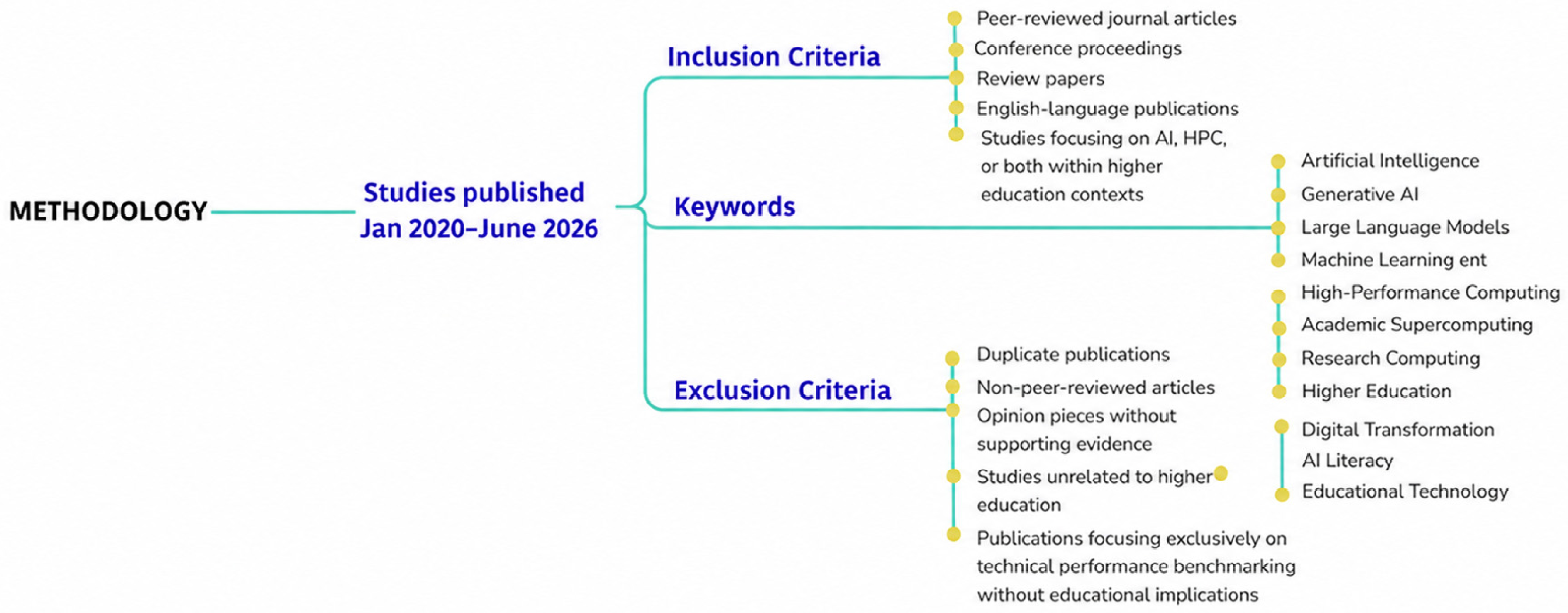
The overall methodology, including the inclusion criteria, exclusion criteria, and keywords used to identify relevant studies, is illustrated in Figure 1.
Figure 1.
Systematic literature review methodology showing the inclusion criteria, exclusion criteria, and keywords used in the study selection process.
The search strategy employed combinations of keywords including: Artificial Intelligence, Generative AI, Large Language Models, Machine Learning, and High-Performance Computing, with an emphasis on Academic Supercomputing and Research Computing. These domains are explored in the context of Higher Education, Digital Transformation, AI Literacy, and Educational Technology, highlighting the role of emerging technologies in advancing research, learning, innovation, and institutional transformation.
3.1. Literature Search and Study Selection
The literature search was conducted between May and June 2026 using multiple academic databases, including Scopus, Web of Science, IEEE Xplore, ACM Digital Library, SpringerLink, ScienceDirect, and Google Scholar. Boolean search operators (AND, OR) and combinations of keywords such as Artificial Intelligence, Generative AI, Large Language Models, Machine Learning, High-Performance Computing, Research Computing, Academic Supercomputing, Higher Education, Digital Transformation, and AI Literacy were used to identify relevant studies. The retrieved records were exported for screening, and duplicate entries were removed where applicable. Titles and abstracts were initially screened to exclude studies that were unrelated to higher education, Artificial Intelligence, or High-Performance Computing. The remaining articles underwent full-text assessment to determine their relevance to the objectives of this review. Studies meeting the predefined inclusion criteria were retained for qualitative synthesis. This systematic screening process improved the transparency and reproducibility of the review while ensuring that only relevant and high-quality literature was included. To ensure relevance to contemporary developments, the review focused primarily on studies published between January 2020 and June 2026. The inclusion criteria comprised peer-reviewed journal articles, conference proceedings, and review papers published in the English language. Studies were selected based on their relevance to Artificial Intelligence (AI), High-Performance Computing (HPC), or both within higher education contexts, with a focus on their applications, implications, and contributions to academic research, teaching, learning, and institutional transformation.
3.2. Quality Assessment of Included Studies
To enhance the methodological rigor of this systematic review, the included studies were subjected to a qualitative quality assessment. Rather than applying a numerical scoring system, each publication was evaluated using commonly adopted criteria for systematic literature reviews. The assessment considered publication type, relevance to the research objectives, methodological clarity, contribution to Artificial Intelligence (AI) and High-Performance Computing (HPC) in higher education, and overall academic credibility.
Priority was given to peer-reviewed journal articles, high-quality conference proceedings, review papers, and reports published by recognized international organizations. Studies lacking sufficient methodological detail or direct relevance to the scope of AI, HPC, and higher education were excluded during the screening process.
This quality assessment helped ensure that the final set of forty studies represented reliable, relevant, and academically credible sources for synthesizing current knowledge, identifying research gaps, and developing future research directions. The criteria used to assess the quality of the included studies are summarized in Table 1.
Table 1.
Quality Assessment Criteria.
4. Literature Review and Current State of Research
4.1. Evolution of Artificial Intelligence in Higher Education
The integration of Artificial Intelligence (AI) into higher education has evolved significantly over the past decade. Early applications of AI in educational settings primarily focused on learning analytics, intelligent tutoring systems, recommendation engines, and automated assessment tools. These technologies were designed to support student learning, improve educational outcomes, and assist educators in managing increasingly complex academic environments [8,14,15].
Recent advances in machine learning and natural language processing have accelerated AI adoption across universities worldwide. The emergence of generative AI systems has further transformed the educational landscape by enabling automated content generation, conversational learning support, coding assistance, and research augmentation. As a result, AI is increasingly viewed not merely as an educational technology but as a strategic driver of institutional transformation [7,16].
Although AI offers substantial educational and research benefits, concerns regarding academic integrity, transparency, privacy, bias, and governance remain significant. These challenges have prompted universities to develop policies and frameworks that encourage responsible and ethical AI adoption [17,18].
4.2. Generative Artificial Intelligence and Academic Transformation
The introduction of generative AI represents one of the most significant developments in contemporary higher education. Unlike traditional AI applications that primarily focused on prediction and classification tasks, generative AI systems can produce human-like text, code, images, and other forms of content. These capabilities have fundamentally altered how students, educators, and researchers interact with digital technologies [1,19].
Recent studies suggest that generative AI has become deeply integrated into academic workflows. Students frequently use AI tools for learning support, programming assistance, brainstorming, language translation, and assignment preparation. Faculty members increasingly explore AI-assisted teaching methods, content generation, and assessment strategies. Researchers employ generative AI for literature exploration, data analysis, manuscript drafting, and research planning [2,13].
The literature identifies several educational benefits associated with generative AI adoption. These include increased accessibility to educational resources, enhanced personalization of learning experiences, improved productivity, and expanded opportunities for independent learning. Generative AI also has the potential to support students with diverse learning needs through adaptive and interactive educational assistance [7,20]. However, concerns regarding plagiarism, authorship, misinformation, intellectual property, and academic integrity continue to generate debate within higher education communities. Researchers emphasize the need for clear institutional policies and responsible AI governance frameworks to ensure ethical and transparent use of generative technologies [9,10]. The growing body of literature demonstrates that generative AI is not merely a technological innovation but a catalyst for broader transformation within higher education. Its influence extends beyond teaching and learning to encompass research practices, institutional governance, and workforce development [21,22].
The major application areas of Artificial Intelligence within higher education institutions are represented in Table 2. The reviewed literature indicates that AI technologies are increasingly being utilized across teaching, assessment, research, student support, and administrative functions. Generative AI tools have further expanded the scope of AI applications by enabling automated content creation and research assistance.
Table 2.
Major application areas of Artificial Intelligence within higher education institutions.
4.3. AI Literacy and Workforce Readiness
Several frameworks have been proposed to define AI literacy within educational contexts. These frameworks generally emphasize understanding fundamental AI concepts, evaluating AI-generated outputs, applying AI tools effectively, and recognizing ethical considerations associated with automated systems. Researchers argue that AI literacy should be considered a foundational skill comparable to digital literacy and information literacy. Researchers further emphasize that AI literacy should include ethical awareness, critical thinking, and responsible technology use. Such competencies are essential for addressing challenges related to misinformation, algorithmic bias, privacy, and accountability. The growing influence of AI across industries has increased the importance of AI literacy within higher education. Institutions are therefore integrating AI-related competencies into curricula to prepare graduates for technology-driven workplaces while promoting responsible and informed use of AI systems [23].
4.4. Emergence of Research Computing and High-Performance Computing in Higher Education
While much of the literature focuses on AI applications in teaching and learning, a growing body of research highlights the importance of research computing and High-Performance Computing (HPC) as foundational enablers of AI-driven transformation [3,6]. Research computing refers to the integrated ecosystem of computational infrastructure, software platforms, technical expertise, and support services that facilitate advanced research activities. Universities increasingly establish dedicated research computing centers to support data-intensive research, machine learning, scientific simulations, and interdisciplinary collaborations [3,24]. The rapid growth of AI workloads has significantly increased demand for advanced computational resources. Modern AI models often require GPU acceleration, large-scale storage systems, high-speed networking, and sophisticated workload management platforms. Consequently, HPC infrastructure has become an essential component of contemporary research environments [4,25].
Studies examining academic HPC initiatives demonstrate that access to advanced computational resources enhances research productivity, supports workforce development, and promotes interdisciplinary collaboration. Universities equipped with GPU-accelerated clusters and research computing facilities are better positioned to participate in emerging AI research domains and attract external funding opportunities [3,6]. Research computing infrastructure also contributes to educational objectives by providing students with practical experience in advanced computational environments. Exposure to HPC platforms helps prepare graduates for careers in data science, artificial intelligence, scientific computing, and digital innovation [26,27]. The literature increasingly recognizes that AI adoption and HPC development are interconnected processes. As AI models continue to grow in complexity, the strategic importance of HPC infrastructure within higher education is expected to increase further [4,28].
4.5. Research Gap and Critical Synthesis
A review of the existing literature reveals substantial research on Artificial Intelligence (AI) in higher education, particularly in teaching and learning, generative AI, AI literacy, student engagement, academic integrity, and institutional transformation. These studies provide valuable insights into the educational opportunities and challenges associated with AI adoption. However, comparatively limited attention has been given to the computational infrastructure and research computing ecosystems required to support advanced AI applications at institutional scale. In particular, the role of High-Performance Computing (HPC), GPU-accelerated infrastructure, storage, networking, workload scheduling, and resource management remains less developed within higher-education-focused reviews.
The literature also tends to examine AI adoption from separate educational, technological, or policy perspectives. Although issues such as privacy, algorithmic bias, academic integrity, governance, and workforce development are increasingly recognized, fewer studies examine these considerations alongside the infrastructure, expertise, and institutional capabilities required for sustainable AI adoption. This separation creates a gap in understanding AI and HPC as interconnected components of university transformation. The present study addresses this gap by synthesizing AI adoption, HPC, research computing infrastructure, AI literacy, governance, and institutional transformation within a unified higher education framework. Rather than considering AI solely as an educational software capability, the review positions computational infrastructure as a foundational enabler of AI-driven teaching, research, innovation, and administration. It further examines the opportunities and challenges associated with this integration and considers emerging directions for future AI-enabled universities. The review therefore contributes an integrated perspective that connects AI technologies, computational infrastructure, institutional capabilities, and educational outcomes. This perspective highlights that successful AI adoption requires more than access to AI tools; it depends on appropriate HPC resources, skilled personnel, effective governance, responsible practices, and sustainable institutional planning. A comparison of previous AI-focused reviews with the broader integrated perspective adopted in this study is presented in Table 3.
Table 3.
Comparison of previous AI-focused reviews and the present review.
Overall, the synthesis indicates that AI and HPC should be considered complementary elements of higher-education transformation. Integrating computational infrastructure with educational, research, governance, and workforce perspectives provides a more comprehensive basis for understanding institutional AI readiness and future development.
5. Role of High-Performance Computing in Ai-Driven Higher Education
The rapid growth of Artificial Intelligence (AI) has significantly increased the computational requirements of academic research and education. As AI models and datasets become more complex, their effective deployment increasingly depends on advanced computing infrastructure. High-Performance Computing (HPC) has therefore emerged as a critical foundation for AI-driven innovation in higher education, evolving from a specialized resource for scientific simulation into a strategic institutional asset supporting machine learning, large language models, data analytics, and interdisciplinary research [4,29,30].
5.1. Computational Demands of Modern Artificial Intelligence
Contemporary AI systems require substantial computational resources for both training and deployment. Deep neural networks and large language models may contain millions or billions of parameters and require extensive processing, memory bandwidth, and storage capacity when trained on large datasets [25,31]. Conventional desktop and server environments may therefore be insufficient for large-scale AI workloads. HPC platforms provide scalable computing, high-performance storage, and high-speed networking that enable researchers to execute computationally intensive AI workloads efficiently [29,32,33,34].
5.2. GPU-Accelerated Computing and Academic Research
Graphics Processing Units (GPUs) have become central to modern AI computing because their highly parallel architecture can substantially accelerate model training and large-scale data processing [25,31]. Universities increasingly deploy GPU clusters, research computing centers, and dedicated AI infrastructure to provide researchers and students with access to capabilities that may be impractical through conventional computing environments [3,6]. GPU-accelerated HPC supports workloads ranging from deep learning, natural language processing and computer vision to genomics, climate modeling, drug discovery, computational science, and social-science analytics [4,24].
5.3. HPC Infrastructure Challenges in Higher Education
Despite its importance, deploying and operating AI-enabled HPC infrastructure presents significant challenges. Universities must manage the costs of GPU hardware, high-performance networking, storage, power, and cooling while also addressing ongoing maintenance and infrastructure lifecycle requirements. Effective operation further requires specialized expertise in systems administration, cybersecurity, networking, storage, workload scheduling, container technologies, and AI frameworks. Recruiting and retaining such skilled personnel can be particularly challenging for resource-constrained institutions [6,28].
5.4. HPC and the Future of AI-Enabled Universities
The future of AI-enabled higher education will increasingly depend on the integration of advanced computing infrastructure with institutional research and educational ecosystems. Emerging developments such as exascale computing, AI-native data centers, digital twins, federated learning, and autonomous research systems may further expand HPC capabilities across teaching, research, and institutional services. Strategic investment in AI-HPC infrastructure should therefore be viewed not simply as a technology upgrade, but as a foundation for research productivity, interdisciplinary collaboration, educational innovation, and institutional competitiveness [4,6].
6. Opportunities Created by Artificial Intelligence and High-Performance Computing in Higher Education
The integration of AI and HPC provides significant benefits for higher education institutions. AI-supported computational environments accelerate scientific discovery, improve teaching and learning experiences, strengthen interdisciplinary collaboration, and enhance workforce development. Universities can leverage these technologies to process large datasets, support advanced simulations, personalize learning experiences, and improve research productivity.
AI-HPC ecosystems also contribute to institutional competitiveness by enabling innovation, attracting research funding, supporting industry partnerships, and improving operational efficiency. As digital transformation continues, institutions with strong AI and HPC capabilities are better positioned to participate in emerging research domains and prepare graduates for technology-driven careers.
While AI and HPC technologies offer substantial benefits in teaching, learning, research, and innovation, institutions must simultaneously address technical, ethical, financial, and governance-related challenges to ensure responsible and sustainable implementation.
7. Challenges, Risks, and Ethical Considerations of Ai and HPC in Higher Education
While Artificial Intelligence (AI) and High-Performance Computing (HPC) offer significant opportunities for transforming higher education, their adoption introduces technical, ethical, organizational, and societal challenges. Universities must address these concerns through appropriate infrastructure, governance frameworks, ethical oversight, and long-term strategic planning.
7.1. Digital Divide and Unequal Access to Technology
One of the significant challenges associated with AI adoption is the digital divide among educational institutions. Advanced AI research increasingly depends on GPUs, large-scale storage, high-speed networking, and specialized software environments, which may be beyond the resources of smaller institutions, particularly in developing regions [11,12]. While leading research universities may have dedicated AI laboratories and supercomputing facilities, resource-constrained institutions can face limitations in research opportunities, educational quality, and workforce preparation [12,35]. Collaborative infrastructure models, national research networks, cloud services, and policy initiatives can help promote more equitable access to advanced computing resources [12,35].
7.2. Infrastructure Costs and Resource Sustainability
Deploying and maintaining HPC infrastructure requires substantial investment in GPU accelerators, high-performance storage, networking, power, cooling, maintenance, software, and technical personnel [6,29]. The rapid pace of technological advancement further complicates procurement and lifecycle planning, as hardware can become outdated relatively quickly. Universities must therefore balance computational requirements with financial and operational sustainability, making infrastructure cost an important barrier to large-scale AI adoption, particularly for institutions with limited resources [4].
7.3. Academic Integrity and Responsible Use of Generative AI
The emergence of generative AI has created significant concerns regarding academic integrity, originality, authorship, and assessment validity. Students increasingly use AI tools for writing, programming, literature summarization, and problem solving, challenging traditional methods of evaluating individual learning [1,10]. Universities therefore need clear policies defining acceptable AI use and may need to redesign assessment practices [9,18]. Beyond detection and enforcement, AI literacy, ethical guidelines, and transparent disclosure can encourage responsible use of AI as a learning and research aid rather than a substitute for genuine academic engagement [2,22].
7.4. Data Privacy and Security Concerns
AI systems increasingly process sensitive student, institutional, administrative, and research data, creating significant concerns related to privacy, confidentiality, and cybersecurity [9,35]. Universities must establish appropriate policies for data collection, storage, sharing, and usage while complying with applicable data protection requirements. Cloud-based AI services introduce additional concerns involving third-party access, data sovereignty, and cross-border data transfers. Consequently, institutions should conduct appropriate security and privacy assessments before adopting external AI platforms and computational services [17].
7.5. Algorithmic Bias and Fairness
AI systems trained on historical datasets may reproduce or amplify existing social, economic, or institutional biases [17,36]. In higher education, such biases can influence admissions, student evaluation, resource allocation, and academic support, potentially creating unfair outcomes and reducing trust in AI-enabled decision-making. Addressing these risks requires diverse and representative datasets, transparent model development, continuous monitoring, human oversight, and accountability mechanisms. Universities therefore have an important responsibility to evaluate both the technical performance and broader societal implications of algorithmic systems [12,18].
7.6. Workforce and Skills Gap
Effective implementation of AI and HPC requires specialized expertise in areas such as machine learning, data science, systems administration, cybersecurity, cloud computing, and research computing [28]. However, demand for these skills frequently exceeds supply, while competition with industry can make recruitment and retention difficult for academic institutions. Existing faculty and staff may also require continuous training to effectively use emerging technologies. Addressing this workforce gap requires professional development, interdisciplinary collaboration, skills-building initiatives, and institutional support for lifelong learning [37].
7.7. Energy Consumption and Environmental Sustainability
The increasing computational demands of AI and HPC have significant environmental implications, particularly because GPU-accelerated systems require substantial electricity and generate considerable heat [25,31]. Universities must therefore consider energy efficiency and sustainability throughout the infrastructure lifecycle, including equipment utilization, cooling, hardware replacement, and facility operations. Energy-aware workload scheduling, efficient resource utilization, renewable energy integration, and energy-efficient hardware and cooling technologies can help reduce the environmental impact of AI-HPC environments [6]. Sustainable computing should consequently become an integral component of long-term institutional AI and HPC planning.
8. Emerging Trends and Future Directions
The rapid evolution of Artificial Intelligence (AI) and High-Performance Computing (HPC) is expected to reshape higher education over the coming decade, influencing teaching, research, administration, and knowledge creation. As computational capabilities and AI systems become increasingly sophisticated, universities will need to adapt their infrastructure, governance, skills, and institutional strategies. The following six emerging trends are likely to significantly influence the future relationship between AI, HPC, and higher education.
8.1. The Rise of Agentic AI Systems
Generative AI is evolving toward Agentic AI systems capable of planning, reasoning, decision-making, and executing multi-step tasks with greater autonomy. In higher education, such systems could support literature reviews, research proposals, data analysis, report preparation, curriculum development, personalized mentoring, and administrative activities. By reducing routine workloads, agentic AI may allow academics to focus on higher-value activities. However, increased autonomy also creates challenges related to accountability, transparency, reliability, and human oversight, requiring appropriate institutional governance frameworks.
8.2. AI Research Assistants and Scientific Discovery
AI-powered research assistants are expected to support increasingly large portions of the scientific workflow, including literature analysis, identification of research gaps, hypothesis generation, experimental design, coding, data analysis, and manuscript preparation. Integrated with HPC infrastructure, these systems could enable researchers to explore larger datasets and more complex scientific problems while accelerating repetitive tasks. Rather than replacing researchers, AI is likely to augment human expertise and improve research productivity and knowledge creation [38].
8.3. AI-Native Universities
The AI-native university represents a model in which AI is embedded across teaching, research, student services, administration, and institutional planning. AI tutors could provide personalized learning and academic guidance, while faculty could use AI for curriculum development, assessment, and research collaboration. Administrative automation may further improve institutional efficiency. Realizing this model will require investment in computational infrastructure, digital literacy, governance, data management, and organizational change.
8.4. Sovereign AI and National Research Infrastructure
AI infrastructure is increasingly viewed as a strategic national asset. Investments in national AI supercomputers, research networks, and shared computational facilities can strengthen research capacity, workforce development, and technological competitiveness. Universities will play an important role by contributing research expertise, developing skilled talent, and providing access to advanced computational resources through national and institutional initiatives.
8.5. Sustainable and Green AI
The growing computational demands of AI and HPC make environmental sustainability an increasingly important consideration. Future infrastructure is likely to emphasize energy-efficient architectures, renewable energy integration, advanced cooling, carbon-aware scheduling, and resource optimization. Universities can contribute by adopting energy-conscious computing practices and incorporating sustainability considerations into AI research, infrastructure planning, and procurement.
8.6. Future Workforce Transformation
The future workforce will require AI literacy, computational thinking, ethical awareness, interdisciplinary collaboration, and adaptability. As AI automates routine activities, universities must increasingly emphasize human-AI collaboration, critical thinking, problem-solving, and lifelong learning. Preparing graduates for this transition will require curricula that combine technical competencies with domain knowledge and responsible use of AI technologies [39].
9. Illustrative Academic Ai-HPC Infrastructure Environment
To provide practical context, an illustrative academic AI-HPC environment is considered. The environment comprises five NVIDIA DGX systems, including DGX A100 and DGX B200 platforms, providing approximately forty GPUs to support more than two hundred students, researchers, and faculty members. Resource allocation and workload scheduling are managed through SLURM v23.02.7 and NVIDIA Run:AI v2.26, enabling efficient GPU utilization and multi-user access [40].
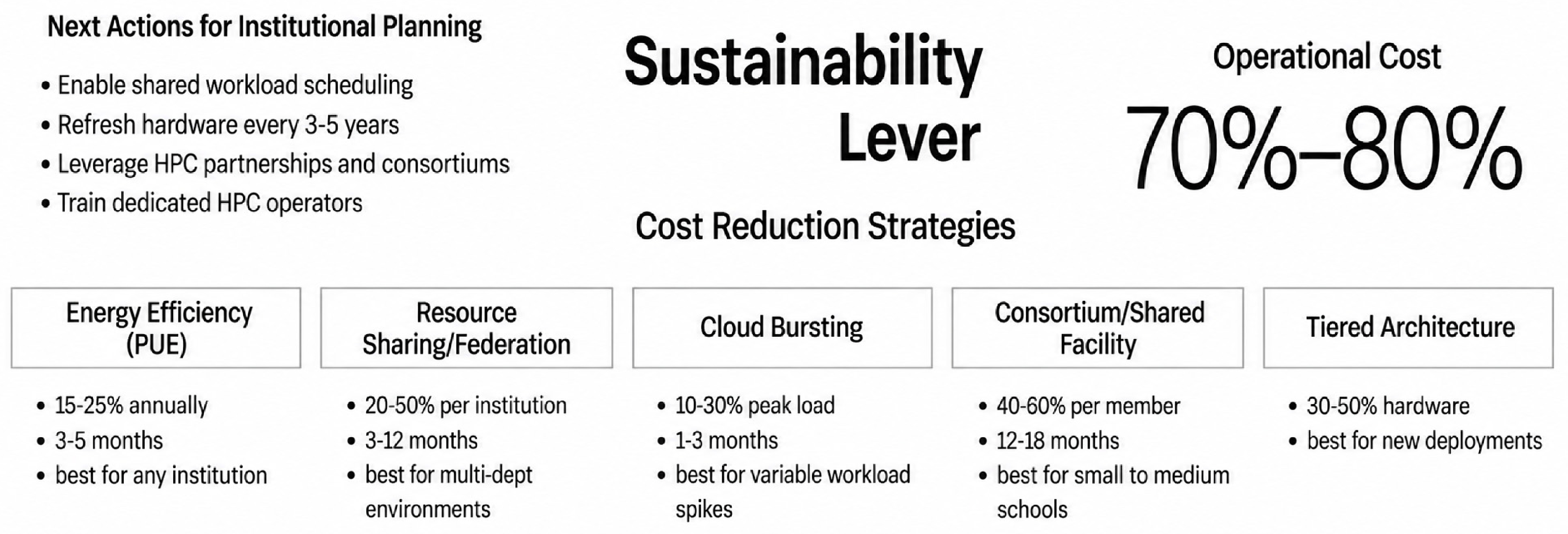
The infrastructure supports diverse workloads, including deep learning, large language models (LLMs), computer vision, natural language processing (NLP), scientific simulations, and interdisciplinary research projects. Operational experience highlights several challenges commonly identified in the literature, including increasing demand for GPU resources, user training and support requirements, infrastructure scalability, storage management, cybersecurity, and long-term sustainability. Figure 2 illustrates potential cost-reduction and sustainability strategies that institutions can consider when planning and operating AI-HPC infrastructure.
Figure 2.
Approaches to reducing total cost of ownership (TCO) and environmental impact in AI-HPC infrastructure.
This example demonstrates that successful institutional AI adoption requires more than software tools and computational resources. It depends on appropriate infrastructure, effective governance mechanisms, skilled technical expertise, research computing support, and sustained institutional investment. The case therefore reinforces the strategic role of HPC infrastructure as a foundational enabler of AI-driven research and education.
10. Findings & Discussion: Academic HPC Infrastructure as a Strategic Enabler of AI Adoption in Higher Education
The findings of this review indicate that while Artificial Intelligence has become a major driver of transformation within higher education, its successful adoption is closely linked to the availability of advanced computational infrastructure. AI applications continue to grow in complexity, requiring substantial computational resources for model development, data processing, simulation, and deployment. Consequently, High-Performance Computing (HPC) infrastructure has emerged as a strategic enabler of AI-driven education, research, and innovation.
Although cloud-based services have expanded access to computational resources, many universities continue to invest in dedicated research computing environments to support growing demands from students, faculty members, and research groups. The increasing adoption of GPU-accelerated computing platforms reflects the recognition that modern AI research cannot be effectively supported by conventional computing systems alone.
10.1. Institutional Challenges and Lessons Learned
Despite the benefits associated with HPC adoption, institutions face numerous operational challenges. Infrastructure planning, resource allocation, user training, cybersecurity, storage management, and sustainability considerations all require continuous attention.
The growing popularity of AI has resulted in increased demand for GPU resources across many universities. Managing this demand effectively requires clear governance policies, efficient scheduling mechanisms, and ongoing user education. Another important lesson emerging from institutional experiences is the need for AI literacy beyond technical disciplines. Researchers and students from diverse academic backgrounds increasingly seek access to AI tools and computational resources. Supporting these users requires training programs, documentation, workshops, and collaborative support structures.
Consequently, successful AI-HPC ecosystems depend not only on hardware investments but also on the development of human expertise and institutional support mechanisms.
10.2. Strategic Implications for University Leadership
University leaders increasingly recognize AI and HPC as critical components of long-term institutional strategy. Investments in computational infrastructure influence research productivity, educational quality, industry partnerships, funding opportunities, and institutional reputation.
The findings of this review suggest that universities should consider several strategic priorities:
- Develop long-term AI and HPC investment roadmaps.
- Promote interdisciplinary access to computational resources.
- Expand AI literacy and workforce development initiatives.
- Establish governance frameworks for responsible AI use.
- Invest in sustainable and energy-efficient computing practices.
- Strengthen collaborations with industry and national research networks.
Such initiatives can enhance institutional competitiveness while ensuring that technological advancements contribute positively to educational and societal objectives.
11. Recommendations and Future Research
The findings of this review indicate that effective AI and High-Performance Computing (HPC) adoption in higher education requires coordinated technological, educational, organizational, and governance strategies. Universities should develop long-term AI-HPC infrastructure plans, expand AI literacy and professional development, improve access to shared computational resources, and align technology investments with institutional research and educational priorities. Infrastructure planning should also incorporate scalability, sustainability, cybersecurity, and workforce requirements to support long-term institutional readiness.
Responsible AI governance should be integrated into these strategies rather than treated as a separate activity. Universities should establish adaptable frameworks addressing academic integrity, data privacy, transparency, fairness, accountability, and appropriate human oversight. Such frameworks should support innovation while ensuring that AI systems are used ethically and responsibly. Collaboration among universities, faculty, students, research computing centers, policymakers, governments, and industry is essential for developing effective and inclusive AI-HPC ecosystems. Table 4 summarizes strategic recommendations for these key stakeholders.
Table 4.
Strategic Recommendations for Key Stakeholders.
Several areas warrant further investigation. Future research should examine how AI literacy and human-AI collaboration influence student learning, critical thinking, employability, research productivity, and lifelong learning across different disciplines. Greater attention is also needed to equity and accessibility, particularly the effects of unequal access to AI and HPC resources across institutions, regions, and socioeconomic groups. Sustainable AI-HPC models represent another important research direction, including energy-efficient architectures, energy-aware scheduling, renewable energy integration, and environmentally responsible infrastructure lifecycle management.
Further studies should evaluate the effectiveness of institutional AI governance frameworks and compare regulatory and policy approaches across countries and higher-education systems. Finally, the concept of the AI-enabled or AI-native university requires empirical investigation. Longitudinal studies could examine how AI-HPC integration influences educational outcomes, institutional effectiveness, research capabilities, workforce development, and organizational transformation over time. These directions can help move the field from conceptual discussion toward evidence-based models for responsible, equitable, and sustainable AI-enabled higher education.
12. Limitations
This review is subject to several limitations. First, the literature search primarily focused on English-language publications published between 2020 and 2026 and may therefore exclude relevant studies published in other languages or outside the selected timeframe. Although efforts were made to identify relevant studies across multiple academic sources, the review relied substantially on literature obtained through Google Scholar and widely accessible scholarly repositories.
Second, the review synthesizes findings from published literature and does not include primary empirical data collected directly from multiple higher education institutions. Consequently, the conclusions presented are dependent upon the quality, scope, and methodological approaches of the reviewed studies.
Third, the field of Artificial Intelligence is evolving rapidly. New technologies, governance frameworks, educational applications, and computational infrastructures continue to emerge at a pace that may outdate some observations presented in this review. Future developments in Generative AI, Agentic AI, High-Performance Computing, and educational technologies may influence the relevance of current findings.
Fourth, while an illustrative academic AI-HPC infrastructure environment was discussed to provide practical context, the case does not represent all higher education institutions. Universities differ significantly in terms of infrastructure capacity, funding models, institutional priorities, governance frameworks, and levels of AI adoption.
Finally, the review primarily focuses on opportunities, challenges, and future trends associated with AI and HPC in higher education and does not perform a quantitative meta-analysis of outcomes. Future studies may address these limitations through broader database coverage, longitudinal investigations, multi-institutional surveys, comparative international analyses, and empirical assessments of AI-HPC adoption across diverse educational environments.
13. Conclusions
Artificial Intelligence and High-Performance Computing are increasingly becoming interconnected components of the computational architecture of modern higher education. This systematic review demonstrates that AI is no longer limited to specialized research environments but increasingly influences teaching, research, administration, student services, and institutional planning. At the same time, HPC has evolved from a specialized scientific-computing resource into a foundational infrastructure supporting the computational requirements of machine learning, generative AI, large language models, data analytics, simulation, and interdisciplinary research.
The reviewed literature demonstrates that the value of AI in higher education depends substantially on the computational infrastructure available to support it. GPU-accelerated systems, high-performance storage, high-speed networking, workload scheduling, distributed computing, research-computing services, and technical expertise increasingly form the underlying infrastructure through which advanced AI workloads can be developed and deployed. Consequently, AI adoption should be understood as an end-to-end systems problem, rather than simply as the acquisition of AI software or access to commercial AI platforms [14].
The integration of AI and HPC creates substantial opportunities for higher education. These include accelerated scientific discovery, large-scale data processing, advanced simulation, enhanced learning experiences, research assistance, interdisciplinary collaboration, institutional automation, and workforce development. Universities with appropriate computational environments are better positioned to participate in emerging AI research domains, support increasingly complex workloads, provide practical computing experiences, and develop the technical capabilities required for technology-intensive research and education.
However, the development of AI-HPC ecosystems also creates significant technical, organizational, financial, and societal challenges. High infrastructure costs, GPU availability, storage and networking requirements, cybersecurity, workforce shortages, energy consumption, data privacy, algorithmic bias, governance, and unequal access can limit institutional adoption. Resource-constrained universities may consequently face disadvantages not only in access to AI tools but also in their ability to develop, evaluate, and support advanced AI systems. Addressing these inequalities requires shared infrastructure models, research networks, cloud and national computing initiatives, institutional collaboration, and strategic investment.
An important conclusion emerging from the review is that AI readiness is fundamentally dependent on computational readiness. As AI models and datasets continue to increase in scale and complexity, universities will require computing environments capable of supporting training, inference, experimentation, data processing, and deployment. This requirement makes research computing and HPC strategic institutional capabilities rather than optional technical services. It also increases the importance of systems administration, cybersecurity, storage management, workload scheduling, container technologies, AI frameworks, and technical support.
The review therefore proposes a systems perspective in which the AI-enabled university is understood as an integrated ecosystem comprising AI applications, computational infrastructure, research computing, data resources, human expertise, governance mechanisms, and institutional strategy. Within this ecosystem, improvements in one layer can create dependencies or constraints in others. For example, expanding AI applications without corresponding GPU capacity can create resource bottlenecks; increasing computational capacity without appropriate governance can introduce security and privacy risks; and investing in infrastructure without developing technical expertise can reduce effective utilization. Sustainable AI transformation consequently requires coordination across the complete system.
The illustrative academic AI-HPC environment examined in the study reinforces this systems perspective. GPU clusters, workload scheduling, multi-user resource allocation, research-computing support, storage, cybersecurity, and sustainability must operate together to support diverse AI workloads. The example demonstrates that successful AI-HPC deployment depends not only on hardware acquisition but also on operational management, technical expertise, governance, user training, and long-term infrastructure planning.
Future higher education computing environments are likely to incorporate increasingly sophisticated architectures, including AI-native data centers, exascale computing, federated learning, digital twins, agentic AI, energy-aware scheduling, and shared national research infrastructure. These developments will further strengthen the relationship between AI capability and computational infrastructure. At the same time, the emergence of AI-native universities will require institutions to reconsider how computing resources, data, expertise, governance, and educational programs are organized.
Ultimately, the transition toward AI-enabled higher education should not be understood as a transition from conventional software to AI software. It represents a transition toward AI-centric computational ecosystems in which infrastructure, algorithms, data, users, governance, and institutional capabilities must operate together. The findings of this systematic review suggest that universities seeking sustainable AI transformation should therefore invest simultaneously in computational infrastructure, research-computing services, AI literacy, technical workforce development, responsible governance, equitable resource access, and energy-efficient computing. Such a systems-oriented approach provides a stronger foundation for developing AI-enabled universities that are computationally capable, academically productive, responsible, inclusive, and sustainable.
Author Contributions
Conceptualization, A.I.; methodology, A.I.; software, A.I.; validation, A.I., S.G., Y.R.B. and R.R.B.; formal analysis, A.I.; investigation, A.I., S.G. and Y.R.B.; resources, A.I. and S.G.; data curation, A.I.; writing—original draft preparation, A.I.; writing—review and editing, A.I., S.G., Y.R.B. and R.R.B.; visualization, A.I.; supervision, A.I.; project administration, A.I.; funding acquisition, not applicable. All authors have read and agreed to the published version of the manuscript.
Funding
This research received no external funding.
Institutional Review Board Statement
Not applicable.
Informed Consent Statement
Not applicable.
Data Availability Statement
The data presented in this study are available upon request from the corresponding author.
Conflicts of Interest
The authors declare no conflict of interest.
References
- Kasneci, E.; Sessler, K.; Küchemann, S.; Bannert, M.; Dementieva, D.; Fischer, F.; Gasser, U.; Groh, G.; Günnemann, S.; Hüllermeier, E.; et al. ChatGPT for good? On opportunities and challenges of large language models for education. Learn. Individ. Differ. 2023, 103, 102274. [Google Scholar] [CrossRef] [Scilit]
- Grassini, S. Shaping the future of education: Exploring the potential and consequences of AI and ChatGPT in educational settings. Educ. Sci. 2023, 13, 692. [Google Scholar] [CrossRef] [Scilit]
- Towns, J.; Cockerill, T.; Dahan, M.; Foster, I.; Gaither, K.; Grimshaw, A.; Hazlewood, V.; Lathrop, S.; Lifka, D.; Peterson, G.D.; et al. XSEDE: Accelerating scientific discovery. Comput. Sci. Eng. 2014, 16, 62–74. [Google Scholar] [CrossRef] [Scilit]
- Deelman, E.; Dongarra, J.; Hendrickson, B.; Randles, A.; Reed, D.; Seidel, E.; Yelick, K. High-performance computing at a crossroads. Science 2025, 387, 829–831. [Google Scholar] [CrossRef] [Scilit]
- Atkins, D.E.; Droegemeier, K.K.; Feldman, S.I.; Garcia-Molina, H.; Klein, M.L.; Messerschmitt, D.G.; Messina, P.; Ostriker, J.P.; Wright, M.H. Revolutionizing Science and Engineering Through Cyberinfrastructure; National Science Foundation: Alexandria, VA, USA, 2003.
- National Academies of Sciences, Engineering, and Medicine. Future Directions for NSF Advanced Computing Infrastructure to Support U.S. Science and Engineering; National Academies Press: Washington, DC, USA, 2020. [Google Scholar]
- Crompton, H.; Burke, D. Artificial intelligence in higher education: The state of the field. Int. J. Educ. Technol. High. Educ. 2023, 20, 22. [Google Scholar] [CrossRef] [Scilit]
- Zawacki-Richter, O.; Marín, V.I.; Bond, M.; Gouverneur, F. Systematic review of research on artificial intelligence applications in higher education. Int. J. Educ. Technol. High. Educ. 2019, 16, 39. [Google Scholar] [CrossRef] [Scilit]
- UNESCO. Guidance for Generative AI in Education and Research; UNESCO Publishing: Paris, France, 2023. [Google Scholar]
- Cotton, D.R.E.; Cotton, P.A.; Shipway, J.R. Chatting and cheating? Ensuring academic integrity in the era of ChatGPT. Innov. Educ. Teach. Int. 2023, 60, 756–768. [Google Scholar] [CrossRef] [Scilit]
- OECD. Artificial Intelligence, Digital Transformation and Education; OECD Publishing: Paris, France, 2021. [Google Scholar]
- UNESCO. AI and Education: Guidance for Policymakers; UNESCO Publishing: Paris, France, 2021. [Google Scholar]
- Dwivedi, Y.K.; Kshetri, N.; Hughes, L.; Slade, E.L.; Jeyaraj, A.; Kar, A.K.; Baabdullah, A.M.; Koohang, A.; Raghavan, V.; Ahuja, M.; et al. So what if ChatGPT wrote it? Multidisciplinary perspectives on opportunities, challenges and implications of generative conversational AI for research, practice and policy. Int. J. Inf. Manag. 2023, 71, 102642. [Google Scholar] [CrossRef] [Scilit]
- Luckin, R.; Holmes, W.; Griffiths, M.; Forcier, L.B. Intelligence Unleashed: An Argument for AI in Education; Pearson Education: London, UK, 2016. [Google Scholar]
- Holmes, W.; Bialik, M.; Fadel, C. Artificial Intelligence in Education: Promises and Implications for Teaching and Learning; Center for Curriculum Redesign: Boston, MA, USA, 2019. [Google Scholar]
- Bozkurt, A.; Karadeniz, A.; Baneres, D.; Guerrero-Roldán, A.E.; Rodríguez, M.E. Artificial intelligence and reflections from educational landscape: A review of AI studies in half a century. Sustainability 2021, 13, 800. [Google Scholar] [CrossRef] [Scilit]
- Akgun, S.; Greenhow, C. Artificial intelligence in education: Addressing ethical challenges in K-12 settings. AI Ethics 2022, 2, 431–440. [Google Scholar] [CrossRef] [Scilit]
- Chan, C.K.Y. A comprehensive AI policy education framework for university teaching and learning. Int. J. Educ. Technol. High. Educ. 2023, 20, 38. [Google Scholar] [CrossRef] [Scilit]
- Tlili, A.; Shehata, B.; Adarkwah, M.A.; Bozkurt, A.; Hickey, D.T.; Huang, R.; Agyemang, B. What if the devil is my guardian angel? ChatGPT as a case study of using chatbots in education. Smart Learn. Environ. 2023, 10, 15. [Google Scholar] [CrossRef] [Scilit]
- Kohnke, L.; Moorhouse, B.L.; Zou, D. ChatGPT for language teaching and learning. RELC J. 2023, 54, 537–550. [Google Scholar] [CrossRef] [Scilit]
- Bearman, M.; Ryan, J.; Ajjawi, R. Discourses of artificial intelligence in higher education: A critical literature review. High. Educ. 2023, 86, 369–385. [Google Scholar] [CrossRef] [Scilit]
- Mhlanga, D. Open AI in education: The responsible and ethical use of ChatGPT towards lifelong learning. In FinTech and Artificial Intelligence for Sustainable Development; Springer Nature: Cham, Switzerland, 2023; pp. 387–409. [Google Scholar] [CrossRef] [Scilit]
- Long, D.; Magerko, B. What is AI literacy? Competencies and design considerations. In Proceedings of the 2020 CHI Conference on Human Factors in Computing Systems; Association for Computing Machinery: New York, NY, USA, 2020; pp. 1–16. [Google Scholar]
- Chard, K.; Foster, I.; Tuecke, S. Globus: Research data management as service and platform. In Proceedings of the Practice and Experience in Advanced Research Computing 2017 on Sustainability, Success and Impact (PEARC ’17); Association for Computing Machinery: New York, NY, USA, 2017; pp. 1–5. [Google Scholar] [CrossRef] [Scilit]
- NVIDIA. NVIDIA DGX Systems Architecture and AI Infrastructure Guide; NVIDIA Corporation: Santa Clara, CA, USA, 2024. [Google Scholar]
- Ponce, M.; Spence, E.; van Zon, R.; Gruner, D. Scientific computing, high-performance computing and data science in higher education. J. Comput. Sci. Educ. 2019, 10, 24–31. [Google Scholar] [CrossRef] [Scilit]
- Terboven, C.; Miller, J.; Wienke, S.; Müller, M.S. Self-paced learning in HPC lab courses. J. Comput. Sci. Educ. 2020, 11, 61–67. [Google Scholar] [CrossRef] [Scilit]
- Rüde, U.; Willcox, K.; McInnes, L.C.; De Sterck, H. Research and education in computational science and engineering. SIAM Rev. 2018, 60, 707–754. [Google Scholar] [CrossRef] [Scilit]
- Dongarra, J.; Beckman, P.; Moore, T.; Aerts, P.; Aloisio, G.; Andre, J.C.; Barkai, D.; Choi, Y.; Fox, G.; Gropp, W.; et al. The international exascale software project roadmap. Int. J. High Perform. Comput. Appl. 2011, 25, 3–60. [Google Scholar] [CrossRef] [Scilit]
- Fox, G.C. From computational science to Internetics: Integration of science with computer science. Math. Comput. Simul. 2000, 54, 295–306. [Google Scholar] [CrossRef] [Scilit]
- OpenAI. GPT-4 Technical Report; OpenAI: San Francisco, CA, USA, 2023. [Google Scholar]
- Sterling, T.; Anderson, M.; Brodowicz, M. High Performance Computing: Modern Systems and Practices; Morgan Kaufmann: San Francisco, CA, USA, 2017. [Google Scholar]
- Hager, G.; Wellein, G. Introduction to High Performance Computing for Scientists and Engineers; CRC Press: Boca Raton, FL, USA, 2010. [Google Scholar]
- Eijkhout, V. Introduction to High Performance Scientific Computing; Lulu Press: Durham, NC, USA, 2016. [Google Scholar]
- European Commission. Digital Education Action Plan 2021–2027: Resetting Education and Training for the Digital Age; European Commission: Brussels, Belgium, 2021. [Google Scholar]
- Williamson, B.; Eynon, R. Historical threads, missing links and future directions in AI in education. Learn. Media Technol. 2020, 45, 223–235. [Google Scholar] [CrossRef] [Scilit]
- World Economic Forum. The Future of Jobs Report 2023; World Economic Forum: Geneva, Switzerland, 2023. [Google Scholar]
- Selwyn, N. Should Robots Replace Teachers? AI and the Future of Education; Polity Press: Cambridge, UK, 2019. [Google Scholar]
- Ng, D.T.K.; Leung, J.K.L.; Chu, S.K.W.; Qiao, M.S. Conceptualizing AI literacy: An exploratory review. Comput. Educ. Artif. Intell. 2021, 2, 100041. [Google Scholar] [CrossRef] [Scilit]
- NVIDIA. NVIDIA Run: AI Platform for AI Workload Orchestration; NVIDIA Corporation: Santa Clara, CA, USA, 2024. [Google Scholar]

Disclaimer/Publisher’s Note: The statements, opinions and data contained in all publications are solely those of the individual author(s) and contributor(s) and not of MDPI and/or the editor(s). MDPI and/or the editor(s) disclaim responsibility for any injury to people or property resulting from any ideas, methods, instructions or products referred to in the content. |
© 2026 by the authors. Licensee MDPI, Basel, Switzerland. This article is an open access article distributed under the terms and conditions of the Creative Commons Attribution (CC BY) license.