


Abstract
The increasing integration of artificial intelligence (AI), machine learning (ML), natural language processing (NLP), big data analytics, and automated decision-support systems into environmental, social, and governance (ESG) reporting is transforming how sustainability information is collected, analyzed, generated, and communicated. While these technologies can improve reporting efficiency, predictive analytics, real-time monitoring, and data processing, they also create new risks when AI-generated disclosures appear credible while containing incomplete, unsupported, or misleading sustainability information. This paper examines this emerging phenomenon as Greenwashing 2.0, focusing on the role of AI-enabled ESG reporting systems in creating new challenges for verification, traceability, attribution, and regulatory accountability. The study employs a doctrinal and comparative legal methodology supported by analysis of AI technologies, ESG reporting processes, regulatory frameworks, enforcement actions, and documented corporate cases across multiple jurisdictions. The paper conceptualizes AI-enabled ESG reporting through three stages: digitization and automation, analysis and diagnosis, and agentic and predictive ESG. Building on this analysis, it proposes an AI-Enabled ESG Reporting Governance Framework that connects AI system characteristics with data provenance, human verification, auditability, disclosure accountability, whistleblower mechanisms, and regulatory oversight. The analysis demonstrates that existing ESG disclosure frameworks remain substantially oriented toward human-authored reporting and do not adequately address the distributed responsibility created when AI systems generate, transform, or evaluate sustainability information. The paper argues that effective governance of Greenwashing 2.0 requires system-level transparency, traceable data and generation processes, human oversight, AI-specific accountability mechanisms, and risk-calibrated enforcement. The proposed framework provides a basis for integrating Computer Science perspectives on AI-enabled reporting systems with ESG and disclosure regulation.
1. Introduction
When green claims are no longer written entirely by humans, the question is no longer only whether they are accurate, but also how the underlying AI-enabled reporting system produces, transforms, and communicates those claims as well as who is accountable when the resulting disclosures are misleading. Environmental, social, and governance (ESG) reporting has become an important information system through which organizations communicate ESG performance to regulators, investors, and other stakeholders [1]. In this paper, the focus is specifically on the regulatory and disclosure dimensions of ESG reporting.
ESG reports transform organizational sustainability data, including emissions, workforce information, governance indicators, and other performance measures, into structured quantitative and narrative disclosures that can be evaluated, compared, and audited. The increasing use of artificial intelligence (AI), including natural language processing (NLP), machine learning, large language models (LLMs), and big-data analytics, changes this reporting process from a predominantly human-authored activity into an increasingly computational process. AI can collect, process, analyse, predict, and generate ESG information, thereby creating new opportunities for efficiency and standardization but also new risks concerning transparency, traceability, and accountability [2].
AI is increasingly used as an enabler of sustainability and governance activities through automation, predictive analytics, real-time monitoring, and data-driven decision-making. The combination of AI and Internet of Things (IoT) technologies can support continuous environmental monitoring, while big-data analytics can process large and heterogeneous sustainability datasets. At the same time, the use of AI introduces technical and institutional concerns involving model transparency, trust, ethical oversight, and the reliability of generated information [3].
AI-enabled ESG reporting can therefore be understood as a progression from automated data processing toward increasingly sophisticated analytical and generative capabilities. In the first stage, AI systems automate the collection and processing of sustainability information from diverse sources. In subsequent stages, machine learning and LLM-based systems can analyse ESG data, identify inconsistencies, assess compliance risks, benchmark organizational performance, and increasingly generate disclosure content.
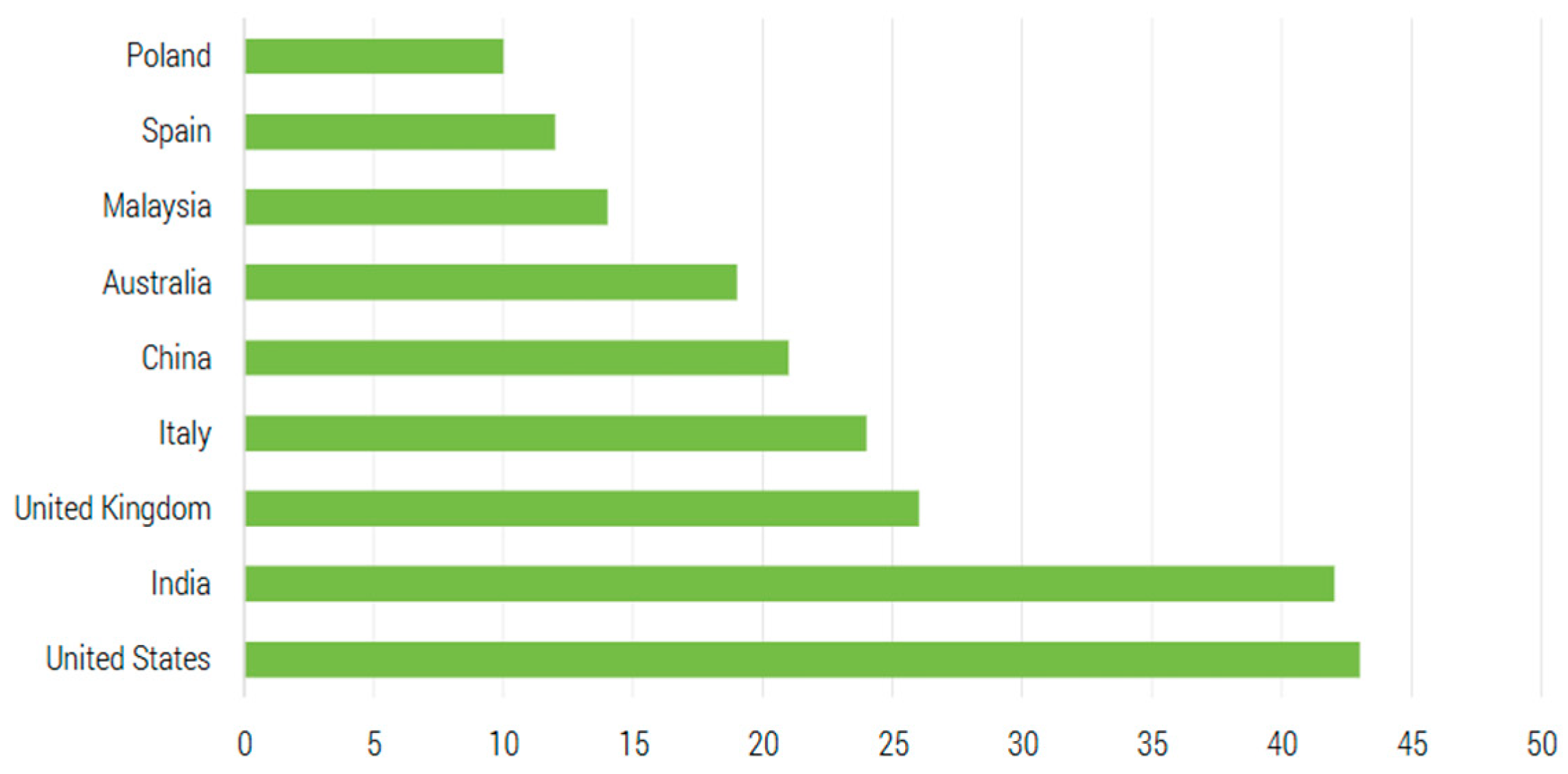
The bibliometric distribution shown in Figure 1 [2] illustrates the geographical development of research on AI-enabled sustainability reporting. The concentration of publications across countries such as the United States, Australia, and the United Kingdom reflects strong institutional and regulatory interest in AI-supported ESG reporting, while contributions from emerging economies demonstrate the expanding global relevance of this research area. India, China, Malaysia, and several European countries also demonstrate significant engagement with AI-enabled sustainability research. [2] The geographical distribution therefore provides an indication that AI-enabled ESG reporting is developing as an interdisciplinary research area involving computational technologies, sustainability information, and regulatory governance.
Figure 1.
Number of publications per country.
The use of AI in ESG reporting can be further understood through three broad technological phases: digitisation and automation, analysis and diagnosis, and agentic and predictive ESG. In Phase 1, AI primarily functions as an administrative assistant, using NLP and related technologies to process structured and unstructured documents and automate data-entry activities. In Phase 2, machine learning and early LLM applications enable AI to act as an analytical assistant capable of identifying inconsistencies, assessing compliance risks, and benchmarking ESG performance. Phase 3 represents the emerging agentic and predictive stage, in which AI systems can perform more autonomous activities such as supply-chain monitoring, regulatory-compliant disclosure generation, and climate-risk simulation [4].
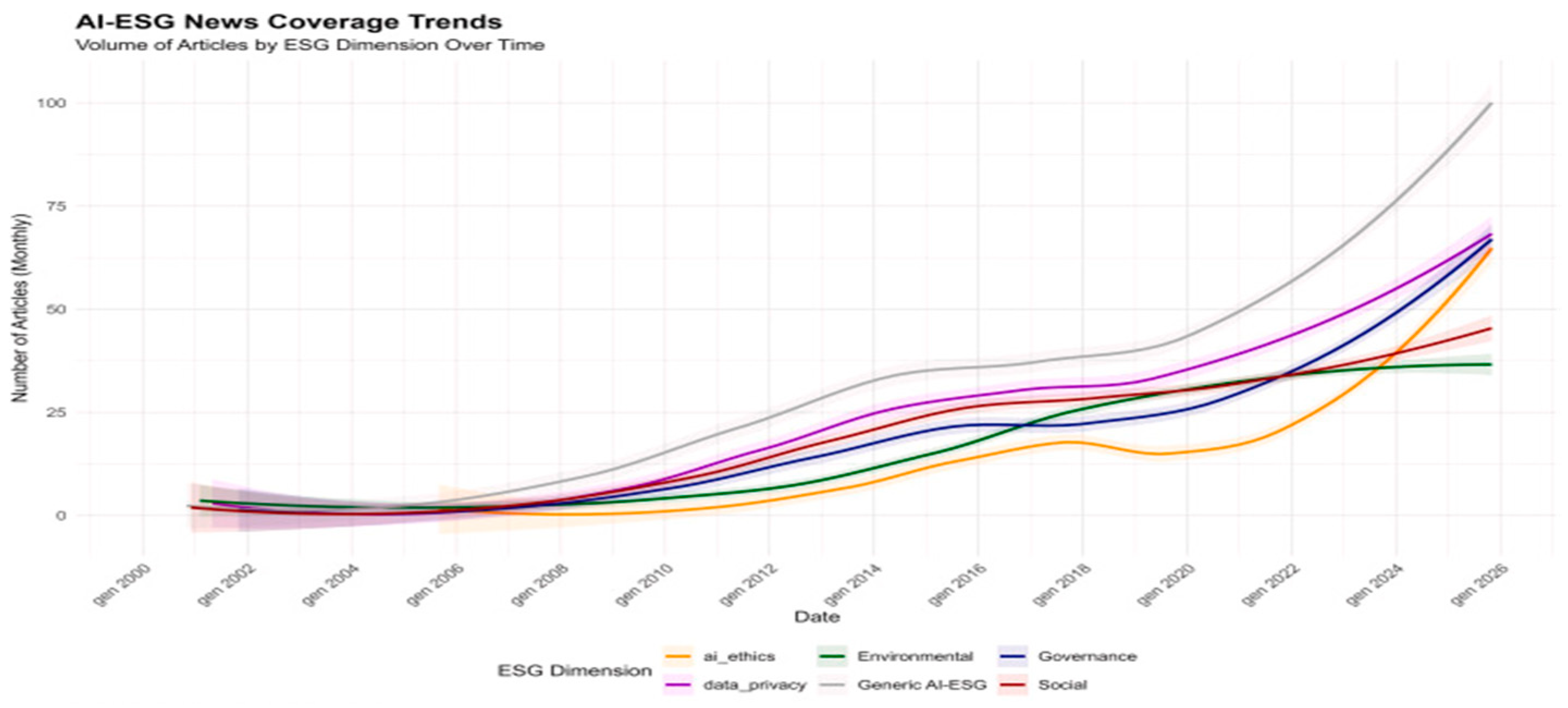
Figure 2 [5] illustrates the growing visibility of AI in ESG-related discourse and provides contextual support for understanding the transition toward AI-enabled ESG reporting. As AI moves from an administrative and analytical tool toward a more autonomous and disclosure-generating system, its role in ESG reporting becomes increasingly significant for regulatory governance.
Figure 2.
AI-ESG News Coverage Trends.
This technological progression gives rise to what this paper terms “Greenwashing 2.0” Traditional greenwashing, referred to here as Greenwashing 1.0, involves organizations making ambiguous, exaggerated, or unverifiable environmental claims to improve their public image. Greenwashing 2.0 represents a more complex information and regulatory problem in which AI-enabled systems can generate, transform, or reproduce ESG disclosures that appear credible while concealing material weaknesses or unsupported claims. Rather than merely misleading consumers through marketing communication, Greenwashing 2.0 can affect investors and regulators through formal sustainability disclosures and compliance-related information [6].
The central issue is therefore not simply whether an ESG statement is false, but whether existing regulatory and accountability mechanisms can identify how an AI-enabled reporting system produced the statement, what data and computational processes contributed to it, and which human or organizational actors can be held responsible. AI-generated ESG reporting introduces a system-level accountability problem because the final disclosure may result from interactions among organizational data, AI models, reporting platforms, automated processing, and human review.
1.1. Statement of the Problem
Multiple legal frameworks govern ESG reporting, and the credibility and admissibility of ESG disclosures are subject to existing disclosure and assurance regimes. However, the increasing use of AI in preparing such reports creates new technical and regulatory anomalies that existing frameworks do not adequately address.
The problem is particularly significant where AI systems operate as computational intermediaries between underlying ESG data and the final disclosure. A system may produce a report that appears compliant with established reporting requirements while obscuring the provenance of individual claims, the assumptions used by the model, or the computational processes through which the final narrative was generated.
1.2. Research Methodology
This paper employs a doctrinal and comparative legal methodology, conducting a cross-jurisdictional analysis of statutory frameworks, regulatory instruments, enforcement actions, and the academic literature to identify the doctrinal gaps that AI-generated ESG reporting exposes in existing disclosure law.
The paper therefore treats AI-enabled ESG reporting not merely as a legal issue but as a socio-technical system problem, where computational processes, data provenance, model behaviour, human oversight, and regulatory accountability interact.
1.3. Research Gaps
Existing legal frameworks are primarily premised on human intent and individual accountability in ESG disclosures. However, the “black box” characteristics of AI systems create difficulties when material misstatements emerge from computational processes whose operation may not be fully transparent [3,7].
As organizations increasingly rely on common AI- and LLM-based reporting platforms mapped to frameworks such as CSRD or GRI, ESG reports may also become highly similar or template-driven, potentially obscuring organization-specific risks.
A further challenge concerns auditability. Traditional audit processes depend on traceable evidence and an audit trail. AI-enabled reporting systems may transform or generate information through multiple computational stages, making it difficult to reconstruct how a particular disclosure was produced.
Existing whistleblower frameworks also largely assume human-led fraud. AI-generated greenwashing creates an additional challenge because individuals may have difficulty identifying whether a misleading disclosure resulted from intentional human manipulation, erroneous data, model behaviour, or the interaction of several components within an AI-enabled reporting system.
These issues reveal a broader research gap concerning the traceability, explainability, verification, and accountability of AI-enabled ESG reporting systems.
1.4. Research Objectives
The study therefore aims to analyse how generative AI and related computational technologies are used in ESG reporting and why AI-generated reports can appear compliant while being substantively inaccurate; compare major ESG disclosure frameworks; and examine how existing enforcement cases would be complicated by AI-mediated authorship and disclosure generation.
1.5. Hypothesis
The paper hypothesizes that existing ESG reporting frameworks, because they are primarily designed around human-authored disclosures, contain structural gaps in recognizing and regulating AI-generated greenwashing. Without appropriate mechanisms for tracing AI-enabled reporting processes and assigning accountability across the relevant human, organizational, and technological actors, existing frameworks may be unable to effectively detect and regulate Greenwashing 2.0.
2. Advantages and Challenges for Greenwashing
In the world we live in, being green makes money flow easily in the market. Today’s consumers are very much worried about the environment, and businesses have recognised this. For example, when you enter a supermarket, you will notice that almost all products claim to be eco-friendly, made with 100 per cent natural ingredients, biodegradable, or carbon-neutral. How many of those claims are actually true? Very few. This practice, commonly known as greenwashing, is widely followed by companies. “Greenwashing is generally the practice of overstating or falsely presenting the environmental benefits or sustainable nature of a certain good, service, or business” [4]. Greenwashing is a kind of marketing strategy that deliberately misleads consumers by convincing them that the goods or services they consume are more environmentally friendly than they usually are. Greenwashing has become one of the most important global issues. Since the beginning of the 1970s, advertisers have made immense profits by advertising environmental concerns. The strategy attempts to make use of people’s awareness with respect to the environment by emphasising environmentally friendly goods, services, and businesses. Today, a significant number of consumers prefer environmentally friendly products, which generates substantial revenue for firms. Examples of greenwashing: “They can range from placing a leaf logo onto a product that is not at all environmentally friendly to using vague terminology in marketing communications without providing any evidence of it being true (for instance, “eco-friendly” or “all natural”) [4]. They can include pictures of lush forests or pristine rivers in advertising communications promoting items that damage the environment in many ways. They can include statements which, while being true, are irrelevant to the advertised item.
2.1. Advantages
2.1.1. Automation
ESG reporting is automated through AI since this technology can gather, analyse, and organise all the data related to sustainability and compile it into ESG reports. The use of this approach saves a lot of time for employees as they do not have to spend their time collecting, verifying, and writing down information for ESG reporting purposes. Therefore, the use of AI for ESG reporting helps save a lot of money. Time and cost savings can be achieved through automation of repetitive processes in reporting without compromising the quality of the reports generated. Consequently, it becomes cheaper for organisations to conduct ESG reporting.
2.1.2. It Improves Brand Image and Market Positioning
The process of greenwashing allows firms to build a picture that they are environmentally friendly. This results in an improved brand image for the company, increasing customer loyalty and market positioning. Increased usage of artificial intelligence (AI) has even enhanced the advantages, as it is possible for AI systems to develop reports that demonstrate sustainability, advertisements that target eco-friendly customers, and statements about the environment to portray the business as being environmentally friendly. By utilising AI technology to communicate these statements on a mass scale, firms can gain a competitive edge. Through greenwashing, firms manage to benefit from these advantages without having to implement any expensive strategies [2].
2.1.3. It Assists Companies in Attracting ESG Investment
ESG investing is arguably one of the quickest-growing trends in today’s global financial system. “As investors start to allocate their capital to those firms that can show evidence of being environmentally friendly and sustainable, greenwashing makes it possible for organisations to portray themselves as meeting the criteria for ESG investment without changing their operations. Despite that, the immediate benefit of using greenwashing in this case is the possibility of gaining more investors and securing financing at reduced rates”. In recent times, technology has played a key role in increasing such activities. This is particularly true for the development of artificial intelligence, which makes it possible for businesses to develop sophisticated sustainability reports, assess ESG data, and make convincing environmental discourses even when the truth is quite the opposite. Through such technology, many organisations have become able to obtain financial benefits in different ways [2].
2.1.4. Improves Real-Time Monitoring and Predictive Analytics
The use of artificial intelligence in sustainability and ESG reporting enhances real-time tracking and predictive analytics capabilities. “With the help of sensors, IoT, and advanced analytical tools, AI makes it possible to monitor ESG parameters, which include but are not limited to energy consumption, emissions, waste management, water consumption, and safety in the workplace” [2]. At the same time, using historical and current data, AI can predict future outcomes concerning sustainability, which includes climate change risks, carbon emissions, supply chain disruptions, and compliance issues. Such an approach makes it possible for companies to become aware of inefficiencies, anticipate risks, and address emerging problems. Thus, it becomes easier to accomplish sustainable goals effectively.
2.2. Challenges
2.2.1. Algorithm Bias
The challenge in using AI for assessing the ESG criteria could be “algorithmic bias”. “Algorithmic bias refers to an AI model being biased due to the existence of biases in society that have made their way into the training data. AI systems are based on previous information, which can carry certain biases or erroneous assumptions, resulting in biased results”. For example, a company gives only the positive data of the company, like the products made in the company are eco-friendly, but it does not give the negative data of the company, like how much pollution the company causes and how much damage it is causing to the environment. This kind of data can cause bias in the market.
2.2.2. Absence of Transparency, Accountability, and Data Privacy
ESG reporting using AI technology can become a “black box”, where it is hard to understand the decision-making process and identify the responsible party. Furthermore, ESG reporting using AI technology uses confidential data about companies and finance, posing the risk of data leakage and hacking.
2.2.3. Greenwashing
One challenge is greenwashing, which refers to presenting a business in a way that suggests it is more eco-friendly or socially responsible than it really is. It creates an illusion that a company is greener than it actually is. The use of AI technologies might involve misuse through the concept of “AI-driven greenwashing”, meaning that they produce sustainable information or adjust ESG performance results without actually implementing any sustainability measures. If ESG data collection and assessment are performed by AI independently of any human or third-party involvement, the process might inadvertently produce misleading claims.
2.2.4. Affecting Human Critical Thinking, Which Leads to Unemployment
Over-reliance on technology may impair human reasoning and critical thinking, ultimately leading to decisions that fail to account for the broader business environment. AI-generated ESG reports may replace human roles, leading to job losses and unemployment.
2.2.5. Absence of Standardised Regulations and Guidelines
Currently, there is no common standardised set of regulations regarding the use of AI in ESG reporting. Although various countries have formulated their own regulations on AI and ESG reporting, these regulations are not adequately integrated. As a result, standards, criteria, and indicators for measuring ESG performance vary by country, making it challenging to maintain consistency and transparency [8].
2.2.6. Problem Faced by Small and Medium-Sized Enterprises and Startups
Small and medium-sized enterprises face challenges because of the high cost of AI implementation. The integration of AI technology in the ESG reports is an investment that may not be possible for under-resourced companies. For startups, the struggle is greater as they are in their early stage of development and do not have enough financial backing, lack financial stability and expertise, and do not have the resources required to deploy an advanced AI system. Therefore, the expenses related to AI-driven ESG tools might become a prohibitive factor for small companies that will not be able to assess, monitor, and report on their environmental, social, and governance issues. Thus, ESG standards and practices might differ between large companies and smaller market participants.
2.2.7. It Enables Companies to Compete Against Truly Sustainable Ones
Greenwashing is also characterised by the fact that it causes an imbalance among companies competing against each other. Real sustainable companies put effort and money into reducing the level of greenhouse gases, using sustainable materials, optimising the production process, and obtaining environmental certification from third parties. Such actions can be costly and even impact pricing strategies. On the other hand, greenwashing companies do not have to spend any money on such activities but still appear to be sustainable companies. Consequently, people can confuse both types of companies when it comes to making purchases, which leads to an unfair playing field where greenwashing companies enjoy a cost advantage over their competitors.
3. Liability: Audit, Whistleblower, and Financial Risks
Liability is a central issue in the governance of AI-generated ESG disclosures, as inaccurate sustainability reporting can cause significant legal, financial, and reputational harm. The increasing use of generative AI and large language models in ESG reporting has complicated the attribution of responsibility for misleading disclosures. Existing legal and regulatory frameworks across jurisdictions remain fragmented and often fail to clearly define accountability for AI-related ESG misstatements. This chapter examines auditor liability, whistleblower protection, enforcement penalties, and civil liability gaps arising from AI-assisted sustainability reporting.
3.1. Audit Liability
Whilst the external auditor has long been the first-line defence against inaccurately stated corporate information, the use of Generative AI and large language models in preparing ESG reports is a threat to this position. Algorithmic systems tend to be multi-layered and distributed, meaning auditors can offer little meaningful assurance on the completeness of AI-generated ESG disclosures, as there are no standards for global liability.
3.2. Auditor Liability Worldwide
Auditor liability for misstatements is far from consistent, and, especially, many jurisdictions must determine how to apply that standard to ESG-related disclosures made by AI. In Germany, Spain, Bulgaria, Slovenia, Serbia, and Montenegro [9], a study shows that audit practitioners generally lack the specialised skills to conduct audits focused on AI-generated content and remain rooted in the traditional auditing standards and frameworks built without AI, which poses questions regarding determining the responsibility for AI-generated content that does not align with the standards of traditional auditing practices.
3.2.1. European Union
The CSRD [10] also mandates sustainability disclosure under the European Sustainability Reporting Standards, and the EU AI Act prescribes transparency requirements for AI systems. An important point is that many of the ESG scoring products are powered by low-transparency algorithms. Unfortunately, there is still a loophole for algorithmic disclosures: ISAE 3000 was not specifically designed to handle algorithmic disclosures, and the CSRD [10] and the AI Act do not place any auditor liability for a failure to detect algorithmic greenwashing.
3.2.2. United Kingdom
The Anti-Greenwashing Rule (2024) [11] by the FCA requires sustainability communications to be clear, fair, and not misleading. The Economic Crime and Corporate Transparency Act 2023 [12] creates the failure to prevent fraud” offence, an approach which, if it is enacted as intended, will be the first way for AI-generated ‘fraud liability’ (though in practice, nothing yet appears to have been prosecuted under the legislation). In SEC v. Vale S.A. [13], the court upheld the possibility that ESG misrepresentations can be considered securities fraud, and the SEC Climate Disclosure Rule 2024 effectively requires public corporations to disclose information about climate change. Additionally, the phenomenon sometimes referred to as AI-washing has increasingly been a focus of the SEC’s Cyber and Emerging Technologies Unit (CETU) in recent years. However, traditional fraud doctrine, which focuses on intent to make a misleading disclosure, is increasingly being challenged where AI systems may make a misleading disclosure without human involvement.
3.2.3. Australia and Non-Enforced Jurisdictions
ASIC [14], since 2023, has had several greenwashing actions under the Corporations Act (s 1041H) and the Australian Consumer Law. However, unlike the other examples above, most of these actions have targeted corporations, not auditors, who are exposed indirectly through negligence claims or disciplinary processes.
3.2.4. India
India has a limited legal framework governing auditors’ liability for AI-generated ESG disclosures; regulatory instruments indirectly address the accuracy, verification, and accountability of sustainability reporting. One significant among these is the Business Responsibility and Sustainability Reporting (BRSR) legal regime introduced by the Securities and Exchange Board of India in 2021 [15] for the top 1000 listed companies and further strengthened through the BRSR Core framework in 2023. It requires companies to disclose detailed information on greenhouse gas emissions, energy consumption, supply chain sustainability, and governance practices. Whereas in 2023, reforms added assurance requirements for ESG indicators, it signals SEBI’s effort to make sustainability disclosures more reliable and easier to compare; these requirements were drafted assuming conventional reporting processes and do not specifically address where ESG reports and sustainability claims are generated using artificial intelligence. Consequently, auditors must verify disclosed information, and it remains their responsibility to assess the integrity of the AI system, training data, and generation tools used in preparing ESG reports. There are additional measures to address greenwashing through the 2024 Guidelines for Prevention and Regulation of Greenwashing, issued by the CCPA Greenwashing Guidelines (2024), and the environmental claims guidelines, which were issued by the CCPA Greenwashing Guidelines (2024). These frameworks ask for environmental claims such as “green”, “eco-friendly”, and “sustainable” to be backed by clear and verifiable evidence; the whole point is to cut down on misleading sustainability representations, which is the key. Moreover, the RBI’s climate risk circular (2023) [16] provides climate-risk guidance that encourages financial institutions to fold climate-related risks into governance and disclosure practices. However, none of these frameworks specifically regulate the use of artificial intelligence in ESG reporting, leaving room for AI-generated sustainability disclosures to include only certain bits of information, without the necessary scrutiny.
3.2.5. China
The ESG disclosure requirements from the Shanghai Stock Exchange and the Shenzhen Stock Exchange emphasise data-driven environmental reporting and regulatory access to underlying sustainability information, thereby reducing auditor opportunities for unsupported environmental claims [17].
3.2.6. Japan
Sustainability disclosure duties, linked to the Tokyo Stock Exchange Corporate Governance Code and climate-related disclosure recommendations, emphasise corporate accountability, transparency and human (i.e., audit) oversight of ESG disclosures, which reduces the risks associated with automated sustainability reporting. There is a deficiency in an investigative procedure for accountability in AI-generated ESG reporting, and neither country has a legislated body to hold auditors accountable.
3.3. Jurisdictional Gap
There is considerable variation across jurisdictions for auditor liability regarding AI-produced environmental, social, and governance (ESG) data. Together, the EU CSRD [10] and EU AI Act offer the best foundation for accountability moving forward, and the U.K. is likely to expand this accountability with anti-greenwashing and corporate-fraud changes. Corporate wrongdoings and a crackdown are the focus in the U.S. and in Australia, although a loophole might lead auditors to be indirectly dragged into liability. There is no coherent framework to define the limits of the auditor’s responsibilities when it comes to AI in sustainability reporting, with India, China, Japan and Singapore not having developed assurance concepts or enforcement agency requirements specific to AI. In the context of sustainability reporting, despite the increasing uptake of AI, no assurance concepts or stringent enforcement environment have been developed to hold the auditor responsible for AI in sustainability reporting.
3.4. The AI Attribution Problem
Attribution is the central issue of liability regimes in the age of AI. If a “black-box” algorithm makes a material misstatement, blaming a legal regulatory agency can be close to impossible. As with any human-made mistake, there is no clear chain of causation, nor can liability be placed on the developer, who would not have had any control over the training data. The risk of liability becomes very real when no specific individual is named as a ‘breacher of duty’ for fines [18], shutdowns, or even criminal conviction if the risk of failing to comply is so great. Current auditing requirements, such as the International Standards on Auditing, were not formulated to attest to the human side of outputs and are inadequate on their own for attesting to the inner workings of an AI system.
3.5. Whistleblower Liability
Whistleblower protection is linked to corporate ESG disclosure requirements and their enforcement. However, if audit assurance does not uncover any AI-generated sustainability claims, whistleblowers, who often have insider access to internal data, are another channel that can raise red flags on AI-generated greenwashing.
3.5.1. United States
In the U.S., whistleblowing protection is offered via the SEC Whistleblower Program under the Dodd-Frank Act §922 (2010), which offers monetary awards to whistleblowers whose information contributes to the successful prosecution of an SEC enforcement action, as well as bans retaliation by the employer, while greenwashing and ESG-related fraud are subject to the same protection regime. Additionally, Sarbanes-Oxley §806 [19] protects whistleblowing disclosures made within regulatory filings involving ESG disclosures derived through AI [20].
3.5.2. European Union
The EU Directive (EU) 2019 puts greater emphasis on internal reporting mechanisms, consequences for failing to report, or a reversed burden of proof in favour of the reporting person. These safeguards are even more relevant if the disclosure might be misleading due to it being AI-generated. The CSRD [10] and the proposed Green Claims Regulation do not provide a specific reporting mechanism for AI-generated greenwashing; therefore, its detection rests on the same basis as under the 2019 framework.
3.5.3. India
Whistleblower protection is being safeguarded mainly by the vigil mechanism under the Companies Act §177(9) [21] and SEBI (LODR) Regulations, 2015 [22], wherein certain companies need to have a reporting mechanism under Audit Committee oversight, which could prove to be a valuable parameter for the dissemination of AI-generated misinformation to bypass the internal audit. Currently, no Indian framework specifically addresses AI-generated greenwashing, and the extant regime in India the Whistleblowers Protection Act, 2014 is restricted to the public sector.
3.6. ESG-Specific Whistleblowing: Landmark Cases
3.6.1. Fixler v. DWS Group and Deutsche Bank
The Desiree Fixler case highlights the central issue in the controversy: whether the DWS Group and its reporting systems could identify and correct misleading ESG disclosures. This alleged misconduct came to light through whistleblower disclosures, rather than internal controls, which exposed weaknesses. Here, there was no final judicial or regulatory investigation by the U.S. Securities and Exchange Commission (SEC), which validated the concerns raised by Fixler. In 2023, DWS entered into a settlement with the SEC for the SEC’s charges and the significant fines incurred for its ESG disclosure deficiencies. The regulatory decision set a precedent that sustainability-related statements can be material disclosures that mislead investors if they cannot be backed by verifiable internal practices.
In the context of whistleblower liability, the controversy in this case is that even when using the traditional human approach to disclosure, ESG disclosures could receive regulatory close attention until a whistleblower uncovered them. With the increasing use of artificial intelligence in ESG reporting, this risk becomes even greater. AI can create complex sustainability reports that may sound like they meet disclosure standards, making misinformation harder to identify. In the context of a reporting system driven by AI, the DWS case highlights the importance of stronger whistleblower protections. Insiders at companies who have access to internal data and AI-driven reporting tools could potentially be in a position to seek gaps between reported and real company ESG initiatives and performance.
3.6.2. SEC v. Goldman Sachs Asset Management, 2022 [13]
The principal issue before the SEC was whether Goldman Sachs Asset Management had failed to implement and follow the ESG policies and procedures that it represented to its investors. Although certain funds were marketed as incorporating ESG considerations, regulatory investigations identified deficiencies in ESG review processes and compliance controls. The secondary issue is whether the firm’s governance was sufficient to ensure that ESG-related disclosures were reflected in actual investment practices. It mainly focuses on the gap between policy promises and operational reality, relevant to the Greenwashing 2.0 allegations. In 2022, the SEC determined that Goldman Sachs Asset Management had violated various policies and procedures in connection with ESG investment reviews and had not maintained compliance controls regarding ESG investment practices. Consequently, Goldman Sachs entered into a settlement with the SEC for the charges and a civil penalty of USD $4 million. The court passed the judgment, and important regulations related to ESG are regulated in the same way as other financial representations: requiring accuracy, consistency, and substantiation. The SEC also noted that companies should not simply communicate about their ESG commitments in their advertisements and instead asked them to put them into a part of actual investment decision-making. The case was not the same as the DWS-Fixler case in terms of whistleblowing, but it did further emphasise that a lack of internal control can allow for false sustainability claims to continue until they are discovered by a regulatory review or through other internal reporting systems. As artificial intelligence becomes increasingly involved in preparing ESG reports, the Goldman Sachs enforcement action supports the argument that disclosure laws must evolve beyond reviewing final reports. There should be transparency in using AI for ESG reporting, third-party verification of ESG data, compliance procedures and systems, and clear accountability for false AI-supported ESG disclosures that outsmart conventional regulatory oversight and confuse investors in sustainable finance.
3.6.3. The Deutsche Telekom Case
The Deutsche Telekom case involves the application of AI in ESG reporting under the CSRD and ESRS frameworks. The main issue was whether AI-assisted analysis could be used for assessing and reporting sustainability information while maintaining accuracy, transparency, and accountability. Deutsche Telekom used an AI-based trend analysis as part of its double-materiality assessment to identify future sustainability matters and also disclosed certain figures generated with AI support. The company did not rely on AI independently; the information was subjected to further validation and the reporting process remained subject to internal controls and external assurance. The corporate conclusion was that AI can assist ESG reporting but cannot replace human responsibility for the accuracy of the final disclosure [23].
3.6.4. Deloitte SustainNext™ [24]: AI-Assisted ESG Reporting and the Risk of Greenwashing 2.0
The emerging risks associated with AI-assisted ESG reporting are illustrated by Deloitte’s SustainNext™ platform and the subsequent controversy surrounding its AI-assisted Australian Government report. The principal issue is whether the use of generative AI in ESG reporting can ensure reliable, consistent, and verifiable disclosures while complying with reporting frameworks such as ISSB, ESRS, and CSRD. Deloitte’s SustainNext™ uses AI to analyze ESG disclosures, identify reporting gaps, and assist in preparing draft sustainability reports, but the process requires human review and validation. This further raises the question of who should be responsible when AI-generated information is misleading or contains errors. The concern was demonstrated by Deloitte’s Australian Government report, where AI-assisted drafting resulted in invented references, incorrect citations and a statement erroneously attributed to a Federal Court judgment. The matter therefore highlights the risks of AI-generated errors, inadequate verification and lack of source traceability in professional reporting. This case is not a judicial proceeding and, therefore, has no court judgment. Deloitte acknowledged the use of generative AI during the drafting process and agreed to refund part of the AUD 440,000 consultancy fee, while the Australian Government issued a corrected version of the report. The incident demonstrates, from a corporate and professional accountability perspective, that the use of AI does not exempt the responsible professional from responsibility for the reliability of the final report. Applied to ESG reporting, SustainNext™ demonstrates the potential of AI to improve reporting efficiency, while the Australian incident demonstrates the necessity of human verification, factual validation, and proper documentation of the information used in the ESG report.
3.6.5. Tata Consultancy Services Limited (TCS)–Tata Motors Prakriti: AI-Enabled ESG Reporting and Corporate Accountability
The TCS–Tata Motors Prakriti raises whether adopting AI-enabled systems for ESG reporting can ensure the accuracy and transparency of corporate sustainability disclosures, particularly when information is collected from multiple manufacturing facilities, suppliers, and other value-chain participants. It also raises the question of responsibility attribution: incomplete information is processed through an automated system and incorporated into the company’s ESG disclosures. The reporting entity, management, data providers, technology developers, and service providers all share responsibility, which is not always clear because of third-party data. Moreover, the case concerns proper human supervision, verification, and transparency in preparing technology-assisted ESG disclosures [25].
This is a corporate technology arrangement, and not a judicial proceeding, and therefore has no formal judicial judgment. The five-year collaboration will leverage TCS’s Intelligent Urban Exchange (IUX) technology to enable Tata Motors’ Prakriti platform for digitising ESG data and monitoring and reporting sustainability. The arrangement demonstrates how advanced technology can improve the collection, processing, and reporting of ESG information. However, reliance upon an automated system does not, by itself, absolve the reporting entity or its responsible management from ensuring the validity of disclosures made to investors, regulators, and other stakeholders. The case does not constitute a finding of greenwashing; rather, it exposes an emerging issue of legal accountability where inaccurate ESG disclosures may result from defective data and a lack of proper verification. Consequently, the case provides a useful basis for examining “Greenwashing 2.0”, specifically the adequacy of existing corporate and disclosure frameworks in responsibility for misleading ESG information generated or processed through technology.
3.7. Specific Doctrinal Gaps
Existing whistleblowing regimes do not specifically recognize disclosure of algorithmic or AI system-level misrepresentation of ESG practices, which are organised around individual disclosures, statements, and filings. Technical and confidentiality obstacles may also make reporting algorithmic greenwashing difficult, as it may require a deeper understanding of model inputs and/or system architecture than conventional financial misconduct. Cross-border AI-assisted ESG reporting adds to the uncertainty: which jurisdictions would govern the whistleblower regime and protections when disclosures are prepared, processed, or stored in more than one jurisdiction?
3.8. Financial Risk and Enforcement Penalties: Price of Greenwashing Escalates
Today, most regulators have started acting against Old School Greenwashing” via substantial monetary fines. However, their efforts are reactive and largely targeted at traditional misrepresentations, which are inadequate against the volume and velocity of misrepresentations driven by artificial intelligence. Systemic risk may arise because inaccurate ESG disclosures can proliferate across ESG reporting ecosystems. Sustainability disclosures play an increasing role in influencing investment allocation, green bonds, and ESG ratings, and AI-generated misleading narratives can lead to misinformed investment decisions.
3.9. Landmark Enforcement Actions and Quantum of Penalties
In recent years, high-profile enforcement actions have illustrated the regulatory crackdown on misleading ESG claims. Germany penalised DWS with a €25 million fine [26], and the SEC imposed a USD 19 million penalty in the United States for its misleading claims about its integration of environmental, social, and governance (ESG) principles. Volkswagen’s “Dieselgate” is the archetypal case of environmental deception; the penalties to date total USD 34 billion for using “defeat devices” to manipulate emissions numbers [27]. Shein was fined €1 million in Italy and €40 million in France for its actions in environmental marketing, and ASIC obtained a landmark judgment against Vanguard Investments [28] where misleading assertions about environmental, social, and governance (ESG) screening on a benchmark index fund were found by the Federal Court. Despite this increased enforcement, existing regimes are under-equipped for the novel challenges raised by reporting based on AI-generated ESG data.
3.10. A Penalty Framework in the Context of Jurisdictional Divergence
One major issue in the governance of transnational ESG is the different regulatory systems. New sustainability, competition, and digital governance regimes on the horizon in the EU offer the option of proportionate sanctions, with penalties of up to 10% of global turnover. Common-law countries, such as the U.S., U.K., India, and Australia, use fixed penalties and settlements rather than reference to specific ordinances for the specific context of generative AI and are subject to fines of up to 10% of global turnover under the Digital Markets, Competition and Consumers Act 2024 [29], as established under the U.K. CAP [30]. Penalties may be too paltry for the multinationals to be deterred, given that they make more money than the sanctions. China both enforces and has strong compliance power. Its disclosure program is still in its upswing, but its focus on disclosure is making strides [31]. Such misalignment opens the door for regulatory arbitrage, and relatively small fines would be ineffective in discouraging the risk choices made pertaining to reporting with the assistance of AI.
3.11. Litigation Risk and Investor Redress: Gap in Civil Liability Regimes
Even as regulatory fines are increasing, AI-driven greenwashing leaves investors without the structural development of civil liability regimes available to provide investors with a right to redress. As generative AI becomes increasingly prevalent in disclosure preparation and verification, attribution becomes a complex issue for directors, compliance and internal audit staff, AI vendors, developers, and assurance providers. The new disclosure requirements apply as companies continue to rely on generative AI, but no civil liability regime exists for such misuse. Although U.S. securities law provides more nuanced mechanisms for redress, ESG-misrepresentation claims face significant evidentiary hurdles. The U.K., Australia, the Indian subcontinent, and China each have distinct, though still evolving, approaches to address the issue, and without clear liability standards, investors in these jurisdictions are left without remedy.
4. Recommendations
- Anti-greenwashing governance must be based on context and the circumstances of the case in which it is applied rather than uniform rules and procedures [32]. In asset-heavy industries, authorities should go beyond disclosures and verify physical asset flows and the technologies used [33]. In consumer sectors, transparent product-level environmental claims are needed, and proper traceability standards are required to determine the accuracy of the ESG claims. NLP-based detection and big data analytics tools are digital enforcement tools that are used to identify and flag sophisticated greenwashing.
- Standard eco-friendly and green claims, including EU eco-labels, are insufficient to build strong consumer trust across diverse markets. Labelling products as eco-friendly or sustainable, or making green claims, is useless when credibility depends on transparency, authenticity, and the legitimacy of sourcing and production. To anchor credibility, companies need consistent product quality, narratives of locals using the products, validated authenticity, and formal labels. Policies should be designed so consumers interpret sustainability signals better, rather than imposing stricter labelling rules [34,35]
- AI tools like NLP and ML raise three governance concerns that need careful, structured attention in ESG disclosure. Algorithmic bias can lead to distortion in ESG scoring and greenwashing detection. Black-box models undermine regulatory legitimacy and explainability, and when AI contributes to the disclosure and drafting structure in ESG reporting, accountability for errors cannot be transferred from humans to automated systems; in such cases, human oversight remains and should remain non-negotiable. It is recommended that governance frameworks be built and enhanced to ensure transparency, auditability, fairness, and accountability before AI-assisted ESG reporting is scaled across regions.
5. Conclusions
This paper examined how the increasing integration of artificial intelligence into ESG reporting is transforming sustainability disclosure from a predominantly human-authored process into an increasingly automated and AI-mediated information system. The analysis demonstrates that AI can provide significant benefits through automation, predictive analytics, real-time monitoring, large-scale data processing, NLP, machine learning, and generative reporting. At the same time, these capabilities create a new class of risks in which sustainability disclosures may appear credible and compliant while being incomplete, unsupported, difficult to trace, or misleading. The paper conceptualizes this emerging phenomenon as Greenwashing 2.0.
The central finding is that Greenwashing 2.0 cannot be understood solely as a conventional greenwashing problem with AI added to the process. AI changes the architecture through which ESG information is collected, processed, analyzed, transformed, and communicated. As AI systems progress from digitization and automation to analysis and diagnosis and increasingly toward agentic and predictive ESG functions, the computational system itself becomes an increasingly important component of the reporting process. Accountability must therefore extend beyond the final report to the data, models, algorithms, generation processes, interfaces, verification mechanisms, and human oversight structures underlying that report.
The analysis also identifies a fundamental AI attribution problem. Responsibility for an AI-generated ESG disclosure may be distributed across corporate management, reporting teams, auditors, data providers, AI vendors, system developers, and automated reporting platforms. When a black-box or complex AI system produces a material misstatement, conventional approaches based on identifiable human authorship may not adequately explain how the error occurred or who possessed the capacity to prevent it. Existing auditing and disclosure mechanisms consequently face difficulties when the information-generation process cannot be sufficiently reconstructed or verified.
The comparative analysis demonstrates that ESG disclosure and AI governance regimes remain fragmented. The EU, U.K., U.S., India, China, and Japan have developed various mechanisms addressing sustainability reporting, greenwashing, corporate accountability, AI transparency, and disclosure requirements. However, these regulatory systems have generally developed in parallel rather than as an integrated governance architecture for AI-enabled ESG reporting. The result is a regulatory gap in which existing rules may regulate the final disclosure without adequately addressing the computational processes through which that disclosure was generated.
The principal contribution of this paper is the proposed AI-Enabled ESG Reporting Governance Framework. The framework connects the technical characteristics of AI-enabled reporting systems with six governance dimensions: data provenance, algorithmic transparency, system auditability, human verification, responsibility attribution, and regulatory enforcement. These dimensions provide a systems-oriented basis for examining Greenwashing 2.0 and for identifying where controls should be introduced throughout the AI-enabled ESG reporting lifecycle.
Data provenance is essential because ESG claims must remain traceable to reliable underlying evidence. Algorithmic transparency is necessary to provide visibility into how AI systems transform, classify, score, or generate sustainability information. System auditability is required to reconstruct the computational pathway through which a disclosure was produced. Human verification remains necessary because AI-generated outputs cannot independently establish the truth of the sustainability claims they communicate. Responsibility attribution ensures that the use of AI does not create an accountability vacuum among corporations, auditors, technology providers, and other actors. Finally, regulatory enforcement must be sufficiently adaptive to address the scale, speed, and cross-border characteristics of AI-enabled reporting.
The documented cases examined in this paper further support the importance of these system-level controls. The DWS and Goldman Sachs cases demonstrate the importance of internal controls and substantiation of ESG claims. The Deloitte incident demonstrates the risks associated with AI-generated errors, inaccurate citations, and inadequate verification. The Deutsche Telekom example illustrates that AI can be used in sustainability reporting while maintaining human validation and reporting controls. The TCS–Tata Motors Prakriti initiative demonstrates the potential value of technology-enabled ESG data collection while also highlighting questions concerning data integration, human supervision, and responsibility across technology and reporting actors. Together, these examples demonstrate that the use of AI does not eliminate corporate responsibility for the final disclosure.
The paper therefore argues that effective governance of Greenwashing 2.0 should move from a report-centric model toward a system-centric model. Regulators and assurance providers should not examine only whether the final ESG statement is misleading. They should also consider how the information was collected, what computational transformations were applied, whether the underlying data can be traced, how AI-generated content was validated, whether human oversight was meaningful, and which actor controlled the relevant stage of the reporting process.
The proposed approach also supports risk-calibrated governance rather than uniform regulation. High-impact ESG reporting systems should be subject to stronger requirements for traceability, model and data documentation, human review, auditability, and verification. NLP and big-data analytics can also be used as enforcement technologies to identify patterns of potentially misleading disclosures at scale. Such computational tools can complement, rather than replace, human regulatory and professional judgement.
Human oversight remains particularly important because AI systems can reproduce algorithmic bias, obscure decision processes, and generate persuasive but unsupported narratives. As the role of AI in ESG reporting expands, responsibility cannot simply be transferred from organizations to automated systems. The entity responsible for an ESG disclosure must retain responsibility for validating the information communicated to investors, regulators, and other stakeholders.
The study is primarily doctrinal, comparative, and conceptual and therefore does not empirically validate the proposed governance framework. Future research should develop and test technical mechanisms for ESG data provenance, AI-generated content verification, automated greenwashing detection, model auditing, and traceable reporting pipelines. Research could also investigate how NLP, machine learning, and multimodal AI can detect inconsistencies between reported ESG claims and underlying operational data. Such research would strengthen the technical foundation of AI-enabled ESG and provide measurable indicators for regulatory and assurance processes.
Ultimately, Greenwashing 2.0 is not only a legal or reporting problem; it is an AI systems-governance problem. As computational systems increasingly participate in the production of sustainability disclosures, the credibility of ESG reporting will depend on whether those systems are transparent, traceable, auditable, and subject to meaningful human accountability. The proposed AI-Enabled ESG Reporting Governance Framework provides a basis for connecting these Computer Science characteristics with disclosure law, audit responsibility, whistleblower protection, and regulatory enforcement. This systems-oriented approach can help ensure that the efficiency and scalability of AI-enabled ESG reporting do not come at the expense of transparency, credibility, and accountability.
Author Contributions
Conceptualization, H.M.; Data curation, G.H.V.S., H.M., C.S.L.K., C.S.R., S.S., S.M. (Singireddy Madhavi), and S.M. (Shameerpeta Manasa); Methodology, G.H.V.S., H.M., C.S.L.K., S.S. and S.M. (Shameerpeta Manasa); Project administration, G.H.V.S. and H.M.; Supervision, G.H.V.S. and H.M.; Visualization, H.M., G.H.V.S., and C.S.L.K.; Investigation, H.M., C.S.L.K., C.S.R., S.S., S.M. (Singireddy Madhavi), and S.M. (Shameerpeta Manasa); Writing—original draft, H.M., C.S.L.K., C.S.R., S.S., S.M. (Singireddy Madhavi), and S.M. (Shameerpeta Manasa); Writing—review & editing, G.H.V.S. and H.M. All authors have read and agreed to the published version of the manuscript.
Funding
This research received no external funding.
Institutional Review Board Statement
Not Applicable.
Informed Consent Statement
Not Applicable.
Data Availability Statement
Data are available in this manuscript.
Acknowledgments
The authors express their heartfelt gratitude to their university, faculty mentor Rishi Raj Bharadwaj, student mentor Gaurav Kumar Yadav, and fellow peers whose guidance, scholarly insight, and encouragement have been invaluable throughout the course of this research. Their constructive feedback, criticism, and support at every stage of the research from conceptualisation to completion have contributed immensely to the quality and rigour of this paper.
Conflicts of Interest
The authors declare no conflict of interest.
Abbreviations
The following abbreviations are used in this manuscript:
| AI | Artificial Intelligence |
| ESG | Environmental, Social, and Governance |
| IoT | Internet of Things |
| GRI | Global Reporting Initiative |
| SASB | Sustainability Accounting Standards Board |
| TCFD | Task Force on Climate-related Financial Disclosures |
| EU | European Union |
| NLP | Natural Language Processing |
| CSRD | Corporate Sustainability Reporting Directive |
| SFDR | Sustainable Finance Disclosure Regulation |
| SEC | Securities and Exchange Commission |
| FTC | Federal Trade Commission |
| BRSR | Business Responsibility and Sustainability Report |
| CCPA | California Consumer Privacy Act |
| RBI | Reserve Bank of India |
| U.K. | United Kingdom |
| U.S. | United States |
| ESRS | European Sustainability Reporting Standards |
| ISSB | International Sustainability Standards Board |
| USD | United State Dollar |
References
- Pollman, E. The Making and Meaning of ESG. 2022. Available online: https://papers.ssrn.com/sol3/papers.cfm?abstract_id=4219857 (accessed on 15 June 2026).
- Berniak-Woźny, J. The role of AI in ESG and sustainability reporting: A bibliometric study. Econ. Environ. 2025, 94, 1167. [Google Scholar] [CrossRef] [Scilit]
- Passas, I. The Evolution of ESG: From CSR to ESG 2.0. Encyclopedia 2024, 4, 1711–1720. [Google Scholar] [CrossRef] [Scilit]
- Lane, E.L. Greenwashing 2.0. Columbia J. Environ. Law 2019, 38. [Google Scholar] [CrossRef]
- Laviola, F.; Cucari, N. From promise to concern: Public perceptions of AI in ESG frameworks over time. Technol. Soc. 2026, 85, 103219. [Google Scholar] [CrossRef] [Scilit]
- Baghel, P.; Desai, S. AI-Driven ESG disclosures: A new frontier for greenwashing risk and regulation. Int. J. Creat. Res. Thoughts (IJCRT) 2025, 13, 2320–2882. [Google Scholar]
- Bathaee, Y. The Artificial Intelligence Black Box and the Failure of Intent and Causation. Harv. J. Law Technol. 2018, 31, 889. [Google Scholar]
- Alshi, S. Artificial Intelligence, ESG, And the Future of Financial Reporting. J. Mark. Soc. Res. 2025, 2, 442–446. [Google Scholar]
- Dani, M. Artificial intelligence and the future of auditing: A structuration perspective. Towards Excell. 2025, 17, 158–164. [Google Scholar] [CrossRef] [Scilit]
- 32022L2464. 2022. Available online: https://eur-lex.europa.eu (accessed on 14 June 2026).
- The Economic Crime and Corporate Transparency Act 2023 (Consequential, Incidental and Miscellaneous Provisions) Regulations 2025. Available online: https://www.legislation.gov.uk/ukdsi/2025/9780348273304/contents (accessed on 14 June 2026).
- Financial Conduct Authority (FCA). FG24/3: Finalised Non-Handbook Guidance on the Anti-Greenwashing Rule. 23 April 2024. Available online: https://www.fca.org.uk/publications/finalised-guidance/fg24-3-finalised-non-handbook-guidance-anti-greenwashing-rule (accessed on 16 June 2026).
- U.S Securities and Exchange Committee v. Goldman Sachs Asset Management, 2022 Release No. 6189, 22 November 2022. Available online: https://www.sec.gov/files/litigation/admin/2022/ia-6189.pdf (accessed on 17 June 2026).
- ASIC’s Interventions on Greenwashing Misconduct: 2023–2024. 2024. Available online: https://www.asic.gov.au/regulatory-resources/find-a-document/reports/rep-791-asic-s-interventions-on-greenwashing-misconduct-2023-2024 (accessed on 20 June 2026).
- Business Responsibility & Sustainability Reporting Format. Section A: General Disclosures. 2021. Available online: https://www.sebi.gov.in/sebi_data/commondocs/may-2021/Business%20responsibility%20and%20sustainability%20reporting%20by%20listed%20entitiesAnnexure1_p.PDF (accessed on 21 June 2026).
- Framework for Acceptance of Green Deposits. 2023. Available online: https://www.rbi.org.in/Scripts/NotificationUser.aspx?Id=12487 (accessed on 22 June 2026).
- Guidelines No. 14 of Shanghai Stock Exchange for Self-Regulation of Listed Companies-Sustainability Report (Trial). Available online: https://english.sse.com.cn/news/newsrelease/c/10753174/files/7896ece797ed435684b77591c8d372a4.pdf (accessed on 25 June 2026).
- Oluka, A. Potential liability risk with artificial intelligence errors in financial reporting. In Advances in Computational Intelligence and Robotics; IGI Global Scientific Publishing: London, UK, 2026; pp. 201–228. [Google Scholar]
- Sarbanes Oxley Act of 2002. Available online: https://www.sarbanes-oxley-act.com/ (accessed on 26 June 2026).
- Calitri, B.; Nemes, C.; Rusting, J.; Wanamaker, A. Kohn, Kohn & Colapinto Discusses Confidentiality Protections for Whistleblowers. CLS Blue Sky Blog, 2025. Available online: https://clsbluesky.law.columbia.edu/2025/10/07/kohn-kohn-colapinto-discusses-confidentiality-protections-for-whistleblowers/ (accessed on 26 June 2026).
- The Companies Act, 2013. 2013. Available online: https://tdb.gov.in/sites/default/files/2024-05/companiesact2013.pdf (accessed on 27 June 2026).
- Listing Obligations and Disclosure Requirements Regulations. 2015. Available online: https://www.sebi.gov.in/legal/regulations/jan-2026/securities-and-exchange-board-of-india-listing-obligations-and-disclosure-requirements-regulations-2015-last-amended-on-january-22-2026-_99375.html (accessed on 29 June 2026).
- Deutsche Telekom the 2025 Financial Year. Available online: https://report.telekom.com/annual-report-2025/_assets/downloads/entire-dtag-ar25.pdf (accessed on 13 July 2026).
- Chaturvedi, A. Deloitte’s AI Fallout Explained: The $440,000 Report That Backfired. NDTV. Available online: https://www.ndtv.com/world-news/deloittes-ai-fallout-explained-the-440-000-report-that-backfired-9417098 (accessed on 24 July 2026).
- Simplifying ESG Data—The Key to Sustainability Transformation. Tcs.Com. 6 October 2025. Available online: https://www.tcs.com/what-we-do/services/sustainability-services/white-paper/simplify-esg-data-key-sustainability-transformation (accessed on 28 June 2026).
- SEC. Deutsche Bank Subsidiary DWS to Pay $25 Million for Anti-Money Laundering Violations and Misstatements Regarding ESG Investments. SEC.Gov. 2023. Available online: https://www.sec.gov/newsroom/press-releases/2023-194 (accessed on 18 July 2026).
- Re Volkswagen ‘Clean Diesel’ Marketing, Sales Practices, and Products Liability Litigation, No. 19-16361 (9Th Cir. 2020). Justia Law. 2020. Available online: https://law.justia.com/cases/federal/appellate-courts/ca9/19-16361/19-16361-2020-09-10.html (accessed on 12 July 2026).
- Australian Securities and Investments Commission v Vanguard. 2024. Available online: https://download.asic.gov.au/media/szgi53ba/24-061mr-australian-securities-and-investments-commission-v-vanguard-investments-australia-ltd-2024-fca-308.pdf (accessed on 15 July 2026).
- Digital Markets, Competition and Consumers Act 2024. 2024. Available online: https://www.legislation.gov.uk/ukpga/2024/13/contents (accessed on 18 June 2026).
- Committee of Advertising Practice (CAP). The CAP Code: The UK Code of Non-Broadcast Advertising and Direct & Promotional Marketing, 12th ed.; 2021; Available online: https://www.asa.org.uk/static/47eb51e7-028d-4509-ab3c0f4822c9a3c4/adf7ccc3-7f09-4fcd-9502a60ffbf4a786/The-Cap-code.pdf (accessed on 16 June 2026).
- Hou, Y.; Yi, L.; Zhang, J. Environmental Policy and ESG Greenwashing. Sustainability 2026, 18, 4524. [Google Scholar] [CrossRef] [Scilit]
- Vilchez Olivares, P.A.; Astorga De La Cruz, B.J. AI and data analytics in sustainable financial reporting and ESG disclosure: A systematic literature review. Sustainability 2026, 18, 5393. [Google Scholar] [CrossRef] [Scilit]
- Zaczyk, M.; Semrau, J. Blockchain technology for ESG transparency and sustainability reporting in supply chains: A systematic literature review. Sustainability 2026, 18, 4877. [Google Scholar] [CrossRef] [Scilit]
- Ren, W.; Yang, Y.; Zhang, Y.; Zhao, B.; Lou, Y. How does artificial intelligence improve corporate ESG performance? Adm. Sci. 2026, 16, 243. [Google Scholar] [CrossRef] [Scilit]
- Ma, S.; Hou, J.; Niu, H.; Chen, H.H. Climate risk, CEO risk preference, and corporate greenwashing in high-emission industry: A debiased machine learning approach. Sustainability 2026, 18, 5174. [Google Scholar] [CrossRef] [Scilit]
Disclaimer/Publisher’s Note: The statements, opinions and data contained in all publications are solely those of the individual author(s) and contributor(s) and not of MDPI and/or the editor(s). MDPI and/or the editor(s) disclaim responsibility for any injury to people or property resulting from any ideas, methods, instructions or products referred to in the content. |
© 2026 by the authors. Licensee MDPI, Basel, Switzerland. This article is an open access article distributed under the terms and conditions of the Creative Commons Attribution (CC BY) license.