


Abstract
The integration of artificial intelligence (AI) into financial advisory services has transformed conventional advisory models into intelligent decision-support systems capable of processing large volumes of financial information and generating automated investment recommendations. Despite the analytical capabilities and scalability of robo-advisory systems, algorithm aversion remains a significant barrier to adoption, particularly when financial decisions involve uncertainty, high perceived risk, and emotional considerations. This systematic literature review examines the technological, human–computer interaction, psychological, and demographic factors that influence user acceptance of AI-based financial advisory systems. Following PRISMA 2020 guidelines, the study synthesizes the literature on algorithm aversion, trust, explainability, financial literacy, and investor characteristics and complements thematic synthesis with bibliometric mapping using VOSviewer version 1.6.19. The review identifies four interconnected system-level themes: algorithm aversion associated with perceived risk and system opacity; trust formation through transparency and Explainable AI (XAI); the financial-literacy paradox in AI adoption; and demographic variation, particularly age, in responses to automated advisory systems. The findings indicate that algorithm aversion is not solely a limitation of computational performance but is strongly associated with how AI decision-support systems communicate reasoning, uncertainty, system capabilities, and limitations to users. The review further identifies gaps in emerging-market evidence, longitudinal analysis of trust dynamics, integrated human–AI adoption models, comparative evaluation of human, robo-advisor, and hybrid configurations, and interpretable predictive models of advisory choice. Based on the synthesis, a trust-centered Human–AI Interaction framework is proposed that integrates algorithm transparency, perceived ease of use, trust, algorithm aversion, financial literacy, age, and investment experience within complementary explanatory and predictive pathways. The framework provides a systems-oriented foundation for designing explainable, adaptive, and human-centered AI financial advisory systems in which computational decision support is integrated with transparency, trust calibration, and appropriate human intervention.
1. Introduction
Artificial intelligence has transformed retail investing by enabling robo-advisors to function as scalable, data-driven financial decision-support systems. These systems can process large volumes of market information and generate automated investment recommendations, providing an alternative to conventional human-centered wealth management [1,2]. As digital platforms increasingly mediate access to financial services, robo-advisors have become an important computational interface between investors and portfolio-management processes [3,4]. However, the technical capability of an AI advisory system does not necessarily translate into user acceptance. The effectiveness of such systems depends not only on recommendation quality and computational efficiency but also on how users perceive, interpret, and trust the system’s decisions.
A central challenge is algorithm aversion, whereby users reject or avoid algorithmic recommendations even when algorithms demonstrate superior analytical performance relative to human judgment [5,6]. This resistance becomes particularly important in financial decision-support environments because investment decisions can involve high levels of uncertainty, perceived financial risk, emotional involvement, and social expectations [7,8]. In these settings, investors may prefer human advisors because human interaction provides functions that conventional algorithmic systems do not inherently reproduce, including reassurance, delegation, interpersonal communication, and emotional support [9]. Consequently, the design of an AI financial advisory system must account for both computational decision quality and the human factors governing interaction with the system.
User acceptance is strongly influenced by the transparency and interpretability of AI-generated recommendations. Investors’ responses to robo-advisory systems are affected by perceived transparency, institutional credibility, and the need for emotional validation, particularly under conditions of uncertainty [10,11]. Explainable AI (XAI) provides a computational mechanism for making algorithmic reasoning more understandable and potentially reducing uncertainty surrounding automated recommendations [12,13]. From a computer science perspective, this makes explainability more than a communication feature: it represents an important component of the human–AI interaction layer through which an intelligent decision-support system exposes information about its reasoning to users.
However, existing research on FinTech adoption has predominantly examined behavioral intentions rather than the specific system-level conditions under which users choose between human and AI-based financial advice [1,14]. Previous reviews have broadly examined algorithm aversion but provide limited integration of the variables required to explain or predict human-versus-AI advisory choices, particularly in emerging markets [14,15]. The literature also identifies a financial-literacy paradox in which subjective perceptions of competence can encourage AI adoption while higher objective knowledge may increase skepticism toward automated systems [12,16,17]. Age further moderates user responses, with younger investors generally demonstrating lower algorithm aversion and greater familiarity with digital advisory technologies [18].
These findings indicate that AI financial advisory should be investigated as an interactive intelligent system rather than as an isolated algorithm. The system incorporates computational recommendation capabilities, user-interface mechanisms, transparency and explainability functions, trust-building mechanisms, user characteristics, and opportunities for human intervention. Understanding algorithm aversion therefore requires examining how these components interact to influence system acceptance and decision behavior.
This study addresses this problem through a systematic literature review of research examining human–AI financial advisory interaction. The review synthesizes evidence concerning the psychological, technological, and demographic determinants of preference for human versus AI-based financial advice. The objective is not simply to determine whether investors trust AI, but to identify the system characteristics and user factors that shape trust, resistance, acceptance, and interaction with AI-enabled financial decision-support systems.
The review is guided by four research questions:
RQ1.
What factors contribute to algorithm aversion in AI-based financial advisory systems?
RQ2.
How do transparency and explainability influence trust and perceived ease of use?
RQ3.
How do financial literacy and user characteristics shape acceptance of AI-based financial advice?
RQ4.
What research gaps remain for future empirical studies on trust, algorithm aversion, and human–AI financial advisory choice?
The study consequently positions algorithm aversion as a Human–Computer Interaction and intelligent-system design problem. The objective is to connect behavioral evidence with system-level design considerations, particularly transparency, explainability, trust calibration, adaptive interaction, and human–AI collaboration. The literature indicates that automated financial advisory systems operate under uncertainty and algorithmic opacity, creating limitations for conventional technology-adoption models based primarily on perceived usefulness and ease of use [1,10,19]. An Extended Technology Acceptance Model incorporating trust and perceived risk is therefore relevant to understanding adoption of AI-based financial advisory systems [14,18].
The proposed conceptualization further integrates XAI as a core system mechanism for reducing the gap between algorithmic computation and human interpretation. XAI can transform opaque computational processes into more interpretable decision-support interactions, although its effectiveness depends on user characteristics and the complexity of the information presented [13,20]. Trust should consequently be treated as a dynamic interaction between system transparency, perceived competence, perceived risk, institutional credibility, and user characteristics rather than as a fixed property of an AI system.
The principal contribution of this study is therefore a trust-centered Human–AI Interaction framework for explainable AI financial advisory systems. The framework translates the findings of the systematic review into complementary explanatory and predictive pathways. The explanatory pathway conceptualizes relationships among algorithm transparency, perceived ease of use, financial literacy, trust, algorithm aversion, and behavioral intention, while the predictive pathway considers trust, financial literacy, age, and investment experience as features for modeling the choice between human and AI-based advisors. In this way, the study establishes a stronger connection between behavioral research and computer science-oriented system design, providing a foundation for future development of adaptive, explainable, and human-centered financial decision-support systems.
2. State of the Art
2.1. Human–AI Interaction and Algorithm Aversion
Algorithm aversion is the psychological reluctance to utilize algorithms even when they consistently outperform human judgment, often rooted in perceived loss of control and uncertain accountability [1,2]. While automated systems offer superior analytical capabilities, users retain a strong bias toward human advisors in high-stakes financial scenarios [5]. This aversion intensifies through negative trust updating when algorithms commit errors [12,17]. However, aversion is highly conditional; it weakens or reverses into appreciation when tasks are explicitly framed as analytical, performance is salient, or evaluated assets are non-controversial [2,5].
2.2. Extended TAM and Trust in Robo-Advisory Systems
Robo-advisors have evolved into autonomous expert systems where investor interaction transcends mere usability, requiring systems to project both cognitive competence and affective benevolence [3,19,21]. The Traditional Technology Acceptance Model (TAM) constructs (perceived usefulness and ease of use), designed for deterministic software, struggle to capture the complexities of AI-generated advice operating under high uncertainty and algorithmic opacity [1,10,19]. Consequently, researchers advocate for an Extended TAM that integrates trust and perceived risk [14,18]. Trust in this context is a multidimensional construct: cognitive trust stems from algorithmic expertise and institutional credibility, while affective trust mediates the acceptance of conversational interfaces [8,10,11,21]. Because opaque black-box designs heighten perceived risk and foster distrust [13,20], adoption relies heavily on transparent disclosures, robust data privacy measures, and a firm reputation to facilitate the user’s cognitive transition from algorithm aversion to sustained usage [4,12,22].
2.3. Explainable AI (XAI)
Explainable AI (XAI) bridges algorithmic complexity and human interpretability, serving as a critical mechanism to reduce algorithm aversion by replacing uncertainty with structured reasoning [6,20]. By making black-box algorithms cognitively accessible, XAI transforms distrust-inducing systems into transparent, collaborative tools [13]. Consequently, high-explainability systems sustain long-term trust by mitigating risk perceptions [12,20,23,24]. However, while XAI is a fundamental trust modulator, it cannot universally eliminate aversion, as emotional validation needs and demographic factors (e.g., age) continue to influence investor choices [1,13].
3. Methodology
3.1. Search Strategy and Analytical Approach
This systematic review adheres strictly to the PRISMA 2020 guidelines to ensure methodological transparency and reproducibility. A comprehensive Boolean search strategy targeting algorithm aversion, trust, explainability, and financial advisory systems was deployed across Scopus, ScienceDirect, and Google Scholar. Following the rigorous screening and quality assessment protocol (detailed subsequently in Section 4.1), data analysis employed a dual approach. First, bibliometric mapping via VOSviewer (version 1.6.19; Centre for Science and Technology Studies, Leiden University, Leiden, The Netherlands) was utilized to visualize keyword co-occurrence networks and identify dominant research streams. Second, a thematic synthesis systematically extracted and categorized empirical findings related to trust formation, demographic influences, and human–AI advisory choice paradigms.
3.2. Screening Procedure
The retrieved records underwent a rigorous two-stage screening process (title/abstract and full-text assessment) to evaluate methodological clarity, empirical rigor, and thematic alignment with AI-based financial advisory adoption. Table 1 outlines the predefined inclusion and exclusion criteria applied during this evaluation. The detailed step-by-step attrition protocol based on these criteria is delineated subsequently in Section 4.1.
Table 1.
Inclusion and Exclusion Criteria.
Prior to the final synthesis, all studies were subjected to a quality assessment process. Articles were evaluated based on methodological clarity, empirical rigor, relevance to AI-based financial advisory systems, and their contribution to understanding trust, algorithm aversion, explainability, and investor behavior. Studies that lacked sufficient methodological transparency or provided limited empirical evidence were excluded from the final corpus.
4. Results
4.1. PRISMA Flow: Literature Selection and Attrition Process
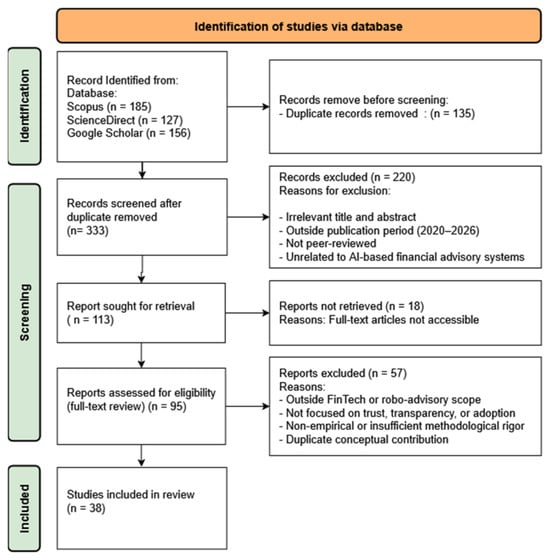
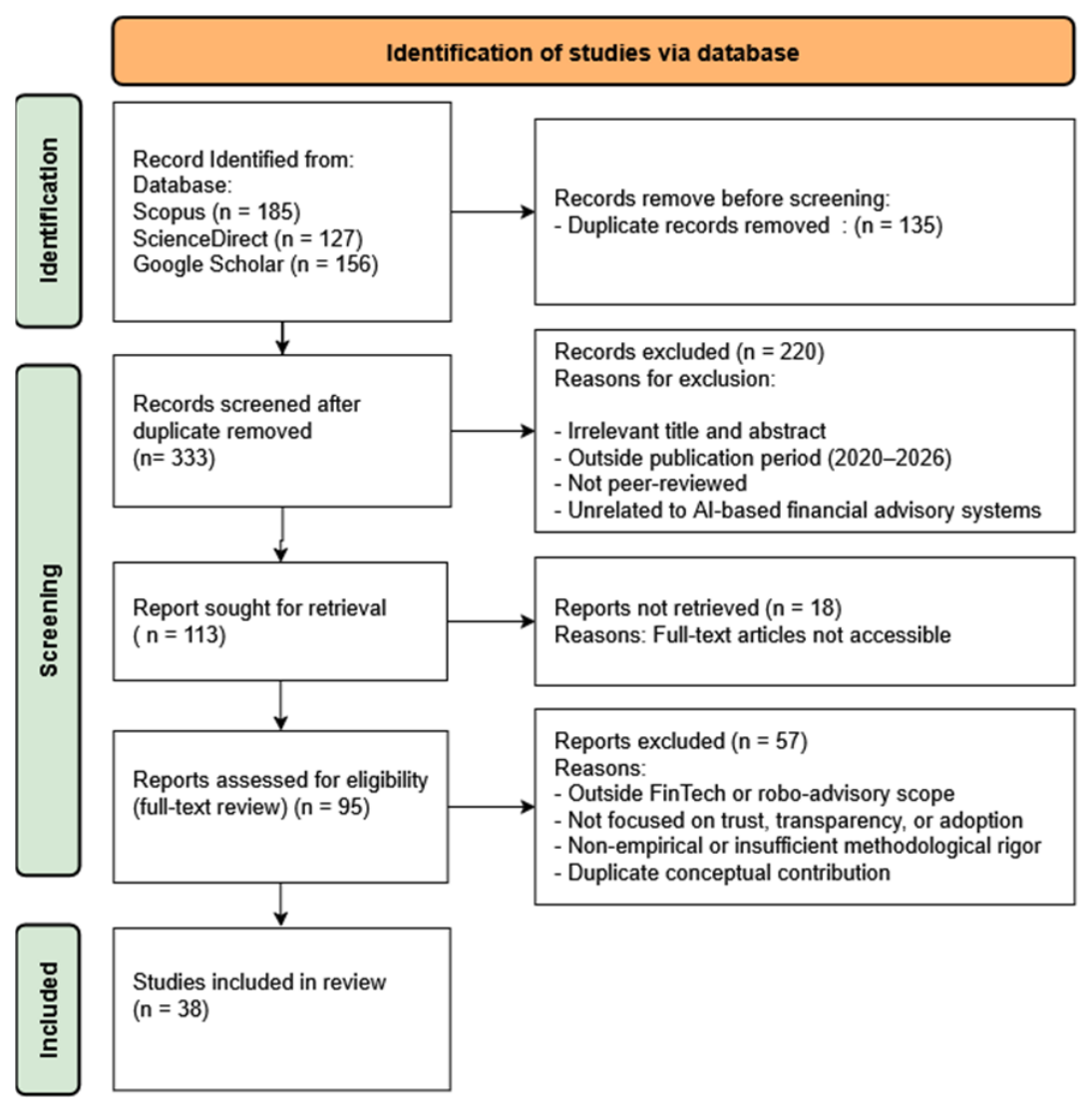
In strict adherence to the PRISMA 2020 guidelines, the systematic retrieval and attrition protocol is delineated in Figure 1. An initial query across Scopus, ScienceDirect, and Google Scholar yielded a preliminary corpus of 468 records. Following deduplication (n = 135), the remaining 333 unique records underwent rigorous title and abstract screening, which excluded 220 records primarily due to thematic irrelevance, lack of peer review, or falling outside the 2020–2026 temporal bound. Of the 113 reports sought, 18 were inaccessible, leaving 95 articles for exhaustive full-text appraisal. This definitive evaluation excluded an additional 62 papers exhibiting insufficient empirical rigor, misalignment with AI-based FinTech trust constructs, or conceptual redundancy. Ultimately, a refined cohort of 33 pivotal studies met all eligibility criteria, forming the robust foundation for the subsequent thematic and bibliometric synthesis.
Figure 1.
PRISMA 2020 Flow Diagram of the Study Selection Process.
4.2. Bibliometric Mapping: Literature Trend Analysis
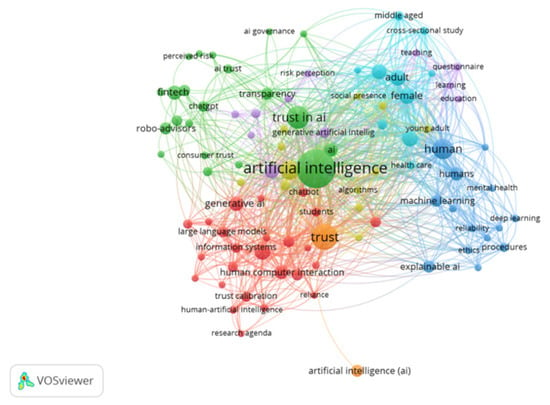
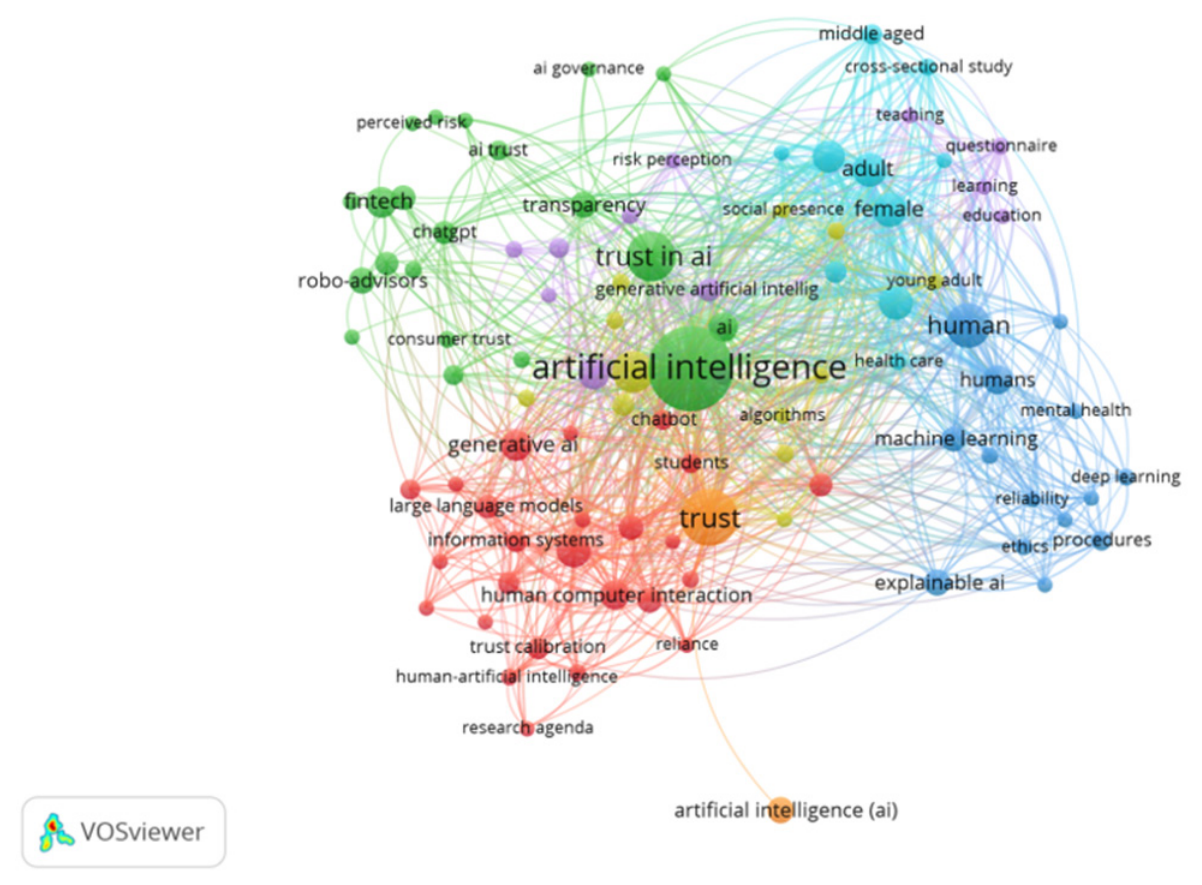
Figure 2 presents the keyword co-occurrence network generated using VOSviewer, illustrating the intellectual structure of contemporary research on artificial intelligence, trust, human–AI interaction, and financial advisory technologies. The visualization reveals three major interconnected research streams. The first cluster centers on trust, human–AI interaction, and trust calibration, highlighting the growing importance of understanding how users develop and maintain trust in intelligent systems. The second cluster is organized around transparency, trust in AI, and perceived risk, emphasizing the role of explainability and openness in reducing uncertainty and improving technology acceptance. The third cluster focuses on FinTech and robo-advisors, reflecting increasing scholarly attention toward AI-enabled financial advisory services and their adoption challenges.
Figure 2.
VOSviewer Network Visualization of keyword co-occurrence.
Overall, the bibliometric map demonstrates a convergence between human–AI interaction, trust and transparency, and financial technology research. These interconnected themes provide strong support for the thematic structure adopted in this review, particularly the examination of algorithm aversion, trust formation, explainability, and investor characteristics. The visualization also indicates that research remains fragmented across disciplinary boundaries, highlighting the need for greater integration between AI adoption, trust mechanisms, and financial decision-making studies.
4.3. Characteristics of Studies
The 33 selected studies, the most pivotal of which are summarized in Table 2, reveal several consistent patterns in the literature on AI-based financial advisory systems. Methodologically, most studies employ cross-sectional surveys, experiments, and quantitative empirical approaches to examine investor perceptions and behavioral responses toward automated financial advice [15,25]. However, the majority of these studies rely on convenience samples from developed economies, limiting the generalizability of findings to emerging-market contexts such as Indonesia. Across the reviewed literature, trust emerges as the most frequently examined construct, followed by transparency, perceived risk, explainability, financial literacy, and demographic characteristics such as age and investment experience. The importance of trust assessment in AI-driven systems has also been demonstrated in related domains such as intelligent network architectures [26]. Collectively, these variables influence how investors evaluate and respond to AI-generated financial advice. The evidence further suggests that preferences for human or AI-based advisors are highly contextual, depending on factors such as task framing, institutional credibility, transparency mechanisms, and individual user characteristics [2,5,9].
Table 2.
Comprehensive Summary of Pivotal Studies.
Overall, the literature demonstrates a clear shift from traditional technology adoption perspectives toward broader investigations of human–AI interaction, algorithm aversion, trust calibration, and explainable AI. This evolution reflects growing recognition that successful adoption depends not only on technological capability but also on users’ perceptions of trustworthiness, transparency, and understanding.
4.4. Theme 1: Algorithm Aversion Drivers
Algorithm aversion in financial advisory is a well-documented phenomenon stemming from perceived risk, system opacity, and a psychological preference for human judgment [2,28,29]. Investors heavily favor human advisors for high-stakes, emotional decisions to fulfill inherent needs for reassurance and delegation [7,8,9]. Primary trust-breakers include black-box opacity, privacy concerns, and financial anxiety, which directly elevate perceived risk and lower adoption rates [3,4,12,13,22,30]. However, algorithm aversion is highly context-dependent; it weakens or transforms into appreciation when investment tasks are explicitly framed as analytical, algorithmic performance is salient, or evaluated assets are non-controversial [2,5]. Thus, the acceptance of robo-advisory systems is dictated not merely by the presence of AI itself, but by how transparently its reasoning is integrated into the investor’s decision-making process [5,28].
4.5. Theme 2: Trust Formation Through Transparency and Explainable AI
While transparency and Explainable AI (XAI) are established as primary trust drivers [10,11,19], the current literature often over-relies on self-reported intentions rather than actual risk-taking behavior under market volatility. Although XAI mitigates perceived risk by translating opaque algorithms into interpretable rationale [13,20,23,31], excessive technical explanations risk inducing cognitive overload in users with lower financial literacy. Furthermore, while affective trust mediates conversational robo-advisor acceptance [21], XAI functions not as a universal remedy, but as a strategic trust-building mechanism requiring careful calibration to user capabilities.
4.6. Theme 3: The Financial Literacy Paradox and Investor Characteristics
Financial literacy presents a distinct adoption paradox: subjective competence and digital literacy consistently drive positive adoption [16,32,33], whereas higher objective literacy can foster skepticism and sharper trust deterioration following algorithmic errors [12,17]. Demographically, age consistently moderates adoption. Younger investors exhibit lower algorithm aversion due to weaker preexisting trust ties with human advisors and greater digital familiarity [18,34]. Consequently, responses to robo-advisors are highly heterogeneous, demanding adaptive adoption strategies rather than a one-size-fits-all approach across diverse investor segments [35,36].
4.7. Emerging Research Gaps
Based on the thematic synthesis, five critical research gaps are identified: (1) a severe lack of emerging-market studies, as the current literature heavily relies on developed-economy convenience samples [13,18,25]; (2) a deficit in longitudinal evidence tracing trust dynamics over long-term human–AI interactions; (3) a lack of integrated frameworks linking algorithm aversion, trust, and demographics within a unified adoption model [1,15]; (4) insufficient comparative empirical research between human, robo, and hybrid human–AI advisory configurations under varying risk contexts [6]; and (5) a lack of interpretable predictive models explaining how investor characteristics jointly dictate human-versus-robo choices in real-world environments [14,18].
5. Discussion
5.1. Critical Synthesis and Theoretical Implications: Algorithm Aversion and Extended TAM
Algorithm aversion in financial advisory is fundamentally a Human–Computer Interaction (HCI) and relational design failure rather than a technological limitation. Investors often reject superior robo-advisors because financial decisions require emotional reassurance and interpersonal trust traditionally supplied by humans [9]. When AI systems act as opaque black boxes, they fail to establish affective trust, elevating financial anxiety [3,4,22]. Consequently, traditional adoption models like TAM or the Unified Theory of Acceptance and Use of Technology (UTAUT), which rely heavily on functional constructs like perceived usefulness and ease of use, are insufficient to explain behavior under conditions of high uncertainty and algorithmic opacity [4]. The synthesized evidence theoretically advocates for an Extended TAM that explicitly centers on trust and Explainable Artificial Intelligence (XAI) as core constructs. Across the reviewed studies, trust consistently emerges as the central mechanism linking technological characteristics to user acceptance [10,11,19]. By conceptualizing transparency and explainability not just as technical features but as critical antecedents of trust [12,13,20], and acknowledging the moderating roles of financial literacy and age [16,17,18], this trust-centered framework provides a robust foundation for modeling how users evaluate, accept, and interact with AI-based advisors.
5.2. Practical and System Design Implications
For FinTech developers, this synthesis highlights the critical necessity of evolving toward hybrid human–AI models and trust-centric system architectures [6]. Mitigating algorithm aversion requires abandoning traditional black-box interfaces in favor of transparent, conversational onboarding that functions as a surrogate of trust [21]. UI/UX designs must prioritize adaptive Explainable AI (XAI) mechanisms tailored to varying financial literacy levels, simplifying disclosures for novices while providing deep analytics for experienced investors [13,22]. By prominently communicating algorithmic logic, system limitations, privacy protocols, and institutional affiliations, platforms can effectively reduce financial anxiety [11,12,37]. Ultimately, market acceptance depends significantly less on raw computational accuracy and far more on establishing transparent, relationally validating interactions that support sustainable human–AI collaboration [10,19].
6. Conclusions and Outlook
6.1. Conclusions
This systematic literature review demonstrates that the effectiveness and adoption of AI-based financial advisory systems depend not only on their computational capabilities but also on the quality of human–AI interaction through which algorithmic recommendations are communicated, interpreted, and evaluated. Although robo-advisors can provide scalable and analytically sophisticated financial decision support, investors may continue to prefer human advisors when decisions involve high uncertainty, financial risk, emotional involvement, or limited understanding of algorithmic reasoning.
The findings identify trust, transparency, explainability, perceived risk, financial literacy, age, and investment experience as interconnected determinants of interaction with AI-based financial advisory systems. Algorithm aversion is therefore better understood as a system-level Human–Computer Interaction challenge rather than simply as resistance to automated technology. In particular, opaque algorithmic processes can increase perceived risk and reduce trust, whereas transparent and explainable system behavior can support more informed interaction [1,12,13].
The review further indicates that conventional technology-adoption models based primarily on perceived usefulness and perceived ease of use do not fully capture the complexity of AI-enabled financial decision support. AI systems operate under uncertainty and may produce recommendations whose reasoning is difficult for users to evaluate. Consequently, trust and Explainable AI (XAI) should be treated as important components of the system interaction architecture rather than as secondary adoption variables [4,19,20].
From a computer science perspective, this review establishes a trust-centered Human–AI Interaction perspective for AI financial advisory systems. Such systems should be considered as integrated decision-support environments comprising computational recommendation mechanisms, user interfaces, explainability functions, transparency mechanisms, trust signals, privacy controls, and opportunities for human intervention. System design should therefore account for the interaction between algorithmic performance and the user’s ability to understand and appropriately use algorithmic recommendations.
The evidence also suggests that XAI should be implemented adaptively rather than uniformly. While explanations can reduce uncertainty and improve understanding, excessively technical explanations may increase cognitive burden, particularly for users with lower financial literacy. Future systems should therefore consider user-adaptive explanation strategies that vary the depth, format, and complexity of explanations according to user characteristics, task requirements, and financial-risk conditions.
The principal conceptual contribution of this study is the integration of these findings into complementary explanatory and predictive pathways. The explanatory pathway provides a basis for examining how algorithm transparency, perceived ease of use, trust, algorithm aversion, and financial literacy influence behavioral intention. The predictive pathway provides a basis for using interpretable machine-learning techniques to examine how trust, financial literacy, age, and investment experience jointly influence the choice between human and AI-based financial advisors.
6.2. Future Research Agenda
Several research directions emerge from the review. First, future empirical studies should investigate AI financial advisory systems in emerging-market environments, where institutional trust, financial literacy, digital infrastructure, and cultural expectations may differ from those of developed economies. Second, longitudinal research is required to examine how trust is initially formed and subsequently changes following successful recommendations, system errors, market volatility, or changes in system transparency.
Third, future research should empirically compare human, robo-advisor, and hybrid human–AI advisory architectures under different levels of financial risk and decision complexity. Such research could clarify when autonomous AI decision support is appropriate and when human intervention should remain part of the system architecture.
Fourth, future studies should investigate adaptive XAI mechanisms capable of tailoring explanations to individual users. This includes determining how explanation depth, visualization, conversational interaction, uncertainty communication, and disclosure of system limitations affect trust and decision quality across different levels of financial literacy.
Finally, interpretable machine-learning models should be developed and evaluated to predict investor preferences between human and AI-based advisory configurations. The proposed variables—including trust in AI, financial literacy, age, and investment experience—provide candidate features for such predictive systems. Future work should evaluate whether these models can support adaptive advisory platforms that dynamically determine when autonomous AI advice, additional explanation, or human intervention is most appropriate.
6.3. Proposed Conceptual Frameworks
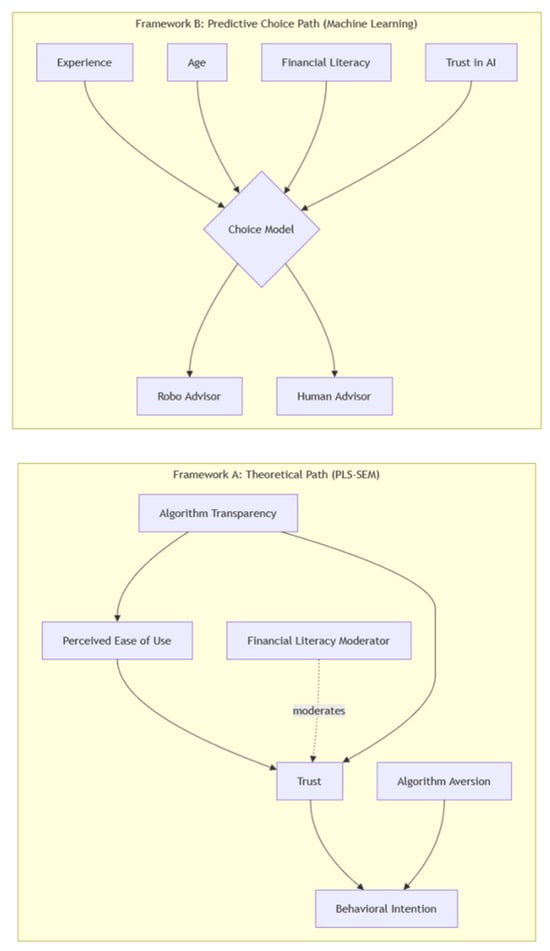
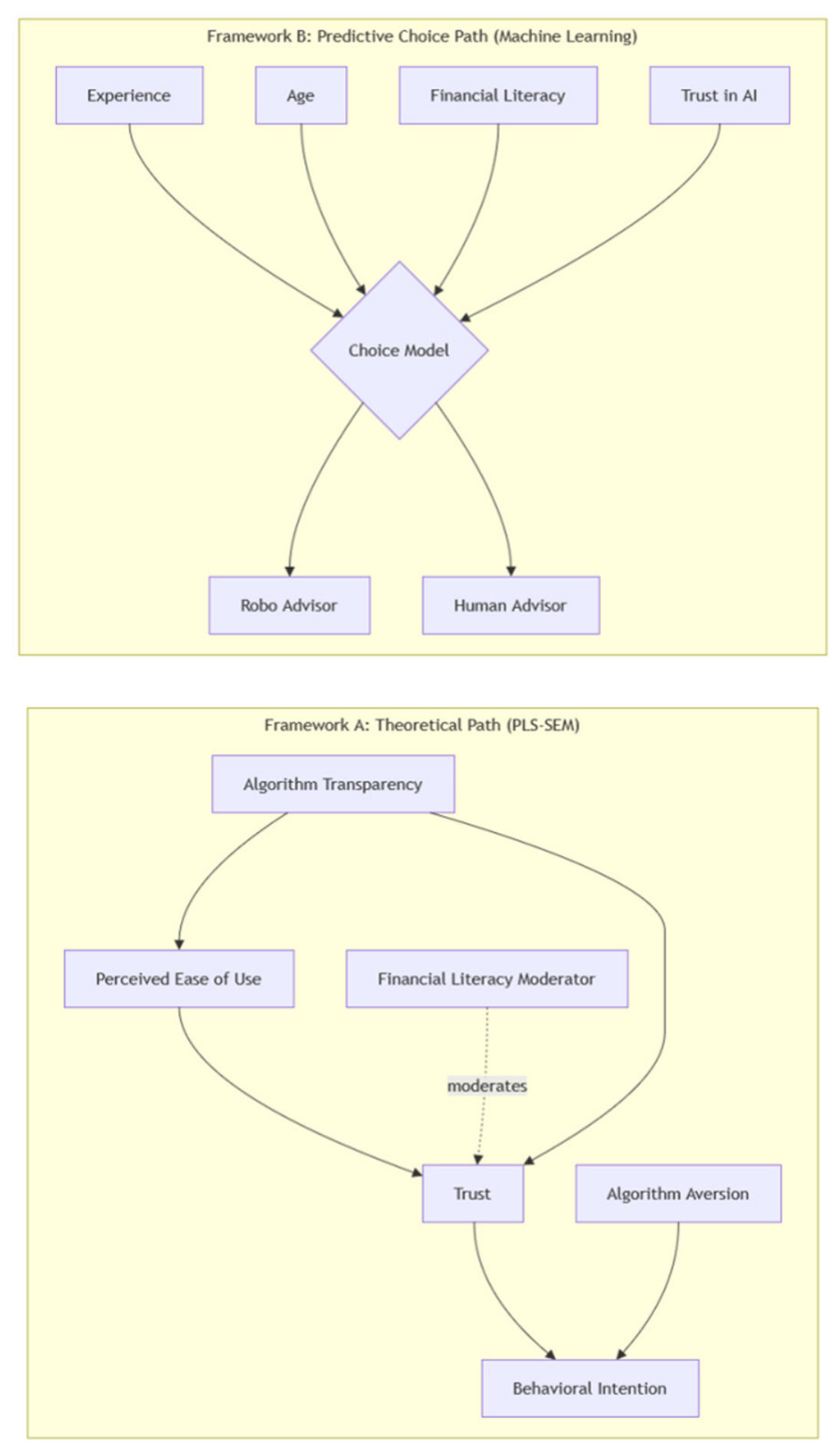
To translate the findings of this systematic literature review into a computer science-oriented research and system-design agenda, Figure 3 presents the proposed dual-path conceptual framework. The framework is not presented as a validated computational model; rather, it provides a structured roadmap for future empirical validation and development of intelligent financial advisory systems.
Figure 3.
Proposed dual-path framework for future empirical research.
Framework A represents the explanatory Human–AI interaction pathway. It proposes that algorithm transparency influences trust and perceived ease of use, which subsequently contribute to behavioral intention toward AI-based financial advisory systems. Algorithm aversion is positioned as a negative influence on adoption intention, while financial literacy is considered a moderating factor in trust formation. This pathway can be empirically examined using structural equation modeling, including Partial Least Squares Structural Equation Modeling (PLS-SEM).
Framework B represents the predictive AI decision pathway. It considers trust in AI, financial literacy, age, and investment experience as potentially important features for predicting whether an investor prefers a human advisor or a robo-advisor. This pathway provides a basis for future implementation using interpretable machine-learning approaches [38], allowing researchers and FinTech developers to investigate how user characteristics influence human–AI advisory choices.
Together, the two pathways provide complementary perspectives on AI financial advisory systems. Framework A focuses on explaining the mechanisms through which system characteristics and user factors influence trust and adoption, whereas Framework B focuses on predicting advisory preferences from user and behavioral characteristics. This distinction establishes a direct connection between behavioral theory, Human–AI Interaction, explainable AI, and intelligent decision-support system design.
The explanatory framework can be validated through cross-sectional or longitudinal investor studies using validated measures of trust, algorithm aversion, perceived ease of use, and financial literacy. PLS-SEM can then be used to test the proposed relationships and moderation effects. The predictive framework can subsequently be evaluated using supervised and interpretable machine-learning techniques trained on investor demographic and behavioral data.
From a system-design perspective, the two pathways can ultimately support adaptive human–AI financial advisory architectures. For example, an intelligent advisory platform could use interpretable predictive models to identify users with high algorithm aversion or low trust and subsequently provide enhanced explanations or offer human intervention. Conversely, users demonstrating high trust and appropriate levels of financial literacy could receive more autonomous algorithmic support. Such adaptive mechanisms could enable financial advisory systems to balance computational efficiency with transparency, explainability, user capability, and appropriate human oversight.
Therefore, the proposed framework provides a foundation for moving beyond the simple question of whether investors will adopt robo-advisors toward a more technically meaningful question: how should AI financial advisory systems be designed to dynamically support different users, levels of trust, and decision contexts? This systems-oriented perspective provides a pathway for future research integrating Human–AI Interaction, Explainable AI, interpretable machine learning, and intelligent financial decision-support systems.
Author Contributions
Conceptualization, R.P. and M.W.W.; methodology, F.I.R.; formal analysis, M.W.W.; writing—original draft preparation, M.W.W.; writing—review and editing, R.P. and F.I.R.; supervision, R.P. All authors have read and agreed to the published version of the manuscript.
Funding
This research received no external funding.
Institutional Review Board Statement
Not applicable.
Informed Consent Statement
Not applicable.
Data Availability Statement
No new data were created or analyzed in this study. Data sharing is not applicable to this article.
Conflicts of Interest
The authors declare no conflicts of interest.
Abbreviations
The following abbreviations are used in this manuscript:
| AI | Artificial Intelligence | HAI | Human–AI Interaction |
| HCI | Human–Computer Interaction | PEOU | Perceived Ease of Use |
| PLS-SEM | Partial Least Squares Structural Equation Modeling | PRISMA | Preferred Reporting Items for Systematic Reviews and Meta-Analyses |
| PU | Perceived Usefulness | SLR | Systematic Literature Review |
| TAM | Technology Acceptance Model | XAI | Explainable AI |
References
- Mahmud, H.; Islam, A.K.M.N.; Ahmed, S.I.; Smolander, K. What influences algorithmic decision-making? A systematic literature review on algorithm aversion. Technol. Forecast. Soc. Change 2022, 175, 121390. [Google Scholar] [CrossRef] [Scilit]
- Niszczota, P.; Kaszás, D. Robo-investment aversion. PLoS ONE 2020, 15, e0239277. [Google Scholar] [CrossRef] [Scilit] [PubMed]
- Tahvildaria, M. Integrating generative AI in Robo-Advisory: A systematic review of opportunities, challenges, and strategic solutions. Multidiscip. Rev. 2025, 8, e2025379. [Google Scholar] [CrossRef] [Scilit]
- Fatima, S.; Chakraborty, M. Adoption of artificial intelligence in financial services: The case of robo-advisors in India. IIMB Manag. Rev. 2024, 36, 113–125. [Google Scholar] [CrossRef] [Scilit]
- Jussupow, E.; Benbasat, I.; Heinzl, A. An Integrative Perspective on Algorithm Aversion and Appreciation in Decision-Making. MIS Q. 2024, 48, 1575–1590. [Google Scholar] [CrossRef] [Scilit]
- Mahmud, H.; Islam, N.; Krishnan, S. Human-Robo-advisor collaboration in decision-making: Evidence from a multiphase mixed methods experimental study. Decis. Support Syst. 2025, 198, 114541. [Google Scholar] [CrossRef] [Scilit]
- Northey, G.; Hunter, V.; Mulcahy, R.; Choong, K.; Mehmet, M. Man vs machine: How artificial intelligence in banking influences consumer belief in financial advice. Int. J. Bank Mark. 2022, 40, 1182–1199. [Google Scholar] [CrossRef] [Scilit]
- Hermann, E.; Alberhasky, M. The Trusted Partner for financial decision making: Romantic partner or AI? Comput. Hum. Behav. 2026, 177, 108877. [Google Scholar] [CrossRef] [Scilit]
- Rossi, A.G.; Utkus, S.P. The Needs and Wants in Financial Advice: Human versus Robo-advising. SSRN Electron. J. 2021. [Google Scholar] [CrossRef] [Scilit]
- Lourenço, C.J.S.; Dellaert, B.G.C.; Donkers, B. Whose Algorithm Says So: The Relationships Between Type of Firm, Perceptions of Trust and Expertise, and the Acceptance of Financial Robo-Advice. J. Interact. Mark. 2020, 49, 107–124. [Google Scholar] [CrossRef] [Scilit]
- Luo, H.; Liu, X.; Lv, X.; Hu, Y.; Ahmad, A.J. Investors’ willingness to use robo-advisors: Extrapolating influencing factors based on the fiduciary duty of investment advisors. Int. Rev. Econ. Financ. 2024, 94, 103411. [Google Scholar] [CrossRef] [Scilit]
- Trinh, T.K.; Jia, G.; Cheng, C.; Ni, C. Behavioral Responses to AI Financial Advisors: Trust Dynamics and Decision Quality Among Retail Investors. Appl. Comput. Eng. 2025, 144, 69–79. [Google Scholar] [CrossRef] [Scilit]
- Zhu, H.; Sallnäs Pysander, E.L.; Söderberg, I.L. Not transparent and incomprehensible: A qualitative user study of an AI-empowered financial advisory system. Data Inf. Manag. 2023, 7, 100041. [Google Scholar] [CrossRef] [Scilit]
- Abbas, S.K. Understanding User and Investor Perspectives on Robo-Advisors Adoption in Fintech. Doctoral Dissertation, Corvinus University of Budapest, Budapest, Hungary, 2025. Available online: https://artefacts-discovery.researcher.life/full_text/DA-2/c9/c9d1ea77b8f4396193de49bf4a657f74/full_text/e2ffdc8809094ec17c9d3558b6b5cbb1.pdf (accessed on 15 June 2026).
- Jafri, J.A.; Mohd Amin, S.I.; Abdul Rahman, A.; Mohd Nor, S. A systematic literature review of the role of trust and security on Fintech adoption in banking. Heliyon 2024, 10, e22980. [Google Scholar] [CrossRef] [Scilit] [PubMed]
- Aristei, D.; Gallo, M. Financial literacy, robo-advising, and the demand for human financial advice: Evidence from Italy. J. Behav. Exp. Financ. 2026, 49, 101125. [Google Scholar] [CrossRef] [Scilit]
- Han, J.; Ko, D. Trust Formation, Error Impact, and Repair in Human-AI Financial Advisory: A Dynamic Behavioral Analysis. Behav. Sci. 2025, 15, 1370. [Google Scholar] [CrossRef] [Scilit] [PubMed]
- Oehler, A.; Horn, M.; Wendt, S. Investor Characteristics and their Impact on the Decision to use a Robo-advisor. J. Financ. Serv. Res. 2022, 62, 91–125. [Google Scholar] [CrossRef] [Scilit]
- Cabiddu, F.; Moi, L.; Patriotta, G.; Allen, D.G. Why do users trust algorithms? A review and conceptualization of initial trust and trust over time. Eur. Manag. J. 2022, 40, 685–706. [Google Scholar] [CrossRef] [Scilit]
- Zerilli, J.; Bhatt, U.; Weller, A. How transparency modulates trust in artificial intelligence. Patterns 2022, 3, 100455. [Google Scholar] [CrossRef] [Scilit] [PubMed]
- Hildebrand, C.; Bergner, A. Conversational robo advisors as surrogates of trust: Onboarding experience, firm perception, and consumer financial decision making. J. Acad. Mark. Sci. 2021, 49, 659–676. [Google Scholar] [CrossRef] [Scilit]
- Verma, B.; Schulze, M.; Goswami, D.; Upreti, K. Artificial intelligence attitudes and resistance to use robo-advisors: Exploring investor reluctance toward cognitive financial systems. Front. Artif. Intell. 2025, 8, 1623534. [Google Scholar] [CrossRef] [Scilit] [PubMed]
- Pandey, A.; Caliskan, A. Disparate Impact of Artificial Intelligence Bias in Ridehailing Economy’s Price Discrimination Algorithms. In Proceedings of the 2021 AAAI/ACM Conference on AI, Ethics, and Society (AIES), Virtual, 19–21 May 2021; ACM: New York, NY, USA, 2021; pp. 822–833. [Google Scholar] [CrossRef] [Scilit]
- Koutsoupias, N.; Nosios, M. Explainable Artificial Intelligence for Social Sciences and Humanities: A Systematic Bibliometric Analysis. Eng. Proc. 2026, 124, 113. [Google Scholar] [CrossRef] [Scilit]
- Kaufmann, E.; Chacon, A.; Kausel, E.E.; Herrera, N.; Reyes, T. Task-specific algorithm advice acceptance: A review and directions for future research. Data Inf. Manag. 2023, 7, 100040. [Google Scholar] [CrossRef] [Scilit]
- Saeedi Taleghani, E.; Maldonado Valencia, R.I.; Sandoval Orozco, A.L.; García Villalba, L.J. Towards Reliable 6G: Intelligent Trust Assessment with Hybrid Learning. Eng. Proc. 2026, 123, 27. [Google Scholar] [CrossRef] [Scilit]
- Germann, M.; Merkle, C. Algorithm aversion in delegated investing. J. Bus. Econ. 2023, 93, 1691–1727. [Google Scholar] [CrossRef] [Scilit]
- Keding, C.; Meissner, P. Managerial overreliance on AI-augmented decision-making processes: How the use of AI-based advisory systems shapes choice behavior in R&D investment decisions. Technol. Forecast. Soc. Change 2021, 171, 120970. [Google Scholar] [CrossRef] [Scilit]
- Kulkarni, M.S.; Patil, K.P.; Pramod, D. The role of robo-advisors in behavioural finance, shaping investment decisions. Cogent Econ. Financ. 2025, 13, 2571403. [Google Scholar] [CrossRef] [Scilit]
- Nevrataki, T.; Iliadou, A.; Ntolkeras, G.; Sfakianakis, I.; Lazaridis, L.; Maraslidis, G.; Asimopoulos, N.; Fragulis, G.F. A Survey on Federated Learning Applications in Healthcare, Finance, and Data Privacy/Data Security. AIP Conf. Proc. 2023, 2909, 120015. [Google Scholar] [CrossRef] [Scilit]
- Siganos, M.; Radoglou-Grammatikis, P.; Lagkas, T.; Argyriou, V.; Goudos, S.; Psannis, K.E.; Kollias, K.-F.; Fragulis, G.F.; Sarigiannidis, P. Explainable Artificial Intelligence for Object Detection in the Automotive Sector. Eng. Proc. 2025, 107, 44. [Google Scholar] [CrossRef] [Scilit]
- Qadoos, A.; AbouGrad, H.; Wall, J.; Sharif, M.S. AI Investment Advisory: Examining Robo-Advisor Adoption Using Financial Literacy and Investment Experience Variables. Appl. Comput. Eng. 2025, 125, 201–207. [Google Scholar] [CrossRef] [Scilit]
- Eichler, K.S.; Schwab, E. Evaluating robo-advisors through behavioral finance: A critical review of technology potential, rationality, and investor expectations. Front. Behav. Econ. 2024, 3, 1489159. [Google Scholar] [CrossRef] [Scilit]
- Brenner, L.; Meyll, T. Robo-advisors: A substitute for human financial advice? J. Behav. Exp. Financ. 2020, 25, 100275. [Google Scholar] [CrossRef] [Scilit]
- Akhtar, F.; Akhtar, S.; Laeeq, M. Evolution of Robo-Advisors: A Literature Review and Future Research Agenda. Int. J. Consum. Stud. 2025, 49, e70131. [Google Scholar] [CrossRef] [Scilit]
- Eichler, K.S.; Schwab, E. Differences in Investment Behavior-A Quantitative Study on the Effects of Robo-Advisors and Human Financial Advisors. J. Appl. Bus. Econ. 2025, 27, 2. [Google Scholar] [CrossRef] [Scilit]
- Arora, S.; Rajesh, A.; Misra, R.; Singh, G. Bridging technology and trust: The role of AI-driven robo-advisors in middle-class financial management. Manag. Decis. 2025, 1–24. [Google Scholar] [CrossRef] [Scilit]
- Sami, M.; Mir, A.; Insany, G.P. Detection of Bank Transaction Fraud Using Machine Learning. Eng. Proc. 2025, 107, 34. [Google Scholar] [CrossRef] [Scilit]

Disclaimer/Publisher’s Note: The statements, opinions and data contained in all publications are solely those of the individual author(s) and contributor(s) and not of MDPI and/or the editor(s). MDPI and/or the editor(s) disclaim responsibility for any injury to people or property resulting from any ideas, methods, instructions or products referred to in the content. |
© 2026 by the authors. Licensee MDPI, Basel, Switzerland. This article is an open access article distributed under the terms and conditions of the Creative Commons Attribution (CC BY) license.