


Abstract
This paper studies the topics of chaos and cryptography, and how chaotic systems can be used in data encryption. Previous research show that chaos can generate pseudo-random sequences and help protect data, but there are problems because many studies do not analyze security deeply, and chaotic systems can be attacked. In this work, chaotic systems are studied, and a variation of a chaotic encryption algorithm is implemented. The security and performance of this algorithm are tested and analyzed. The results show some advantages but also limitations of chaotic encryption, and give important information for future use and research in cryptography.
1. Introduction
In today’s digital age, many important processes depend on the exchange of data, including social media, financial transactions, healthcare systems, and smart homes. Protecting the integrity and confidentiality of this data is very important. Encryption is a key tool for this protection, transforming readable information into an unreadable form that only authorized users with the correct key can access. At the same time, chaos theory studies systems with unpredictable and seemingly random behavior, where small changes in initial conditions can lead to very different outcomes, known as the butterfly effect. Chaos is observed in many natural and social phenomena, like weather, stock markets, and social dynamics [1,2,3]. However, current encryption methods face challenges in providing both high security and efficiency, and traditional approaches sometimes have vulnerabilities that can be exploited by attackers. This paper aims to explore how chaotic systems, because of their properties, can be used to design more secure and effective encryption methods. This research is important because it combines the unpredictability of chaos with cryptography, potentially improving the strength of data protection and contributing to secure communication in digital systems. To achieve this, we examine the principles of cryptography and chaos, explore applications of chaotic systems in encryption, analyze security against various attacks, and implement a chaotic image encryption algorithm to evaluate its performance. The main contributions of this paper are a detailed study of different types of chaotic systems in cryptography, security analysis of chaotic encryption methods against common attacks, and implementation and evaluation of a chaotic image encryption algorithm, highlighting its advantages and limitations. The paper is organized as follows: Section 2 presents a background on chaos theory and cryptography, Section 3 explains applications of chaotic systems in data encryption, Section 4 gives the implementation of a chaotic hash algorithm for image encryption, Section 5 presents results of our method, and Section 6 and Section 7 give a discussion with future directions and the conclusions.
2. Background Theory—Data Encryption and Chaos Theory
2.1. Data Encryption
Data encryption is the process of converting readable information (plain text, images, etc.) into an unreadable form in order to protect its confidentiality and integrity during transmission or storage. Only those with the correct decryption key can restore the original data. The main objectives of encryption are to protect data during both transfer (data in transit) and storage (data at rest), ensuring that it remains confidential and intact even if it falls into the hands of unauthorized persons [4,5,6].
The history of encryption dates back centuries, with early examples such as Herodotus’s steganography, the Spartan skytale (substitution method), Caesar’s cipher (substitution), and Morse code. In modern times, encryption is divided into three main categories:
In Symmetric Encryption, the same secret key is used for both encryption and decryption. It is fast and consists of block cipher algorithms (e.g., DES, AES) and stream ciphers. Its major disadvantage is the need for secure distribution of the secret key.
In Asymmetric Encryption (or public key encryption), two different keys are used: a public key for encryption and a private key for decryption. It provides better security in key management, but is usually slower. Typical examples are RSA and ECC.
Hash Functions convert input data into a unique, fixed-length value (hash). They do not use keys and are irreversible. They are used to verify data integrity and store passwords. Examples are the SHA and MD5 algorithms.
Due to the constant evolution of threats, there is a constant need for new and stronger encryption methods. Chaotic systems have been proposed as a promising tool in this area, mainly because of their sensitivity to initial conditions and their unpredictable, pseudo-random behavior, properties that can be exploited to create strong cryptographic keys and algorithms.
2.2. Chaotic Systems
A chaotic system is defined as a deterministic dynamical system that exhibits pseudo-random behavior and extreme sensitivity to initial conditions. Although governed by deterministic equations, such systems produce behavior that appears random and unpredictable over long time intervals.
A system must satisfy three fundamental properties to be characterized as chaotic:
2.2.1. Sensitivity to Initial Conditions (Butterfly Effect)
Microscopic variations in the initial state lead to exponentially diverging trajectories over time. This makes long-term prediction practically impossible.
2.2.2. Ergodicity
Over time, the system explores the entire accessible phase space, regardless of its initial condition.
2.2.3. Topological Mixing
Any region of the phase space eventually overlaps with any other region as time evolves, indicating strong dynamical mixing.
2.3. Chaotic Attractors
Chaotic attractors are invariant sets in phase space toward which trajectories evolve. These attractors often possess fractal structure and exhibit complex geometrical properties.
Representative examples include
- Lorenz attractor;
- Rössler attractor;
- Chen attractor;
- Hénon map attractor.
The Lorenz System
The Lorenz system is a classical chaotic model described by three nonlinear differential equations [7]:
It is widely known for demonstrating the butterfly effect. Due to its high sensitivity and complex dynamics, it has been applied in the following (see e.g., [8,9]):
- Cryptography;
- Secure data transmission;
- Information hiding;
- Pseudorandom number generation.
2.4. Common Chaotic Maps Used in Cryptography
2.4.1. Logistic Map
A simple discrete nonlinear system is defined by
For , the system exhibits fully developed chaotic behavior. It is widely used for generating pseudo-random sequences.
2.4.2. Chen System
The Chen system is a three-dimensional continuous chaotic system structurally similar to the Lorenz system. It has applications in secure communication and encryption schemes [4]:
The Chen map is a discrete chaotic system often used in cryptography and nonlinear dynamics. A simple form of the Chen map is
where are the system states at iteration n, and are control parameters. For common chaotic behavior, typical values are
2.4.3. Sine Map
Defined by
Depending on the value of k, the system transitions from periodic to chaotic behavior. Its chaotic properties can be enhanced using the Sine Chaotification Model (SCM) [6].
Several analytical tools are commonly employed to evaluate the dynamical behavior of chaotic systems. Bifurcation diagrams are used to illustrate how the asymptotic behavior of a system changes as a control parameter (e.g., k) varies, enabling the identification of transitions between stable fixed points, periodic oscillations, and chaotic regimes. Time series analysis provides a direct representation of the temporal evolution of system variables, facilitating the distinction between periodic, quasi-periodic, and chaotic dynamics. Lyapunov exponents quantify the average exponential rate of divergence or convergence of nearby trajectories in phase space; a positive Lyapunov exponent indicates sensitivity to initial conditions and, therefore, chaotic behavior, whereas a negative exponent corresponds to stable or periodic dynamics. Phase portraits represent the relationship between successive states (e.g., versus ) and, in chaotic systems, reveal characteristic features such as strange attractors, fractal structures, and complex geometric patterns.
3. Applications of Chaotic Systems in Data Encryption
Chaotic systems find important applications in both symmetric and asymmetric encryption, taking advantage of their properties.
In symmetric encryption, the main application is the use of chaotic systems as pseudo-random number generators (PRNGs). The sequences produced by chaotic systems, due to their pseudo-randomness and unpredictability, are ideal for creating encryption keys (keystreams) used in stream ciphers. In this technique, the keystream is combined with the original data (e.g., via an XOR operation) to produce the encrypted text [10,11,12,13]. Classical encryption methods can be computationally expensive or have limited key space. Chaotic systems offer advantages such as large key space (due to sensitivity to initial conditions), high complexity, fast sequence generation, and often lower computational requirements. However, there are also challenges, such as the need for high numerical accuracy in their design and implementation to avoid deviations due to rounding errors.
In asymmetric cryptography, research is less developed but active. Schemes have been proposed that combine chaotic systems with established algorithms (e.g., RSA) or use chaotic functions as a basis for generating public and private keys. Challenges here include proving mathematical security under standard cryptographic models, ensuring sufficient complexity, and addressing potential cryptographic weaknesses that may be introduced by the dynamics of chaotic systems.
The encryption process, especially for images, which is a popular application area, typically involves two basic steps that can be driven by chaotic systems: Permutation changes the position of the image pixels without changing their values, suppressing spatial correlation. Chaotic sequences can be used to generate a random but reproducible reordering sequence. Substitution changes the values of the pixels (e.g., through an XOR operation with a chaotically generated keystream), suppressing statistical properties and eliminating obvious patterns. The color image is usually treated as a three-dimensional array (height × width × 3 RGB color channels). Analysis of the encrypted image involves studying the histograms of pixel values (which should be uniformly distributed) and measuring the correlation between neighboring pixels (which should be very low) [14,15,16,17].
3.1. Digital Images
A grayscale image is an array of pixels, where each pixel has an intensity value from 0 (black) to 255 (white). A color image usually consists of three such arrays, one for each primary color (Red, Green, Blue—RGB). The histogram of an image is a graph showing the frequency of occurrence of each possible intensity value. In image encryption, the goal is to convert the original image into a form that does not reveal information. By applying only scrambling, the histogram remains the same, which is a weakness. Proper encryption, which combines substitution and scrambling, results in a histogram with a uniform distribution, making statistical analysis much more difficult. These principles apply similarly to text encryption.
3.2. Security Analysis
Security analysis is critical to ensuring that the proposed algorithms are truly robust. First, the three basic principles of information security are mentioned: Confidentiality (only authorized persons have access), Integrity (data has not been altered), and Availability (information is accessible when needed). Security analysis for cryptographic algorithms involves checking the statistical randomness of the generated sequences, as any detectable patterns can be exploited. Their resistance to various attacks is also tested, the balance between performance and security (performance–security trade-off) is examined, and an assessment is made of how effectively they implement Shannon’s principles of diffusion (scrambling) and confusion (substitution). Diffusion disperses information so that a small change in the plaintext causes a large change in the ciphertext. Confusion hides the relationship between plaintext and ciphertext. Finally, the entropy of the system is measured, as high entropy indicates greater randomness and security [18,19,20,21,22,23,24,25,26,27,28,29,30,31,32].
Main Attacks Against Cryptographic Systems
Cryptographic systems must be evaluated against a wide spectrum of attack models. These models differ based on the attacker’s knowledge and capabilities.
- Chosen Plaintext Attack (CPA)In a Chosen Plaintext Attack, the adversary can arbitrarily select plaintexts and obtain their corresponding ciphertexts. By analyzing the input–output relationship, the attacker attempts to infer information about the secret key or the internal structure of the encryption algorithm.
- Known Plaintext Attack (KPA)In a Known Plaintext Attack, the attacker possesses one or more plaintext–ciphertext pairs. Using this known correspondence, the attacker attempts to deduce the encryption key or recover additional plaintexts.
- Ciphertext-Only Attack (COA)In a Ciphertext-Only Attack, the adversary has access only to ciphertext data. The objective is to reconstruct the original plaintext or recover the secret key solely through statistical or structural analysis of the ciphertext.
- Differential CryptanalysisDifferential cryptanalysis studies how differences in plaintext inputs influence differences in the resulting ciphertext outputs. By analyzing statistical correlations between input differences and output differences, the attacker may extract partial information about the key.
- Linear CryptanalysisLinear cryptanalysis seeks highly probable linear relationships among plaintext bits, ciphertext bits, and key bits. If such approximations exist with non-negligible bias, they can be exploited to gradually recover key information.
- Brute Force AttackA brute force attack systematically tests all possible keys in the key space until the correct one is found. The computational feasibility of this attack depends directly on the key length and the size of the key space. Larger key spaces exponentially increase resistance to brute force attacks.
- Man-in-the-Middle (MITM) AttackIn a Man-in-the-Middle attack, the adversary covertly intercepts and potentially alters communication between two legitimate parties. This attack is particularly effective during key exchange protocols, where the attacker can substitute public keys and establish independent encrypted channels with each party.
- Attacks Targeting Image Encryption SystemsImage encryption schemes introduce additional considerations due to the structural and statistical properties of images.
- Histogram AnalysisHistogram analysis exploits the statistical distribution of pixel intensities. If an encryption scheme preserves certain statistical properties (e.g., histogram structure), the attacker can use this information to perform statistical inference on the encrypted image.
- Cropping AttackIn a cropping attack, a portion of the encrypted image is removed or destroyed. The impact on the decrypted image depends on the encryption structure:
- –
- Without hashing or diffusion mechanisms, the corresponding portion of the decrypted image is simply missing.
- –
- With strong diffusion or hashing, the corruption propagates across the image, resulting in widespread distortion.
- Tampering AttackIn a tampering attack, the adversary injects or modifies data within the encrypted image. Similar to cropping, the severity of the impact depends on the diffusion characteristics of the encryption algorithm.
- Noise Addition AttackIn this attack model, random noise (e.g., salt-and-pepper noise or Gaussian noise) is added to the encrypted image. The goal is to evaluate the robustness of the encryption scheme against channel noise and its effect on decrypted image quality.
4. Implementation of a Chaotic Hash Algorithm for Image Encryption
The present study employs a chaotic encryption scheme based on the chaotic map presented in [33]. In the referenced work, two successive shuffling stages were proposed prior to encryption. The permuted image was subsequently encrypted using the XOR operation. In contrast, the present work adopts only the first shuffling stage, incorporating a minor modification.
4.1. Methodology
First it is necessary to pre-process the image. In this case, the image is read and converted into “double” type. This conversion is essential so the numerical operations can be performed later.
4.1.1. Preprocessing
The algorithm begins with standard image preprocessing:
- Image reading;
- Conversion to grayscale (if required);
- Conversion to a double-precision numerical array.
A grouping parameter, denoted as groupSize, is defined to partition image rows and columns into blocks prior to shuffling. The hash map parameters are initialized to generate pseudo-random sequences that determine the new positions of each group.
4.1.2. Shuffling Stage
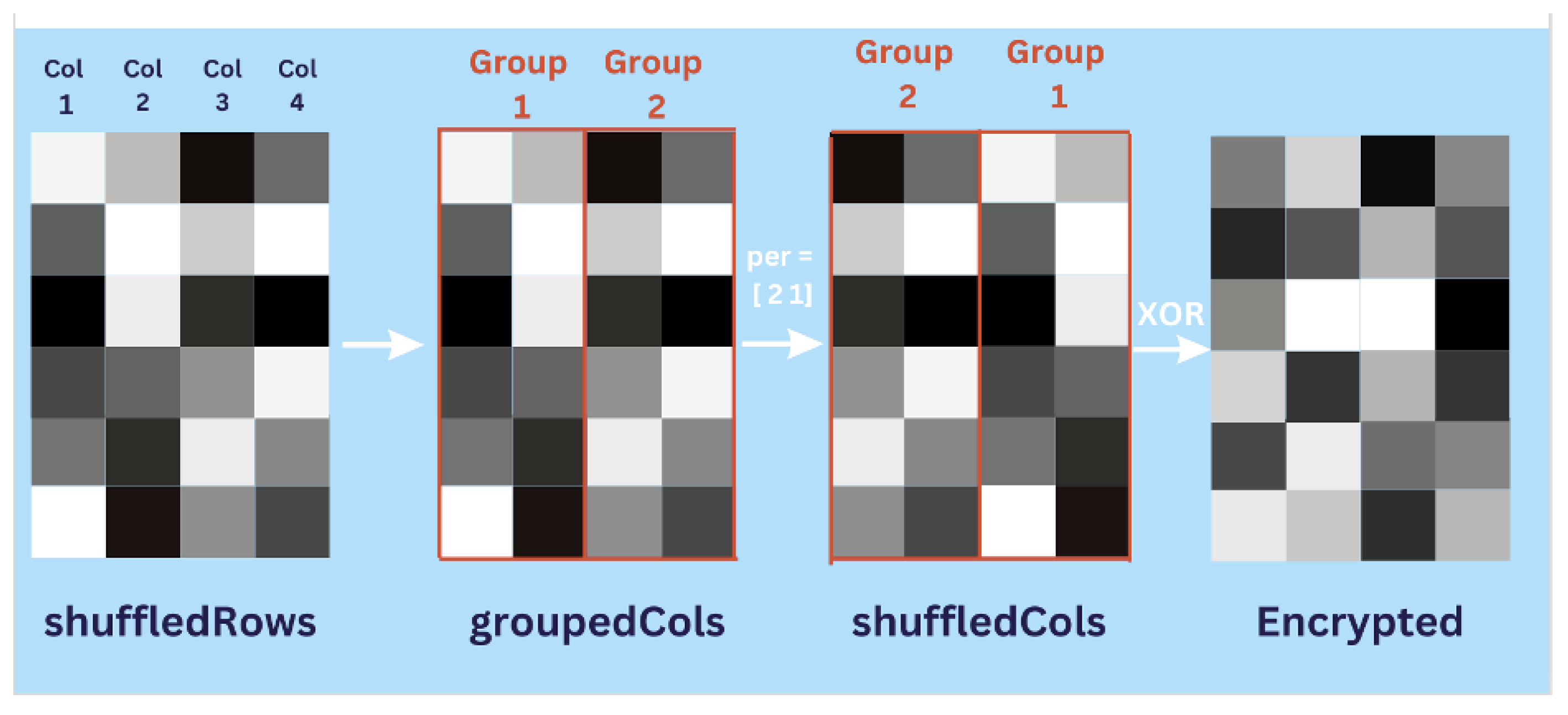
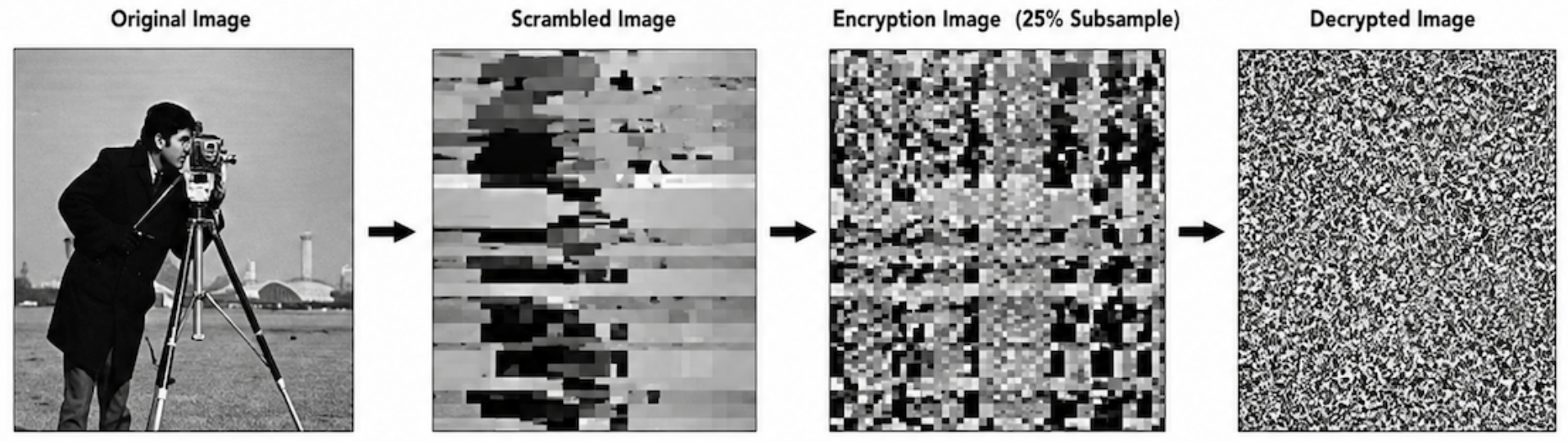
The permutation process is performed in two sequential phases (see Figure 1):
- Row shuffling;
- Column shuffling.
Figure 1.
Shuffle and Substitution method.
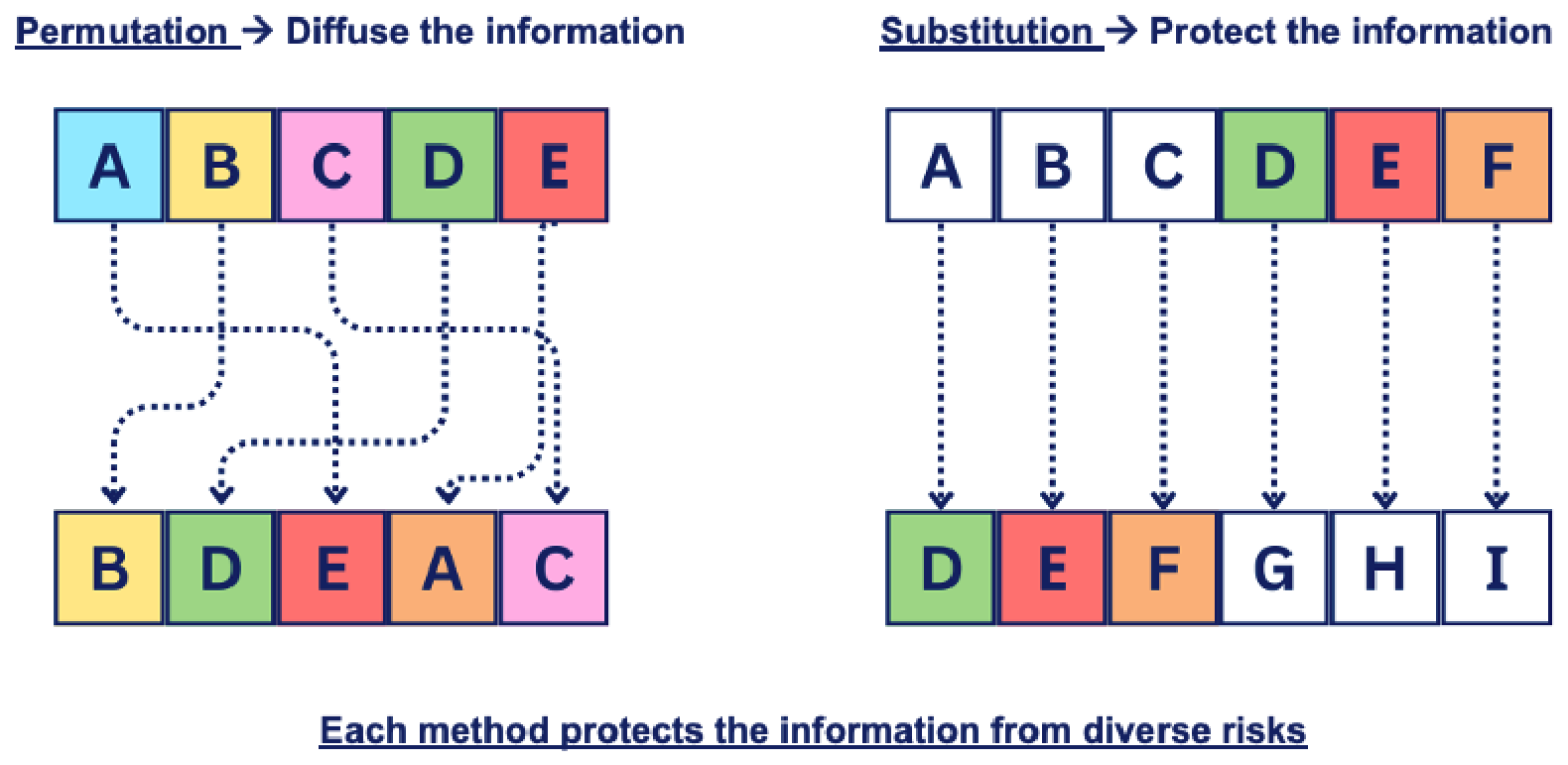
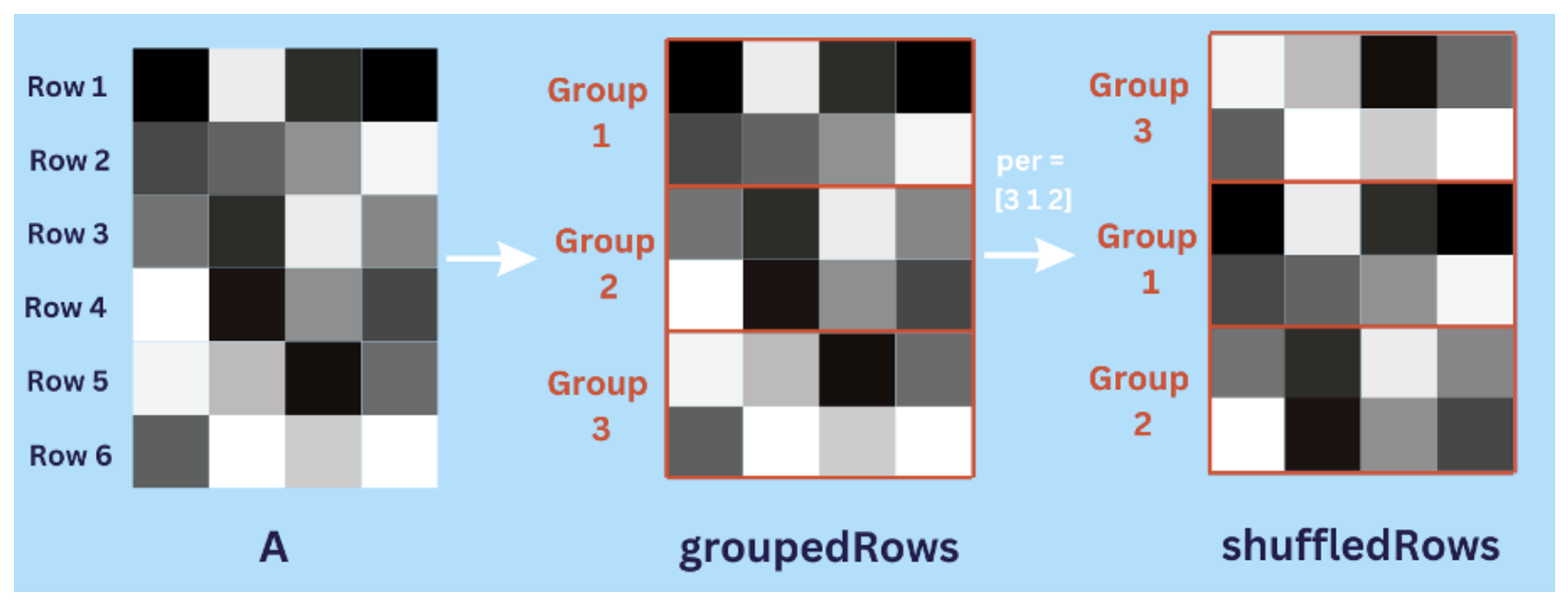
For each phase, a unique pseudo-random position sequence is generated via the hash map. A transformation matrix (e.g., a left permutation matrix for rows) is constructed to map each group from its original position to a new pseudo-random position.
The scrambling operation is implemented through matrix multiplication between the image matrix and the corresponding transformation matrices. This stage modifies pixel positions while preserving pixel intensity values.
4.1.3. Substitution Stage
After permutation, the substitution phase is applied:
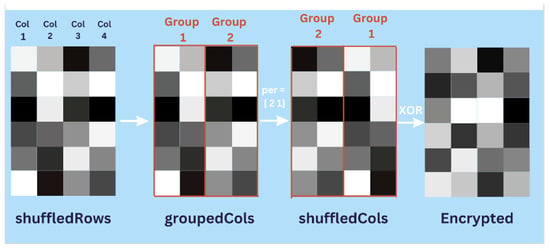
- The scrambled image matrix is converted into a binary bit stream.
- A second pseudo-random binary sequence is generated using the hash map with different predefined parameters.
- The encryption is performed using the XOR operation between the image bit stream and the generated hash stream:where P is the binary representation of the permuted image and H is the hash stream.
- The resulting binary stream is converted back into image format, producing the final encrypted image.
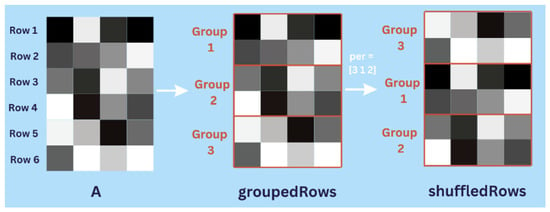
Figure 2.
Shuffle and Substitution method—part I.
Figure 3.
Shuffle and Substitution method—part II.
4.2. Encryption with XOR
Let be the shuffled matrix produced by Algorithm 1. The encryption procedure operates on this output in Algorithm 2.
| Algorithm 1 Chaos-Based Matrix Shuffling |
| Require: N, initial seed , chaotic map , matrix Ensure: Permutation vector , shuffled matrix
|
| Algorithm 2 XOR-Based Encryption of Shuffled Image |
| Require: Shuffled matrix Ensure: Encrypted matrix
|
5. Results
The present study uses a chaotic encryption algorithm with a chaotic map developed by [33]. In this paper, two rounds of shuffling were suggested. The shuffled image is then encrypted using the XOR method. However, in this paper we only used the first shuffling algorithm with a slight variation.
In this chapter, we will apply the encryption algorithm to the images of “cameraman” and “peppers”, with dimensions 256 × 256 and 512, respectively. In addition we will perform some tests using the code in MATLAB R2025b; in each case, we will assess the security of this encryption:
- Correlation Analysis: Examines the connections between two adjacent pixels.
- Cropping: Removes parts of the encrypted image.
- Tampering: Falsification of the encrypted image.
- Salt and Pepper: Adds noise to the encrypted image.
The algorithm was evaluated using two standard test images:
- Cameraman (256 × 256, grayscale);
- Peppers (512 × 512, color).
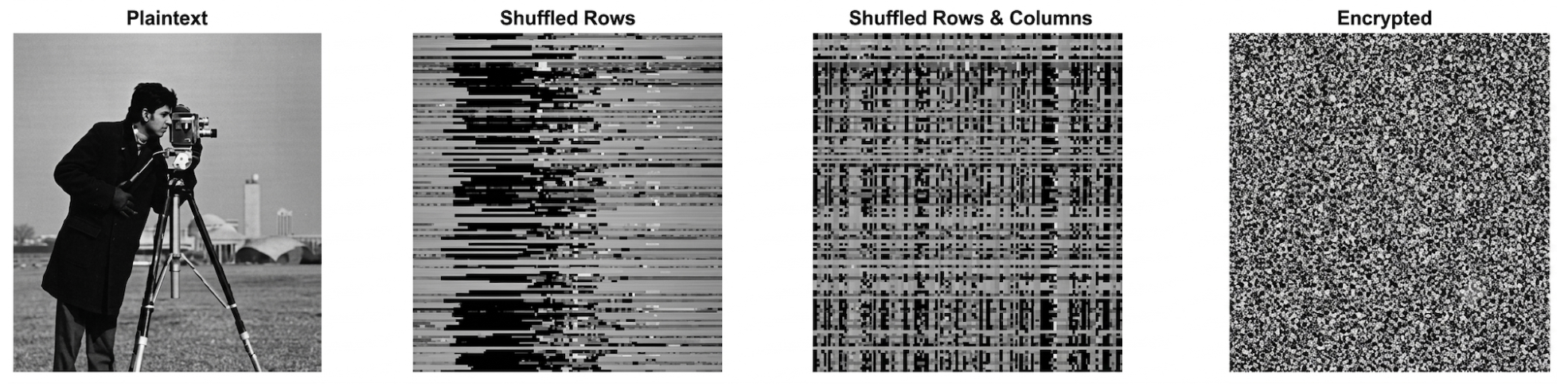
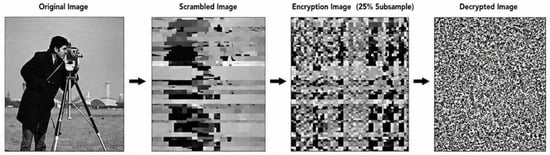
The encryption was performed for multiple groupSize values (2, 4, 8, 16, 32, 64, etc.) to assess the effect on security and computational performance. Figure 4 shows the result for “group size = 2”. We observe that by shuffling only the rows, a connection between the pixels remains, although by shuffling both the rows and columns, those connections are not as apparent. After replacing the pixel values the “Encrypted” image appears as noise.
Figure 4.
Groups of 2 rows/columns before shuffling (cameraman).
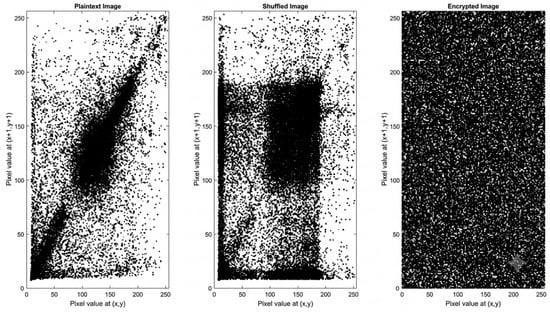
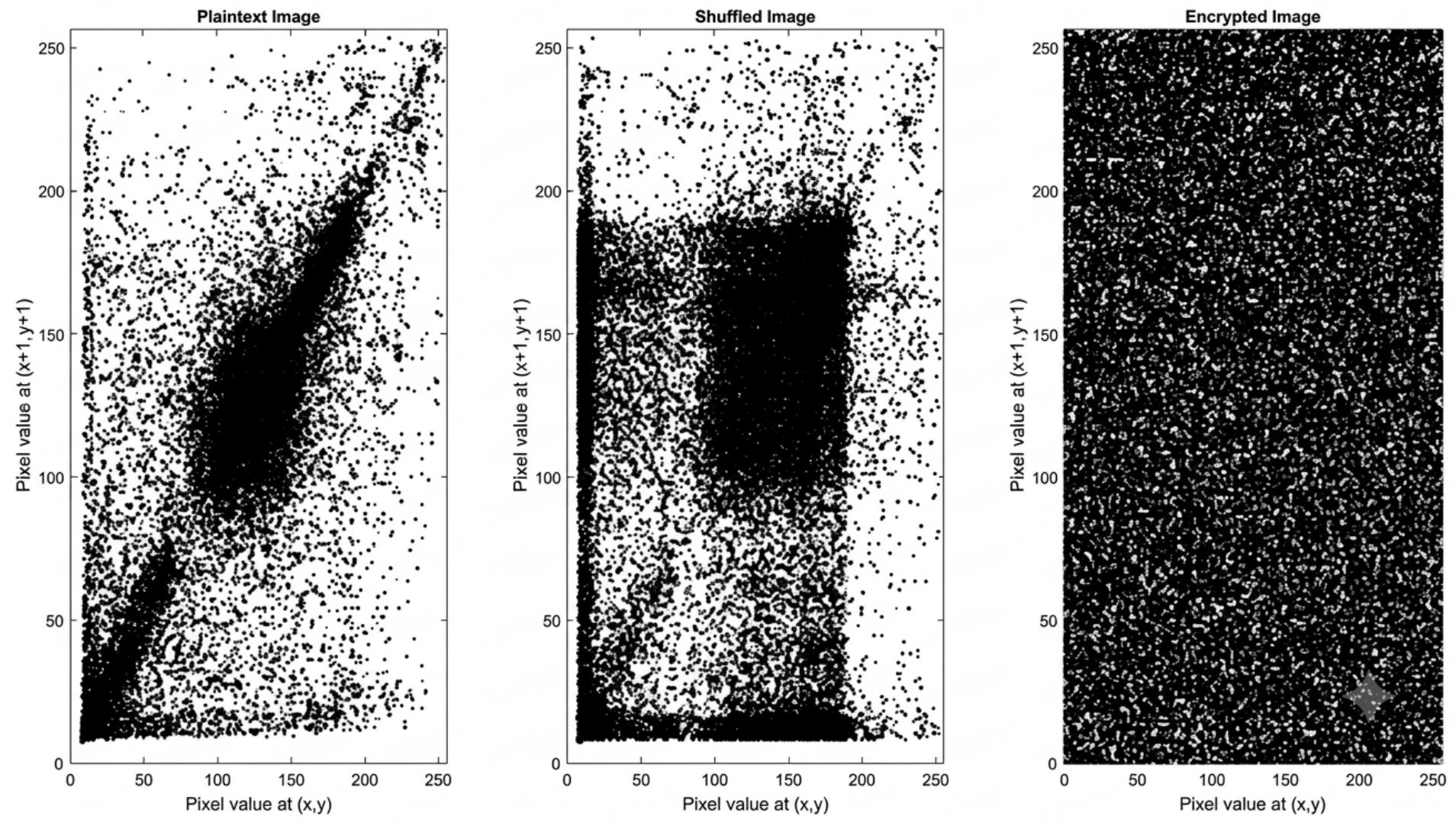
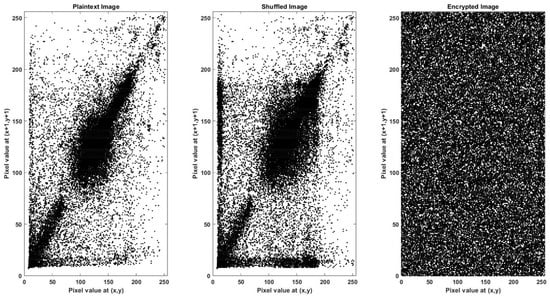
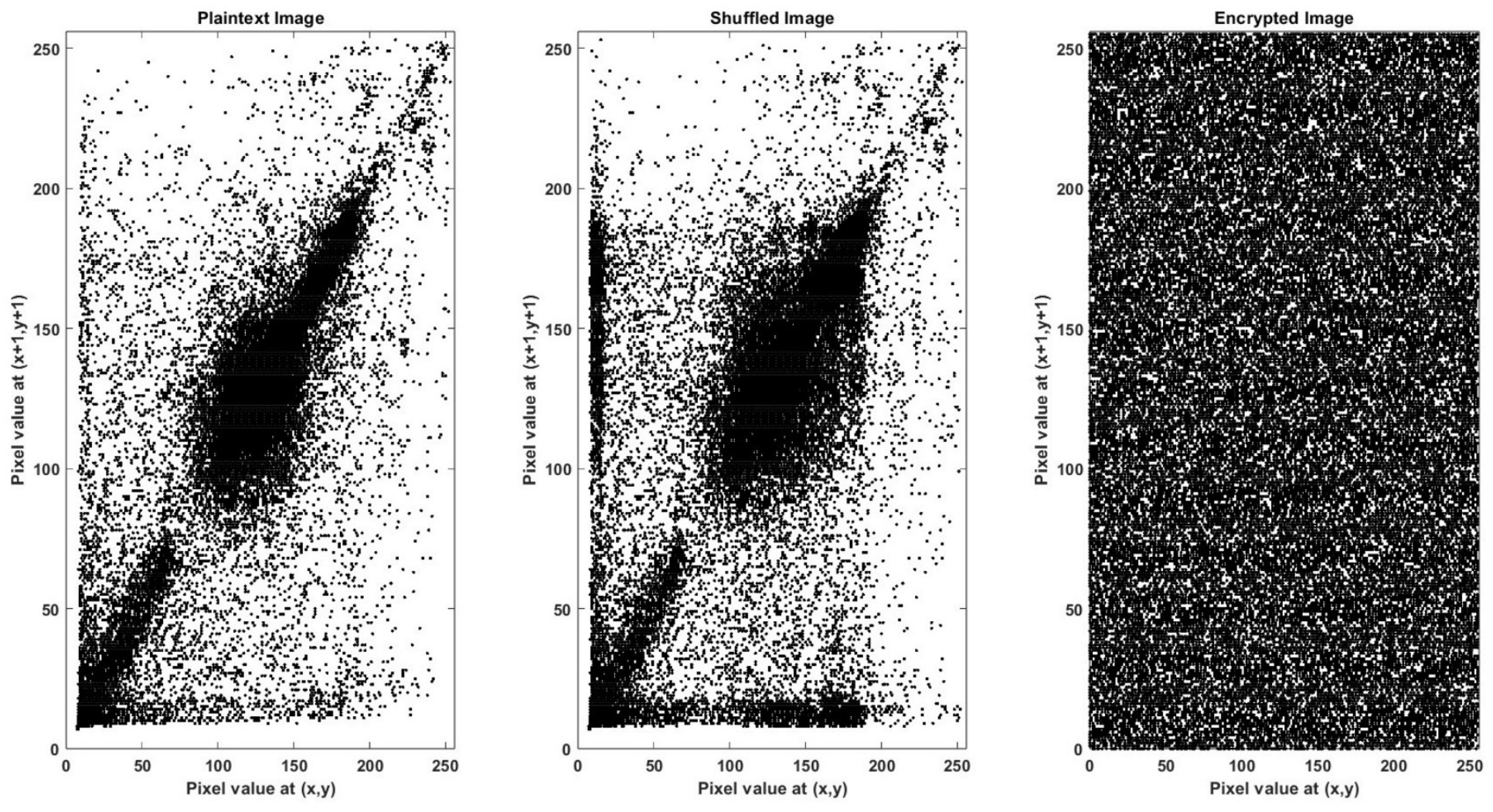
Figure 5 illustrates the results of correlation analysis attack. In the plaintext image, it is undeniable that adjacent pixels are connected to each other, as there are areas in the image where many pixels are concentrated. In the shuffled image, the pixels have changed positions, whereas they are better distributed in the diagram while maintaining some correlations between them. Finally, in the encrypted image the pixels have changed values, and thus they appear evenly distributed in this diagram.
Figure 5.
Correlation analysis of adjacent pixels for “group size = 2” (cameraman).
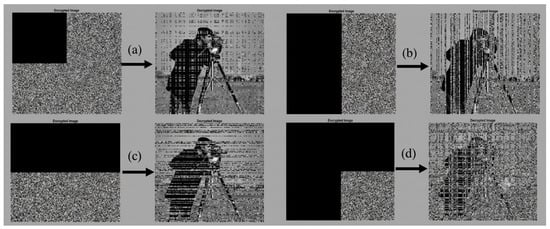
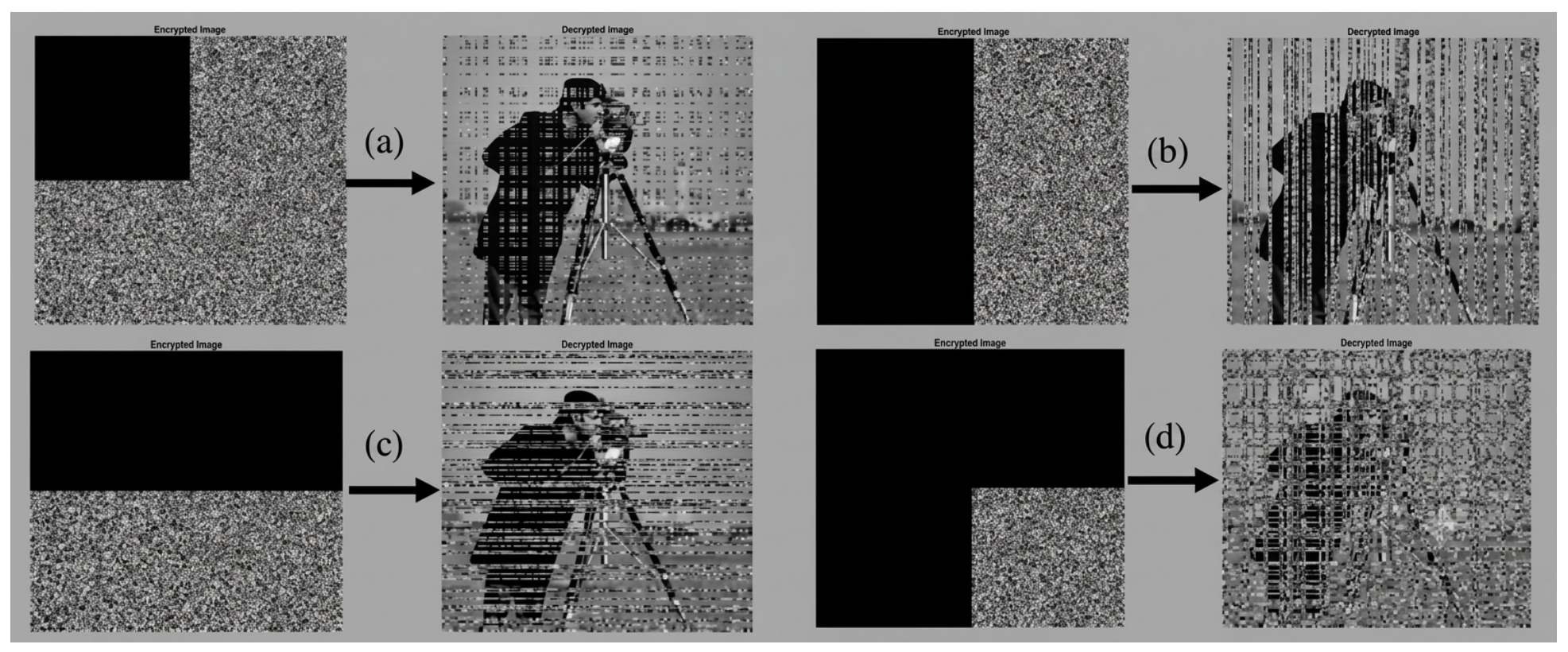
In Figure 6, 25%, 50% and 75% of the encrypted image was removed. We attempted to restore the encrypted image to its original form, but that is not entirely possible due to the missing information. Specifically, it was observed that the missing pieces are in columns and rows of at least two, due to the mixing method of grouping. Then in the 50% cropping, the same columns appear as in the 25% cropping, since the 25% block is also part of the 50% cropped block. The key difference is that in 50% cropping the entire row is missing, while in 25% cropping half of it is. The same applies for horizontal cropping. Finally, in the 75% cropping it goes without saying that the decrypted image has been significantly altered and its details are not easily discernible. Moreover, upon closer examination it appears that 75% cropping is the combination of 50% vertical and horizontal cropping.
Figure 6.
(a) 25% (b), 50% (c), 50% (d) and 75% cropping for “group size = 2” (cameraman).
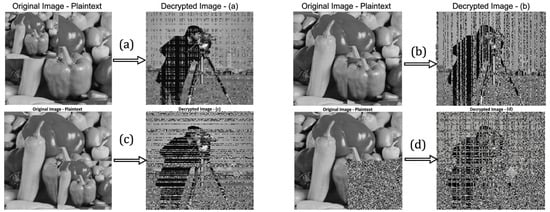
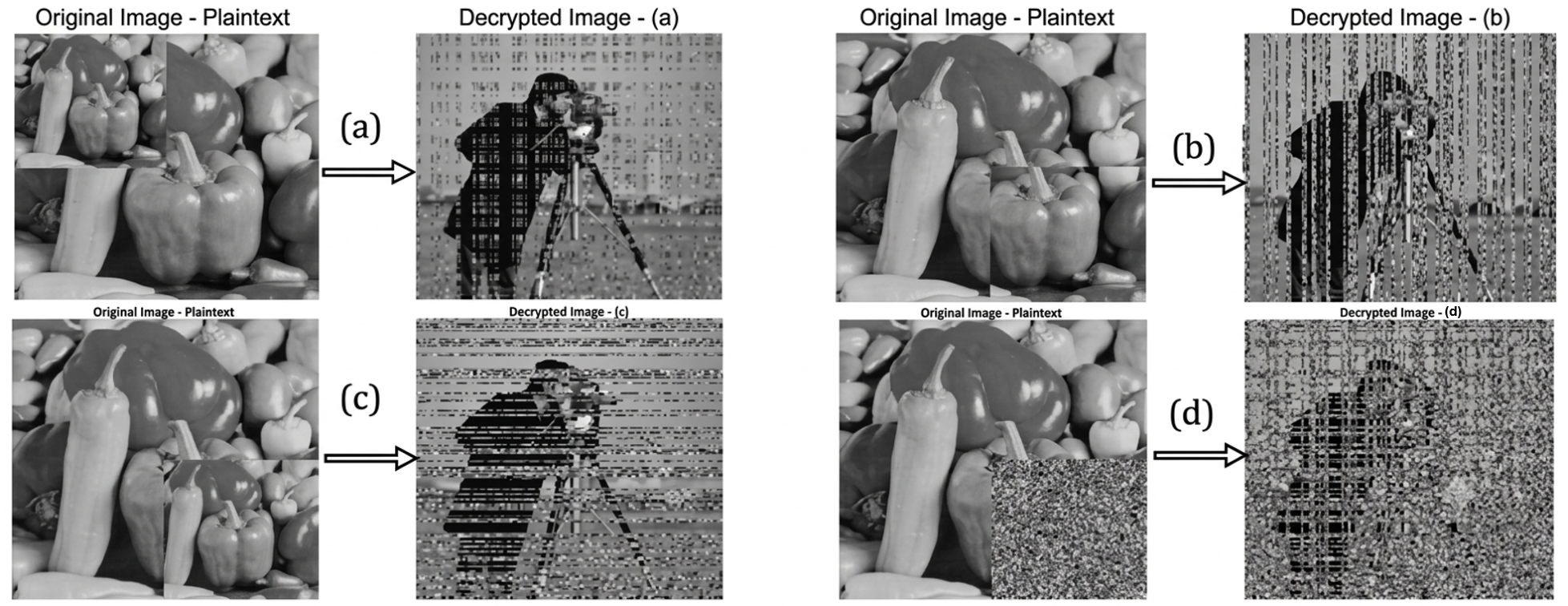
Subsequently, in Figure 7 the encrypted image was tampered by adding the image of peppers to different percentages. The purpose of this assessment is to determine whether the encryption algorithm is resistant to such attacks. There is no doubt that by adding another picture into the encrypted one, the result is similar to the case of cropping the corresponding percentage of encrypted images (Figure 6). Hence, the pixels that have been altered are in the same positions as the ones in the corresponding percentage of cropping. The main differentiation between the two cases is the pixel values, since cropping involves a lack of information while tampering involves the addition of information.
Figure 7.
(a) 25%, (b) 50%, (c) 50% and (d) 75% tampering for “group size = 2” (cameraman).
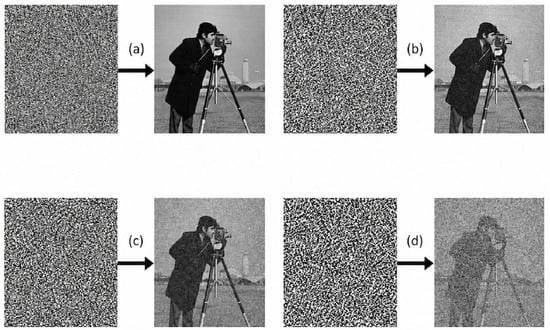
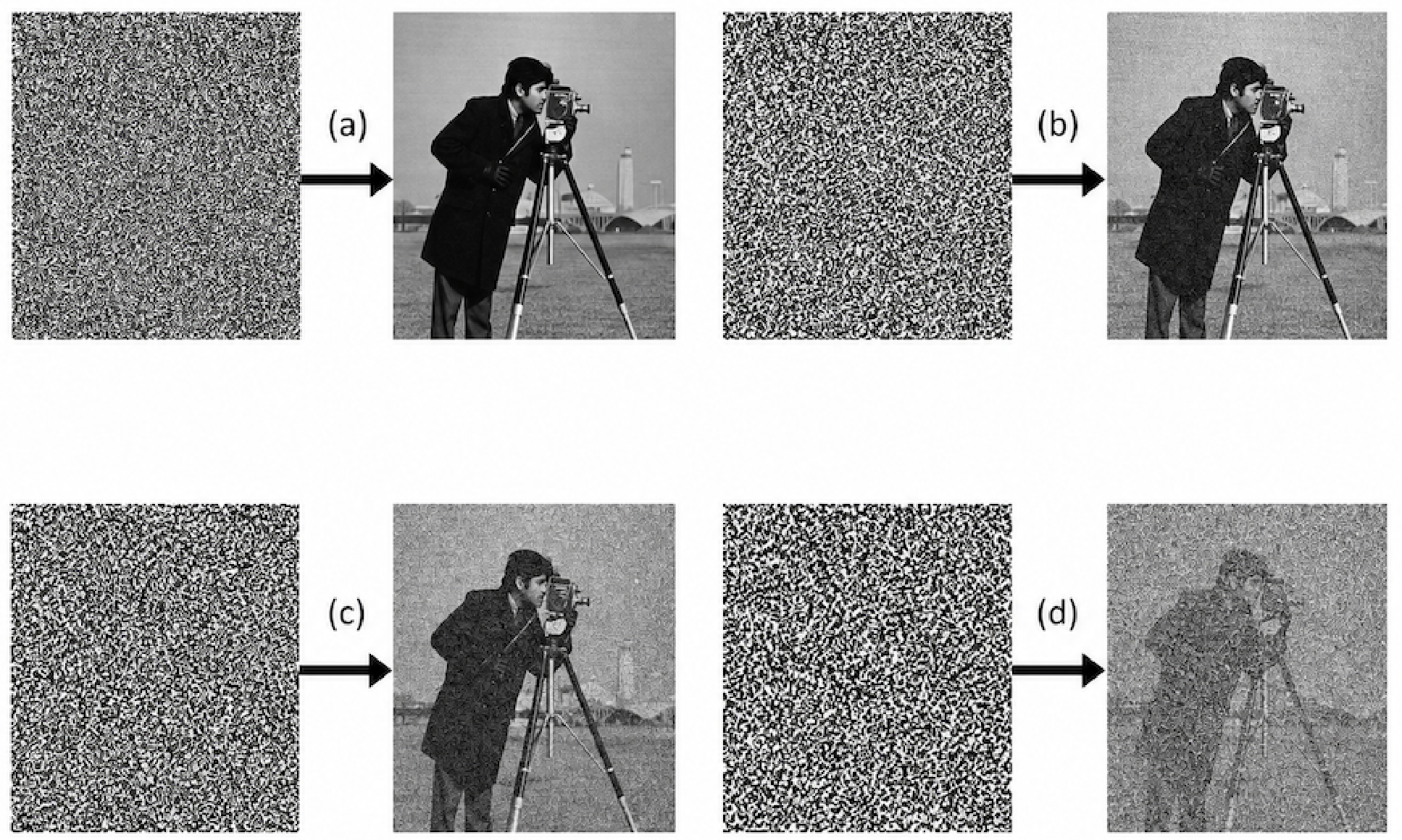
To evaluate the algorithm’s resistance to noise addition, salt-and-pepper noise was applied to the encrypted image (Figure 8). As was expected from this type of noise, some white (salt) and black (pepper) pixels are scattered throughout the decrypted image. In the decrypted image with 5% noise these additions are not visible, while in 25% noise they are more noticeable. As the noise percentage increases, the scattered black and white pixels become denser and the cameraman’s original image is not as clearly visible due to the high noise level. Therefore, it is evident that the chaotic encryption algorithm is resistant to relatively low noise levels, as the image becomes more distorted as the noise increases.
Figure 8.
(a) 25%, (b) 50%, (c) 50% and (d) 75% salt-and-pepper noise for “group size = 2” (cameraman).
5.1. Image Size of 256 × 256 and Groups of 8
As mentioned, by increasing the number of rows and columns per group, more information is retained in the shuffled image. This is also proven in Figure 9 and Figure 10, where the shuffled image’s correlation diagram seems to be close to the original image’s one. The main distinction is the minimal pixel dispersion in the shuffled image. Hence, the correlations between neighboring pixels are preserved, which is a result of the increase in rows and columns within the groups. Nevertheless, after the substitution and XOR method, the image appears to be effectively protected.
Figure 9.
Groups of 8 rows/columns before shuffling (cameraman).
Figure 10.
Correlation analysis of adjacent pixels for “group size = 8” (cameraman).
5.2. Image Size 512 × 5112 and Groups of 2
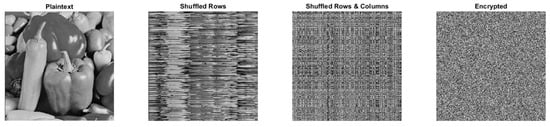
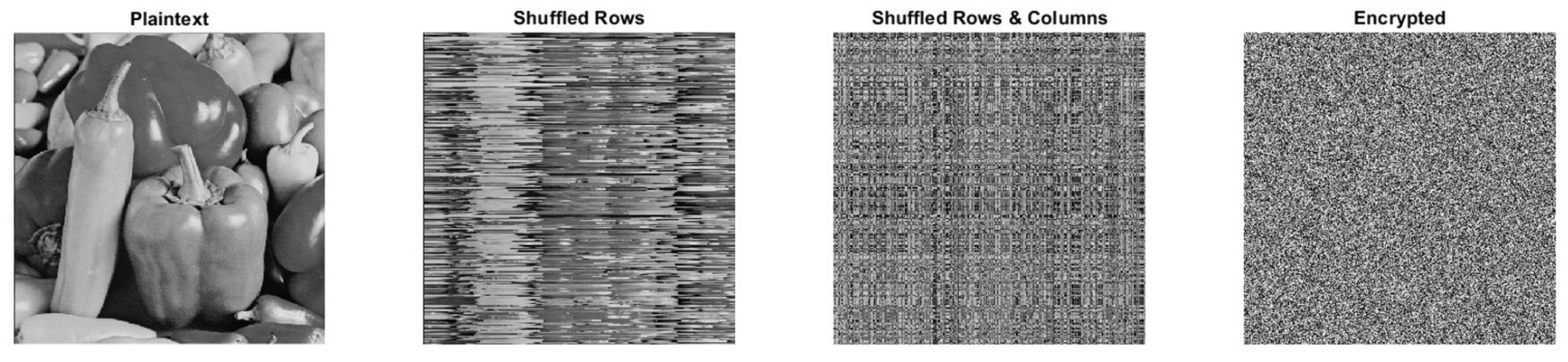
Figure 11 shows plaintext image “peppers” being shuffled and encrypted for “group size = 2”. By shuffling only the rows, the image appears to be ‘blurry’, maintaining a connection between adjacent pixels. However, by shuffling the columns as well, the connections are not as obvious. After substitution the image appears as noise.
Figure 11.
Groups of 2 rows/columns before shuffling (peppers).
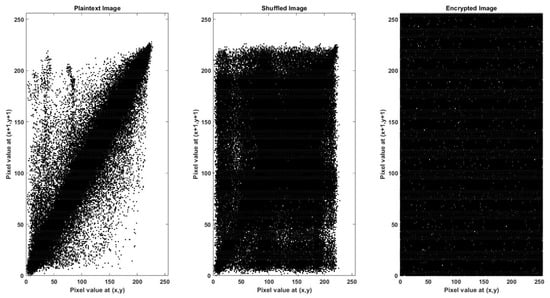
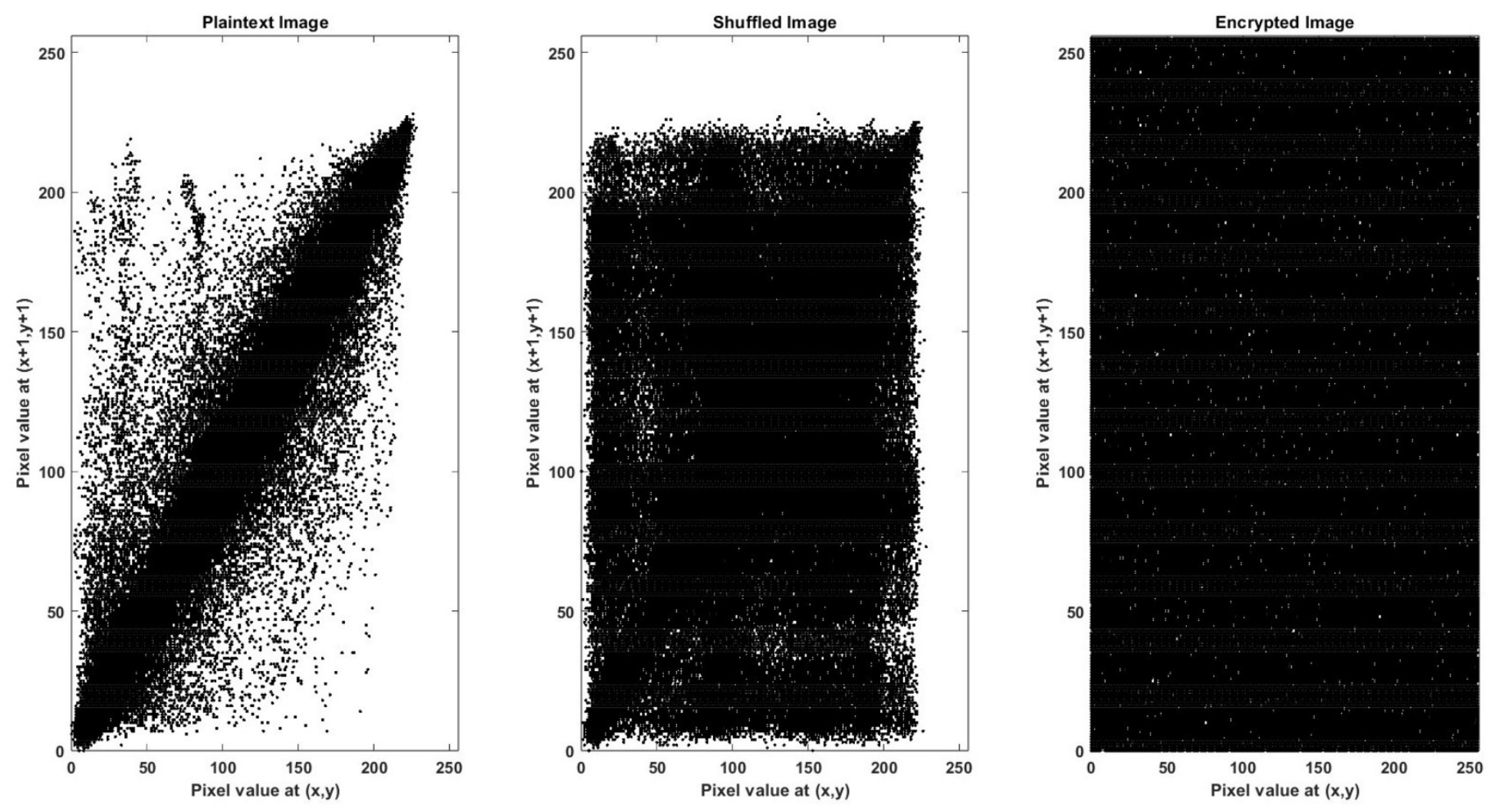
In Figure 12 the correlation diagrams are displayed. In the plaintext image, the points show linear connections, as they are concentrated around specific sections. Then in the scrambled image, the points are scattered almost evenly through the boundaries of the original image. Finally, in the encrypted image, they are perfectly distributed.
Figure 12.
Correlation analysis of adjacent pixels for “group size = 2” (peppers).
Grouping the rows and then the columns before mixing them has certain advantages in terms of time efficiency (see Table 1):
Table 1.
Average encryption time for different group sizes.
6. Discussion
The proposed hash-based image encryption algorithm combines permutation and XOR-based substitution to achieve strong statistical security properties. Experimental evaluation confirms
- Effective decorrelation of adjacent pixels;
- Uniform ciphertext histograms;
- Robustness against cropping, tampering, and moderate noise levels;
- Improved execution time with controlled grouping.
The balance between security robustness and computational efficiency depends significantly on the selected groupSize, making parameter selection a critical design consideration.
Future Extensions
The following directions are proposed for future research:
- Investigation of different parameter values of the hash map in order to analyze their influence on the structure of the generated hash sequence. Particular emphasis should be placed on avoiding the placement of adjacent groups in consecutive positions after shuffling.
- Incorporation of error correction algorithms or filtering techniques to mitigate the impact of transmission noise and improve overall robustness.
- Exploration of alternative grouping strategies, such as dividing the image into square blocks (e.g., ) combined with double shuffling procedures (intra-block and inter-block permutations).
- Application and evaluation of the algorithm on higher-dimensional data and color images to assess scalability and performance in more complex scenarios.
7. Conclusions
This study demonstrated the potential of chaotic cryptography as an effective framework for secure data transmission. Chaotic systems, due to their inherent properties such as sensitivity to initial conditions, ergodicity, and pseudo-random behavior, provide strong cryptographic foundations. However, they also introduce practical challenges related to numerical precision, computational resources, and rigorous security validation. The experimental implementation confirmed the necessity of combining permutation (shuffling) and substitution mechanisms.
- The shuffling stage reduces spatial correlations, protecting against attacks that exploit structural dependencies.
- The substitution stage, implemented through the XOR operation, eliminates statistical leakage and protects against histogram-based attacks.
The parameter groupSize, representing the number of rows or columns per group, was identified as a critical design factor. Increasing groupSize improves computational efficiency by reducing the number of shuffled groups. However, larger group sizes preserve more structural correlation in the intermediate shuffled image (prior to substitution). Despite this trade-off, the final encrypted images exhibited near-zero correlation for all tested group sizes due to the effectiveness of the substitution stage. Overall, the proposed image encryption algorithm demonstrates high efficiency and satisfactory security performance. It is particularly suitable for applications requiring fast processing under limited computational resources, provided that system parameters are carefully selected to maintain an optimal balance between performance and security.
Author Contributions
Conceptualization, E.P. and G.F.F.; methodology, E.P.; software, E.P.; validation, G.F.F.; writing—original draft preparation, E.P.; writing—review and editing, G.F.F. All authors have read and agreed to the published version of the manuscript.
Funding
This research received no external funding.
Institutional Review Board Statement
Not applicable.
Informed Consent Statement
Not applicable.
Data Availability Statement
No new data were created.
Acknowledgments
The authors want to thank Lazaros Moysis from the University of Nova Gorica, Slovenia, and Marcin Lawnick from the University of Gliwice, Poland, for their valuable comments on the original draft.
Conflicts of Interest
The authors declare no conflicts of interest.
References
- Deepa, N.R.; Sivamangai, N.M. A State-Of-Art Model of Encrypting Medical Image Using DNA Cryptography and Hybrid Chaos Map-2d Zaslavaski Map: Review. In Proceedings of the 2022 6th International Conference on Devices, Circuits and Systems (ICDCS); IEEE: New York, NY, USA, 2022; pp. 190–195. [Google Scholar] [CrossRef] [Scilit]
- Kolivand, H.; Hamood, S.F.; Asadianfam, S.; Mohd Rahim, M.S.; Hurst, W. Image Encryption Framework Based on Multi-Chaotic Maps and Equal Pixel Values Quantization. Multimed. Tools Appl. 2024, 84, 17769–17804. [Google Scholar] [CrossRef] [Scilit]
- Lv, J.; Li, X.; Yang, T.; Yu, H.; Liu, B. A General Pseudo-Random Number Generator Based on Chaos. In 4th EAI International Conference on Robotic Sensor Networks; Mu, S., Yujie, L., Lu, H., Eds.; Springer International Publishing: Cham, Switzerland, 2022; pp. 103–109. [Google Scholar] [CrossRef] [Scilit]
- Wen, H.; Lin, Y.; Yang, L.; Chen, R. Cryptanalysis of an Image Encryption Scheme Using Variant Hill Cipher and Chaos. Expert Syst. Appl. 2024, 250, 123748. [Google Scholar] [CrossRef] [Scilit]
- Lawnik, M.; Moysis, L.; García-Grimaldo, C.; Campos-Cantón, E.; Fragulis, G.F.; Volos, C. Generalized Vertigo Maps—A New Family of Chaotic Maps with Robust Chaos but without Fixed Points. Int. J. Bifurc. Chaos 2025, 35, 2530012. [Google Scholar] [CrossRef] [Scilit]
- Khan, S.; Peng, H.; Gu, Z.; Usman, S.; Mukhtar, N. Integration of a Novel 3D Chaotic Map with ELSS and Novel Cross-Border Pixel Exchange Strategy for Secure Image Communication. Complex Intell. Syst. 2024, 10, 8433–8465. [Google Scholar] [CrossRef] [Scilit]
- Lorenz, E.N. Predictability: Does the Flap of a Butterfly’s Wings in Brazil Set Off a Tornado in Texas? In Proceedings of the 139th Annual Meeting of the American Association for the Advancement of Science (AAAS), Washington, DC, USA, 29 December 1972. [Google Scholar]
- Al-Dayel, I.; Nadeem, M.F.; Khan, M.A.; Abraha, B.S. An Image Encryption Scheme Using 4-D Chaotic System and Cellular Automaton. Sci. Rep. 2025, 15, 19499. [Google Scholar] [CrossRef] [Scilit] [PubMed]
- Alexan, W.; Shabasy, N.H.E.; Ehab, N.; Maher, E.A. A Secure and Efficient Image Encryption Scheme Based on Chaotic Systems and Nonlinear Transformations. Sci. Rep. 2025, 15, 31246. [Google Scholar] [CrossRef] [Scilit] [PubMed]
- Moysis, L.; Lawnik, M.; Baptista, M.S.; Volos, C.; Fragulis, G.F. A Family of 1D Modulo-Based Maps without Equilibria and Robust Chaos: Application to a PRBG. Nonlinear Dyn. 2024, 112, 12597–12621. [Google Scholar] [CrossRef] [Scilit]
- Moysis, L.; Lawnik, M.; Volos, C.; Baptista, M.S.; Fragulis, G.F.; Goudos, S.K. Validating a Chaos Based PRBG under Different Chaotic Maps. In Proceedings of the 2024 Panhellenic Conference on Electronics & Telecommunications (PACET); IEEE: New York, NY, USA, 2024; pp. 1–4. [Google Scholar]
- Dinu, A.; Frunzete, M. Image Encryption Using Chaotic Maps: Development, Application, and Analysis. Mathematics 2025, 13, 2588. [Google Scholar] [CrossRef] [Scilit]
- Jackson, J.; Perumal, R. A Robust Image Encryption Technique Based on an Improved Fractional Order Chaotic Map. Nonlinear Dyn. 2025, 113, 7277–7296. [Google Scholar] [CrossRef] [Scilit]
- Kouadra, I.; Bekkouche, T.; Ziet, L.; Mehidi, I.; Alshathri, S.; El-Shafai, W. New Composite Chaotic Map Applied to an Image Encryption Scheme in Cybersecurity Applications. IEEE Access 2025, 13, 70676–70690. [Google Scholar] [CrossRef] [Scilit]
- Moysis, L.; Lawnik, M.; Fragulis, G.F.; Volos, C. Continuous-Time Density-Colored Bifurcation Diagrams. Int. J. Bifurc. Chaos 2025, 35, 2530028. [Google Scholar] [CrossRef] [Scilit]
- Moysis, L.; Lawnik, M.; Kollias, K.F.; Baptista, M.S.; Goudos, S.; Fragulis, G. Dynamic Analysis of a Generalized Attention Deficit Disorder Model with Soboleva Activation Functions. Chaos Interdiscip. J. Nonlinear Sci. 2025, 35, 083105. [Google Scholar] [CrossRef] [Scilit] [PubMed]
- Mahalakshmi, K.; Nagarajan, S. Comprehensive Review and Analysis of Image Encryption Techniques. IEEE Access 2025, 13, 109783–109813. [Google Scholar] [CrossRef] [Scilit]
- Moysis, L.; Lawnik, M.; Maraslidis, G.S.; Fragulis, G.F.; Volos, C. False Strange Attractors as Sources of Pseudo Randomness. Phys. Scr. 2025, 100, 115234. [Google Scholar] [CrossRef] [Scilit]
- Moysis, L.; Lawnik, M.; Baptista, M.S.; Volos, C.; Fragulis, G.F. A Review of Chaotification Techniques for Discrete-Time Systems. Nonlinear Dyn. 2025, 113, 14103–14119. [Google Scholar] [CrossRef] [Scilit]
- Pandey, K.; Sharma, D. Novel Image Encryption Algorithm Utilizing Hybrid Chaotic Maps and Elliptic Curve Cryptography with Genetic Algorithm. J. Inf. Secur. Appl. 2025, 89, 103995. [Google Scholar] [CrossRef] [Scilit]
- Tiwari, A.; Diwan, P.; Diwan, T.D.; Miroslav, M.; Samal, S.P. A Compressed Image Encryption Algorithm Leveraging Optimized 3D Chaotic Maps for Secure Image Communication. Sci. Rep. 2025, 15, 14151. [Google Scholar] [CrossRef] [Scilit] [PubMed]
- Zhang, H.; Feng, X.; Sun, J.; Yan, P. Chaotic Image Security Techniques and Developments: A Review. Mathematics 2025, 13, 1976. [Google Scholar] [CrossRef] [Scilit]
- Choumpaev, A.; Moysis, L.; Lawnik, M.; Fragulis, G.F. Exploring the Effects of an Asymmetric Activation Function in a Chaotic Neural Network Model of Epilepsy. IEEE Access 2025, 13, 214706–214720. [Google Scholar] [CrossRef] [Scilit]
- Gökstorp, S.; Katsikeas, S.; Johnson, P. Machine Learning for Cybersecurity: A Comprehensive Literature Review. ACM Comput. Surv. 2026, 58, 3796543. [Google Scholar] [CrossRef] [Scilit]
- Khalifa, I.A.; Saleem, S.M.; Sengur, A. Multilayer Steganalysis in the Encryption Era: A Comprehensive Review. Eur. J. Appl. Sci. Eng. Technol. 2026, 4, 73–99. [Google Scholar] [CrossRef] [Scilit] [PubMed]
- Kumar Rao, S.; Choudhary, N.; Shikder, A.; Tripathi, S.; Nishchal, N.K. Optical Cryptosystems Using Structured Light: Principle, Progress, and Future Prospects. J. Opt. 2026, 28, 013002. [Google Scholar] [CrossRef] [Scilit]
- Moysis, L.; Lawnik, M.; Volos, C.; Fragulis, G.F. Securing IoT Technologies for Smart Cities-Can Chaos Be the Answer? IET: London, UK, 2025. [Google Scholar]
- Moysis, L.; Lawnik, M.; Volos, C.; Baptista, M.S.; Goudos, S.K.; Fragulis, G.F. Testing the Strength of Chaotic Systems as Seeds in a Pseudo Random Bit Generator. IEEE Access 2025, 13, 23645–23657. [Google Scholar] [CrossRef] [Scilit]
- Negi, L.; Ragiri, P.R.; Bhatt, S.; Garg, G.; Sharma, K.; Bhatt, N. Integration of Artificial Intelligence with Information Security: A Systematic Literature Review: L. Negi et al. Knowl. Inf. Syst. 2026, 68, 38. [Google Scholar]
- Ngwenya, T.; Ndlovu, B. A Systematic Review of Post-Quantum Cryptography for Healthcare Data Protection: Performance, Readiness, and Deployment Challenges. J. Appl. Inform. Comput. 2026, 10, 134–149. [Google Scholar] [CrossRef] [Scilit]
- Moysis, L.; Lawnik, M.; Alexan, W.; Goudos, S.; Baptista, M.S.; Fragulis, G.F. Efficient Chaotic Image Encryption with Circular Shifting and Soboleva-modulo Map. In Proceedings of the 2025 14th International Conference on Modern Circuits and Systems Technologies (MOCAST); IEEE: New York, NY, USA, 2025; pp. 1–4. [Google Scholar]
- Doğanaksoy, A.; Sulak, F.; Uğuz, M.; Şeker, O.; Akcengiz, Z. New Statistical Randomness Tests Based on Length of Runs. Math. Probl. Eng. 2015, 2015, 626408. [Google Scholar] [CrossRef] [Scilit]
- Moysis, L.; Kafetzis, I.; Volos, C.; Tutueva, A.V.; Butusov, D. Application of a Hyperbolic Tangent Chaotic Map to Random Bit Generation and Image Encryption. In Proceedings of the 2021 IEEE Conference of Russian Young Researchers in Electrical and Electronic Engineering (ElConRus); IEEE: New York, NY, USA, 2021; pp. 559–565. [Google Scholar] [CrossRef] [Scilit]

Disclaimer/Publisher’s Note: The statements, opinions and data contained in all publications are solely those of the individual author(s) and contributor(s) and not of MDPI and/or the editor(s). MDPI and/or the editor(s) disclaim responsibility for any injury to people or property resulting from any ideas, methods, instructions or products referred to in the content. |
© 2026 by the authors. Licensee MDPI, Basel, Switzerland. This article is an open access article distributed under the terms and conditions of the Creative Commons Attribution (CC BY) license.