


Proceeding Paper

A Computational Architecture for Learning Behavior Analytics in AI-Enhanced Educational System †
by
Ritchfildjay L. Mariscal
*,
Nemuel H. Awid
,
Kurt Andrew O. Jale
and
Stanley J. Sy
College of Industrial Technology and Teacher Education, Caraga State University, Cabadbaran 8605, Philippines
*
Author to whom correspondence should be addressed.
Presented at the 8th International Global Conference Series on ICT Integration in Technical Education & Smart Society, Aizuwakamatsu City, Japan, 20–26 January 2026.
Eng. Proc. 2026, 143(1), 56; https://doi.org/10.3390/engproc2026143056
Published: 10 August 2026

Abstract

The rapid integration of Generative Artificial Intelligence (GenAI) technologies into educational environments has generated new opportunities for developing intelligent systems capable of monitoring learner interactions, modeling learning behaviors, and supporting adaptive educational decision-making. As learners increasingly engage with AI-powered tools for content generation, information retrieval, problem solving, and knowledge construction, educational platforms require robust analytics architectures that can transform human–AI interaction data into actionable insights for instructors, administrators, and learning support systems. This paper proposes a computational architecture for learning behavior analytics in AI-enhanced educational environments. The architecture integrates multiple analytical components, including learner interaction monitoring, behavioral data aggregation, AI utilization profiling, performance-related indicator analysis, and decision-support modules for adaptive intervention and learner support. The proposed framework is designed to capture measurable dimensions of AI-assisted learning behavior, enabling educational systems to identify usage patterns, model learner engagement, and generate analytics-driven recommendations for instructional improvement. The architecture adopts a data-driven approach in which behavioral indicators derived from learner interactions with GenAI tools are processed through learning analytics mechanisms to support predictive modeling, learner classification, and intelligent feedback generation. The framework further incorporates dashboards and reporting components that facilitate real-time monitoring of AI-assisted learning activities and provide evidence-based insights for educational stakeholders. To demonstrate the applicability of the proposed architecture, a pilot implementation was conducted using learner interaction and perception data collected from higher education students. Preliminary analytical results indicate that task-specific AI utilization behaviors provide meaningful behavioral signals that can be incorporated into learner modeling and adaptive learning analytics processes. These findings support the feasibility of integrating GenAI interaction data into intelligent educational systems for monitoring and decision-support purposes. The proposed architecture contributes to the development of next-generation educational technologies by providing a scalable framework for learning behavior analytics, human–AI interaction modeling, and intelligent educational decision support. The study offers practical implications for the design of adaptive learning platforms, educational data analytics systems, and AI-enabled learning environments that support effective and responsible human–AI collaboration.

1. Introduction

Generative Artificial Intelligence (GenAI) has intensified the need for computational architectures capable of capturing, processing, and interpreting human–AI interaction data within AI-enhanced educational systems. Contemporary GenAI systems are commonly built on transformer-based neural architectures that use attention mechanisms to process sequential data and generate context-sensitive outputs [1]. The development of large language models has further expanded the ability of AI systems to support prompt-based interaction, task generalization, language generation, summarization, information retrieval, and structured content production [2]. These capabilities have transformed GenAI from a stand-alone intelligent tool into an interactive computational layer that can be embedded within digital learning environments, analytics platforms, and decision-support systems. In AI-enhanced educational systems, learner engagement with GenAI tools produces measurable interaction traces. These traces may include prompt formulation, frequency of use, task-specific AI utilization, generated-output refinement, information-seeking behavior, problem-solving support, and user feedback on AI-generated responses. Such traces represent behavioral data that can be collected, structured, and processed through learning analytics mechanisms. Learning analytics is concerned with the measurement, collection, analysis, and reporting of learner-related data to understand and optimize learning processes and environments [3]. However, the emergence of GenAI requires learning analytics systems to move beyond conventional platform logs and incorporate AI-specific behavioral indicators that describe how learners interact with intelligent systems. Existing learning analytics and educational data mining approaches provide important computational foundations for modeling learner behavior, identifying patterns, and supporting performance prediction. These approaches commonly use data mining, machine learning, classification, clustering, visualization, and predictive modeling to transform learner-generated data into interpretable indicators [4]. A reference model for learning analytics emphasizes the relationship among data sources, stakeholders, objectives, and analytical methods, thereby providing a basis for designing analytics systems that are methodologically structured and computationally coherent [5]. Nevertheless, conventional learning analytics architectures were generally developed around learning management system activities, assessment records, and digital learning traces. They do not fully address the additional data layer produced by human interaction with GenAI tools. This gap creates a need for a computational architecture that can integrate GenAI interaction data into learning behavior analytics. Such an architecture must support data acquisition, behavioral data aggregation, feature extraction, AI utilization profiling, learner modeling, performance-related indicator analysis, dashboard visualization, and decision-support processes. The architecture should also enable the conversion of raw human–AI interaction traces into meaningful behavioral features that can be used for learner classification, predictive modeling, and adaptive intervention. In this sense, GenAI utilization is not treated merely as technology adoption but as a computationally observable behavior within an intelligent educational system. The proposed architecture is informed by established work in human–AI interaction, learning analytics, and technology acceptance. Human–AI interaction research emphasizes the importance of designing AI systems that support transparency, user control, feedback, and appropriate reliance on AI-generated outputs [6]. These principles are particularly relevant to systems that monitor and interpret AI-assisted learning behaviors because learner interactions with GenAI may involve cognitive offloading, content generation, output verification, and task delegation. At the same time, technology acceptance theory explains how perceived usefulness and perceived ease of use influence user acceptance and continued use of information systems [7]. In this architecture, acceptance-related indicators provide a basis for interpreting why learners repeatedly use GenAI tools and how such use becomes part of their learning behavior. A further architectural concern is the reliability of AI-generated outputs. Large language models can produce fluent and plausible responses, but they may also generate inaccurate, fabricated, or unverifiable information, a problem commonly referred to as hallucination [8]. For this reason, an AI-enhanced learning analytics system should not only monitor frequency of GenAI use but should also consider task-specific utilization, user familiarity, output evaluation behavior, and performance-related indicators. These variables allow the architecture to represent AI-assisted learning as a structured behavioral analytics problem rather than a simple measure of tool access. This study proposes and demonstrates a computational architecture for learning behavior analytics in AI-enhanced educational systems. The architecture is organized around interconnected modules for learner interaction monitoring, GenAI utilization profiling, behavioral feature extraction, analytics processing, learner modeling, performance-indicator analysis, visualization, and adaptive decision support. Using pilot learner interaction and perception-based data from higher education students, the study examines GenAI familiarity and task-specific utilization as behavioral indicators and analyzes their relationships with perceived learning-performance measures. The main contribution of the paper is a modular analytics framework that converts learner profiles, GenAI tool-use patterns, familiarity indicators, task-specific utilization, and perceived learning-performance measures into structured behavioral features for learner modeling and decision support. By framing GenAI use as a system-level analytics problem, the study provides a scalable basis for future AI-enabled educational analytics systems that move beyond measuring GenAI access toward understanding how learners use AI tools for academic tasks and responsible human–AI collaboration.

2. Methodology

2.1. Research Design

This study employed a quantitative descriptive-correlational design within a proof-of-concept computational architecture for learning behavior analytics in AI-enhanced educational systems. The descriptive component was used to characterize the respondents’ profile, identify commonly used Generative Artificial Intelligence (GenAI) tools, and determine the levels of GenAI familiarity, task-specific utilization, and perceived academic performance indicators. The correlational component examined whether GenAI familiarity and task-specific GenAI utilization were significantly associated with performance-related indicators. The study was not intended as a full-scale deployment of an intelligent learning platform. Rather, it served as a pilot implementation for testing whether measurable GenAI-related learner data could be collected, processed, and interpreted as preliminary inputs for learning behavior analytics and decision-support.

2.2. Computational Architecture and Analytical Workflow

The methodology followed a modular analytics workflow composed of six layers: learner data source, data acquisition, behavioral feature extraction, analytics processing, learner modeling, and decision-support visualization. The learner data source layer represented the human–AI interaction environment in which students used GenAI tools for academic tasks. The data acquisition layer gathered structured responses on GenAI familiarity, AI tool use, task-specific utilization, and perceived performance indicators. The behavioral feature extraction layer converted survey responses into measurable variables, including GenAI familiarity scores, task-specific utilization scores, and performance-indicator scores. The analytics processing layer applied descriptive statistics and correlation analysis to examine usage patterns and performance-related associations. The learner modeling layer interpreted the computed indicators as evidence of AI-assisted learning behavior, while the decision-support visualization layer provided a basis for future dashboards, reports, and instructional recommendations. This workflow demonstrated how learner-generated data may move from raw responses to analytical outputs and decision-support insights. To make the proposed architecture operationally clear, the computational workflow was organized into modular components. Each module performs a defined function in transforming learner-generated GenAI data into analytics-ready features, learner profiles, and decision-support outputs. Table 1 summarizes the major computational modules, their inputs, processing functions, and expected outputs.
This modular structure clarifies how the proposed architecture differs from a conventional descriptive survey process. In the proposed workflow, learner responses are not treated only as statistical outputs but are converted into computational features that can support learner profiling, dashboard reporting, and future adaptive decision-support functions.

2.3. Participants and Case Dataset

The study used a case dataset consisting of 170 technology education students from Caraga State University Cabadbaran Campus. The participants came from different year levels and specialization areas, providing a varied learner group for examining GenAI utilization in an AI-assisted learning environment. Total enumeration sampling was used, and all available and willing students from the identified program during the data-gathering period were invited to participate. The dataset was considered appropriate because the respondents had exposure to digital learning tools and GenAI applications, making their responses relevant for examining AI-assisted academic behaviors.

2.4. Research Instrument and Behavioral Indicators

A structured survey questionnaire served as the primary data collection instrument. It was designed to gather data on learner profile variables, commonly used GenAI tools, GenAI familiarity, task-specific GenAI utilization, and perceived academic performance indicators. The instrument contained sections aligned with the major variables of the study. The learner profile section captured demographic and academic characteristics. The GenAI tool-use section identified the AI-enabled platforms commonly accessed by the respondents. The GenAI familiarity section measured learners’ awareness, understanding, confidence, and perceived capability in using AI-assisted tools. The GenAI utilization section measured task-specific applications such as information searching, content generation, idea organization, writing assistance, grammar refinement, summarization, and problem-solving support. The perceived academic performance section measured knowledge acquisition, skills development, and problem-solving and critical thinking. Items were rated using a five-point Likert scale. Higher scores indicated greater GenAI familiarity, stronger agreement with task-specific AI utilization behaviors, or more favorable perceived academic performance indicators. Responses were converted into composite mean scores representing the main variables used in the analysis.

2.5. Data Gathering and Preprocessing Procedure

Permission was secured from the appropriate college authority before the conduct of the study. The questionnaire was personally administered to the respondents. Before data collection, the purpose of the study, voluntary participation, confidentiality of responses, and right to withdraw were explained. After retrieval, the responses were checked for completeness, encoded, cleaned, and prepared for analysis. The preprocessing procedure involved coding Likert-scale responses, grouping related items into composite indicators, and organizing the dataset for descriptive and correlational analysis.

2.6. Ethical and Data Governance Considerations

The study observed ethical procedures in the collection and handling of learner data. Participation was voluntary, and informed consent was obtained from the respondents. No personally identifiable information was disclosed, and all results were reported in aggregate form. The responses were used only for academic and research purposes. Because the study involved learner data within a proposed analytics architecture, data governance was considered part of the methodological process. Privacy protection, restricted access to identifiable information, responsible data use, and aggregate reporting were observed to ensure that learner monitoring and profiling remained transparent, fair, and educationally responsible.

2.7. Data Analysis and Analytics Processing

Frequency and percentage were used to describe the respondents’ profile and commonly used GenAI tools. Mean and standard deviation were used to determine the levels of GenAI familiarity, task-specific GenAI utilization, and perceived academic performance indicators. Composite mean scores were computed for GenAI familiarity, task-specific GenAI utilization, and each performance-related indicator. Pearson product–moment correlation was used to determine the direction and strength of association between GenAI familiarity and perceived academic performance indicators, and between task-specific GenAI utilization and perceived academic performance indicators. The level of significance was set at 0.05. In the proposed analytics workflow, descriptive statistics generated baseline learner behavior profiles, while correlation analysis identified relationships between AI-assisted learning behaviors and performance-related outcomes. The resulting patterns were interpreted as preliminary decision-support signals for future learner classification, instructional monitoring, and adaptive support.

2.8. Validity and Reliability of the Instrument

The questionnaire was validated by faculty experts to ensure that the items were clear, relevant, and aligned with the objectives of the study. Expert validation focused on the appropriateness of the items in measuring GenAI familiarity, task-specific utilization, and perceived academic performance indicators. A pilot test was conducted with 40 students who were not part of the final respondents. The instrument obtained a Cronbach’s alpha of 0.937 and a standardized alpha of 0.939, indicating excellent internal consistency as shown in Table 2. The reliability result supports the use of the instrument as a structured tool for collecting data on AI-assisted learning behavior.

3. Results and Discussion

3.1. Learner-User Dataset Profile for the Pilot Analytics Implementation

Figure 1 presents the learner-user dataset profile used in the pilot implementation of the proposed learning behavior analytics architecture. The dataset consisted of 170 learner-user cases classified according to age, sex, specialization, and year level. Most participants were 18–20 years old, representing 63.53% of the dataset, followed by those aged 21–25 years old at 29.41%. Female learners accounted for the largest proportion at 60.59%, while male learners represented 38.82%. In terms of specialization, Food Service Management had the highest representation at 25.88%, followed by Garments, Fashion and Design at 24.71%, Automotive Technology at 16.47%, and Electronics Technology at 15.29%. For year level, first-year learners formed the largest group at 49.41%, followed by second-year learners at 22.94%. These distributions provide the baseline learner metadata needed to contextualize AI-assisted learning behavior. In the proposed architecture, demographic and academic profile variables serve as contextual inputs that can be linked with GenAI familiarity, tool utilization, task-specific use, and performance-related indicators. Learning analytics emphasizes the collection, analysis, interpretation, and communication of learner-related data to generate actionable insights for improving learning and teaching [3]. Thus, age group, sex, specialization, and year level are not interpreted only as descriptive variables but as contextual features that can support learner profiling and segmented analysis. Since the architecture is proposed and demonstrated through pilot data rather than implemented as a real-time analytics system, Figure 1 shows how the learner-user dataset would normally appear before computational processing.
The Figure 1 showed the distribution of the 170 learner user cases according to age group, sex, specialization, and year level. Under a conventional research process, these profile variables would remain largely descriptive. Within the proposed architecture, however, they can be encoded in the learner model and connected to behavioral and performance indicators. This allows the system to support more organized dashboard reporting, learner grouping, and decision-support functions. Such integration should be guided by ethical learning analytics principles, particularly transparency, privacy protection, appropriate data use, and responsible interpretation of learner data [9].

3.2. GenAI Tool Utilization Profile of the Learner-User Dataset

Table 3 presents the GenAI tool utilization profile of the learner-user dataset. ChatGPT (GPT-5) was the most frequently used tool, reported by 148 learner-users or 87.06% of the dataset. This was followed by QuillBot with 91 users or 53.53%, Grammarly with 75 users or 44.12%, Cici with 62 users or 36.47%, Google Gemini with 58 users or 34.12%, and Brainly with 45 users or 26.47%. Other tools were used by smaller proportions of the dataset, including Gamma, Copilot, Jenni AI, Meta AI, Jasper, DeepSeek, DALL-E, Qwen, Blackbox AI, Perplexity, Debunked AI, POE AI, and Litmaps. The dominance of ChatGPT indicates that conversational AI served as the primary GenAI interface among the learner-users. This suggests that learners were more likely to engage with general-purpose AI platforms capable of supporting information retrieval, content generation, explanation, and academic task assistance. This pattern is consistent with recent discussions on GenAI in education, which identify ChatGPT and related large language model applications as accessible tools for academic support while also raising concerns related to accuracy, misuse, assessment validity, and responsible integration [10,11]. The relatively high use of QuillBot and Grammarly further indicates that a substantial portion of learner-AI interaction was writing-centered, particularly for paraphrasing, grammar correction, and language refinement. Meanwhile, the use of Gamma, Copilot, Jenni AI, Perplexity, Litmaps, and Blackbox AI shows that some learners also used task-specific tools for presentation generation, productivity support, academic writing, AI-assisted search, literature mapping, and coding-related assistance.
In the proposed architecture, this tool-use profile represents the AI-interaction source layer. Instead of treating Table 3 only as a frequency distribution, each reported tool can be categorized according to its primary academic function, such as conversational AI, writing support, information retrieval, coding assistance, presentation generation, image generation, verification support, and literature mapping. These categories can then be linked with learner profile variables, familiarity indicators, task-specific utilization scores, and performance-related outcomes. This improves the analytical value of the data by transforming fragmented self-reported tool use into structured behavioral indicators for learner modeling.

3.3. GenAI Familiarity Indicators

Table 4 presents GenAI familiarity as a set of learner-readiness features for the proposed learning behavior analytics architecture. The composite familiarity score obtained a mean of 3.42 and a standard deviation of 0.84, interpreted as Very Familiar. This result indicates that the learner-user dataset generally demonstrated favorable readiness to interact with GenAI tools. Among the three indicators, task compatibility obtained the highest mean of 3.47 with a standard deviation of 0.92, interpreted as Very Familiar. This suggests that learners perceived GenAI tools as compatible with their preferred learning and task-completion methods. In the proposed architecture, task compatibility may be encoded as a behavioral-readiness feature that reflects how well AI tools fit into learner workflows. This interpretation is supported by the Technology Acceptance Model, which explains that perceived usefulness and perceived ease of use influence technology acceptance [7]. Similarly, the Unified Theory of Acceptance and Use of Technology identifies performance expectancy and effort expectancy as important determinants of technology-use behavior [12].
Functional awareness obtained a mean of 3.44 and a standard deviation of 0.95, also interpreted as Very Familiar. This suggests that learners were generally aware of the capabilities and applications of GenAI, including content generation, explanation, summarization, writing support, information assistance, and task support. This is relevant because large language models have been increasingly associated with educational functions such as feedback generation, tutoring support, content assistance, and interactive learning [13]. However, awareness of GenAI functions must be complemented by critical judgment, especially because AI-generated outputs may raise concerns related to accuracy, transparency, privacy, and academic integrity [13,14]. The lowest-rated indicator was technical readiness, with a mean of 3.34 and a standard deviation of 0.97, interpreted as Moderately Familiar. This suggests that learners may be comfortable using GenAI interfaces but less prepared to manage the technical and evaluative demands of responsible AI use. These include prompt formulation, recognition of model limitations, output validation, bias detection, privacy awareness, and responsible interpretation of generated responses. This distinction is important because familiarity with AI functions does not necessarily mean that learners can critically evaluate the quality, reliability, or ethical implications of AI-generated content.
Within the proposed architecture, familiarity indicators can be encoded as learner-readiness features and connected with tool-use categories, task-specific utilization patterns, and performance-related indicators. For example, learners with high functional awareness but only moderate technical readiness may require targeted support in prompt design, output verification, ethical use, and critical evaluation. In this way, familiarity data can move beyond static survey interpretation and become actionable input for learner profiling, adaptive support, and instructional decision-making.

3.4. Task-Specific GenAI Utilization Features

Table 5 presents the task-specific GenAI utilization indicators of the learner-user dataset. The composite GenAI utilization score obtained a mean of 3.91 and a standard deviation of 0.60, interpreted as a High Level of Agreement. This result indicates that learners frequently applied GenAI tools across academic tasks. In the proposed architecture, the composite utilization score may serve as an overall behavioral feature representing the intensity of AI-assisted academic engagement. The highest-rated indicator was information retrieval, with a mean of 4.08 and a standard deviation of 0.79. This was followed by research material aggregation and technical information simplification, both with a mean of 4.04. These findings suggest that learners most frequently used GenAI tools to search for information, gather research materials, summarize content, and simplify technical concepts. These indicators may be grouped as knowledge-access behaviors because they reflect the use of GenAI for information processing, content interpretation, and academic support. The next group of indicators reflects writing, ideation, and language-support behaviors. Grammar and style refinement obtained a mean of 3.99, project brainstorming obtained 3.97, idea generation and outlining obtained 3.95, language translation support obtained 3.89, and writing assistance obtained 3.78. These results show that learners did not use GenAI only as a search tool but also as a support mechanism for organizing ideas, improving written outputs, translating content, and completing academic tasks. This aligns with studies showing that large language models can support content generation, feedback, learner interaction, and academic assistance when used with appropriate human oversight [13,14]. The lowest-rated indicators were study-aid generation, with a mean of 3.67, and multimedia content generation, with a mean of 3.71. Although both were still interpreted as a High Level of Agreement, their lower means suggest that GenAI use in the dataset was more text-based and information-centered than multimedia-oriented. This distinction is useful for the proposed architecture because it allows utilization indicators to be classified into functional domains, such as knowledge access, writing support, ideation, study-resource generation, and multimedia production. Under a conventional non-architectural process, these results would normally remain as descriptive survey means.
Through the proposed architecture, however, each utilization indicator can be transformed into a structured behavioral feature and processed through the feature-extraction and analytics layers. For instance, information retrieval, research material aggregation, and technical simplification may be grouped as knowledge-access behaviors; grammar refinement, translation, and writing assistance as writing-support behaviors; and brainstorming, outlining, study-aid generation, and multimedia creation as learning-production behaviors. This classification provides a more coherent basis for learner modeling and dashboard-based reporting.

3.5. Analytics for GenAI Features and Learning Performance

Table 6 presents the correlation analytics between GenAI familiarity and the learning-performance indicators. The GenAI familiarity feature obtained a mean of 3.42 and a standard deviation of 0.84, while the performance-related indicators obtained mean scores of 3.92 for knowledge acquisition, 3.74 for skills development, and 3.81 for problem-solving and critical thinking. The results show significant positive associations between GenAI familiarity and all three learning-performance indicators. Specifically, GenAI familiarity was significantly associated with knowledge acquisition, r = 0.28, t = 3.81, p = 0.001; skills development, r = 0.28, t = 3.73, p = 0.001; and problem-solving and critical thinking, r = 0.26, t = 3.51, p = 0.001. Although the coefficients are low, the findings indicate that learners with higher GenAI familiarity tended to report more favorable perceived learning outcomes. The strongest associations were observed between familiarity and knowledge acquisition, and between familiarity and skills development, both with r = 0.28. These relationships may be explained by the role of GenAI tools in supporting information retrieval, explanation, summarization, writing assistance, and feedback-related tasks. Recent literature on large language models in education suggests that GenAI can support content assistance, learner interaction, feedback generation, and academic task support, provided that use is guided by responsible human oversight [13,14].
The association between GenAI familiarity and problem-solving and critical thinking was also significant, r = 0.26, but slightly lower than the associations with knowledge and skills. This suggests that familiarity alone may be insufficient to support higher-order learning outcomes. Problem-solving and critical thinking require evaluation, reasoning, reflection, verification, and independent judgment. Therefore, the proposed architecture should treat familiarity as a readiness feature rather than as a strong predictor of learning performance. In an analytics system, GenAI familiarity can help contextualize how prepared learners are to engage with AI-supported academic tasks. However, the low correlation coefficients indicate that familiarity explains only a limited portion of the variation in perceived learning-performance indicators. Other factors, such as prior academic preparation, digital literacy, instructional support, motivation, access to technology, and quality of GenAI use, may also influence learning outcomes. Therefore, the proposed architecture should combine familiarity with other behavioral features, including task-specific utilization, output verification, ethical use, engagement logs, and learner profile variables. These findings should be interpreted cautiously because correlation does not establish causation. The results provide useful pilot analytics, but they should not be used to claim that GenAI familiarity directly improves learning performance. Instead, they suggest that familiarity may serve as one contextual input in a broader learner analytics model.

3.6. Analytics for GenAI Utilization Feature and Learning Performance

Table 7 presents the correlation analytics between task-specific GenAI utilization and the learning-performance indicators. The task-specific GenAI utilization feature obtained a mean of 3.91 and a standard deviation of 0.60, indicating a high level of GenAI use across academic tasks. The results show significant positive associations between task-specific GenAI utilization and all three performance-related indicators. Specifically, task-specific GenAI utilization was strongly associated with knowledge acquisition, r = 0.69, t = 12.38, p = 0.001; moderately to strongly associated with skills development, r = 0.63, t = 10.62, p = 0.001; and moderately associated with problem-solving and critical thinking, r = 0.48, t = 7.14, p = 0.001.
These findings suggest that learners who reported more frequent task-based use of GenAI also tended to report more favorable learning-performance indicators. Compared with general familiarity, task-specific utilization produced stronger associations with knowledge acquisition, skills development, and problem-solving and critical thinking. This indicates that actual academic use of GenAI may provide a more meaningful behavioral signal than awareness or familiarity alone. The strongest relationship was observed between task-specific GenAI utilization and knowledge acquisition. This suggests that AI-supported behaviors such as information retrieval, summarization, research material aggregation, and technical simplification may contribute to perceived knowledge development. The association with skills development was also strong, indicating that writing assistance, grammar refinement, translation, brainstorming, outlining, and project-related use may support the development of academic and task-related skills. These findings are consistent with studies suggesting that large language models can assist with content generation, feedback, explanation, and academic task support when used critically and responsibly [13,14]. The relationship between task-specific GenAI utilization and problem-solving and critical thinking was lower but still significant. This result indicates that task-based GenAI use may support higher-order learning, although to a lesser extent than knowledge and skills development. This is expected because problem-solving and critical thinking require learners to evaluate information, verify outputs, compare alternatives, and apply human judgment. Since AI-generated responses may be fluent but inaccurate, biased, or unsupported, learners must critically assess outputs before using them in academic work [15]. Because the proposed architecture has not yet been fully implemented as a real-time learning analytics platform, the results should be interpreted as pilot analytics derived from manually processed survey data. The value of the proposed architecture lies in its ability to transform these survey-based indicators into computable behavioral features. Task-specific utilization scores can be linked with learner profiles, GenAI familiarity, tool-use categories, and performance indicators to support learner profiling, instructional monitoring, and decision-support.

4. Conclusions

This study proposed a computational architecture for learning behavior analytics in AI-enhanced educational systems by modeling learner profile variables, GenAI tool-use patterns, familiarity indicators, task-specific utilization, and perceived learning-performance measures as structured behavioral features. Using a pilot dataset of 170 learner-users, the results showed that ChatGPT was the most frequently used GenAI tool, followed by writing- and language-support applications such as QuillBot and Grammarly. Learners demonstrated a very familiar level of GenAI readiness, particularly in functional awareness and task compatibility, although technical readiness remained comparatively lower. Task-specific GenAI utilization was also high, especially for information retrieval, research material aggregation, technical simplification, grammar refinement, brainstorming, and writing support. Correlation analytics showed that GenAI familiarity had significant but low positive associations with knowledge acquisition, skills development, and problem-solving and critical thinking, while task-specific GenAI utilization showed stronger significant associations with all three learning-performance indicators. These findings suggest that actual academic use of GenAI provides a more meaningful behavioral signal for learner modeling than general familiarity alone. The main contribution of the study is the development of a modular analytics framework that demonstrates how GenAI-related learner data can be transformed into computable features for learner profiling, performance-indicator analysis, dashboard-based monitoring, and instructional decision support. However, the study is limited by its reliance on self-reported data from a single learner-user dataset and by the fact that the proposed architecture was not yet deployed as a real-time learning analytics system. Therefore, the findings should be interpreted as pilot analytics rather than causal evidence of GenAI impact on learning performance. Future work should implement the architecture in an operational dashboard environment, integrate actual GenAI interaction logs and learning management system data, validate the model across larger and more diverse populations, and examine how AI-assisted behavioral features predict academic performance, engagement, and higher-order learning outcomes over time.

Author Contributions

Conceptualization, R.L.M., N.H.A., K.A.O.J. and S.J.S.; methodology, R.L.M., N.H.A., K.A.O.J. and S.J.S.; software, R.L.M., N.H.A., K.A.O.J. and S.J.S.; validation, R.L.M., N.H.A., K.A.O.J. and S.J.S.; formal analysis, R.L.M., N.H.A., K.A.O.J. and S.J.S.; investigation, R.L.M., N.H.A., K.A.O.J. and S.J.S.; resources, R.L.M., N.H.A., K.A.O.J. and S.J.S.; data curation, R.L.M., N.H.A., K.A.O.J. and S.J.S.; writing—original draft preparation, R.L.M., N.H.A., K.A.O.J. and S.J.S.; writing—review and editing R.L.M., N.H.A., K.A.O.J. and S.J.S.; visualization, R.L.M., N.H.A., K.A.O.J. and S.J.S.; supervision, R.L.M. All authors have read and agreed to the published version of the manuscript.

Funding

This research received no external funding. The authors wish to extend gratitude to Caraga State University for the funding support.

Institutional Review Board Statement

The study was conducted in accordance with institutional research ethics procedures. Ethical clearance was waived because the study involved minimal-risk survey data, no sensitive personal information, and aggregate reporting only.

Informed Consent Statement

Informed consent was obtained from all participants involved in the study.

Data Availability Statement

The data presented in this study are available upon request from the corresponding author through rlmariscal@carsu.edu.ph.

Acknowledgments

The authors wish to extend their gratitude to Caraga State University for the support extended to researchers.

Conflicts of Interest

The authors declare no conflicts of interest.

Abbreviations

The following abbreviations are used in this manuscript:
AIArtificial Intelligence
GenAIGenerative Artificial Intelligence
LLMLarge Language Model
ChatGPTChat Generative Pretrained Transformer
UTAUTUnified Theory of Acceptance and Use of Technology
TAMTechnology Acceptance Model

References

  1. Vaswani, A.; Shazeer, N.; Parmar, N.; Uszkoreit, J.; Jones, L.; Gomez, A.N.; Kaiser, L.; Polosukhin, I. Attention Is All You Need. arXiv 2023, arXiv:1706.03762. [Google Scholar] [CrossRef]
  2. Brown, T.B.; Mann, B.; Ryder, N.; Subbiah, M.; Kaplan, J.; Dhariwal, P.; Neelakantan, A.; Shyam, P.; Sastry, G.; Askell, A.; et al. Language Models are Few-Shot Learners. arXiv 2020, arXiv:2005.14165. [Google Scholar] [CrossRef]
  3. “What is Learning Analytics.” Society for Learning Analytics Research (SoLAR). Available online: https://www.solaresearch.org/about/what-is-learning-analytics/ (accessed on 28 June 2026).
  4. López-Meneses, E.; Mellado-Moreno, P.C.; Herrerías, C.G.; Pelícano-Piris, N. Educational Data Mining and Predictive Modeling in the Age of Artificial Intelligence: An In-Depth Analysis of Research Dynamics. Computers 2025, 14, 68. [Google Scholar] [CrossRef]
  5. Chatti, M.A.; Dyckhoff, A.L.; Schroeder, U.; Thüs, H. A reference model for learning analytics. Int. J. Technol. Enhanc. Learn. 2012, 4, 318–331. [Google Scholar] [CrossRef]
  6. Amershi, S.; Weld, D.; Vorvoreanu, M.; Fourney, A.; Nushi, B.; Collisson, P.; Horvitz, E. Guidelines for Human-AI Interaction. In Proceedings of the 2019 CHI Conference on Human Factors in Computing Systems, in CHI ’19; Association for Computing Machinery: New York, NY, USA, 2019; pp. 1–13. [Google Scholar] [CrossRef]
  7. Davis, F.D. Perceived Usefulness, Perceived Ease of Use, and User Acceptance of Information Technology. MIS Q. 1989, 13, 319–340. [Google Scholar] [CrossRef] [PubMed]
  8. Li, J.; Cheng, X.; Zhao, X.; Nie, J.-Y.; Wen, J.-R. HaluEval: A Large-Scale Hallucination Evaluation Benchmark for Large Language Models. In Proceedings of the 2023 Conference on Empirical Methods in Natural Language Processing; Bouamor, H., Pino, J., Bali, K., Eds.; Association for Computational Linguistics: Singapore, 2023; pp. 6449–6464. [Google Scholar] [CrossRef]
  9. Slade, S.; Prinsloo, P. Learning Analytics: Ethical Issues and Dilemmas. Am. Behav. Sci. 2013, 57, 1510–1529. [Google Scholar] [CrossRef]
  10. Guidance for Generative AI in Education and Research|UNESCO. Available online: https://www.unesco.org/en/articles/guidance-generative-ai-education-and-research (accessed on 28 June 2026).
  11. Zastudil, C.; Rogalska, M.; Kapp, C.; Vaughn, J.; MacNeil, S. Generative AI in Computing Education: Perspectives of Students and Instructors. arXiv 2023, arXiv:2308.04309. [Google Scholar] [CrossRef]
  12. Venkatesh, V.; Morris, M.G.; Davis, G.B.; Davis, F.D. User Acceptance of Information Technology: Toward a Unified View. MIS Q. 2003, 27, 425–478. [Google Scholar] [CrossRef]
  13. Kasneci, E.; Sessler, K.; Küchemann, S.; Bannert, M.; Kasneci, G. ChatGPT for good? On opportunities and challenges of large language models for education. Learn. Individ. Differ. 2023, 103, 102274. [Google Scholar] [CrossRef]
  14. Yan, L.; Sha, L.; Zhao, L.; Li, Y.; Martinez-Maldonado, R.; Chen, G.; Li, X.; Jin, Y.; Gašević, D. Practical and Ethical Challenges of Large Language Models in Education: A Systematic Scoping Review. Br. J. Educ. Technol. 2024, 55, 90–112. [Google Scholar] [CrossRef]
  15. Ji, Z.; Lee, N.; Frieske, R.; Yu, T.; Su, D.; Xu, Y.; Ishii, E.; Bang, Y.J.; Madotto, A.; Fung, P. Survey of Hallucination in Natural Language Generation. ACM Comput. Surv. 2023, 55, 1–38. [Google Scholar] [CrossRef]
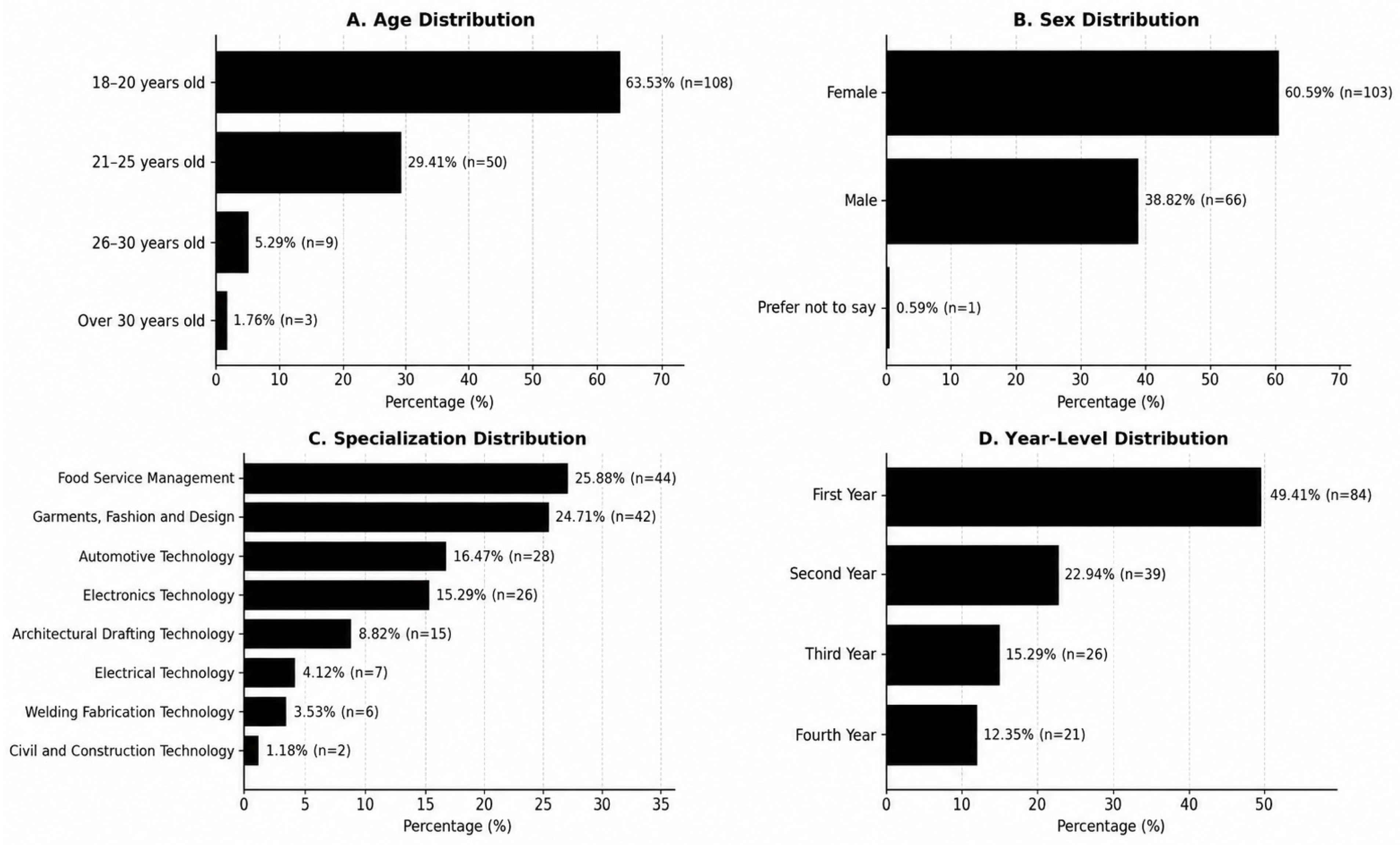
Figure 1. Learner-user dataset profile.
Engproc 143 00056 g001
Table 1. Functional Modules and Data Flow of the Proposed Computational Architecture.
ModuleInputProcessing FunctionOutput
Learner Data SourceLearner profile data, GenAI tool-use data, academic task responsesIdentifies the human–AI interaction environment and learner-related data sourcesRaw learner-user dataset
Data
Acquisition
Survey responses, GenAI familiarity items, task-specific utilization items, performance indicatorsCollects and encodes structured learner responsesOrganized learner data matrix
Behavioral Feature
Extraction
Encoded survey indicatorsConverts responses into composite scores and behavioral featuresGenAI familiarity, utilization, and performance-related feature scores
Analytics
Processing
Behavioral feature scores and learner profile variablesApplies descriptive statistics and correlation analyticsUsage patterns and performance-related associations
Learner
Modeling
Analytics outputs and behavioral indicatorsInterprets readiness, utilization, and performance indicators as learner behavior profilesLearner-readiness and AI-utilization profiles
Decision-
Support Visualization
Learner model outputs and analytics resultsPrepares outputs for dashboards, reporting, and instructional interpretationDashboard-ready indicators and instructional decision-support insights
Table 2. Reliability test result of research instrument.
StatisticsValue
Mean156.625
Standard deviation20.360
Valid N40
Cronbach alpha0.937
Standardized alpha0.939
Average inter-item correlation0.281
Table 3. GenAI Tool Utilization Profile for the Learner-User Dataset.
RankGenAI ToolFrequencyPercentage of Learner-Users (%)Functional Category
1ChatGPT14887.06Conversational AI/content generation
2QuillBot9153.53Paraphrasing/writing refinement
3Grammarly7544.12Grammar and writing support
4Cici6236.47Conversational AI/learning assistance
5Google Gemini5834.12Conversational AI/information retrieval
6Brainly4526.47Academic question support
7Gamma3319.41Presentation and content generation
8Copilot169.41AI-assisted productivity/coding support
9Jenni AI148.24Academic writing support
10Meta AI74.12Conversational AI
11Jasper21.18Content generation
12DeepSeek21.18Conversational AI/coding support
13DALL·E10.59Image generation
14Qwen10.59Conversational AI
15Blackbox AI10.59Coding assistance
16Perplexity10.59AI-assisted search
17Debunked AI10.59Verification/fact-checking support
18POE AI10.59Multi-model AI access
19Litmaps10.59Literature mapping/research support
Table 4. GenAI Familiarity Indicators as Learner-Readiness Features.
Learner-Readiness IndicatorBehavioral Feature RepresentedMeanSDInterpretation
Technical knowledge required to utilize GenAI toolsTechnical readiness3.340.97Moderately Familiar
Familiarity with GenAI capabilities and applicationsFunctional awareness3.440.95Very Familiar
Alignment of GenAI with preferred learning and task-completion methodsTask compatibility3.470.92Very Familiar
Composite familiarity scoreOverall GenAI readiness feature3.420.84Very Familiar
Legend. 1.00–1.79 = Not at all Familiar; 1.80–2.59 = Slightly Familiar; 2.60–3.40 = Moderately Familiar; 3.41–4.20 = Very Familiar; 4.21–5.00 = Extremely Familiar.
Table 5. Task-Specific GenAI Utilization Features for Learning Behavior Analytics.
GenAI Utilization IndicatorBehavioral Feature RepresentedMeanSDInterpretation
Use of GenAI tools to help with writing essays and assignmentsWriting assistance3.780.85High Level of Agreement
Use of GenAI tools to gather research materials and summariesResearch material aggregation4.040.78High Level of Agreement
Use of GenAI tools to generate ideas and outlinesIdea generation and outlining3.950.87High Level of Agreement
Use of GenAI tools to interpret technical information into simpler termsTechnical information simplification4.040.80High Level of Agreement
Use of GenAI tools for language translationLanguage translation support3.890.89High Level of Agreement
Use of GenAI tools to research informationInformation retrieval4.080.79High Level of Agreement
Use of GenAI tools to brainstorm ideas for projects or assignmentsProject brainstorming3.970.85High Level of Agreement
Use of GenAI tools to review and improve grammar and writing styleGrammar and style refinement3.990.87High Level of Agreement
Use of GenAI tools to create study aids, such as flashcards or quizzesStudy-aid generation3.671.03High Level of Agreement
Use of GenAI tools to create visual or multimedia contentMultimedia content generation3.711.00High Level of Agreement
Composite GenAI utilization scoreOverall task-specific AI utilization feature3.910.60High Level of Agreement
Legend. 1.00–1.79 = Very Low Level of Agreement; 1.80–2.59 = Low Level of Agreement; 2.60–3.40 = Moderate Level of Agreement; 3.41–4.20 = High Level of Agreement; 4.21–5.00 = Very High Level of Agreement.
Table 6. Correlation Analytics between GenAI Familiarity Feature and Learning-Performance Indicators.
Predictor FeaturePerformance-Related IndicatorMeanSDrt-Value p -ValueDecisionAnalytics
Interpretation
GenAI familiarityKnowledge acquisition3.920.550.283.810.001Reject H0Significant positive association
GenAI familiaritySkills development3.740.600.283.730.001Reject H0Significant positive association
GenAI familiarityProblem-solving and critical thinking3.810.600.263.510.001Reject H0Significant positive association
Note. The GenAI familiarity feature obtained a mean of 3.42 and SD of 0.84. Correlation was tested using Pearson product–moment correlation at α = 0.05.
Table 7. Correlation Analytics between Task-Specific GenAI Utilization Feature and Learning-Performance Indicators.
Predictor FeaturePerformance-Related IndicatorMeanSDrt-Value p -ValueDecisionAnalytics Interpretation
Task-specific GenAI utilizationKnowledge acquisition3.920.550.6912.380.001Reject H0Significant positive association
Task-specific GenAI utilizationSkills development3.740.600.6310.620.001Reject H0Significant positive association
Task-specific GenAI utilizationProblem-solving and critical thinking3.810.600.487.140.001Reject H0Significant positive association
Note. The task-specific GenAI utilization feature obtained a mean of 3.91 and SD of 0.60. Correlation was tested using Pearson product–moment correlation at α = 0.05.
Disclaimer/Publisher’s Note: The statements, opinions and data contained in all publications are solely those of the individual author(s) and contributor(s) and not of MDPI and/or the editor(s). MDPI and/or the editor(s) disclaim responsibility for any injury to people or property resulting from any ideas, methods, instructions or products referred to in the content.



