


Abstract
This research focuses on the creation and implementation of a digital Decision Support System for building inspections at the Bureau of Fire Protection (BFP) in Romblon, Romblon. For a long period, the agency has relied on traditional, paper-heavy workflows, leading to operational bottlenecks that necessitate modernization. This project re-imagines BFP operations by introducing a web-based framework to handle building permit and certificate applications digitally. The paper outlines the technical parameters, data structures, and configurations used to capture inspection details essential for generating official reports and Fire Safety Inspection Certificates (FSICs). Key findings highlight the success of contactless licensing procedures and the automated generation of corrective actions based on the Revised Implementing Rules and Regulations of the Philippine Fire Code (RA 9514). Evaluation via the ISO 25010:2011 metric yielded a weighted mean of 4.41, signifying a “very satisfactory” performance level for the system within the Romblon BFP office.
1. Introduction
Rapid technological progression continues to redefine how public institutions manage data and interact with the community. Today, the integration of advanced digital tools is a fundamental necessity for enhancing operational efficiency and meeting the evolving demands of a modern society.
Philippine government agencies are increasingly transitioning to ICT-driven models to streamline public service and ensure higher levels of transparency. As highlighted by the Department of Information and Communications Technology (DICT), an ICT-enabled government fosters a more accountable administrative environment, providing citizens with ubiquitous, on-demand access to essential services and information regardless of their location [1].
Mandated by RA 6975, the BFP’s primary objective is to manage fire safety and suppression efforts for various residential and commercial infrastructures. Therefore, constant systematic, effective, and reliable fire safety inspection is needed. Based on the latest report of the Bureau of Fire Protection, Romblon, Romblon, the number of building establishments in Romblon, Romblon is 1400, which is composed of one University, two Public Hospitals, three High Schools, four Elementary Schools, 1000 Mercantile Occupancies, and other types of establishments.
While providing essential public services, the agency has relied on paper-based workflows for an extended period, leading to systemic bottlenecks that now necessitate digital modernization. First, the complexity of the inspection process and checklist complicates the inspections for different buildings. There is an available checklist, but due to its complexity, the Fire Inspector tends not to use it and instead uses a blank sheet of paper and writes the common violation and deficiencies of the buildings and gives its jurisdiction based on the inspection conducted. Since the checklist is very complex, the BFP tends not to use it thoroughly but instead, looks only for the common problems of the building. Second, the report creation is a mundane and repetitive task, thus requiring the creation of an After Inspection Report (AIR), and then, if approved by the BFP Fire Marshall, another report is created for the issuance of a Fire Safety Inspection Certificate (FSIC) or Notice to Comply (NTC). Moreover, the accumulation of unsummarized physical documentation obstructs the bureau from achieving a comprehensive understanding of a building’s safety status. A significant technical gap also exists, as inspection teams frequently lack specialized backgrounds in structural or civil engineering. This lack of expertise, combined with a manual review process, imposes a heavy cognitive load on decision-makers and often results in reports that fail to provide oversight authorities with a clear, holistic view of structural risks.
To bolster operational output and public service reliability, the Bureau of Fire Protection (BFP) is actively optimizing its licensing and permitting workflows. A cornerstone of this initiative is the “Zero-Contact Policy”, which institutionalizes contactless transactions to safeguard both government personnel and the public from health risks like COVID-19 while minimizing physical bureaucratic friction. Additionally, following the mandates of the BFP is transitioning toward modernized protocols for the Fire Safety Inspection Certificate (FSIC) process. This shift focuses on accelerating processing durations and refining the distribution of licenses to ensure a more agile administrative response [1,2].
Consequently, this research addresses the multifaceted challenges of building inspection procedures, specifically targeting administrative redundancies and inefficient management protocols. By integrating a specialized web-based framework with business process re-engineering (BPR) principles [3], the study offers a customized digital intervention for the Romblon municipal branch of the Bureau of Fire Protection.
2. Materials and Methods
This section presents the research methods and procedures that were used to conduct this research study. It includes a discussion of the development model phases, a discussion of the system architecture, and testing and evaluation.
2.1. Software
The system’s development environment was established using Visual Studio Code version 1.84, which facilitated the integration of an Apache HTTP Server and a MySQL 8.0 database. In this architecture, Apache serves as the primary engine for managing web-based traffic and delivering application content to users. Simultaneously, the MySQL component provides the backend infrastructure necessary for organized data storage and the execution of complex information processing tasks required for the inspection reports.
2.2. Hardware Requirements for Development and Testing Dataset
By engineering a tailored platform for the Romblon Bureau of Fire Protection, the study enables the Inspectorate and Municipal Fire Marshall to derive high-fidelity reports with minimal turnaround time. The current lack of a centralized support framework often translates into procedural delays and inconsistent data output, which negatively impacts the agency’s broader operational efficiency. To ground the system in actual organizational needs, the core datasets were obtained through a sequence of collaborative meetings with Romblon BFP personnel.
2.3. Software Methodology Model
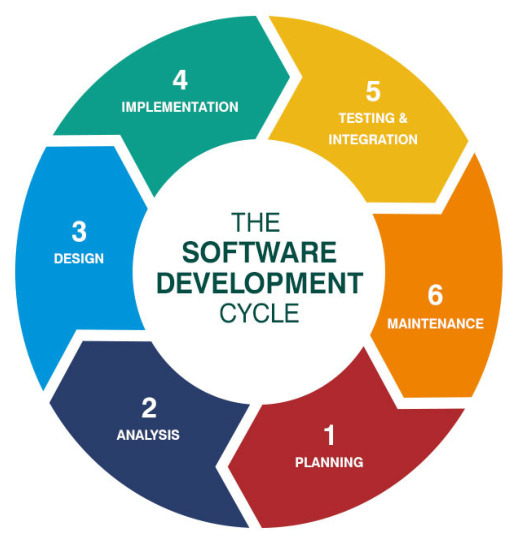
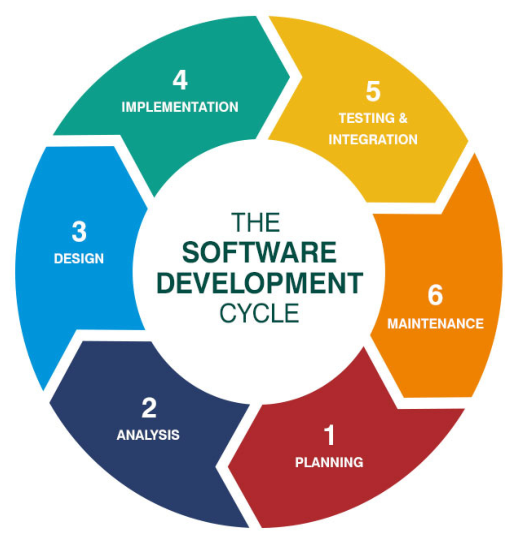
Figure 1 shows the sequence of the system’s development life cycle (SDLC). The SDLC model designed for this research utilizes an incremental approach where system modifications are continuously calibrated using stakeholder and customer feedback. This interactive progression aligns with the iterative prototyping method of decision support development, wherein an initial operational model is systematically refined through collaborative, ongoing evaluation until the system fully satisfies user requirements. This strategy proved essential for addressing the time-critical demands of this project, as the timeline to build, validate, and deploy the functional system was strictly constrained to a five-month window, including comprehensive testing [4].
Figure 1.
The software development cycle.
The executed development process followed a highly structured life cycle consisting of initial project planning and requirement analysis, followed by the architectural design phase. Once the framework was established, the study proceeded to system implementation, rigorous testing and integration, and finally, the implementation of long-term maintenance protocols.
In the development of the system, there is a continuous visibility between users/clients and the researcher to assure that they would equally understand and come up with the expected output throughout the development process.
2.4. Analysis of Existing System
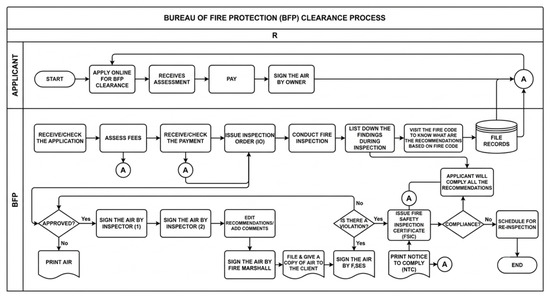
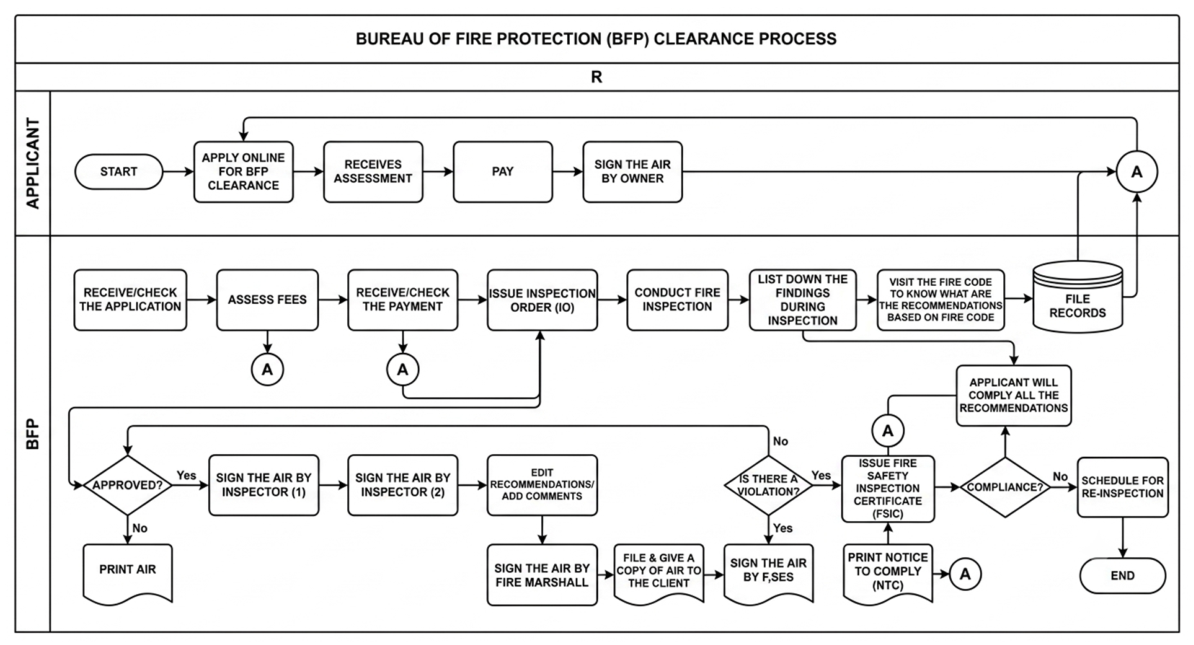
In the existing “As-Is” model (see Figure 2), the licensing cycle begins with the manual accomplishment of an application form by the applicant. This documentation is then formally submitted to the Customer Relation Officer (CRO) to start the manual verification sequence.
Figure 2.
Fire safety inspection process flow.
2.5. Analysis of the Developed System
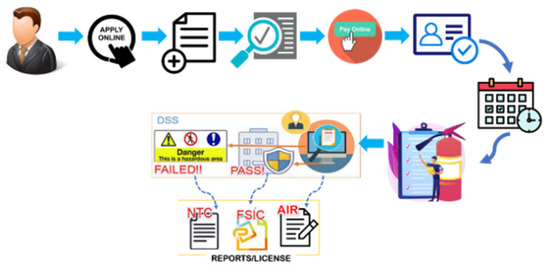
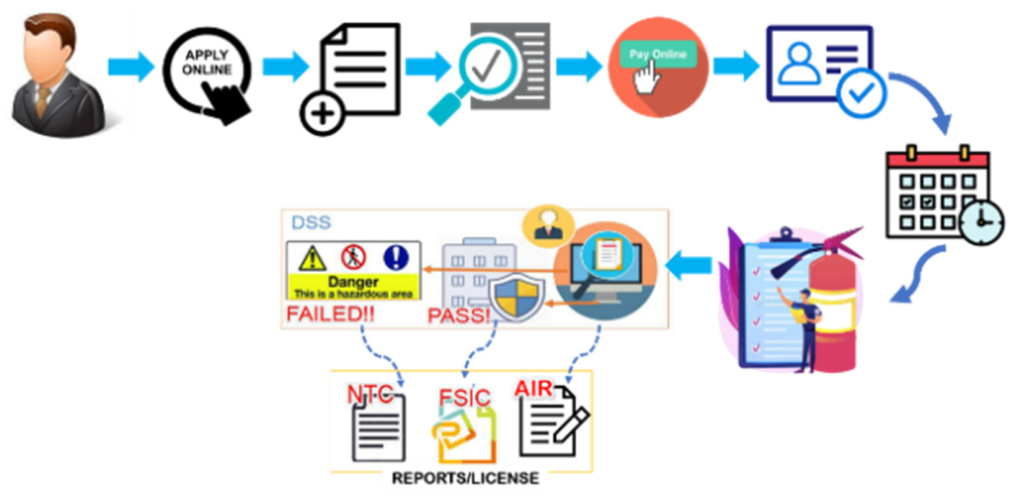
The process was taken from the manual phases of processing the documents; the advantage is that the application, documents, and payments can be sent and approved online. The whole scenario of this study is shown in Figure 3.
Figure 3.
Functional flow of the system.
The proponent applied a process re-engineering to the developed system to design contactless transactions when implementing the BFP—FSIC licensing.
2.5.1. Apply for BFP Clearance
Applicants initiate the process by creating an account on the digital portal, where they submit their personal information, a digital signature, and the required supporting files. These attachments include the official endorsement from the Building Office (BO) or the Business Permit Licensing Office (BPLO), along with digitized copies of the building permit. Furthermore, users must provide the assessment for the Occupancy Permit fee or the BPLO Tax Bill, in addition to any other pertinent certification required for the evaluation.
2.5.2. Receive the Application (Customer Relation Officer)
The Customer Relation Officer (CRO) will sign in to their account and can view the status of applicants. Upon checking that there is a pending application, they will check the validity of the submitted documents and affix a signature and the status will automatically update from “for receiving—for fees assessment”.
2.5.3. Assessment of Fees (Fire Code Assessor (FCA))
The Fire Code Assessor (FCA) will sign in to their account, and can view the status of applicants. Upon checking that there is a pending application, they will assess the fees and affix signature and the status will automatically update from “for fees assessment—for payment”.
2.5.4. Payment
The client can make a payment through a gateway facility provided by the BFP Office. Client will log-in to their account and provide details of payment. The status will automatically update from “for payment -for payment verification”.
2.5.5. Receive Payment
Once payment is posted, the Fire Code Assessor (FCA) will validate the payment and the status will automatically update from “for payment verification—schedule for inspection”.
2.5.6. Schedule of Inspection
The FSES will sign in to their account and can view the status of applicants. Upon checking that there is a pending application, they shall schedule the inspection on government business days (holidays and weekends are excluded), Monday through Friday only, no later than 3:30 p.m.
An Inspection Order (I.O) document will be generated in this phase with the signature of the FSES personnel and approval of the Municipal Fire Marshall and will be acknowledged by the client.
2.5.7. Conducting a Systematic Inspection
The inspector arrives at the inspection site a few minutes before the scheduled time. This allows them to inspect the exterior of the building and become familiar with the entire area to be inspected. At the beginning of the inspection process, the inspector inspects all areas of each floor. Work systematically from bottom to top or top to bottom on each floor. Make sure you have an established inspection system so you do not miss the floor area. All rooms, closets, and hidden areas should be checked for fire hazards. All locked areas must be unlocked and checked.
The two (2) Fire Inspectors fire inspectors will sign in to their accounts and will use the checklist created to choose (YES/NO) about the hazards observed so they can review them with the customer. Upon using the checklist, the system will automatically suggest its findings and recommendations based on the Fire Code. Taking down notes and researching is eliminated in this phase.
2.5.8. Completing the Inspection
After the inspectors have completed the inspection, the inspectors can present to the client their findings and recommendations on the same day, without wasting another day or time for a scheduled meeting to discuss their findings and recommendations due to the need of extensive research on the Fire Code.
2.5.9. After Inspection Report (AIR)
In this phase, there is no need to create an After Inspection Report because the system can generate the After Inspection Report (AIR) right after the ocular inspection. Also, there is no need to review and revisit the Fire Code fees as these are all in the system.
The two (2) inspectors will affix their e-signatures in the document and forward it to FSES for review, The FSES, Municipal Fire Marshall, and client will affix their e-signatures too. This document is available on the accounts of the concerned users.
A Notice to Comply (NTC) document will be generated by the system and the client can access this document in their account.
A Fire Safety Inspection Certificate document will be generated by the system and the client can access this document in their account.
2.5.10. Reinspection’s
If all violations have been corrected, the client will apply for another inspection date using their account in the system. The FSES will set a reinspection date (this is not a compliance date) that meets the customer’s schedule. If all violations have not been corrected, the inspector will discuss the delay with the customer. If the situation is beyond the customer’s control, they need to schedule a second reinspection date and the inspector should emphasize that violations must be corrected at that time.
2.6. Implementation
To ensure the successful adoption of the Decision Support System (DSS) and mitigate resistance to digital transition, a phased training program is proposed for BFP Romblon personnel. This includes hands-on workshops designed to bridge digital literacy gaps among senior inspectors accustomed to manual logging. Furthermore, the system includes a built-in User Manual and Help Desk module, providing real-time guidance on the Revised Fire Code of the Philippines (RA 9514) standards [5]. By involving end-users in the UAT (User Acceptance Testing) phase, the development team ensures that the interface remains intuitive, thereby reducing the cognitive load on inspectors and increasing perceived ease of use.
3. Results and Discussion
This section presents the final output of the project and the result interpretation of the testing and evaluation performed for the developed system. In line with the objectives of the study, the findings presented in this section demonstrate the potential for merging theory and practice involving process re-engineering of FSIC licensing pertinent to the Bureau of Fire Protection, Romblon.
3.1. Contactless Transactions in BFP—FSIC Licensing
Following the methodology proposed by Salwa et al. (2013) [6], this study implemented a refined business process re-engineering (BPR) approach tailored for the BFP. The process began by mapping the entire service life cycle from the citizen’s initial request to the final output. Every stage was analyzed to differentiate between active processing duration and idle waiting periods, with efficiency gains quantified using a standard percentage reduction formula. The researcher visualized these workflows through comprehensive diagrams that categorized tasks by specific personnel and agency roles. To optimize the system, overlapping functions were consolidated, ensuring that staff members focused on high-value, non-redundant activities. Each step was audited for its regulatory necessity, allowing for the introduction of digital tools designed to eliminate lag and non-essential processing. Ultimately, the re-engineering was benchmarked against a 60% reduction in processing time to ensure a significant operational transformation.
Table 1 shows the comparative result of the process re-engineering for a FSIC license in BFP Romblon.
Table 1.
Result of process re-engineering.
By integrating expert feedback with BPR methodologies, the researcher redesigned the business licensing workflow, as detailed in Table 1. A comparative analysis reveals that the transition from the legacy system to the automated framework reduced idle waiting periods from 6.30 h to just 2.10 h. Similarly, the duration of value-added tasks was optimized from 2.10 h down to 36 min. Overall, the end-to-end processing time for acquiring an FSIC was shortened from 8.40 h to 2.46 h. To quantify this efficiency gain, a percentage reduction calculation was applied:
Formula: Efficiency Improvement = ((Legacy Time − Automated Time)/Legacy Time) × 100
Calculation: Efficiency Improvement = ((8.40 − 2.46)/8.40) × 100 = 70.71%
Calculation: Efficiency Improvement = ((8.40 − 2.46)/8.40) × 100 = 70.71%
This 70.71% decrease in total processing time confirms that the digital intervention significantly enhances the speed of inspections and document issuance, exceeding the standard benchmarks for successful process re-engineering.
3.2. Generated Findings and Recommendations and/or Corrective Actions Based on the Violation and Deficiency IRR RA 9514 Fire Code of the Philippines
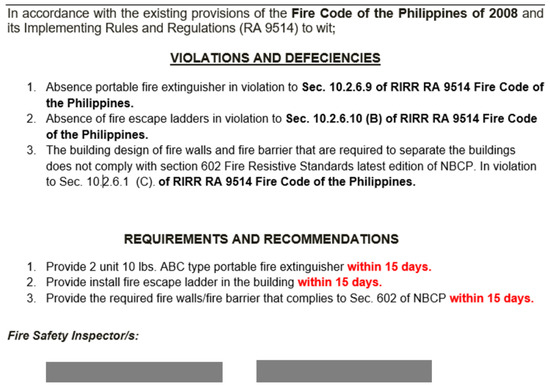
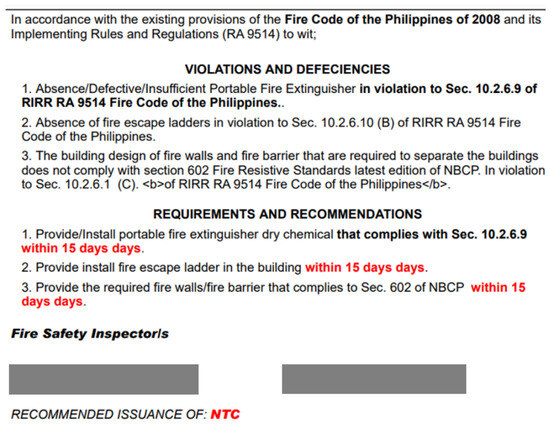
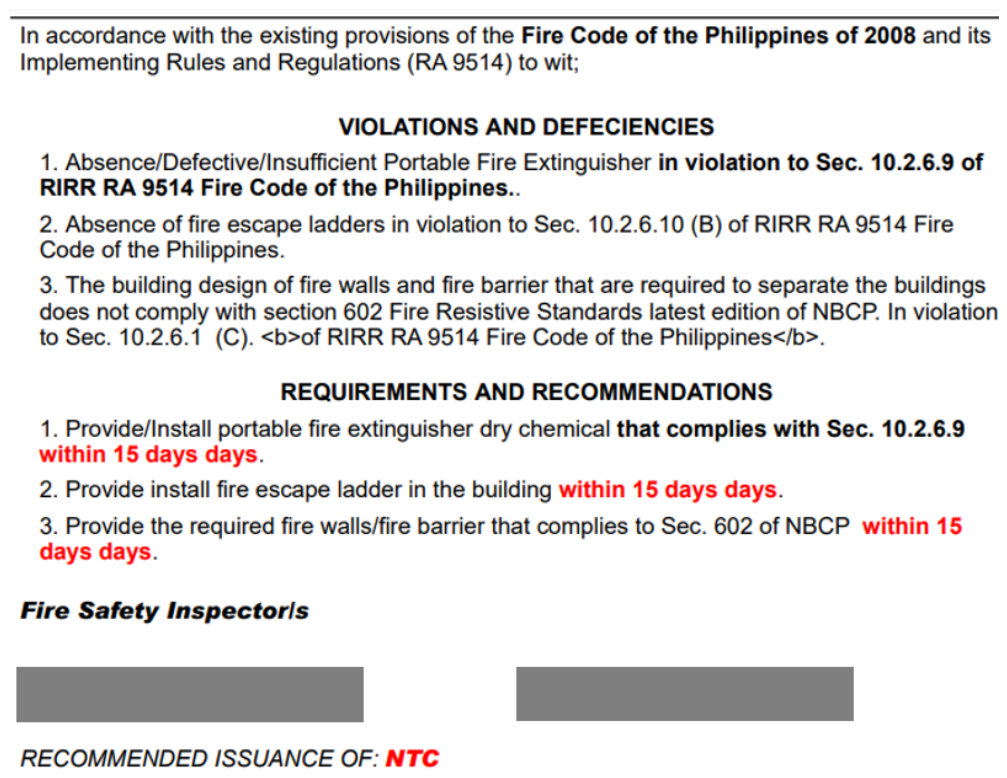
Figure 4 shows the violations and deficiencies and requirements and recommendations generated in the AIR of the existing system.
Figure 4.
AIR generated by the existing process.
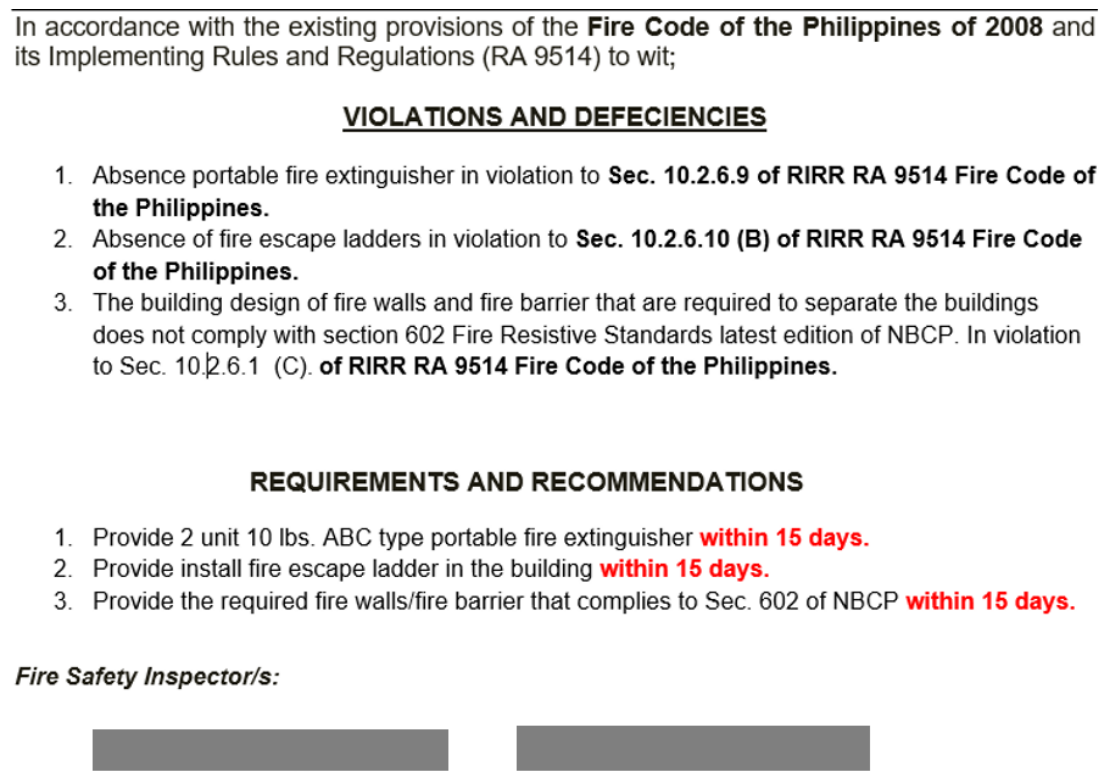
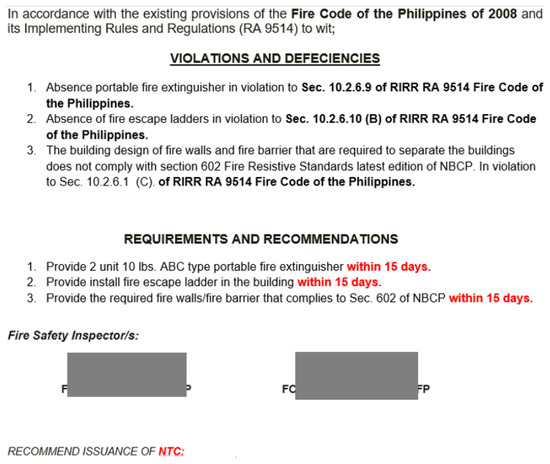
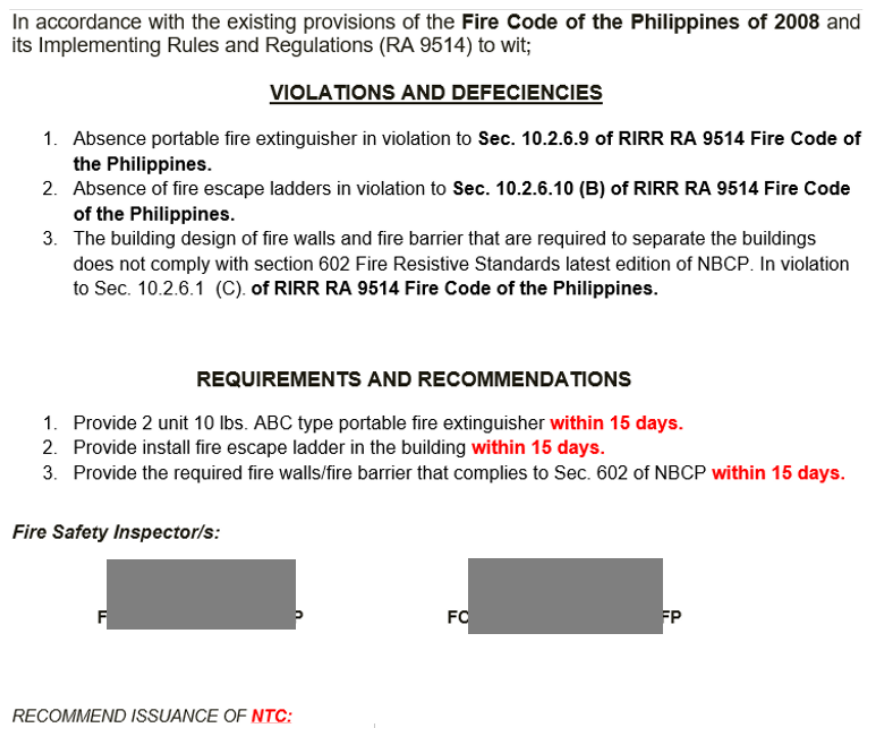
Figure 5 shows the violations and deficiencies and requirements and recommendations generated in the AIR of the developed system.
Figure 5.
AIR generated by the developed system.
3.3. Report Generation
The report generation phase represents the crucial synthesis of the inspection process. Once field data is gathered, it is compiled into standardized, legally binding documentation to ensure transparency, statutory compliance, and efficient administrative tracking.
3.3.1. After Inspection Report (AIR)
Following the ocular inspection, the After Inspection Report (AIR) is immediately generated to serve as an official record detailing specific violations, deficiencies, and corrective recommendations in accordance with Republic Act No. 9514 and the National Building Code of the Philippines (NBCP). As displayed in Figure 6, this document cross-references each observed hazard with its corresponding legal provision and establishes a strict timeline-typically a 15-day grace period for property owners to execute all mandatory compliance actions.
Figure 6.
Sample of an After Inspection Report (AIR) detailing violations, deficiencies, and compliance recommendations.
The After Inspection Report (AIR) is the document generated after the inspection. AIR contains the violations and deficiencies and requirements recommendations noted after the ocular inspection.
3.3.2. Fire Safety Inspection Certificate (FSIC)
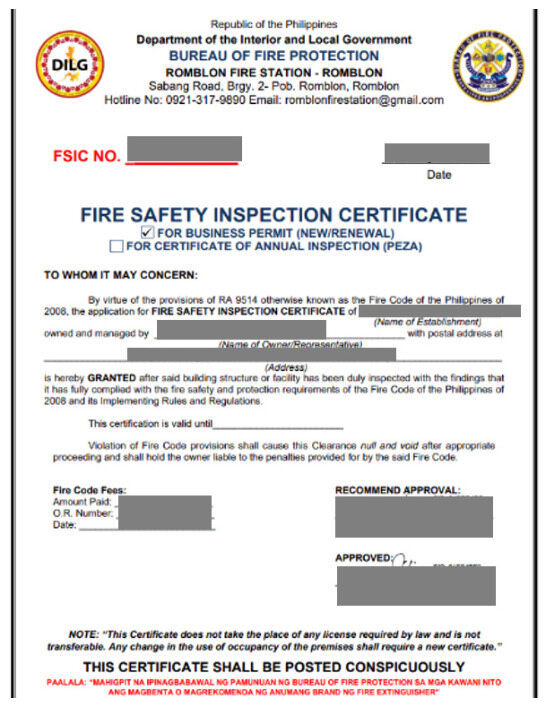
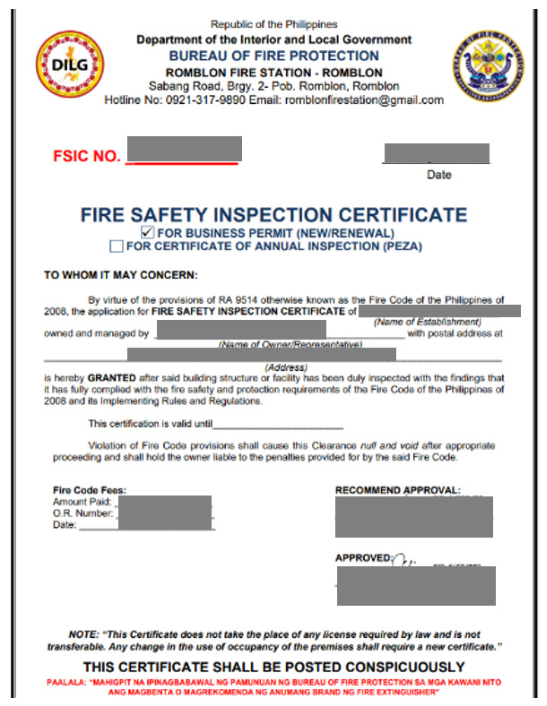
Figure 7 shows the Fire Safety Inspection Certificate (FSIC).
Figure 7.
Fire Safety Inspection Certificate (FSIC).
The Fire Safety Inspection Certificate (FSIC) is the document generated after the acknowledgement of the AIR by the Fire Inspector, FSES, Fire Marshall, and the Client. The FSIC acknowledges the compliant establishment.
3.3.3. Notice to Comply Report (NTC)
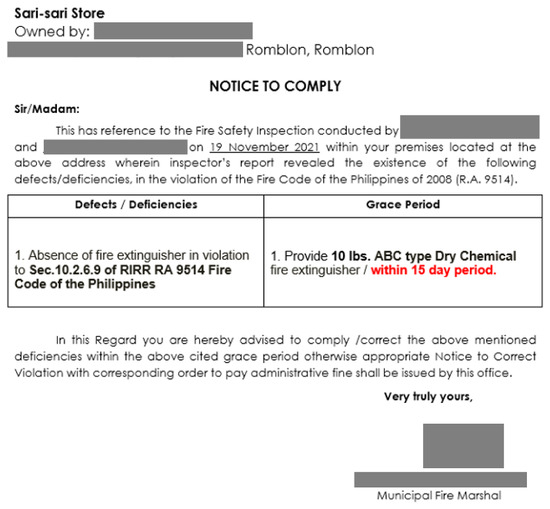
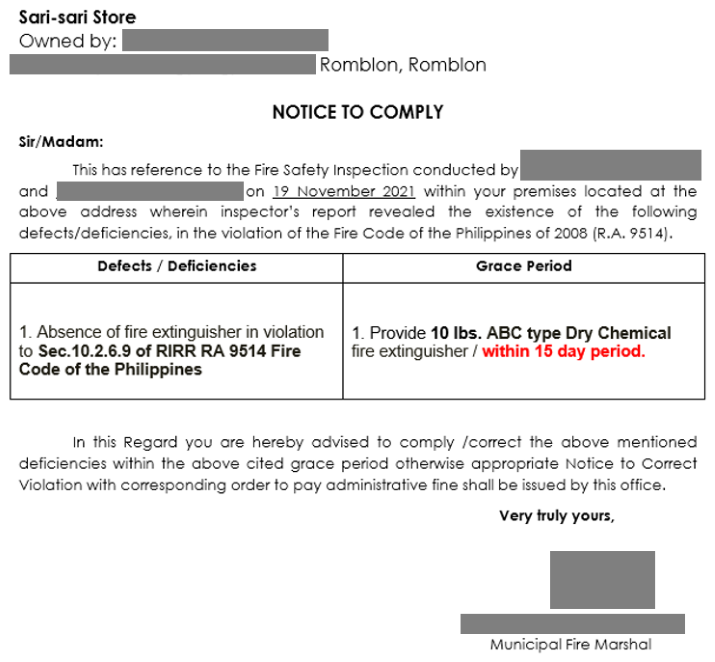
Figure 8 shows the Notice to Comply (NTC) report.
Figure 8.
Notice to Comply (NTC) report.
The Notice to Comply (NTC) is the document generated after the acknowledgement of AIR by the Fire Inspector, FSES, Fire Marshall, and the client. The NTC contains the defects and deficiencies and requirements and grace period of the non-compliant establishment.
3.4. Acceptability Result of the System Using ISO 25010:2011 Standard
Based on the results presented in Table 2 done by the respondents, the evaluation achieved the highest weighted mean of 4.6 or “Outstanding” on compatibility, which is focused on co-existence and interoperability. This means that the users are aware that the designed system could be used all the time since it is compatible to all devices and software. The testing of mobile app compatibility is very critical in quality testing to ensure that the application is easy to use. This should provide satisfactory user experiences that are expected in both mobile devices and browsers [7].
Table 2.
Summary of results on the software evaluation for the acceptability of the system.
The lowest weighted mean was 4.29 or “Very Satisfactory” regarding reliability-focused availability, maturity, fault tolerance, and recoverability. This means that maturity of the system should also be given a focus. Although the result got “very satisfactory”, the users revealed that fault tolerance and recoverability are important factors that the developed system should possess. Software needs to run without errors and service interruptions and software should have the capability to recover from crashes and failure. Moreover, the overall weighted mean is 4.41 or “Very Satisfactory”, which means that the respondents of the system are very satisfied with the developed system.
4. Conclusions
This study aimed to design and re-engineer the processes of BFP by developing a web application framework for all transactions related to the issuance of building permits and certificates. A web application designed for contactless transactions when implementing the BFP—FSIC licensing was developed. The system ensures that all transactions other than ocular inspection were performed online.
The DSS significantly improves operational efficiency by reducing the turnaround time for Fire Safety Inspection Certificate (FSIC) issuance. Initial testing indicates that the automated generation of inspection findings reduces manual clerical work by approximately 40% to 50%. By eliminating redundant data entry and providing instant access to building histories, the BFP can prioritize high-risk structures, thereby enhancing the overall public safety of the province. Future field implementation will focus on gathering longitudinal data to measure the exact reduction in “contact time” and administrative costs.
A decision support algorithm was applied to automatically generate findings and recommendations based on the Fire Code. The web application was able to provide reports and licensing for the After Inspection Report (AIR), Notice to Comply Report (NTC), and Fire Safety Inspection Certificate (FSIC). The system was evaluated using ISO 25010:2011 standard [8]. The Software Development Cycle was used in the development of the system that was written in a combination of PHP and MySQL. The system was tested and evaluated through a series of tests using the data entry to the developed system by the registered users. The functionality of the system was tested according to the test plans.
5. Recommendations
For further development of this study and based on the findings and conclusion, the following recommendations were offered: (1) It is recommended that the BFP personnel in Romblon use their register of their electronic signatures to DICT’s PNPKI for the security and validity of their e-signatures. (2) Machine learning techniques should be used to further enhance the recommendations being generated by the system. (3) Digital payment and electronic money should be included for processing their transaction.
To ensure the long-term sustainability of the Building Inspection Decision Support System (BIDS), it is recommended that the Bureau of Fire Protection (BFP) adopt a modular maintenance and scalability framework. This includes the implementation of scheduled automated backups of the MySQL database to guarantee data integrity and disaster recovery. Furthermore, the system’s cloud-ready architecture should be leveraged to facilitate a transition from provincial deployment in Romblon to a broader regional or national implementation. Finally, to maintain a robust security posture, routine patching of the PHP framework and continuous monitoring against SQL injection and cross-site scripting (XSS) must be prioritized to safeguard sensitive public safety records.
Author Contributions
Conceptualization, methodology, validation, formal analysis, investigation, resources, data curation, and writing—original draft preparation, J.M.M.M.-M. and R.V.A.; Review and editing, visualization, supervision, and project administration, J.M.M.M.-M., R.V.A. and J.P.M.M. All authors have read and agreed to the published version of the manuscript.
Funding
This research received no external funding.
Institutional Review Board Statement
This study involving system development and user evaluation complied with the ethical standards of the institution. Formal ethical review board approval was not required for this capstone project in accordance with institutional guidelines.
Informed Consent Statement
Informed consent was obtained from all participants involved in the study. All participants voluntarily agreed to participate in the evaluation of the system.
Data Availability Statement
The data supporting the findings of this study are available from the corresponding author upon reasonable request. Some data may not be publicly available due to privacy and confidentiality considerations.
Conflicts of Interest
The authors declare no conflict of interest.
Abbreviations
The following abbreviations are used in this manuscript:
| BFP | Bureau of Fire Protection |
| IRR | Implementing Rules and Regulations |
| FSIC | Fire Safety Inspection Certificate |
| AIR | After Inspection Report |
References
- Anti-Red Tape Authority; Department of Trade and Industry; Department of the Interior and Local Government; Department of Information and Communications Technology. Joint Memorandum Circular No. 01, Series of 2021: Guidelines for Processing Business Permits, Related Clearances, and Licenses in All Cities and Municipalities. 2021, 1–38. Available online: https://www.scribd.com/document/337063811/Dilg-Joincircular-2016815-81d0d76d7e (accessed on 9 March 2021).
- Bala, A.D.R.; Atty Belgica, J.B.; Lopez, R.M. Joint Memorandum Circular No. 2019-001 s.2019. The Implementing Rules and Regulations of Republic Act No. 11032 Otherwise Known as the “Ease of Doing Business and Efficient Government Service Delivery Act of 2018”. 25. 2019. Available online: https://www.officialgazette.gov.ph/downloads/2019/07jul/20190717-RA-IRR-11032-RRD.pdf (accessed on 9 March 2021).
- Ilago, S.A. NPM, Business Process Re-engineering and Local Governments: The Case of Local Business Permitting and Licensing System Regulatory Reform. J. Natl. Coll. Public Adm. Gov. 2017, LXI, 1–19. [Google Scholar]
- Tripathi, K.P. Decision Support System is a Tool for Making Better Decisions in the Organization. Indian J. Comput. Sci. Eng. (IJCSE) 2021, 2, 1–6. [Google Scholar]
- Bureau of Fire Protection. The 2019 Revised Implementing Rules and Regulations of Republic Act No. 9514, Otherwise Known as the Fire Code of the Philippines of 2008. Department of the Interior and Local Government. 2019. Available online: https://bfp.gov.ph/wp-content/uploads/2019/10/RA9514-RIRR-rev-2019.pdf?fbclid=IwY2xjawTKql5leHRuA2FlbQIxMABicmlkETFHSHV5U0ZROEdQcnRwMVVoc3J0YwZhcHBfaWQQMjIyMDM5MTc4ODIwMDg5MgABHkowwFqdO3_XUtbBA4okdrzY-25nxWcTcr42yTJqdbd_r9fJodIL1LQR4_BT_aem_Q4ceWDySV6OhrDLvjYyWEQ (accessed on 14 February 2026).
- Salwa, U.; Bustamam, A.; Shukor, S.A.; Bustamam, U.A.; Mohamed, Z.; Ridhwan, M.; Aziz, A. Rejuvenating Business Licensing Process in State Government Agencies through Business Process Reengineering (BPR) KAMPUNG COOPERATIVES View project Islamic Social Enterprise (ISE) View project Rejuvenating Business Licensing Process in State Government Agencies through Business Process Reengineering (BPR). Int. J. Manag. Sci. 2013, 1, 3. Available online: http://www.rassweb.com (accessed on 20 January 2021). [CrossRef] [Scilit]
- Gilmore, L. 4 Steps to Creating an Agile Mobile App Compatibility Test—Testlio. 10 October 2019. Available online: https://testlio.com/blog/4-steps-to-creating-an-agile-mobile-app-compatibility-test/ (accessed on 15 January 2021).
- ISO/IEC 25010:2011; Systems and Software Engineering—Systems and Software Quality Requirements and Evaluation (SQuaRE)—System and Software Quality Models. ISO: Geneva, Switzerland, 30 May 2021. Available online: https://www.iso.org/standard/35733.html (accessed on 20 January 2021).

Disclaimer/Publisher’s Note: The statements, opinions and data contained in all publications are solely those of the individual author(s) and contributor(s) and not of MDPI and/or the editor(s). MDPI and/or the editor(s) disclaim responsibility for any injury to people or property resulting from any ideas, methods, instructions or products referred to in the content. |
© 2026 by the authors. Licensee MDPI, Basel, Switzerland. This article is an open access article distributed under the terms and conditions of the Creative Commons Attribution (CC BY) license.