


Abstract
The complexity of authentic assessment within Deep Learning frameworks often hinders teacher adoption. This study analyses the diffusion process of such an innovation at SMP Taruna Bakti Bandung using an Explanatory Sequential Mixed Methods design. Through Social Network Analysis (SNA) of the entire teacher population and in-depth interviews, this study maps communication patterns and the roles of key actors. SNA results reveal a network structure with moderate density and subject-based clustering patterns. Qualitative findings confirm that adoption success relies heavily on opinion leaders acting as “pedagogical translators” to simplify the technical complexities of assessment. Through collaborative strategies, innovation barriers are reduced by enhancing aspects of trialability and observability. The study concludes that the adoption of authentic assessment requires synergy between formal institutional support and technical validation fostered within interpersonal trust networks, rather than relying solely on managerial instruction.
1. Introduction
Twenty-first century education demands a fundamental transition from mere content mastery to higher-order thinking competencies. In this context, Deep Learning serves as a crucial pedagogical framework requiring students not only to memorize but also to perform critical analysis and complex problem-solving. To support this objective, conventional evaluation methods are deemed insufficient. As a solution, authentic assessment emerges as a transformative approach bridging learning activities with real-world situations. This method is considered capable of holistically capturing student competence, ranging from classroom engagement to the mastery of 21st-century skills [1,2]. However, despite its conceptual ideal, the implementation of authentic assessment in the field is not simple. Planning complexity, the need for pedagogical shifts, and the gap between theory and practice constitute major challenges for teachers. This condition is exacerbated by the need for psychological safety so that teachers feel secure in attempting innovations without pressure. Consequently, the adoption of authentic assessment often proceeds slowly because teachers struggle to design instruments that are truly valid and representative of the measured competencies [3,4,5]. At this point, inter-teacher social factors become decisive. Teachers generally do not learn in isolation; they seek support from colleagues perceived as more competent.
Informal interactions such as staffroom discussions, working groups, and lesson study practices become primary arenas for innovation dissemination. Therefore, Diffusion of Innovations theory provides a relevant conceptual framework to explain how authentic assessment spreads within educational communities. Innovations often diffuse through social ties and the presence of influential figures or opinion leaders who can accelerate acceptance [3,6]. Nevertheless, research on the diffusion of innovations in the educational context, specifically linking it to authentic assessment and teacher social network structures, remains limited. Most diffusion studies focus on health and business sectors, while studies mapping pedagogical information flows in schools using Social Network Analysis (SNA) are rare, particularly in Indonesia [7,8]. This study advances prior work by providing an empirical map of pedagogical information flows in an Indonesian school context, offering a relational model for innovation adoption.
2. Review of Related Literature
2.1. The Complexity of Authentic Assessment in Deep Learning
Authentic assessment within a Deep Learning framework represents a significant departure from traditional testing. It requires students to demonstrate competence through realistic, cognitively challenging tasks that mirror real-world practices [9,10]. While recent literature confirms its efficacy in fostering critical thinking, student agency, and collaborative problem-solving, its implementation is highly complex [11]. Designing these assessments demands a paradigm shift, pedagogical innovation, and a psychologically safe environment for teachers to experiment without fear of immediate failure. Because it is not a simple administrative procedure but a profound shift in teaching philosophy, understanding how this complex pedagogical innovation spreads among teachers requires a theoretical lens that goes beyond traditional top–down administrative mandates [12].
2.2. Diffusion of Innovations (DOI) and Pedagogical Complexity
Everett Rogers’ Diffusion of Innovations (DOI) theory [3,13] posits that the adoption of new practices depends heavily on how they are communicated within a social system over time. For an innovation to be adopted, potential adopters evaluate it based on five characteristics: relative advantage, compatibility, complexity, trialability, and observability. In the context of authentic assessment, complexity often acts as the primary barrier. To overcome this, teachers require high trialability and the opportunity to experiment with the assessment in a limited, safe setting. Interpersonal communication channels are far more effective than formal mass dissemination in shaping teacher attitudes and reducing perceived complexity [3,12]. Therefore, the diffusion of such practices relies heavily on peer-to-peer interactions where teachers can negotiate meaning, share practical tips, and build confidence.
2.3. Social Network Analysis (SNA) as a Relational Lens
Because interpersonal communication is the engine of diffusion, Social Network Analysis (SNA) provides a critical methodological extension to DOI. SNA maps the relational architecture of a school, demonstrating that diffusion follows structural patterns of interaction rather than random or purely hierarchical flows [13]. Through SNA, researchers can empirically measure how information and influence circulate by examining network metrics. For instance, degree centrality reveals actors with broad connections, while betweenness centrality identifies those who act as bridges between otherwise disconnected or siloed teacher groups [14,15,16]. Furthermore, understanding network density and homophily and the tendency of similar individuals to group together helps explain why some pedagogical innovations remain trapped within specific subject departments while others spread school-wide [8].
2.4. Opinion Leaders as “Pedagogical Translators” in Indonesia
Within these structural networks, certain actors emerge as informal opinion leaders. These are trusted peers who possess high centrality and bridge structural holes between isolated teacher clusters [17,18]. Unlike formal change agents (such as principals or curriculum heads), opinion leaders derive their influence from social legitimacy and shared classroom struggles. They act as “pedagogical translators,” taking complex, abstract assessment theories and translating them into practical, actionable steps for their peers [19]. Despite the proven importance of this relational dynamic, empirical studies combining DOI and SNA to map teacher networks in Indonesia remain extremely limited. Much of the existing research in the region focuses heavily on administrative readiness rather than relational diffusion. By explicitly identifying these opinion leaders and mapping their communication structures, this study fills a crucial gap, demonstrating how structural network patterns and human meaning-making collectively drive the diffusion of authentic assessment in Indonesian schools.
3. Methodology
3.1. Research Design
This study applies a Mixed Methods approach with an Explanatory Sequential Design [20]. This design was selected to dissect the diffusion process of authentic assessment, which is not merely technical–pedagogical but also propagates through the school’s social structure. The quantitative phase serves as the initial step to objectively map the communication network architecture. These numerical findings are then deepened through a qualitative phase to understand the meaning, motivation, and context behind the interaction patterns formed.
3.2. Site and Participants
The research was conducted at SMP Taruna Bakti Bandung, an educational institution currently strengthening the implementation of authentic assessment practices. The population included all active teachers at the school (N = 56). Given that network analysis requires intact relational data (whole-network design), a census sampling technique was employed. Participation of the entire population is crucial to avoid missing links that could distort the accuracy of network centrality metrics.
3.3. Data Collection
Data collection was carried out using a digital sociometric questionnaire (online survey). The instrument was designed using a name generator technique, where respondents were asked to nominate colleagues in three relational dimensions: (1) technical consultation for assessment design, (2) perceived expertise, and (3) frequency of discussion on learning innovations. The response rate was strictly monitored to achieve 100% data completeness.
Based on the initial network mapping results, participants for in-depth interviews were selected using a purposive sampling technique. Selection criteria were based on their topological positions in the network generated by Gephi, including: (a) Central Actors (Opinion Leaders) with high in-degree scores, (b) Bridging Actors (Bridges) with high betweenness scores, and (c) Peripheral Actors (Isolates) to capture varied perspectives. Interviews were semi-structured, recorded, and focused on teachers’ perceptions of authentic assessment attributes (relative advantage, complexity, compatibility, trialability, observability), as well as collaboration dynamics within the school.
3.4. Data Analysis
In accordance with the research design, data analysis was performed separately and then integrated during the final interpretation stage. Quantitative Analysis (SNA): Sociometric nomination data were converted into an adjacency matrix and imported into Gephi 0.9.2 software. Analysis was performed at three levels:
- (1)
- Macro Level: Calculating network density to examine the compactness of information flow.
- (2)
- Meso Level: Using the Modularity Class algorithm to identify social clusters or groups formed (e.g., based on subject matter).
- (3)
- Micro Level: Calculating individual centrality metrics, specifically In-Degree Centrality (to identify opinion leaders) and Betweenness Centrality (to identify information connectors).
Qualitative Analysis: Interview transcripts were analyzed using Thematic Analysis. The coding process was conducted deductively based on Rogers’ Attributes of Innovation framework [8] and inductively. Attributes of Innovation framework and inductively to capture emerging themes related to institutional barriers. Data Integration (Mixing): This study connects the data where SNA results are used to select qualitative participants. In the discussion stage, qualitative findings are used to explain the statistical phenomena that emerged, for instance: “Why does Teacher X have high centrality?” or “Why is Cluster Y isolated?” Research Ethics: All participants provided informed consent before the research commenced. Given the sensitive nature of network analysis in mapping personal relationships, data confidentiality was strictly maintained. In reporting and sociogram visualization, participants’ real names were pseudonymized using alphanumeric codes (e.g., G-01, G-02) to ensure anonymity.
4. Findings and Results
4.1. Quantitative Phase Findings: Communication Network Analysis (SNA)
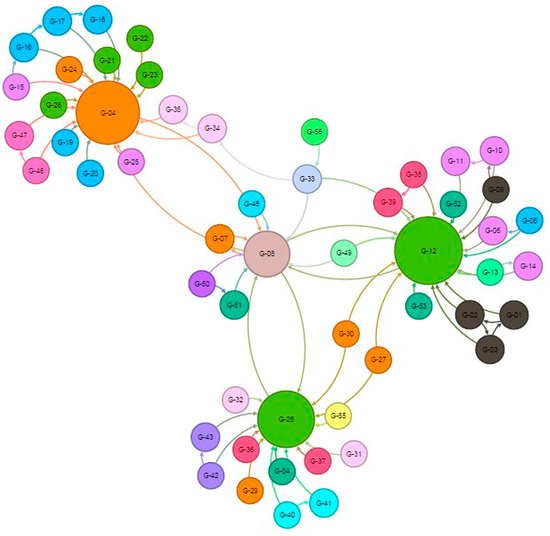
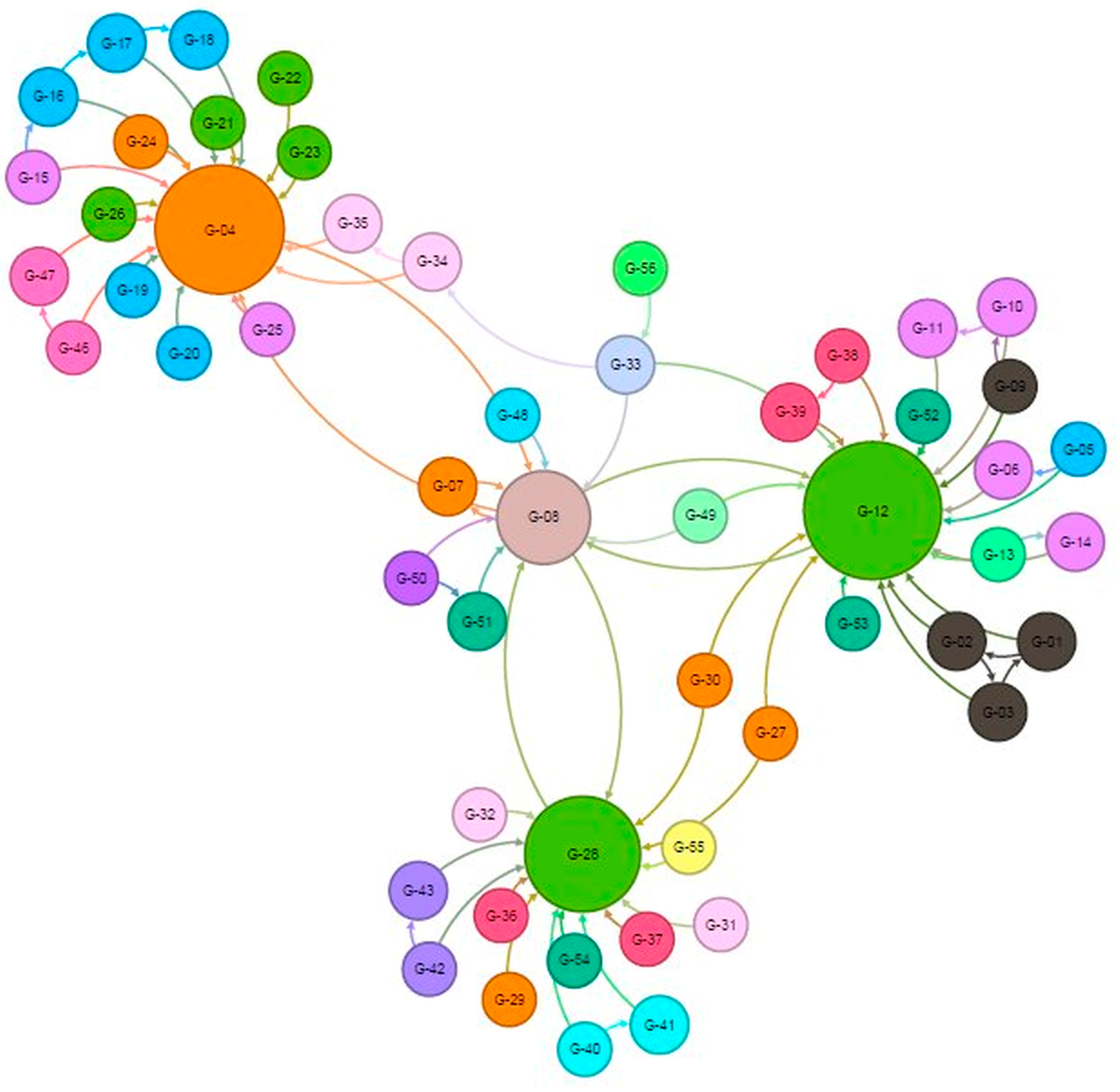
This section presents the quantitative findings of the Social Network Analysis (SNA), beginning at the macro level with an overview of the teacher communication network’s overall structure and density. Network mapping was conducted on the entire teacher population (N = 56) to visualize information flow patterns regarding the technical design and implementation of authentic assessment. Based on sociometric data, a directed graph was formed representing consultation relations regarding rubric construction and project-based assessment. The resulting network structure is visualized in Figure 1, with descriptive network metrics summarized in Table 1 and the identification of central actors presented in Table 2. The Average Degree was recorded at 5.4, indicating that, on average, a teacher discusses assessment issues with five to six colleagues.
Figure 1.
Communication Network Analysis (Social Network Analysis with Gephi). Note: Node size reflects In-Degree Centrality. Node color indicates clusters based on subject matter groups. Arrows indicate the direction of consultation (from the teacher seeking advice to the colleague consulted). Centrality calculations identified actors with the highest scores on two main metrics.
Table 1.
Descriptive Metrics of Teacher Assessment Communication Network (N = 56).
Table 2.
Identification of Central Actors and Roles in the Network.
- (1)
- In-Degree Centrality: Three actors emerged with the highest number of references: Teacher G-12 (score 19), Teacher G-04 (score 16), and Teacher G-28 (score 14). This data indicates the number of colleagues who nominate these three teachers as a reference for consultation.
- (2)
- Betweenness Centrality: The highest score was recorded by Teacher G-08 (145.2). This score indicates the frequency with which this actor lies on the shortest path connecting two other actors in the network.
- (3)
- Community Structure Analysis (Modularity Class): This produced a value of 0.425, forming five main clusters within the network. The graph visualization shows that node grouping tends to follow subject matter clusters (homophily). Furthermore, the data shows no isolated actors (isolates); all teachers in the periphery have at least one active connection to a cluster.
4.2. Qualitative Phase Findings: Interviews with Opinion Leaders and Key Actors
Network mapping was conducted on the entire teacher population (N = 56) to visualize information flow patterns regarding the technical design and implementation of authentic assessment. Based on sociometric data, a directed graph was constructed representing consultation relationships concerning rubric construction and project-based assessment. The network structure reveals a density value of 0.108. This figure indicates that approximately 10.8% of potential assessment consultation ties have been actively formed. The Average Degree was recorded at 5.4, implying that, on average, a teacher engages in discussions with five to six colleagues regarding authentic assessment issues.
Centrality analysis highlights a significant disparity in roles, with knowledge references concentrated among a select few actors. Regarding In-Degree Centrality, three actors recorded the highest values: Teacher G-12 (score 19), Teacher G-04 (score 16), and Teacher G-28 (score 14). These high scores indicate the substantial number of colleagues who rely on them for consultation regarding technical assessment difficulties. Meanwhile, in terms of Betweenness Centrality, Teacher G-08 achieved the highest score (145.2). This metric signifies G-08’s strategic role as a liaison facilitating information flow across different subject matter groups. Furthermore, Modularity Class analysis (value 0.425) reveals the formation of five distinct clusters based on subject disciplines, yet, notably, no completely isolated actors (isolates) were identified within the network.
Interviews with high-centrality actors reveal their pivotal role in grounding the concept of authentic assessment, often perceived as abstract, into operational grading practices. The primary challenge in adopting Deep Learning-based assessment lies in teachers’ perceptions of the complexity involved in designing non-test instruments, such as performance rubrics. In this context, opinion leaders perform technical simplification by assisting colleagues in understanding that authentic assessment need not be administratively burdensome. This is evidenced by the finding that opinion leaders frequently provide concrete examples of how to construct simple yet authentic performance rubrics, thereby making the innovation appear more feasible for other teachers to undertake. Field findings confirm that teachers occupying central positions within the communication network utilize participatory collaborative approaches rather than instructional ones. The primary strategy employed is the exchange of assessment artifacts, such as sharing draft grading rubrics, demonstrating examples of student work, and opening classrooms for peer observation. Key actors tend to recommend gradual implementation, commencing with low-stakes yet meaningful assessment components. This approach serves to reduce the teachers’ cognitive load, inviting them to pilot a single small component (e.g., student reflection) before progressing to more complex projects.
Although the acceptance of the authentic assessment concept is generally positive, the data maps several operational challenges faced by teachers. The primary barrier lies not in resistance to the Deep Learning ideology, but in the technical burden of designing valid assessment instruments. Teachers highlighted the significant time investment required to draft detailed rubrics and the complexity of tailoring task difficulty to student diversity. The data indicate that adoption delays are frequently attributed to the teachers’ need for time to execute design adjustments (re-invention) to suit classroom conditions, rather than a rejection of the innovation’s principles. Beyond peer interaction factors, research findings underscore the significance of the institutional role within the adoption ecosystem. Teachers emphasized that complex innovations like Deep Learning necessitate tangible structural support, encompassing technical training on instrument design, allocated time for collaboration, and the availability of digital infrastructure for portfolio documentation. This organizational support is perceived by teachers as a psychological reinforcement that provides a sense of security. The provision of school facilities and training ensures teachers do not feel isolated in transforming their teaching practices, which directly enhances their self-efficacy to attempt authentic assessment.
4.3. Network Structure Dynamics in Authentic Assessment Diffusion
The findings of this study highlight that the diffusion of innovation in schools does not move solely through formal command channels but propagates through informal trust channels. A network structure with moderate density (0.108) yet possessing a concentration on specific opinion leaders indicates an efficient diffusion model: the school does not need to train all teachers intensively and simultaneously, but rather empower key nodes (G-12, G-04) as peer mentors. Furthermore, the presence of actor G-08 as a bridge proves crucial in preventing the occurrence of “information silos” between subject matters. This finding confirms the relevance of Burt’s theory of Structural Holes [15,17] in the educational context, where bridging actors function to maintain innovation coherence so that it does not become fragmented within disciplinary blocks.
The sociogram visualization in Figure 1 provides a topological representation of the communication structure at SMP Taruna Bakti. The enlarging node sizes represent high In-Degree Centrality, indicating that these teachers (G-12, G-04) are central actors serving as primary references for their colleagues. Additionally, the polarization of the network into five colored clusters is clearly visible, reflecting grouping based on subject matter (homophily). Opinion Leaders as “Pedagogical Translators”: The synthesis of quantitative and qualitative data successfully explains why certain actors have dominant In-Degree Centrality. Statistically, they are reference centers, but qualitatively, their role is far deeper: they function as “Pedagogical Translators.” Consistent with interview findings, opinion leaders perform a mechanism of complexity reduction. Authentic assessment, which is inherently complex (high complexity), is translated into practical steps, for instance, by sharing simple rubrics or single-component strategies. This validates Rogers’ theory [8] that the primary function of opinion leaders is not merely to spread awareness, but to provide social validation and reduce technical uncertainty. They transform colleagues’ perceptions from “this innovation is too difficult” to “this innovation is manageable.” Thus, their high centrality is a reflection of collective trust that these actors can provide pragmatic solutions to the demands of the Deep Learning curriculum.
4.4. Authentic Assessment as a Complex Pedagogical Innovation
This research confirms that authentic assessment is perceived as an innovation with a high level of complexity due to the demand for a paradigm shift from standardized testing to subjective performance evaluation. Referring strictly to Rogers’ theory, complex innovations should have slow adoption rates. However, field findings show that adoption proceeds thanks to trialability and observability strategies facilitated by social networks. Through collaborative strategies such as borrowing rubric formats and classroom observations, the teacher communication network successfully mitigates these complexity barriers. When teachers see colleagues successfully implementing project assessments (observability) and are given the opportunity to try on a small scale (trialability), their risk perception decreases. This proves that in the context of heavy pedagogical innovations, the existence of a supportive network is more crucial than the mere quality of the innovation itself. Teachers adopt authentic assessment not only because the method is superior (relative advantage), but because they see “social proof” that the method is compatible with real conditions in their school.
4.5. Implications: Hybrid Diffusion Model
Overall, this research formulates a Hybrid Diffusion Model at SMP Taruna Bakti that combines the strengths of informal networks and institutional support. Qualitative findings regarding the importance of training and school infrastructure complement the SNA map. Structural support from school management provides legitimacy (signaling that this innovation is important/official), while the interpersonal network of opinion leaders provides technical execution (practical know-how). The theoretical implication of this study enriches the Diffusion of Innovations literature in education by demonstrating that Deep Learning adoption cannot be forced solely through top–down channels. A network-based approach that recognizes and empowers informal opinion leaders is required. In practical terms, schools are advised not only to focus on mass training but to strategically place central teachers (identified via SNA) as mentors in learning communities, as they are the true keys to accelerating diffusion. The synergy between supportive school policies and collaborative teacher networks guarantees the sustainability of authentic assessment practices in the future.
5. Conclusions and Recommendations
5.1. Conclusions
Overall, this study concludes that the diffusion of authentic assessment at SMP Taruna Bakti Bandung is a systemic process moving through an organized communication network structure, not merely an automatic response to administrative instructions. Findings from the Social Network Analysis (SNA) prove that this innovation flow follows an efficient yet clustered interaction pattern, where adoption success heavily relies on the strategic role of opinion leaders. These central actors are proven to function not only as information hubs but also play a vital role as “pedagogical translators” capable of simplifying the complexity of Deep Learning concepts into operational and relevant grading practices for their colleagues. Furthermore, this diffusion mechanism is strengthened by collaborative strategies growing organically within the network. Through a culture of sharing rubrics, informal discussions, and classroom observations, perception barriers related to assessment design complexity can be mitigated. This process effectively enhances the aspects of trialability and observability, allowing teachers to adopt the innovation gradually with measurable risk. Ultimately, this study asserts that the transformation of learning towards a 21st-century paradigm in a school environment cannot be achieved solely through top–down policies, but is created from the synergy between structural legitimacy provided by the institution and technical validation offered by solid interpersonal networks.
5.2. Recommendations
Based on the findings of this study, several strategic recommendations are proposed to enhance the adoption of pedagogical innovations in school settings:
- Empowerment of Informal Opinion Leaders: School management should strategically identify and empower central teachers who act as opinion leaders. Rather than relying solely on formal top–down instructions, these “pedagogical translators” should be utilized as mentors within learning communities to simplify complex concepts for their peers.
- Strengthening Organic Collaboration Networks: Schools should formalize and support existing informal practices such as rubric-sharing, peer classroom observations, and low-stakes discussion groups. These activities reduce innovation barriers by increasing trialability and observability, allowing teachers to experiment with new assessment methods at a manageable pace.
- Development of Integrated Institutional Support: To ensure sustainability, there must be synergy between structural legitimacy (e.g., formal training and infrastructure) and interpersonal validation. Institutional policies should provide the necessary resources and psychological safety, while interpersonal networks provide the technical know-how required for classroom implementation.
- Focus on Subject-Based Clusters: Since communication patterns often follow subject matter homophily, intervention strategies should be tailored to specific clusters. Professional Learning Communities (PLCs) should be encouraged within these clusters to maintain innovation coherence while addressing the unique technical demands of different disciplines.
- Future Research on Long-Term Sustainability: Further research is recommended to observe the long-term sustainability of these adoption patterns and to explore how digital platforms might further facilitate network communication in the diffusion of pedagogical innovations.
Author Contributions
Conceptualization: S.K. and D.S.L.; Methodology: S.K.; Database Collection: S.K.; Data Curation and Validation: S.K.; Formal Analysis: S.K. and M.R.; Writing original draft preparation: S.K.; Writing, reviewing and editing: D.S.L. and M.R. All authors have read and agreed to the published version of the manuscript.
Funding
This research’s APC was funded by the Lembaga Pengelola Dana Pendidikan—LPDP (Indonesia Endowment Fund for Education) under the Ministry of Finance of the Republic of Indonesia under LoG No. 202406111203623.
Institutional Review Board Statement
Ethical review and approval were waived for this study, as it involved minimal-risk survey and interview procedures with voluntary, informed participation of adult teachers, and all data were anonymized using alphanumeric codes to ensure confidentiality. The study was conducted with formal research permission from Universitas Pendidikan Indonesia (Surat Izin Penelitian No. 7575/UN40.A2/PT.01.01/2025, dated 11 December 2025).
Informed Consent Statement
Informed consent was obtained from all subjects involved in the study.
Data Availability Statement
The data presented in this study are available on request from the corresponding author. The data are not publicly available due to privacy and confidentiality restrictions, as the dataset contains sensitive information regarding interpersonal communication networks among teachers within the school.
Acknowledgments
The authors sincerely acknowledge the support of the Lembaga Pengelola Dana Pendidikan—LPDP (Indonesia Endowment Fund for Education under the Ministry of Finance of the Republic of Indonesia) for sponsoring the authors’ master’s degree and facilitating the completion of this publication and collaboration.
Conflicts of Interest
The authors declare no conflicts of interest.
References
- Villarroel, V.; Bloxham, S.; Bruna, D.; Bruna, C.; Herrera-Seda, C. Authentic assessment: Creating a blueprint for course design. Assess. Eval. High. Educ. 2018, 43, 840–854. [Google Scholar] [CrossRef] [Scilit]
- Vlachopoulos, D.; Makri, A. A systematic literature review on authentic assessment in higher education: Best practices for the development of 21st century skills, and policy considerations. Stud. Educ. Eval. 2024, 83, 101425. [Google Scholar] [CrossRef] [Scilit]
- Rogers, E.M. Evolution: Diffusion of Innovations. In International Encyclopedia of the Social & Behavioral Sciences, 2nd ed.; Elsevier: Amsterdam, The Netherlands, 2015; pp. 378–381. [Google Scholar] [CrossRef] [Scilit]
- Wake, S.; Pownall, M.; Harris, R.; Birtill, P. Balancing pedagogical innovation with psychological safety? Assess. Eval. High. Educ. 2024, 49, 511–522. [Google Scholar] [CrossRef] [Scilit]
- Jopp, R. A case study of a technology enhanced learning initiative that supports authentic assessment. Teach. High. Educ. 2020, 25, 942–958. [Google Scholar] [CrossRef] [Scilit]
- Lai, X.; Zhang, W.; Chen, S. How can a single spark kindle a Prairie fire? Diffusion process and mechanism of medical disruptive innovation. Chin. Manag. Stud. 2025, 19, 1200–1224. [Google Scholar] [CrossRef] [Scilit]
- Valente, T.W. Social Networks and Health: Models, Methods, and Applications; Oxford University Press: New York, NY, USA, 2010. [Google Scholar]
- McPherson, M.; Smith-Lovin, L.; Cook, J.M. Birds of a Feather: Homophily in Social Networks. Annu. Rev. Sociol. 2001, 27, 415–444. [Google Scholar] [CrossRef] [Scilit]
- Chen, J.; Andrade, H.L. Authentic Assessment. In Oxford Research Encyclopedia of Education; Oxford University Press: New York, NY, USA, 2017. [Google Scholar] [CrossRef] [Scilit] [PubMed]
- Press, N.; Ashford-Rowe, K.; Huijser, H. Authentic assessment: Opportunities and challenges. In Research Handbook on Innovations in Assessment and Feedback in Higher Education: Implications for Teaching and Learning; Evans, C., Waring, M., Eds.; Edward Elgar Publishing: Cheltenham, UK, 2024; pp. 425–442. [Google Scholar] [CrossRef] [Scilit]
- Oroh, E.Z.; Ali, M.I.; Pelenkahu, N.; Usman, H.; Rorintulus, O. Authentic assessment in higher education to increase critical thinking and develop metacognitive awareness. Stud. Engl. Lang. Educ. 2025, 12, 827–844. [Google Scholar]
- Namatame, A. Diffusion and emergence in social networks. In Intelligent Systems for Automated Learning and Adaptation: Emerging Trends and Applications; IGI Global: Hershey, PA, USA, 2010; pp. 231–247. [Google Scholar] [CrossRef] [Scilit]
- Menzli, L.J.; Smirani, L.K.; Boulahia, J.A.; Hadjouni, M. Investigation of open educational resources adoption in higher education using Rogers’ diffusion of innovation theory. Heliyon 2022, 8, e09885. [Google Scholar] [CrossRef] [Scilit] [PubMed]
- Namatame, A.; Chen, S.H. Agent-Based Modeling and Network Dynamics; Oxford University Press: Oxford, UK, 2016. [Google Scholar]
- Wasserman, S.; Faust, K. Social Network Analysis: Methods and Applications; Cambridge University Press: Cambridge, UK, 1994. [Google Scholar]
- Borgatti, S.P. Centrality and network flow. Soc. Netw. 2005, 27, 55–71. [Google Scholar] [CrossRef] [Scilit]
- Lazega, E. Reviewed Work: Structural Holes: The Social Structure of Competition Ronald S. Burt. Rev. Française Sociol. 1995, 36, 779–781. [Google Scholar] [CrossRef] [Scilit]
- Wang, N.; Xie, W.; Tiberius, V.; Qiu, Y. Accelerating new product diffusion: How lead users serve as opinion leaders in social networks. J. Retail. Consum. Serv. 2023, 72, 103297. [Google Scholar] [CrossRef] [Scilit]
- Vargo, S.L.; Akaka, M.A.; Wieland, H. Rethinking the process of diffusion in innovation: A service-ecosystems and institutional perspective. J. Bus. Res. 2020, 116, 526–534. [Google Scholar] [CrossRef] [Scilit]
- Creswell, J.W.; Plano Clark, V.L. Designing and Conducting Mixed Methods Research, 3rd ed.; Sage Publications: Thousand Oaks, CA, USA, 2018. [Google Scholar]

Disclaimer/Publisher’s Note: The statements, opinions and data contained in all publications are solely those of the individual author(s) and contributor(s) and not of MDPI and/or the editor(s). MDPI and/or the editor(s) disclaim responsibility for any injury to people or property resulting from any ideas, methods, instructions or products referred to in the content. |
© 2026 by the authors. Licensee MDPI, Basel, Switzerland. This article is an open access article distributed under the terms and conditions of the Creative Commons Attribution (CC BY) license.