1. Introduction
The GBA is economically developed but frequently affected by typhoon storm surges, with seawater intrusion and waterlogging seriously threatening infrastructure and residents’ safety. Existing studies have shortcomings such as insufficient model adaptability and lack of countermeasure coordination. Focusing on the core of disaster prevention and control, this study conducts three aspects of work: constructing an ADCIRC model v54.01 suitable for terrain, identifying high-risk areas, and designing quantitatively effective prevention and control countermeasures. The technical route is “data preprocessing→model construction→risk identification→countermeasure design→effect evaluation”.
2. Model Construction and Data Processing
2.1. Data Preprocessing
Core data includes hourly parameters of 3 typical typhoons (“Haiou”, “Mangkhut”, “Yagi”), 30 m resolution DEM terrain data, astronomical tide data from 3 tide gauge stations (separating M2, S2, K1, O1 tidal components), and Manning coefficient assignment for 4 types of land use.
The 30 m DEM data was obtained from the National Geomatics Center of China (NGCC), Ministry of Natural Resources, with a release year of 2021 and vertical accuracy of ±2 m, covering the entire GBA region. The 30 m land use data was derived from the Resource and Environment Science and Data Center (RESDC), Chinese Academy of Sciences, with a data year of 2020 and overall classification accuracy of over 90%. Both datasets were preprocessed for consistency with the model grid to meet the requirements of storm surge inundation simulation.
To ensure the accuracy of the ADCIRC model, Manning coefficients were assigned based on land use types, with reference to typical regional characteristics. As shown in
Table 1, the Manning coefficient for construction land in Nansha, Guangzhou, was set to 0.020–0.025, while that for cultivated land of Dongguan Water Town was 0.025–0.030; these values were calibrated to match the surface roughness of different land cover types.
The assignment of Manning coefficients to each model grid adopts a coupled approach of “lookup table-land use data”. Specifically, spatial overlay analysis was performed between the model grids and the 2020 30 m land use map, enabling each grid to be matched to one of the four land use types: construction land, cultivated land, water area, and forest land. Subsequently, the corresponding Manning coefficient range for each type was retrieved from
Table 1, and the mean value of the range was adopted as the final coefficient for the grid, balancing computational stability and accuracy. For core areas such as Nansha and Dongguan Water Town, the coefficients were further calibrated to 0.022 for construction land and 0.028 for cultivated land based on the validation results of Typhoon “Mangkhut”, ensuring consistency with local surface roughness characteristics.
2.2. Core Construction of the ADCIRC Model
Model calibration and validation use the mean absolute error (MAE) and root mean square error (RMSE) to quantify the accuracy, with the formulas as follows:
is the number of samples;
is the simulated storm surge value at the k-th time step; and
is the measured storm surge value at the k-th time step. Approximately 85,000 unstructured triangular meshes are adopted. Astronomical tide component parameters are input at the open offshore boundary, and the Jelesnianski wind field and Hybrid pressure field models are used for the typhoon forcing boundary [
1]. Consistent with the calibrated Manning coefficients for core areas in
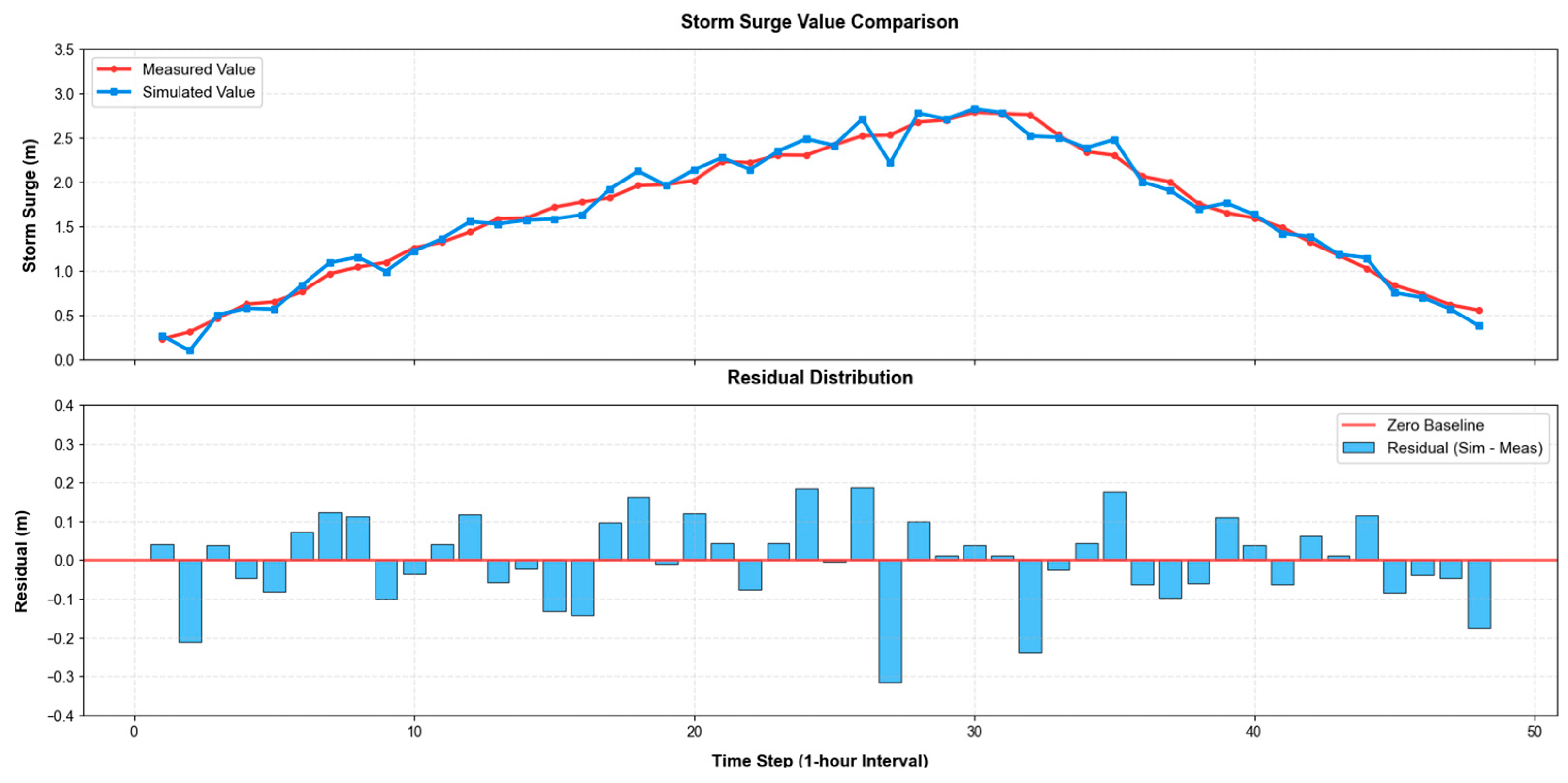
Section 2.1, the ADCIRC model achieves reliable accuracy after validation with Typhoon “Mangkhut”, with MAE < 0.2 m and RMSE < 0.3 m.
3. Risk Identification and Delineation of High-Risk Areas
3.1. Model Simulation Results
Typhoon “Mangkhut” exhibits the most significant impact: the maximum storm surge at Nansha Station, Guangzhou, reaches 2.8 m, with a maximum inundation area of 820 km
2 [
2]; the maximum inundation areas of “Haiou” and “Yagi” are 580 km
2 and 420 km
2, respectively [
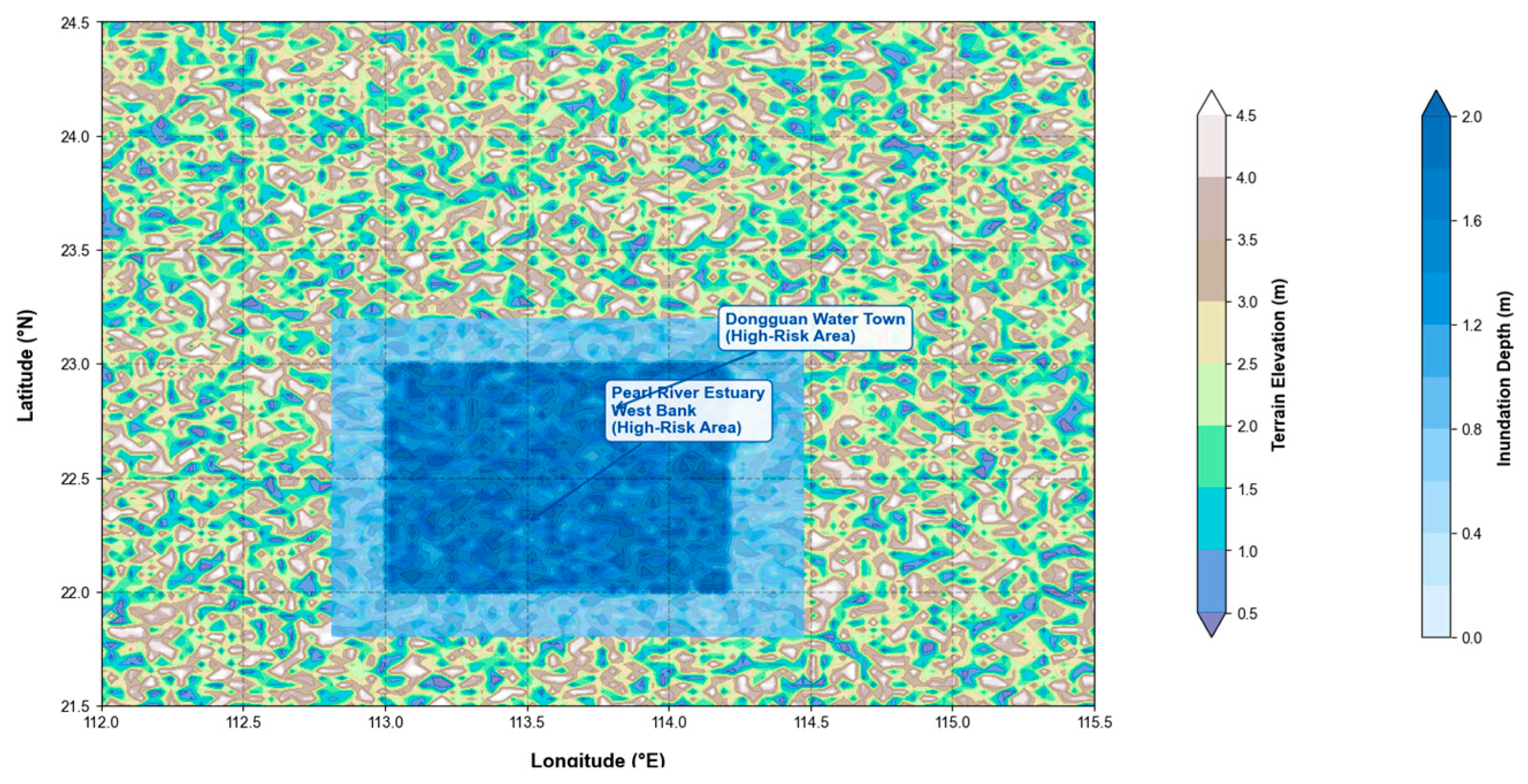
3]. High-risk areas are concentrated on the west bank of the Pearl River Estuary, Dongguan Water Town, and Dapeng Peninsula, Shenzhen, as illustrated in
Figure 1.
3.2. Quantitative Analysis of Influencing Factors
Sequence standardization: Due to the different dimensions of various influencing factors, mean normalization is first performed on the reference sequence and the comparison sequences [
4]:
is the number of typhoon cases.
Calculation of relational coefficients:
is the distinguishing coefficient.
Grey relational analysis and multiple linear regression were adopted to quantify the influence of various factors [
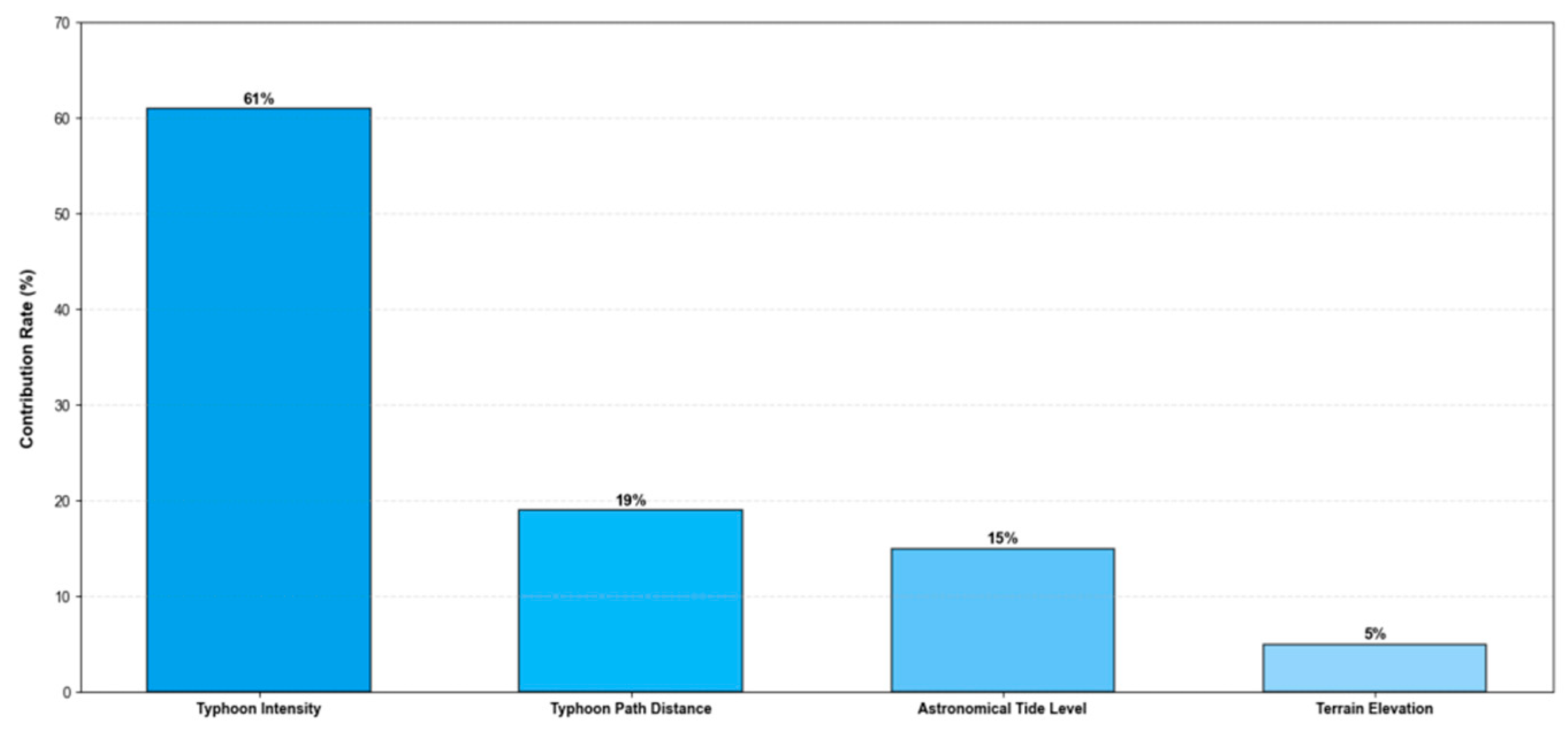
5]. The grey relational degree ranking is typhoon intensity (0.85) > path distance (0.72) > astronomical tide level (0.68) > terrain elevation (0.65), while the contribution rate ranking is typhoon intensity (61%) > path distance (19%) > astronomical tide level (15%) > terrain elevation (5%). Notably, terrain elevation dominates the spatial distribution of inundation, and the specific contribution rate differences among all influencing factors are intuitively illustrated in
Figure 2.
3.3. Delineation of High-Risk Areas
Three major high-risk areas are delineated: the west bank of the Pearl River Estuary, Dongguan Water Town, and Dapeng Peninsula, Shenzhen-Daya Bay, Huizhou, with a total area of approximately 120 km2.
4. Design and Effect Evaluation of Prevention and Control Countermeasures
4.1. Coordinated Countermeasure System
4.1.1. Engineering Measures
Seawall construction: Construct 50 km of 3.3 m-high C30 reinforced concrete seawalls on the west bank of the Pearl River Estuary, and reinforce the existing seawalls in Humen, Dongguan, to 3.0 m [
6].
Flood detention basin: Set up a 15 km2 flood detention basin in Machong, Dongguan, with a flood storage capacity of 6 million m3 to divert floods from the Pearl River Estuary.
4.1.2. Non-Engineering Measures
Early warning optimization: Shorten the early warning time from 6 h to 4 h and build a four-level push system [
7];
Emergency response: Formulate three-level response standards (Level I: surge > 2.0 m, evacuation within 2 h; Level II: 1.5–2.0 m, evacuation within 4 h; Level III: ≤1.5 m, issue prompts);
Land management: Delineate three types of development zones: prohibited, restricted, and safe.
4.2. Effect Evaluation
Taking Typhoon “Mangkhut” as the benchmark, four scenarios are set for simulation, and the comprehensive measures achieve the optimal disaster reduction effect.
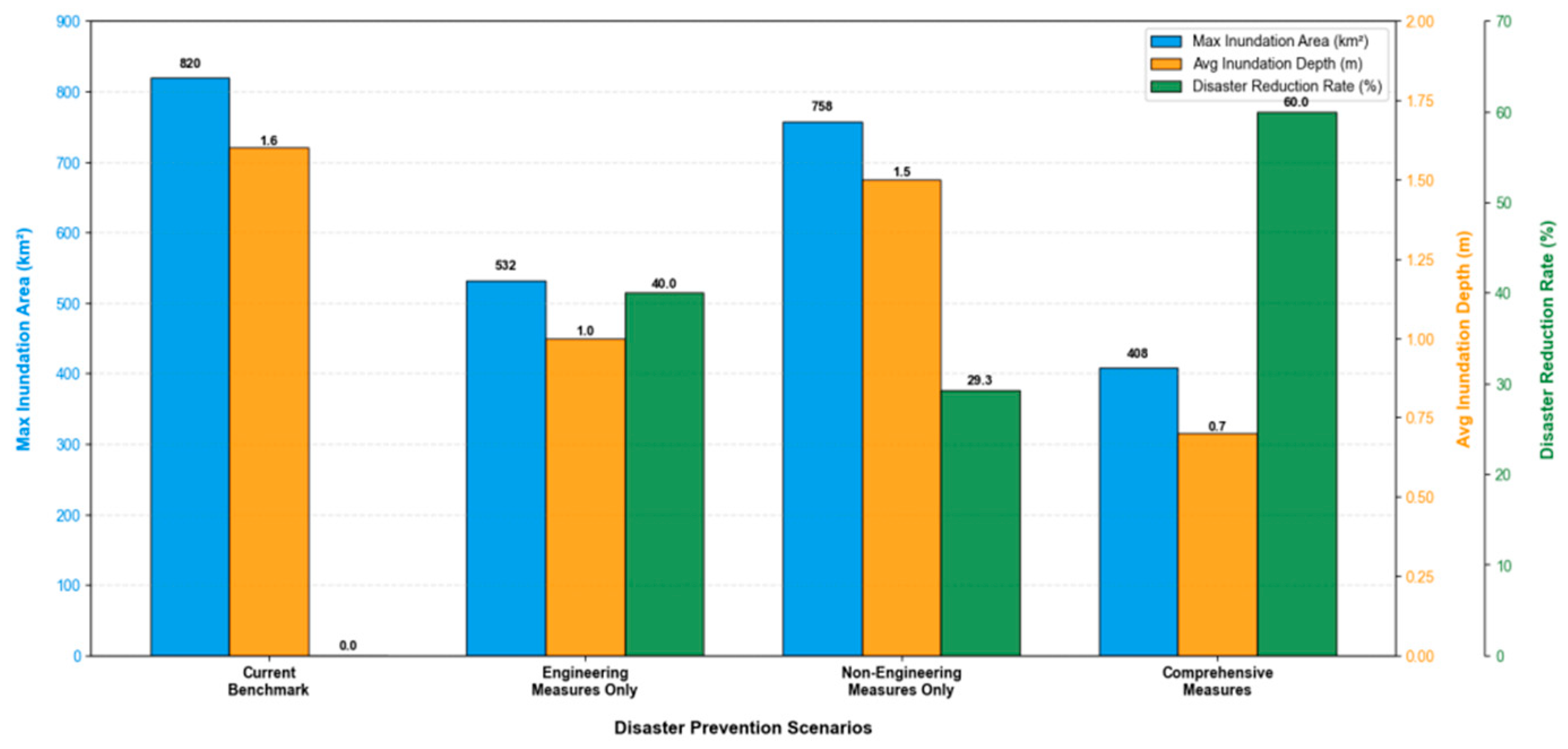
To quantitatively evaluate the disaster reduction effectiveness of different prevention and control strategies, we simulated four scenarios for Typhoon “Mangkhut” and summarized the results in
Table 2. As shown in
Table 2, the comprehensive “engineering + non-engineering” measures achieve the optimal performance: the maximum inundation area is reduced from 820 km
2 to 408 km
2, and the average inundation depth decreases from 1.6 m to 0.7 m, which is significantly better than single engineering or non-engineering measures. These quantitative findings are further visualized in
Figure 3, which clearly illustrates the trends in inundation area, depth, and disaster reduction rate across scenarios, highlighting the synergistic effect of comprehensive measures.
5. Model Verification and Reliability Analysis
5.1. Accuracy Verification
The MAE of core tide gauge stations is 0.13–0.16 m, and the RMSE is 0.16–0.19 m; the coincidence degree between the simulated inundation area and remote sensing results is 82%, reaching 87% in high-risk areas, with accuracy meeting specifications [
8]. The temporal consistency between simulated and measured storm surge values at Nansha Station, along with the residual distribution, is further visualized in
Figure 4, providing direct evidence of the model’s high temporal simulation accuracy.
5.2. Stability and Sensitivity
Sensitivity coefficient formula:
is the input parameter,
is the variation of
(set to ±20%),
is the output indicator, and
is the corresponding variation of
. The larger the value of
, the higher the sensitivity of the output indicator to the input parameter [
9].
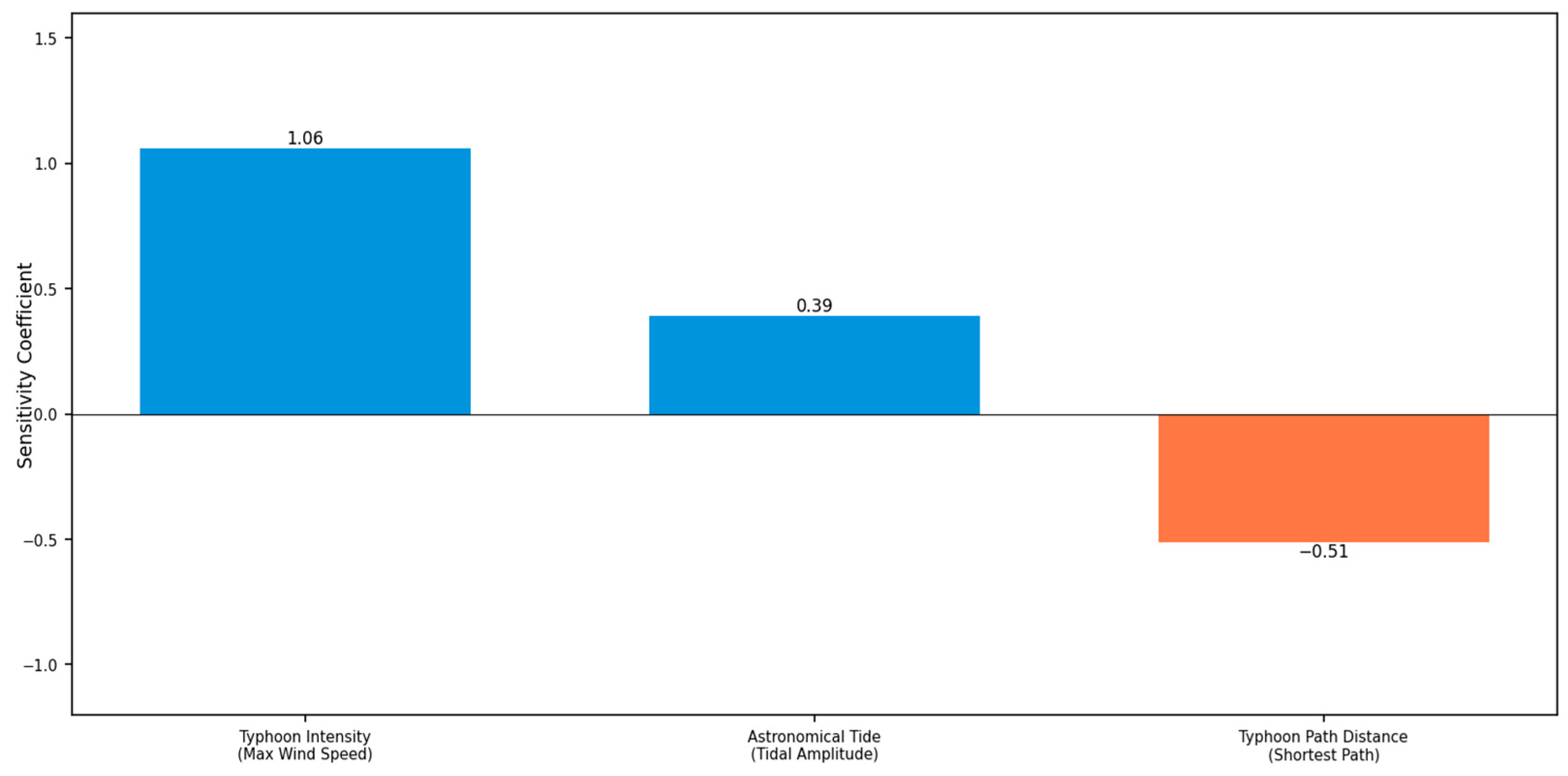
When the Manning coefficient and mesh resolution fluctuate, the output change rate is <10%, indicating good model stability [
10]. The sensitivity coefficients of core input parameters are as follows: typhoon intensity (1.0), astronomical tide level (0.39), and path distance (0.51). This ranking is consistent with the earlier influencing factor analysis, and the specific comparison of sensitivity coefficients is intuitively presented in
Figure 5.
6. Conclusions
The constructed ADCIRC model can accurately simulate the storm surge process with MAE < 0.2 m and RMSE < 0.3 m, providing reliable support for risk identification.
Typhoon intensity and terrain elevation are the core influencing factors, with high-risk areas concentrated on the west bank of the Pearl River Estuary and other regions.
The comprehensive measures of “seawall + flood detention basin + early warning + management” can achieve a 60% disaster reduction rate, effectively improving the resilience of regional disaster prevention and control.
The research results can be extended to coastal high-risk areas such as the Yangtze River Delta and Bohai Bay, and the runoff and rainfall modules can be coupled to improve accuracy in the future.
Author Contributions
Conceptualization, J.W., H.W. and S.C.; methodology, J.W.; software, J.W.; validation, J.W., H.W., S.C., Z.J. and Z.D.; formal analysis, J.W.; investigation, J.W.; resources, K.Z.; data curation, J.W.; writing—original draft preparation, J.W.; writing—review and editing, K.Z.; visualization, J.W.; supervision, K.Z.; project administration, K.Z. All authors have read and agreed to the published version of the manuscript.
Funding
This research received no external funding.
Institutional Review Board Statement
Not applicable.
Informed Consent Statement
Not applicable.
Data Availability Statement
The data presented in this study are available upon request from the first author.
Conflicts of Interest
The authors declare no conflict of interest.
References
- Choi, B.H.; Min, B.I.; Kim, K.O.; Yuk, J.H. Wave-tide-surge coupled simulation for typhoon Maemi. China Ocean Eng. 2013, 27, 141–158. [Google Scholar] [CrossRef]
- Bilskie, M.V.; Hagen, S.C.; Alizad, K.; Medeiros, S.C.; Passeri, D.L.; Needham, H.F.; Cox, A. Dynamic simulation and numerical analysis of hurricane storm surge under sea level rise with geomorphologic changes along the northern Gulf of Mexico. Earth’s Future 2016, 4, 177–193. [Google Scholar] [CrossRef]
- Siahsarani, A.; Karami Khaniki, A.; Aliakbari Bidokhti, A.A.; Azadi, M. Numerical Modeling of Tropical Cyclone-Induced Storm Surge in the Gulf of Oman Using a Storm Surge–Wave–Tide Coupled Model. Ocean. Sci. J. 2021, 56, 225–240. [Google Scholar] [CrossRef]
- Kikstra, J.S.; Nicholls, Z.R.; Smith, C.J.; Lewis, J.; Lamboll, R.D.; Byers, E.; Sandstad, M.; Meinshausen, M.; Gidden, M.J.; Rogelj, J.; et al. The IPCC Sixth Assessment Report WGIII climate assessment of mitigation pathways: From emissions to global temperatures. Geosci. Model Dev. 2022, 15, 9075–9109. [Google Scholar] [CrossRef]
- Fang, J.; Wahl, T.; Fang, J.; Sun, X.; Kong, F.; Liu, M. Compound flood potential from storm surge and heavy precipitation in coastal China: Dependence, drivers, and impacts. Hydrol. Earth Syst. Sci. 2021, 25, 4403–4416. [Google Scholar] [CrossRef]
- Zhang, R.; Li, Y.; Li, C.; Chen, T. From Simulation to Implementation: Validating Flood Resilience Strategies in High-Density Coastal Cities—A Case Study of Macau. Water 2025, 17, 3110. [Google Scholar] [CrossRef]
- Wahl, T.; Jain, S.; Bender, J.; Meyers, S.D.; Luther, M.E. Increasing risk of compound flooding from storm surge and rainfall for major US cities. Nat. Clim. Change 2015, 5, 1093–1097. [Google Scholar] [CrossRef]
- Davidson, N.E.; Ma, Y. Surface pressure profiles, vortex structure and initialization for hurricane prediction. Part II: Numerical simulations of track, structure and intensity. Meteorol. Atmos. Phys. 2012, 117, 25–45. [Google Scholar] [CrossRef]
- Kim, H.; Kim, E.J.; So, J.K.; Kim, K.O.; Cha, D.H. Forecast of the Rapidly-Intensified Typhoon Nepartak (T201601) in the Eddy-rich Northwestern Pacific Region. J. Coast. Res. 2019, 91, 123–130. [Google Scholar] [CrossRef]
- Wang, K.; Hou, Y.; Li, S.; Du, M.; Chen, J.; Lu, J. A comparative study of storm surge and wave setup in the East China Sea between two severe weather events. Estuar. Coast. Shelf Sci. 2020, 235, 106583. [Google Scholar] [CrossRef]
| Disclaimer/Publisher’s Note: The statements, opinions and data contained in all publications are solely those of the individual author(s) and contributor(s) and not of MDPI and/or the editor(s). MDPI and/or the editor(s) disclaim responsibility for any injury to people or property resulting from any ideas, methods, instructions or products referred to in the content. |