


Abstract
We investigate how to integrate AI-generated content (AIGC) into project-based teaching (PBT) in higher vocational colleges to address the limitations of traditional models and advance digital transformation in engineering education. AIGC generation systems in PBT provide teaching resources, personalized skill guidance, and project process management. Improvement was observed in learning performance and project outcomes by 15%, confirming that AIGC fosters engineering practice, innovation, and collaboration. The results show that AIGC can be utilized in vocational engineering education and talent cultivation.
1. Introduction
AI-generated content (AIGC) technologies have brought new paradigms for the development and delivery of project-based teaching (PBT) in higher vocational colleges. AIGC systems, supported by deep learning, natural language processing, and computer vision, enable the automated generation of engineering-relevant content such as computer-aided design, technical documentation, simulation models, and interactive virtual environments, providing new technical support for the innovation of project-based teaching models [1]. From an engineering perspective, AIGC technologies provide scalable solutions for constructing complex instructional resources that traditionally require significant human expertise and time investment.
Generative AI (GenAI) tools, including large language models (LLMs) and diffusion-based image generators, have been widely used in engineering education to support course design, technical resource development, and performance evaluation. In mechanical and electrical engineering curricula, AIGC is used to generate parametric design variations, simulate manufacturing processes, and produce annotated schematics, enhancing the fidelity of project-based learning. Such capabilities of AIGC technologies improve instructional efficiency and ensure that students engage with content aligned to current industrial standards and practices [2].
AIGC also contributes to adaptive engineering education by enabling the intelligent analysis of student performance data. Through the algorithmic assessment of design outputs, coding practices, or simulation results, AIGC systems are used to identify skill gaps and propose targeted interventions. This engineering-oriented feedback is essential for the creation of personalized learning trajectories since it can help students learn diverse technical foundations and have career orientations. Moreover, the integration of AIGC into project-based teaching facilitates the transition from static instructional materials to dynamic, data-driven learning ecosystems.
The incorporation of AIGC technologies in vocational education reshapes the traditional teacher–student interaction into a teacher–student–machine collaboration. In this model, human instructors provide domain expertise and contextual judgment, while AIGC systems deliver computational support through automated content generation, simulation, and verification. This collaborative framework enhances the robustness of project-based teaching by enhancing human creativity, which leads to the development of problem-solving, iterative design, and technical validation [3].
AIGC is adopted in establishing curriculum design and pedagogical strategy. As generative AI (GenAI) increasingly assumes responsibility for routine content creation and verification, students are required to shift from task execution toward supervisory roles involving the technical oversight, validation, and optimization of AI-generated outputs. Such a transition of students’ roles necessitates the development of adaptive project-based learning pathways that emphasize autonomy, critical evaluation, and competence in managing AI-assisted engineering workflows. Therefore, AIGC technologies can be used to improve the technical infrastructure of vocational education by redefining the skills required to be engineering professionals [4].
2. Literature Review
PBT in higher vocational colleges has been advanced through the integration of GenAI technology that automates the development and delivery of technical content. The technology has contributed to the technical integration of AIGC within specific engineering disciplines in vocational settings. A technical hurdle is the disconnect between static instructional content and dynamic industrial requirements, suggesting that digital empowerment with AI is the key to addressing these issues [3]. At the Changzhou College of Information Technology, PBT model optimization was conducted. AIGC has been used for the development of programming curricula, especially for the teaching of code optimization and collaborative development [5]. An AIGC-based framework for mechanical engineering requires the integration of generative technology to provide intelligent support for project design and simulation verification [6].
Recent PBT models focus on cultivating human–machine collaboration, where students transition from manual execution to the supervision of AI-driven engineering outputs. GenAI’s potential is most evident in high-complexity engineering subjects such as embedded systems, mechanical design, and electrical engineering. PBT models in engineering technology programs can effectively improve industry adaptability [5,6]. Through the development of AI-assisted project platforms for electrical engineering, personalized technical solutions and simulation models are established on the basis of student skill levels. AI tools are also used to optimize team communication and enhance the rationality of project process management in engineering contexts.
While AIGC improves creative output and efficiency, it poses challenges to independent problem-solving and academic integrity in engineering cohorts [7]. To address such challenges, multi-dimensional evaluation frameworks using LLMs are used to assess technical completeness and practical applicability. Despite the potential of AIGC for content creation, a lack of standardized application programming interface integration must be solved. There is also a significant deficiency in standardized interfaces between AIGC development tools and traditional engineering software, such as Automatic Computer-Aided Design (AutoCAD 2024, R24.3), SolidWorks 2025, or Programmable Logic Controller (PLC) Simulators [8].
PBT models are mainly used in single-course or single-major applications, such as big data or programming. There is a lack of systematic research on a cross-disciplinary AIGC development framework that covers the entire engineering talent training lifecycle. An in-depth analysis of the teacher–student–machine collaborative mechanism must be investigated to enhance the model’s effectiveness in vocational education. Therefore, it is necessary to construct a systematic AIGC content development framework for AIGC generation and its validation for the digital transformation of engineering vocational education.
3. PBT and AIGC Application
The integration of AIGC into PBT enhances vocational engineering education. The integration is conceptualized in three interrelated demand dimensions: engineering-oriented resource generation, personalized skill guidance, and project process management. These dimensions are the basis of a framework that supports the modernization of vocational engineering pedagogy.
AIGC technologies, with cross-modal generation capabilities (text, images, 3D models, and simulation videos), provide scalable solutions for enriching PBT resources. By aligning instructional materials with industrial standards and project requirements, AIGC is used to generate engineering-specific content, such as standard operating procedures (SOPs), mechanical structure drawings, circuit schematics, and virtual simulation scenarios [1]. For example, in computer numerical control (CNC) machining courses, AIGC tools are used to produce customized process cards and tool-path simulations tailored to specific materials and geometries, enabling students to learn complex operations. The integration with virtual reality and augmented reality in PBT enables immersive practice environments, expanding training opportunities and reducing costs. Through the integration, PBT can be synchronized with evolving industrial technologies [9].
AIGC systems enable individualized skill development by analyzing students’ project data, including operation logs, error frequencies, and problem-solving processes. Such intelligent monitoring supports the identification of skill gaps and the formulation of targeted improvement strategies [6]. In mechanical design, AIGC is used to recommend appropriate CAD tools and optimization methods based on students’ proficiency levels and innovation capacity [5]. Additionally, natural language interaction allows the simulation of AIGC, providing real-time consultation on equipment operation, process parameters, and fault diagnosis. This dimension helps address the challenge of heterogeneous student backgrounds and ensures that PBT accommodates diverse learning trajectories and career orientations [10].
The third dimension of the AIGC-enabled education focuses on project execution and collaborative management. Traditionally, instructors devote substantial effort to coordinating schedules, resolving technical conflicts, and monitoring quality [3]. AIGC-based tools automate these processes by tracking task completion, predicting risks, and issuing progress reminders. In intelligent manufacturing integration projects, AIGC is used to generate optimal task division plans based on team members’ expertise, improving efficiency and reducing delays. Moreover, AIGC contributes to the production of standardized technical communication documents and offers the real-time translation of specialized terminology, enhancing effective teamwork among students with diverse technical backgrounds. Therefore, AIGC can be used to improve the project execution quality and enhance the project management competencies of students [9].
The three dimensions, resources, skills, and management, constitute the integrated AIGC-enabled PBT models. Resource generation ensures the alignment with industrial standards, personalized guidance addresses individual learning needs, and process management enhances collaborative efficiency. The dimensions are essential for a framework that combines human expertise and intelligent assistance to strengthen engineering education in higher vocational colleges.
4. AIGC Generation for PBT
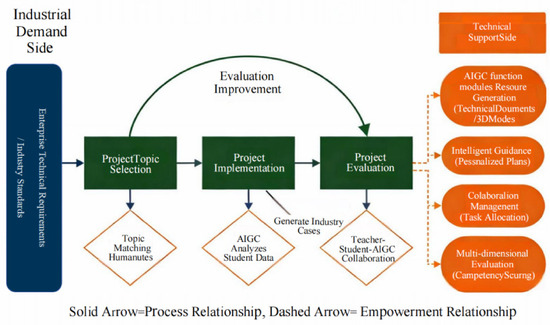
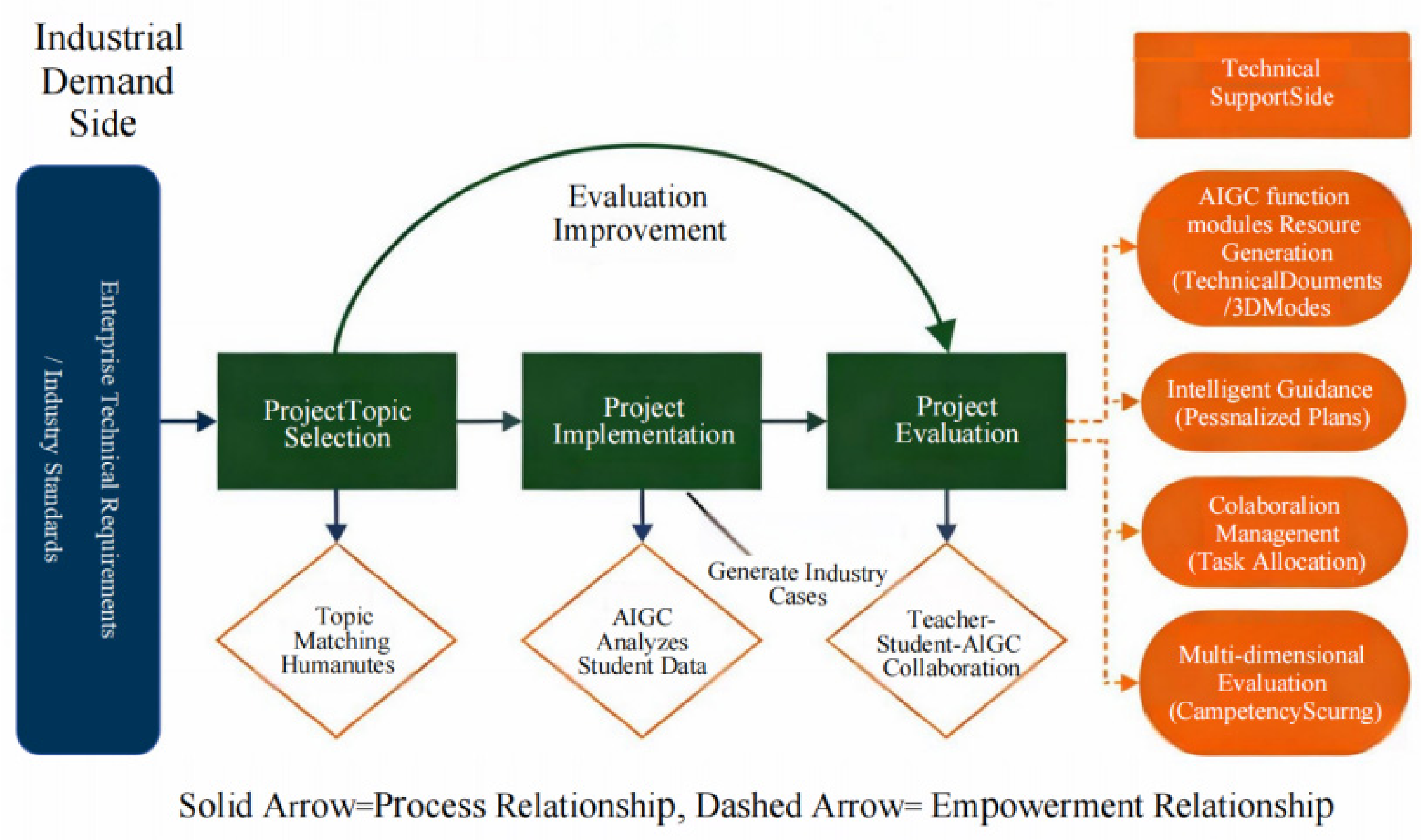
The development of AIGC tools for higher engineering vocational education is structured as a technical pipeline that transitions from industrial data acquisition to multi-modal content generation and synergetic validation. This framework prioritizes technical support as a foundational engineering infrastructure, ensuring that generated instructional resources are technically robust and industrially relevant (Figure 1).
Figure 1.
The workflow of AIGC-generation for PBT (created in this study using AI).
4.1. Data Layer: Industrial Standard and Knowledge Integration
The data layer serves as the backend infrastructure, utilizing LLMs and industrial big data platforms to identify forward-looking technical hotspots. The AIGC generation system collects and analyzes massive datasets, including national policy documents, enterprise technical requirements, and industry development reports, to ensure project topics reflect cutting-edge industrial applications, such as intelligent fault diagnosis. To ensure technical precision, the development process requires a curated dataset of engineering principles and technical specifications to minimize AI hallucinations and ensure that generated 3D models and technical documents meet industrial standards [4]. The layer further integrates student performance data, such as learning behavior records and course scores, to generate personalized technical profiles and identify skill gaps.
4.2. Implementation Layer: Multi-Modal Engineering Content Generation
This layer is responsible for the automated production of technical artifacts through specialized AIGC development tools, emphasizing the technical validation of generated outputs. The AIGC system generates 3D mechanical models and virtual simulation scenarios for CNC machining or mechatronics. These tools enable the virtual testing of structural stability and performance parameters, identifying design flaws before physical prototype production. AIGC tools are developed to generate PLC code, Python 3.13.0 scripts for big data analysis, and detailed circuit schematics. For example, AI-generated wiring diagrams and troubleshooting flowcharts for electrical control systems simplify complex technical processes. A core component of the AIGC generation system implementation involves developing specialized prompts that guide AI to generate the initial code frameworks, which are then iteratively modified and optimized by students to ensure technical compliance and efficiency.
4.3. Collaborative Layer: Human–AI Synergy and Intelligent Evaluation
The collaborative layer is used to construct a human–AI synergy mechanism, redefining the interaction between instructors, students, and intelligent systems within an engineering workflow. The system operates on API-driven interactions where AIGC acts as a digital engineer, providing real-time technical consultation. Current systems achieve a 93% accuracy in answering engineering principles and technical operation questions, offering a robust support system for independent problem-solving. The evaluation engine is developed to analyze process-based logic rather than just the outcomes. This includes automated multi-dimensional inspections of student-written code, focusing on naming conventions, comment completeness, and logical efficiency, as well as the structural rationality of 3D models. The evaluation module of the system quantifies individual contributions by analyzing communication records and task completion rates within collaborative projects, identifying AI-assisted innovation points. Based on automated evaluation results, the tool generates targeted improvement plans, such as suggesting specific optimization algorithms or material replacements, while summarizing common learning bottlenecks for instructors to adjust pedagogical strategies.
5. Verification and Effect Analysis of AIGC Generation System
To validate the effectiveness of the AIGC generation system in PBT, we selected two classes from the Grade 2025 Big Data Technology at the Changzhou College of Information and Technology, which is an essential Engineering and Information Technology course. The classes were selected based on the high compatibility of the course with AIGC generation and application, since students learn data analysis, algorithmic model construction, and iterative scheme optimization. The experimental group (n = 40) integrated the AIGC tool, while the control group (n = 40) utilized traditional methods without using AIGC. Both classes possessed similar foundational skills in information technology and academic performance to ensure the comparability of technical proficiency outcomes.
The implementation of the AIGC tool followed a rigorous engineering method focused on technical feasibility and industry-standard alignment over two semesters. AIGC tools (Chat Generative Pre-trained Transformer 4.0 and industrial big data platforms) were used to analyze industrial trends and generate technically viable project architectures, such as intelligent customer segmentation systems and industrial data anomaly detection. Using a human–AI synergy framework, the students utilized the tool for data preprocessing, model design, and simulation testing. This mechanism allowed for the real-time addressing of technical bottlenecks and the optimization of project processes. The AIGC generation system was used for multi-dimensional technical assessments, generating data-driven feedback on outcome quality and structural rationality.
To evaluate the AIGC generation system, technical proficiency metrics were used to evaluate students’ performance. Technical accuracy and logic were measured using model accuracy and code efficiency inspections. Productivity was estimated by tracking the task completion speed and SOP generation time. Innovation and complexity were assessed to evaluate the integration of AI-assisted innovations, such as personalized data models. Human–AI synergy acceptance was assessed using a questionnaire survey (Appendix A), in which the technology acceptance model was applied to measure the ease of operation and its support for technical optimization.
All data were processed using Statistical Package for the Social Sciences 26.0 and Python (Scikit-learn). Descriptive statistics and paired sample t-tests were applied to proficiency data to distinguish the technical performance gap between AI-augmented and manual workflows. The results indicate that the AIGC system significantly enhanced the technical outcomes (Table 1). The experimental group achieved a project score of 82.2 (out of 100), a 20.0% increase over pre-test levels, compared to a marginal 8.4% increase in the control group.
Table 1.
Comparison of students’ performance improvement.
The results of the experimental and control groups highlight the system’s impact on core engineering metrics (Table 2). The experimental group demonstrated a 92% acceptance rate of AIGC as a necessary engineering infrastructure. The digital engineer’s role within the AIGC system is to help students overcome high-difficulty technical barriers. While the system provided an effective feedback loop for technical oversight and optimization, the further development of these tools is required to assess and mitigate the risks associated with AI-generated logic.
Table 2.
Comparison of performance of the experimental and control groups.
Table 2 presents quantitative evidence of the performance differences between the experimental and control groups. In the final examination results, the experimental group achieved an average score increase of 13.5%, compared with 3.3% in the control group. This improvement reflects the ability of AIGC to align instructional content with the core courses of the Big Data major, enhancing theoretical comprehension and examination performance. In project scoring, the experimental group showed a 20.0% increase, compared with an 8.4% increase in the control group. The practical projects, Big Data Analysis, Modeling, and AIGC-assisted Solution Design, were evaluated on achievement completeness, innovation, and the degree of technological application. The substantial improvement in the experimental group demonstrates that AIGC integration not only strengthens technical execution but also fosters innovation and applied engineering competencies. These results underscore the following findings.
AIGC-generated resources improved the accuracy and relevance of project tasks, enabling students to engage with industrial-grade content and workflows. The significant increases in practical project scores show that AIGC-supported PBT accelerates the development of hands-on engineering skills, particularly in complex domains such as data modeling and intelligent system design. The enhanced performance in innovation-related scoring dimensions suggests that AIGC fosters creativity and adaptability, preparing students to address real-world engineering challenges with greater competence.
The role of AIGC in a transformative infrastructure was observed in the results for vocational engineering education. By linking theoretical learning with applied practice, AIGC-enabled workflows can enhance academic outcomes and professional readiness.
6. Conclusions and Future Prospects
We validated an AIGC-generation system for PBT for higher engineering vocational colleges, to address the limitations of traditional PBT and promote the digital transformation of engineering vocational education. Through the integration of AIGC, engineering teaching resources can be enriched by generating multimodal content, including technical documents, simulation videos, and 3D models, resolving the shortage of high-quality project resources and bridging the gap between teaching and industrial practice. The results of this study showed that AIGC enables the development of personalized technical guidance and skill improvement plans to meet different learning needs and enhance learning effectiveness [6]. AIGC is used for scheme simulation, real-time consultation, and collaborative management, which are essential to significantly improve students’ engineering practice capabilities, problem-solving skills, and teamwork awareness [9]. The multi-dimensional evaluation system with AIGC also enhances the objectivity and comprehensiveness of the teaching assessment, providing effective feedback for instructional optimization [2].
In this study, the experimental group showed a 13.5% improvement in final examination scores and a 20.0% increase in practical project performance scores, compared with 3.3 and 8.4% in the control group. These results indicate that AIGC can be used to improve theoretical comprehension, skill acquisition, and innovation level in applied engineering contexts. The students reported a 92% acceptance rate of AIGC as essential infrastructure, with interview data highlighting the role of the digital engineer in overcoming high-difficulty technical barriers.
The AIGC generation system also enables industrial relevance by aligning project topics with enterprise needs [5], realizes personalized skill training through the precise analysis of student characteristics [6], and optimizes the teaching ecosystem by reconstructing the teacher–student–machine collaborative mechanism [3].
However, limitations remain. The high application costs associated with hardware and software deployment pose challenges for resource-constrained institutions [10]. Teachers’ insufficient adaptability to AIGC tools reduces the integration depth [9], and the risks of over-reliance on AI hinder the cultivation of independent thinking and fundamental engineering skills. This necessitates the reduction in costs through school–enterprise cooperation, teacher training in AI tool application, and balanced human–machine collaboration mechanisms. Teaching guidelines must be created to make AIGC serve as a supplementary tool rather than a substitute for the cultivation of core engineering competencies such as problem-solving and innovation. As AIGC technologies mature and become more accessible, their application in higher engineering vocational education expands across disciplines such as electrical engineering, civil engineering, and intelligent manufacturing. Large-scale empirical studies are required to verify the universality of the model and refine its engineering integration.
The continuous development of AIGC generation systems is required through the continuous validation of reliability and scalability. The automated evaluation of AI-generated schematics, code, and logic is also essential to mitigate risks in the integration with advanced technologies. Adaptive learning tools must be designed to transform students’ roles from task execution to enhancing their competence in supervising AI-assisted processes. Such efforts make AIGC-enabled PBT contribute to cultivating high-quality technical talent, supporting industrial transformation, and upgrading.
Funding
This research was funded by The 2026 Annual National Higher Vocational College Teaching Research Project of the Ministry of Education’s Vocational Education Information Technology Instruction Guidance Committee on ‘The Paradigm Transformation and Implementation Strategies of PBT Mode Based on AIGC in Higher Vocational Colleges’, grant number KT2508011.
Institutional Review Board Statement
Not applicable.
Informed Consent Statement
Not applicable.
Data Availability Statement
No new data were created or analyzed in this study. Data sharing is not applicable to this article.
Conflicts of Interest
The author declares no conflicts of interest.
Appendix A
A questionnaire with a 5-point scale was used in this study (5: strongly agree, 4: agree, 3: neutral/undecided, 2: disagree, and 1: strongly disagree).
| Number | Investigation Dimension | Items |
| 1 | Technical acceptance | 1.1. AIGC tools (such as AI design simulators and intelligent topic selection assistants) are easy to operate and get started with |
| 1.2. AIGC technology can provide effective support for project design and scheme optimization | ||
| 2 | Perception of learning outcomes | 2.1. This teaching mode has helped me better master the professional knowledge of big data |
| 2.2. With the help of AIGC tools, my practical operation skills (such as project design and problem-solving) have been significantly enhanced | ||
| 3 | Satisfaction with teaching mode | 3.1. The project topic selection based on AIGC (industry hot topic orientation, and matching personal interests) is reasonable and valuable |
| 3.2. The teacher–student–machine trinity collaboration model (teacher–student + AIGC collaboration) can effectively promote the progress of the project | ||
| 3.3. AIGC multi-dimensional evaluation (outcome quality, collaboration ability, and innovative thinking) is objective and targeted | ||
| 4 | Learning experience | 4.1. This teaching mode has enhanced my interest in the study of big data |
| 4.2. I am more willing to actively participate in classroom interaction and project collaboration |
References
- Chen, X.; Hu, Z.; Wang, C. Empowering Education Development through AIGC: A Systematic Literature Review. Educ. Inf. Technol. 2024, 29, 17485–17537. [Google Scholar] [CrossRef] [Scilit]
- Ming, D.; Meng, S. Exploration and research of generative artificial intelligence on higher vocational education. In Proceedings of the 2nd International Conference on Educational Knowledge and Informatization, Shanghai, China, 19 July 2024. [Google Scholar] [CrossRef] [Scilit]
- Jian, X.; Li, F.; Liu, Z. A Study on the Application of AIGC Context in the Development of Digital Resources for Online Courses. In Proceedings of the 2024 International Conference on Artificial Intelligence and Teacher Education, Beijing, China, 12 October 2024. [Google Scholar] [CrossRef] [Scilit]
- Garg, A.; Soodhani, K.S.; Rajendra, R. Enhancing data analysis and programming skills through structured prompt training: The impact of generative AI in engineering education. Comput. Educ. Artif. Intell. 2025, 8, 100380. [Google Scholar] [CrossRef] [Scilit]
- Fu, S. Exploration on the Empowerment of AIGC Technology in Higher Vocational Education Teaching Modes. J. Contemp. Educ. Res. 2025, 9, 126–132. [Google Scholar] [CrossRef] [Scilit]
- Shi, Y.; Tang, W.; Feng, T.; Zhang, J. Research on Mechanisms and Pathways of Generative Artificial Intelligence Empowering Intelligent Manufacturing Curriculum Teaching Reform. LNE 2025, 3, 214–228. [Google Scholar] [CrossRef] [Scilit]
- Fan, L.; Deng, K.; Liu, F. Educational Impacts of Generative Artificial Intelligence on Learning and Performance of Engineering Students in China. Sci. Rep. 2025, 15, 26521. [Google Scholar] [CrossRef] [Scilit] [PubMed]
- Ariza, J.Á.; Restrepo, M.B.; Hernández, H.C. Generative AI in Engineering and Computing Education: A Scoping Review of Empirical Studies and Educational Practices. IEEE Access 2025, 13, 30789–30810. [Google Scholar] [CrossRef] [Scilit]
- Liao, X. Visualizing the Current Application and Future Directions of GenAI-Supported Student Learning and Development. Int. J. Web-Based Learn. Teach. 2025, 20, 1–27. [Google Scholar] [CrossRef] [Scilit]
- Zhai, Y. Research on library management paradigm in the AIGC era: Theoretical construction and practical exploration. J. Acad. Librariansh. 2025, 51, 103085. [Google Scholar] [CrossRef] [Scilit]

Disclaimer/Publisher’s Note: The statements, opinions and data contained in all publications are solely those of the individual author(s) and contributor(s) and not of MDPI and/or the editor(s). MDPI and/or the editor(s) disclaim responsibility for any injury to people or property resulting from any ideas, methods, instructions or products referred to in the content. |
© 2026 by the author. Licensee MDPI, Basel, Switzerland. This article is an open access article distributed under the terms and conditions of the Creative Commons Attribution (CC BY) license.