


Abstract
Digital twin (DT) offers advantages for technical and vocational education and training. In a controlled study, DT-supported learners achieved higher mastery rates (82.9 vs. 57.1%) and reached mastery faster (312.4 ± 88.6 vs. 421.7 ± 102.3 min). They showed higher procedural accuracy (86.3 vs. 78.4%), faster error convergence (1.2 vs. 2.4 errors/session), stronger safety compliance (0.3 vs. 0.9 violations/session), and superior transfer performance (81.2 vs. 75.8%). These results confirm that DT-based closed-loop feedback accelerates learning, improves safety and quality, and enhances adaptability, supporting scalable integration into competency-based vocational education.
1. Introduction
Rapid advancements in cyber–physical systems, the Industrial IoT (IIoT), and intelligent automation are changing industrial work environments, restructuring human–machine workflows, and elevating the baseline definitions of operational competence [1,2]. Modern automated shop floors rely on interconnected programmable logic controller networks, supervisory control and data acquisition systems, and cobots, increasing the demand for technical workforces equipped to manage these advanced environments [3]. Technical and vocational education and training (TVET) institutions are under intense pressure to modernize their training rigs to match these technological shifts [3]. However, traditional instruction relies heavily on static simulations or expensive, high-stakes physical training rigs where student errors lead to equipment damage, severe safety violations, and costly downtime. Therefore, it is necessary to develop and deploy scalable, real-time, closed-loop training platforms that relate virtual learning to hands-on operational systems.
Rather than relying on virtual reality or unlinked simulations, implementing a digital twin (DT) in TVET presents a challenge in cyber–physical engineering. Industrial DT systems are defined as dynamic virtual representations of physical assets or processes, maintaining bidirectional, continuous real-time data synchronization across their lifecycles [4]. To repurpose this industrial paradigm for training environments, a robust multi-layer architecture must be constructed to convert high-frequency physical data from sensors, actuator states, and control relays to stateful virtual models and pedagogical evaluation algorithms. Standard simulations lack this continuous cyber–physical feedback loop, preventing them from tracking step-by-step procedural precision, troubleshooting sequences, or safety-critical constraints in real time. Additionally, instructors must use analytics to objectively verify student competency without manually monitoring every practical step.
To address these challenges, a multi-layer DT platform was designed for industrial automation and mechatronics training in this study. A real-time analytics engine was also created to evaluate student actions against optimal target sequences and safety boundaries. The results of this study show that the system enables students to gain hands-on technical skills while maintaining strict safety standards and system integrity, preventing them from over-relying on automated assistance.
2. Literature Review
In industrial engineering, DT is defined as a dynamic virtual representation of a physical asset, system, or process that maintains continuous, bidirectional synchronization via real-time data streams across its operational lifecycle. The standard five-dimensional industrial DT framework emphasizes data fusion, multi-scale model fidelity, and real-time operational decision support. When repurposed for technical training environments, the framework requires converting high-frequency data from sensors, actuators, and controllers to reflect physical equipment status accurately. However, these systems must be scaled up to address engineering challenges.
The foundational technologies for DT deployment include IoT edge sensing, industrial connectivity, cloud/distributed computing, and advanced data analytics to identify technical boundaries such as protocol interoperability, latency, data quality, and secure access governance [5]. To overcome these barriers in automated environments, modern deployments depend on standard communication layers such as open platform communications unified architecture (OPC UA). A platform-independent, service-oriented architecture secures semantic interoperability between cross-vendor programmable logic controllers (PLCs) and virtual edge models [6]. Modbus transmission control protocol/Internet protocol (TCP/IP) is used to ensure low-overhead, high-frequency register mapping for fast telemetry ingestion.
At the institutional and systems level, digitalization is reshaping technical education. The United Nations Educational, Scientific, and Cultural Organization’s International Centre for Technical and Vocational Education and Training stresses that modern curricula must embed digital competencies directly into instruction to stay aligned with fast-changing labor markets [1]. The International Labour Organization frames this shift as a structural transition that redefines how skills are developed, assessed, and certified [2]. This transition requires auditable evidence infrastructures that replace episodic manual testing with continuous, high-fidelity data logs. Scalable feedback loops that deliver automated, real-time corrections without adding instructor workload, and robust data governance that secures role-based access, minimizes data use, and preserves telemetry integrity across connected training spaces [2].
Recent deployments of educational DT platforms have moved beyond passive, disconnected simulations toward interactive, synchronized systems [3]. Standard virtual simulations reproduce isolated mechanical actions in closed environments. In contrast, DT-driven learning establishes cyber–physical loops that parse operational sequences, detect manual or programming errors against expert traces, and adapt parameters to scaffold student progress [4]. Weis et al. built a web-based interactive DT framework that rendered complex system dynamics while supplying telemetry-driven analytics to evaluate technical mastery [7]. Zhang et al. tested a project-based DT platform and showed significant gains in skill retention and diagnostic accuracy compared to conventional models [8]. Karanam and Hartman pointed out trends in smart manufacturing education. Cloud-based DT deployment offloads heavy simulations to distributed networks; modular architectures that separate data acquisition from rendering and analytics for quick reconfiguration; and telemetry integration efforts to resolve interoperability issues, data dropouts, and role-based stream management [9].
Previous studies propose policy rationales and technical milestones for standalone DT applications, but lack a unified, mastery-oriented architecture. Current systems do not process high-frequency cyber–physical data, such as register states, sensor thresholds, and timestamps, to structured competency domains, such as procedural accuracy, error convergence, and safety compliance, while remaining independent of proprietary hardware Therefore, in this study, a multi-layer DT platform was designed for scalable industrial automation training in this study by engineering, deploying, and evaluating the platform [7].
3. Methodology
3.1. Platform Architecture
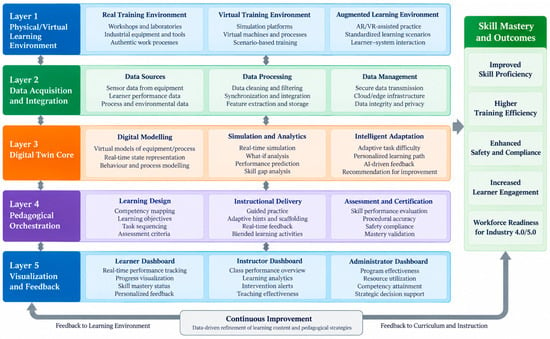
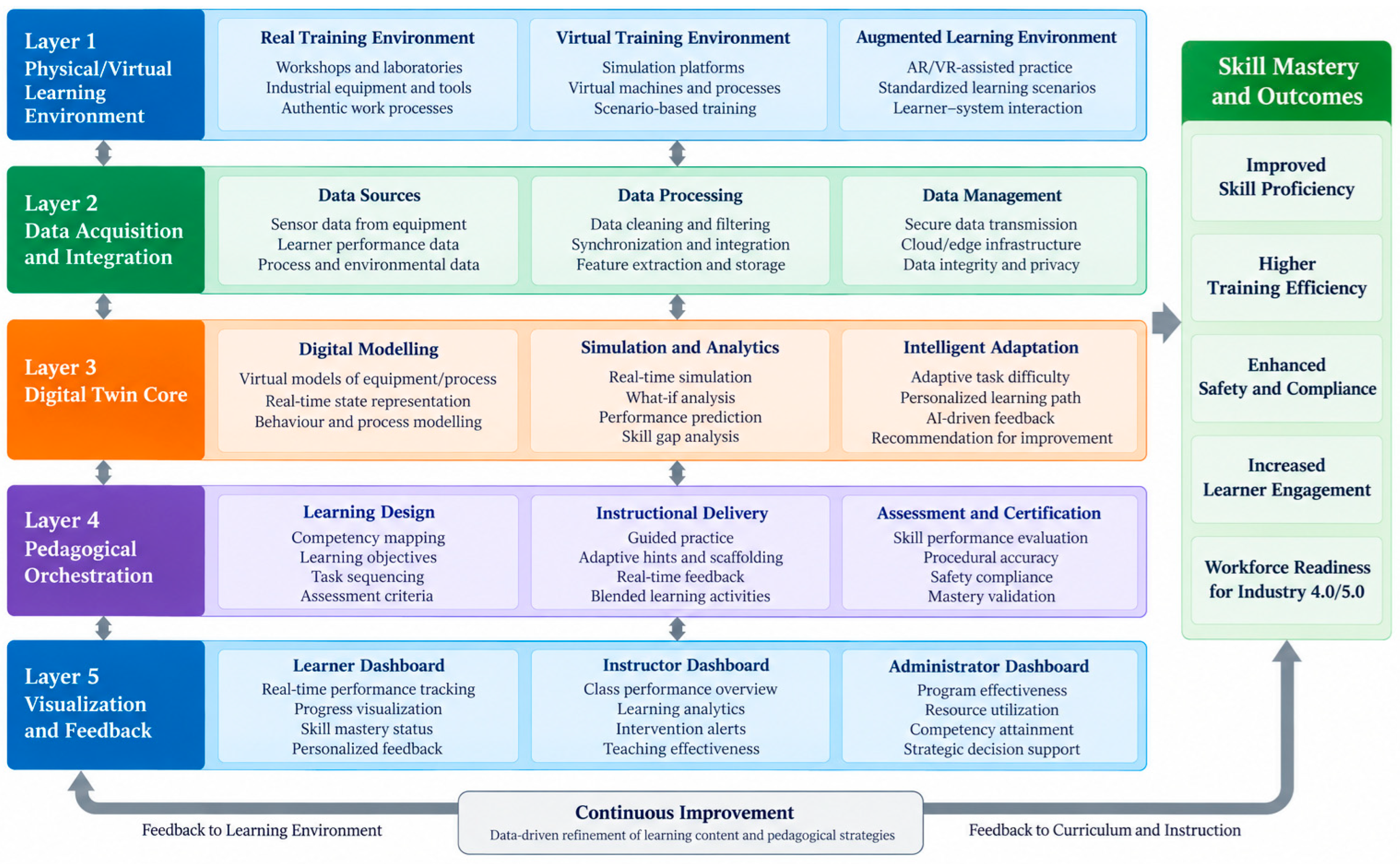
To validate the engineering performance and educational efficacy of the developed DT platform, we adopted a design-based, quasi-experimental method. The architecture of the DT system was designed to continuously monitor and assess operational mastery on the basis of quantitative evaluation protocols. The platform is structured as an integrated five-layer cyber–physical architecture designed to bridge physical mechatronics hardware with high-fidelity virtual counterparts and automated analytics (Figure 1).
Figure 1.
DT-supported pedagogical architecture for skill mastery in TVET.
- Layer A: physical and emulated layer
The physical training environment comprises mechatronics rigs instrumented with industrial sensors (photoelectric, inductive, capacitive, and ultrasonic), pneumatic actuators, variable frequency drives, cobots, and automated sorting conveyors. Control operations are handled by Siemens S7-1500 PLCs [10]. For scalable deployment, the platform is supported by validated software-emulated PLCs (PLCSIM Advanced) configured to match exact hardware input/output.
- 2.
- Layer B: data acquisition and synchronization layer
This layer establishes high-frequency, bidirectional communication between the physical/emulated assets and the digital system. The layer employs an (1) OPC unified architecture server deployed at the edge to expose PLC data block registers securely as unified, semantic data nodes [6], (2) Modbus TCP/IP protocol that handles high-speed polling (50 ms interval) of analog sensor outputs and actuator state vectors, (3) synchronization engine that perform data cleaning, handles transient dropouts, and stamps arriving sensor values with millisecond-precision Unix timestamps.
- 3.
- Layer C: digital twin core
Developed within Unity 3D, this layer maintains a stateful, real-time virtual representation of the training rig’s mechanical and electrical systems. A dynamic physics and state solver replicates the physical kinematics of sorting arms, rotational velocities of motors, and transit paths of parts. Dynamic synchronization ensures that the virtual asset’s state reflects the physical state within a target latency of <100 ms [4].
- 4.
- Layer D: pedagogical orchestration layer
An embedded rule-based orchestration engine evaluates incoming student interaction telemetry in real time. This layer continuously evaluates the current state vector against a predefined multi-dimensional competency model. The engine computes real-time feedback loops and dynamically adjusts simulated parameters (e.g., introducing simulated tool wear or path obstructions) to test adaptive capabilities.
- 5.
- Layer E: assessment and evidence layer (dashboards)
This layer translates low-level system logs into auditable, high-level competency scores. High-frequency telemetry streams are parsed and packed into standardized learning record store formats. These records are visualized via web-accessible dashboard panels, showing real-time mastery progression curves, error convergence rates, and safety violation tallies for instructors.
The developed platform was deployed to an industrial mechatronics laboratory. Physical workstation units were configured as shown in Table 1.
Table 1.
Hardware, interface, and software deployment specifications of the DT workstation.
To initialize a training session, students log in through a web interface linked to the dashboard. The system initializes both the virtual twin and the local/emulated PLC, validating connectivity via a continuous watchdog signal. As students modify physical wiring, program control logic, or operate the mechatronics assembly, continuous telemetry is transmitted to the core database.
3.2. Performance Evaluation
To assess the impact of the DT platform on competency development, a 6-week quasi-experimental evaluation was conducted with students majoring in mechatronics (N = 70). The students were grouped into the Experiment experimental group (n = 35) and the control group (n = 35). The experiment group completed training on physical/emulated mechatronics rigs integrated with the five-layer DT system, receiving real-time automated telemetry feedback, dynamic scaffolding, and dashboard analytics. The control group performed identical tasks using standard simulation software and physical rigs, receiving manual feedback from instructors. Both groups completed an identical 6-week syllabus covering PLC configuration, sensor calibration, conveyor routing, and system troubleshooting.
For evaluation, four performance indicators were used. Procedural accuracy was calculated by the orchestration layer using Levenshtein distance metrics to compare the student’s actual step sequence against the optimal reference sequence. Error convergence rate was calculated as the decline in critical system errors (incorrect actuator triggers, sequencing faults) across successive attempts. Safety zone compliance was tracked by virtual collision-detection boundaries in the DT core, recording physical boundary violations (reaching into hazard zones during operation). Adaptability and transfer performance were assessed in Week 6 using a complex transfer task where unexpected physical faults, such as a jammed inductive proximity sensor or an out-of-calibration actuator limit switch, were injected into the system without warning.
An independent samples t-test was conducted on pre-test practical scores. Performance progression was modeled using mixed-effects regression, treating training sessions as repeated measures (fixed effect) and individual students as random variables to account for inter-subject variation. Mastery achievement was measured using chi-square tests, with effect sizes quantified using Cohen’s d and phi coefficients to verify statistical power.
4. Results
Pre-test assessment scores showed that the Experiment and control groups were compared at baseline, with no significant differences in initial competency (p > 0.05). Telemetry completeness was high in the Experiment condition because the pipeline continuously captured event logs, timestamps, and sensor indicators during practice sessions. This ensured consistent measurement across learners and aligned with DT architectures that depend on synchronized data flows and stateful task representations to generate reliable evidence streams [11].
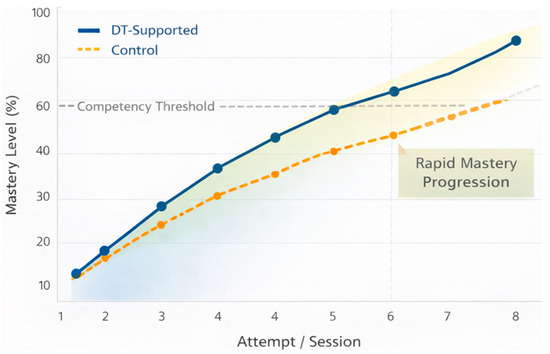
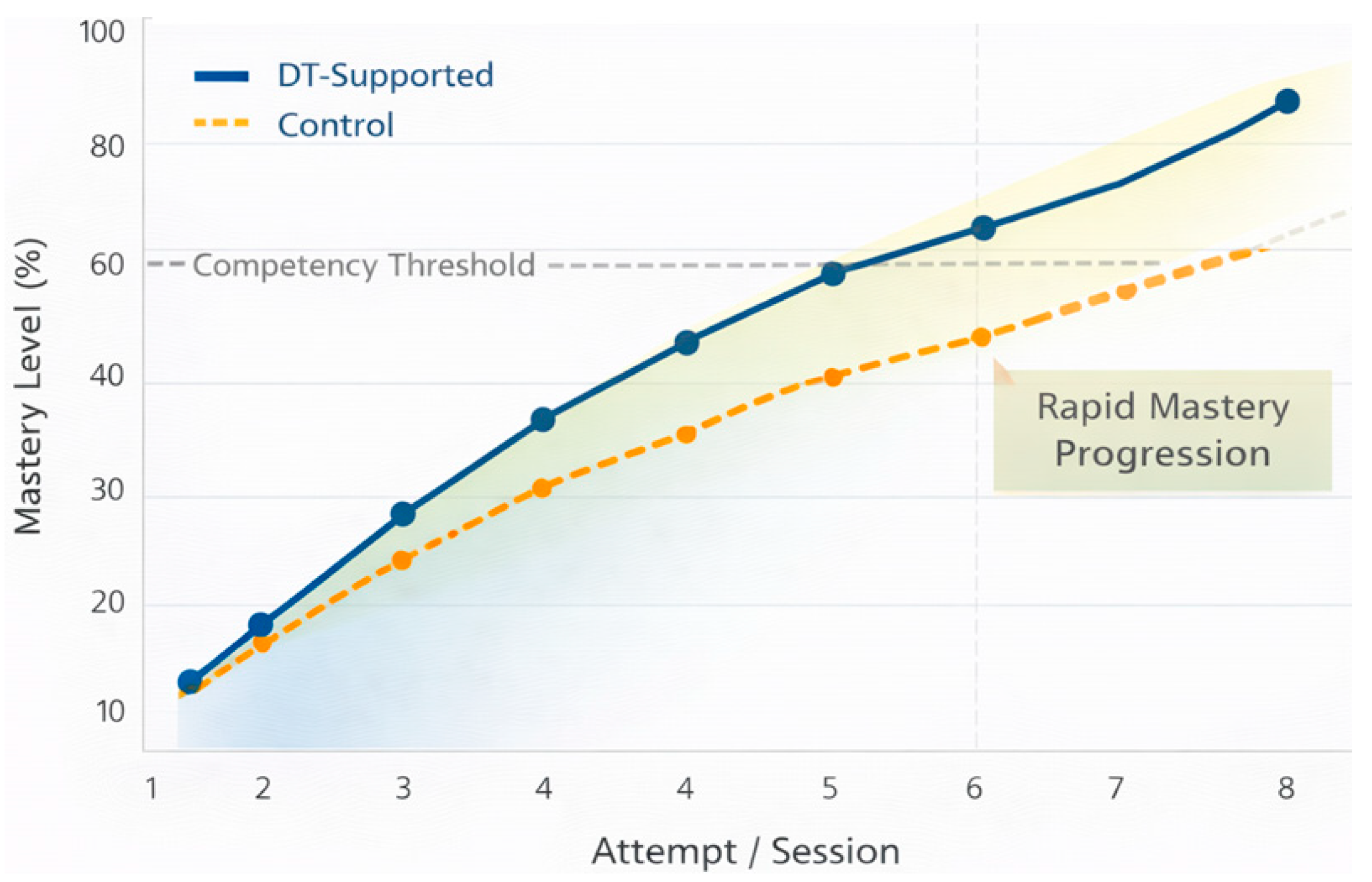
Mastery achievement was observed by the end of Week 6, defined as sustaining a mastery threshold (≥0.85) across consecutive attempts. The experiment group achieved a higher mastery rate (82.9%) than the control group (57.1) (Figure 2). They also reached mastery faster, with a mean time-to-mastery of 312.4 ± 88.6 min compared to 421.7 ± 102.3 min in the control group. Mixed-effects regression confirmed a significant effect of instructional condition (β < 0, p < 0.01), showing that Experiment pedagogy reduced learning time while maintaining stable performance. These findings align with prior evidence that DT systems improve learning outcomes when used as instructional interventions rather than visualization-only tools [8]. Figure 2 shows that the experiment group’s mastery curve rises steeply, crossing the competency threshold earlier and sustaining higher levels of mastery across sessions. The shaded region labeled rapid mastery progression underscores the accelerated improvement relative to the control group.
Figure 2.
Mastery progression curves for Experiment and control groups.
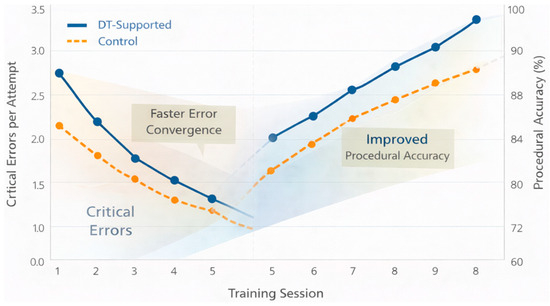
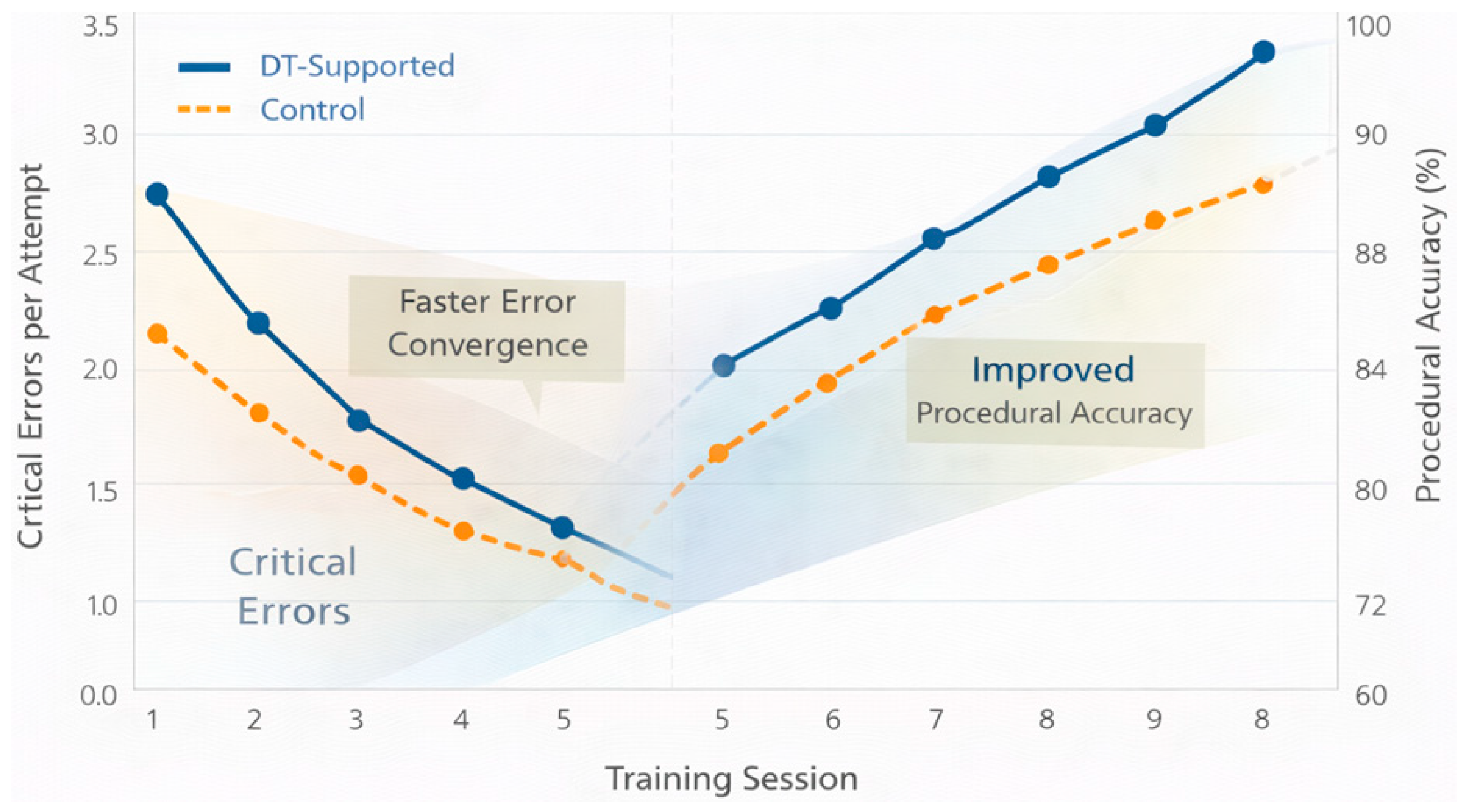
Procedural accuracy was measured using normalized sequence scores derived from DT data, including step order, omissions, and loops. Post-test accuracy was higher in the experiment group (86.3 ± 6.9) than in the control group (78.4 ± 8.1), a statistically significant difference (p < 0.01) (Figure 3). Session trends further showed that experiment group stabilized their procedural performance earlier, with reduced variance from Week 4 onward. Figure 3 also shows a dual effect: faster error convergence and sharper gains in procedural accuracy. The experiment group’s error rate declined more quickly, reaching a low steady-state level earlier than the control group, while accuracy rose more consistently.
Figure 3.
Error convergence and procedural accuracy trends across training sessions.
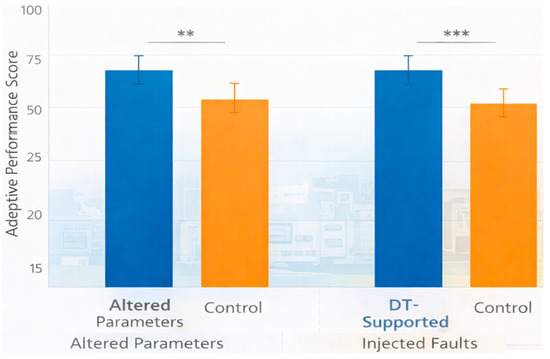
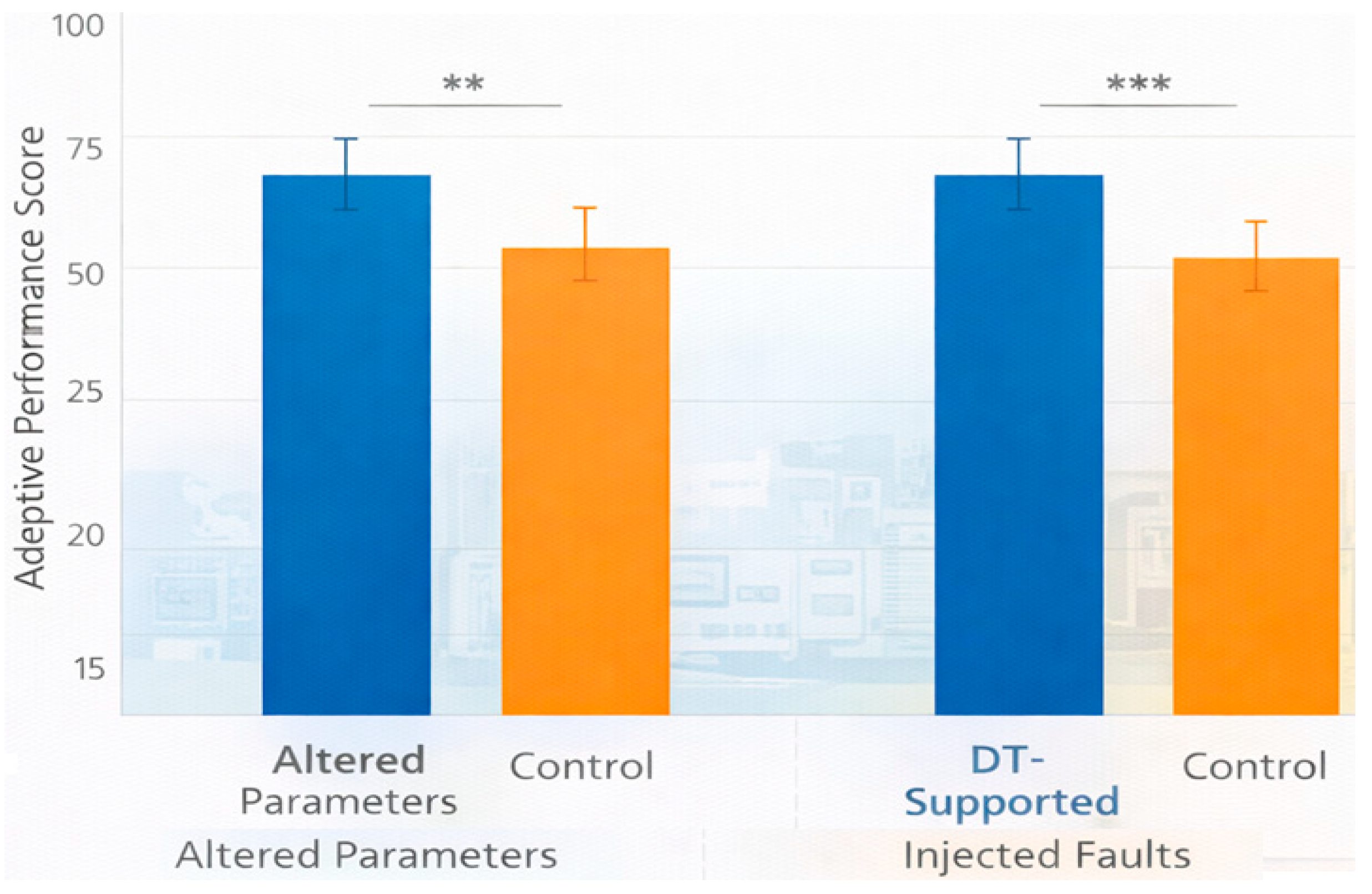
Critical error rates decreased in both groups, but the experiment group converged faster, averaging 1.2 ± 0.5 errors per session compared to 2.4 ± 0.7 in the control group (p < 0.01). Safety compliance also improved quickly, with fewer violations per session (0.3 ± 0.2 vs. 0.9 ± 0.4, p < 0.05). These results support the view that DT systems, through real-time sensing, state estimation, and immediate alerts, reduce unsafe behaviors and accelerate correction [5]. Performance quality, measured by calibration accuracy, tolerance conformity, and correct outputs, was significantly higher in the experiment group (84.7 ± 7.2 vs. 77.9 ± 8.5, p < 0.05) (Figure 4). The experiment group also showed fewer regressions in quality performance, particularly in later sessions, suggesting that adaptive scaffolding and process visibility improved consistency. Figure 4 presents the gains in adaptive performance. Under altered parameters and injected faults, the experiment group outperformed controls, with statistical significance markers (** and ***) confirming robust differences. The experiment group adapted more effectively to unexpected conditions.
Figure 4.
Transfer task performance analysis. ** = p < 0.01—statistically significant at the 1% level. *** = p < 0.001—statistically significant at the 0.1% level.
Transfer tasks tested adaptability under altered parameters and injected faults. Experiment participants scored higher (81.2 ± 7.4) than controls (75.8 ± 8.2), with a medium effect size (d = 0.61). They diagnosed faults faster and relied less on trial-and-error, indicating robust competency rather than rote memorization. This supports theories that DTs enhance experiential learning by enabling what-if scenario analysis and structured pedagogic reasoning [7,9].
All metrics, including time-to-mastery, mastery rate, procedural accuracy, error reduction, safety compliance, quality performance, and transfer, the experiment group consistently outperformed controls, with statistically significant differences and moderate-to-large effect sizes (Table 2). Performance stability was also higher in the experiment group, with lower variance across sessions. Overall, Experiment pedagogy produced (1) higher mastery achievement rates, (2) reduced time-to-mastery, (3) improved procedural accuracy and faster error convergence, (4) stronger safety compliance and quality performance, and (5) better transfer under novel conditions. These findings reinforce emerging vocational evidence that DT learning systems can generate measurable improvements when integrated with pedagogy, assessment, and analytics rather than deployed as standalone technical demonstrations [8].
Table 2.
Comparative results: experiment and control group.
DT-supported pedagogy offers advantages for skill mastery in TVET compared with conventional simulation or workshop instruction. Higher mastery rates and shorter time-to-mastery indicate that closed-loop feedback from DT telemetry accelerates learning while maintaining stable performance. Gains in procedural accuracy, faster error convergence, and stronger safety compliance suggest that continuous, data-driven feedback enables learners to correct mistakes earlier and internalize correct practices more effectively, consistent with DT principles reported in prior studies.
The superior transfer performance under novel conditions highlights the role of DT-based what-if scenarios in fostering adaptable competence rather than rote repetition. This outcome aligns with emerging evidence that DT-integrated learning environments strengthen experiential learning and support generalization [7,8]. Effective adoption, however, depends on institutional readiness, instructor capacity, and robust data governance. Future research should examine long-term retention, scalability across trades, and fairness across learner subgroups to build a stronger evidence base for DT-enhanced TVET pedagogy [1,2,3].
5. Conclusions
The DT-based platform provides a solution for advancing mastery in TVET. By combining cyber–physical data gathering, twinned modeling, and mastery-oriented instruction design, DT-supported learning enables faster competency attainment, higher procedural accuracy, stronger safety compliance, and improved quality performance compared with traditional methods. The platform showed superior transfer performance (81.2 vs. 75.8%), reduced time-to-mastery (312.4 vs. 421.7 min), and higher mastery achievement rates (82.9 vs. 57.1%), underscoring adaptability and robust skill application. DT also strengthens assessment validity through continuous, auditable evidence streams. Effective adoption, however, requires institutional readiness, instructor development, and sound data governance. Future research should examine long-term retention, cross-disciplinary scalability, and integration with national qualification frameworks to support large-scale adoption.
Author Contributions
Conceptualization, W.Y.L. and Y.Z.L.; methodology, Y.Z.L.; software, Y.Z.L.; validation, W.Y.L. and Y.Z.L.; formal analysis, Y.Z.L.; investigation, Y.Z.L.; resources, W.Y.L.; data curation, Y.Z.L.; writing—original draft preparation, Y.Z.L.; writing—review and editing, W.Y.L.; visualization, Y.Z.L.; supervision, W.Y.L.; project administration, W.Y.L.; funding acquisition, W.Y.L. All authors have read and agreed to the published version of the manuscript.
Funding
This research received no external funding.
Institutional Review Board Statement
Not applicable.
Informed Consent Statement
Not applicable.
Data Availability Statement
The data that support the findings of this study are available upon request.
Acknowledgments
During the preparation of this manuscript/study, the author used ChatGPT 5.0 for the purpose of generating images. The authors have reviewed and edited the output and take full responsibility for the content of this publication.
Conflicts of Interest
The authors declare no conflicts of interest.
References
- UNESCO-UNEVOC. Available online: https://unevoc.unesco.org/home/Digital+Transformation+in+TVET (accessed on 27 December 2025).
- UNESCO-UNEVOC. Available online: https://unevoc.unesco.org/home/ICT+in+TVET (accessed on 27 December 2025).
- International Labour Organization. Available online: https://www.ilo.org/ (accessed on 27 December 2025).
- Villegas, L.F.; Macchi, M.; Polenghi, A. Digital twins in manufacturing: A unified conceptual framework. Annu. Rev. Control 2025, 60, 101031. [Google Scholar] [CrossRef] [Scilit]
- Fuller, A.; Fan, Z.; Day, C.; Barlow, C. Digital twin: Enabling technologies, challenges and open research. IEEE Access 2020, 8, 108952–108971. [Google Scholar] [CrossRef] [Scilit]
- Ladegourdie, M.; Kua, J. Performance Analysis of OPC UA for Industrial Interoperability towards Industry 4.0. IoT 2022, 3, 507–525. [Google Scholar] [CrossRef] [Scilit]
- Weis, P.; Woschank, M.; Dallasega, P. A Web-Based Digital Twin Framework for Interactive E-Learning. Computers 2025, 14, 435. [Google Scholar] [CrossRef] [Scilit]
- Zhang, J.; Zhu, J.; Tu, W.; Wang, M.; Yang, Y.; Qian, F.; Xu, Y. The effectiveness of a digital twin learning system in assisting engineering education courses: A case of landscape architecture. Appl. Sci. 2024, 14, 6484. [Google Scholar] [CrossRef] [Scilit]
- Karanam, S.A.K.; Hartman, N.W. A systematic review of digital twins (DT) and virtual learning environments (VLE) for smart manufacturing education. Manuf. Lett. 2025, 44, 1597–1608. [Google Scholar] [CrossRef] [Scilit]
- Ortiz, J.S.; Andaluz, V.H.; Carvajal, C.P. Real-Time Digital Twin Architecture for Immersive Industrial Automation Training. Sensors 2026, 26, 2023. [Google Scholar] [CrossRef] [Scilit] [PubMed]
- Tao, F.; Zhang, H.; Liu, A.; Nee, A.Y.C. Digital twin in industry: State-of-the-art. IEEE Trans. Ind. Inform. 2019, 15, 2405–2415. [Google Scholar] [CrossRef] [Scilit]

Disclaimer/Publisher’s Note: The statements, opinions and data contained in all publications are solely those of the individual author(s) and contributor(s) and not of MDPI and/or the editor(s). MDPI and/or the editor(s) disclaim responsibility for any injury to people or property resulting from any ideas, methods, instructions or products referred to in the content. |
© 2026 by the authors. Licensee MDPI, Basel, Switzerland. This article is an open access article distributed under the terms and conditions of the Creative Commons Attribution (CC BY) license.