


Abstract
A multi-tier enterprise software system, the 3-4-5 framework, was designed to optimize workforce allocation and streamline training pipelines in vocational engineering education. The system decouples workflows into four interoperable platforms, ranging from virtualized campus simulations to distributed industrial internship data pipelines. An application programming interface-driven gateway synchronizes telemetry and resource dispatch across five groups: colleges, enterprises, families, government, and social organizations. The deployment results show significant improvements in tracking throughput, data consistency, and user literacy. The system provides a scalable reference model for digital learning ecosystems and enhances efficiency in human capital development pipelines.
1. Introduction
In production, enterprise resource planning and workforce scheduling software have become essential for ensuring industrial safety and operational efficiency [1]. Within engineering and vocational training, digital management systems must go beyond administrative logging to provide robust capabilities for tracking, modeling, and optimizing how personnel interact with complex industrial software environments [2]. This transformation reflects the demands of Industry 4.0, where production lines increasingly rely on cyber-physical automation, distributed edge-to-cloud systems, lean configuration logic, and real-time safety protocols [3].
Despite these advances, conventional vocational training systems and legacy learning management platforms often remain siloed. They lack integration with industrial data standards and fail to provide interoperable middleware, leaving institutions disconnected from lean logic, automated resource optimization, and compliance frameworks [4]. These architectural gaps introduce latency, weaken productivity metrics, and reduce the resilience of workforce development networks.
The effectiveness of vocational training frameworks depends on the stability and throughput of their digital runtime environments. Intelligent manufacturing systems must accommodate human-in-the-loop dependencies where operator workflows intersect with automated machine tasks. However, current solutions frequently suffer from design vulnerabilities: tracking layers are superficial, data schemas lack unification, and middleware components fail to interoperate with core data engines. As a result, legacy architectures cannot meet the concurrency, reliability, and real-time validation requirements of high-density training pipelines.
A lack of unified industrial standard integration within training management systems produces fragmented data pipelines. This means that graduates often lack proficiency in lean execution and safety-critical protocols. Weak schema design undermines the validation of engineering metrics, poor integration across instructional and industrial modules creates disconnected data streams, and the lack of linkage between training engines and project management frameworks marginalizes the role of telemetry in workforce development.
To address these challenges, we developed a multi-tier enterprise software architecture for workforce resource allocation, structured around the three-layer integration, four-platform core, and five-party coordination (3-4-5) model [5]. The model provides a scalable pathway for optimizing multi-tenant asset allocation in complex industrial contexts. Through rigorous design, deployment, and validation, the 3-4-5 model ensures that vocational training metrics align with industrial benchmarks of efficiency, safety, and systemic stability [6]. By embedding automated workforce monitoring directly into training software, the framework bridges the divide between academic data management and real-time industrial production imperatives.
2. Literature Review
2.1. Background Knowledge
The optimization of enterprise training and distributed workforce planning systems requires structural efficiency, modular integration, and high data throughput. In software engineering, the design of simulation engines and contextual state management aligns closely with human–computer interaction frameworks and process-simulation paradigms. Embedding operational tasks within authentic or virtualized sandbox environments enables operators to build technical literacy while generating telemetry data for modeling systemic behavior and exception-handling routines [7]. This runtime architecture aligns with industrial paradigms such as automated testing environments and work-study data pipelines, where integrating processing modules unifies asynchronous logs with live execution states, thereby improving adaptability and data consistency.
From a usability perspective, effective interface design must align task complexity with the operational capacity of the target user role. This principle, rooted in human factors engineering, minimizes transactional errors, increases data-entry speed, and prevents bottlenecks [7]. Engagement improves when data-dispatching engines dynamically map assignments to historical performance logs, role-based privileges, and deployment vectors, enhancing efficiency and utilization [8]. These architectural guidelines are adopted to establish a framework for workforce data infrastructures that are computationally secure, ergonomically optimized, and operationally reliable.
Conventional monolithic platforms rely on isolated data nodes and manual synchronization, creating silos and bottlenecks. In contrast, the developed 3-4-5 enterprise model integrates an application programming interface (API)-driven core engine, interoperable multi-platform layers, and multi-tenant gateway middleware, enabling abstracted machine interfaces, virtualized sandboxes, automated transmission of data from remote or distributed sources, and dynamic resource dispatching [7,9,10]. Modern workforce systems increasingly combine technical execution logging with enterprise innovation routines, unifying low-level telemetry with high-level managerial analytics [11]. By embedding these mechanisms into vocational frameworks, fragmented data processing is reduced, strengthening real-time pipeline relevance [9]. However, many platforms remain fragmented, deploying isolated utilities rather than systematic, multi-dimensional enterprise ecosystems. Germany’s dual vocational system integrates centralized academic servers with distributed enterprise training terminals, offering a cooperative model for data sharing and production ecosystem engineering [12]. Similarly, U.S. community college platforms employ distributed social practice subsystems to monitor localized operations, reflecting resilient socio-technical system design [11].
Despite these advances, systemic limitations persist. Integration of emerging automation technologies into workforce training software remains constrained, with no unified enterprise specifications [13]. Multi-tenant synchronization and governance protocols across colleges, enterprises, families, government, and social organizations are often vague, lacking robust API gateways or consensus mechanisms [10].
To address these challenges, we implement the 3-4-5 model. On the basis of pipeline optimization, platform interoperability, and stakeholder synchronization, the model strengthens workforce tracking networks. By moving beyond single-tenant silos, the architecture enhances the capacity to process, monitor, and deploy skilled, adaptable, and innovation-oriented engineering assets across modern digital enterprise environments.
2.2. Structural and Methodological Deficiencies in Existing System
Enterprise architectures and learning management pipelines in higher vocational education continue to exhibit significant structural and data-handling deficiencies. A major weakness lies in their reliance on static, low-level operational logs rather than dynamic data pipelines directly linked to technical domains. Legacy database designs do not include practical tracking modules, relegating them to supplementary functions and thereby compromising system autonomy and integration. In these systems, data collection strategies remain monotonous, restricted to text-based entries or short-term manual updates, while failing to exploit the throughput potential of live telemetry engines and scalable microservice layers [2]. This fragmentation undermines the accuracy of operator performance modeling. When data pipelines are limited to basic execution tracking without incorporating complex software integration and system dynamics, platforms cannot provide meaningful evaluations of technical adaptability or readiness for real-world production environments. These bottlenecks are reinforced by systemic constraints. Legacy systems prioritize static professional records while relegating runtime tracking modules to peripheral status. Infrastructures required for high-throughput experiential simulations are underdeveloped, and real-time data streams are rarely synchronized across instructional engines and innovation frameworks. As a result, opportunities for multi-tier workflow synergy are lost, leaving training environments disconnected from industrial execution requirements.
2.3. 3-4-5 Model
To overcome these limitations, the 3-4-5 model is used to harmonize content pipelines, data-carrier platforms, and multi-tenant stakeholder endpoints. This model transforms tracking from superficial external forms into substantive, data-driven metrics that support robust operator validation [2]. The model embeds technical execution logs directly into professional course databases and system simulations, ensuring that theoretical tracking is unified with practical runtime metrics. Lifecycle performance data are integrated with agile project environments, enabling operators to develop competencies in version control and accountability. Real-world operational tracking is extended through external node logging, enhancing adaptability beyond local networks [7,9].
The model contains a four-platform infrastructure that combines on-campus simulation sandboxes, off-campus distributed pipelines, innovation incubation engines, and external social telemetry nodes. These components provide controlled environments for skill development, collaborative cloud channels for industrial internship monitoring, computational spaces for project validation, and community-based data collection for macro-level operational metrics [9].
The model incorporates a five-party synchronization gateway that coordinates colleges, enterprises, families, government agencies, and social organizations. Colleges manage system-wide configuration and resource routing, enterprises provide industry-aligned benchmarks and remote task allocation, families contribute baseline behavioral records, government bodies enforce compliance and privacy standards, and social organizations supply localized resources and verification assets [10]. Through its multi-tier design, the 3-4-5 model addresses the deficiencies of previous systems by embedding pipeline optimization, platform interoperability, and stakeholder synchronization into a unified enterprise framework. It strengthens workforce tracking networks, enhances data consistency, and ensures that vocational training environments are fully aligned with industrial standards of efficiency, safety, and systemic stability.
3. Model Implementation
The deployment of the 3-4-5 model follows a continuous execution pipeline that integrates data ingestion workflows, automated middleware routing, and multi-tenant telemetry consolidation. This end-to-end framework ensures that system input nodes are seamlessly connected to schema integration, platform deployment, and orchestration layers, ultimately producing a unified system output engine.
Embedding the workforce data framework into the enterprise software layer is essential for establishing database uniformity and systemic coherence. Tracking structures are implemented as compulsory relational dependencies within primary database schemas and processing configurations. The workforce data framework is embedded directly into the enterprise software layer to ensure that all databases operate consistently and share information smoothly. Legacy systems often fail because their databases do not include training and tracking modules as part of the main design, treating them instead as optional add-ons. In the proposed architecture, these modules are built into the core schema as required relational components. This means that compliance rules, safety requirements, and engineering standards are stored in structured tables that connect classroom instruction with industrial practice. At the same time, specialized processing layers record practical execution data, such as operator performance logs, error rates, and production outcomes, and link them directly to real-time industrial records.
The database design incorporates fields that capture system constraints, quality assurance checks, and ethical standards. This ensures that operators learn not only how automated compilation works but also how to generate telemetry that can be verified against industrial benchmarks. By embedding these elements into the schema, the system achieves broad data coverage, integrates previously disconnected modules, and provides a stronger foundation for modeling operator competency.
To improve the accuracy of telemetry and encourage active engagement with the software interface, the model supports several execution modes. In project-based loops, operators solve real engineering problems by writing production scripts, which creates a record of teamwork and technical problem-solving history. In case-driven simulations, operators are tested on how they respond to typical system failures, strengthening their troubleshooting skills and logical reasoning. In hybrid sandbox processing, workloads are routed through either local campus environments or distributed industrial channels, giving operators experience with deployment under realistic stress conditions. The model ensures that training data reflects both theoretical knowledge and practical adaptability, while maintaining consistency across the enterprise software environment.
4. Implementation Effect
To empirically validate the structural stability, data consistency, and operational throughput of the 3-4-5 model, a mixed-methods evaluation pipeline was conducted. Over a one-year production period, telemetry data were collected from a developer cohort (N = 120) distributed across six engineering domains, including mechanical systems, electronic information processing, and industrial data management. Validation combined structured quantitative telemetry scales (using a 5-point Likert usability index), detailed interaction logs from 20 core developer representatives, and direct performance testing of compilation outputs and multi-tenant internship pipeline tasks.
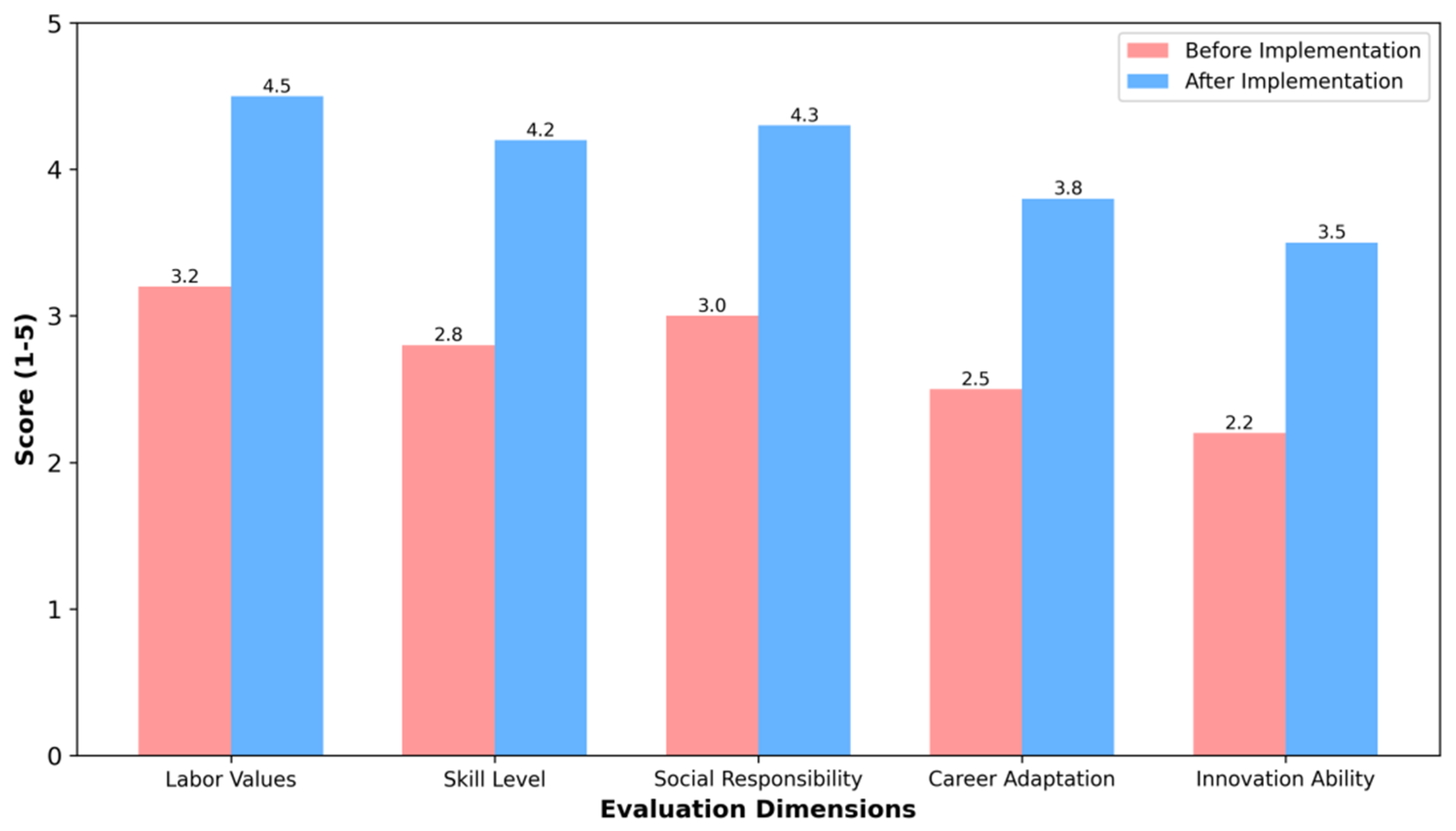
The analysis results of execution logs showed statistically significant improvements in workflow metrics following deployment of the 3-4-5 architecture. As shown in Figure 1, the effects of the 3-4-5 enterprise software model on workforce efficiency: scores across all evaluation dimensions increased markedly after implementation. Labor values rose from 3.2 to 4.5, skill levels from 2.8 to 4.2, social responsibility from 3.0 to 4.3, career adaptability from 2.5 to 3.8, and innovation ability from 2.2 to 3.5. These results confirm that the architecture not only strengthens technical execution but also enhances broader socio-technical competencies essential for industrial engineering contexts.
Figure 1.
Implementation effects of the labor education model.
The value creation index increased from 3.2 to 4.5 by 40.6%. Operators shifted from basic task completion to high-value digital asset creation, with nearly 90% of the participants demonstrating advanced understanding of algorithmic workflows within manufacturing pipelines. The compilation skill cap improved from 2.8 to 4.2 by 50%, with mechanical engineering simulation nodes showing automated test pass rates rising from 68 to 92%. Socio-technical synchronization increased from 3.0 to 4.3 with a 43.3% improvement, supported by integration with external social telemetry nodes that expanded operator engagement, adding an average of 120 volunteer service hours per terminal. Ecosystem adaptability increased from 2.5 to 3.8 by 52%, as distributed data pipelines accelerated operator readiness for live industrial environments, boosting client satisfaction from 72 to 91%. Finally, the agile innovation rate climbed from 2.2 to 3.5 by 59.1%, with project-based execution loops generating 15 independent operator-led repositories, three of which achieved top-tier recognition in provincial innovation indices.
The 3-4-5 model successfully transforms training pipelines from fragmented monolithic logging into a substantive, data-driven optimization engine. The model establishes a scalable and resilient reference framework for system deployment, infrastructure optimization, and workforce efficiency enhancement across modern vocational engineering networks.
5. Discussion
The results and operational telemetry collected during the production lifecycle confirm the effectiveness of the 3-4-5 enterprise software architecture compared with legacy siloed training frameworks. From an industrial engineering perspective, the model functions simultaneously as an algorithmic dispatcher and a data-alignment middleware. It eliminates throughput bottlenecks inherent in multi-tenant workforce pipelines, transforming manual resource coordination into predictable, optimized workflow streams [1]. In terms of line balancing, capacity constraints, and queue management, the integration of distributed off-campus pipelines establishes an efficient routing mechanism. This mechanism significantly reduces the latency traditionally observed between theoretical instruction and workplace execution nodes [4].
The data collected during production showed that the 3-4-5 model is more effective than older siloed training systems. From an industrial engineering perspective, the model works as both a dispatcher and a middleware layer. It removes bottlenecks in multi-tenant workforce pipelines and turns manual resource coordination into predictable, optimized workflows [1]. By combining on-campus practice zones with off-campus pipelines, the system creates an efficient routing mechanism. This reduces the delay that usually occurs between classroom instruction and workplace execution [4].
Older sequential pipelines handled assets through a single ingestion process and local compute queues. This often caused idle time and slow throughput. The 3-4-5 architecture avoids this problem by using a core integration engine with an API gateway. It supports asynchronous ingestion before class, synchronous multi-tenant computation during class, and continuous feedback after class. This keeps data flows smooth and synchronized across all layers. The 50% improvement in technical mastery (from 2.8 to 4.2) shows how automated middleware removes low-level barriers. In industrial engineering terms, this is similar to reducing non-value-added setup time, consistent with single-minute exchange of die. Routine tasks such as syntax parsing, compliance checks, and initialization are handled by background API nodes. This enables operators to focus on diagnostics, design optimization, and troubleshooting [2]. Mechanical systems assessments confirm this effect: automated validation success rates rose from 68% to 92%. The architecture acts like a software-based poka-yoke (mistake-proofing) system, catching errors before they reach the core database.
Telemetry logs also reveal limitations. Cognitive overhead and queue latency remain important, with AHP analysis showing system operability (0.16 priority) and technical self-efficacy (0.28 priority) as key factors for runtime balance. Synchronization delays occur when operators move between sandbox servers and enterprise pipelines, creating switching penalties. Telemetry saturation is another risk: without filtering and throttling at the API gateway, large volumes of external data (for example, from social or family nodes) can overload the system and cause inconsistencies.
Maintaining the 52% improvement in ecosystem adaptability requires strict schema uniformity and low-latency synchronization across all five tenant nodes [14]. The 59.1% increase in prototyping speed further shows that the design of multi-tier communication layers is the critical path for maximizing yield in modern digital workforce architectures.
6. Conclusions
The 3-4-5 model provides a robust enterprise systems architecture that transforms workforce training and resource allocation from fragmented, manual logging into a unified, optimized digital ecosystem. By synchronizing data nodes across colleges, enterprise terminals, domestic proxies, government agencies, and social organizations, the framework establishes a low-latency consensus mechanism that significantly improves efficiency in vocational engineering domains. Model validation results show that embedding automated verification loops directly into professional domain databases resolves critical weaknesses in legacy systems, particularly issues of cross-platform fragmentation and the absence of unified structural integration. The production deployment has already demonstrated measurable gains in technical mastery, ecosystem adaptability, and innovation throughput, showing that the 3-4-5 model can serve as a scalable reference design for modern industrial workforce platforms.
At the same time, long-term scalability requires continuous architectural refinement. Future development is required to build a multi-dimensional analytical database layer that integrates structured telemetry with unstructured behavioral logs and transition toward distributed edge–cloud infrastructure to eliminate storage bottlenecks and ensure high availability. It is also necessary to implement smart event-driven management engines that provide real-time monitoring, automated exception handling, and instant feedback loops.
The 3-4-5 model serves as a resilient and adaptable foundation for digital engineering education and workforce development. Through ongoing refinement of its validation gateways, data retention layers, and multi-tenant coordination mechanisms, the framework enhances operational efficiency, increases throughput, and strengthens data integrity across modern industrial engineering networks. For enterprises, the 3-4-5 model offers a way to integrate training data directly into production systems, reducing onboarding time and improving operator readiness. Companies can deploy the architecture to streamline internship pipelines, automate compliance checks, and enhance real-time monitoring of workforce performance. For vocational institutions, the model provides a scalable digital infrastructure that links classroom simulations with industry-aligned tasks, ensuring that students gain practical experience under realistic conditions. Together, these applications allow organizations to close the gap between education and industrial practice, creating a workforce that is both technically skilled and adaptable to rapidly evolving production environments.
Funding
This research was funded by the Jiangsu Province Education Science Planning Project: Research on the Innovation of Labor Education Model in Higher Vocational Colleges in the Era of Intelligence (B/2025/02/19).
Institutional Review Board Statement
Not applicable.
Informed Consent Statement
Not applicable.
Data Availability Statement
No new data were created or analyzed in this study. Data sharing is not applicable to this article.
Conflicts of Interest
The author declares no conflict of interest.
References
- Cheng, L. The Construction of Labor Education and Training System in Higher Vocational Colleges under the Background of the New Era. Front. Humanit. Soc. Sci. 2023, 3, 156–159. [Google Scholar] [CrossRef] [Scilit]
- Wu, J. The Predicament and Practice Path of Labor Education. J. High. Educ. Res. 2022, 3, 108–111. [Google Scholar] [CrossRef] [Scilit]
- Gui, R. The connotation and practical path of labor education for college students in the new era. Front. Humanit. Soc. Sci. 2024, 4, 93–99. [Google Scholar] [CrossRef] [Scilit]
- Peng, Z. Realistic Significance, Core Content and Practical Path of Labor Education for Higher Vocational Students in the New Era. Front. Humanit. Soc. Sci. 2022, 3, 406–412. [Google Scholar] [CrossRef]
- Zhang, B.Z. The Labor of Training Artificial Intelligence: Data Infrastructure, Mobility, and Marginality. In Proceedings of the 2023 Conference on Computer Supported Cooperative Work and Social Computing, Minneapolis, MN, USA, 14–18 October 2023. [Google Scholar] [CrossRef] [Scilit]
- Samad, N.R. Competency-Based Learning Models in Vocational Education: A Literature Review. JOVETE 2026, 1, 1–9. [Google Scholar] [CrossRef] [Scilit]
- Zhang, X. Research on the Implementation Path of Labor Education in Higher Vocational Colleges in the New Era. Sci. J. Econ. Manag. Res. 2025, 7, 287–290. [Google Scholar] [CrossRef] [Scilit]
- Kan, W. Research and Practice on the Construction of High-level Teaching Innovation Team in Higher Vocational Colleges under the Background of “Internet+”. In Proceedings of the 4th International Conference on Information Systems and Computer-Aided Education, Dalian, China, 24 September 2021. [Google Scholar] [CrossRef] [Scilit]
- Sun, X.; Zhu, R.; Wang, C. Research on the Mechanism and Path of Integrated Education from the Perspective of Type Education for Higher Vocational Colleges and Undergraduate Programs. Educ. Reform Dev. 2025, 7, 39–44. [Google Scholar] [CrossRef] [Scilit]
- Liu, J. Managing Massification: Challenges of Expansion and Equity in Chinese Higher Education. Dev. Humanit. Soc. Sci. 2025, 1, 61–79. [Google Scholar] [CrossRef] [Scilit]
- Li, L.; Cai, X. Practical Dilemmas and Optimization Paths of Innovation and Entrepreneurship Education in Higher Vocational Colleges under the Background of New Quality Productive Forces. Dev. Humanit. Soc. 2025, 1, 112–121. [Google Scholar] [CrossRef] [Scilit]
- Song, W. Research on the Integration of Innovation and Entrepreneurship Education with the Cultivation of Talents in Higher Vocational Business Administration Major. Educ. Reform Dev. 2025, 7, 25–31. [Google Scholar] [CrossRef] [Scilit]
- Yu, T.; Niu, J. The Logic and Practical Path of Vocational Education Innovation and Development from the Perspective of the Integration of Educational, Technological and Talented Personnel. World Vocat. Tech. Educ. 2025, 1, 557–576. [Google Scholar] [CrossRef] [Scilit]
- Chen, X.; Zhang, G.; Chen, L. Exploration on the Integration of Labour Education in Universities, Elementary and Secondary Schools in the New Period. Front. Educ. Res. 2021, 6, 154–160. [Google Scholar] [CrossRef] [Scilit]
Disclaimer/Publisher’s Note: The statements, opinions and data contained in all publications are solely those of the individual author(s) and contributor(s) and not of MDPI and/or the editor(s). MDPI and/or the editor(s) disclaim responsibility for any injury to people or property resulting from any ideas, methods, instructions or products referred to in the content. |
© 2026 by the author. Licensee MDPI, Basel, Switzerland. This article is an open access article distributed under the terms and conditions of the Creative Commons Attribution (CC BY) license.