


Abstract
Stroke is a leading cause of death and long-term disability worldwide. Post-stroke hemiparesis often leads to asymmetric force generation and reduced postural control, making transitions difficult. Although quad canes improve walking stability, their designs mainly address gait rather than sit-to-stand (STS) movements. During STS, stroke patients commonly shift weight toward the unaffected side, which existing canes fail to support adequately. We applied the Contextual Observation Method to analyze STS behavior in stroke patients (the Modified Rankin Scale 2–3) and proposed a Support Quad Cane concept to enhance standing stability while preserving normal walking use.
1. Introduction
Stroke is a major global health concern and remains one of the leading causes of mortality worldwide, frequently resulting in long-term functional decline and activity limitations [1]. Hemiparesis is among the most common consequences of stroke, leading to asymmetric muscle strength, impaired postural control, and altered weight distribution, which in turn affect the execution of daily functional movements [2].
Among fundamental daily activities, the sit-to-stand (STS) transition is considered essential for independent living. STS represents a critical shift from a static to a dynamic state, requiring coordinated forward displacement of the center of mass, vertical elevation of the body, and lower-limb extension. Successful performance of STS is closely associated with balance, mobility, and functional independence [3]. Inadequate or poorly controlled forward weight shift during STS substantially increases the risk of instability and falls [4]. Due to asymmetric force generation caused by hemiparesis, stroke patients face particular difficulty in completing STS safely and efficiently.
The quad cane is a commonly used mobility aid for stroke patients. Its multi-point base structure enhances stability during standing and walking [5]. However, conventional quad cane designs primarily emphasize walking assistance and do not adequately address the biomechanical demands of STS. Previous studies have shown that stroke patients often rely on the unaffected side during standing and STS, compensating for reduced force production on the affected side [6]. The use of a quad cane influences gait performance and movement stability in stroke patients; however, its support mechanism does not specifically address the asymmetric weight-bearing pattern required during STS [7]. Furthermore, stroke patients frequently exhibit altered motor strategies characteristically marked by asymmetrical weight-bearing during transitional motor tasks, such as rising from a chair [8] or during transitional movements [9]. While this strategy facilitates movement initiation, it may compromise balance control and increase fall risk. These findings highlight the limitations of existing quad cane designs in supporting the STS transition.
The STS task is a vital yet high-risk activity for stroke patients, directly influencing both safety and independence. Conventional quad canes are insufficient in accommodating STS-related force patterns, and current assistive devices fail to adequately support the unaffected-side-dominant strategies commonly observed in stroke patients. Moreover, few existing assistive devices are specifically designed to support STS by integrating upper-limb support, foot positioning, and base stabilization. In response to these gaps, this study aims to develop an assistive device concept that more closely reflects actual STS behavior, informed by contextual observation and behavioral analysis.
The objectives of this study are threefold. First, we analyzed force direction, posture characteristics, and compensatory strategies employed by stroke patients during STS. Second, we examined the limitations of conventional quad canes in supporting patients during this critical phase. Third, a Support Quad Cane (SQC) design concept was proposed to align with the behavioral patterns and functional needs of stroke patients during STS.
This study is exploratory in nature, focusing on behavioral analysis and conceptual design development. Through literature review and contextual observation, STS behavior in stroke patients is analyzed to derive design concepts and operational principles for an assistive device. The term “design” in this study refers to conceptual exploration, structural configuration, and feasibility of usage flow. Clinical trials, quantitative performance evaluation, and engineering validation are beyond the scope of this research. The physical models developed serve as conceptual demonstrations rather than tools for clinical verification. The participants were limited to stroke patients with mild to moderate functional impairment, corresponding to Modified Rankin Scale levels 2–3. Consequently, the findings may not be generalizable to individuals with severe functional impairment. Further validation through prototyping and user testing will be necessary in future studies to establish clinical applicability and effectiveness.
2. Literature Review
2.1. Post-Stroke Motor Characteristics and STS Difficulty
Post-stroke hemiparesis leads to asymmetric muscle strength and impaired postural control, increasing instability during functional movements [2]. Stroke patients commonly demonstrate weight-bearing asymmetry toward the unaffected side to compensate for reduced force on the affected side [6]. The STS task requires forward and upward displacement of the center of mass; insufficient control during this process can result in movement failure or instability [4]. To assist rising from a chair [8] or transitioning into walking [9], stroke patients often employ hip–trunk and asymmetrical loading strategies. While these compensatory mechanisms facilitate movement completion, they significantly reduce dynamic postural stability and impair the mechanical efficiency of weight transfer during these respective tasks [8,9].
2.2. Functions and Limitations of Quad Canes
Quad canes provide enhanced stability through a multi-contact base and are widely used for standing and walking assistance [5]. However, their design primarily supports walking and does not adequately address the movement characteristics required during STS. As a result, existing quad canes offer limited assistance during the critical STS transition phase.
2.3. Summary of Literature Review
STS performance in stroke patients relies heavily on dominant force generation from the unaffected side and controlled forward weight transfer. Conventional quad canes, designed mainly for walking, do not sufficiently accommodate these requirements. Assistive devices that align with users’ actual force patterns and movement strategies may improve STS stability and safety.
3. Methodology
We conducted a literature review, contextual observation, interview supplementation, and design derivation in this study. Multiple data sources were integrated to establish the assistive device design concept.
Contextual Observation with Interviewing
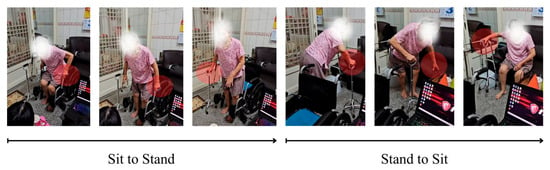
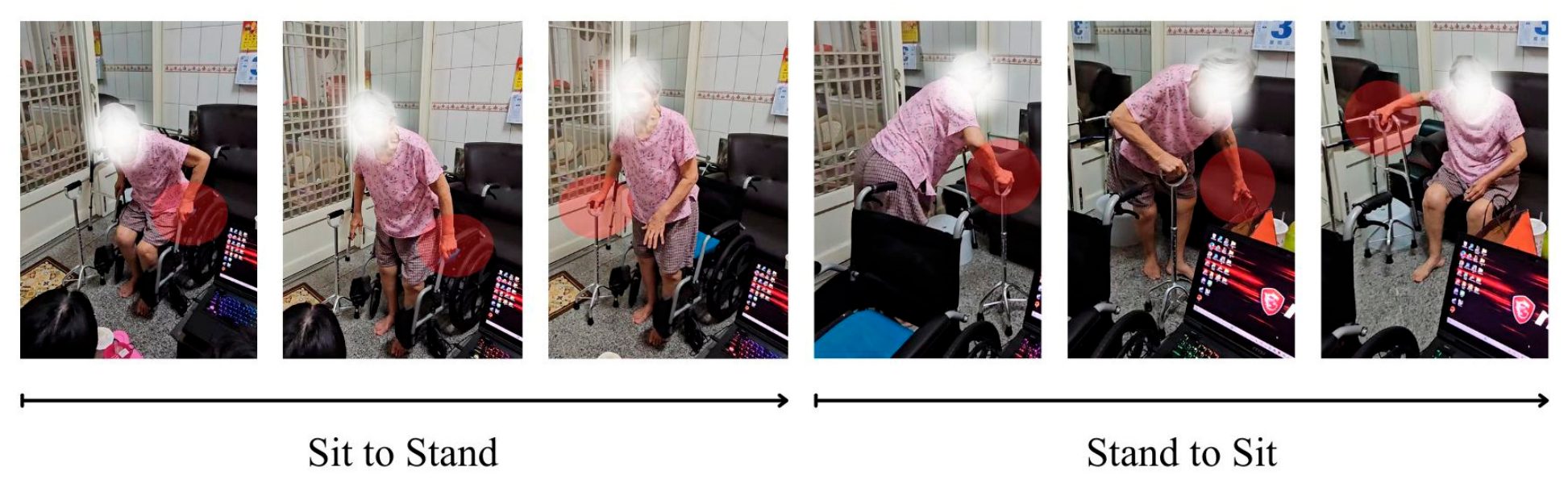
We adopted the Contextual Observation Method to examine how stroke patients performed the sit-to-stand (STS) task in home or home-like environments. Observations focused on posture, force direction, and interactions with conventional quad canes under real-life conditions [10]. Particular attention was given to the initiation phase of STS, including the sequence of force application, center-of-mass transfer, and functional differences between the affected and unaffected sides. Behavioral observations (Figure 1) indicated that conventional quad canes provided limited support during the initiation phase of STS. Consequently, participants often sought additional support from nearby furniture or handrails to compensate for insufficient support during movement initiation. These compensatory behaviors complicated postural adjustment and center-of-mass control, potentially increasing instability during the transition.
Figure 1.
Behavioral observation of a stroke patient performing the sit-to-stand (STS) task using a conventional quad cane.
In addition to direct observation, informal and non-structured interviews were used to refine behavior findings. Respondents were briefly asked about how difficult and unstable they found standing and past experience of using an assistive device in standing activities. These interviews were referred to as an independent form of qualitative data, serving to add context to the behaviors observed. By contrast, the stand-to-sit movement was more predictable with the high use of upper-limb support, indicating the relevance of assistive device interfaces during transitional actions.
Based on observational and interview data, important STS behavioral characteristics were identified and translated into assistive device design requirements, forming the foundation for the proposed design concept.
4. Results and Discussions
4.1. Behavioral Findings in STS
Observations showed that stroke patients predominantly shifted body weight toward the unaffected side during STS initiation and relied on the unaffected upper limb for support. Trunk flexion was frequently used to generate momentum and reduce instantaneous lower-limb force demand. When the cane support did not align with the actual force direction, support efficiency decreased. These findings indicate that STS assistance requires not only stability but also structural compatibility with users’ force sequence and weight transfer direction. Three main behavioral requirements were recognized as follows.
- Support for dominant force generation on the unaffected side;
- Stable accommodation of simultaneous downward loading and forward weight shift;
- Structural integration for coordinated hand–foot support.
4.2. Design Concept of the Support Quad Cane
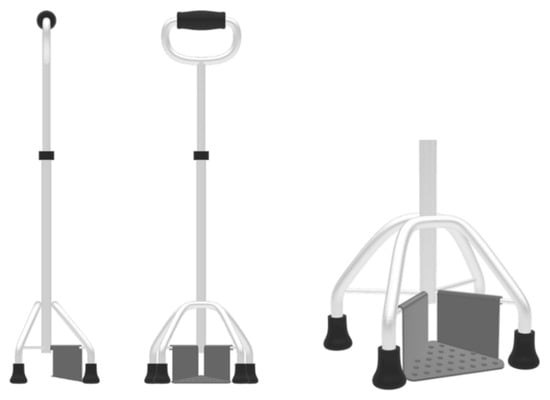
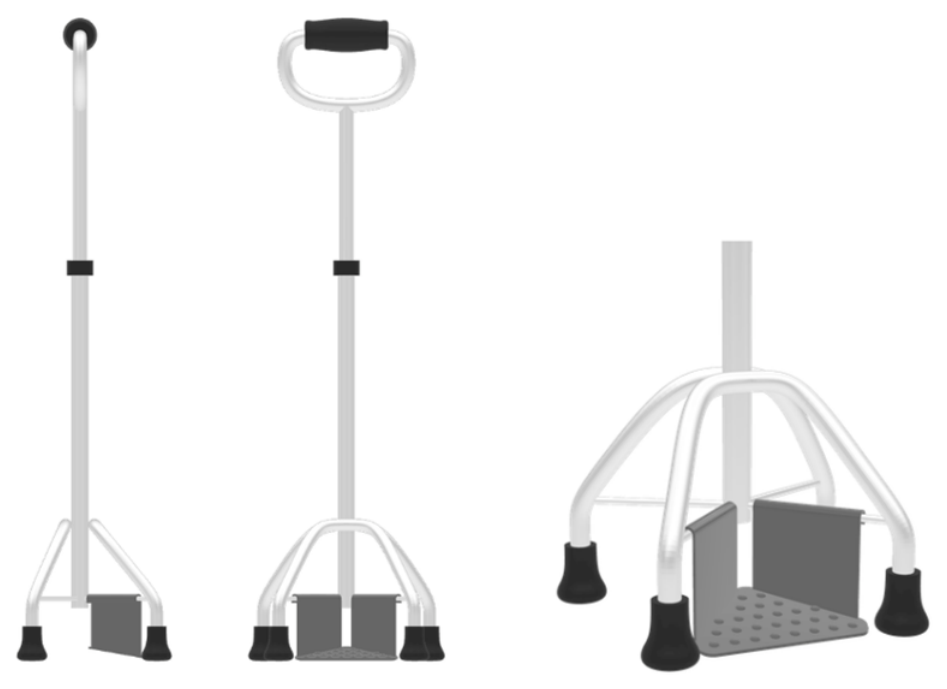
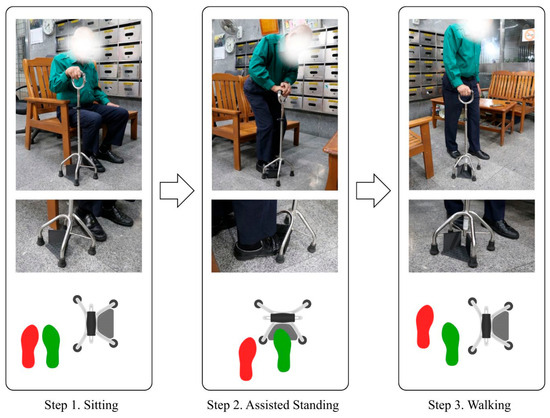
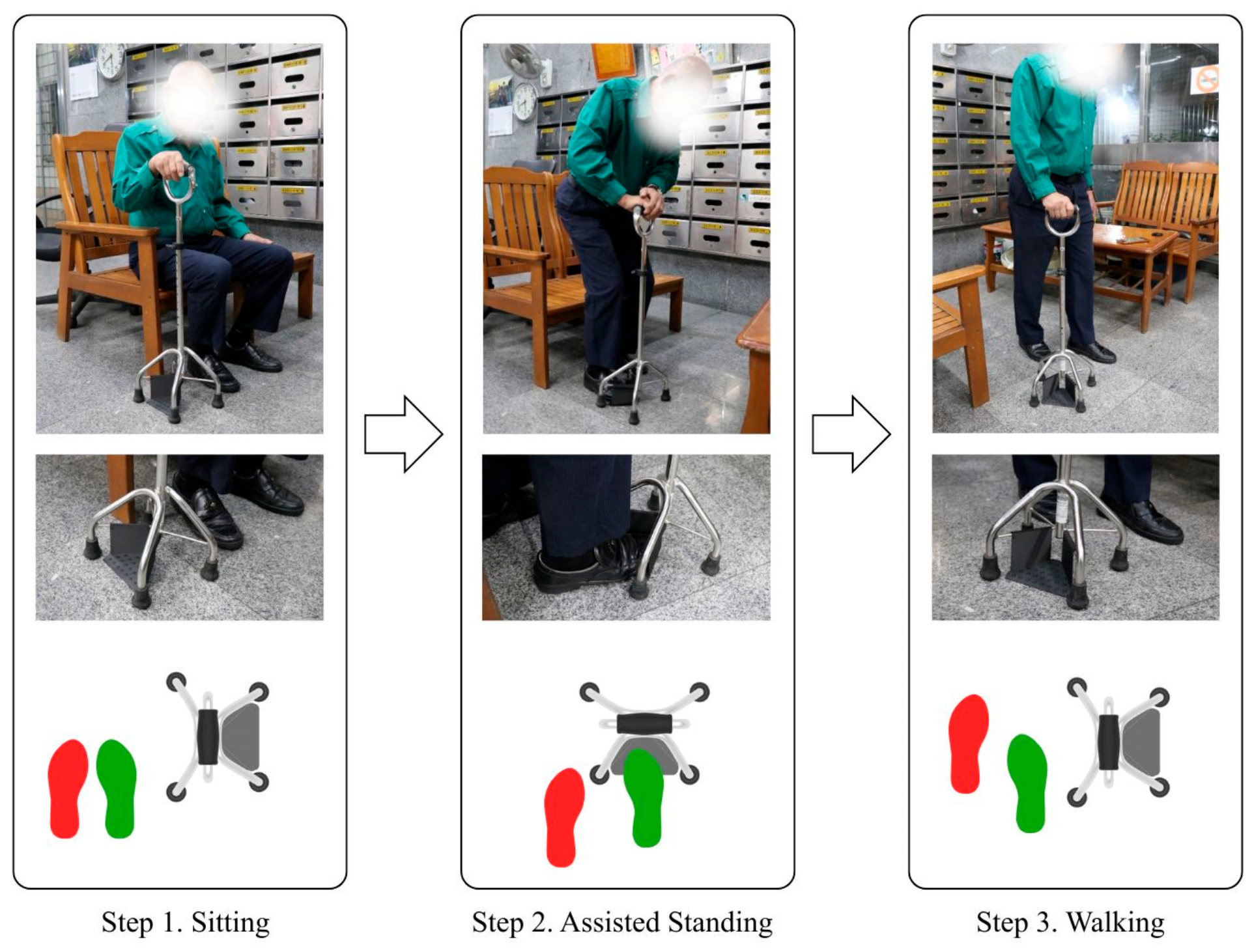
Based on the behavioral characteristics and support requirements identified above, this study proposes the design concept of SQC. During preparation for standing, the user slightly rotates the cane base toward the unaffected side, creating a foot-stabilizing zone between the quad base and the main shaft (Figure 2), into which the unaffected foot can be naturally positioned. During the sit-to-stand movement, the user applies downward force through the cane while simultaneously exerting force with the unaffected foot. This interaction allows the hand, foot, and cane base to form a stable triangular support structure, guiding a smooth forward and upward shift in the body’s center of mass and facilitating a controlled standing motion (Figure 3). After standing, the cane can be rotated back to its standard grip orientation, returning to the conventional quad cane configuration to support subsequent walking. This design concept redefines the support role of an existing assistive device by aligning it with users’ actual sit-to-stand behavior, without introducing additional mechanical complexity.
Figure 2.
An integrated foot-stabilizing zone formed between the quad base and main shaft of SQC.
Figure 3.
Sit-to-stand operation sequence of SQC. Red and green footprints indicate the affected and unaffected sides, respectively.
The proposed SQC addresses the absence of STS-specific support in existing quad canes by aligning assistive structure to natural movement behavior. It transforms the quad cane from a walking aid to an interface for transitional support during STS.
5. Conclusions
By employing contextual observation and behavioral analysis, we clarified the force application patterns of stroke patients during the STS movement and identified limitations of conventional quad canes in addressing the support demands of the rising phase, particularly those related to unaffected-side-dominant loading and forward weight transfer. Based on these observations, the concept of SQC is proposed to redefine the role of the quad cane during the STS phase without altering its basic structure or its conventional use for walking. The proposed design addresses unmet needs during the sit-to-stand transition within an existing and well-established assistive device framework through a behavior-oriented design approach. This concept serves as a reference for future research and design of sit-to-stand assistive devices. Design refinement, physical prototyping, and usability evaluation must be considered in future investigations. The potential impact of the proposed concept across environments and user populations should also be examined.
Author Contributions
Conceptualization, T.J.C. and I.-J.S.; methodology, T.J.C. and I.-J.S.; software, T.J.C.; validation, T.J.C. and I.-J.S.; formal analysis, T.J.C.; investigation, T.J.C.; resources, I.-J.S. and T.-W.K.; data curation, T.J.C. and I.-J.S.; writing—original draft preparation, T.J.C.; writing—review and editing, T.J.C., I.-J.S. and T.-W.K.; visualization, T.J.C.; supervision, I.-J.S. and T.-W.K.; project administration, I.-J.S. and T.-W.K. All authors have read and agreed to the published version of the manuscript.
Funding
This research received no external funding.
Institutional Review Board Statement
Not applicable.
Informed Consent Statement
Informed consent was obtained from all subjects involved in the study.
Data Availability Statement
Data are available in this manuscript.
Conflicts of Interest
The authors declare no conflict of interest.
References
- World Health Organization. Stroke. Available online: https://www.who.int/news-room/fact-sheets/detail/stroke (accessed on 18 September 2024).
- Lawrence, E.S.; Coshall, C.; Dundas, R.; Stewart, J.; Rudd, A.G.; Howard, R.; Wolfe, C.D.A. Estimates of the prevalence of acute stroke impairments and disability in a multiethnic population. Stroke 2001, 32, 1279–1284. [Google Scholar] [CrossRef] [Scilit] [PubMed]
- Kerr, K.M.; White, J.A.; Barr, D.A.; Mollan, R.A.B. Analysis of the sit–stand–sit movement cycle in normal subjects. Clin. Biomech. 1997, 12, 236–245. [Google Scholar] [CrossRef] [Scilit]
- Cheng, P.T.; Liaw, M.Y.; Wong, M.K.; Tang, F.T.; Lee, M.Y.; Lin, P.S. The sit-to-stand movement in stroke patients and its correlation with falling. Arch. Phys. Med. Rehabil. 1998, 79, 1043–1046. [Google Scholar] [PubMed]
- Laufer, Y. Effects of one-point and four-point canes on balance and weight distribution in patients with hemiparesis. Clin. Rehabil. 2002, 16, 141–148. [Google Scholar] [PubMed]
- Adegoke, B.O.A.; Olaniyi, O.; Akosile, C.O. Weight bearing asymmetry and functional ambulation performance in stroke survivors. Glob. J. Health Sci. 2012, 4, 87–94. [Google Scholar] [CrossRef] [Scilit] [PubMed]
- Kuan, T.-S.; Tsou, J.-Y.; Su, F.-C. Hemiplegic gait of stroke patients: The effect of using a cane. Arch. Phys. Med. Rehabil. 1999, 80, 777–784. [Google Scholar] [CrossRef] [Scilit] [PubMed]
- Engardt, M.; Olsson, E. Body weight-bearing while rising and sitting down in patients with stroke. Scand. J. Rehabil. Med. 1992, 24, 67–74. [Google Scholar] [CrossRef] [Scilit] [PubMed]
- Hesse, S.; Schauer, M.; Petersen, M.; Jahnke, M. Sit-to-stand manoeuvre in hemiparetic patients before and after a 4-week rehabilitation programme. Scand. J. Rehabil. Med. 1998, 30, 81–86. [Google Scholar] [PubMed]
- Beyer, H.; Holtzblatt, K. Contextual Design: Defining Customer-Centered Systems; Morgan Kaufmann: San Francisco, CA, USA, 1998; pp. 1–472. [Google Scholar]
Disclaimer/Publisher’s Note: The statements, opinions and data contained in all publications are solely those of the individual author(s) and contributor(s) and not of MDPI and/or the editor(s). MDPI and/or the editor(s) disclaim responsibility for any injury to people or property resulting from any ideas, methods, instructions or products referred to in the content. |
© 2026 by the authors. Licensee MDPI, Basel, Switzerland. This article is an open access article distributed under the terms and conditions of the Creative Commons Attribution (CC BY) license.