


Abstract
The CAELESTIS project aims to promote the development and design of innovative aircraft and engine structures through an integrated ecosystem of simulations and digital tools, enabling synergy across all stages of the manufacturing process. The component selected was an Outlet Guide Vane (OGV), a static engine part composed of a central composite section and titanium inserts at both ends, joined in a single manufacturing step. A detailed investigation of the joints between these materials was carried out using surface treatments of different natures to evaluate properties that directly influence the final joint quality. Optical analysis techniques were employed to characterize the morphology, roughness and surface free energy (SFE), complemented by mechanical tests to determine the adhesion and shear strength. All specimens were manufactured using the Resin Transfer Molding (RTM) “one-shot” process.
1. Introduction
The use of composite materials has increased over recent decades, which is a trend that is reflected in the latest aircraft designs, where the proportion of composites already exceeds that of traditional aluminum alloys [1]. The incorporation of these materials in the aerospace industry offers several advantages over conventional materials, ranging from weight and cost reduction to improved mechanical properties. These factors are essential in this sector, as they directly contribute to increasing fuel efficiency and reducing operational costs [2].
Currently, hybrid metal–composite structures have gained significant relevance, particularly in the aerospace sector, due to the need to produce lightweight, high-strength structures with optimized structural performance [3]. Combining both materials makes it possible to exploit their complementary properties, primarily enhancing their strength to weight ratio, among other benefits.
Among the various manufacturing technologies, the one-shot RTM process is gaining importance as an approach that is capable of producing multi-material structures in a single step, removing traditional assembly stages such as bonding or riveting, which increase the process time, weight and cost [4]. In this technique, the metallic component is placed inside the mold together with the dry carbon fiber preform, where the resin is injected and cured, forming the metal–composite joint during resin curing. To ensure the structural integrity of the composite, a high-quality interface between both materials is required. Surface treatments can enhance the quality of this joint, as their aim is to increase the surface free energy, roughness and both mechanical and chemical adhesion to the polymer matrix [5].
In this study, a detailed analysis of dissimilar joints between titanium and composite materials was carried out within the framework of the European CAELESTIS project [6,7], which aims to develop an Outlet Guide Vane combining titanium metallic inserts with a central composite section. The joining of these materials was conducted using the RTM “one-shot” technique. The purpose of this work is to optimize the joint quality and assess how different surface treatments influence key parameters such as the roughness, surface free energy, adhesion strength (Pull-Off test) and shear strength (Single Lap Shear test).
2. Materials and Methods
Different surface treatments were applied to commercial Grade V titanium (Technalloy, Sant Cugat del Vallès, Spain), with the aim of improving its adhesion to the composite. The first mechanical surface treatment employed was sandblasting (SA) using fine-grain alumina powder, while the second involved the use of a Scotch-Brite (SB) abrasive disk pad applied manually in the 0° and 90° directions. In addition, a chemical “etching” (E) treatment was performed. According to the literature [8], the acid and processing parameters reported for titanium involve concentrated sulfuric acid 48% for 30 min at 60 °C, which increases the roughness values and bond strength compared to the use of 18% HCl or 43% H3PO3. Finally, a plasma (P) treatment was applied using the atmospheric-pressure PlasmaBeam system (ANAME, Madrid, Spain) with a torch height of 6 mm, and a laser (L) treatment was performed with process parameters of 200 W, 166 kHz, and 5 m/s, applying a total of 8 passes per groove with an inter-track distance of 200 µm. All surface treatments were replicated, after which an epoxy primer Hexcel’s HexBond 122 (Composites Distribution, Beziers, France) was applied by spraying to preserve the integrity of the treated surface, as well as to enhance the compatibility of the titanium with the RTM6 epoxy resin.
The surface roughness of the titanium was measured using a Sensfar S-Neox system (Sensfar Advanced Materials, Barcelona, Spain), a high-performance optical profilometer. This equipment was also employed to obtain 3D surface images to evaluate the morphology as a function of the applied surface treatment. For each surface treatment, a total of three specimens were used, with three measurements performed on each specimen: two at the ends of the regions and one at the center, in order to obtain the most representative value possible. The surface free energy was determined using a Theta 200 instrument (Biolin Scientific, Gothenburg, Sweden), following the WORK/Fowkes method in accordance with the UNE-EN828:2013 standard [9]. Three titanium specimens (40 × 40 mm) were used for each surface treatment. Liquids with different polarities, namely water, diiodomethane and ethylene glycol, were employed. Ten repetitions were performed on each specimen for each of the liquids. Additionally, to evaluate the effectiveness of the titanium surface treatment, a rapid test was performed using a Positest ATM Manual Pull-Off Adhesion Tester (DeFelsko Corporation, Ogdensburg, NY, USA), resulting in a total of six tests for each use case.
To manufacture the preforms, an AddComposites XS AFP head (AddComposites, Helsinki, Finland) was employed, applying a compaction force of 200 N on the tape surface and a deposition speed of 250 mm/s. The AFP head is mounted on an ABB IRB-6600 robot (ABB, Zurich, Switzerland). The materials selected for laminate fabrication correspond to those used in the real application case: a carbon fiber tape that is specifically formulated for the AFP/ATL process Teijin Toho Tenax IMS65 VO/25:194 (SAERTEX, Saerbeck, Germany), with an area weight of 194 g/m2, a ply thickness of 0.182 mm, and a tape width of 25.4 mm. The tapes incorporate a thermoplastic binder (PA1206, 6 g/m2).
For the manufacturing of the titanium–composite panels by the RTM process, an ISOJET RTM machine (ISOJET Equipements, Corbas, France) was employed, with a working capacity of 10 bars and a tank temperature of 120 °C. The matrix material was HexFlow RTM6-2. The resin was injected at 0.7 bars to ensure homogeneous impregnation of the preform, followed by a final stage of gradual compaction of up to 6 bars to eliminate any residual porosity or dry spots in the final part.
For the mechanical characterization of the laminates produced by RTM, single-lap shear (SLS) tests were performed on titanium–composite specimens with a 25 mm overlap length, following the EN 2243-6 standard [10]. The multi-material panels were manufactured with a 2.9 mm dry carbon preform and 2 mm titanium plate, and also with a 25 mm overlap length. Areas of the mold that remained unfilled with material were temporarily filled with a silicone membrane, which was removed after the injection process was completed.
3. Results and Discussion
3.1. Roughness, Surface Free Energy and Adhesion Strength
The application of different surface treatments on grade V titanium significantly modifies roughness, surface free energy and adhesion strength, which are key parameters for achieving a strong multi-material bond. First, the mechanical characteristics of the surface are evaluated by examining its roughness and morphology as a function of the applied treatment. These parameters are critical because a higher surface roughness increases the effective bonding area and, depending on the morphology, the resin will anchor better or worse to the titanium surface, as a smooth surface would limit the adhesion. Moreover, regions with a large effective bonding area may expose more reactive chemical groups, enabling the formation of a stronger bond between the Ti and composite.
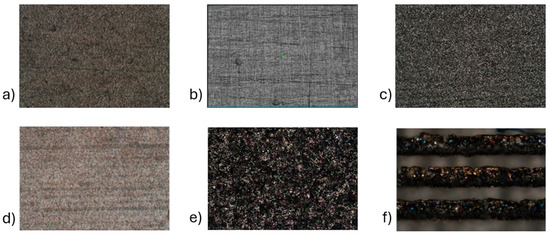
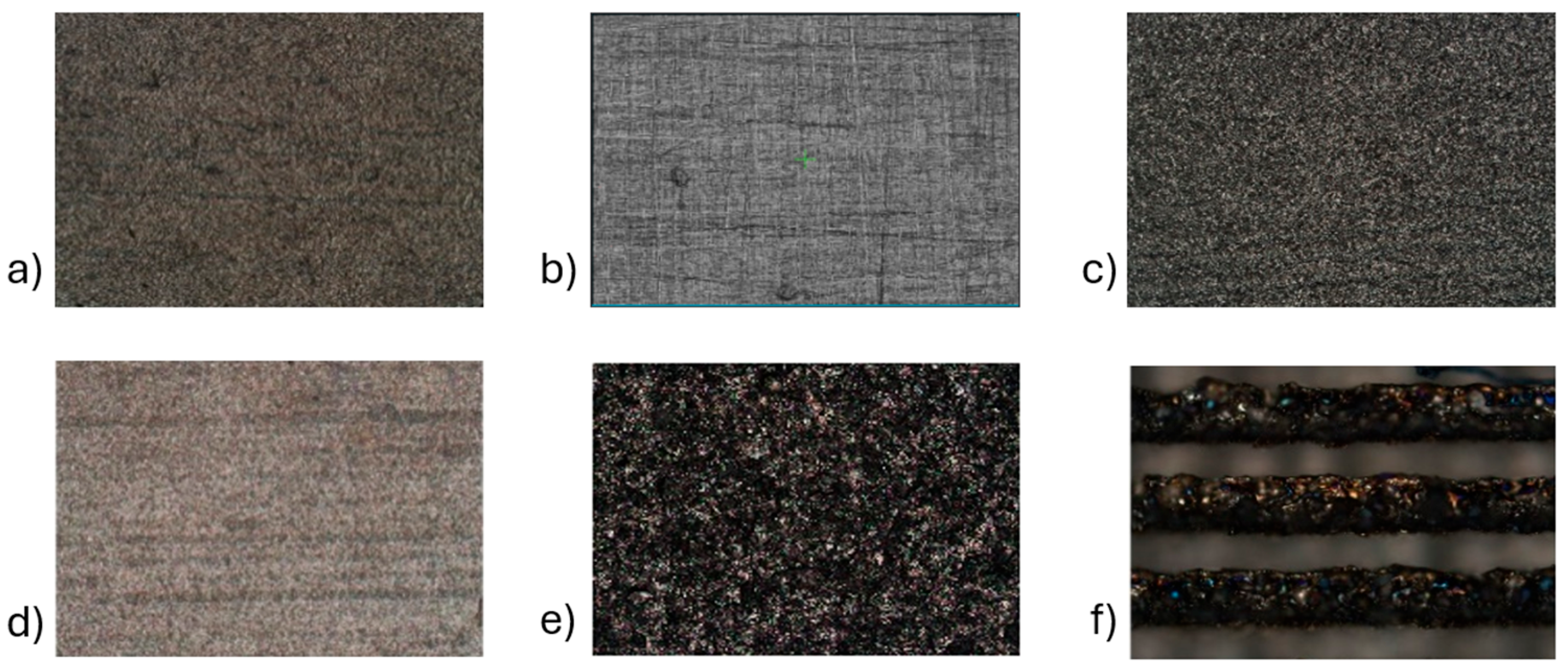
As shown in Figure 1 after applying Scotch-Brite, the microgrooves at 0° and 90° become visible due to the manual application, whereas laser microtexturing generates optimized microgrooves across the entire surface. Both sandblasting and etching produce homogeneous roughness throughout the surface. Finally, in the plasma-treated samples, small horizontal marks can be observed, corresponding to the path of the torch.
Figure 1.
Surface topographies of Ti-V: (a) titanium substrate; (b) Scotch-Brite; (c) sandblasting; (d) plasma; (e) etching; and (f) laser microtexturing.
The baseline roughness of the untreated titanium was 0.592 µm. The treatment that produced the highest roughness was laser micro-texturing (60.288 µm), followed by sandblasting (1.144 µm). In contrast, both Scotch-Brite and plasma treatments reduced the roughness values to close to 0.5 µm, while acid etching slightly increased them to 0.687 µm. The application of the epoxy primer masked the titanium surface topography, preventing accurate roughness measurement, as corroborated in Table 1, with highly variable values and no clear trend.
Table 1.
Values of roughness, surface free energy and adhesion strength for different surface treatments.
Surface free energy is determined by the polar component (hydroxyl groups (-OH), titanium oxides (TiO2), etc.) and by the dispersive component (van der Waals forces, etc.). The untreated titanium exhibited a value of 39.167 mN/m. The highest increase was observed with laser micro-texturing (64%), since the use of a high-power laser source and the generation of controlled grooves substantially raise the SFE due to the formation of stable oxides and the increase in the effective bonding area. Plasma treatment increased SFE by 51%, mainly because highly reactive plasma breaks C-H bonds and hydroxyl groups (-OH), promoting the oxidation of the Ti surface and leading to the formation of OH and Ti-O-Ti groups. This process increases SFE, acting as treatment that cleans, oxidizes and functionalizes the surface. Sandblasting produced a 19% increase, while etching resulted in only a 3% rise. In contrast, Scotch-Brite decreased SFE by 17%.
When the epoxy primer was applied, SFE decreased in most treatments by 14–40%, except for Scotch-Brite and sandblasting, where slight increases of 3% and 6%, respectively, were observed. The dispersive component decreased slightly in all cases compared to untreated titanium without primer, except for sandblasting, which showed a 28% increase. The polar component was drastically reduced in all treatments, since the epoxy primer masked the polar groups on the titanium surface, which previously contributed strongly to the polar component. The epoxy primer contains aromatic groups, oxiranes and hydrocarbon chains that are slightly polar, but they show a strong tendency to interact through dispersion forces. Therefore, the low polarity of the primer determined that the SFE was mainly governed by its dispersive component.
With respect to adhesion strength (Pull-Off test), the treatments that achieved the highest values were laser micro-texturing and sandblasting, both with increases of approximately 78%. These were followed by etching (53%), Scotch-Brite (39%), and plasma (12%). The application of the epoxy primer reduced the adhesion strength across all treatments by 15–32%, with the most pronounced decrease being in the case of sandblasting.
3.2. Mechanical Characterization of Multi-Material Panels by RTM
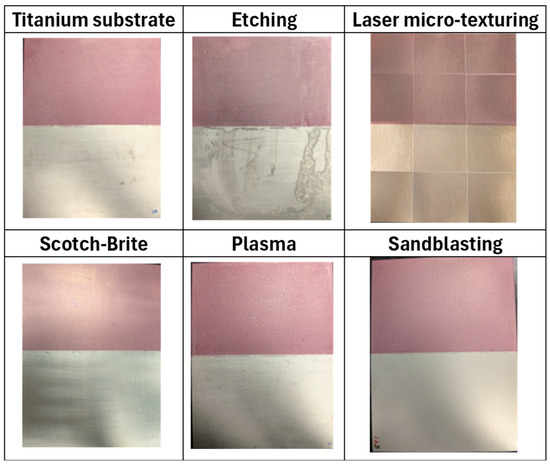
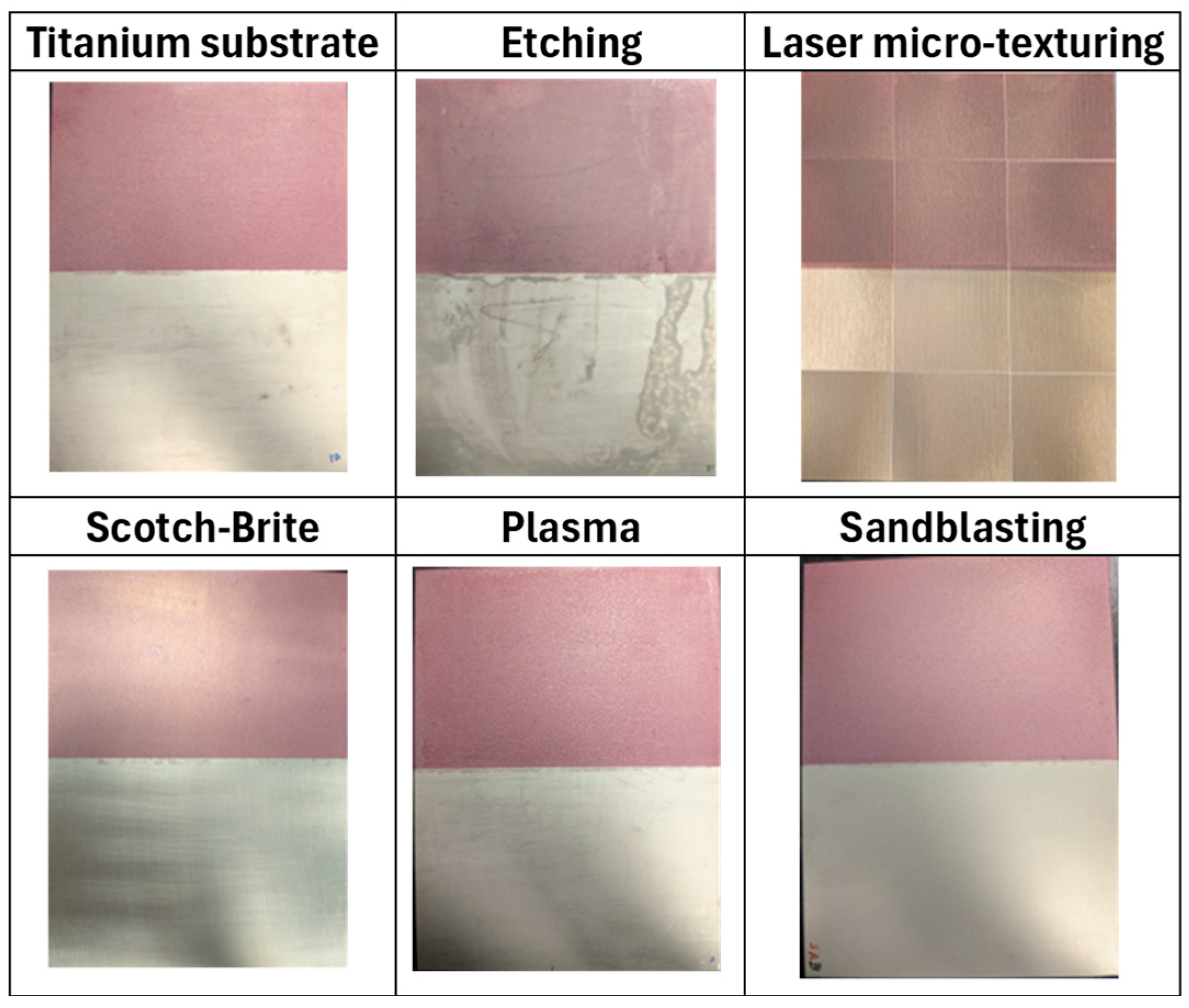
Two panels were manufactured using the RTM process with the purpose of being mechanically evaluated through the single lap shear test. For specimen preparation, six titanium plates were selected, with each plate being subjected to the corresponding surface treatment over its entire area. On one half of each plate, the epoxy primer was applied (pink area), as detailed in Figure 2.
Figure 2.
Titanium plates with surface treatment with and without primer.
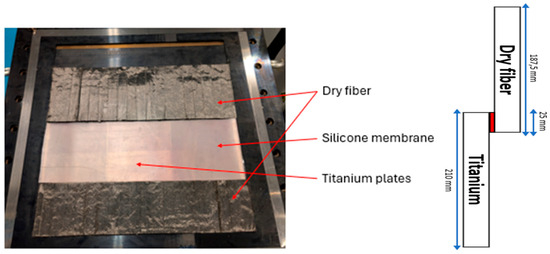
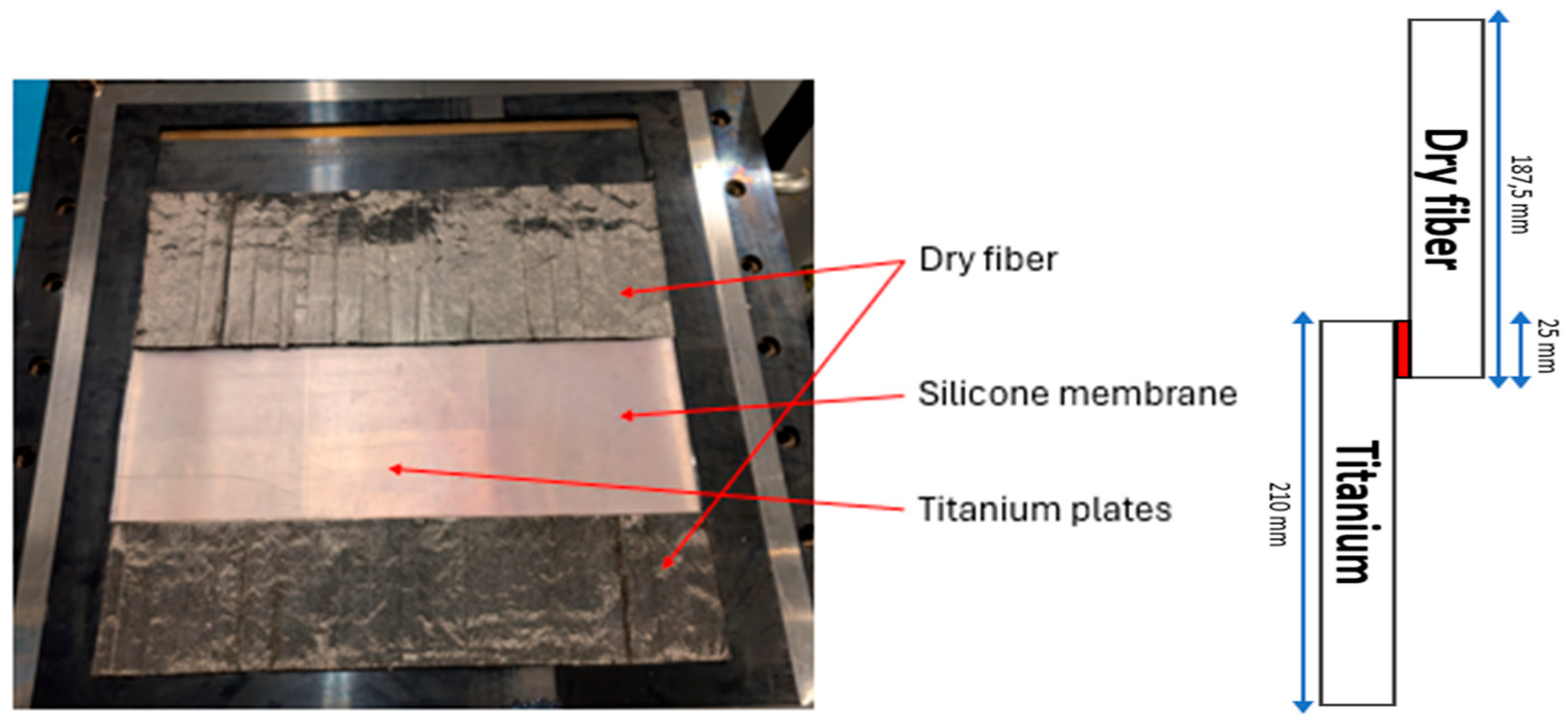
The titanium plates were positioned in the central region of the RTM mold, where the carbon fiber was placed to ensure a 25 mm overlap between the titanium and the composite material. Additionally, the central space was filled with a silicone sheet to prevent fiber displacement during the injection process. The general scheme that we followed for the specimen fabrication is shown in Figure 3.
Figure 3.
General diagram of the RTM plate (left) and diagram of the SLS specimen (right).
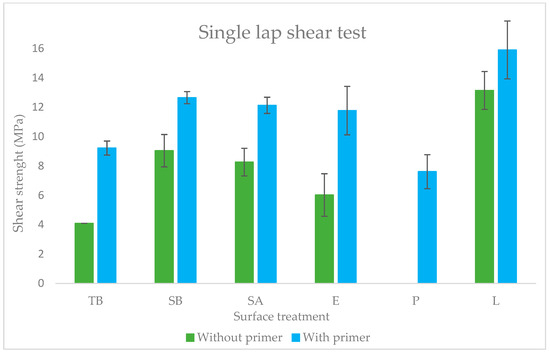
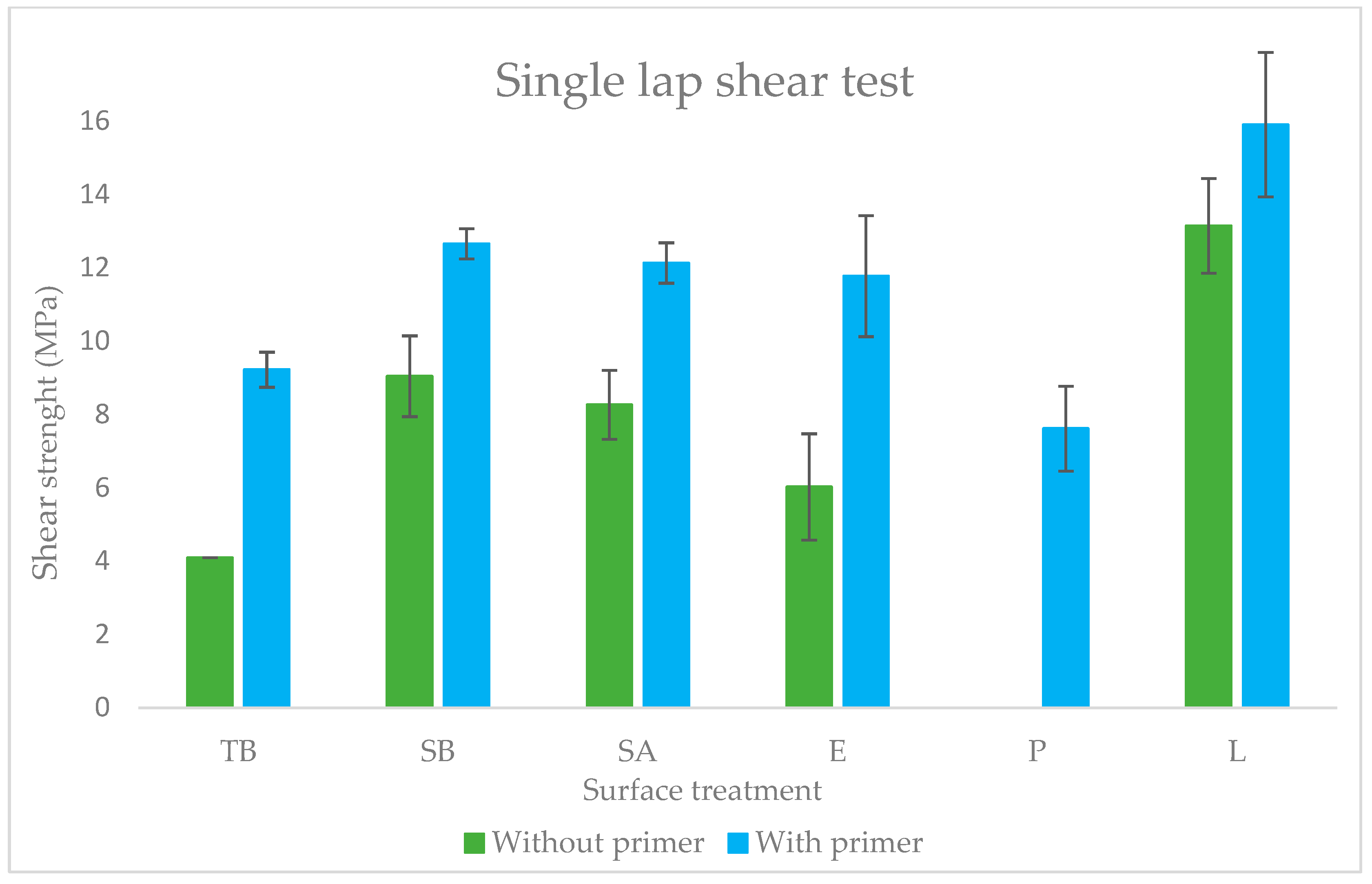
Once the plates were manufactured, the specimens were cut by water jet and subsequently tested. The SLS results obtained for the different treatments are shown in Figure 4.
Figure 4.
SLS test results for Ti-V under each surface treatment condition.
The results revealed differences according to the surface treatment applied and the presence or absence of primer epoxy. In the titanium group without primer and considering the titanium substrate value (4.09 MPa) as a reference, the laser microtexturing treatment showed the highest shear strength value, with an increase of 221%, followed by the Scotch-Brite, sandblasting, and etching treatments, with increases of 121.03%, 101.96% and 47.19%, respectively. However, for the plasma treatment without primer, no results could be obtained, as no adhesion occurred between the composite and the titanium.
In the test performed with primer application, a trend similar to that observed in cases without primer was found. The treatment that yielded the highest shear strength value was laser microtexturing, with a 72.4% increase compared to the titanium substrate reference value (9.22 MPa). The Scotch-Brite, sandblasting and etching treatments showed slight variations among them, although with very similar outcomes, with relative increases in the titanium substrate of 7.20%, 31.56% and 27.66%, respectively. In the case of plasma treatment, the primer application enabled proper adhesion between titanium and composite; however, the lowest values among the evaluated treatments were obtained (7.85 MPa).
Overall, when comparing the effect of primer, its application significantly improves the adhesion values across all studied treatments, indicating that primer use may be a highly effective way to optimize titanium–composite bonding.
4. Conclusions
Surface treatments applied to titanium have a significant influence on its physic-chemical properties, as well as on the quality of the joint with the composite. Laser microtexturing and sandblasting produces increased and controlled roughness, together with high surface free energy values, which are key factors for improving adhesion to the composite. In contrast, chemical etching only slightly increases the surface roughness while reducing the SFE to untreated material. A similar behavior is observed for the Scotch-Brite finish, where no substantial improvements are achieved in any of the evaluated parameters. Plasma treatment acts as a surface cleaning and activation process, reducing roughness but significantly increasing the SFE. Finally, when a primer is applied, the SFE is primarily governed by this coating, which provides protection to the metal–composite interface. This aspect is crucial in aerospace applications, where the joint must withstand humidity, UV radiation, and extreme thermal cycling. Therefore, the primer acts as a sealing layer, preventing corrosion, moisture uptake, and damage propagation along the interface.
The results obtained from the pull-off test and the mechanical characterization through the single lap shear test do not show a direct correlation in all cases. The pull-off test evaluates the bond between the titanium surface and metallic bucking bar, where the bonding force between the two metals is applied manually, and the load is applied perpendicularly to the surface. In contrast, the single lap shear test evaluates the bond between the titanium surface and the composite material, with the load being applied in the plane of the joint. The pull-off test was implemented, as it is relatively quick and easy to provide a preliminary assessment of the effectiveness of the different surface treatments, although it is not conclusive.
The evaluation of the mechanical performance of the titanium–composite joint through a shear strength test on RTM manufactured plates reveals a direct correlation between the surface properties and interfacial strength for most treatments. Laser microtexturing exhibited the highest shear strength values, which aligns with its high roughness and elevated surface free energy. Unexpectedly, the Scotch-Brite treatment provided the second-best mechanical performance, despite not showing significant improvements in either roughness or SFE. The results obtained for sandblasting and chemical etching were consistent with their intermediate roughness and SFE values. Plasma treatment did not generate adhesion between both materials, confirming its primary role as a surface activation and cleaning process.
Author Contributions
Conceptualization, M.R.R. and C.B.C.; methodology, M.R.R.; validation, E.R.S.; formal analysis, M.R.R. and A.L.G.; investigation, M.R.R. and A.L.G.; resources, C.B.C.; data curation, M.R.R. and A.L.G.; writing—original draft preparation, C.B.C. and M.R.R.; writing—review and editing, M.R.R.; visualization, E.R.S. and C.B.C.; supervision, E.R.S.; project administration, E.R.S. and C.B.C. All authors have read and agreed to the published version of the manuscript.
Funding
This research was funded by the EU Horizon-RIA project CAELESTIS “Hyperconnected simulation ecosystem supporting probabilistic design and predictive manufacturing of next generation aircraft structures”, with grant number 101056886, under the HORIZON-CL5-2021-D5-01 call. The project information is available on its web page: https://www.caelestis-project.eu/ (accessed on 10 December 2024).
Institutional Review Board Statement
Not applicable.
Informed Consent Statement
Not applicable.
Data Availability Statement
Data are available upon request from the corresponding author. The data are not publicly available due to intellectual property restrictions.
Acknowledgments
The authors would like to thank all AIMEN staff that participated in this research. Special mention to Silvia Trillo for all her contributions to this study. Thanks to CINEA and the EASN association for all the support and guidance during this conference.
Conflicts of Interest
Mario Román Rodríguez, Cristian Builes Cárdenas and Elena Rodríguez Senín were employed by the company AIMEN Technology Center. The remaining authors declare that the research was conducted in the absence of any commercial or financial relationships that could be construed as a potential conflict of interest.
References
- Zhang, D.; Zhang, Q.; Fan, X.; Zhao, S. Review on Joining Process of Carbon Fiber-Reinforced Polymer and Metal: Methods and Joining Process. Rare Met. Mater. Eng. 2018, 47, 3686–3696. [Google Scholar] [CrossRef] [Scilit]
- Parveez, B.; Kittur, M.I.; Badruddin, I.A.; Kamangar, S.; Hussien, M.; Umarfarooq, M.A. Scientific Advancements in Composite Materials for Aircraft Applications: A Review. Polymers 2022, 14, 5007. [Google Scholar] [CrossRef] [Scilit] [PubMed]
- Hergan, P.; Lechner, C.; Fauster, E.; Pilz, G.; Schledjewski, R. Minimum invasive production-related SLS specimen manufacturing for interface characterization of hybrid materials made by RTM. Int. J. Adv. Manuf. Technol. 2019, 102, 1963–1972. [Google Scholar] [CrossRef] [Scilit]
- Studer, J.; Keller, A.; Leone, F.; Stefaniak, D.; Dransfeld, C.; Masania, K. Local reinforcement of aerospace structures using co-curing RTM of metal foil hybrid composites. Prod. Eng. 2018, 12, 195–201. [Google Scholar] [CrossRef] [Scilit]
- Droździel-Jurkiewicz, M.; Bieniaś, J. Evaluation of Surface Treatment for Enhancing Adhesion at the Metal–Composite Interface in Fibre Metal-Laminates. Materials 2022, 15, 6118. [Google Scholar] [CrossRef] [Scilit] [PubMed]
- CAELESTIS—Hyperconnected Simulation Ecosystem Supporting Probabilistic Design and Predictive Manufacturing of Next Generation Aircraft Structures. Available online: https://cordis.europa.eu/project/id/101056886 (accessed on 26 November 2025).
- RTDS. CAELESTIS—Next Generation Aircraft. Available online: https://caelestis-project.eu/ (accessed on 26 November 2025).
- Ban, S.; Taniki, T.; Sato, H.; Kono, H.; Iwaya, Y.; Miyamoto, M. Acid Etching of Titanium for Bonding with Veneering Composite Resins. Dent. Mater. J. 2006, 25, 382–390. [Google Scholar] [CrossRef] [Scilit] [PubMed]
- UNE-EN828:2013; Adhesives-Wettability-Determination by Measurement of Contact Angle and Surface Free Energy of Solid Surface. European Committee for Standardization: Brussels, Belgium, 2013.
- EN 2243-6:2005; Aerospace Series-Non-Metallic Materials-Structural Adhesives-Test Method-Part 6: Determination of Shear Stress and Shear. European Committee for Standardization: Brussels, Belgium, 2005.

Disclaimer/Publisher’s Note: The statements, opinions and data contained in all publications are solely those of the individual author(s) and contributor(s) and not of MDPI and/or the editor(s). MDPI and/or the editor(s) disclaim responsibility for any injury to people or property resulting from any ideas, methods, instructions or products referred to in the content. |
© 2026 by the authors. Licensee MDPI, Basel, Switzerland. This article is an open access article distributed under the terms and conditions of the Creative Commons Attribution (CC BY) license.