


Abstract
Vibration-induced fatigue requires novel methodologies to assess damage based on statistical parameters of the dynamic stress response. Establishing a direct theoretical link between spectral indicators, such as the power spectral density, and the corresponding load spectrum remains challenging from a theoretical standpoint. Consequently, experimental approaches are essential for method development. Since experimental signals are often arbitrarily designed, the representativeness and quality of the load dataset become critical for ensuring the reliability and applicability of the proposed approach. This work emphasizes the need for a robust framework to generate realistic excitation signals, providing a consistent basis for advancing vibration fatigue assessment.
1. Introduction
Vibration-induced fatigue is a significant concern in the design and durability assessment of mechanical and structural components subject to dynamic loading. In industrial applications, damage assessment methods are expected to provide a good ratio between high accuracy and computational efficiency. Spectral methods [1] address these needs by offering rapid fatigue evaluation through direct relationships between signal statistics and cycle-dependent damage, in contrast to time-domain approaches [2] which although highly precise are highly time-consuming.
Despite their utility, spectral methods display substantial variability in accuracy due to restrictive assumptions regarding load behavior. Notably, widely applied approaches such as Dirlik’s [3] and Tovo-Benasciutti’s [4] methods assume the input signal to be stationary and stochastic, which seldom reflects real operating conditions [5,6]. While advances have been made in terms of considering the presence of non-stationary and non-Gaussian conditions by researchers, including Cianetti [7] and Trapp [8], inconsistencies persist and further refinement is required.
Theoretical challenges in correlating specific frequency spectral load properties to the load spectrum result in experimental formulations being prominent in recent research [9]. However, actual operational load data are often unsuitable for broad generalization or are inaccessible. Thus, researchers have frequently and historically relied on arbitrarily constructed datasets, resulting in significant variability in power spectral density (PSD) distributions, potential redundancies and unexplored scenarios.
It is important to note that in empirical theories, the quality of the dataset is directly connected to the goodness of the final formulation. This underscores the importance of dataset quality in the development and validation of new fatigue assessment methodologies.
As of today, no standard has been proposed to design a robust and representative load dataset.
To address this issue, a robust framework for generating minimal yet representative load datasets is deemed essential. This study introduces a novel theory that enables the description of generic PSDs using a concise set of parameters, facilitating the creation of comprehensive yet non-redundant datasets of operational representative loads.
The proposed approach employs a simple rectangular bimodal PSD geometry, controlled by a limited number of parameters, with bandwidth indices serving as damage equivalence criteria.
The importance of the choice of the domain of the parameters describing the process is explained and a potential solution is proposed.
The performance of the framework that connects PSD geometrical descriptors to bandwidth indices is evaluated in terms of real response loads coverage and damage equivalence. The first is carried out by comparing the representable domain of the proposed framework against the domain obtained from elemental responses of a finite element model; the latter is conducted by comparing the potential damage of a measured process and a bimodal equivalent.
2. Theoretical Background
Spectral methods rely on the use of bandwidth indices to relate the spectral distribution of power to the shape of the load spectrum. Such indices are calculated via spectral moments obtained in the generic formulation as [10,11]:
where is the order of the moment, the frequency and the one-sided PSD.
Multiple indices exist in the literature; however, the ones employed by the most used methods are the following [12]:
where and are the parameters used by Dirlik [3] in his formulation and and are the parameters used by Tovo-Benasciutti [4]. These methods are considered to be the most reliable according to several benchmarks [13,14,15].
It is important to notice that [16] therefore intrinsically both methods employ the same indices.
All indices in Equations (3)–(5) share the property of assuming a value towards unity when the process is narrowband and towards nought when it is wideband.
From the load spectrum damage per unit time can be assessed via the Palmgren-Miner rule which in its generalized version is defined as [17]:
where is the expected value operator, the peak rate of the process, the zero-th spectral moment, the stress cycle amplitude, the normalized statistical distribution of amplitude cycles and considering an S-N curve with the Basquin equation [18]:
then and are the material dependent constants of the curve and is the number of cycles.
3. The Proposed Bimodal Approximation
Flexible structures alter the spectral content of the input load due to resonance effects. This effect is also prominent in local stress behavior. Consequently, stress responses typically exhibit a spectral distribution, comprising a combination of the system’s inherent vibration modes. Furthermore, in the evaluation of damage, it is often observed that a limited number of modes are predominantly responsible for the majority of the damage. For this reason, when evaluating a generic load, it is reasonable to synthesize a bimodal process.
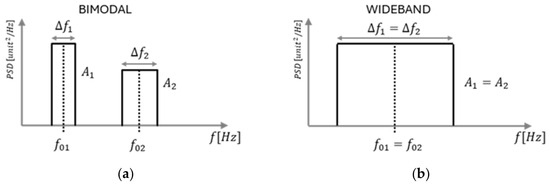
This hypothesis serves as the foundational premise for the proposed approach. Furthermore, for simplicity the design incorporates a rectangular shape for each mode, as illustrated in Figure 1.
Figure 1.
Proposed geometries for generic load representation. (a) Bimodal, (b) wideband. Reprinted with permission from ref. [19] 2025 G. Curti.
It is hypothesized that the width of each mode is directly connected to a virtual global adimensional damping coefficient (ξ) through the dynamic amplification factor (). The following parameters are used to completely define the PSD’s geometry:
- —Central frequency of the first mode;
- —Global variance of the process;
- —Dynamic amplification factor;
- —Central modal frequency ratio;
- —Modal area ratio.
The last two parameters will be referred to from now on as “bimodal parameters”.
The formulation in Equation (3) allows the parameter to be excluded from the relevant parameters since equal geometries with different global variance result in the same load spectrum shape.
It is important to remember that the scope of the load dataset is to represent the entire spectrum of scenarios regarding load spectra geometries. Since damage is the ultimate interest, the correlation between the load spectrum geometry and the distribution of power in the spectral domain has been demonstrated to be directly proportional to the adimensional bandwidth indices expressed in Equations (2)–(4).
The proposed bimodal process is characterized by a simple parametrization, which facilitates the straightforward calculation of spectral moments. The rectangular shape in fact allows the spectral moments to be calculated on each mode separately and then summed. Consequently, bandwidth indices can be obtained and result in the following formulations:
Since shown in Equation (2) can be expressed as a function of and , it can be obtained directly from them.
The formulations in Equations (7) and (8) do not show a dependency on the location of the PSD within the frequency spectrum since the is absent from both equations. This is coherent with the general formulation of damage given by Miner in Equation (5) where the peak frequency is outside the integral. Even though this concept was already discovered properly, obtaining it on this simple case allows to appreciate its meaning in avoiding redundancies while developing a dataset. Therefore, it can be concluded that parameters , , and are the minimum independent parameters necessary for defining a set of PSDs uniquely representing a set of load spectrum geometries.
Moreover Equations (7) and (8) can both be written with the generic formulation:
This simple formulation enables the evaluation of the components in a distinct manner.
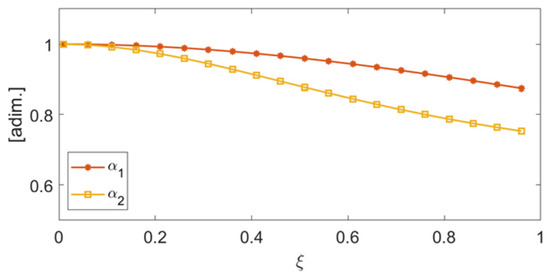
The initial function of Equation (9) () is dependent on the damping imposed on both modes. It is evident that an elevated damping level corresponds to a broader bandwidth, thereby causing a lower value of the bandwidth index. The function of both indices was plotted against the damping value, revealing an overall monotone decreasing slope, as expected (Figure 2).
Figure 2.
Modulation function calculated in terms of percentage damping for all bandwidth indices. Adapted with permission from ref. [19] 2025 G. Curti.
These functions can be considered as direct descriptors of the unimodal wideband process. This is achieved by setting and unitary, which causes the function of Equation (9) to assume a unitary value.
In the second part of Equation (9), the two-dimensional functions exhibit on both indices a central symmetry about the point ( = = 1) from a logarithmic scale of positive values of the bimodal parameters. This assertion is substantiated by the following equation: .
Therefore, for the sake of simplicity, the domain can be limited to > 1, which entails that the second mode’s central frequency is always greater than the first one.
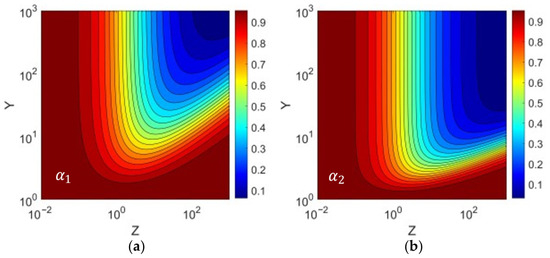
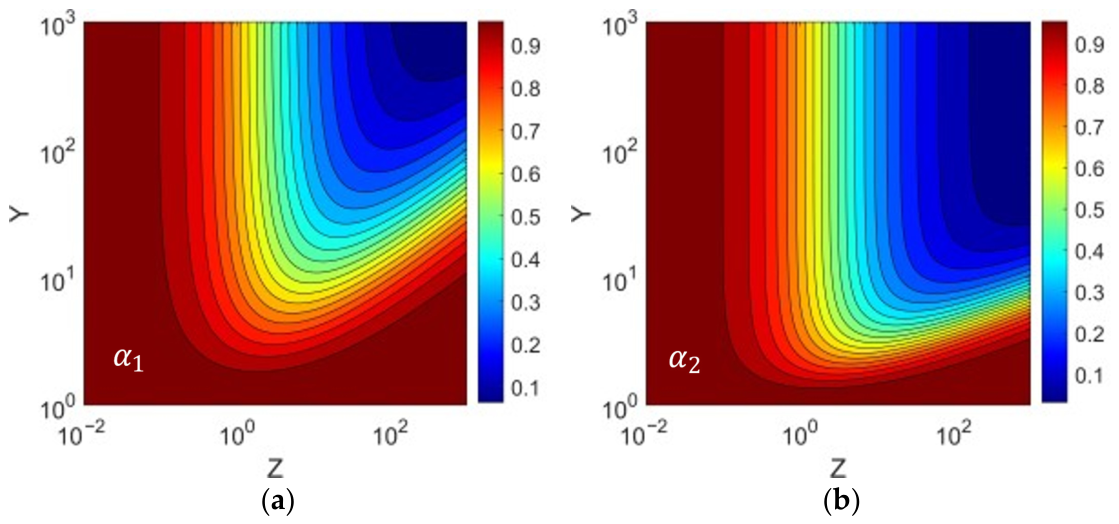
The functions are plotted as isocurves in Figure 3 for both indices, with the domains of and imposed.
Figure 3.
Isocurve plot of maps calculated on each bandwidth parameter used: (a) , (b) . Reprinted with permission from ref. [19] 2025 G. Curti.
As expected, under these conditions, the process behaves as a narrowband if one of the modes prevails over the other or if they are very close. Conversely, if they are separated but the first mode has significant energy compared to a wideband higher-frequency mode, the process will be wideband. While the probability of this latter scenario remains indeterminate, the proposed bimodal geometry, utilizing the bimodal parameters, possesses the capacity to depict it. It is evident that the indices under consideration are highly sensitive to lower values of and . Consequently, the plots are exhibited on a bi-logarithmic scale in order to enhance readability.
The domain choice of the bimodal parameters, however, cannot be carried out by means of the representation of a single bandwidth index. In fact, a review of the spectral damage assessment methods reveals that a set of at least two indices is necessary for obtaining reliable results. Consequently, a mapping problem can be formulated in which bimodal parameters are associated with pairs of bandwidth indices. Therefore, if the indices used on the Tovo-Benasciutti’s method are employed.
The injectivity of the mapping problem at hand ensures that each bimodal process, defined with different bimodal parameters and , results in a unique representation of the load spectrum geometry. The simple question to answer is whether two different coordinates of result in the same .
There are multiple methods one could employ to get to the desired result. However, given the intricacy of the formulae, a preliminary numerical approach was deemed the most efficacious course of action. This demonstrated that within the specified domain used in Figure 3, apart from the axis = 1, where the two modes overlap, all points guaranteed injectivity. Furthermore, given the independence of the modulation functions depicted in Figure 2, the value guarantees injectivity over its entire domain.
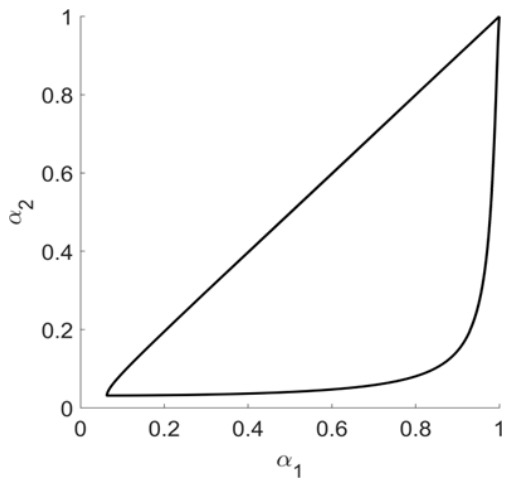
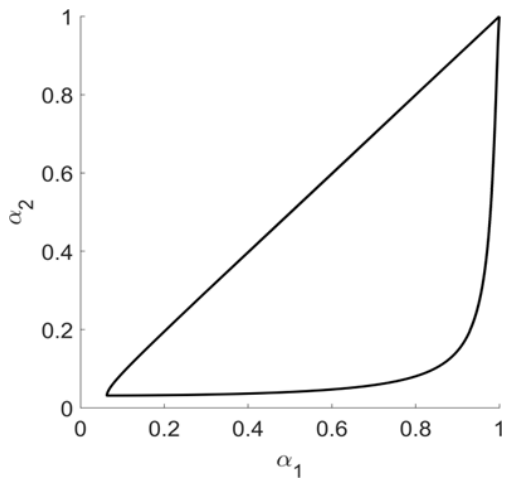
Given the established mapping, it is worthwhile assessing the joint codomain of the pairs of bandwidth indices given a specific, as illustrated in Figure 4. The definition of boundaries in terms of bandwidth indices is crucial for the validity of the approximation. Indeed, it is evident that indices of this nature can be readily obtained from empirical processes. If these indices fall within the domain of the bimodal representation, a damage-equivalent bimodal load can be constructed from them.
Figure 4.
Joint codomain boundary () calculated from and . Reprinted with permission from ref. [16] 2025 G. Curti.
Furthermore, access to real distributions of bandwidth indices facilitates the evaluation of the domain of the bimodal parameters from the bandwidth indices. Therefore, the mapping problem must be inverted .
4. Validation
In order to validate the bimodal approximation, a finite element model of a structural steel component is utilized as a reference. After a modal analysis, the first natural frequencies were extracted from each model choosing the ones below 300 Hz. A state-space model was constructed, under the supposition of a damping ratio of 3%, a common value in the field of steel alloys, to obtain the stress over excitation frequency response function (FRF) of all elements. A wideband PSD was imposed as the base motion to each model in accordance with the “Rail Cargo” base excitation proposed on the MIL-STD-810H standard [20]. Consequently, the response was obtained for each element in terms of directional stress PSD via linear combination with the FRF.
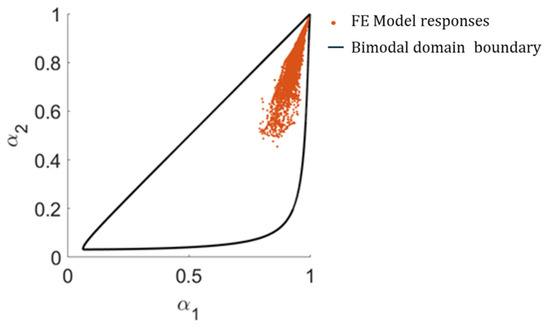
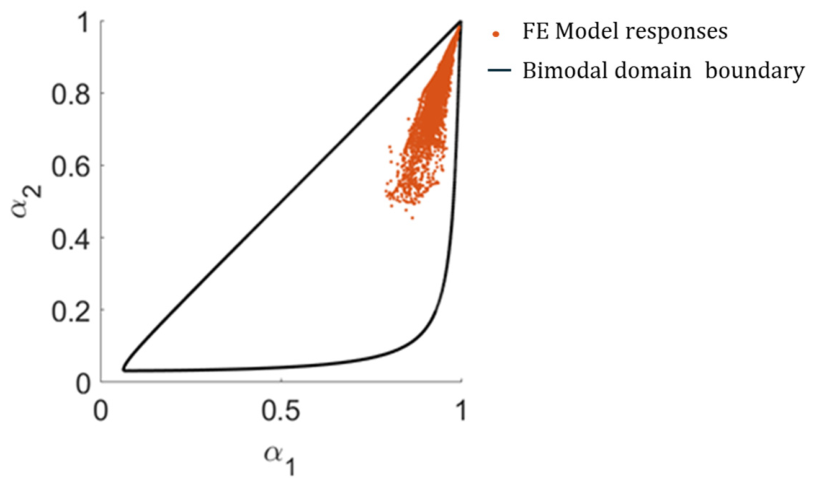
The bandwidth indices calculated on both models are plotted on top of the joint codomain plots of Figure 4 and the results are shown in Figure 5 for the space . It is evident that both distributions fall within the domain of both sets of indices. Therefore, theoretically, all elemental responses admit an approximated bimodal power spectrum with an equal load spectrum.
Figure 5.
Scatter plot of distribution of bandwidth indices () in example finite element model against the representable boundary using and .
To assess the load spectra equivalence, an equivalent bimodal process can be delineated from a generic spectrum using the previously defined inverted mapping problem . However, given the complexity of Equations (7) and (8), the inversion was performed through a numerical best-fit procedure. To achieve this, high-resolution maps are constructed from a broad bimodal parameter’s domain and the best-fitting coordinates are identified.
To assess the load spectrum equivalence between a complex process and the bimodal approximation, two strain PSDs measured from real case scenarios are chosen as example responses. Each process was sampled at 10 kHz and the PSDs were obtained via the Welch method with a 4096-point window width. Since bandwidth indices are independent from the zero-th moment, the power on both responses is normalized. The bandwidth indices () calculated from such PSDs are shown in Table 1.
Table 1.
Bandwidth indices calculated from elemental stress response of Load 1 and 2.
In order to obtain the equivalent bimodal parameters, damping on the component is hypothesized to be equal to 3%. Therefore, on each map , the relative modulation function value with was multiplied. Subsequently, via , the and parameters are obtained.
It is important to stress that performing the inversion procedure using and , indices used by the Tovo-Benasciutti’s method would theoretically return the same results as using the indices used by Dirlik and . However, expecting to obtain the same bimodal parameters from the different sets of indices, for the limitations of the numerical inversion employed, the set is chosen for its higher sensitivity.
The bimodal parameters obtained from these models are shown in Table 2.
Table 2.
Bimodal parameters obtained from elemental stress response of Load 1 and 2 via numerical extrapolation from the bandwidth indices of Table 1.
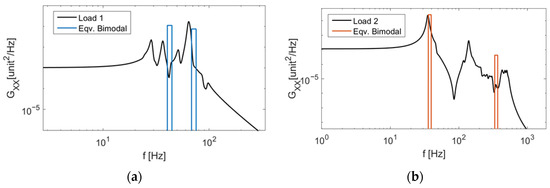
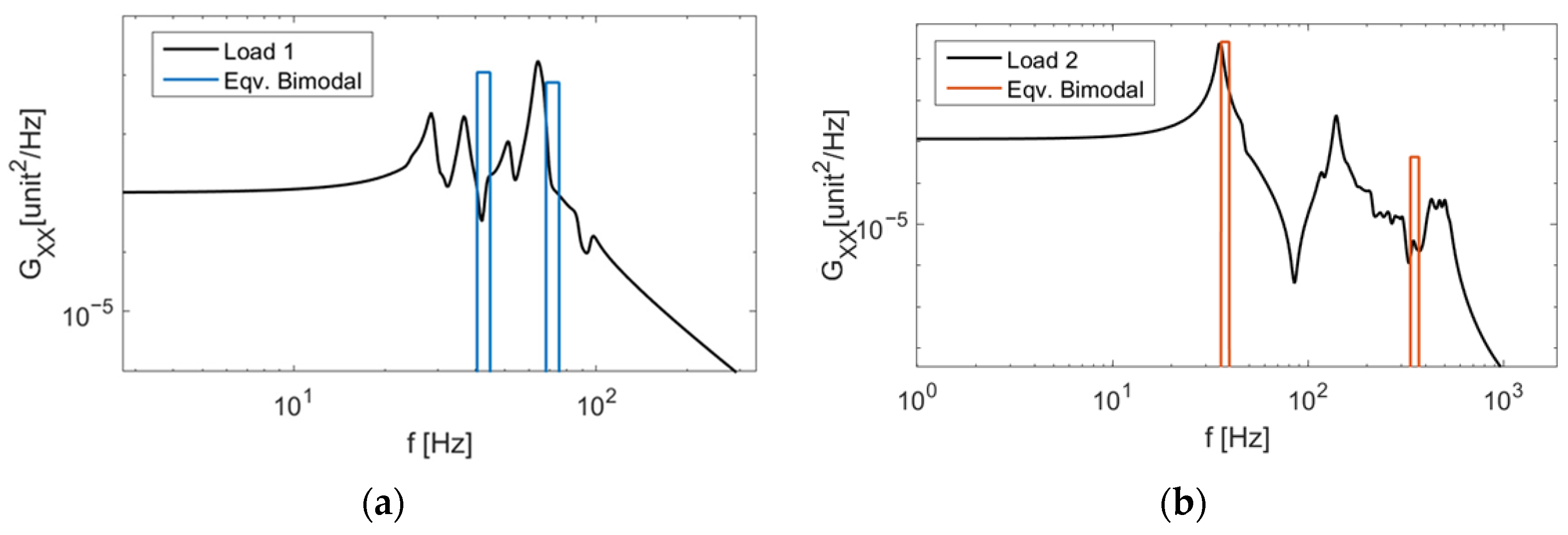
With the parameters obtained, the equivalent processes designed are shown in Figure 6 in terms of PSD on top of the original stress responses. For better readability of these results the equivalent bimodal processes are shown with the same peak rate and RMS of the original load.
Figure 6.
PSDs comparison between the stress response from the experimental loads and the equivalent bimodal obtained on Load 1 (a) and Load 2 (b).
It is noteworthy that the resulting spectral content of the approximated process does not bear much resemblance to the original one. This demonstrates the true potential of this approach, as different PSD geometries may not readily be associated with a shared load spectrum. Consequently, in a dataset defined in an arbitrary manner, they would be redundant.
Load spectra are obtained from both power spectra using a time-domain approach. A total of 10 time-domain signals were generated from each PSD. The time lengths of these signals were proportional to 105 times the lowest relevant frequency to ensure statistical relevance also to the low tones of the response. The sampling frequency was set to 10 times the highest relevant frequency to avoid aberrations on the results given by the insufficient sampling [21].
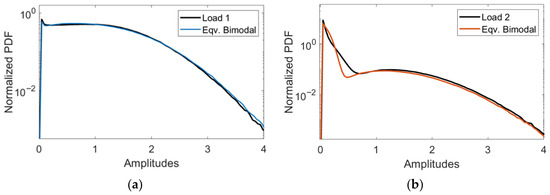
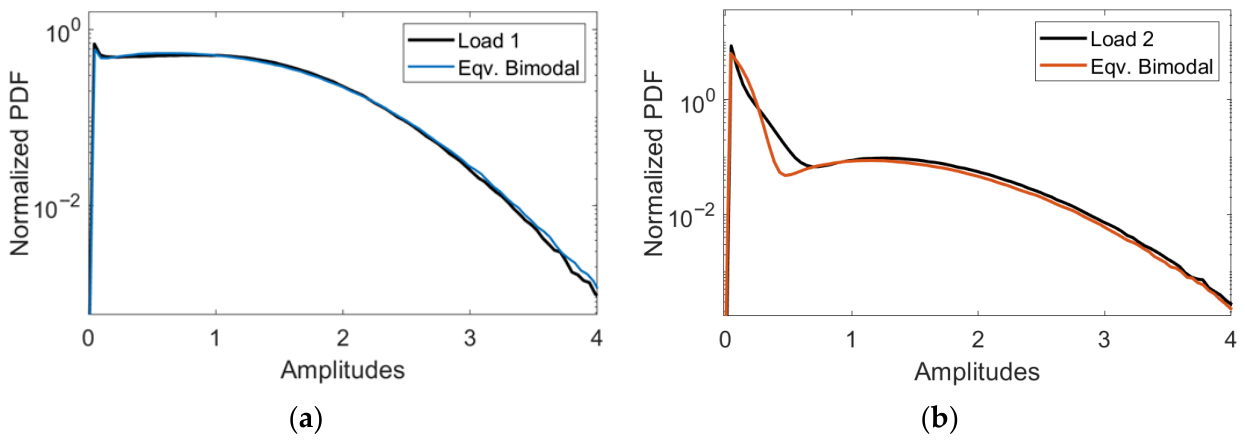
The normalized load spectra that were obtained were then subjected to averaging, and the results are displayed in Figure 7. A close examination of the data reveals striking similarities in the behaviors exhibited, particularly regarding high-amplitude cycles. These cycles are of particular concern due to their susceptibility to damage, as evidenced by the Miner power-law model presented in Equation (5).
Figure 7.
Load spectrum comparison between experimental load and equivalent bimodal on Load 1 (a) and Load 2 (b).
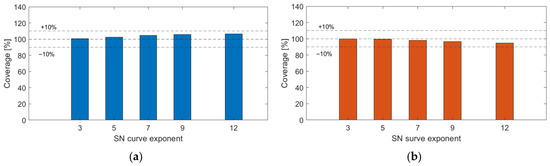
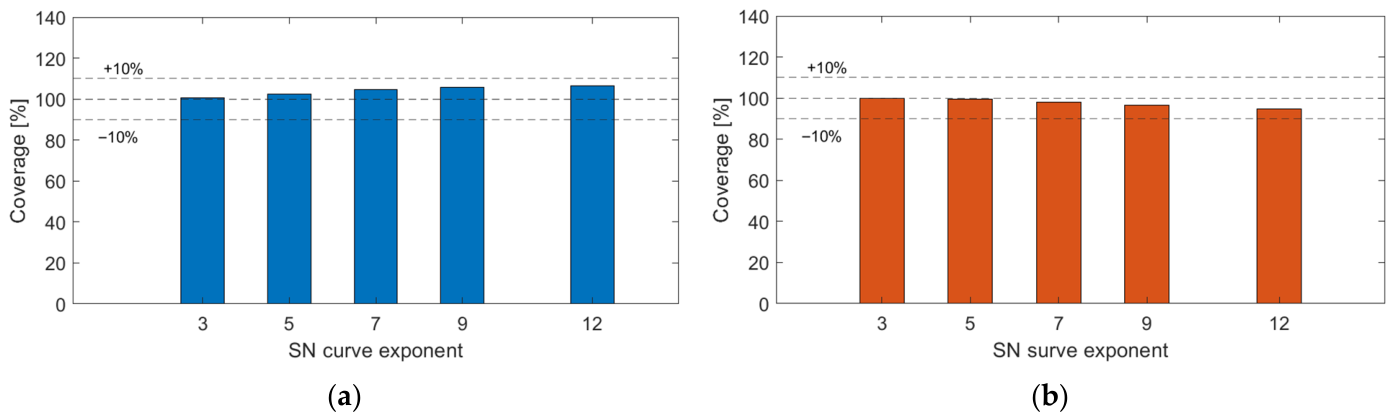
From each load spectrum, a damage potential can be calculated by imposing an SN curve with C = 1 and different slope coefficients m = {3,5,7,9,12}.
From each potential a percentage coverage value can be obtained as a ratio between the approximated damage and the one obtained by the original process.
The results of this comparison are shown on both models in Figure 8. Here it is clear that the bimodal approximation commits similar errors to those obtained by the spectral approach. In fact, even with high slope coefficients the maximum error committed is within the highly acceptable 10% and falls under 1% if low slope coefficients are used.
Figure 8.
Damage potential coverage of equivalent bimodal on Load 1 (a) and Load 2 (b).
This is a highly valuable result considering the simple geometry of the equivalent power spectrum.
5. Conclusions
This work proposed a straightforward yet effective framework for generating representative load datasets. These datasets are intended to be useful for future researchers. They can be used to develop new fatigue damage assessment tools or as a benchmark. A simple bimodal geometry was selected as a generic response for a component in terms of PSD. The mathematical relationship between the descriptive parameters of the bi-rectangular process and the bandwidth indices enables the reduction in the number of required parameters for process description, thereby preventing redundancies.
The mapping problem defined between the bimodal parameters and the bandwidth indices is pivotal in determining the robustness of the domain of the bimodal parameters. Bandwidth indices are indeed quantifiable from actual processes. In the event that one has access to the joint domain of pairs of indices, the domain of the bimodal parameters can be tailored accordingly. The present study used a generic finite element model to elucidate this concept by comparing the joint distribution of the elemental response bandwidth indices against the representable domain, obtained from a given domain of bimodal parameters.
In addressing the question of whether the bimodal process can be represented in terms of damage, two example measured processes were utilized as a benchmark. From each case, an equivalent bimodal distribution was obtained, and load spectra were calculated via the time domain approach. The approximated bimodal with equivalent bandwidth indices maintains high accuracy in damage estimation, with errors generally below 10% and often below 1% for commonly encountered slopes of the SN curve, supporting its utility in both new method development and benchmarking. Subsequent research endeavors will concentrate on investigating the impact of varying parameters on the load spectrum equivalence search. The objective is to identify the optimal set of bandwidth indices for load spectrum equivalence.
Author Contributions
Conceptualization, G.C. and M.P.; methodology, G.C.; software, G.C.; validation, G.C., M.P. and F.C.; formal analysis, G.C.; investigation, G.C.; resources, M.P., F.C.; data curation, G.C.; writing—original draft preparation, G.C.; writing—review and editing, G.C., M.P. and F.C.; visualization, G.C.; supervision, M.P. and F.C.; project administration, F.C. All authors have read and agreed to the published version of the manuscript.
Funding
This research received no external funding.
Institutional Review Board Statement
Not applicable.
Informed Consent Statement
Not applicable.
Data Availability Statement
Data is available on request.
Conflicts of Interest
The authors declare no conflicts of interest.
References
- Dirlik, T.; Benasciutti, D. Dirlik and Tovo-Benasciutti Spectral Methods in Vibration Fatigue: A Review with a Historical Perspective. Metals 2021, 11, 1333. [Google Scholar] [CrossRef] [Scilit]
- Lee, Y.-L.; Tjhung, T. Rainflow Cycle Counting Techniques. In Metal Fatigue Analysis Handbook; Elsevier: Amsterdam, The Netherlands, 2012; pp. 89–114. [Google Scholar]
- Dirlik, T. Application of Computers in Fatigue Analisys. Doctoral Dissertation, University of Warwick, Coventry, UK, 1985. [Google Scholar]
- Benasciutti, D.; Tovo, R. Spectral methods for lifetime prediction under wide-band stationary random processes. Int. J. Fatigue 2005, 27, 867–877. [Google Scholar] [CrossRef] [Scilit]
- Sgamma, M.; Palmieri, M.; Barsanti, M.; Bucchi, F.; Cianetti, F.; Frendo, F. Study of the response of a single-dof dynamic system under stationary non-Gaussian random loads aimed at fatigue life assessment. Heliyon 2024, 10, e30832. [Google Scholar] [CrossRef] [Scilit] [PubMed]
- Cianetti, F.; Palmieri, M.; Slavič, J.; Braccesi, C.; Morettini, G. The effort of the dynamic simulation on the fatigue damage evaluation of flexible mechanical systems loaded by non-Gaussian and non stationary loads. Int. J. Fatigue 2017, 103, 60–72. [Google Scholar] [CrossRef] [Scilit]
- Cianetti, F.; Palmieri, M.; Braccesi, C.; Morettini, G. Correction formula approach to evaluate fatigue damage induced by non-Gaussian stress state. Procedia Struct. Integr. 2018, 8, 390–398. [Google Scholar] [CrossRef] [Scilit]
- Trapp, A.; Fräulin, D.; Hinz, M.; Wolfsteiner, P. Data-driven spectral damage estimator for non-stationary vibration loading. Procedia Struct. Integr. 2024, 54, 521–535. [Google Scholar] [CrossRef] [Scilit]
- Jun, S.-H.; Park, J.-B. Development of a novel fatigue damage model for Gaussian wide band stress responses using numerical approximation methods. Int. J. Nav. Archit. Ocean Eng. 2020, 12, 755–767. [Google Scholar] [CrossRef] [Scilit]
- Vanmarcke, E.H. Properties of Spectral Moments with Applications to Random Vibration. J. Eng. Mech. Div. 1972, 98, 425–446. [Google Scholar] [CrossRef] [Scilit]
- Newland, D.E. An Introduction to Random Vibrations, Spectral & Wavelet Analysis; Dover Publications: Garden City, NY, USA, 2005. [Google Scholar]
- Lutes, L.D.; Sarkani, S. Random Vibrations: Analysis of Structural and Mechanical Systems; Butterworth-Heinemann: Oxford, UK, 2004. [Google Scholar]
- Mršnik, M.; Slavič, J.; Boltežar, M. Frequency-domain methods for a vibration-fatigue-life estimation–Application to real data. Int. J. Fatigue 2013, 47, 8–17. [Google Scholar] [CrossRef] [Scilit]
- Benasciutti, D.; Tovo, R. Comparison of spectral methods for fatigue analysis of broad-band Gaussian random processes. Probabilistic Eng. Mech. 2006, 21, 287–299. [Google Scholar] [CrossRef] [Scilit]
- Zorman, A.; Slavič, J.; Boltežar, M. Vibration fatigue by spectral methods—A review with open-source support. Mech. Syst. Signal Process. 2023, 190, 110149. [Google Scholar] [CrossRef] [Scilit]
- Benasciutti, D. Fatigue Analysis of Random Loadings: A Frequency-Domain Approach; LAP LAMBERT Academic Publishing: Saarbrücken, Germany, 2012. [Google Scholar]
- Miner, M.A. Cumulative Damage in Fatigue. J. Appl. Mech. 1945, 12, A159–A164. [Google Scholar] [CrossRef] [Scilit]
- Basquin, O.H. The Exponential Law of Endurance Tests. Am. Soc. Test. Mater. Proc. 1910, 10, 625–630. [Google Scholar]
- Curti, G.; Massimiliano, P.; Filippo, C. Towards systematic random process representation: Bimodal PSDs characterized by bandwidth indices. Int. J. Fatigue 2025, 204, 109359. [Google Scholar] [CrossRef] [Scilit]
- MIL-STD-810H; Environmental Engineering Considerations and Laboratory Tests. US Department of Defense: Aberdeen, MD, USA, 2019.
- Trapp, A.; Hoesch, Q.; Wolfsteiner, P. Effects of insufficient sampling on counting algorithms in vibration fatigue. Procedia Struct. Integr. 2022, 38, 260–270. [Google Scholar] [CrossRef] [Scilit]

Disclaimer/Publisher’s Note: The statements, opinions and data contained in all publications are solely those of the individual author(s) and contributor(s) and not of MDPI and/or the editor(s). MDPI and/or the editor(s) disclaim responsibility for any injury to people or property resulting from any ideas, methods, instructions or products referred to in the content. |
© 2026 by the authors. Licensee MDPI, Basel, Switzerland. This article is an open access article distributed under the terms and conditions of the Creative Commons Attribution (CC BY) license.