


Abstract
Structural health monitoring (SHM) of machinery represents a topic of significant engineering interest. In machine design, the development of diagnostic systems capable of tracking structural integrity during operation is essential, provided that such systems do not interfere with or compromise the machine’s performance. This paper presents a SHM designed to reconstruct, in real time, the full deformation field of a machine from discrete measurements collected at a limited number of locations. The proposed approach combines modal reconstruction techniques with mode selection criteria, further enhanced by the integration of a supervised machine learning classifier. This hybrid framework enables the continuous reconstruction of the structural deformation at each timestep of the measured signal. The methodology is validated on a benchmark geometry, a rectangular plate, by comparing finite element simulations with reconstructions obtained through the proposed modal–machine learning strategy. Results demonstrate the capability of the approach to approximate the global deformation with high fidelity from sparse measurements, establishing a foundation for the extension of the method to more complex machine geometries. The study highlights the potential of integrating data-driven and physics-based techniques for SHM, paving the way for future diagnostic tools in advanced mechanical systems.
1. Introduction
Modal superposition is a well-established technique in structural dynamics. It relies on representing displacements or strains as a linear combination of modal shapes and has been extensively used in engineering for several decades. Its popularity is largely due to the significant reduction in computational effort it offers when compared with direct numerical integration methods [1,2]. The approach is traditionally applied to the evaluation of transient dynamic responses of structures [3,4], although its scope extends to other areas, such as seismic site response analysis [5,6].
Beyond these classical applications, modal superposition provides the theoretical foundation for modal reconstruction, namely the recovery of a structure’s deformation field from sparse measurement data. Modal reconstruction algorithms make it possible to reconstruct the complete displacement field using only a limited number of measurements [7,8,9,10]. This relies on the assumption that the structural response to dynamic loading can be captured by a reduced set of vibration modes, thereby enabling efficient analysis while reducing measurement requirements. In engineering contexts, this is especially valuable when dealing with isotropic, homogeneous, and linearly elastic materials, since displacement and strain fields can be consistently related to stresses through compatibility conditions and Hooke’s law. Consequently, reconstructing displacements and strains also enables inference of the stress state of the entire structure, which is particularly relevant for monitoring machinery and critical safety systems.
Modal reconstruction has also been investigated in shape-reconstruction problems, where the deformation of an object is inferred from partial measurements [11,12]. Such applications are particularly significant in structural health monitoring (SHM), where only sparse data can be collected in real time from accessible points that do not interfere with system operation [13,14]. If modal shapes are obtained from a finite element (FE) model, a small set of displacement measurements can be used to determine the modal coordinates, which quantify the contribution of each vibration mode to the overall deformation. These coordinates in turn provide the basis for reconstructing the full-field structural response, yielding valuable information for damage detection and anomaly identification.
A central challenge in modal reconstruction is the problem of selecting the appropriate modes [15,16]. To ensure accuracy and computational efficiency, only the modes that significantly contribute to the structural response under the relevant loading conditions should be retained. Several criteria for mode selection have been proposed [17,18,19,20]. Among these, the Internal Strain Potential Energy Criterion (ISPEC) [21] is of particular importance for the present study.
The ISPEC evaluates the relevance of each vibration mode by quantifying its contribution to the internal strain potential energy. The method does not require a full FE solution and can be directly applied using sparse deformation or strain measurements together with material properties. Unlike alternative criteria, it operates effectively with limited measurement data and without full-field knowledge of the deformation, making it especially suitable for SHM. Theoretically, the criterion is consistent with the energetic contribution of each mode, as only those with strain energy above a predefined threshold are retained. This ensures accurate reconstruction while maintaining computational efficiency.
Although both modal reconstruction and the ISPEC are well established from a theoretical perspective, their integration into SHM frameworks creates new opportunities. In particular, real-time displacement field reconstruction can be achieved by combining ISPEC-based mode selection with advanced data-driven identification strategies.
The aim of this paper is to present an SHM-oriented algorithm capable of reconstructing the deformation of a structure in terms of displacements. Numerical validation is carried out in a benchmark case study using an FE model of an aluminum plate, which provides a straightforward context for assessing the method while verifying consistency with classical plate theory.
2. Modal Reconstruction
The principle of modal reconstruction relies on the idea that the displacement and strain fields of a structure can be expressed as linear combinations of its vibration modes [16,22]. These modal shapes, obtained from the geometry and boundary conditions of the system, form a basis that describes the structural deformation with reduced dimensionality.
In practical applications, measurements are available only at a finite number of discrete locations on the structure. These measurement points are strategically chosen on the surface or geometry of the component of interest, typically where sensors or optical markers can be placed. The displacement vector and the strain vector therefore represent the experimental data collected at these discrete points. By projecting the measurements onto the modal basis, it becomes possible to reconstruct the complete displacement and strain fields, even at locations where no direct measurements are available.
Formally, displacement and strain vectors can be written as:
where and are matrices collecting the modal displacements and strains, respectively, and is the vector of modal coordinates. The latter quantifies the contribution of each retained mode to the overall deformation.
2.1. Estimation of Modal Coordinates from Discrete Measurements
Given the measured values of and at the selected points, the modal coordinates can be estimated through least-squares inversion:
These expressions correspond to solving an over-determined system, where the number of equations equals the number of discrete measurement points multiplied by the degrees of freedom per point.
For the reconstruction to be valid, this number must be larger than or equal to the number of retained modes [22]. In other words, a sufficiently dense set of discrete measurements is required to ensure that the inversion problem is well-posed and that the reconstruction does not suffer from instability or overfitting. Once is obtained, the displacement and strain fields at unmeasured locations can be reconstructed by applying the modal expansion. This is the key advantage of the method: a sparse set of measurements allows for the estimation of the full-field deformation.
2.2. Energy-Based Mode Selection
Since the number of available modes can be large, retaining only the most relevant ones is crucial. A criterion based on the internal strain potential energy, known as the Internal Strain Potential Energy Criterion (ISPEC), is used to quantify the physical significance of each mode [9,21,23].
The strain energy of a deformation is defined as:
where is the elasticity matrix, depending on material properties such as Young’s modulus and Poisson’s ratio [24,25].
When the strain field is reconstructed through modal superposition, the energy contribution of the i-th mode becomes:
The reconstruction capability is then defined as:
where denotes the total strain energy of the actual deformation. Only modes satisfying are retained, ensuring that the reduced modal basis contains the physically dominant contributions while limiting computational cost.
2.3. Measurement Setup
Modal reconstruction relies on measurements collected at discrete locations on the structure. In this work, the measured quantity is the out-of-plane deflection of the plate, recorded at specific marker positions. These measurements provide the sparse input data required to identify modal coordinates and reconstruct the full displacement and strain fields via modal superposition.
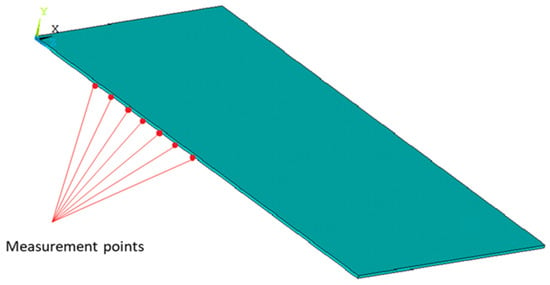
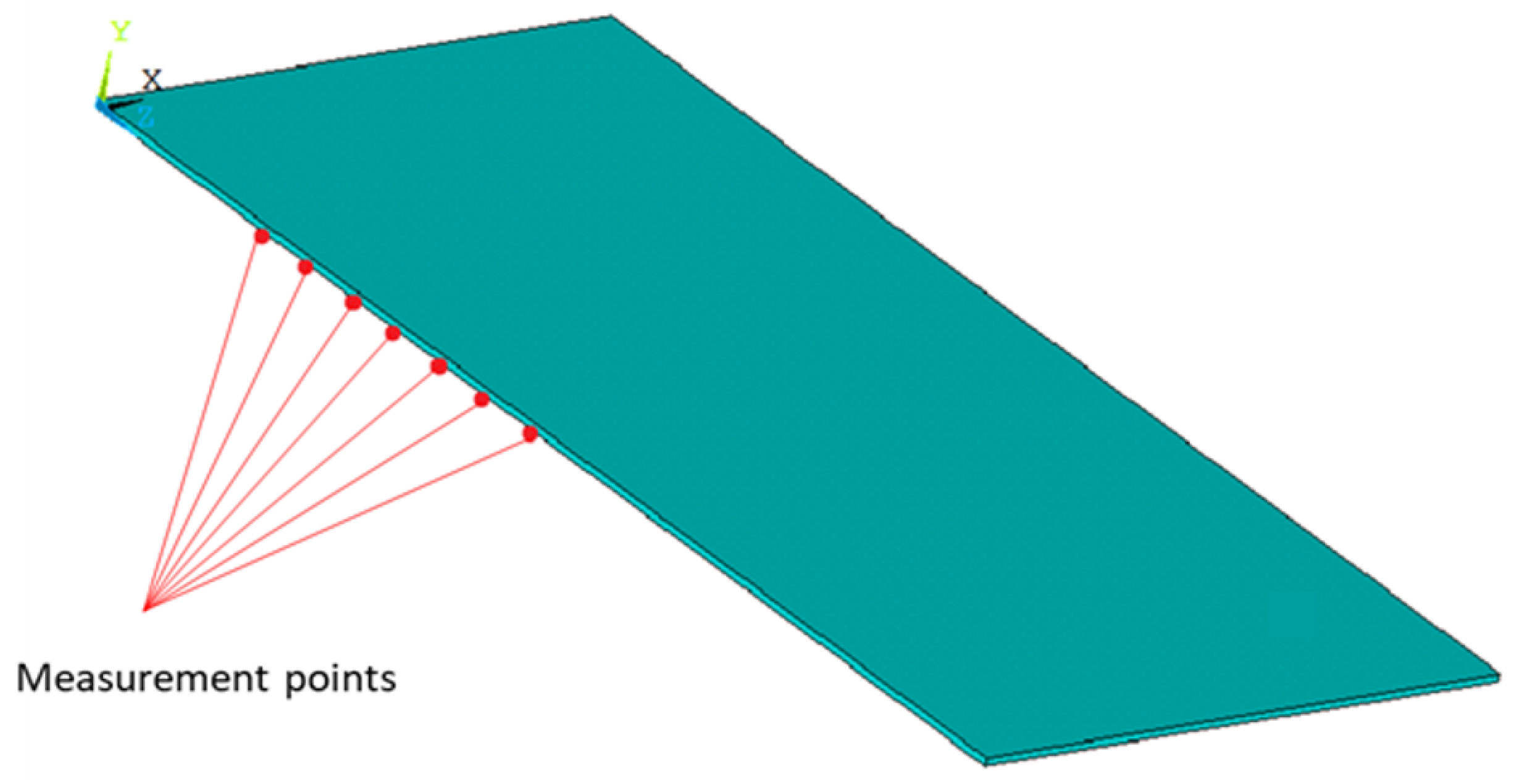
A total of 7 measurement points are selected on the lateral surface of the plate, as illustrated in Figure 1. The lateral surface is chosen as it is accessible and offers high sensitivity to the global deformation of the plate.
Figure 1.
Schematic of the plate with the 7 measurement nodes positioned along the lateral surface. Each marker records the out-of-plane deflection.
The choice of 7 measurement points provides a balance between measurement feasibility and reconstruction accuracy. On the one hand, too few measurements would not contain sufficient information to capture the dominant modal contributions; on the other hand, an excessive number would complicate acquisition and increase computational burden. The adopted configuration ensures that the most significant deformation features are captured with a lightweight experimental setup.
2.4. Machine Learning-Based Modal Identification
Once the reduced modal basis is identified, the deflection measurements at the 7 selected nodes are used as input for a machine learning model that predicts modal participation. Specifically, a random forest classifier (scikit-learn) is trained on synthetic datasets generated by random linear combinations of the retained modes. The classifier is implemented using an ensemble of 100 decision trees with bootstrap aggregation, Gini impurity as the splitting criterion, and unrestricted tree depth, while the number of features considered at each split scales with the square root of the input dimension; the adequacy of this configuration is supported by the low normalised root mean square error (NRMSE) of obtained between reconstructed and measured displacement signals, which is discussed in the subsequent Section 4, with its formulation reported in Section 2.5.
Each training sample consists of the deflections measured at the 7 lateral measurement nodes, while the target output corresponds to the active modes and their relative weights. After training, the classifier can infer modal participation factors from new measurements, which are then used within the modal superposition framework to reconstruct the full displacement field of the plate.
Validation is carried out by comparing reconstructed deflections against independent measurements taken at additional marker positions not included in the training process, thereby assessing the model’s generalisation ability.
2.5. Validation Metrics
The accuracy of the reconstruction is quantified by comparing measured and reconstructed deflections at the validation markers. Let and denote the measured and reconstructed out-of-plane deflections for component i, respectively. The instantaneous residual is defined as:
Visual inspection of , alongside and , provides insight into systematic deviations, phase shifts, or transient mismatches.
For quantitative evaluation, the root-mean-square error (RMSE) is computed over a time window T [26]:
where N is the number of samples. To enable comparison across markers and deformation amplitudes, a normalised RMSE (NRMSE) is also defined:
This normalisation expresses the reconstruction error as a percentage of the signal range, providing a scale-independent measure that facilitates comparison between experiments and sensor locations.
In summary, by combining sparse deflection measurements, energy-based mode selection, and machine learning identification, the methodology enables accurate reconstruction of the full-field deformation of the plate from a limited set of experimental observations.
3. Finite Element Model
The numerical model of the aluminum plate was developed in Ansys APDL (ANSYS Inc. Canonsburg, PA, USA, 2020) under the assumptions of linear elasticity, homogeneity, and isotropy of the material. The structural discretization employed the SOLID185 element formulation, based on an eight-node structural solid with three translational degrees of freedom per node. Full integration was adopted to ensure robust representation of the stress and strain fields, while the solution was performed using the sparse solver.
The plate dimensions are (width × height × thickness). The finite element discretization consists of 12,800 hexahedral SOLID185 elements, with four elements distributed along the thickness to properly capture out-of-plane stress gradients. One short edge of the plate is fully clamped, while the opposite edge is subjected to dynamic excitation.
Modal analyses were conducted with mass normalisation using the Block Lanczos method, providing the vibration modes later employed in the modal reconstruction.
For the generation of synthetic signals, a transient dynamic analysis was performed. The plate was excited at the free end by a sinusoidal force in the y direction of the form:
where and (corresponding to ). The load was applied for a duration of , after which it was released, and the simulation was continued for an additional to capture free vibration response.
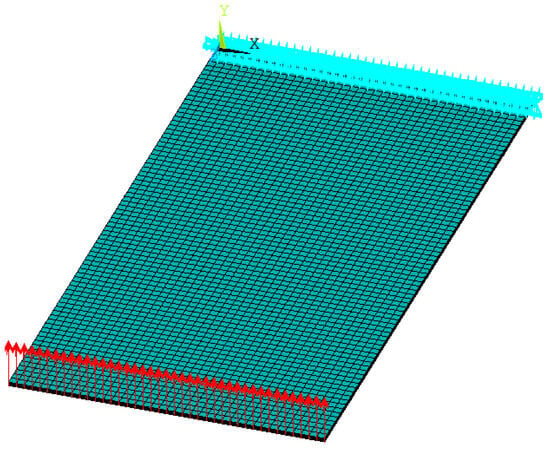
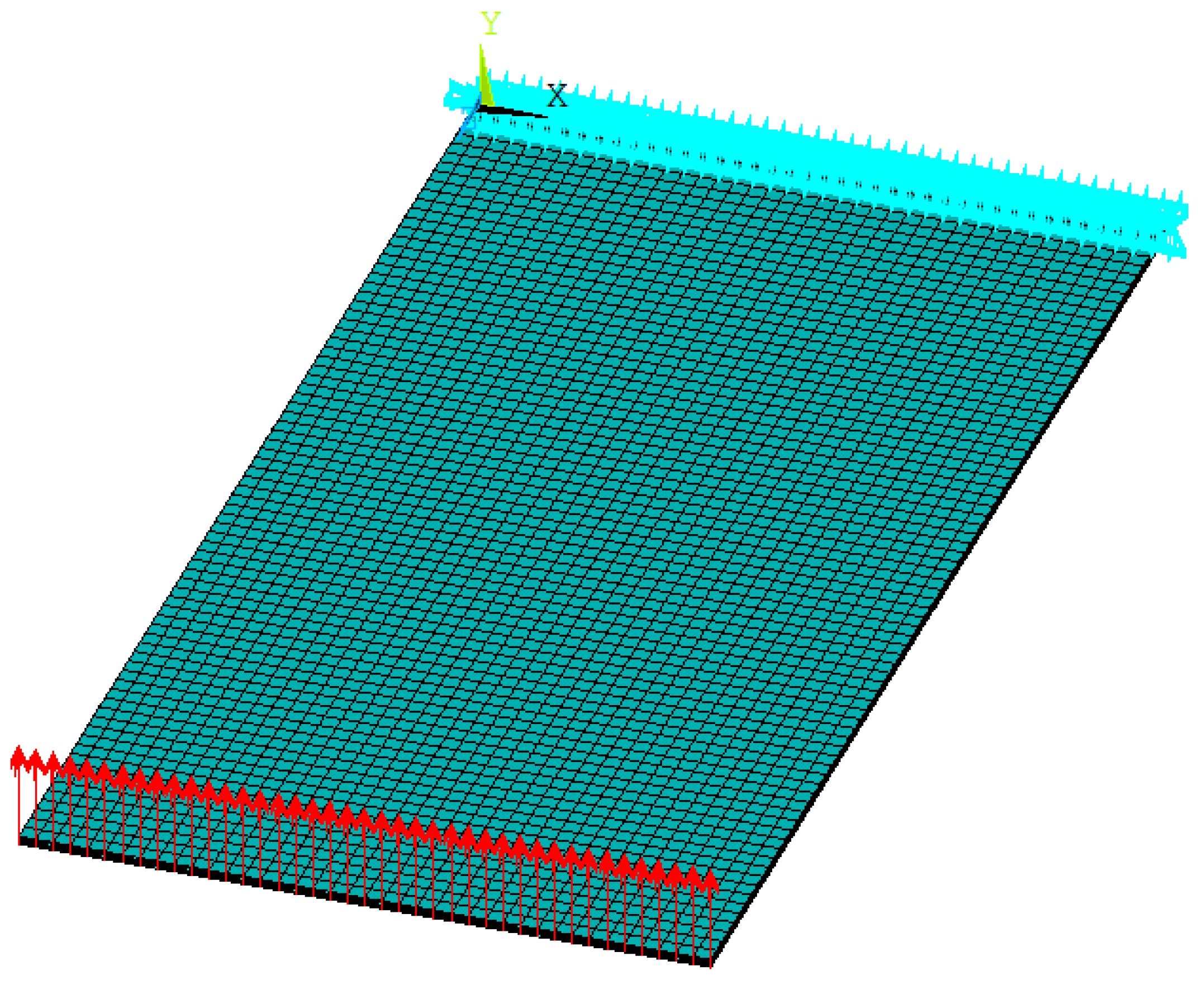
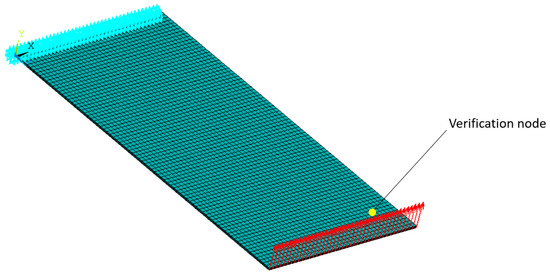
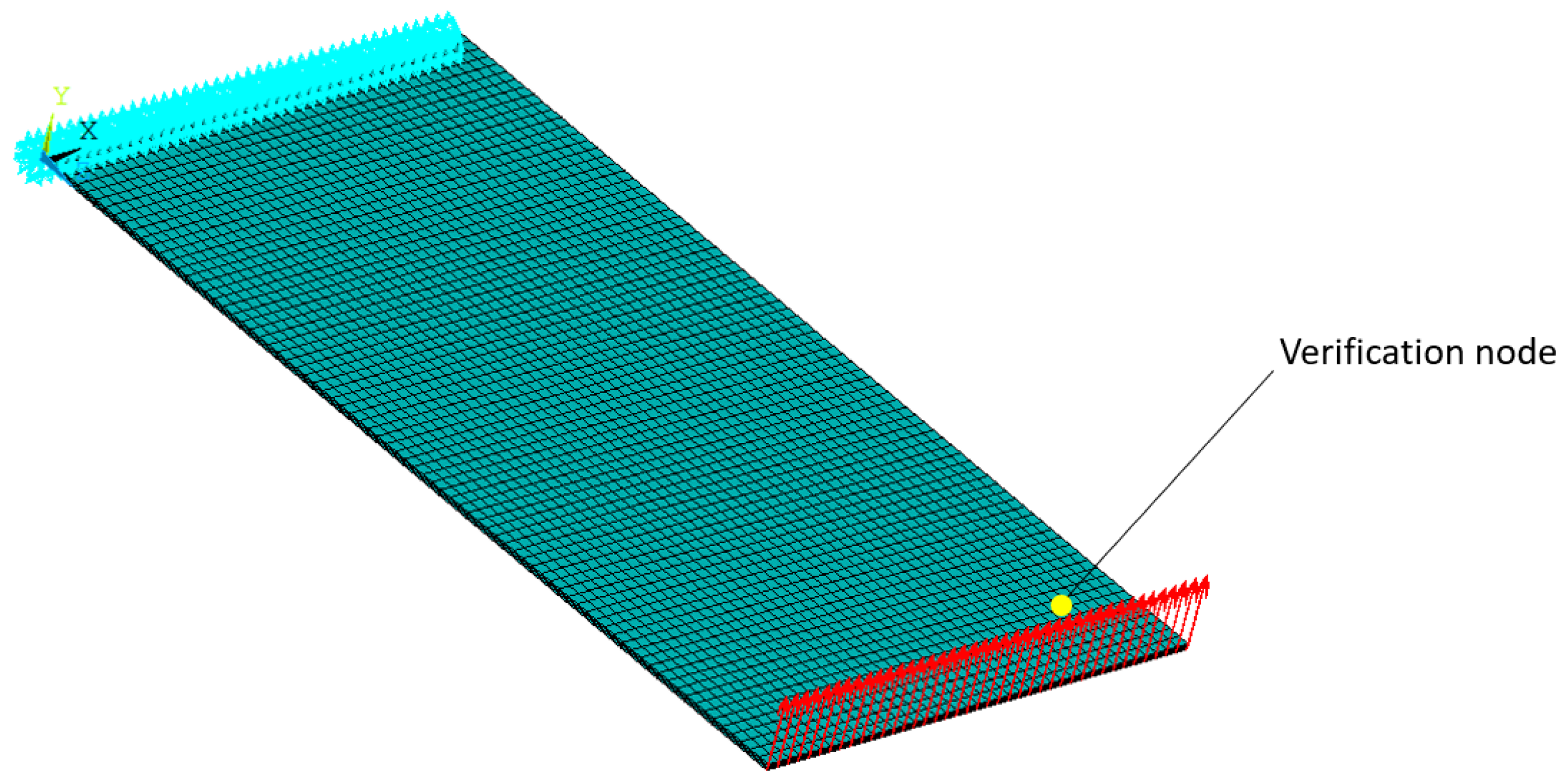
Figure 2 shows the finite element model of the plate, including the mesh discretization, boundary condition at the clamped edge, and the applied force at the opposite free end.
Figure 2.
Finite element model of the aluminum plate discretized with SOLID185 elements. The clamped boundary condition is applied at , while the sinusoidal force excitation is applied at the free end at .
In addition, the Random Forest classifier was trained on deformation cases, obtained from time steps of a transient analysis in which a variable pressure front was applied along the z direction at different heights of the plate. Specifically, each of these deformation cases was generated by recording the plate deformation and corresponding modal selection at each time step of a transient simulation in which the excitation consisted of a harmonic function varying both in time and along the longitudinal direction of the plate.
4. Results
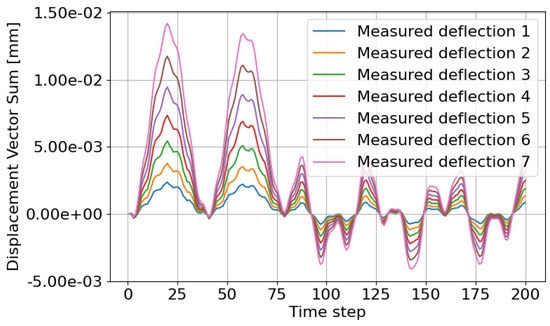
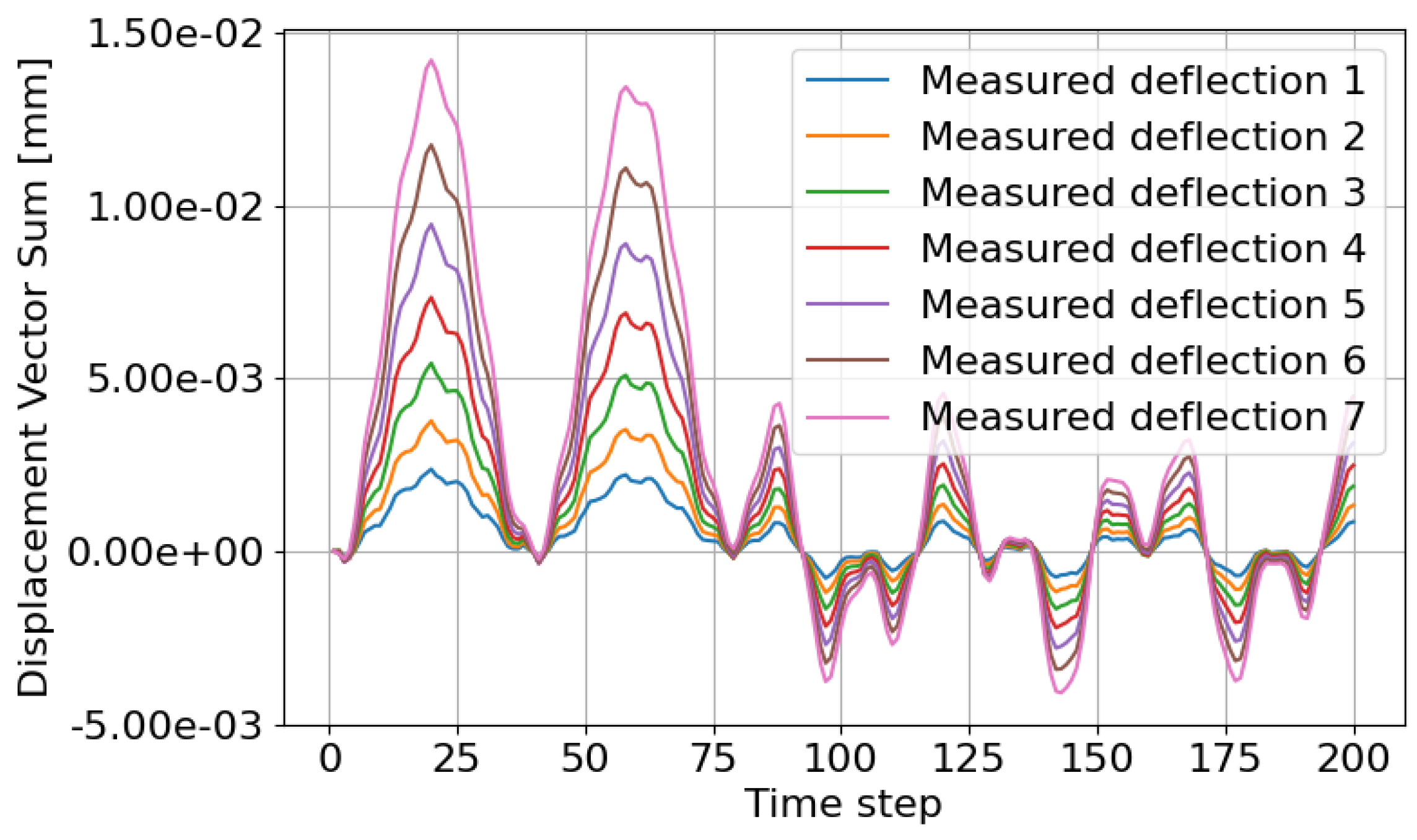
The proposed SHM-oriented modal reconstruction algorithm was validated through the transient response of the aluminum plate obtained via FE simulations. A total of 200 time steps were considered, providing the displacement signals at the 7 measurement points located on the lateral surface of the plate. These signals, shown in Figure 3, constitute the input of the SHM algorithm. Based on such input, the trained Random Forest classifier outputs the optimal modal coordinates, which in turn enable the reconstruction of the deformation field.
Figure 3.
Total displacements (FE results) at the 7 measurement points along the lateral surface of the plate, used as input to the SHM algorithm.
A verification node, not included among the 7 measurement points, was selected to assess the reconstruction accuracy. Its position on the plate is indicated in Figure 4. At this node, the comparison between the finite element response and the reconstructed response was performed on the magnitude of the global displacement vector, rather than on a single component.
Figure 4.
Location of the verification node used to compare FE displacements with reconstructed results.
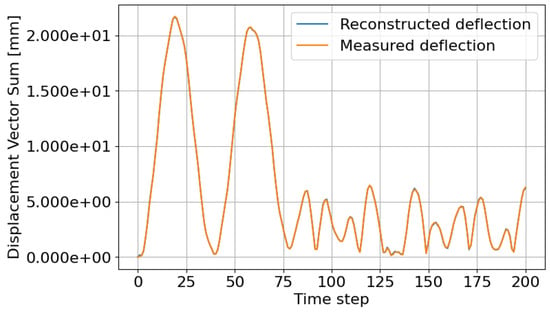
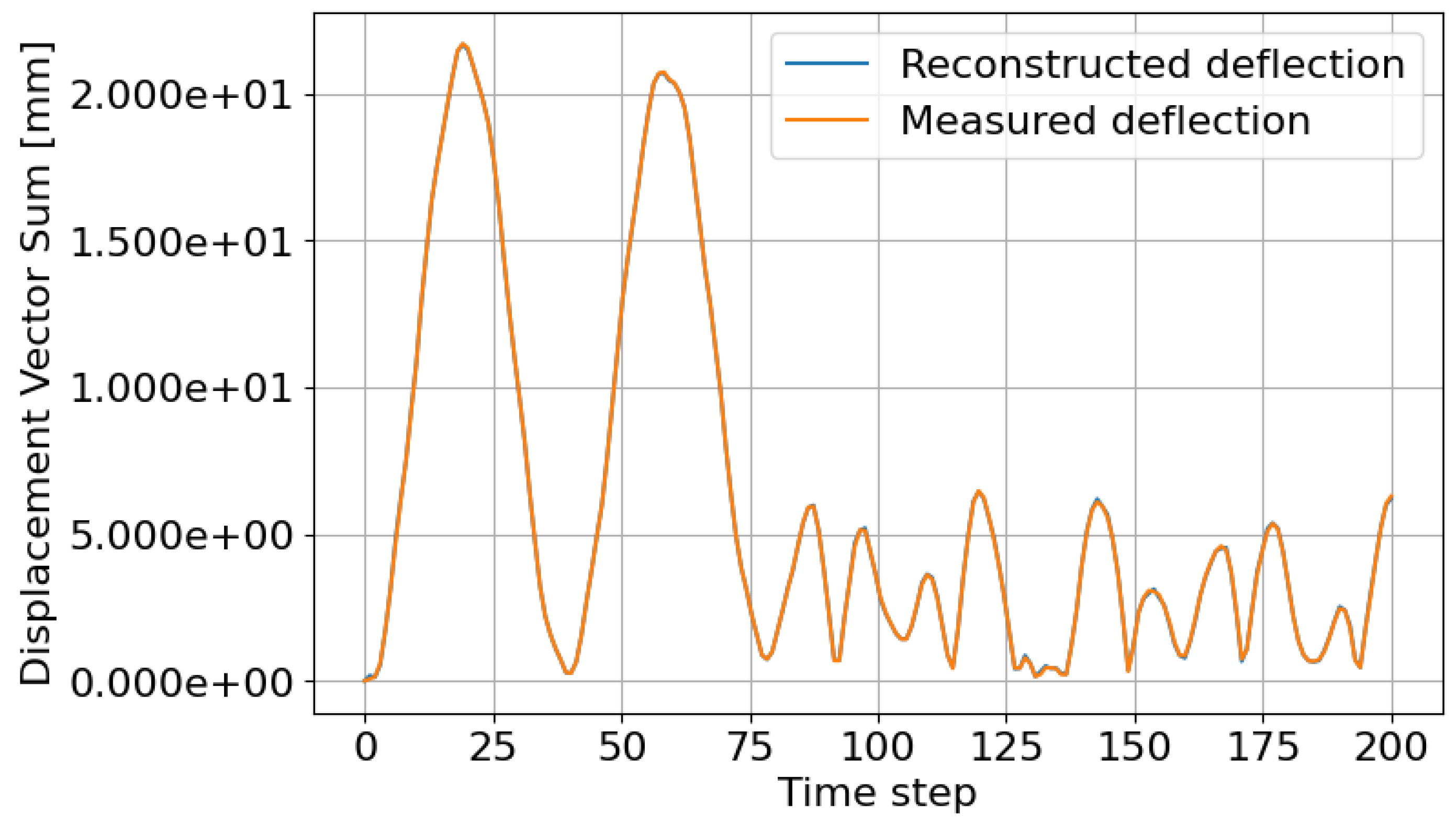
Figure 5 shows the direct comparison between the FE total displacement time history and the reconstructed displacement at the verification node. The two signals overlap almost perfectly, indicating that the Random Forest-assisted modal reconstruction is able to reproduce the dynamic response of the plate with very high fidelity. This result is particularly relevant in SHM applications, as it demonstrates the possibility of recovering full-field displacement information from sparse measurements.
Figure 5.
Comparison between FE total displacement and reconstructed displacement at the verification node. The two time histories overlap, confirming the accuracy of the reconstruction.
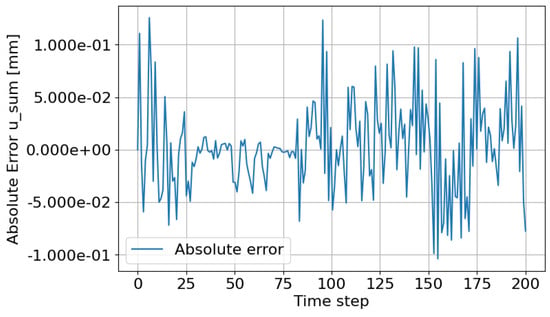
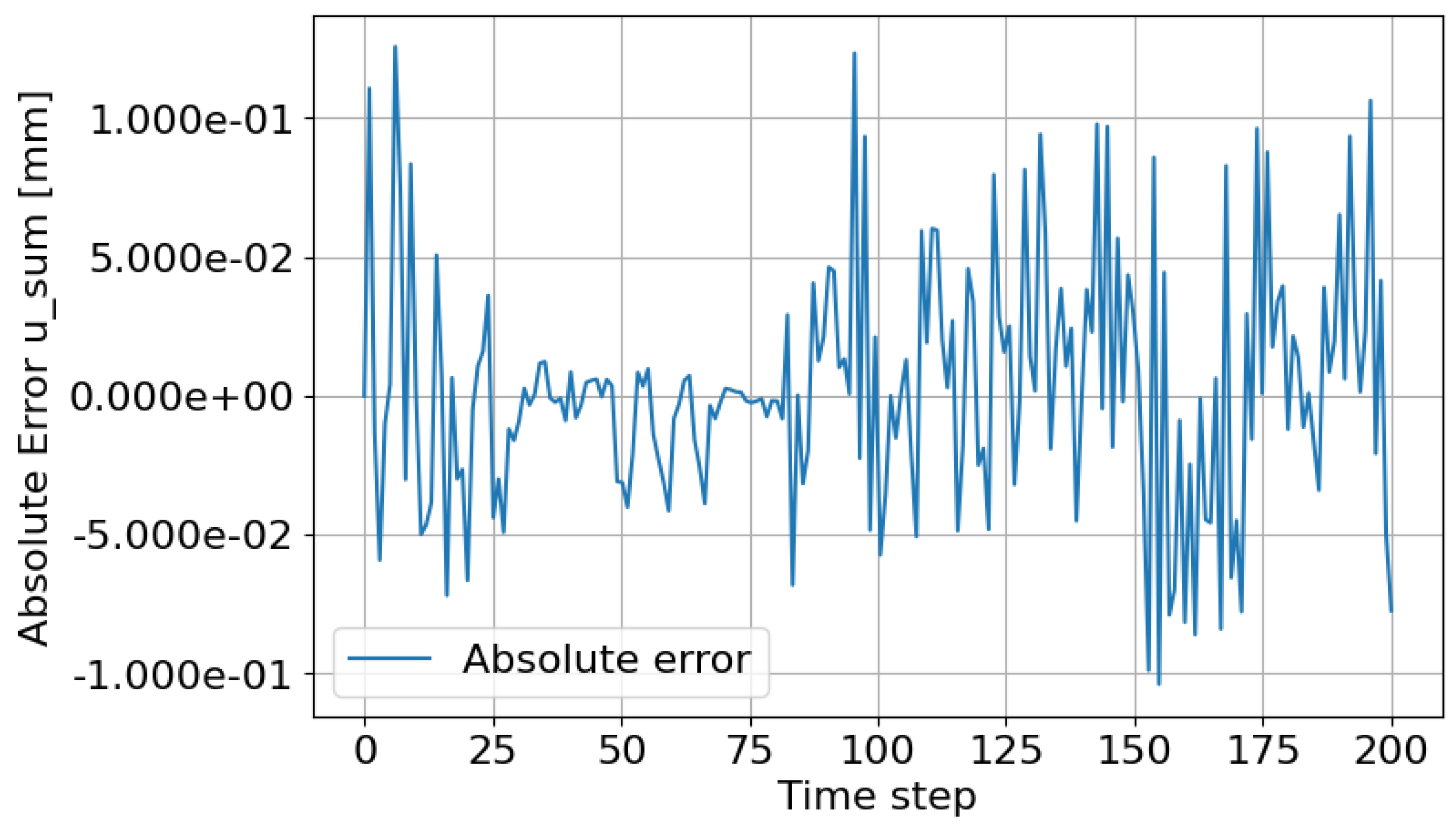
A more informative perspective is obtained by analyzing the residuals, defined as the difference between the FE total displacement and the reconstructed displacement. Figure 6 displays the residual signal over the entire time window. The maximum residual amplitude is , which is very small compared to the global displacement amplitude. This confirms the capability of the method to provide accurate displacement reconstructions, which is of paramount importance in SHM scenarios where reliable information on structural response must be obtained in real time.
Figure 6.
Residuals between FE total displacement and reconstructed displacement at the verification node. The maximum residual is .
The reconstruction accuracy was further quantified using the root-mean-square error (RMSE) and the normalised root-mean-square error (NRMSE), defined in Section 2.5. The results are reported in Table 1. The RMSE was found to be , while the NRMSE amounts to . These values highlight the excellent agreement between FE and reconstructed displacements. In particular, the very low NRMSE indicates that, when the error is normalised with respect to the displacement range, the discrepancy between measured and reconstructed signals is almost negligible. From a time-domain perspective, this means that the reconstructed signal not only follows the amplitude of the FE response but also correctly captures its phase evolution, leading to an almost complete overlap of the two time histories.
Table 1.
Error metrics at the verification node.
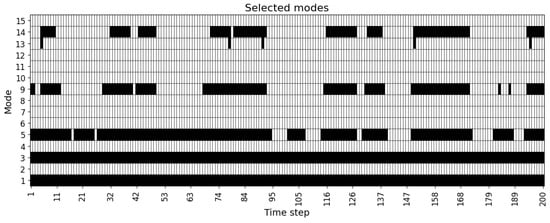
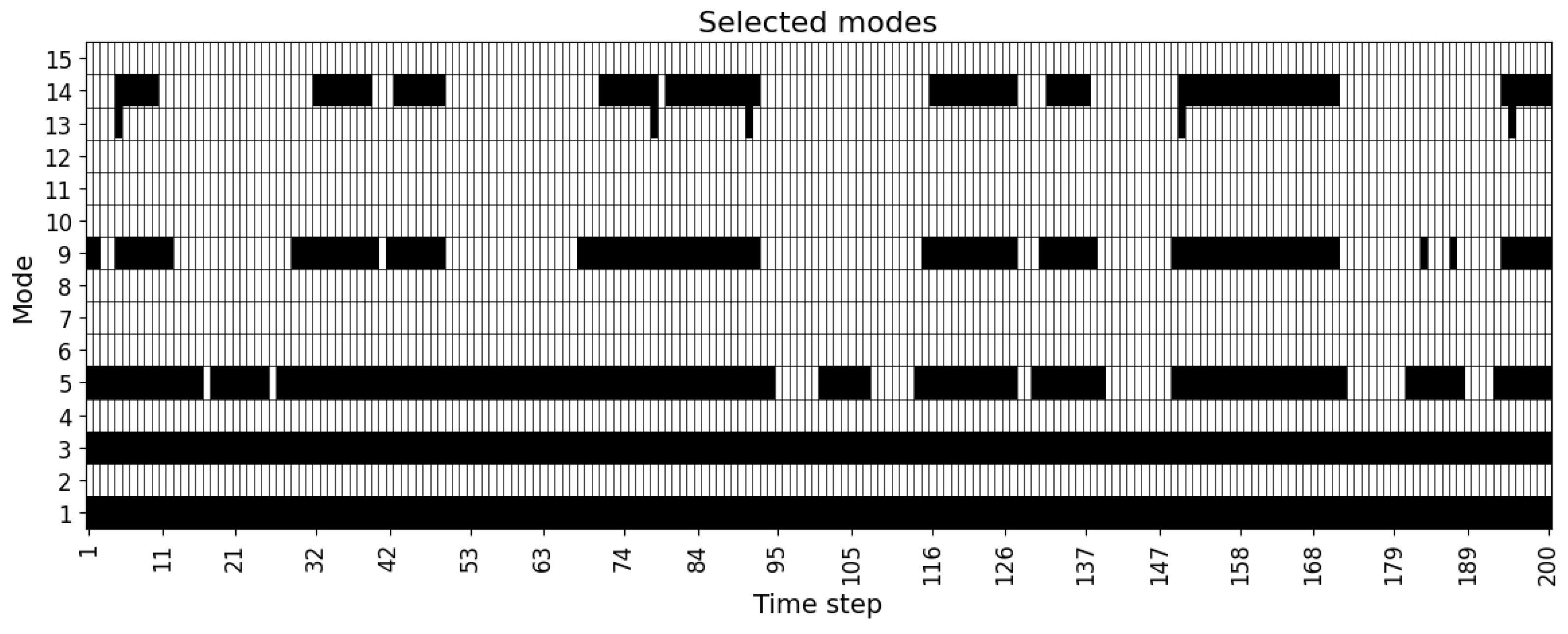
Finally, Figure 7 reports the modes retained at each of the 200 time steps according to the Internal Strain Potential Energy Criterion (ISPEC). All reconstructed deformations were found to be representable by the first 15 modes of the plate. Among these, modes 1 and 3 were the most frequently selected, corresponding to the fundamental flexural modes of the plate. This is consistent with the physical intuition that the dominant contribution to the dynamic response is provided by flexural behaviour, which governs the global displacement of the structure. The systematic recurrence of these modes further validates the modal reconstruction framework, showing that it identifies and exploits the physically meaningful contributions for displacement reconstruction.
Figure 7.
Modes retained by ISPEC during the reconstruction across the 200 time steps. Modes 1 and 3, corresponding to the flexural behaviour, are the most recurrent.
In summary, the results demonstrate that the combination of FE-based training data, Random Forest identification, and ISPEC mode selection provides a highly accurate reconstruction of the plate displacement field. The very low error levels, together with the physical consistency of the retained modes, confirm the potential of the proposed method for SHM applications.
5. Conclusions
This work has presented a methodology for structural health monitoring (SHM) that integrates finite element (FE) modeling, energy-based mode selection, and machine learning to enable full-field deformation reconstruction from sparse deflection measurements. The approach combines the Internal Strain Potential Energy Criterion (ISPEC) for the physically consistent selection of vibration modes with a Random Forest classifier trained on synthetic FE data, thereby linking model-based and data-driven strategies.
Validation on an aluminum plate benchmark demonstrated the robustness and accuracy of the method. The reconstructed deflections at a verification node showed an almost perfect overlap with the FE reference, as confirmed by both visual comparison of the time histories and quantitative error metrics. The RMSE and NRMSE values, and respectively, highlight that the reconstruction captures not only the amplitude but also the temporal evolution of the dynamic response with negligible discrepancies. The residuals, which never exceeded , further confirm the ability of the method to provide highly reliable results. From an SHM perspective, these levels of accuracy are particularly significant, as they ensure that small deviations in the structural response can be confidently attributed to physical changes rather than reconstruction artefacts.
The systematic recurrence of flexural modes (in particular the first and third), consistently retained across 200 time steps, demonstrates that the framework is able to identify and exploit the physically dominant contributions governing plate dynamics. At the same time, the fact that the reconstruction was always achievable using a limited set of the first 15 modes underscores the efficiency of the ISPEC-based reduction. This balance between physical accuracy and computational tractability makes the approach particularly suitable for real-time SHM applications.
Overall, the proposed methodology paves the way for advanced monitoring strategies in which sparse measurements can be leveraged to reconstruct full-field displacements without requiring dense sensing arrays or exhaustive numerical simulations. Future developments will focus on extending the framework to experimental data, which will require careful consideration of sensor positioning to ensure feasibility and minimal interference with the system operation. Prior to installation, a preliminary sensor placement analysis using a digital twin can be performed to identify locations that minimize the reconstruction error between known numerical deformations and predicted values. Once sensor positions are established, the Random Forest classifier can be trained using data that include realistic measurement uncertainties, such as sensor noise and discrepancies due to imperfect boundary condition reproduction. In this context, introducing controlled perturbations in the numerical training signals can help the model learn to accommodate these uncertainties. In future experimental applications, it is expected that noise and model discrepancies will increase the reconstruction error, including the NRMSE. For a more conservative approach, training the algorithm with cases that slightly overestimate the displacement field (e.g., higher strain scenarios) may be preferable to ensure that the reconstructed values do not underestimate critical deformations.
Author Contributions
Conceptualization, G.L.; methodology, G.L.; software, G.L.; validation, G.L. and P.F.; formal analysis, G.L.; investigation, G.L. and P.F.; resources, G.L. and P.F.; data curation, G.L. and P.F.; writing—original draft preparation, G.L. and P.F.; writing—review and editing, G.L. and P.F.; visualization, G.L. and P.F.; supervision, P.F.; project administration, P.F.; funding acquisition, P.F. All authors have read and agreed to the published version of the manuscript.
Funding
This research received no external funding.
Institutional Review Board Statement
Not applicable.
Informed Consent Statement
Not applicable.
Data Availability Statement
The raw data supporting the conclusions of this article will be made available by the authors on request.
Conflicts of Interest
The authors declare no conflicts of interest.
Abbreviations
The following abbreviations are used in this manuscript:
| SHM | Structural Health Monitoring |
| FE | Finite Element |
| ISPEC | Internal Strain Potential Energy Criterion |
| RMSE | Root Mean Square Error |
| NRMSE | Normalised Root Mean Square Error |
References
- Huang, C.; Liu, Z.S.; Chen, S.H. An accurate modal method for computing response to periodic excitation. Comput. Struct. 1997, 63, 625–631. [Google Scholar] [CrossRef] [Scilit]
- Strzalka, C.; Marinkovic, D.; Zehn, M.W. Stress mode superposition for a priori detection of highly stressed areas: Mode normalisation and loading influence. J. Appl. Comput. Mech. 2021, 7, 1698–1709. [Google Scholar] [CrossRef] [Scilit]
- Kant, T.; Arora, C.; Varaiya, J. Finite element transient analysis of composite and sandwich plates based on a refined theory and a mode superposition method. Compos. Struct. 1992, 22, 109–120. [Google Scholar] [CrossRef] [Scilit]
- Wang, M.; Sheng, X. Combining empirical wavelet transform and transfer matrix or modal superposition to reconstruct responses of structures subject to typical excitations. Mech. Syst. Signal Process. 2022, 163, 108162. [Google Scholar] [CrossRef] [Scilit]
- Semblat, J.F.; Duval, A.M.; Dangla, P. Modal superposition method for the analysis of seismic-wave amplification. Bull. Seismol. Soc. Am. 2003, 93, 1144–1153. [Google Scholar] [CrossRef] [Scilit]
- Gao, Z.; Zhao, M.; Du, X.; Wang, J. Effective-mode superposition response spectrum method for three dimensional seismic response analysis of underground structures. Soil Dyn. Earthq. Eng. 2023, 174, 108161. [Google Scholar] [CrossRef] [Scilit]
- Foss, G.; Haugse, E. Using modal test results to develop strain to displacement transformations. In Proceedings of the 13th International Modal Analysis Conference, Nashville, TN, USA, 13–16 February 1995; Volume 2460, p. 112. [Google Scholar]
- Pisoni, A.C.; Santolini, C.; Hauf, D.E.; Dubowsky, S. Displacements in a vibrating body by strain gage measurements. In Proceedings-SPIE the International Society for Optical Engineering; Citeseer: Gaithersburg, MD, USA, 1995; pp. 119–125. [Google Scholar]
- Liuzzo, G.; Meloni, S.; Fanelli, P. Structural Health Monitoring of a Lamina in Unsteady Water Flow Using Modal Reconstruction Algorithms. Fluids 2025, 10, 276. [Google Scholar] [CrossRef] [Scilit]
- Liuzzo, G.; Fanelli, P. Non-Destructive Structural Deformation Reconstruction via Data-Driven Modal Superposition. Appl. Sci. 2026, 16, 2168. [Google Scholar] [CrossRef] [Scilit]
- Choi, S.M.; Kim, M.H. Shape reconstruction from partially missing data in modal space. Comput. Graph. 2002, 26, 701–708. [Google Scholar] [CrossRef] [Scilit]
- Yang, J.; Fu, Z.; Zou, Y.; He, X.; Wei, X.; Wang, T. A response reconstruction method based on empirical mode decomposition and modal synthesis method. Mech. Syst. Signal Process. 2023, 184, 109716. [Google Scholar] [CrossRef] [Scilit]
- Horas, C.S.; De Jesus, A.M.; Ribeiro, D.; Calçada, R. Efficient multiscale methodology for local stress analysis of metallic railway bridges based on modal superposition principles. Eng. Fail. Anal. 2022, 138, 106391. [Google Scholar] [CrossRef] [Scilit]
- Cui, J.; Zeng, J.; Shao, F.; Wang, S.; Liu, S.; Huang, Y.; Tang, S. Reconstruction of composite panel deformation based on modal superposition and calibration method by fiber optic sensors. In First Conference on Distributed Optical Fiber Sensing Technology and Applications (DOFS 2024); SPIE: Philadelphia, PA, USA, 2025; Volume 13654, pp. 327–339. [Google Scholar] [CrossRef] [Scilit]
- Esposito, M.; Gherlone, M. Composite wing box deformed-shape reconstruction based on measured strains: Optimization and comparison of existing approaches. Aerosp. Sci. Technol. 2020, 99, 105758. [Google Scholar] [CrossRef] [Scilit]
- Fanelli, P.; Biscarini, C.; Jannelli, E.; Ubertini, F.; Ubertini, S. Structural health monitoring of cylindrical bodies under impulsive hydrodynamic loading by distributed FBG strain measurements. Meas. Sci. Technol. 2017, 28, 024006. [Google Scholar] [CrossRef] [Scilit]
- Bogert, P.; Haugse, E.; Gehrki, R. Structural shape identification from experimental strains using a modal transformation technique. In Proceedings of the 44th AIAA/ASME/ASCE/AHS/ASC Structures, Structural Dynamics, and Materials Conference, Norfolk, VA, USA, 7–10 April 2003; p. 1626. [Google Scholar]
- Ferhatoglu, E.; Cigeroglu, E.; Özgüven, H.N. A new modal superposition method for nonlinear vibration analysis of structures using hybrid mode shapes. Mech. Syst. Signal Process. 2018, 107, 317–342. [Google Scholar] [CrossRef] [Scilit]
- Ferhatoglu, E.; Cigeroglu, E.; Özgüven, H.N. A novel modal superposition method with response dependent nonlinear modes for periodic vibration analysis of large MDOF nonlinear systems. Mech. Syst. Signal Process. 2020, 135, 106388. [Google Scholar] [CrossRef] [Scilit]
- Schwarz, B.J.; Richardson, M.H. Linear superposition and modal participation. In Topics in Modal Analysis I, Volume 7: Proceedings of the 32nd IMAC, A Conference and Exposition on Structural Dynamics, 2014; Springer: Berlin/Heidelberg, Germany, 2014; pp. 161–172. [Google Scholar] [CrossRef] [Scilit]
- Liuzzo, G.; Parisi, M.; Fanelli, P. Modal Shapes Selection Criterion for Modal Reconstruction Aimed at Structural Health Monitoring. Eng. Proc. 2025, 85, 39. [Google Scholar] [CrossRef] [Scilit]
- Li, L.; Zhong, B.S.; Geng, Z.Y.; Sun, W. Structural Shape Reconstruction of FBG Flexible Plate Using Modal Superposition Method. In International Design Engineering Technical Conferences and Computers and Information in Engineering Conference; American Society of Mechanical Engineers: New York, NY, USA, 2017; Volume 58226, p. V008T12A038. [Google Scholar] [CrossRef] [Scilit]
- Liuzzo, G.; Parisi, M.; Fanelli, P. Analytical Formulation of New Mode Selection Criteria in the Reconstruction of Static Deformation of Structures Through Modal Superposition. Appl. Mech. 2025, 6, 67. [Google Scholar] [CrossRef] [Scilit]
- Casini, P.; Vasta, M. Scienza Delle Costruzioni, 4th ed.; CittàStudi: Turin, Italy, 2019. [Google Scholar]
- Timoshenko, S.; Goodier, J. Theory of Elasticity, 2nd ed.; McGraw-Hill Book Company: New York, NY, USA, 1951. [Google Scholar]
- Hodson, T.O. Root mean square error (RMSE) or mean absolute error (MAE): When to use them or not. Geosci. Model Dev. Discuss. 2022, 2022, 5481–5487. [Google Scholar] [CrossRef] [Scilit]

Disclaimer/Publisher’s Note: The statements, opinions and data contained in all publications are solely those of the individual author(s) and contributor(s) and not of MDPI and/or the editor(s). MDPI and/or the editor(s) disclaim responsibility for any injury to people or property resulting from any ideas, methods, instructions or products referred to in the content. |
© 2026 by the authors. Licensee MDPI, Basel, Switzerland. This article is an open access article distributed under the terms and conditions of the Creative Commons Attribution (CC BY) license.