1. Introduction and Related Work
Forests are vital for biodiversity maintenance, carbon sequestration, water regulation, and climate change mitigation. In Algeria, accurate forest mapping presents significant challenges due to data limitations. While global datasets like ESA WorldCover v100 [
1] provide valuable large-scale land cover information at a 10-m resolution, they often suffer from misclassification errors when applied to specific regions, stemming from their general-purpose design that may not capture the nuanced characteristics of Algeria’s diverse landscapes. Recent studies have highlighted similar challenges in Algerian land cover and agricultural mapping, emphasizing the critical need for robust deep learning architectures capable of handling noisy training labels, uncertainty, and domain shifts in data-scarce environments [
2,
3,
4].
To address this need, we propose an AI-powered solution for mapping Algeria’s forests using high-resolution Sentinel-2 satellite imagery [
5] and advanced deep learning techniques [
6,
7]. We enhance multispectral data by incorporating key vegetation indices (NDVI, EVI, and SAVI) to improve forest segmentation accuracy. This study builds upon the DeepLabV3+ architecture [
8], a state-of-the-art semantic segmentation model, incorporating advanced loss functions including Dice Loss [
9] and Deep Abstaining Classifier (DAC) Loss [
10] to address uncertainty and label noise.
Recent research has increasingly turned to deep learning approaches for forest mapping. Chen et al. [
8] introduced DeepLabV3+, which employs atrous convolutions and an encoder–decoder structure for improved boundary delineation. The challenge of label noise has spurred development of robust loss functions, with various approaches addressing this through pseudo-labeling [
11], weakly supervised methods [
12], and task-specific pretraining [
13]. The DAC Loss [
10] manages uncertainty by allowing networks to abstain from predictions on highly uncertain pixels, while composite loss functions [
9] balance class imbalances in globally sourced datasets.
Our novelty lies in combining DAC Loss with a carefully curated training strategy that prioritizes clean, manually annotated data (derived from Google Earth Pro [
14]) alongside noisy ESA WorldCover data. We employ strategic mixed clean/noisy sampling (optimized in the 0.85–0.90 clean-weight range) and differentiated augmentation strategies to leverage large-scale coverage while mitigating misclassifications. Our contributions are: (1) a custom composite loss function for noisy label handling, (2) a high-quality manually annotated validation dataset, and (3) a noise-resilient training strategy achieving superior performance in regions with data quality challenges.
2. Materials and Methods
2.1. Data Collection and Preprocessing
For our forest classification task, we utilized Sentinel-2 satellite imagery, focusing on six spectral bands (Blue, Green, Red, NIR, SWIR1, and SWIR2) to capture detailed spectral information. To enhance the differentiation between forested and non-forested areas, vegetation indices such as NDVI, EVI, and SAVI were calculated. The dataset was normalized, and any anomalies, such as NaN or Inf values, were removed to ensure data integrity and quality. In this protocol, we used ESA WorldCover v100-aligned patch data prepared under the documented Sentinel-2 preprocessing workflow (L2A/SCL filtering and compositing) [
15,
16].
2.1.1. ESA WorldCover Dataset
We employed the ESA WorldCover v100 product, which provides global land cover data at a 10-m resolution, for initial forest mapping. Specifically, we extracted the “trees” class to focus on forested regions. ESA WorldCover v100 is produced from Sentinel-1 and Sentinel-2 with a documented preprocessing and classification workflow (including L2A/SCL filtering and compositing) [
15]. Initial extractions were carried out from selected regions in Algeria characterized by high forest density. These areas were chosen to provide clear examples of forest cover, although, as expected, the corresponding ESA WorldCover masks in these regions also exhibited noisy labels (misclassifications), particularly at forest boundaries and in areas with mixed vegetation. We also collected corresponding Sentinel-2 imagery for each region, capturing the spectral characteristics of the forest and the surrounding land cover.
2.1.2. Manual Extraction Using Google Earth Pro
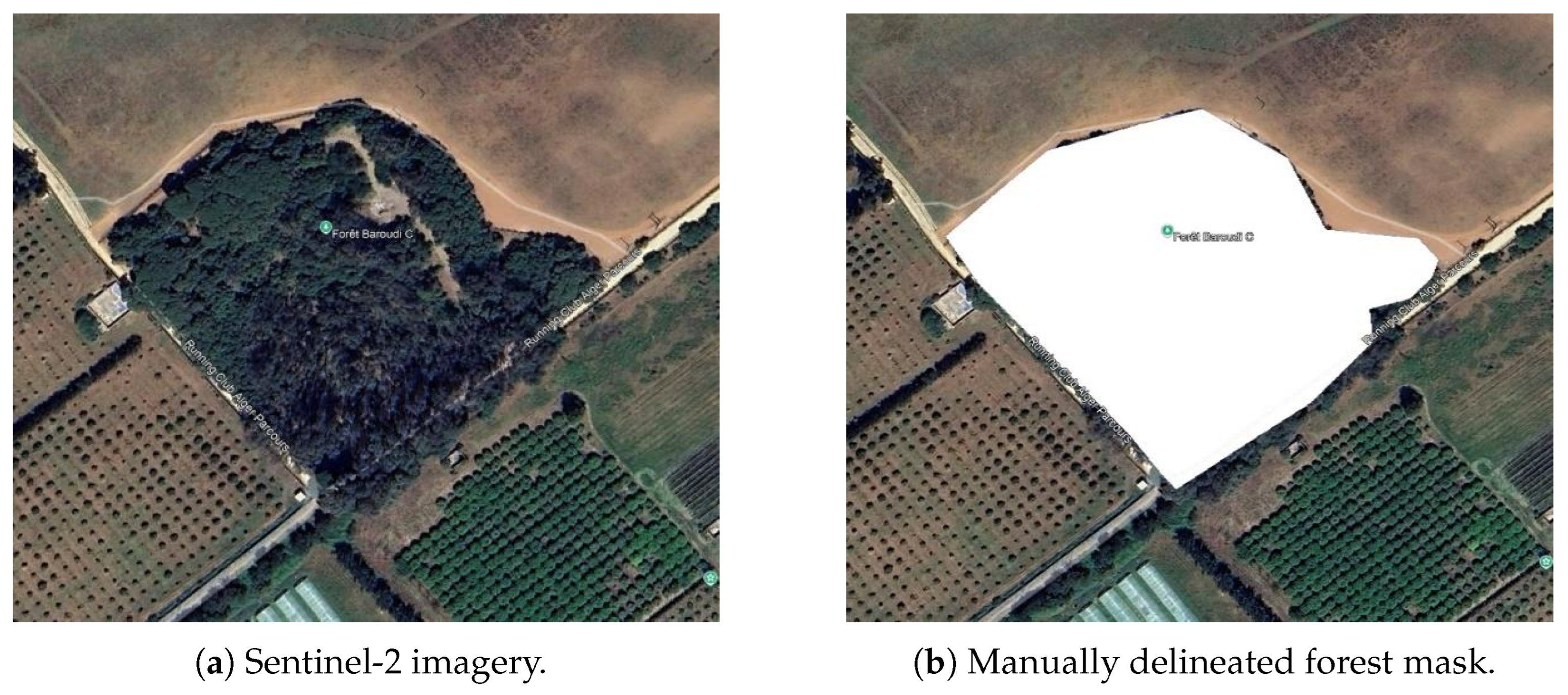
To address the noisy labels in the ESA WorldCover v100 dataset, we manually selected and extracted 22 forest regions using high-resolution imagery from Google Earth Pro (Version 7.3.6) [
14] (
Figure 1). Temporal consistency between datasets was verified by cross-referencing acquisition dates with Sentinel-2 sensing dates. These manually curated regions provided high-quality ground truth data for training and validation.
2.1.3. Patch Creation and Dataset Preparation
For both the ESA WorldCover and manually extracted datasets, we generated pixel patches to ensure uniform input data for model training and evaluation. We implemented a strategic sampling strategy where each batch comprised samples from the clean, manually annotated dataset and from the noisy ESA WorldCover dataset, effectively prioritizing high-quality data. For reproducibility, patch extraction used stride 256 (no overlap), and the current dataset indexed 33 clean image–mask pairs and 252 ESA image–mask pairs.
We applied dataset-specific augmentation strategies: aggressive augmentation (flips, rotations, zoom, brightness/contrast adjustments, hue shifts, and Gaussian noise) for the clean dataset to increase its effective size, and conservative augmentation (flips, rotations, and zoom only) for the noisy ESA WorldCover dataset to avoid exacerbating existing noise. This differentiated strategy helped the model learn robust features from clean data while avoiding overfitting to noisy patterns. Before training, invalid patches (non-finite values or degenerate inputs) were filtered, and ESA empty-mask prevalence was capped to avoid degenerate supervision.
2.2. Model Architecture
2.2.1. Baseline Model
As a baseline, we implemented a standard U-Net architecture [
17] with an EfficientNetB0 [
18] backbone for pixel-wise forest classification, accepting 9-channel input (6 Sentinel-2 spectral bands plus NDVI, EVI, and SAVI) as
pixel patches.
2.2.2. DeepLabV3+ Architecture
Our segmentation model builds upon DeepLabV3+ [
8], adapted to accept nine-channel input (six Sentinel-2 spectral bands plus NDVI, EVI, and SAVI). A custom Spectral Projection layer processes the six spectral bands and three vegetation indices separately using distinct convolutional layers with batch normalization and ReLU activation. The outputs are concatenated and projected via a
convolution to a unified 32-channel feature space, allowing the network to learn a weighted combination of spectral and index information for the DeepLabV3+ encoder–decoder structure.
2.3. Loss Functions and Optimization
We employed a custom composite loss function to address class imbalance and label noise. The loss combines Dice Loss [
9], which optimizes spatial overlap between predictions and ground truth (weighted with
and
to prioritize false-negative reduction), and Categorical Focal Cross-Entropy [
9], which emphasizes difficult boundary pixels using a focusing parameter
and class weights
to prioritize the forest class. This base loss function (
) balances pixel-wise accuracy with structural coherence while handling class imbalance.
To manage label noise in the ESA WorldCover dataset, we implemented the Deep Abstaining Classifier (DAC) Loss [
10], which enables the model to abstain from classifying highly uncertain pixels:
where
is the custom focal Dice Loss,
is the abstention probability,
is a dynamically adjusted penalty parameter,
is the uncertainty margin, and
is a fixed coefficient. This formulation guides the model to focus on reliable patterns while avoiding overfitting to noisy labels.
Training Configuration
All experiments followed a deterministic protocol, using a fixed random seed (seed = 42) with fold-specific offsets for spatial cross-validation. Optimization used AdamW with learning_rate = , weight_decay = , and clipnorm = 1.0. We used a batch size of 4 for training and 16 for validation and trained for up to 90 epochs with staged DAC warm-up controlled by learn_epochs. Model selection was based on validation IoU.
To ensure stable convergence and reproducibility, we used a fixed callback policy across experiments: TerminateOnNaN, ReduceLROnPlateau (factor 0.5, patience 7, minimum learning rate ), EarlyStopping (patience 18, minimum delta , restore best weights), ModelCheckpoint (best validation IoU), CSVLogger, and TensorBoard epoch logging.
To control clean/noisy supervision balance, the mixed training dataset used weighted sampling between ESA and clean streams. We report controlled ratio-sensitivity experiments and targeted searches around the best-performing region (notably clean weights 0.85 and 0.90) in the results.
The final best-performing DAC setting used a 90/10 clean–noisy mix (clean_ weight = 0.90), learn_epochs = 12, dac_alpha_final = 0.5, dac_alpha_init_factor = 256, and dac_ewma_mu = 0.1.
3. Results and Discussion
3.1. Quantitative Performance Metrics
Table 1 presents the comparative performance metrics between our DeepLabV3+ model and the baseline U-Net model on the validation dataset.
As shown in
Table 1, our DeepLabV3+ model outperforms the baseline on accuracy, Dice, IoU, and recall, with the largest gain in overlap quality (IoU
percentage points). The model maintains high recall (
) with only a small precision trade-off (
percentage points), which is favorable for forest mapping where missing forest pixels is particularly costly. These improvements—despite training predominantly on noisy ESA WorldCover labels—underscore the robustness of our loss design and mixed-supervision strategy.
3.2. Loss Robustness Comparison (CE, SCE, and DAC)
To directly address robustness to noisy supervision, we summarize representative loss-controlled results in
Table 2. CE is reported from a matched control experiment, while SCE and DAC are compared under the same 90/10 clean–noisy setting and learning schedule (learn_epochs = 12).
The results show a clear progression from CE to noise-robust alternatives. SCE substantially improves over CE, and the best DAC configuration further improves over SCE under matched 90/10 conditions, supporting DAC as the selected loss in the final pipeline.
3.3. Channel Ablation (Six Bands vs. Nine Channels)
We ran a controlled channel ablation under the same DAC setting (clean_weight = 0.85, learn_epochs = 12) to test whether adding NDVI/EVI/SAVI changes behavior. Results are summarized in
Table 3.
Although the controlled ablation showed mixed behavior under a constrained setup, the six-channel configuration did not reach the performance of the best nine-channel model selected in the final pipeline. We therefore retain the nine-channel configuration as the main setting for the reported final model.
3.4. Clean–Noisy Ratio Sensitivity
To test whether the clean:noisy mix is arbitrary, we analyzed a ratio sweep over clean weights
, and
using the same training pipeline.
Table 4 reports mean IoU for the curated clean slice and unseen ESA weak-label slice.
The sweep is non-monotonic and identifies a stable optimum region around a clean weight of 0.85–0.90. This replaces the previous fixed-ratio justification with evidence-driven selection.
3.5. Spatial Cross-Validation
Beyond single holdout, we executed a five-fold region-aware spatial cross-validation. Aggregate fold metrics are shown in
Table 5.
Fold diagnostics show large ecological imbalance (two validation folds with very low forest prevalence, about 1.2–1.4% positive pixels), which explains the higher variance and conservative mean. We therefore report spatial CV means with variance explicitly, rather than over-claiming uniform cross-region performance.
3.6. Qualitative Visual Assessment
Visual inspection reveals substantial qualitative differences demonstrating the practical advantages of our approach.
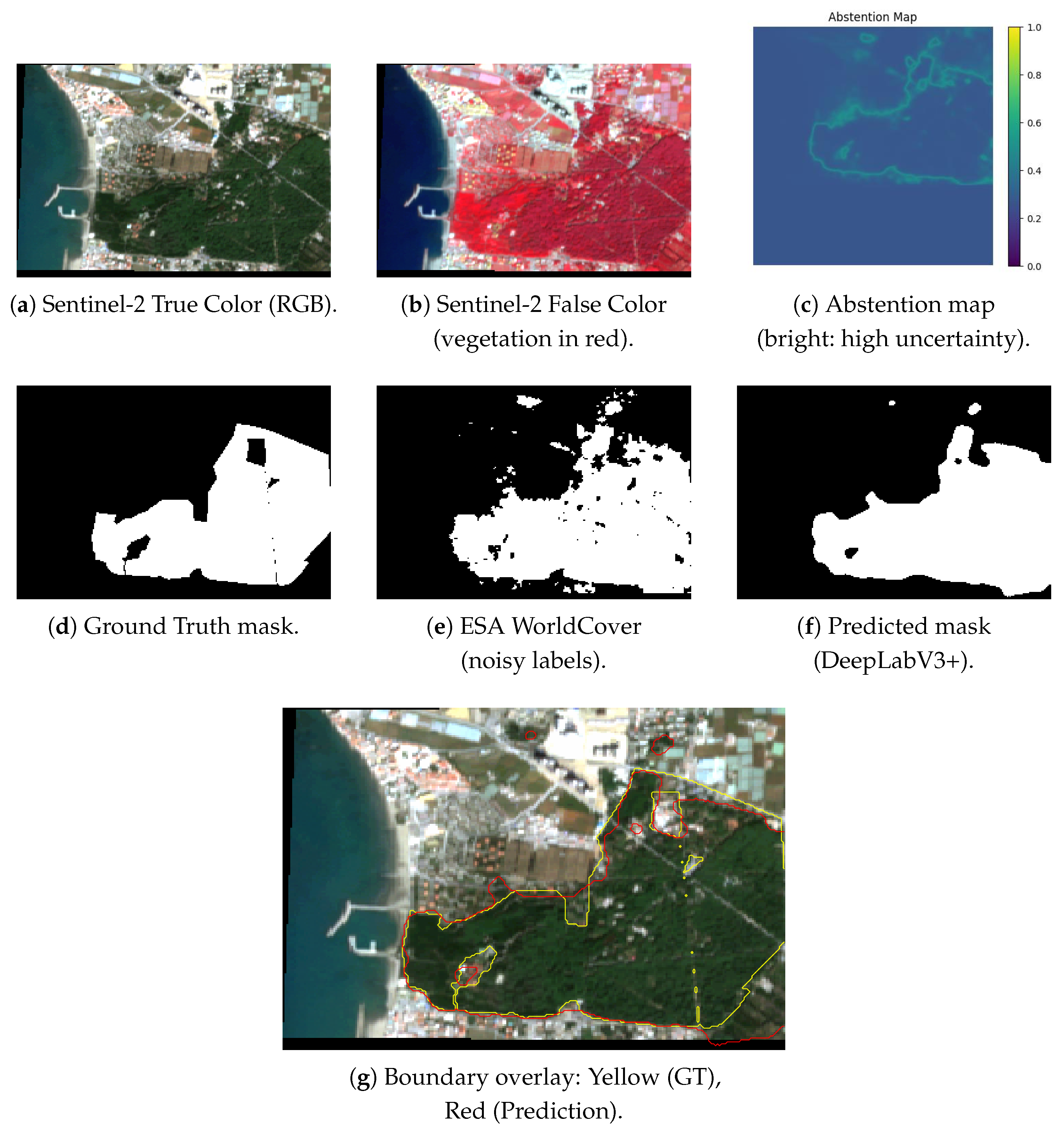
Figure 2 presents input data, segmentation results, and boundary comparisons for a validation sample from an Algerian forest region.
The most striking visual difference is spatial coherence. Our DeepLabV3+ model successfully learned to ignore the noise in ESA WorldCover labels (
Figure 2e) and produce consolidated forest predictions (
Figure 2f) that closely match the clean ground truth (
Figure 2d). The ESA baseline exhibits substantial salt-and-pepper noise and over-segmentation artifacts. In contrast, our model generates predictions with natural continuity reflecting actual forest formations. The boundary overlay (
Figure 2g) shows remarkable alignment between ground truth and predicted contours.
3.7. Abstention Analysis
The abstention map (
Figure 2c) reveals a concentration of high abstention values along forest–non-forest boundaries, consistent with expected DAC behavior as boundaries present inherent ambiguity. Quantitative analysis revealed an average abstention probability of
across all pixels, with approximately
of pixels identified as highly uncertain. A moderate correlation (
) between pixel-level abstention and prediction errors indicates the model tends to abstain more frequently in areas where it is more likely to make mistakes. While no pixels exceeded the
abstention threshold at convergence, the abstention mechanism effectively functions as a training regularizer, guiding the model to focus on reliable patterns.
3.8. Practical Implications
The visual coherence and reduced noise artifacts in our predictions have significant practical implications for forest management and conservation in Algeria. The consolidated forest maps provide clearer delineation of forest boundaries, facilitating more accurate assessment of forest coverage, fragmentation patterns, and conservation priorities. The model’s robustness to label noise suggests improved transferability to new regions where ground truth data may be scarce or imperfect—particularly valuable in the Algerian context where comprehensive, high-quality forest mapping datasets have historically been limited.
4. Conclusions
This study demonstrates a robust AI-powered framework for forest mapping in Algeria by integrating Sentinel-2 imagery and vegetation-aware inputs with noise-robust training. Using high-quality manual annotations for evaluation and ESA WorldCover for weak supervision, the DeepLabV3+ model achieves strong performance with Dice, IoU, accuracy, and recall.
The experiments further strengthen the methodology claims. First, the selected DAC configuration remains superior to CE and SCE under matched settings, supporting DAC as the final robust-loss choice. Second, clean/noisy ratio sensitivity shows a non-monotonic trend and an evidence-based optimum region around a clean weight of 0.85–0.90. Third, channel ablation under matched conditions shows that although a constrained six-channel run can be competitive, it does not match the best nine-channel final model selected in the full pipeline.
Spatially coherent delineation and reduced noise artifacts are observed relative to ESA labels and baseline predictions. Spatial five-fold cross-validation reports explicit cross-region variability (IoU ), providing a conservative estimate of generalization in heterogeneous ecological conditions. Future work should explore: (1) larger manually labeled regional coverage, (2) additional boundary-aware objectives, (3) multi-class extension, and (4) transfer testing in other regions with similar label-noise constraints.
This framework, developed in collaboration with the Algerian Space Agency (ASAL) and benefiting from their expert supervision, paves the way for broader operational deployment and represents a significant step toward improved forest management, biodiversity preservation, and climate change mitigation efforts in Algeria and similar regions facing data quality challenges.
Author Contributions
Conceptualization, M.B., M.M.K., M.A.Z., M.I. and M.E.A.L.; methodology, M.B. and M.M.K.; validation, M.B., M.M.K., M.A.Z., M.I. and M.E.A.L.; investigation, M.B., M.M.K. and M.A.Z.; resources, M.B., M.M.K., M.A.Z., M.I. and M.E.A.L.; data curation, M.A.Z.; writing—original draft preparation, M.B., M.M.K. and M.A.Z.; writing—review and editing, M.B., M.M.K., M.A.Z., M.I. and M.E.A.L.; visualization, M.M.K. and M.A.Z.; supervision, M.M.K., M.I. and M.E.A.L.; project administration, M.M.K. and M.I. All authors have read and agreed to the published version of the manuscript.
Funding
This research received no external funding.
Institutional Review Board Statement
Not applicable.
Informed Consent Statement
Not applicable.
Data Availability Statement
The data presented in this study are available on request from the corresponding author. The data are not publicly available due to ongoing research.
Acknowledgments
The authors would like to acknowledge the ESA WorldCover project for providing the global land cover dataset and the European Space Agency for the Sentinel-2 satellite imagery. We express our deepest gratitude to the Algerian Space Agency (ASAL) for their essential technical support and for providing the expert supervision that guided this research. We also thank the National Higher School of Artificial Intelligence (ENSIA) for its institutional support.
Conflicts of Interest
The authors declare no conflicts of interest.
Abbreviations
The following abbreviations are used in this manuscript:
| AI | Artificial Intelligence |
| ASAL | Algerian Space Agency |
| ASPP | Atrous Spatial Pyramid Pooling |
| CNN | Convolutional Neural Network |
| DAC | Deep Abstaining Classifier |
| ESA | European Space Agency |
| EVI | Enhanced Vegetation Index |
| IoU | Intersection over Union |
| NDVI | Normalized Difference Vegetation Index |
| NIR | Near-Infrared |
| SAVI | Soil-Adjusted Vegetation Index |
| SWIR | Short-Wave Infrared |
References
- Zanaga, D.; Van De Kerchove, R.; De Keersmaecker, W.; Souverijns, N.; Brockmann, C.; Quast, R.; Wevers, J.; Grosu, A.; Paccini, A.; Vergnaud, S.; et al. ESA WorldCover 10 m 2020 v100; Zenodo: Geneve, Switzerland, 2021. [Google Scholar] [CrossRef]
- Iftene, M.; Larabi, M.E.A. Robust Deep Learning for Cereal Crop Classification with Noisy Training Labels. In Proceedings of the IEEE International Geoscience and Remote Sensing Symposium (IGARSS); IEEE: New York, NY, USA, 2025; pp. 7322–7327. [Google Scholar] [CrossRef]
- Larabi, M.E.A.; Iftene, M. Self-Correcting Inference for Land Cover Mapping via Test-Time Domain Adaptation. In Proceedings of the IEEE International Geoscience and Remote Sensing Symposium (IGARSS); IEEE: New York, NY, USA, 2025; pp. 7380–7384. [Google Scholar] [CrossRef]
- Larabi, M.E.A.; Iftene, M.; Alikara, O. Uncertainty-Guided Continuous Adaptation of Deep Learning in Dynamic Remote Sensing Environments. In Proceedings of the IEEE International Geoscience and Remote Sensing Symposium (IGARSS); IEEE: New York, NY, USA, 2025; pp. 468–472. [Google Scholar] [CrossRef]
- European Space Agency. Sentinel-2 Mission. ESA Earth Online. Available online: https://earth.esa.int/eogateway/missions/sentinel-2 (accessed on 15 November 2024).
- Long, J.; Shelhamer, E.; Darrell, T. Fully Convolutional Networks for Semantic Segmentation. In Proceedings of the IEEE Conference on Computer Vision and Pattern Recognition (CVPR); IEEE: New York, NY, USA, 2015; pp. 3431–3440. [Google Scholar]
- Zhang, L.; Zhang, L.; Du, B. Deep Learning for Remote Sensing Data: A Technical Tutorial on the State of the Art. IEEE Geosci. Remote Sens. Mag. 2016, 4, 22–40. [Google Scholar] [CrossRef]
- Chen, L.C.; Zhu, Y.; Papandreou, G.; Schroff, F.; Adam, H. Encoder-Decoder with Atrous Separable Convolution for Semantic Image Segmentation. In Proceedings of the European Conference on Computer Vision (ECCV); Springer: Berlin/Heidelberg, Germany, 2018; pp. 801–818. [Google Scholar]
- Lin, T.Y.; Goyal, P.; Girshick, R.; He, K.; Dollár, P. Focal Loss for Dense Object Detection. In Proceedings of the IEEE International Conference on Computer Vision (ICCV); IEEE: New York, NY, USA, 2017; pp. 2980–2988. [Google Scholar]
- Thulasidasan, S.; Bhattacharya, T.; Bilmes, J.; Chennupati, G.; Mohd-Yusof, J. Combating Label Noise in Deep Learning Using Abstention. arXiv 2019, arXiv:1905.10964. [Google Scholar] [CrossRef]
- Lu, X.; Jiang, Z.; Zhang, H. Weakly Supervised Remote Sensing Image Semantic Segmentation with Pseudo-Label Noise Suppression. IEEE Trans. Geosci. Remote Sens. 2024, 62, 5406912. [Google Scholar] [CrossRef]
- Wang, J.; Ding, C.H.Q.; Chen, S.; He, C.; Luo, B. Semi-Supervised Remote Sensing Image Semantic Segmentation via Consistency Regularization and Average Update of Pseudo-Label. Remote Sens. 2020, 12, 3603. [Google Scholar] [CrossRef]
- Liu, C.; Yao, J.; Zhang, J.; Qi, J.; Shi, M.; Duan, X.; Lu, X. Task-Specific Pretraining with Noisy Labels for Remote Sensing Image Segmentation. arXiv 2024, arXiv:2402.16164. [Google Scholar]
- Google LLC. Google Earth Pro, Version 7.3.6; Mountain View, CA, USA, 2024. Available online: https://earth.google.com/ (accessed on 1 November 2024).
- Van De Kerchove, R.; Zanaga, D.; De Keersmaecker, W.; Li, L.; Tsendbazar, N.-E.; Lesiv, M. Product User Manual: ESA WorldCover 10 m 2020 v100 (Version 1.0). European Space Agency: Paris, France, 2021. Available online: https://esa-worldcover.s3.amazonaws.com/v100/2020/docs/WorldCover_PUM_V1.0.pdf (accessed on 3 March 2026).
- Copernicus Sentinel-2 Mission Performance Centre. S2 Products (Processing Levels and L2A Product Description). SentiWiki. Available online: https://sentiwiki.copernicus.eu/web/s2-products (accessed on 3 March 2026).
- Ronneberger, O.; Fischer, P.; Brox, T. U-Net: Convolutional Networks for Biomedical Image Segmentation. In Proceedings of the Medical Image Computing and Computer-Assisted Intervention (MICCAI); Springer: Berlin/Heidelberg, Germany, 2015; pp. 234–241. [Google Scholar]
- Tan, M.; Le, Q.V. EfficientNet: Rethinking Model Scaling for Convolutional Neural Networks. In Proceedings of the 36th International Conference on Machine Learning (ICML); ICML: Broken Arrow, OK, USA, 2019; pp. 6105–6114. [Google Scholar]
| Disclaimer/Publisher’s Note: The statements, opinions and data contained in all publications are solely those of the individual author(s) and contributor(s) and not of MDPI and/or the editor(s). MDPI and/or the editor(s) disclaim responsibility for any injury to people or property resulting from any ideas, methods, instructions or products referred to in the content. |



 ,
,