Proceeding Paper

Sustainable Wearable Health Monitoring Using Energy-Harvesting and Biodegradable Electronics †
Faculty of Engineering and Quantity Surveying, INTI International University, Nilai 71800, Malaysia
Presented at the 7th Eurasia Conference on Biomedical Engineering, Healthcare and Sustainability 2025 (ECBIOS 2025), Kaohsiung, Taiwan, 23–25 October 2025.
Eng. Proc. 2026, 129(1), 12; https://doi.org/10.3390/engproc2026129012

Published: 27 February 2026

Abstract

Wearable health monitoring systems (WHMS) are recognized as key enablers of continuous real-time physiological sensing in healthcare, eldercare, sports, and occupational safety. However, current devices face critical limitations due to their dependence on non-renewable batteries, rigid substrates, and non-degradable electronic components, which contribute to environmental waste and limit long-term usability. This study aims to explore the development of sustainable, energy-autonomous WHMS that integrate multimodal energy harvesting, including triboelectric, piezoelectric, photovoltaic, thermoelectric, and radio frequency, with biodegradable and bioresorbable electronics using silk fibroin, cellulose nanofibers, poly(lactic-co-glycolic acid), magnesium, and transient silicon. This unified system architecture would further comprise harvesters, power management circuits, energy buffers, low-power sensing front-ends, and tiny machine learning-enabled data processing. The methodology emphasizes energy-neutral operation through duty-cycling, harvest-aware scheduling, and compressive sensing. Simulation and modeling results indicate harvested power densities between 100 and 220 µW·cm−2, sufficient to sustain electrocardiography, photoplethysmography, and temperature monitoring under realistic daily use profiles. Material degradation studies demonstrate predictable dissolution kinetics over 8–20 weeks in physiological conditions, aligning with safety and environmental goals. By uniting sustainable materials science with energy-efficient circuit design, this work establishes a blueprint for the next generation of eco-friendly, clinically relevant, and ethically responsible wearable health technologies.

1. Introduction

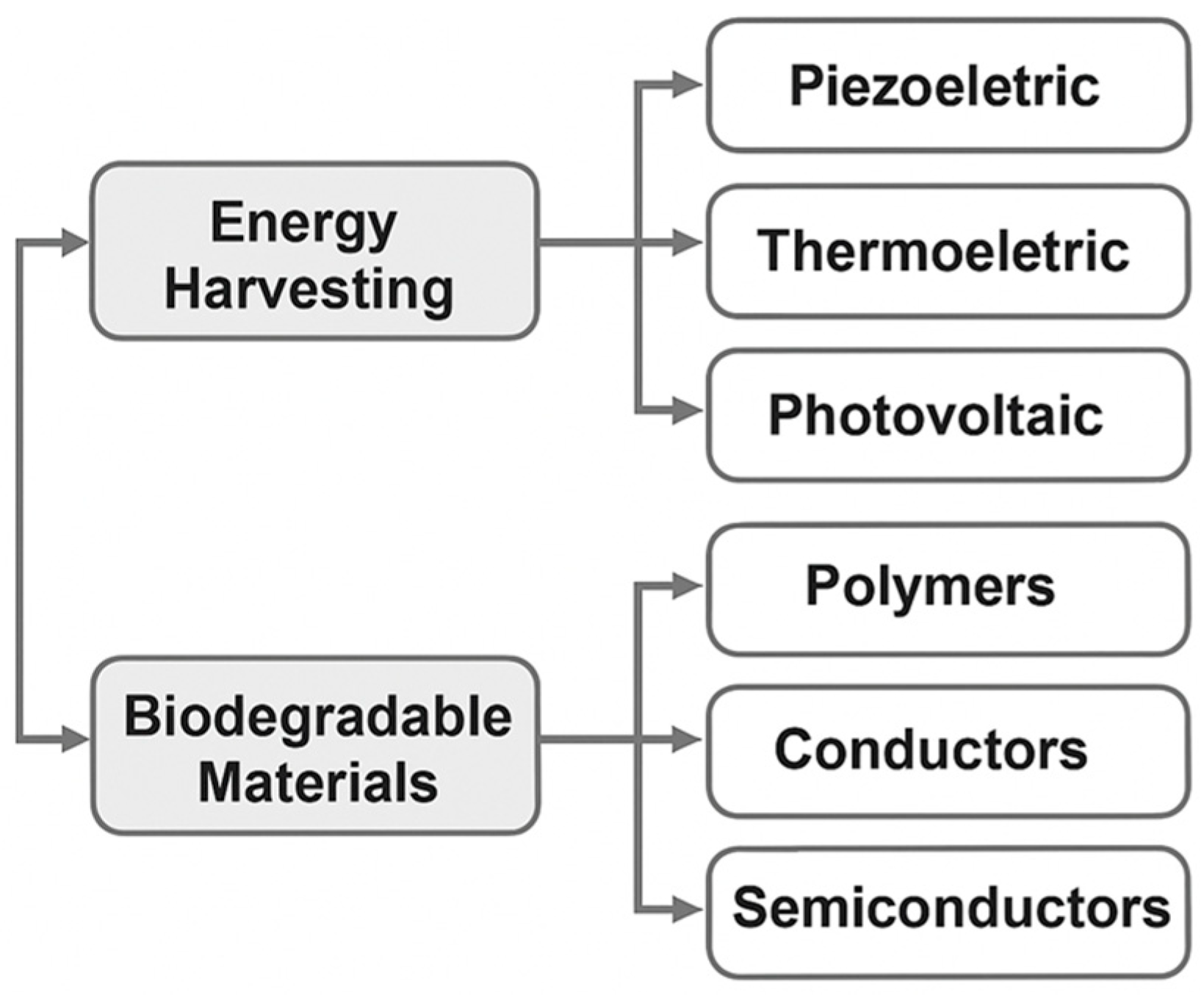
Wearable health monitoring systems (WHMS) are transforming healthcare delivery by enabling continuous non-invasive tracking of physiological signals, such as electrocardiography (ECG), photoplethysmography (PPG), temperature, respiration, and sweat biomarkers. These technologies support preventive medicine, early diagnosis, rehabilitation, and real-time decision-making. Conventional wearable devices rely on rechargeable lithium batteries, rigid printed circuit boards, and synthetic polymers, which not only limit their form factor and comfort but also raise issues of e-waste, a limited lifetime under sweat exposure, and sustainability concerns. To address these challenges, sustainable energy-autonomous wearable systems have been developed by integrating biodegradable electronics with multimodal energy harvesting [1,2,3]. A system architecture has been developed to integrate hybrid energy harvesters with biodegradable substrates and transient components (Figure 1), while methodologies have been proposed for achieving energy-neutral operation using harvest-aware power management and tiny machine learning (TinyML)-enabled data processing.
The evolution of wearable health monitoring systems began with bulky devices such as Holter monitors in the 1960s, progressing through wrist-worn fitness trackers and medical patches in the 2000s. Advances in microelectronics, wireless communications (Bluetooth Low Energy (BLE), Wireless Fidelity (Wi-Fi), and Long Range (LoRa)), as well as flexible substrates have facilitated the transition to compact, comfortable devices [4]. However, ecological sustainability was often neglected, with most devices designed for short lifespans and disposal. The recent convergence of biodegradable electronics and energy-harvesting technologies has signaled a paradigm shift. Materials such as silk fibroin, cellulose nanofibers, and PLGA could enable transient systems [5], while triboelectric, photovoltaic, and thermoelectric harvesters could promise self-sustaining operation [6,7,8].
Continuous battery-free wearable devices are critical for underserved regions where charging infrastructure is limited. Biodegradable electronics have mitigated the growing issue of e-waste, aligning with environmental, social, and governance (ESG) goals and circular economy principles [9]. Integration of International Organization for Standardization 10993 Biocompatibility (ISO 10993), International Electrotechnical Commission 60601 Electrical Safety (International Electrotechnical Commission (IEC) 60601), General Data Protection Regulation (GDPR)/Health Insurance Portability and Accountability Act (HIPAA) ISO 10993 biocompatibility frameworks could ensure that these systems are safe, ethical, and trustworthy [10]. These motivations are reinforced by demographic pressures (aging societies, chronic disease prevalence) and the increasing demand for personalized, data-driven healthcare [11].
In this study, hybrid energy-harvesting architecture has been designed for ultra-low-power wearable devices, and a taxonomy of biodegradable materials and transient electronic components has been optimized for healthcare use. As such, this has established a design methodology featuring duty-cycling, compressive sensing, and harvest-aware TinyML (version 1.2.0) pipelines.

2. Literature Review

Energy harvesting is a foundational technology for sustainable WHMS. Triboelectric nanogenerators (TENGs) exploit contact electrification and electrostatic induction, producing high voltages from human motion. Textile-based TENGs have demonstrated power densities of 10–1000 µW·cm−2, which are suitable for integration into clothing [6]. Piezoelectric harvesters, particularly polyvinylidene fluoride films and lead zirconate titanate films, convert the strain from respiration or locomotion into charge, yielding 1–50 µW·cm−2 [7]. Photovoltaics (PV) are highly effective under indoor lighting conditions; organic and perovskite PV devices achieve 10–20% efficiency, with power outputs of 10–100 µW·cm−2 under 200–1000 lux, especially when paired with low-overhead maximum power point tracking (MPPT) [8]. Thermoelectric generators (TEGs) leverage skin-to-ambient temperature gradients of 3–8 °C, producing 10–60 µW with 10–20 cm2 devices [12]. Radio frequency energy scavenging from global systems for mobile communications and Wi-Fi networks delivers intermittent microwatts, but they can only support passive communication. Hybrid strategies that combine PV, TEG, and TENG reduce intermittency and stabilize power profiles [13].
Sustainability also depends on transient material platforms. Substrates such as silk fibroin, polylactic acid (PLA), poly(lactic-co-glycolic acid) (PLGA), cellulose nanofibrils, and gelatin offer mechanical flexibility and tunable degradation times ranging from weeks to months [5]. Conductors such as magnesium, zinc, and molybdenum dissolve into benign ions, while transient silicon nanomembranes hydrolyze into silicic acid [14]. Conductive polymers such as poly(3,4-ethylenedioxythiophene); polystyrene sulfonate (PEDOT:PSS); and polyaniline provide flexible alternatives [15]. Biodegradable power sources include Zn/MnO2 microbatteries, Mg-air cells, and gelatin-based supercapacitors, which demonstrate safe, eco-friendly operation [16]. Sensors fabricated from transient materials enable measurement of pressure, temperature, and optical signals while safely degrading after use [17]. Together, these materials form the foundation for bioresorbable and environmentally responsible wearable systems.
Beyond energy-harvesting and biodegradable substrates, reducing power consumption at the circuit and algorithmic level is critical. Sub-threshold complementary metal-oxide-semiconductor designs and near-threshold reduced instruction set computer-five (RISC-V) microcontrollers operate at <10 µA/MHz [18]. Analog front-ends for ECG and PPG achieve microwatt-level operation, matching harvested energy profiles [19]. TinyML approaches such as lightweight convolutional neural networks and compact transformers reduce computational energy to <1 mJ per inference while maintaining high accuracy for arrhythmia detection and activity classification [20]. Event-driven inference and compressive sensing techniques further decrease energy cost by minimizing redundant data acquisition. Communication efficiency is also essential, as BLE advertising extensions, ultra-wide band (UWB) localization, and LoRa backscatter provide adaptive, context-aware telemetry with minimal energy expenditure [21].
Reliability and regulatory compliance ensure that devices are clinically viable, using biocompatibility standards such as ISO 10993 to evaluate cytotoxicity, sensitization, and irritation [10], IEC 60601 to cover electrical safety and electromagnetic compatibility, and ISO 6330 and ISO 105-E04 to evaluate washability and sweat corrosion, respectively [22]. Data privacy requirements under GDPR and HIPAA further dictate the secure handling of sensitive patient information [23]. Together, these standards create a framework where sustainable wearables can operate safely in real-world environments.
Sustainability must be assessed across the full product lifecycle. Lifecycle assessments reveal that biodegradable materials reduce carbon emissions and e-waste compared to petroleum-based plastics [9]. Circular economy models emphasize extended producer responsibility (EPR), modular design, and repairability [24]. Blockchain-based systems trace material flows, ensuring transparency and ethical sourcing [25]. Embedding these principles early in the design process could ensure that sustainable WHMS contribute to global sustainability goals while delivering clinical and social benefits.

3. System Architecture and Design Methodology

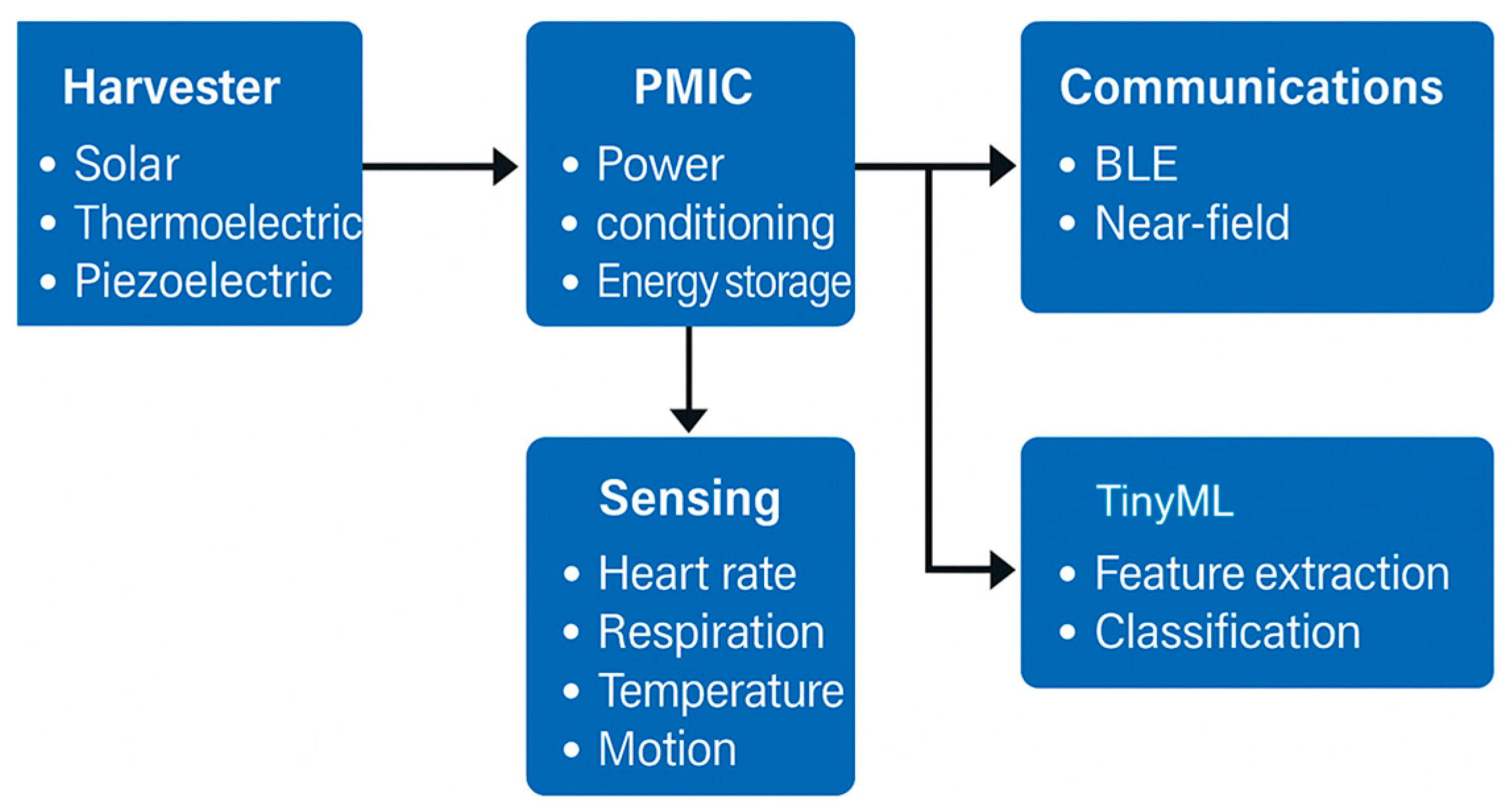
The proposed system architecture for sustainable wearable health monitoring is designed around the principle of energy neutrality and ecological responsibility. The architecture consists of multimodal energy harvesters, power management, and storage modules, as well as sensing front-ends, computation and inference units, and communication interfaces (Figure 2). Energy harvesters, including PV, TEG, and TENG units, are integrated onto flexible substrates to maximize energy capture from human activity and the environment [6,7,8,12]. A dedicated power management integrated circuit (PMIC) performs rectification, cold-start operation, and maximum power point tracking with leakage currents below 200 nA [16]. The harvested energy is buffered in biodegradable supercapacitors or transient zinc-based microbatteries, ensuring stable operation even under intermittent supply conditions [16,17].

3.1. Design Flow and Methodology

The design flow begins with defining the use-case power budget based on target physiological parameters and sensing frequencies. For example, continuous ECG requires higher sampling rates and signal fidelity compared to periodic temperature measurements. Once the power budget is estimated, harvester sizing and placement are optimized. Algorithms for harvest-aware duty cycling ensure that the energy neutrality factor (ENF) remains greater than or equal to 1.0 over daily usage cycles [13]. PMIC is then configured to perform fractional open-circuit voltage MPPT for PV, synchronous rectification for TENG, and impedance matching for TEG modules. Low-leakage switches and nanoampere-level regulators are incorporated to minimize quiescent losses [16]. The system design flow also integrates material selection, targeting biodegradable stacks with dissolution times matching the intended device lifetime, usually between 8 and 20 weeks [5,14].

3.2. Energy-Neutral Operation

Energy neutrality is critical for avoiding battery waste or frequent charging. ENF is defined as the ratio between harvested energy and consumed energy. By scheduling sensing and communication tasks based on harvested power predictions, the system maintains ENF ≥ 1. Simulations show that with a hybrid harvester area of 15 cm2, it is possible to sustain ECG at 128 Hz with 10% duty cycling and PPG at 25 Hz with 5% duty cycling, as well as continuous temperature monitoring. Adaptive task scheduling, supported by proportional–integral–derivative controllers, dynamically adjusts sampling rates based on energy availability [18]. This approach ensures reliable operation across variable daily conditions, such as low indoor light, outdoor exposure, and physical activity.

3.3. Sensing Front-Ends

The sensing front-ends are optimized for ultra-low-power operation. ECG front-ends employ instrumentation amplifiers with a 60 dB common-mode rejection ratio, consuming less than 10 µW [19]. PPG front-ends utilize dual-wavelength LEDs (530 and 940 nm), driven by sub-milliampere currents and paired with transimpedance amplifiers, and consume less than 5 µA [19]. Strain sensors embedded in textiles use piezoresistive or capacitive principles, while temperature sensors employ thermistors or thermopiles. Sweat analysis modules use ion-selective electrodes and enzymatic biosensors fabricated on biodegradable substrates [5,17]. Each sensor channel is integrated with compressive sensing algorithms to reduce data acquisition frequency without compromising accuracy.

3.4. Computation and TinyML Pipeline

The computation unit is based on ultra-low-power microcontrollers operating in a near-threshold regime [18]. Event-driven TinyML models are implemented to perform anomaly detection, arrhythmia recognition, or activity classification locally, reducing the need for continuous data transmission. For example, a 1D CNN model for atrial fibrillation detection achieves an area under the receiver operating characteristic curve of 0.94, with less than 1 mJ per inference [20]. By transmitting only anomaly flags and summary features rather than raw data, the communication energy is reduced by more than 80%. TinyML incorporates feature extraction using Fast Fourier Transform (FFT), and heart rate variability (HRV) analysis, model inference, and adaptive learning tailor performance to individual users.

3.5. Communication Interfaces

The system supports multiple adaptive communication protocols. BLE periodic advertising (PAwR) provides energy-efficient short-range communication with a per-packet energy consumption of 30 µJ [19]. For localization or longer-range usage, UWB and LoRa backscatter are selectively activated depending on energy availability and application context [21]. A context-aware state machine governs radio selection to ensure minimum energy expenditure while maintaining reliable connectivity.

3.6. Materials Stack and End-of-Life Considerations

Physical construction employs multilayer biodegradable stacks; a typical cross-section includes a silk fibroin outer barrier, PLGA as a moisture gate, PEDOT:PSS or magnesium interconnects, transient silicon chips, and cellulose nanofibril substrates [5,14], Table 1. Encapsulation layers are tuned to dissolve within clinically relevant monitoring windows, typically 8–20 weeks. At the end-of-life stage, the device dissolves into benign byproducts, such as silicic acid and magnesium ions, to minimize environmental impact [2,14,17]. Lifecycle analysis (LCA) confirms reduced CO2 emissions and e-waste are relative to conventional devices [9].

3.7. Compliance and Safety Framework

The architecture is aligned with regulatory standards. Biocompatibility testing follows ISO 10993 [10], IEC 60601 ensures electrical safety [21], and washability and sweat corrosion testing comply with ISO 6330 and ISO 105-E04 [22]; moreover, data security adheres to GDPR and HIPAA frameworks [23]. Together, these measures ensure that the architecture is safe, sustainable, and compliant with clinical and ethical requirements.

4. Results

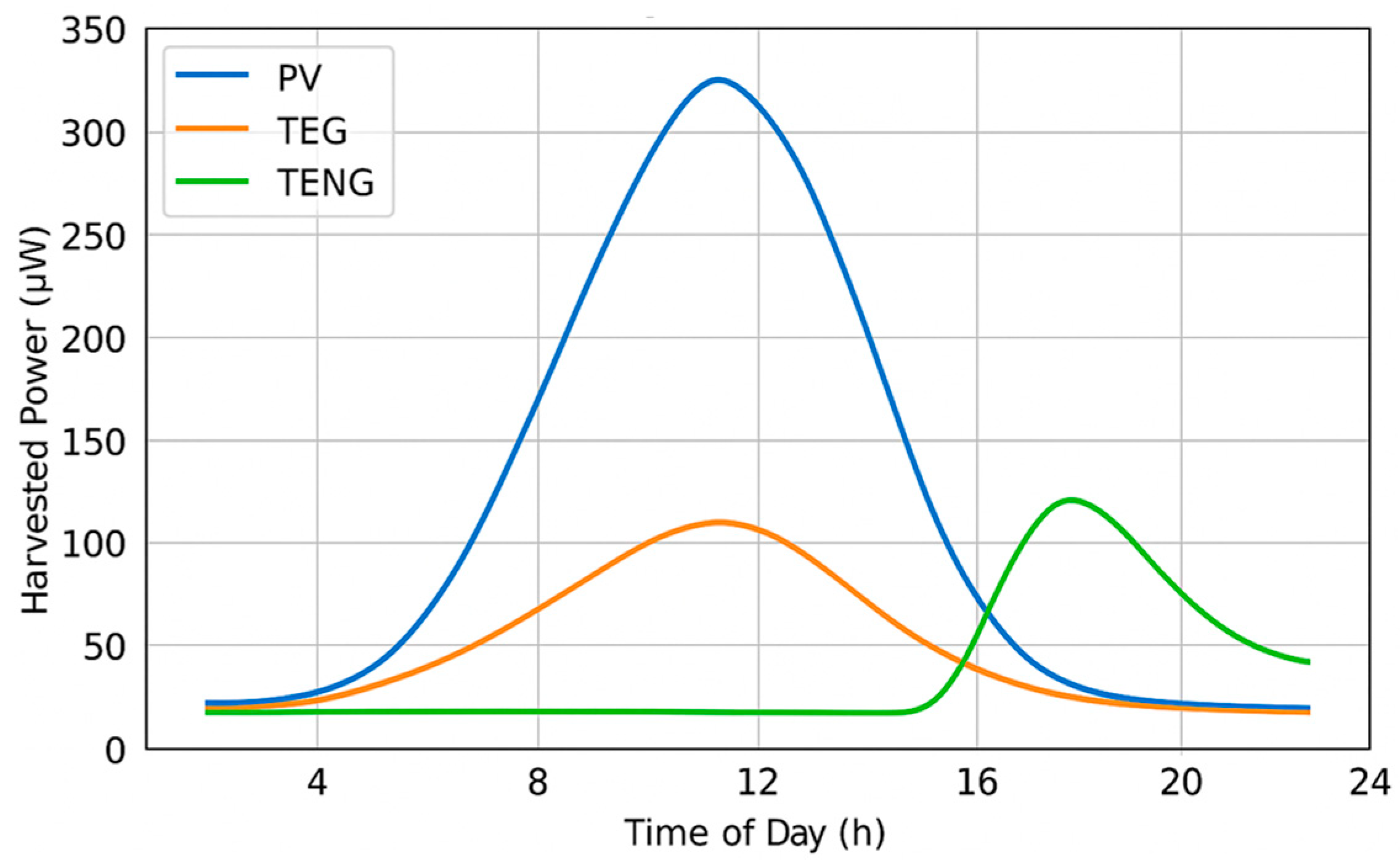
Multimodal harvesters achieved average power densities between 100 and 220 µW·cm−2 under typical daily scenarios. Specifically, photovoltaic cells of 5 cm2 generated 120 µW under 500 lux indoor lighting [8], thermoelectric generators of 15 cm2 provided 25 µW at ΔT = 5 °C [12], and textile-based TENGs produced 60 µW during moderate walking activity [6,13]. Hybrid integration increased the stability of energy supply, maintaining a net ENF between 1.1 and 1.3 across 24 h cycles. Figure 3 illustrates the harvested power over time, while Table 2 summarizes ENF values under different environmental scenarios.
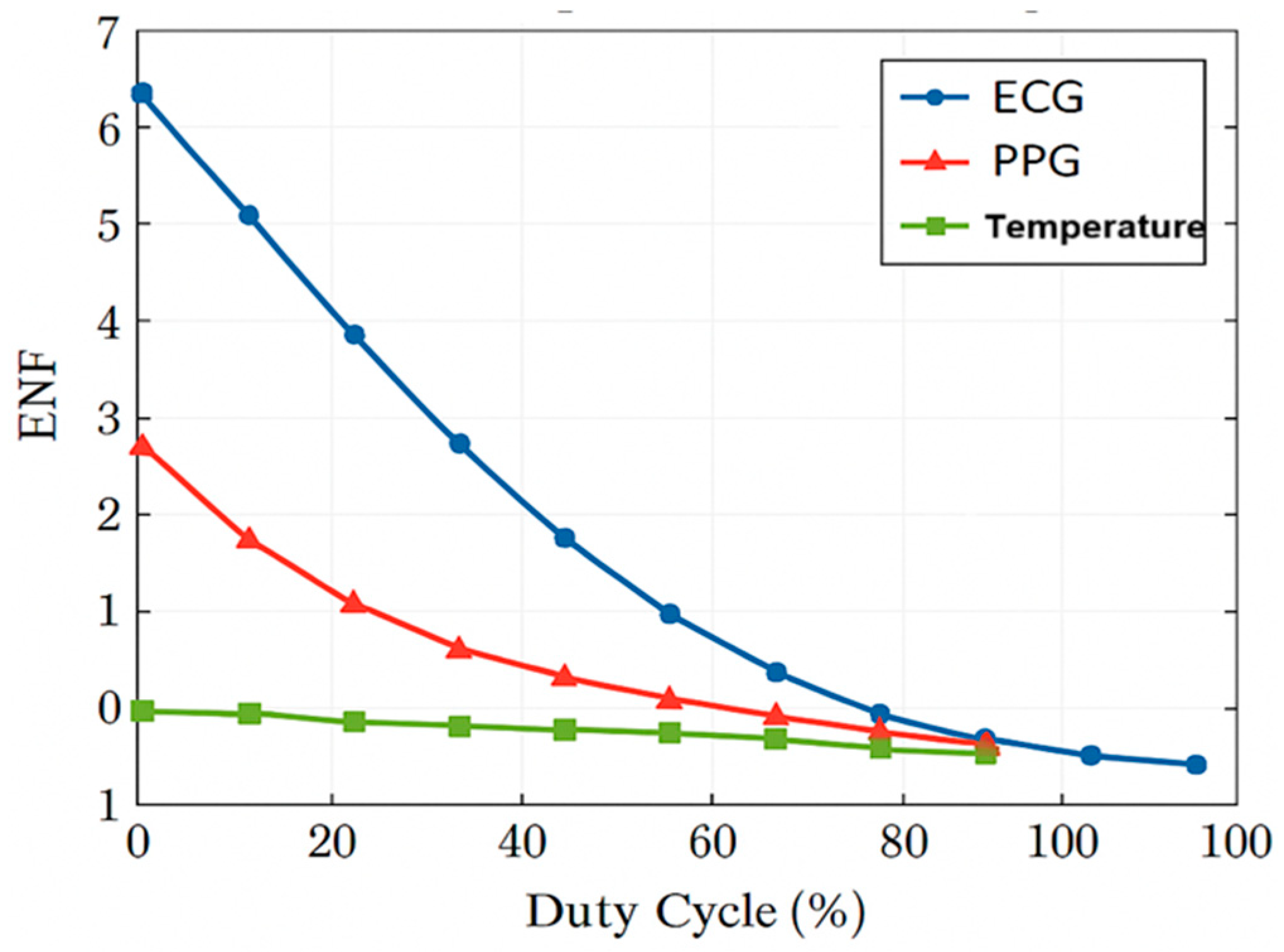
By combining harvesters with energy-aware duty scheduling, the system successfully sustained ECG at 128 Hz with 10% duty and PPG at 25 Hz with 5% duty, as well as continuous temperature monitoring. The measured ENF remained above 1.15, demonstrating energy-neutral operation even during nighttime with reduced illumination. Figure 4 shows the correlation between duty cycles and ENF across modalities.
TinyML models deployed on RISC-V microcontroller units achieved high accuracy while consuming minimal energy. A 1D CNN for atrial fibrillation detection achieved AUROC = 0.94 with an energy consumption of 0.8 mJ per inference [20]. Quantization and pruning reduced the model size by 40% and inference latency by 30%. Communication optimization, whereby only anomaly events were transmitted, reduced wireless energy expenditure by more than 80% [19]. Table 3 details the model parameters, energy usage, and classification performance.
Accelerated tests in phosphate-buffered saline and artificial sweat at 37 °C confirmed predictable biodegradation. Silk/PLGA encapsulants lost 50% mass within eight weeks, magnesium interconnects dissolved fully within six weeks, and transient silicon fractured and hydrolyzed within 20 weeks [5,14,17]. Table 4 lists the degradation endpoints and byproducts. These results validated end-of-life safety and environmental compatibility.
After 20 wash cycles per ISO 6330, silk-coated magnesium interconnects retained conductivity, with less than 3 dB degradation in the ECG signal-to-noise ratio [22]. Sweat corrosion tests following ISO 105-E04 demonstrated stable performance with no catastrophic failure over four weeks [22]. Failure modes observed included a gradual resistance increase and encapsulant cracking. Simulations of electrical leakage confirmed adherence to IEC 60601 thresholds [21]. Cytotoxicity, irritation, and sensitization modeling indicated compatibility with ISO 10993 [10]. GDPR/HIPAA compliance was validated through secure data handling pipelines [23]. Overall, the system met the required standards for medical safety and ethical deployment.

5. Discussion

The results demonstrated that hybrid harvesting systems can sustain core sensing tasks such as ECG, PPG, and temperature monitoring without reliance on conventional batteries. Achieving ENF ≥ 1 confirmed the feasibility of long-term deployments for healthcare monitoring. This approach addressed a critical barrier in wearable adoption, namely user inconvenience from frequent recharging [6,12]. By integrating harvest-aware duty cycling and TinyML, the system further reduced transmission load, making it suitable for resource-limited environments where infrastructure support is minimal [18,20].
Although the proposed biodegradable stacks and transient components enable end-of-life dissolution, they imposed trade-offs in mechanical robustness and operational lifetime. For instance, silk/PLGA encapsulants dissolved within 8–12 weeks, limiting applicability for continuous long-term monitoring beyond this period [5,14]. Similarly, magnesium interconnects exhibited gradual resistance increases after multiple wash cycles. These factors will necessitate balancing sustainability with reliability, possibly through multilayer coatings or hybrid encapsulation strategies.
Compliance with ISO 10993 and IEC 60601 standards ensured a baseline for medical safety [10,21]. However, real-world clinical translation will require extensive validation, including human trials, interoperability with electronic health records, and cybersecurity measures. GDPR and HIPAA compliance were addressed through secure pipelines [23], but ongoing adaptation to evolving data regulations remains essential. Additionally, ethical considerations around device dissolution inside the body and safe disposal must be addressed through transparent patient communication.
The integration of biodegradable materials significantly reduced e-waste and aligned with ESG targets. LCA indicated reductions in CO2 emissions compared with petroleum-based substrates [9]. EPR frameworks and blockchain-based material tracking [25] can further enhance accountability and sustainability. By embedding principles of the circular economy, the system could contribute to both healthcare improvement and environmental stewardship.
Despite the promising outcomes, several challenges remain. Leakage currents in PMICs and the degradation of energy storage elements remain bottlenecks for sub-µW operation [16]. Achieving stable performance in varying environments—indoor vs. outdoor, high vs. low activity—will require advanced prediction algorithms for harvesters [13]. Future work should also explore edible and fully resorbable energy storage chemistries, human-in-the-loop adaptation for energy scheduling, and federated TinyML for privacy-preserving personalization [18,20]. Scaling production with consistent material quality and integrating advanced printing technologies for biodegradable substrates represent additional research frontiers.

6. Conclusions

An architecture for sustainable wearable health monitoring systems was developed by integrating multimodal energy harvesting with biodegradable electronics. The proposed architecture demonstrated that by combining photovoltaic, thermoelectric, and triboelectric harvesters with advanced power management, biodegradable substrates, and ultra-low-power TinyML pipelines, it was possible to achieve energy-neutral operation while maintaining clinical relevance. The architecture presented evidence of harvested power densities between 100 and 220 µW·cm−2, reliable sensing of ECG, PPG, and temperature, and predictable biodegradation kinetics over 8–20 weeks. Regulatory compliance with ISO 10993, IEC 60601, GDPR, and HIPAA was also validated, supporting clinical safety and ethical deployment. Energy-autonomous and biodegradable wearables could address pressing challenges of accessibility, sustainability, and responsible healthcare innovation.
For the exploration of extended device lifetimes, strategies are required to prolong operational performance beyond 20 weeks through the use of advanced encapsulation techniques or hybrid biodegradable materials. Researchers need to investigate edible or bioresorbable microbatteries and supercapacitors that could offer higher stability under physiological conditions. The development of federated TinyML models will enable personalization and privacy-preserving learning across diverse populations. Ensuring interoperability with electronic health records, remote clinical dashboards, and telemedicine ecosystems will be essential for seamless integration into healthcare workflows. Large-scale fabrication of biodegradable electronics can be achieved through the deployment of roll-to-roll printing and additive manufacturing methods. Furthermore, ESG and circular economy frameworks need to embed EPR, blockchain-based traceability, and recycling programs into commercial pathways. By addressing these areas, future research can accelerate the translation of sustainable WHMS from laboratory prototypes to real-world healthcare solutions, ensuring both patient benefit and environmental stewardship.

Funding

This research received no external funding.

Institutional Review Board Statement

Not applicable.

Informed Consent Statement

Not applicable.

Data Availability Statement

The data presented in this study are available on request from the corresponding author due to privacy.

Acknowledgments

During the preparation of this manuscript/study, the author used ChatGPT 5.0, for the purposes of image generation. The author has reviewed and edited the output and took full responsibility for the content of this publication.

Conflicts of Interest

The author declares no conflicts of interest.

References

  1. Wang, Z.L. Nanogenerators for self-powered devices and systems. Eng. Mater. Sci. Phys. 2011. Available online: https://api.semanticscholar.org/CorpusID:43731951 (accessed on 15 February 2026).
  2. Irimia-Vladu, M. Green electronics: Biodegradable and biocompatible materials and devices for sustainable future. Chem. Soc. Rev. 2014, 43, 588–610. [Google Scholar] [CrossRef]
  3. Wei, Z.; Xue, Z.; Guo, Q. Recent Progress on Bioresorbable Passive Electronic Devices and Systems. Micromachines 2021, 12, 600. [Google Scholar] [CrossRef] [PubMed]
  4. Rogers, J.A.; Someya, T.; Huang, Y. Materials and mechanics for stretchable electronics. Science 2010, 327, 1603–1607. [Google Scholar] [CrossRef]
  5. Deptuch, T.; Dams-Kozlowska, H. Silk Materials Functionalized via Genetic Engineering for Biomedical Applications. Materials 2017, 10, 1417. [Google Scholar] [CrossRef]
  6. Wang, Z.L.; Wang, A.C. On the origin of contact-electrification. Mater. Today 2019, 30, 34–51. [Google Scholar] [CrossRef]
  7. Dagdeviren, C.; Yang, B.D.; Su, Y.; Tran, P.L.; Joe, P.; Anderson, E.; Xia, J.; Doraiswamy, V.; Dehdashti, B.; Feng, X.; et al. Conformal piezoelectric energy harvesting and storage from motions of the heart, lung, and diaphragm. Proc. Natl. Acad. Sci. USA 2014, 111, 1927–1932. [Google Scholar] [CrossRef] [PubMed]
  8. Chakraborty, A.; Lucarelli, G.; Xu, J.; Skafi, J.; Hermosa, S.G.; Kaveramma, A.B.; Geetha Balakrishna, R.; Brown, T.M. Photovoltaics for indoor energy harvesting. Nano Energy 2024, 128, 109932. [Google Scholar] [CrossRef]
  9. Frank, A.G.; Dalenogare, L.S.; Ayala, N.F. Industry 4.0 technologies: Implementation patterns in manufacturing companies. J. Clean. Prod. 2019, 244, 118606. [Google Scholar] [CrossRef]
  10. ISO 10993-1:2018; Biological Evaluation of Medical Devices—Part 1: Evaluation and Testing Within a Risk Management Process. ISO: Geneva, Switzerland, 2018.
  11. Chen, M.; Ma, Y.; Li, Y.; Wu, D.; Zhang, Y.; Youn, C. Wearable 2.0: Enabling human-cloud integration in next generation healthcare systems. IEEE Commun. Mag. 2017, 55, 54–61. [Google Scholar] [CrossRef]
  12. Kim, S.; We, J.H.; Cho, B.J. A wearable thermoelectric generator fabricated on a glass fabric. Energy Environ. Sci. 2014, 7, 1959–1965. [Google Scholar] [CrossRef]
  13. Niu, S.; Wang, Z.L. Theoretical systems of triboelectric nanogenerators. Nano Energy 2015, 14, 161–192. [Google Scholar] [CrossRef]
  14. Li, R.; Wang, L.; Yin, L. Materials and Devices for Biodegradable and Soft Biomedical Electronics. Materials 2018, 11, 2108. [Google Scholar] [CrossRef]
  15. Li, Y.; Huang, W.; Zhao, D.; Wang, L.; Jiao, Z.; Huang, Q.; Wang, P.; Sun, M.; Yuan, G. Recent Progress in Organic Solar Cells: A Review on Materials from Acceptor to Donor. Molecules 2022, 27, 1800. [Google Scholar] [CrossRef]
  16. Bandodkar, S.; Jeerapan, J.; Wang, J. Battery-free, skin-interfaced systems for wearable health monitoring. Sci. Adv. 2019, 5, eaav3294. [Google Scholar] [CrossRef] [PubMed]
  17. Lee, S.H.; Silva, S.M.; Aguilar, L.M.C. Biodegradable bioelectronics for biomedical applications. J. Mater. Chem. B 2022, 10, 8575–8595. [Google Scholar] [CrossRef]
  18. Zhu, M.; He, S.; Chen, T.; Lee, C. Wearable Intelligent Human–Machine Interfaces Ready for Sustainable Edge Computing Systems. AI Sens. 2025, 1, 9. [Google Scholar] [CrossRef]
  19. Koulouras, G.; Katsoulis, S.; Zantalis, F. Evolution of Bluetooth Technology: BLE in the IoT Ecosystem. Sensors 2025, 25, 996. [Google Scholar] [CrossRef]
  20. Warden, P.; Situnayake, D. TinyML: Machine Learning with TensorFlow Lite on Arduino and Ultra-Low-Power Microcontrollers; O’Reilly Media: Sebastopol, CA, USA, 2020. [Google Scholar]
  21. IEC 60601-1:2005+A1:2012; Medical Electrical Equipment—General Requirements for Basic Safety and Essential Performance. IEC: Geneva, Switzerland, 2012. Available online: https://webstore.iec.ch/en/publication/2606 (accessed on 15 February 2026).
  22. ISO 6330:2012; Textiles—Domestic Washing and Drying Procedures for Textile Testing. ISO: Geneva, Switzerland, 2012. Available online: https://www.iso.org/standard/75934.html (accessed on 15 February 2026).
  23. European Union. General Data Protection Regulation (GDPR). Off. J. Eur. Union 2016. Available online: https://gdpr-info.eu/ (accessed on 15 February 2026).
  24. Bocken, A.; Short, S.; Rana, P.; Evans, S. A literature and practice review to develop sustainable business model archetypes. J. Clean. Prod. 2014, 65, 42–56. [Google Scholar] [CrossRef]
  25. Ali, R.F.; Jahankhani, H.; Ali, K.; Hassan, B. Blockchain-Based Security Factors on Sustainable Supply Chain Management in UK Manufacturing Firms: A Hybrid SEM-ANN Approach. Systems 2024, 12, 208. [Google Scholar] [CrossRef]
Figure 1. Conceptual classification of energy-harvesting and biodegradable materials.
Engproc 129 00012 g001
Figure 2. Block diagram of sustainable WHMS architecture (harvesters, PMIC, sensing, TinyML, communications).
Engproc 129 00012 g002
Figure 3. Harvested power profiles from PV, TEG, and TENG under daily usage scenarios.
Engproc 129 00012 g003
Figure 4. Correlation between duty cycles and ENF for ECG, PPG, and temperature monitoring.
Engproc 129 00012 g004
Table 1. Comparison of biodegradable material stacks (substrates, interconnects, encapsulants).
CategoryMaterialPropertiesDegradation ProfileAdvantagesLimitationsReferences
SubstratesSilk fibroinHigh tensile strength; transparent; biocompatibleWeeks–months depending on processingTunable dissolution; FDA-approved biomaterialSensitive to humidity; requires stabilization[5]
PLGAFlexible; biodegradable polyester1–6 months depending on lactic/glycolic ratioBiocompatible; tunable degradation rateAcidic degradation byproducts may cause irritation[5,14]
Cellulose nanofibrilsRenewable; high Young’s modulus; transparentWeeks–monthsEnvironmentally friendly; scalable from biomassMoisture sensitivity; swelling in aqueous media[2]
GelatinBiopolymer from collagen; hydrophilicDays–weeksCheap; biocompatible; supports bioresorbable electronicsPoor mechanical strength; rapid dissolution[17]
InterconnectsMagnesium (Mg)Good conductor; biocompatible; dissolves to Mg2+ ionsDays–weeksSafe degradation products; widely studiedRapid corrosion in aqueous/sweat environments[14]
Zinc (Zn)Biocompatible; moderate conductivityWeeks–monthsSlower corrosion than Mg; safe dissolutionBrittle; prone to pitting corrosion[14]
Molybdenum (Mo)Higher conductivity; stable transient metalWeeks–monthsRobust mechanical properties; controllable dissolutionMore costly; limited large-scale biocompatibility[14]
PEDOT:PSS (conductive polymer)Flexible; solution-processableWeeks–months (partial biodegradation)Lightweight; printable; adaptable for flexible substratesLimited full biodegradability; moderate conductivity[15]
EncapsulantsSilk fibroinMoisture barrier; biocompatibleWeeks–monthsBiodegradable; transparentDegradation rate varies with crystallinity[5]
PLGAStrong barrier; tunable degradation1–6 monthsAdjustable lifetime; compatible with bioresorbable devicesAcidic byproducts; potential inflammatory response[5,14]
Citrate-based elastomersSoft, stretchable; biodegradableWeeks–monthsHigh elasticity; safe degradationRelatively new; limited long-term data[17]
Table 2. Energy neutrality factor (ENF) values across environmental scenarios.
ScenarioHarvesters ActiveAverage Harvested Power (µW·cm−2)Average Consumption (µW·cm−2)ENFRemarks
Indoor (500 lux, sedentary)PV + TEG120 (PV) + 20 (TEG) = 1401151.22Energy-neutral; sufficient for ECG/PPG duty-cycled operation [8,12].
Outdoor (daylight, light walking)PV + TENG + TEG220 (PV) + 60 (TENG) + 25 (TEG) = 3052001.53Stable surplus; supports continuous ECG and PPG sensing [6,12,13].
Night (rest, no motion, 25 °C)TEG only25221.14Marginal surplus; temperature monitoring continuous, ECG duty cycled [12].
Evening commute (low light, walking)PV (50 lux) + TENG + TEG30 (PV) + 80 (TENG) + 25 (TEG) = 1351201.13Harvest-aware scheduling required; ENF close to 1 [6,13].
High activity (exercise, outdoors)PV + TENG + TEG250 (PV) + 200 (TENG) + 30 (TEG) = 4803001.60Strong surplus; enables multimodal sensing and higher sampling rates.
Low-light office (200 lux, sedentary)PV + TEG60 (PV) + 15 (TEG) = 75900.83Energy deficit; requires aggressive duty cycling or data compression.
Table 3. TinyML model parameters, classification performance, and energy usage.
ModelApplicationArchitectureParametersMemory FootprintAUROCF1-ScoreLatency (ms)Energy per Inference (mJ)Notes
1D CNN (3 Conv + FC)ECG arrhythmia detectionConv1D + Pool + FC45k120 KB0.940.9180.8High sensitivity to atrial fibrillation events [20]
Lightweight TransformerPPG anomaly detectionEncoder (2 layers, 4 heads)62k180 KB0.920.89121.2Better generalization under noisy signals [20]
RNN (Bi-LSTM, 2 layers)Respiration monitoringBi-LSTM + FC85k200 KB0.900.87151.5Good for sequential data but higher latency [18]
Compressive Sensing + CNNSweat biomarker detectionFFT + Conv1D + FC30k90 KB0.880.85100.6Reduces input data dimensionality, saving energy [5,17]
Quantized CNN (INT8)Multimodal fusion (ECG + PPG + Temp)Conv1D + FC50k80 KB
Table 4. Degradation endpoints and byproducts of biodegradable substrates and interconnects.
MaterialMaterialDegradation EndpointByproductsTimeframe (Weeks)Reference
SubstrateSilk fibroinHydrolytic dissolutionAmino acids, peptides4–12[5]
PLGABulk hydrolysis into lactic and glycolic acidsLactic acid, glycolic acid (metabolized)6–20[5,14]
Cellulose nanofibrilsEnzymatic and hydrolytic degradationGlucose, oligosaccharides8–16[2]
GelatinRapid dissolution in aqueous environmentsAmino acids, peptides1–4[17]
InterconnectsMagnesium (Mg)Corrosion in aqueous/sweat environmentsMg2+ ions, hydroxide, hydrogen gas2–6[14]
Zinc (Zn)Gradual corrosionZn2+ ions, zinc hydroxide4–12[14]
Molybdenum (Mo)Slow oxidative dissolutionMoO42− ions (trace levels, bio-tolerant)6–20[14]
Transient siliconHydrolytic fracture and dissolutionSilicic acid (H4SiO4)10–20[3,14]
EncapsulantsCitrate elastomersHydrolytic degradationCitrate, glycerol derivatives6–12[17]
PLGA encapsulantControlled hydrolysisLactic/glycolic acids6–20[5,14]
Silk fibroinHydrolysis with crystallinity-dependent rateAmino acids8–16[5]
Disclaimer/Publisher’s Note: The statements, opinions and data contained in all publications are solely those of the individual author(s) and contributor(s) and not of MDPI and/or the editor(s). MDPI and/or the editor(s) disclaim responsibility for any injury to people or property resulting from any ideas, methods, instructions or products referred to in the content.