


Abstract
The widespread distribution of digital videos in social networks, streaming services, and surveillance systems has increased the risk of manipulation, unauthorized redistribution, and adversarial tampering. This paper presents a lightweight deep learning framework for robust and imperceptible video watermarking designed specifically for cybersecurity environments. Unlike heavy architectures that rely on multi-scale feature extractors or complex adversarial networks, our model introduces a compact encoder–decoder pipeline optimized for real-time watermark embedding and recovery under adversarial attacks. The proposed system leverages spatial attention and temporal redundancy to ensure robustness against distortions such as compression, additive noise, and adversarial perturbations generated via Fast Gradient Sign Method (FGSM) or recompression attacks from generative models. Experimental simulations using a reduced Kinetics-600 subset demonstrate promising results, achieving an average PSNR of 38.9 dB, SSIM of 0.967, and Bit Error Rate (BER) below 3% even under FGSM attacks. These results suggest that the proposed lightweight framework achieves a favorable trade-off between resilience, imperceptibility, and computational efficiency, making it suitable for deployment in video forensics, authentication, and secure content distribution systems.
1. Introduction
Video watermarking is increasingly recognized as a fundamental security mechanism for ensuring content authenticity and provenance in the digital era. In cybersecurity contexts, such as digital forensics, surveillance data integrity, and copyright protection, watermarks serve as an invisible trace that can verify ownership or detect unauthorized manipulation [1,2,3]. However, recent developments in adversarial machine learning and generative video synthesis (e.g., deepfakes, AI-based recompression) have exposed the limitations of traditional watermarking schemes.
Conventional spatial- or frequency-domain techniques such as DCT, DWT, or DT-CWT [4,5,6] are effective against standard distortions (e.g., compression, noise) but remain highly vulnerable to adversarial perturbations designed to remove or distort embedded patterns without perceptible changes to the visual content. Deep learning has emerged as a powerful alternative, enabling adaptive and trainable watermarking systems [7,8]. Nevertheless, most existing deep watermarking models fall into two extremes: lightweight designs that ignore temporal coherence (e.g., ItoV [9]) or highly complex frameworks requiring heavy training pipelines and high-end GPUs (e.g., DVMark [10]).
To address these challenges, this work proposes a lightweight, adversarial resilient video watermarking framework optimized for cybersecurity applications. The design emphasizes efficiency, modularity, and robustness under both conventional and adversarial attacks. Unlike prior deep learning–based systems that focus solely on signal fidelity, our model explicitly integrates adversarial training routines to enhance resilience against perturbations generated by deep neural attackers.
2. Methodology
2.1. Overall Arquitecture
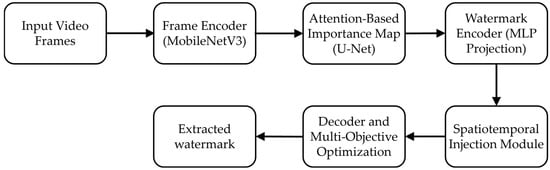
The proposed framework, shown conceptually in Figure 1, is composed of five main modules trained end-to-end:
Figure 1.
Conceptual overview of the proposed lightweight watermarking architecture.
- Frame Encoder: A MobileNetV3-based lightweight encoder extracts semantic features from each input frame Vt, reducing spatial redundancy while preserving key structural information.
- Attention Map Generator: A shallow U-Net estimates a block importance map Mt, which highlights perceptually redundant and temporally stable regions suitable for watermark insertion.
- Watermark Encoder: A compact multilayer perceptron (MLP) converts the binary watermark vector into a spatial tensor , aligned with the video frame dimensions.
- Spatiotemporal Injection Module: The encoded watermark is embedded additively into the selected regions following , where is the binary mask derived from Mt. Temporal redundancy is introduced by spreading the watermark across T = 8 consecutive frames.
- Decoder and optimization: A mirrored MobileNet decoder reconstructs the watermark from possibly distorted frames. The network is optimized using multi-objective loss:
2.2. Adversarial Training and Attack Simulation
To improve resilience under malicious manipulation, the model incorporates adversarial training where both encoder and decoder are jointly optimized under perturbations generated via the Fast Gradient Sign Method (FGSM) and Projected Gradient Descent (PGD). During training, frames are also subjected to H.264 compression (QP = 28–40), Gaussian noise (σ = 5), and frame dropping (20%), simulating real-world degradation in surveillance or streaming systems.
2.3. Computational Efficiency
The total model size is 4.3 M parameters (≈1/8 of DVMark [10]) and processes 42 frames per second on an RTX 3060 GPU (NVIDIA, Santa Clara, CA, USA), making it deployable in real-time forensic or streaming pipelines.
3. Results and Discussion
3.1. Evaluation Setup
Experiments were conducted on a reduced version of the Kinetics-600 dataset [11], using 2000 clips (16 frames each, 224 × 224 pixels). The benchmark compared the proposed model with ItoV [9] and DVMark [10] under five representative attack conditions:
- H.264 compression (QP = 28);
- Gaussian noise (σ = 5);
- Frame drop: 20%;
- FGSM perturbations (ε = 8/255); and
- Deepfake recompression simulated with a GAN-based encoder.
3.2. Quantitative Results
Under standard conditions, as shown in Table 1, the model achieves an average PSNR ≈ 39 dB and SSIM ≈ 0.97, comparable to more complex architectures but with substantially fewer parameters. Against adversarial perturbations (FGSM, GAN-based recompression), the proposed system maintains BER < 3%, confirming its ability to recover watermark bits even after targeted attacks.
Table 1.
Comparative performance of video watermarking models under various attack conditions.
3.3. Qualitative Analysis
Visual inspection confirms that watermarked frames remain indistinguishable from originals. The adaptive mask avoids high-saliency regions such as faces and edges, while temporal redundancy mitigates degradation due to frame loss or adversarial reordering. The model’s lightweight design also reduces overfitting to specific attacks, improving generalization.
4. Conclusions and Future Work
This paper introduced a compact deep learning framework for adversarial-resilient video watermarking, explicitly oriented toward cybersecurity applications. By combining lightweight convolutional backbones, attention-guided block selection, and adversarial training, the system achieves a strong balance between invisibility, robustness, and real-time efficiency.
Compared to prior works such as DVMark and ItoV, the proposed model achieves comparable imperceptibility with up to 80% fewer parameters and higher robustness under adversarial perturbations and deepfake recompression. These features make it particularly suitable for edge-based forensic verification, distributed video authentication, and online copyright monitoring.
Future research will explore the integration of self-supervised attack generation, dynamic payload watermarking, and transformer-based temporal modeling to further enhance resilience in large-scale, adversarial compromised multimedia environments.
Author Contributions
Conceptualization, L.V.-G. and A.C.-H.; methodology, L.V.-G. and A.C.-H.; investigation, M.C.-H.; writing—original draft preparation, L.V.-G. and A.C.-H.; writing—review and editing, M.C.-H.; project administration, A.C.-H.; validation, M.C.-H. All authors have read and agreed to the published version of the manuscript.
Funding
This research received no external funding.
Institutional Review Board Statement
Not applicable.
Informed Consent Statement
Not applicable.
Data Availability Statement
The original contributions presented in the study are included in the article; further inquiries can be directed to the corresponding author.
Conflicts of Interest
The authors declare no conflict of interest.
References
- Aberna, P.; Agilandeeswari, L. Digital image and video watermarking: Methodologies, attacks, applications, and future directions. Multimed. Tools Appl. 2024, 83, 5531–5591. [Google Scholar] [CrossRef] [Scilit]
- Mansour, S.; Ben, J.S.; Zagrouba, E. A comprehensive overview of deep learning-based video watermarking: Current works, challenges and future trends. Multimed. Tools Appl. 2024, 84, 1–48. [Google Scholar] [CrossRef] [Scilit]
- Singh, H.K.; Singh, A.K. Comprehensive review of watermarking techniques in deep-learning environments. J. Electronic Imaging 2023, 32, 031804. [Google Scholar] [CrossRef] [Scilit]
- Saritas, O.F.; Ozturk, S. A blind DCT-based robust color image watermarking method. Multimed. Tools Appl. 2023, 82, 15475–15491. [Google Scholar] [CrossRef] [Scilit]
- Huan, W.; Li, S.; Qian, Z.; Zhang, X. Exploring stable coefficients on joint sub-bands for robust video watermarking in the DT-CWT domain. IEEE Trans. Circuits Syst. Video Technol. 2021, 32, 1955–1965. [Google Scholar] [CrossRef] [Scilit]
- Mansour, S.; Jabra, S.B.; Zagrouba, E. A Robust Deep Learning-Based Video Watermarking Using Mosaic Generation. In Proceedings of the 18th International Joint Conference on Computer Vision, Imaging and Computer Graphics Theory and Applications (VISAPP) 2023, Lisbon, Portugal, 19–21 February 2023; Volume 5, pp. 668–675. [Google Scholar]
- Chen, H.; Liu, C.; Zhu, T.; Zhou, W. When deep learning meets watermarking: A survey of applications, attacks and defenses. Comput. Stand. Interf. 2024, 89, 103830. [Google Scholar] [CrossRef] [Scilit]
- Zhu, J.; Kaplan, R.; Johnson, J.; Fei-Fei, L. Hidden: Hiding data with deep networks. In Proceedings of the European Conference on Computer Vision (ECCV 2018), Munich, Germany, 8–14 September 2018; pp. 657–672. [Google Scholar]
- Ye, G.; Gao, J.; Wang, Y.; Song, L.; Wie, X. ItoV: Efficiently adapting deep learning-based image watermarking to video watermarking. In Proceedings of the 2023 International Conference on Culture-Oriented Science and Technology (CoST), Taipei, Taiwan, 4–6 December 2023; pp. 192–197. [Google Scholar]
- Luo, X.; Li, Y.; Chang, H.; Liu, C.; Milanfar, P.; Yang, F. Dvmark: A deep multiscale framework for video watermarking. IEEE Trans. Image Process 2023, 34, 37030810. [Google Scholar] [CrossRef] [Scilit] [PubMed]
- Carreira, J.; Noland, E.; Banki-Horvath, A.; Hillier, C.; Zisserman, A. A short note about kinetics-600. arXiv 2018, arXiv:1808.01340. [Google Scholar] [CrossRef] [Scilit]

Disclaimer/Publisher’s Note: The statements, opinions and data contained in all publications are solely those of the individual author(s) and contributor(s) and not of MDPI and/or the editor(s). MDPI and/or the editor(s) disclaim responsibility for any injury to people or property resulting from any ideas, methods, instructions or products referred to in the content. |
© 2026 by the authors. Licensee MDPI, Basel, Switzerland. This article is an open access article distributed under the terms and conditions of the Creative Commons Attribution (CC BY) license.