


Abstract
The transamination reaction of enamines is a convenient and selective method for structural modification, allowing the replacement of the dimethylamino group with various heterocyclic moieties, in particular, with the 1,2,4-triazol-3-ylamino group. Based on the results of quantum chemical calculations of the molecular geometry of the E and Z isomers, it is possible to make an assumption about the preferred isomer for each of the substances. It was found that the transamination reaction results in a change in conformation relative to the multiple bond of the product. Transamination under the action of 2-aminobenzimidazole proceeds via a stage of partial retro-cleavage of the enamine to the starting coumarin, followed by their condensation into a more complex condensed polycyclic system.
1. Introduction
Aminomethylidene derivatives of 4-oxochromen-2-one are polyfunctional synthons containing a conjugated enamine system, a lactone ring, and a carbonyl group in their structure [1,2]. Due to the presence of multiple reaction centers, such compounds are widely used in directed organic synthesis to obtain a variety of condensed and hybrid heterocycles, many of which possess potential biological activity. Transamination reactions of enamine derivatives of chromen-2-ones serve as effective structural modifications, enabling the introduction of various N-heterocyclic substituents.
2. Materials and Methods
The progress of the reaction, the composition of the basic mixtures, and the identification of individual isolated products were monitored and verified using thin-layer chromatography (TLC) and 1H, 13C NMR spectroscopy. TLC analysis was performed on Silufol UV-254 plates. The eluent consisted of ethyl acetate, hexane, and chloroform in a 2:2:1 ratio; the chromatograms were visualized using iodine vapor. For column chromatography, silica gel 60 was used as the sorbent, with the same eluent mixture (ethyl acetate:hexane:chloroform, 2:2:1). FT-IR spectra were recorded on a Nicolet 6700 spectrometer (Thermo Scientific, Waltham, MA, USA) using KBr pellets over the wavenumber range of 4000–400 cm−1, with a spectral resolution of 4 cm−1. 1H NMR, 13C NMR, and HSQC spectra were acquired on a Varian 400 spectrometer at 20–25 °C. The operating frequency was 400 MHz for 1H NMR spectra and 100 MHz for 13C NMR spectra. TMS served as the internal standard, and the solvents used were CDCl3 and dimethyl sulfoxide-d6.
Quantum chemical calculations were performed using the density functional theory (DFT) with Becke’s three-parameter Lee–Yang–Parr (B3LYP) hybrid functional and the 6-311G(d,p) basis set, involving p-orbitals for the hydrogen atom and d-ones for more heavy atoms as well as involving polarization functions (B3LYP/6-311G++ (d,p)).
The complete geometry was optimized for each possible isomer with a strict convergence criterion.
Synthesis and Characterization of Compounds 4a-c
A mixture of 0.05 g (0.042 mmol) 3-(Z)-dimethylaminomethylene-4-(thio)oxochromen-2-one (1a-b) and 0.003 g (0.042 mmol) of 1,2,4-triazol-3-amine (2) refluxed for 40 min in 10 mL i-PrOH.
(Z)-3-(((4H-1,2,4-Triazol-3-yl)amino)methylene)chromene-2,4-dione (4a)
Yield 0.32 g. mp. 198–199 °C; FTIR, cm−1 1716 (C=O), 1880 (C=O), 1580 (C=C). 1H NMR (400 MHz, CDCl3): δ 9.80 (s, 1H, NH), 8.45 (s, 1H, =CH), 7.17–7.88 (m, 4H, Ar-H). Anal. Calcd. For C12H8N4O3 C: 56.25%; H: 3.15%; N: 21.87%; Found: C: 56.43%; H: 2.68%; N: 22.16%.
(E)-3-(((4H-1,2,4-Triazol-3-yl)amino)methylene)-4-thioxochroman-2-one (4b)
Yield 0.25 g. mp. 176–177 °C; FTIR, cm−1 1718 (C=O), 1878 (C=O), 1576 (C=C). 1H NMR (400 MHz, CDCl3): δ 9.87 (s, 1H, NH), 8.43 (s, 1H, =CH), 7.20–8.08 (m, 4H, Ar-H). Anal. Calcd. For C12H8N4O3 C: 52.93%; H: 2.96%; N: 20.58%; S: 11.77%; Found: C: 57.13%; H: 2.71%; N: 21.56%; S: 11.45%.
7-(4-Hydroxy-2-oxo-2H-chromen-3-yl)-6a,7,9,14a-tetrahydro-6H-benzo[4,5]imidazo[1,2-a]chromeno[3,4-e]pyrimidin-6-one (7)
A mixture of 0.002 g (0.042 mmol) 3-(Z)-(dimethylamino)methylene)chroman-2,4-dione (1a) and 0.01 g (0.042 mmol) of 1H-benzo[d]imidazol-2-amine (3) refluxed for 80 min in 10 mL i-PrOH.
Yield 0.14 g. mp. 172–173 °C; FTIR, cm−1 3350–3200 (NH), 1710–1680 (C=O), 1650–1620 (C=O), 1610–1580 (C=C), 1550–1500 (C=C). 1H NMR (400 MHz, CDCl3): δ 12.5 (s, 1H, OH), 10.7 (s, 1H, NH), 8.60 (s, 1H, =CH), 7.25–8.02 (m, 8H, Ar-H). Anal. Calcd. For C26H15N3O5 C: 69.49%; H: 3.36%; N: 9.35%; Found: C: 64.43%; H: 2.88%; N: 8.96%.
3. Results and Discussion
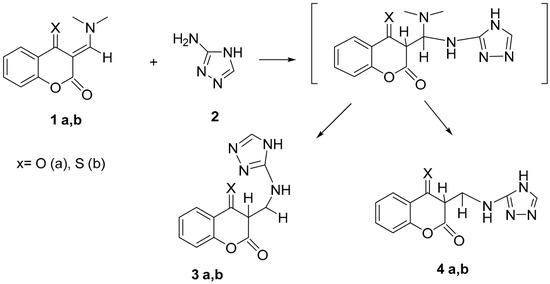
Transamination reactions of enamine derivatives of chromen-2-ones serve as effective structural modifications, enabling the introduction of various N-heterocyclic substituents. Despite the numerous studies dedicated to the synthesis and properties of aminomethylidenechromenones, no systematic investigation into the transamination of their thio-analogs—conducted using Lawesson’s reagent—has been carried out to date. The transamination reaction was carried out by reacting compounds 1a and 1b with 1,2,4-triazol-3-amine in ethanol at room temperature (Scheme 1).
Scheme 1.
Synthesis of 3-(E)-(((4H-1,2,4-triazol-3-yl)amino)methylene)-4-(thi)oxochroman-2-one (4a,b).
Based on experimental data, a mechanism for the transamination reaction is proposed; it involves a step of nucleophilic attack by the triazole amino group on the C=C double bond of the aminomethylidene fragment, yielding an intermediate adduct that may possess either the R or S configuration at the asymmetric center. Subsequent elimination of dimethylamine leads to the formation of the final product as Z- and E-isomers. This process is analogous to a Michael addition followed by elimination, a conclusion supported by kinetic studies and spectroscopic data.
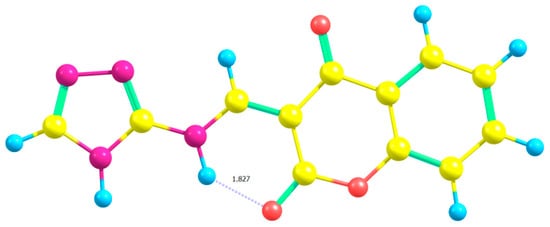
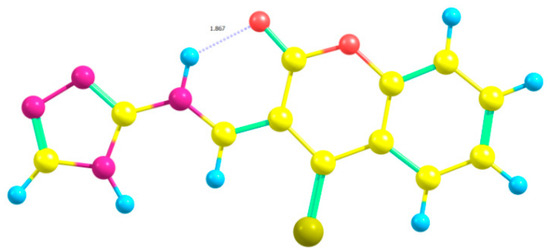
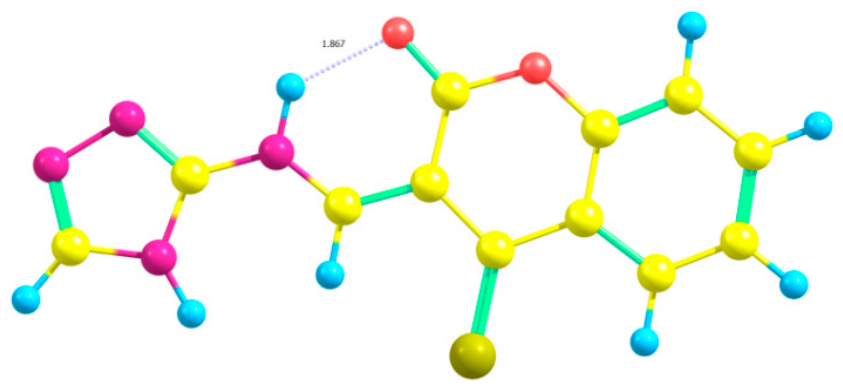
Calculated data regarding the molecular geometry (B3LYP functional with the 6-31G(d,p) basis set) and formation energies of the E- and Z-isomers indicate that isomers 4a and 4b are the preferred forms; they are stabilized by a hydrogen bond between the hydrogen of the exocyclic amino group and the lactone carbonyl (Figure 1 and Figure 2).
Figure 1.
Optimized structure of compound 4a (Z-isomer).
Figure 2.
Optimized structure of compound 4e (E-isomer).
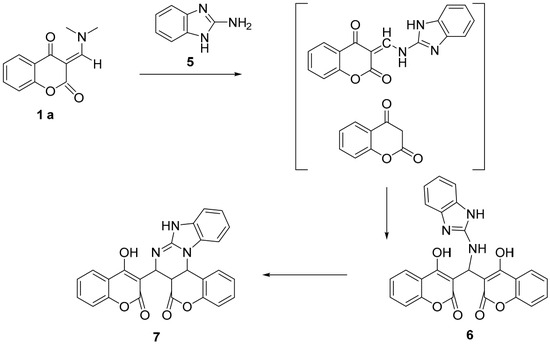
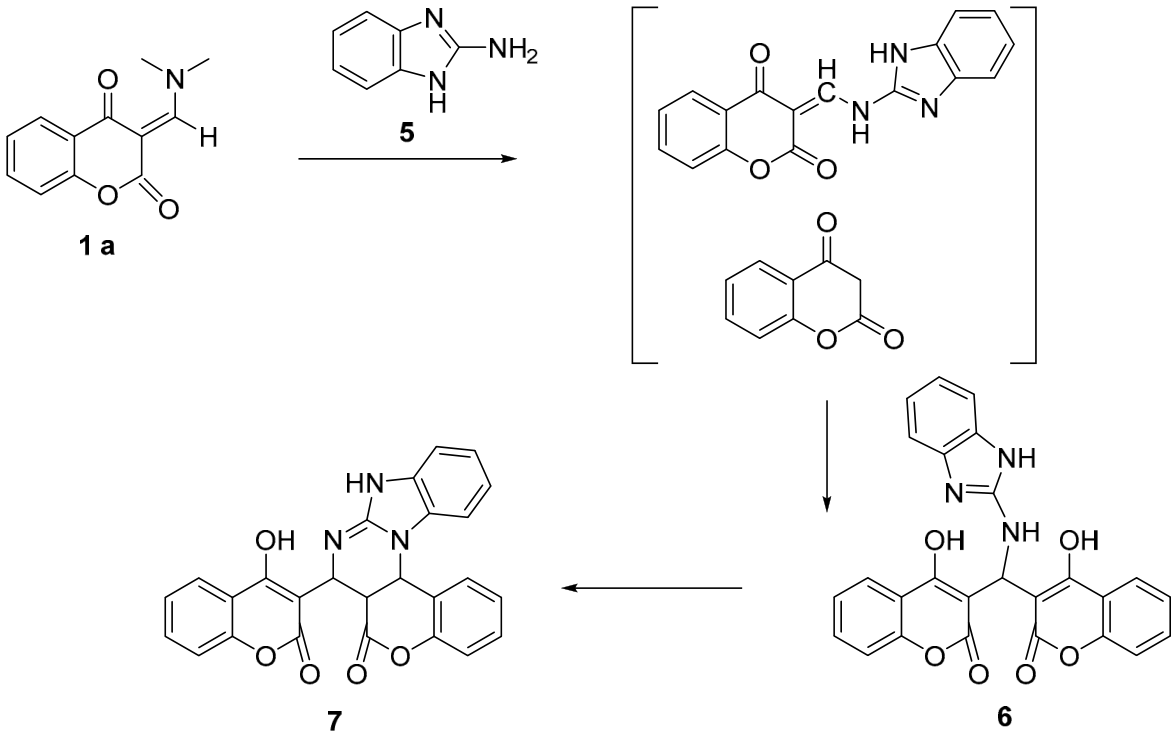
The reaction of 3-((E)-((dimethylamino)methylene))-4-oxo-3,4-dihydro-2H-chromen-2-one (1) with 2-aminobenzimidazole involves a transamination step—comprising the nucleophilic attack of the 2-aminobenzimidazole amino group on the β-carbon atom of the enamine system and partial deaminomethylation of the resulting intermediate [3] (Scheme 2). In the subsequent stage, the resulting adducts undergo a Michael-type reaction, leading to the formation of an aminomethyl-bis-chromene structure (7).
Scheme 2.
Synthesis of 7-(4-hydroxy-2-oxo-2H-chromen-3-yl)-6a,7,9,14a-tetrahydro-6H-benzo[4,5]imidazo[1,2-a]chromeno[3,4-e]pyrimidin-6-one (7).
1H NMR spectroscopy data (solvent: DMSO-d6) provide the most compelling evidence that the transamination reaction has occurred. In the spectrum of product (7), the characteristic intense singlet corresponding to the six protons of the dimethylamino group of the starting material (at δ ≈ 3.10 ppm) disappears completely, indicating its total replacement.
Instead, two broad singlets corresponding to the NH protons of the benzimidazole moiety appear downfield in the δ 11.80–12.70 ppm range. The appearance of a singlet for the methine proton at 5.12 ppm serves as a characteristic signal indicating the formation of the bis-system.
4. Conclusions
Modification of 3H-4-oxo-chromen-2-one was carried out by transamination reaction with 1,2,4-triazol-3-amine and 2-aminobenzimidazole; in the case of benzimidazole, subsequent cycloaddition with the formation of a new condensed tetracyclic system was revealed. Using DFT calculation methods (B3LYP/6-31G(d)), using the example of [(4H-1,2,4-triazol-3-ylamino)methylene]-chroman-2,4-dione, the preferential formation of the E-isomer stabilized by intramolecular hydrogen bonds was shown.
Author Contributions
Conceptualization, O.M. and E.A.; methodology, V.G.; software, O.M.; validation, V.G., O.M., and E.A.; formal analysis, V.G.; investigation, O.M. and E.A.; resources, E.A.; data curation, O.M.; writing—original draft preparation, V.G.; writing—review and editing, O.M.; visualization, E.A.; supervision, A.Y.; project administration, V.G. All authors have read and agreed to the published version of the manuscript.
Funding
This research received no external funding.
Institutional Review Board Statement
Not applicable.
Informed Consent Statement
Not applicable.
Data Availability Statement
The original contributions presented in this study are included in the article.
Conflicts of Interest
The authors declare no conflicts of interest.
Abbreviations
The following abbreviations are used in this manuscript. NMR—Nuclear Magnetic Resonance; HMBC—Heteronuclear Multiple Bond Correlation; DMSO—Dimethyl Sulfoxide; TMS—Tetramethylsilane (NMR standard); DFT—Density Functional Theory; B3LYP—Becke, 3-parameter, Lee–Yang–Parr
References
- Aghaalizadeh, T.; Nasiri, F. Serendipitous synthesis of 4-thioxochromen-2-one derivatives through the one-pot three-component reaction of primary amines, carbon disulfide, and 4-chlorocoumarin-3-carbaldehyde. J. Sulphur Chem. 2017, 38, 635–643. [Google Scholar] [CrossRef] [Scilit]
- Löwe, W. (Hydroxyphenyl)-âthanone aus Dehydracetsäure. Arch. Pharm. 1977, 310, 931–935. [Google Scholar] [CrossRef] [Scilit] [PubMed]
- Jacomini, A.P.; Silva, M.J.V.; Silva, R.G.M.; Gonçalves, D.S.; Volpato, H.; Basso, E.A.; Rosa, F.A. Synthesis and evaluation against Leishmania amazonensis of novel pyrazolo[3,4-d]pyridazinone-N-acylhydrazone(bi)thiophene hybrids. Eur. J. Med. Chem. 2016, 124, 340–349. [Google Scholar] [CrossRef] [Scilit] [PubMed]
Disclaimer/Publisher’s Note: The statements, opinions and data contained in all publications are solely those of the individual author(s) and contributor(s) and not of MDPI and/or the editor(s). MDPI and/or the editor(s) disclaim responsibility for any injury to people or property resulting from any ideas, methods, instructions or products referred to in the content. |
© 2026 by the authors. Licensee MDPI, Basel, Switzerland. This article is an open access article distributed under the terms and conditions of the Creative Commons Attribution (CC BY) license.