


Abstract
Salphen-type ligands are known to form stable chelate complexes with different metals. Those metal complexes with Pt(II), Pd(II), Ni(II), Cu(II), Zn(II), etc., are capable of selective G-quadruplex DNA binding and therefore are promising anticancer agents. Such compounds may provide a basis for developing metal-containing systems capable of targeting telomeric and oncogene-associated G-quadruplex DNA structures while retaining structural variability for comparative coordination studies. The recent works also showed that imidazole-4-carbaldehyde can replace salicylic aldehyde in Schiff-base ligands. We focused our synthetic efforts on the preparation of potential ligands with either salicylic aldehyde or imidazole-4-carbaldehyde Schiff base on one side of ethylenediamine, while the other amino group of the ethylenediamine was modified with heterocyclic fragment. As the heterocycle, we have chosen 4-aminoquinazoline, which is the core structure of Gefitinib, a well-known highly effective anticancer drug, and many others. We also directed our attention to the thieno[2,3-d]pyrimidine scaffold, which could be considered bioisosteric to quinazoline and is considered as a privileged scaffold for anticancer drug discovery. The synthetic scheme was started with readily available 4-chloroquinazoline and 4-chloro-5-methylthieno[2,3-d]pyrimidine treated with mono-Boc-protected ethylenediamine. Subsequent deprotection of Boc-group in the obtained product followed by condensation with the corresponding aldehyde produced the desired ligands.
1. Introduction
Schiff bases are versatile imine compounds readily obtained by the condensation of primary amines with aldehydes or ketones. Their straightforward synthesis and ability to incorporate different nitrogen- and oxygen-donor atoms make them attractive modular ligands in coordination chemistry and ligand platforms for the development of metal-based anticancer agents [1]. Variation in the amine and aldehyde components enables the donor environment, electronic properties, and coordination behaviour of the ligands to be adjusted. Classical salen- and salphen-type systems derived from salicylaldehydes form stable complexes with various metal ions and have been widely investigated in coordination and medicinal chemistry [2]. Replacement of salicylaldehyde with imidazole carbaldehydes changes the potential donor set and electronic structure of the ligand. Both salicylaldehyde- and imidazole-derived Schiff bases have been shown to coordinate Zn(II), Cu(II), and Ag(I) [3]. These findings indicate that variation in the aldehyde-derived donor environment may influence the coordination and DNA-binding properties of the resulting metal complexes, supporting the use of the two aldehyde components for comparing alternative donor environments within a common ligand framework.
In addition to the modification of the donor environment, the ligand structure can be further varied through the introduction of heteroaromatic fragments. 4-Aminoquinazoline is a well-established scaffold in anticancer drug discovery and forms the core of several EGFR inhibitors, including gefitinib [4,5]. Thieno[2,3-d]pyrimidine represents a bioisosteric alternative in which the benzene portion of quinazoline is replaced by a thiophene ring. Derivatives of this scaffold have been investigated as anticancer, anti-inflammatory, antimicrobial, and central nervous system-active compounds [6,7]. Incorporation of these two heterocycles therefore provides structurally related ligands with different ring compositions and electronic properties. Such variations may influence not only their coordination behaviour but also the molecular-recognition properties of the corresponding metal complexes, making them relevant to the development of potential DNA-binding systems.
In this context, G-quadruplex DNA represents one of the potential biological targets for the metal complexes to be developed in subsequent studies. G-quadruplexes are non-canonical structures formed by guanine-rich sequences located in the telomeres and promoter regions of cancer-related genes. Their stabilization may affect telomere maintenance or gene transcription, making them potential targets in anticancer research [8]. Previous studies have shown that Schiff-base metal complexes can bind and stabilize different G4 structures and that their affinity and selectivity depend on both the ligand architecture and the coordinated metal ion, while more recent results confirmed that structural modifications of the ligand can alter G4 affinity and binding mode [9]. These observations provide a rationale for preparing structurally varied ligand precursors before investigating their metal complexes and biological properties.
Guided by these findings, the present study reports the synthesis and characterization of four asymmetric Schiff-base ligands built around an ethylenediamine linker. The four ligands were designed by combining two heteroarylamine fragments, quinazolin-4-yl and 5-methylthieno[2,3-d]pyrimidin-4-yl, with two aldehyde components, salicylaldehyde and imidazole-4-carbaldehyde, generating a 2 × 2 structural design. This approach allows the aldehyde-derived donor environment and the heteroaromatic fragment to be varied independently within a common scaffold. The aim of this work is to obtain and characterize the free ligands as structurally defined precursors for subsequent metal-complex formation. In future studies, these ligands will be used to prepare metal complexes and to investigate their interactions with G-quadruplex DNA.
2. Results and Discussion
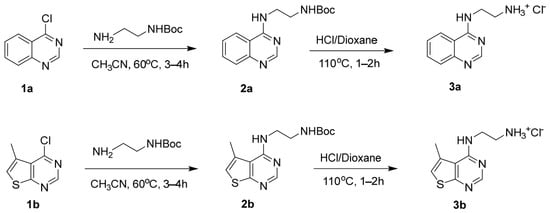
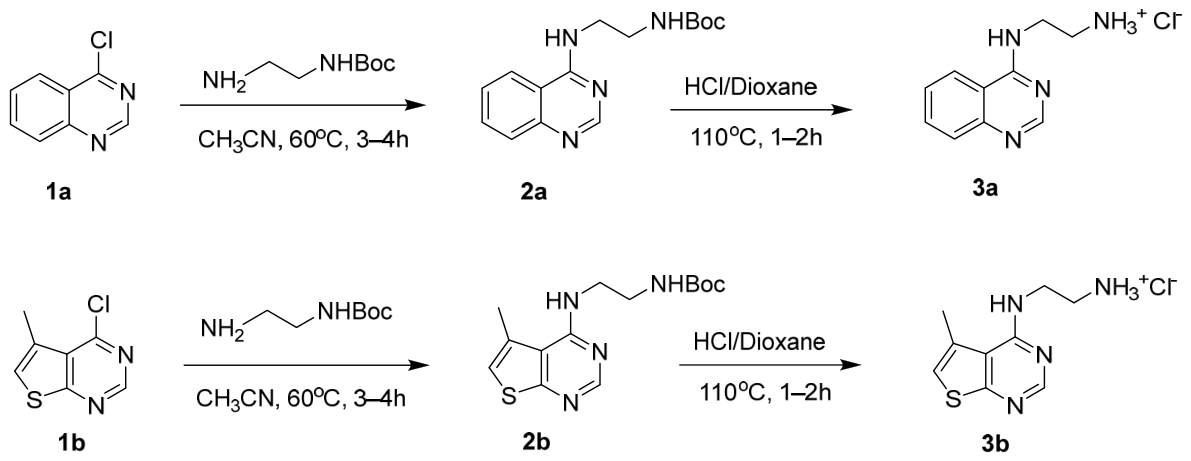
The most prospective strategy of unsymmetrical derivatives of ethylenediamine is based on the application of ethylenediamine protected from one side as the starting material; we therefore started from mono-Boc derivative. A similar approach was successfully used for the preparation of N-(quinazolin-4-yl)ethane-1,2-diamine hydrochloride (3a) [10]. We modified the conditions by changing 1,4-dioxane with acetonitrile at the first stage as a volatile solvent and used a lower temperature (Scheme 1). The obtained hydrochlorides 3 were isolated and used in the next step in the form of salts.
Scheme 1.
Preparation of N-(hetaryl)ethane-1,2-diamines hydrochlorides 3a and 3b.
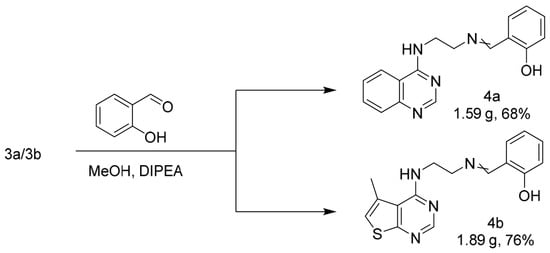
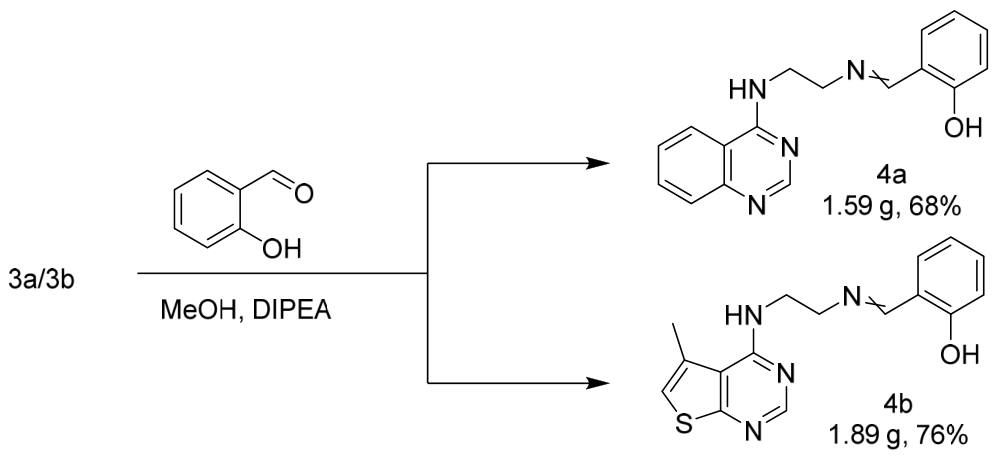
For synthesis of a Schiff base it is possible to use basic or acidic catalysts by boiling the reaction mixture in alcohol. In high temperature, this reaction leads to unpredictable by-products, so to avoid it we optimized the reaction condition to carry out the synthesis with minimal possible heating. The best solvent for the synthesis of salicylic aldehyde imines 4a and 4b is methanol. It allowed us to carry out reaction homogeneously for in situ prepared basic forms of corresponding amines, obtained by the treatment of hydrochlorides with DIPEA. The following Schiff-base formation with salicylic aldehyde was carried out at 40 °C in the same flask. It was also beneficial that the products 4a and 4b precipitated from the reaction mixture and did not require additional purification (Scheme 2).
Scheme 2.
Preparation of salicylic aldehyde imines 4a and 4b.
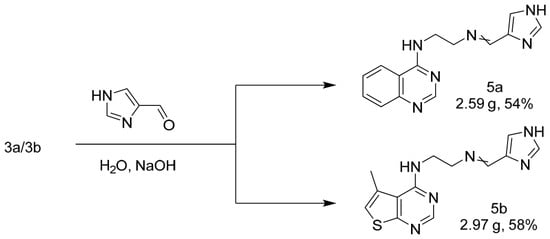
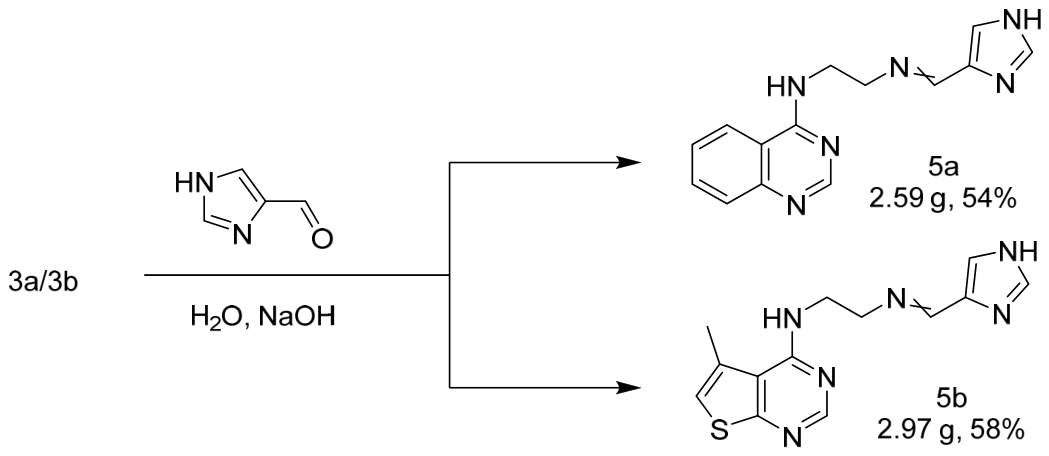
The attempt to carry out condensation of 3a and 3b with imidazole-4-carbaldehyde in methanol, catalyzed with DIPEA, faced the problem of the product isolation. 5a and 5b are highly soluble in methanol in the presence of DIPEA (Scheme 3).
Scheme 3.
Preparation of imidazole-4-carbaldehyde imines 5a and 5b.
To optimize the reaction conditions, we used water as the solvent with sodium hydroxide for hydrochloride neutralization. These unusual conditions allowed the synthesis of imidazole-4-carbaldehyde imines 5a and 5b in high yields with high degree of purity.
The obtained imines appeared to be rather unstable for LC-MS analyses and the molecular ion peaks for compounds 4a and 5a of the quinazoline series were identified only by using HRMS technics. For all the imines 4 and 5 the structure was assigned using a combination of 1H and 13C NMR spectroscopy.
3. Experimental Section
3.1. General Information, Instrumentation and Chemicals
The solvents were purified according to the standard procedures. All starting materials were obtained from Enamine Ltd. (Enamine Ltd., Kyiv, Ukraine). All other starting materials were purchased from commercial sources. Melting points were measured on the MPA100 OptiMelt automated melting point system (Stanford Research Systems, Inc., Sunnyvale, CA 94089, USA). 1H, and 13C NMR spectra were recorded on a Varian Unity Plus 400 spectrometer (Varian, Inc., Palo Alto, CA, USA) (at 400 MHz for 1H NMR) and a Bruker 170 Avance 500 spectrometer (Bruker BioSpin, Rheinstetten, Germany) (at 126 MHz for 13C NMR). NMR chemical shifts are reported in ppm (δ scale) downfield from TMS as an internal standard, and the NMR chemical shifts are referenced using the solvent signals at 2.48 and 39.5 ppm for 1H and 13C nuclei, respectively, in DMSO-d6. Coupling constants (J) are presented in Hz. Spectra are reported as follows: chemical shift (δ, ppm), multiplicity, coupling constants (Hz), and integration. LCMS analyses were performed with the assistance of an Agilent LC/MSD SL 1100 instrument ES-API (Agilent, Santa Clara, CA, USA). HRMS spectra were obtained on Agilent 6200 Series system TOF and 6500 Series Q-TOF LC/MS (Agilent, Melbourne, Australia).
3.2. General Procedure for Preparation of N-(Hetaryl)ethane-1,2-diamines Hydrochlorides
To (0.03 mol) 4-chloroquinolone 1a or 4-chloro-5-methylthieno[2,3-d]pyrimidine 1b in a pear-shaped flask, 0.6 g (0.037 mol) of N-Boc-ethylendiamine and 70 mL of dry acetonitrile, and then 6 mL (0.034 mol) of DIPEA were added. The reaction mixture was heated for 3–4 h at 60 °C (LC-MS monitoring). Then, the solvent was removed under reduced pressure and treated with water. The solid was extracted with methylene chloride and the organic layer was separated, dried over sodium sulfate and evaporated to obtain the analytical samples of N-Boc derivatives 2a or 2b. For the telescopic procedure the solid residue after evaporation of acetonitrile was treated with 60 mL of HCl (4 M) solution in 1,4-dioxane and heated at 110 °C with stirring till the evolution of gaseous products was stopped (1–2 h). Then the reaction mixture was evaporated to dryness in vaccuo and the crude grey solid hydrochloride was used in further transformations without additional purification.
3.3. General Procedure for Synthesis of Salicylic Aldehyde Imines 4a and 4b
To 0.008 mol of corresponding hydrochloride 3a or 3b in 8 mL of methanol, 0.016 mol of DIPEA was added and the mixture was stirred at 40 °C for 5 min. Then, 0.008 mol of salicylic aldehyde was added. The mixture was allowed to stir for an additional 1 h after the yellow precipitate started to form. The reaction mixture was cooled to room temperature and the precipitate of the product was filtered and washed with minimal amount of cold methanol.
3.4. General Procedure for Synthesis of Imidazole-4-Carbaldehyde Imines
To (0.018 mol) of the corresponding hydrochloride 2a or 2b in 50 mL of freshly distilled water, 1.17 g (0.018 mol) of imidazole-4-carbaldehyde was added. Then, to the stirred reaction mixture, the solution of 1.12 g (0.028 mol) of sodium hydroxide in 16 mL of water was added and the solids were dissolved. The clear solution was stirred at room temperature till the formation of precipitation and then for an additional 40 min. The precipitate was filtered and washed with minimal possible amount of cold water and dried at 60 °C.
3.5. Spectral Data
3.5.1. tert-Butyl [2-(Quinazolin-4-ylamino)ethyl]carbamate (2a)
White solid, yield 8.21 g, 95%. m.p. 152–154 °C. (Lit. 135–137 °C [10]). 1H NMR (400 MHz, DMSO-d6) δ 8.45 (s, 1H), 8.33–8.24 (m, 1H), 8.18 (d, J = 8.2 Hz, 1H), 7.79–7.7 (m, 1H), 7.69–7.65 (m, 1H), 7.53–7.44 (m, 1H), 6.97 (t, J = 5.5 Hz, 1H), 3.63–3.53 (m, 2H), 3.23 (q, J = 6.2 Hz, 2H), 1.34 (s, 9H). 13C NMR (101 MHz, DMSO-d6) δ 159.9, 156.2, 155.4, 149.4, 132.8, 127.8, 125.9, 123.1, 115.4, 78.1, 41.5, 28.3. LCMS, calcd. for C15H20N4O2, 288.34; found, positive mode, m/z: 289.2 [M + H]+.
3.5.2. tert-Butyl {2-[(5-Methylthieno[2,3-d]pyrimidin-4-yl)amino]ethyl}carbamate (2b)
White solid, yield 9.05 g, 98%. m.p. 161–162 °C. 1H NMR (400 MHz, DMSO-d6) δ 8.29 (s, 1H), 7.11 (s, 1H), 7.04–6.95 (m, 1H), 6.73 (s, 1H), 3.64–3.49 (m, 2H), 3.21 (d, J = 5.6 Hz, 2H), 2.49 (s, 3H), 1.33 (s, 9H). 13C NMR (126 MHz, DMSO-d6) δ 167.1, 158.1, 156.5, 153.75, 130.1, 117.9, 115.9, 78.1, 41.4, 28.3, 17.7. LCMS, calcd. for C14H20N4O2S, 308.39; found, positive mode, m/z: 309.2 [M + H]+.
3.5.3. N-(Quinazolin-4-yl)ethane-1,2-diamine Hydrochloride (3a)
Grey solid, yield at the final step 6.22 g, 97%. m.p. > 250 °C. 1H NMR (400 MHz, DMSO-d6) δ 10.84 (s, 1H), 8.94 (s, 1H), 8.82 (d, J = 8.1 Hz, 1H), 8.33 (s, 2H), 8.14–8.05 (m, 1H), 7.96 (d, J = 8.1 Hz, 1H), 7.81–7.72 (m, 1H), 4.01 (d, J = 5 Hz, 2H), 3.2 (s, 2H). 13C NMR (126 MHz, DMSO-d6) δ 161.6, 151.2, 137.8, 136.4, 128.7, 125.6, 119.4, 113.7, 38.1.
3.5.4. N-(5-Methylthieno[2,3-d]pyrimidin-4-yl)ethane-1,2-diamine (3b)
Grey solid, yield at the final step 7.13 g, 99%. m.p. 195–197 °C (decomp.). 1H NMR (400 MHz, DMSO-d6) δ 8.68 (s, 1H), 8.29 (s, 3H), 8.01 (s, 1H), 7.36 (s, 1H), 3.92 (d, J = 5.4 Hz, 2H), 3.12 (d, J = 5.1 Hz, 2H), 2.68 (s, 3H). 13C NMR (126 MHz, DMSO-d6) δ 158.0, 149.3, 131.1, 120.5, 117.0, 38.0, 17.5.
3.5.5. 2-[{[2-(Quinazolin-4-ylamino)ethyl]imino}methyl]phenol (4a)
Yellow solid, yield 1.59 g, 68%. m.p. 120 °C. 1H NMR (400 MHz, DMSO-d6) δ 13.66–13.12 (m, 1H), 8.54 (m, 3H), 8.24 (d, J = 6.3 Hz, 1H), 8.17–7.9 (m, 1H), 7.9–7.61 (m, 2H), 7.36 (m, 2H), 6.86 (s, 2H), 3.91 (s, 4H). 13C NMR (126 MHz, DMSO-d6) δ 167.3, 167.2, 161.0, 159.9, 155.3, 149.2, 133.0, 132.7, 132.1, 127.7, 126.1, 123.5, 123.1, 119.0, 116.8, 115.3, 59.2, 57.5, 41.7. HRMS (ESI): calcd. for C17H16N4O [M]+: 292.1334; found: 292.1330.
3.5.6. 2-[({2-[(5-Methylthieno[2,3-d]pyrimidin-4-yl)amino]ethyl}imino)methyl]phenol (4b)
Yellow solid, yield 1.89 g, 76%. m.p. 135 °C. 1H NMR (400 MHz, DMSO-d6) δ 13.45 (s, 1H), 8.55 (s, 1H), 8.33 (d, J = 4.1 Hz, 1H), 7.41 (dd, J = 7.8, 1.8 Hz, 1H), 7.30 (td, J = 7.8, 1.8 Hz, 1H), 7.12 (d, J = 1.5 Hz, 1H), 6.93–6.77 (m, 3H), 3.85 (h, J = 4.5, 4.1 Hz, 4H), 2.55–2.51 (m, 3H). 13C NMR (126 MHz, DMSO-d6) δ 167.3, 167.1, 161.1, 158.0, 153.8, 132.7, 132.0, 129.9, 119.1, 118.9, 118.2, 116.9, 116.0, 57.7, 41.4, 17.7.
3.5.7. N-[1H-Imidazol-4-ylmethylidene]-N’-(Quinazolin-4-yl)ethane-1,2-diamine (5a)
White powder, yield 2.59 g, 54%. m.p. 171 °C. 1H NMR (400 MHz, DMSO-d6) δ 12.20 (br.s, 1H), 8.48 (s, 1H), 8.38 (s, 1H), 8.27–8.16 (m, 2H), 7.84–7.62 (m, 3H), 7.48 (t, J = 7.5 Hz, 1H), 7.41 (s, 1H), 3.79 (s, 4H). 13C NMR (126 MHz, DMSO-d6) δ 159.9, 155.5, 149.5, 132.9, 127.9, 126.0, 123.1, 115.4, 59.4, 42.0. HRMS (ESI): calcd. for C14H14N6 [M]+: 266.1280; found [M + H]+ and [M + Na]+: 266.1354 and 289.1161.
3.5.8. N-[1H-Imidazol-4-ylmethylidene]-N’-(5-Methylthieno [2,3-d]pyrimidin-4-yl)ethane-1,2-diamine (5b)
White powder, yield 2.97 g, 58%. m.p. 168 °C. 1H NMR (400 MHz, DMSO-d6) δ 12.6–12.02 (m, 1H), 8.33 (s, 1H), 8.23 (s, 1H), 7.72 (s, 1H), 7.6–7.26 (m, 1H), 7.12 (s, 1H), 6.72 (s, 1H), 3.75 (s, 4H), 2.49 (s, 3H). 13C NMR (101 MHz, DMSO-d6) δ 167.2, 158.0, 157.9, 153.8, 129.9, 118.2, 115.9, 59.4, 41.6, 17.8, 17.7.
4. Conclusions
The effective procedures for the synthesis of unsymmetrical ethylenediamine Schiff-base ligands bearing heterocyclic fragment of quinazoline or thieno[2,3-d]pyrimidine on one side of the ethylendianine linker were developed. The other side was modified with the residue of a Schiff base of either salicylic aldehyde or imidazole-4-carbaldehyde. The simple synthetic methodology was suggested and the final products were obtained as precipitates which did not need additional purification.
Author Contributions
Conceptualization, L.P., S.V., V.G., R.B., G.B. and O.B.; methodology, L.P., S.V., V.G., R.B., G.B. and O.B.; software, O.T., L.P., S.V., V.G., R.B. and G.B.; validation, S.V., O.B., O.T., L.P. and V.B.; formal analysis, L.P., S.V., O.B., V.G., R.B., G.B., V.B. and O.T.; investigation, S.V., L.P., O.B., V.G., R.B., G.B., V.B. and O.T.; resources, S.V., L.P., O.B., V.G., R.B. and G.B.; data curation, V.B., O.T., L.P., S.V., R.B., G.B. and V.G.; writing—original draft preparation, V.B., O.T., L.P., S.V., R.B. and G.B.; writing—review and editing, V.B., O.T., L.P., S.V., V.G., R.B., G.B. and O.B.; visualization, S.V., V.B. and O.T.; supervision, G.B. and V.G.; project administration, O.B., G.B. and V.G.; funding acquisition, O.B., G.B. and V.G. All authors have read and agreed to the published version of the manuscript.
Funding
This research received no external funding.
Institutional Review Board Statement
Not applicable.
Informed Consent Statement
Not applicable.
Data Availability Statement
All relevant information is contained within the article.
Acknowledgments
The authors acknowledge Enamine Ltd. for the support of synthetic experiments and measurement of 1H, 13C NMR LC-MS and HRMS spectra of the obtained substances. The authors have reviewed and edited the output and take full responsibility for the content of this publication.
Conflicts of Interest
Author Oleksandr Borysov is employed by the company Enamine Ltd. The remaining authors declare that the research was conducted in the absence of any commercial or financial relationships that could be construed as a potential conflict of interest. The authors declare that they have no conflict of interest in relation to this research, whether financial, personal, authorship or otherwise, that could affect the research and its results presented in this article. The funders had no role in the design of the study; in the collection, analyses, or interpretation of data; in the writing of the manuscript; or in the decision to publish the results.
References
- More, M.S.; Joshi, P.G.; Mishra, Y.K.; Khanna, P.K. Metal Complexes Driven from Schiff Bases and Semicarbazones for Biomedical and Allied Applications: A Review. Mater. Today Chem. 2019, 14, 100195. [Google Scholar] [CrossRef] [Scilit] [PubMed]
- Leoni, L.; Dalla Cort, A. The Supramolecular Attitude of Metal–Salophen and Metal–Salen Complexes. Inorganics 2018, 6, 42. [Google Scholar] [CrossRef] [Scilit]
- McGinley, J.; McCann, M.; Ni, K.; Tallon, T.; Kavanagh, K.; Devereux, M.; Ma, X.; McKee, V. Imidazole Schiff Base Ligands: Synthesis, Coordination Complexes and Biological Activities. Polyhedron 2013, 55, 169–178. [Google Scholar] [CrossRef] [Scilit]
- Rusek, M. Chemical Scaffolds Driving Modern Anticancer Drug Discovery and Radiotheranostics: Structural Determinants, Translational Opportunities and Future Perspectives. Pharmaceuticals 2026, 19, 1248. [Google Scholar] [CrossRef] [Scilit] [PubMed]
- Ismail, R.S.M.; Ismail, N.S.M.; Abuserii, S.; Abou El Ella, D.A. Recent Advances in 4-Aminoquinazoline Based Scaffold Derivatives Targeting EGFR Kinases as Anticancer Agents. Future J. Pharm. Sci. 2016, 2, 9–19. [Google Scholar] [CrossRef] [Scilit]
- El-Ansary, A.K.; Kamal, A.M.; Al-Ghorafi, M.A. Synthesis and Evaluation of 4-Anilinoquinazoline Bioisosteres as Potential Anti-Breast Cancer Agents. Eur. J. Med. Chem. 2014, 86, 202–210. [Google Scholar] [CrossRef] [Scilit] [PubMed]
- Ali, E.M.H.; Abdel-Maksoud, M.S.; Oh, C.-H. Thieno[2,3-d]Pyrimidine as a Promising Scaffold in Medicinal Chemistry: Recent Advances. Bioorg. Med. Chem. 2019, 27, 1159–1194. [Google Scholar] [CrossRef] [Scilit] [PubMed]
- Balasubramanian, S.; Hurley, L.H.; Neidle, S. Targeting G-Quadruplexes in Gene Promoters: A Novel Anticancer Strategy? Nat. Rev. Drug Discov. 2011, 10, 261–275. [Google Scholar] [CrossRef] [Scilit] [PubMed]
- D’Anna, L.; Iacono, S.L.; Marretta, L.; Rubino, S.; Piccionello, A.P.; Bonsignore, R.; Barone, G. Targeting Non-Canonical DNA with π-Extended Schiff Base Complexes of Zinc(II), Copper(II), and Nickel(II): Insights into G-Quadruplex Binding Modes. J. Inorg. Biochem. 2026, 276, 113160. [Google Scholar] [CrossRef] [Scilit] [PubMed]
- Bhat, R.M.; Potluri, V.; Kattula, B.; Hegde, V.; AlAjmi, M.F.; Alam, M.R.; Prasad, P.K.; Keri, R.S. Hexokinase 2 inhibition study of lonidamine-tacrine/quinazoline hybrids: Design, synthesis, molecular docking, and dynamics simulations. J. Mol. Struct. 2025, 1344, 142996. [Google Scholar] [CrossRef] [Scilit]
Disclaimer/Publisher’s Note: The statements, opinions and data contained in all publications are solely those of the individual author(s) and contributor(s) and not of MDPI and/or the editor(s). MDPI and/or the editor(s) disclaim responsibility for any injury to people or property resulting from any ideas, methods, instructions or products referred to in the content. |
© 2026 by the authors. Licensee MDPI, Basel, Switzerland. This article is an open access article distributed under the terms and conditions of the Creative Commons Attribution (CC BY) license.