


Abstract
Pyrano[3,2-b]pyrans and indolin-2-ones (oxindole) are two well-established pharmacophore frameworks that independently underpin a broad range of biologically active compounds, including enzyme inhibitors, antioxidants, and antiproliferative agents. Molecular hybridization—the deliberate fusion of two pharmacophores into a single scaffold—has emerged as a powerful strategy in medicinal chemistry for achieving multitarget activity profiles. Herein we report the design and synthesis of novel heterodimeric compounds that incorporate both fragments linked through a thioether bridge, assembled via a concise multistep route. α-Thiocyanatoacetophenone, obtained by nucleophilic substitution of phenacyl bromide with potassium thiocyanate in ethanol (88–93% yield), was treated with isatin in the presence of triethylamine in ethyl acetate to furnish triethylammonium thiolate 1 in up to 86% yield. S-Alkylation of 1 with chlorokojic acid in DMF afforded heterodimer 2, containing intact indolin-2-one and kojic acid fragments. Compound 2 was engaged in a three-component domino condensation with aromatic aldehydes or isatin and malononitrile under basic conditions, proceeding via sequential Knoevenagel condensation and intramolecular Michael cyclization to give pyrano[3,2-b]pyran-indolin-2-one heterodimers 3. Preliminary molecular docking against the monomeric Aβ40 (PDB ID: 2LFM) and the fibrillar Aβ40 model (PDB ID: 2LMN) of the β-amyloid peptide Aβ40, as well as human serum albumin (HSA), identified promising candidates exhibiting high binding affinities simultaneously toward all three targets, with the most favorable predicted docking scores reaching −9.79 kcal/mol for the fibrillar Aβ40 model (2LMN). The results establish the pyrano[3,2-b]pyran-indolin-2-one scaffold as a promising multitarget candidate for Alzheimer’s disease therapy, warranting further medicinal chemistry investigation.
1. Introduction
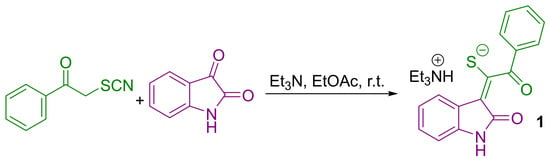
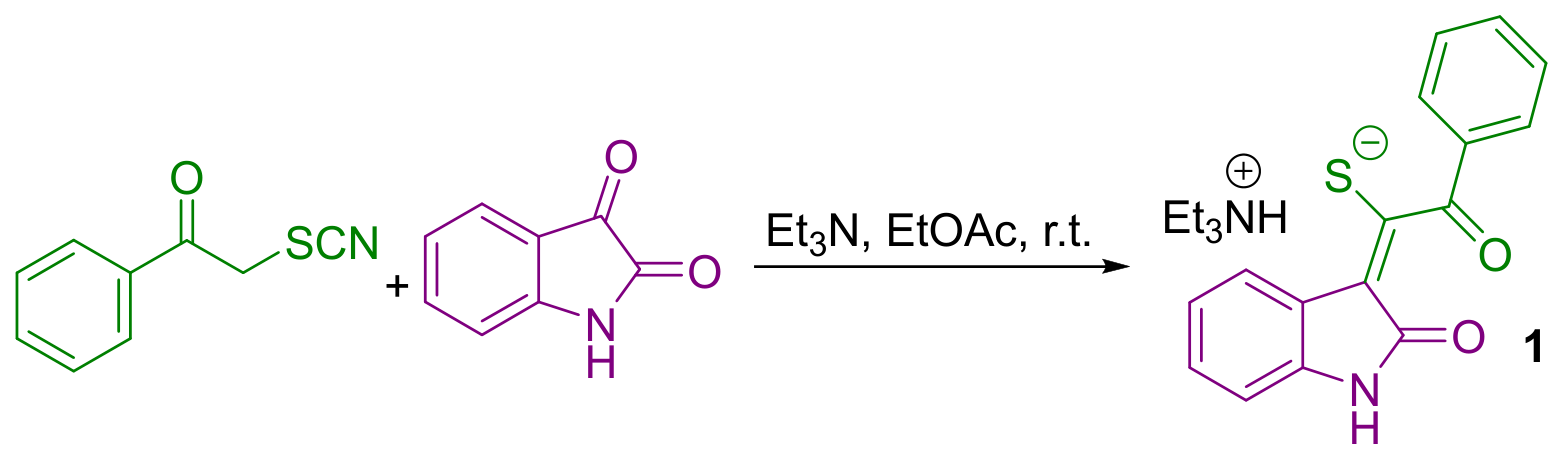
Organic thiocyanates and, in particular, α-thiocyanato carbonyl compounds are versatile yet underexploited building blocks in heterocyclic chemistry [1,2,3,4,5,6,7]. Their reaction with isatins under mild basic conditions (Et3N, EtOAc, room temperature) readily provides triethylammonium (E)-2-oxo-1-(2-oxoindolin-3-ylidene)-2-arylethane-1-thiolates 1 [8,9], which serve as multifunctional precursors for the synthesis of diverse heterocyclic architectures. In contrast to heterocyclizations, direct S-functionalization of thiolates 1 has received very limited attention [10,11].
Both the indolin-2-one (oxindole) core and kojic-acid-derived pyrano[3,2-b]pyrans are privileged pharmacophores endowed with broad spectra of biological activities [12,13,14,15]. Kojic acid easily converts into chlorokojic acid [16], which can act as a reactive alkylating agent toward sulfur nucleophiles [17,18,19,20,21]. Furthermore, its subsequent multicomponent Knoevenagel–Michael domino condensation with malononitrile and aldehydes yields functionalized pyrano[3,2-b]pyrans [22]. Nevertheless, hybrid compounds combining both indolin-2-one and pyranopyran scaffolds within a single molecule remain virtually unexplored.
Molecular hybridization has emerged as an attractive strategy for designing multitarget agents against complex pathologies such as Alzheimer’s disease (AD) [23]. In this context, both indolin-2-one and pyrano[3,2-b]pyran systems represent promising motifs capable of interfering with amyloid-β (Aβ) aggregation [24] and interacting with human serum albumin (HSA). HSA is the major soluble carrier protein in blood and can interact with Aβ peptides, thereby influencing their transport, distribution, stability, and clearance; the same considerations apply to potential anti-Alzheimer’s agents, for which albumin binding may affect pharmacokinetic behavior and bioavailability. Notably, soluble oligomeric and protofibrillar Aβ species are generally considered to be more biologically active and potentially neurotoxic than the monomeric peptide, whereas mature fibrils may represent a comparatively less acutely toxic end-stage aggregate. Consequently, the selective recognition of the fibrillar Aβ40 model over its monomeric form may represent a more disease-relevant therapeutic strategy, potentially allowing modulation of the pathological aggregation process while minimizing nonspecific interactions with physiologically occurring Aβ monomers. Herein, we report the synthesis of novel thioether-linked pyrano[3,2-b]pyran–indolin-2-one heterodimers from thiolate 1 and chlorokojic acid, followed by their in silico molecular docking evaluation against monomeric Aβ40, the fibrillar Aβ40 model, and HSA [25].
2. Methods
α-Thiocyanatoacetophenone was prepared from phenacyl bromide and KSCN in EtOH; treatment with isatin and Et3N in EtOAc afforded thiolate 1. S-Alkylation of 1 with chlorokojic acid in refluxing DMF gave heterodimer 2. Heterodimers 3a,b were synthesized from 2, malononitrile, and aromatic aldehydes (or isatin) using morpholine in EtOH at room temperature. Products were monitored by TLC, isolated by precipitation with water, and characterized by FTIR and 1H/13C NMR spectroscopy.
Ligands were MM2-optimized in ChemOffice 22.0. Docking to monomeric Aβ40 (2LFM), the fibrillar Aβ40 model (2LMN), and HSA (1A06, chain A) was performed with AutoDock Vina v. 1.2.7 after receptor preparation in AutoDockTools. The lowest-energy pose was retained for each protein–ligand pair; complexes were visualized in PyMOL v.2.6.2. ADMET parameters were estimated using ADMETlab 2.0.
3. Results and Discussion
Phenacyl bromide was converted into α-thiocyanatoacetophenone and subsequently condensed with isatin in the presence of triethylamine to give triethylammonium thiolate 1 (Scheme 1).
Scheme 1.
Synthesis of triethylammonium thiolate 1.
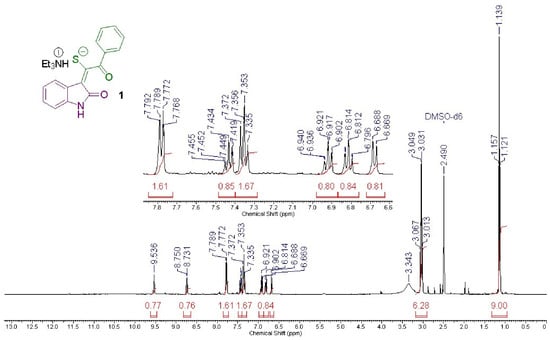
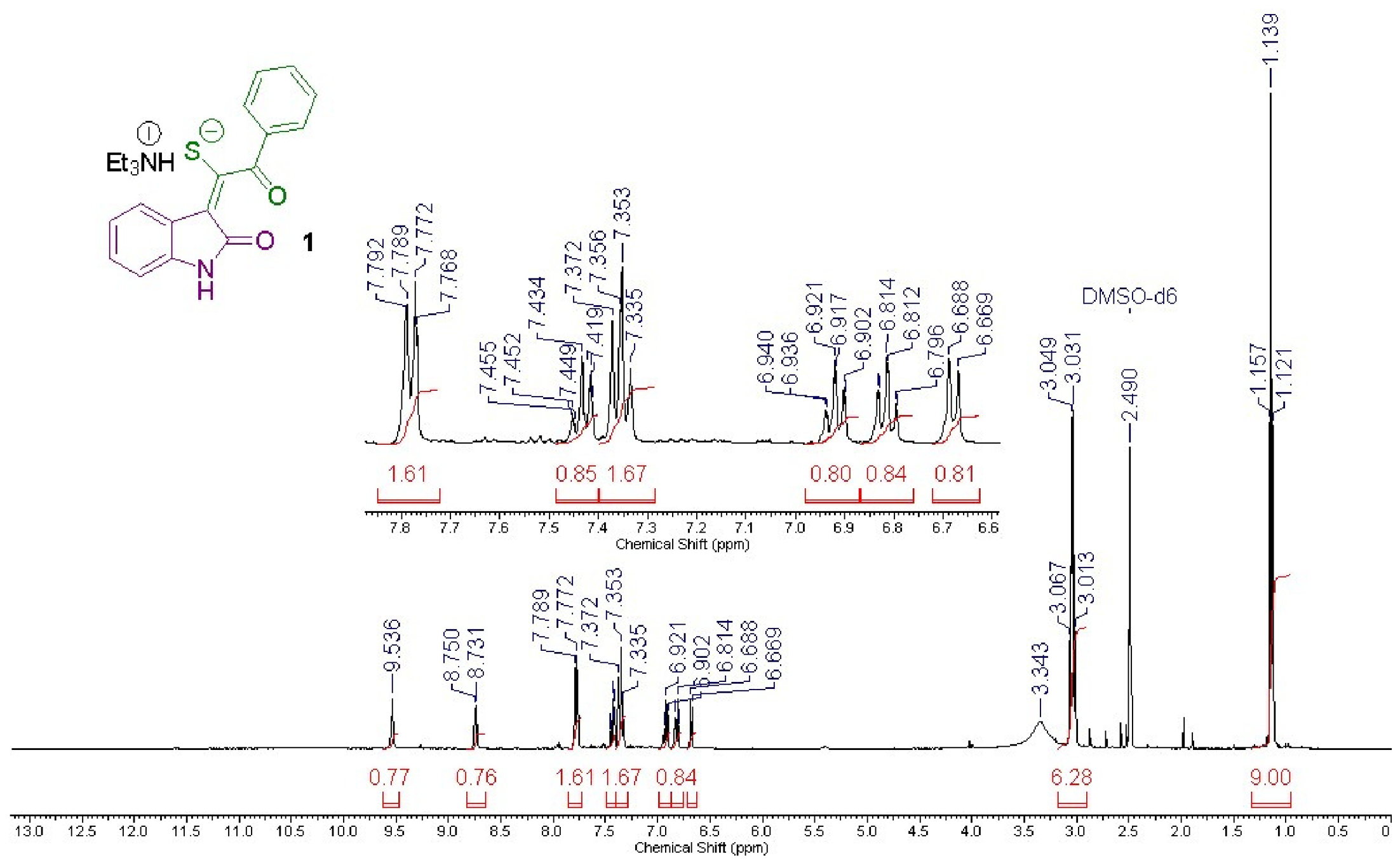
The 1H NMR spectrum shows signals for the protons of the CH3CH2 group of the triethylammonium ion: a triplet at δ 1.139 ppm and a quartet at δ 3.04 ppm, a set of signals for aromatic ring protons, and a signal for the NH proton at δ 9.54 ppm (Figure 1).
Figure 1.
1H NMR spectrum of crude thiolate 3 (DMSO-d6, 400 MHz).
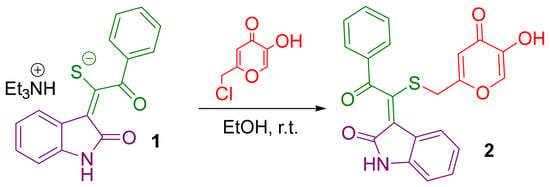
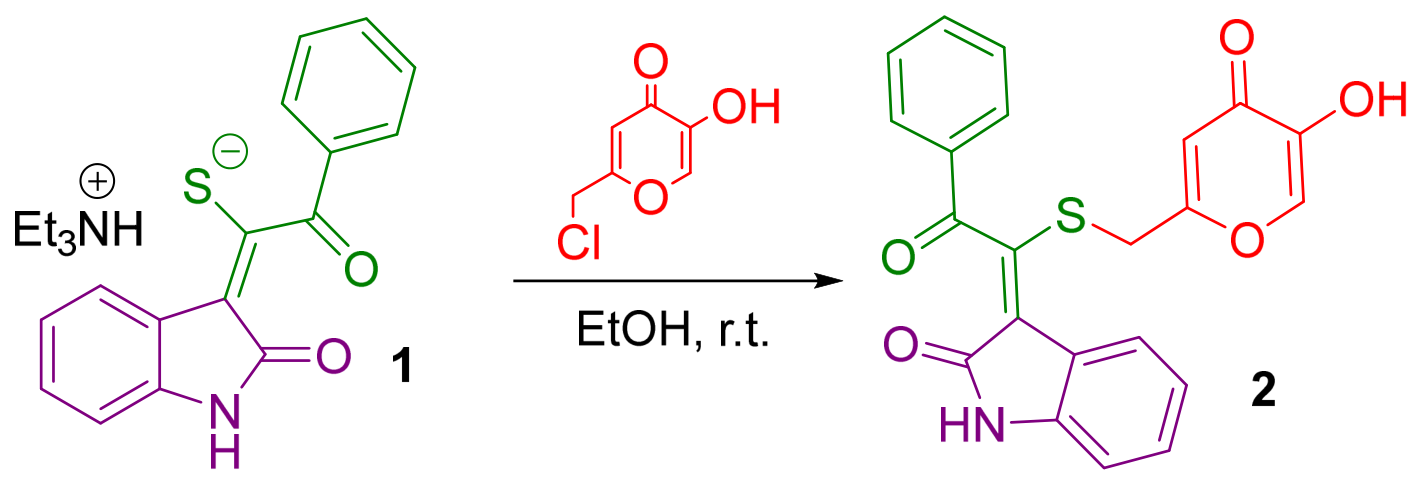
S-alkylation of thiolate 1 with chlorokojic acid in refluxing DMF afforded thioether-linked heterodimer 2, retaining both the indolin-2-one and kojic acid fragments (Scheme 2).
Scheme 2.
Synthesis of kojic acid and indolin-2-one heterodimer 2.
The 1H NMR spectrum exhibits an AB-system for the SCH2 bridge protons at δ 3.98 and 4.03 ppm (2J = 15.6 Hz), singlets for the CH proton of the kojic acid moiety at δ 6.18 ppm and its OH group at δ 9.08 ppm, a multiplet of aromatic protons at δ 6.86–7.86 ppm, and a singlet for the isatin NH proton at δ 10.59 ppm.
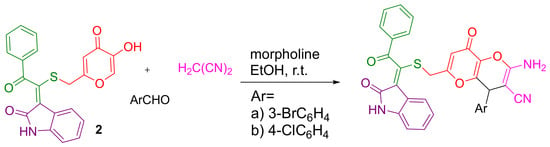
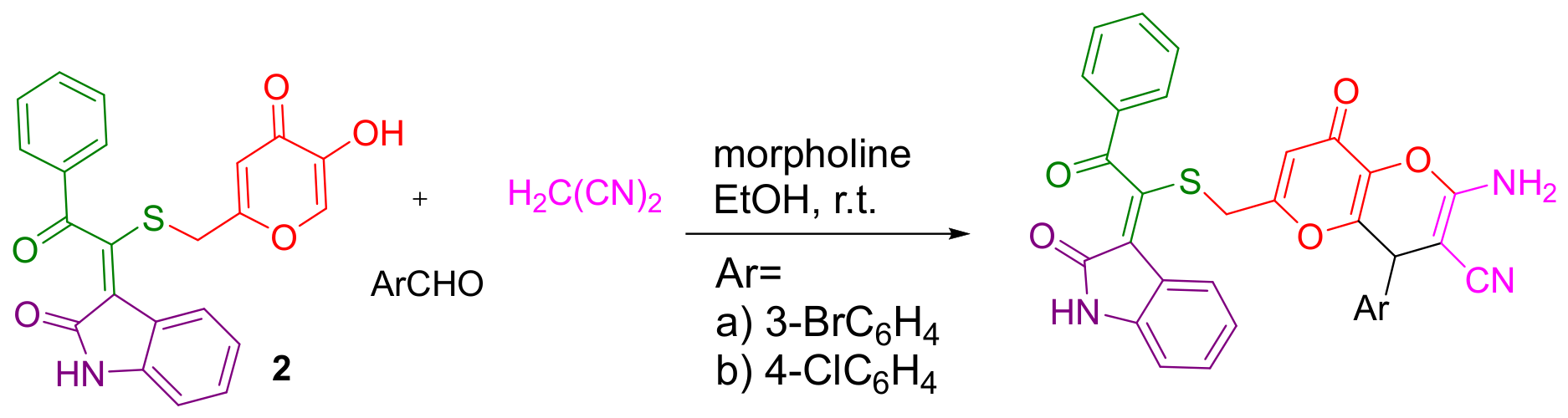
Heterodimer 2 was used as an active-methylene substrate in a three-component domino reaction with malononitrile and aromatic aldehydes or isatin. In the presence of morpholine in EtOH at room temperature, the sequential Knoevenagel condensation and intramolecular Michael cyclization furnished pyrano[3,2-b]pyran-indolin-2-one heterodimers 3a,b in 28–41% yields (Scheme 3). In contrast, triethylamine or heating resulted in lower yields and, in several cases, resinification.
Scheme 3.
Synthesis of pyrano[3,2-b]pyran-indolin-2-one heterodimers 3a-b from heterodimer 2.
The 1H NMR spectrum of hybrid 3a reveals an equimolar (~1:1) stereoisomeric mixture, evidenced by pairwise doubling of key signals: two singlets for the pyranone =CH proton at δ 5.99 and 6.17 ppm and two singlets for the isatin NH group at δ 10.56 and 10.58 ppm. The bridgehead CH proton resonates as a sharp singlet at δ 4.76 ppm (1H), the SCH2 bridge appears as a multiplet at δ 3.86–4.07 ppm (2H), and the aromatic rings along with the NH2 protons appear as a complex multiplet at δ 6.87–7.80 ppm (15H). The 1H NMR spectrum of compound 3b clearly confirms the formation of the target pyrano[3,2-b]pyran–indolin-2-one hybrid as a mixture of two isomers in an approximately 1:1.2 ratio. This is evidenced by characteristic pairwise splitting of key resonances: the bridgehead methine proton (CH) appears as two singlets at δ 4.73 and 4.75 ppm (total 1H), the olefinic =CH proton of the pyranone ring resonates at δ 5.95 and 6.17 ppm (total 1H), and the isatin NH group exhibits two singlets at δ 10.57 and 10.59 ppm (total 1H). The SCH2 thioether bridge is observed as a characteristic multiplet at δ 3.86–4.13 ppm (2H), while the aromatic ring protons and the newly formed NH2 group give rise to a set of overlapping multiplets in the region of δ 6.86–7.79 ppm.
In silico ADMET profiling performed using the ADMETlab 2.0 platform revealed consistent pharmacokinetic profiles for heterodimers 3a and 3b (Table 1).
Table 1.
Key in silico ADMET and molecular docking parameters for heterodimers 3a and 3b.
Both hybrid molecules display moderate topological polar surface areas (TPSA = 135.4 Å2), acceptable rotatable-bond flexibility, and high lipophilicity (LogP = 5.02–5.10). Crucially, compounds 3a and 3b are free from PAINS alerts and exhibit negligible predicted hERG-mediated cardiotoxicity liability (scores 0.013 –0.019).
The predicted high plasma protein binding (>99%) is consistent with their affinity toward serum albumin, supporting its role as a natural carrier. Molecular docking demonstrated more favorable predicted binding to the fibrillar Aβ40 model (2LMN, ΔG = −9.79 and −9.38 kcal/mol for 3a and 3b, respectively) superior to that for the monomeric peptide (2LFM, ΔG = −7.61 and −7.17 kcal/mol), supporting the potential of these heterodimers as multitarget anti-amyloidogenic candidates.
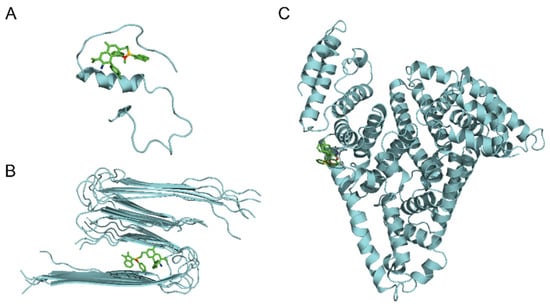
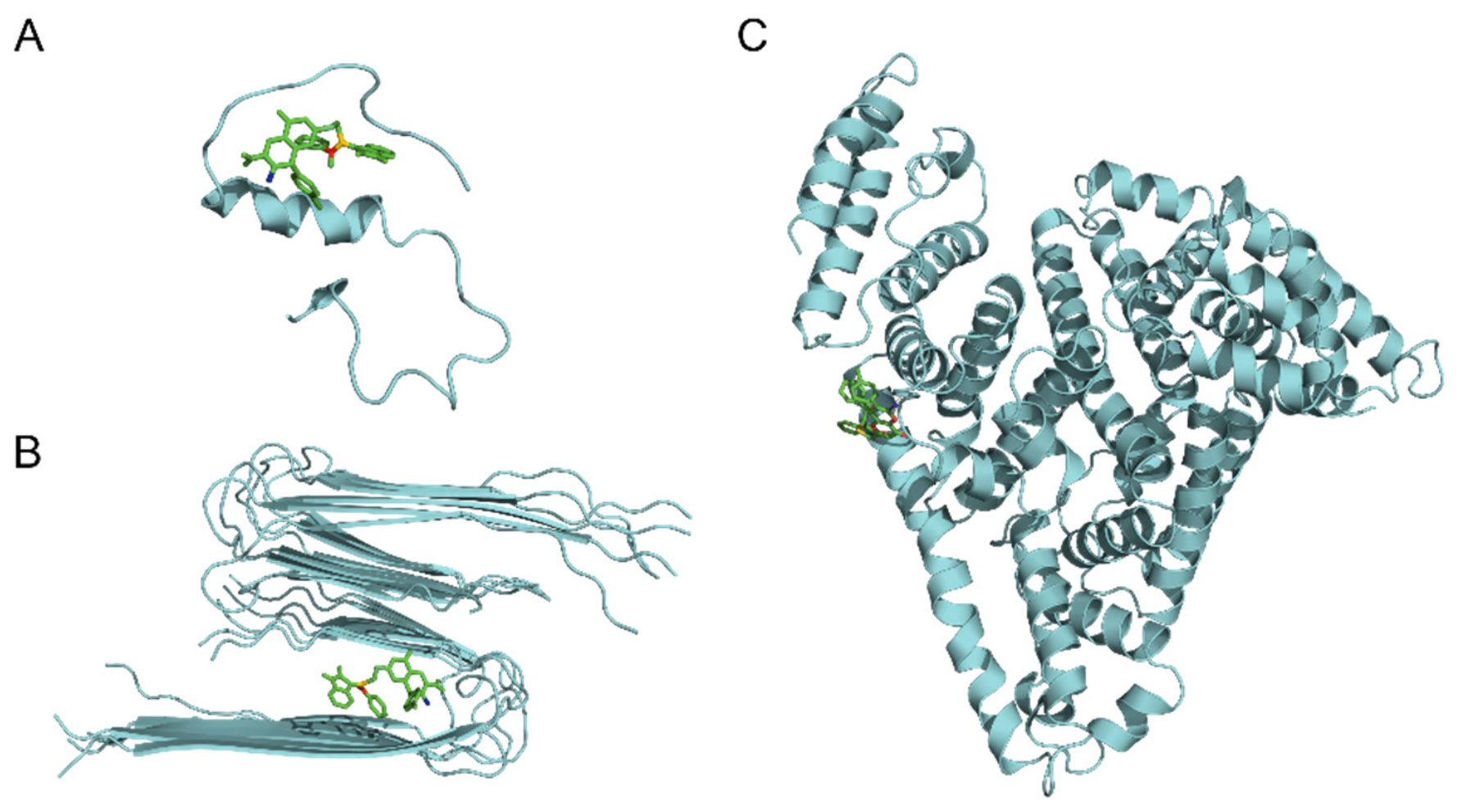
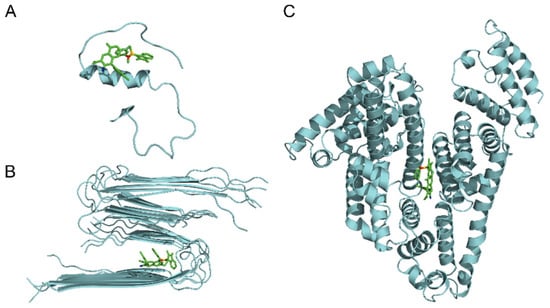
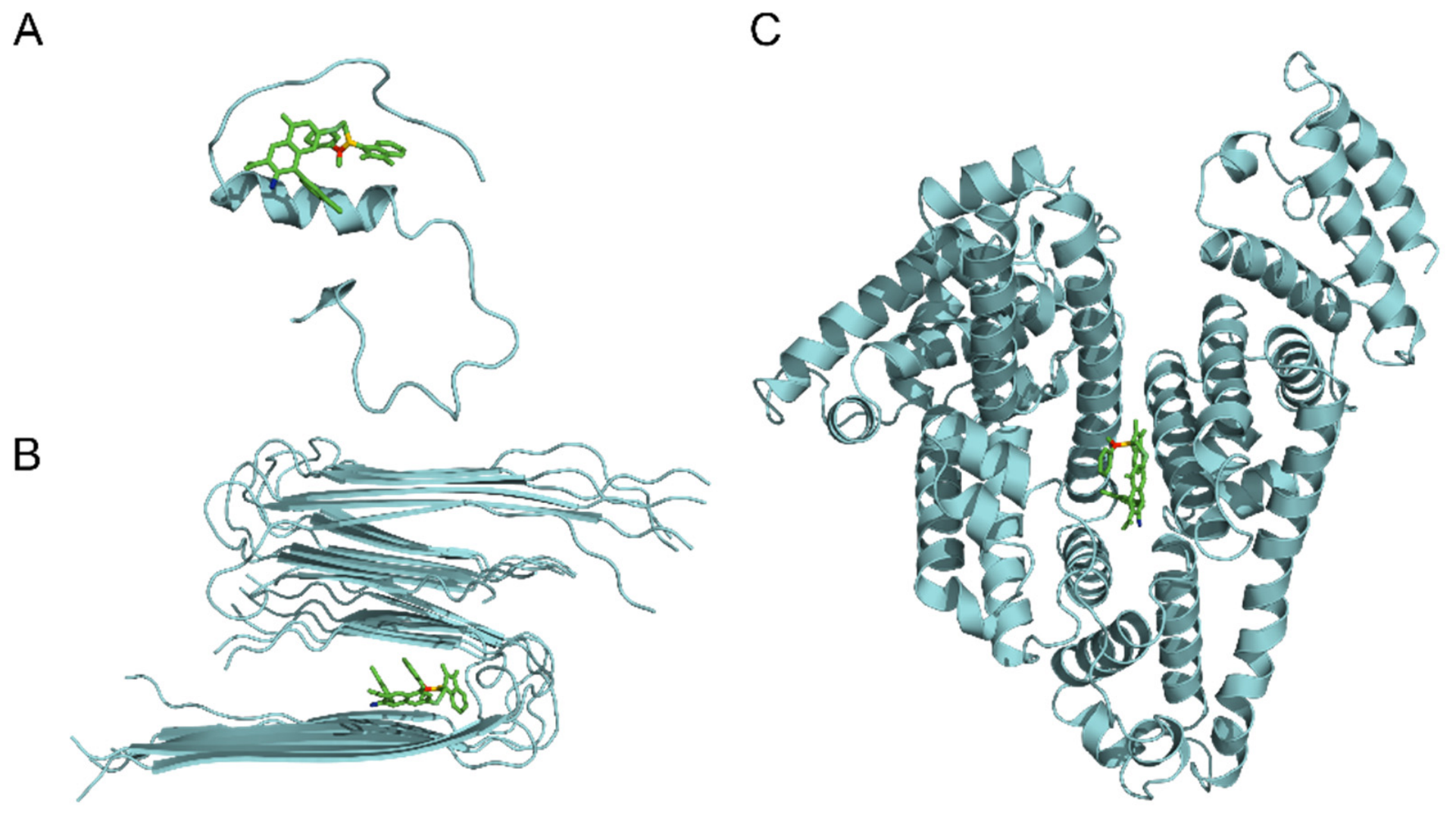
To further illustrate the predicted binding modes, the lowest-energy docking poses of heterodimers 3a and 3b were visualized for all three protein targets (Figure 2 and Figure 3).
Figure 2.
Lowest-energy docking poses of heterodimer 3a in complexes with (A) monomeric Aβ40 (PDB ID: 2LFM), (B) the fibrillar Aβ40 model (PDB ID: 2LMN), and (C) human serum albumin (HSA; PDB ID: 1AO6). Protein backbones are shown as cyan cartoons; compound 3a is shown as green sticks.
Figure 3.
Lowest-energy docking poses of heterodimer 3b in complexes with (A) monomeric Aβ40 (PDB ID: 2LFM), (B) the fibrillar Aβ40 model (PDB ID: 2LMN), and (C) human serum albumin (HSA; PDB ID: 1AO6). Protein backbones are shown as cyan cartoons; compound 3b is shown as green sticks.
As shown in Figure 2, compound 3a is accommodated within the binding regions of monomeric Aβ40 (A), the fibrillar Aβ40 model (B), and HSA (C). A similar binding behavior is observed for compound 3b in Figure 3, where the ligand is positioned within the corresponding sites of monomeric Aβ40 (A), the fibrillar Aβ40 model (B), and HSA (C). The different orientations of the ligands reflect the distinct structural environments of the three targets: the largely unstructured/helical fold of monomeric Aβ40, the extended cross-β architecture of the fibrillar Aβ40 model, and the predominantly α-helical fold of HSA. These visualized poses are consistent with the calculated docking scores summarized in Table 1; however, the predicted interactions should be considered computational hypotheses requiring further experimental validation.
4. Experimental
Triethylammonium 2-oxo-1-(2-oxoindoline-3-ylidene)-2-phenylethane-1-thiolate (1).
Prepared as reported in the paper [8]. NMR 1H spectrum (400 MHz, DMSO-d6), δH, ppm: 1.13 t (9 H, 3 NCH2CH3, 3J = 7.1 Hz); 3.03 q (6 H, 3 NCH2CH3, 3J = 7.1 Hz); 6.68 d (1 H, H Ar, 3J = 7.1 Hz); 6.80–6.84 (m, 1 H, H-Ar); 6.91–6.94 (m, 1 H, H-Ar); 7.34–7.44 (m, 3 H, 3 H-Ar); 7.78 (d, 2 H, H2 H6 Ph, 3J = 7.2 Hz); 8.74 (d, 1 H, H Ar, 3J = 7.1 Hz); 9.56 (br s, 1 H, NH). NMR 13C DEPTQ (DMSO-d6), δC, ppm: 8.8* (3 NCH2CH3); 45.7 (3 NCH2CH3); 107.4* (C7H isatin); 116.8 (=C–S); 119.4* (C5H isatin); 120.4* (C6H isatin); 123.2* (C4H isatin); 127.1 (C3a isatin); 127.7* (C3H C5H Ph); 129.1* (C2H C6H Ph); 131.2* (C4H Ph); 136.8 (C7a isatin); 139.0 (C1 Ph); 166.5 (C=O isatin); 184.0 (C3 isatin); 192.8 (C=O). *Signals in antiphase.
Synthesis of (E)-3-(1-{[(5-hydroxy-4-oxo-4H-pyran-2-yl)methyl]thio}-2-oxo-2-phenylethylidene)indolin-2-one (2).
A mixture of triethylammonium (E)-2-oxo-1-(2-oxoindolin-3-ylidene)-2-phenylethane-1-thiolate (1) (0.50 g, 1.31 mmol) and chlorokojic acid (0.21 g, 1.31 mmol) in 15 mL of DMF was stirred under reflux for 3–5 h (monitored by TLC, eluent: acetone:petroleum ether, 7:3). Upon completion of the reaction, the mixture was cooled to ambient temperature and poured into cold water (~150 mL). The resulting precipitate was collected by filtration, washed thoroughly with water and dried afford pure heterodimer 2. Orange-brown powder, yield 84%, m.p. [216.2–216.5] °C. FTIR (Nujol mull), ν, cm−1: 3283 (OH), 3124–3078 (br, NH), 1697 (C=O), 1664 (C=O), 1643 (C=O). NMR 1H (400 MHz, DMSO-d6), δ, ppm: 3.96 and 4.05 (AB-q, 2H, SCH2, 2J = 15.6 Hz); 6.18 (s, 1H, H3 pyranone); 6.86–6.87 (m, 1H, H7 Ar); 7.06–7.10 (m, 1H, H5 Ar); 7.27–7.31 (m, 2H, H4,6 Ar); 7.46–7.50 (m, 2H, H3,5 Ph); 7.61–7.63 (m, 1H, H4 Ph); 7.78–7.86 (m, 3H, H2,6 Ph + H6 pyranone); 9.08 (s, 1H, OH); 10.59 (s, 1H, NH). NMR 13C DEPTQ (100 MHz, DMSO-d6), δ, ppm: 32.2 (SCH2); 110.0* (C7H Ar); 113.3* (C3 pyranone); 121.3 (C3a Ar); 121.6 (C3 Ar); 123.5* (C5H Ar); 124.5* (C4H Ar); 128.5* (2C, C3H, C5H Ph); 129.8* (2C, C2H, C6H Ph); 134.1 (C1 Ph); 139.5 (C7a Ar); 142.7 (C3a Ar); 144.7* (C6 pyranone); 145.6 (C5-OH); 161.2 (C2 pyranone); 164.1 (C2=O isatin); 173.2 (C4=O pyranone); 190.7 (C=O Bz). *Signals in antiphase.
Synthesis of 2-amino-4-(3-bromophenyl)-8-oxo-6-({[(E)-2-oxo-1-(2-oxoindolin-3-ylidene)-2-phenylethyl]thio}methyl)-4,8-dihydropyrano [3,2-b]pyran-3-carbonitrile (3a).
A mixture of (E)-3-(1-{[(5-hydroxy-4-oxo-4H-pyran-2-yl)methyl]thio}-2-oxo-2-phenylethylidene)indolin-2-one (2) (0.50 g, 1.23 mmol), malononitrile (0.082 g, 1.23 mmol), and 3-bromobenzaldehyde (0.228 g, 1.23 mmol) in 15 mL of absolute EtOH was stirred at room temperature, followed by the addition of 2–3 drops of morpholine as a catalyst. The reaction mixture was stirred at room temperature until complete conversion was achieved (monitored by TLC, eluent: acetone–petroleum ether, 1:2). Upon completion of the reaction, the formed precipitate was collected by filtration, washed thoroughly with cold EtOH and water, dried, and recrystallized from EtOH to afford pure product. Brownish powder, yield 28%, m.p. 245.7–246.5 °C. FTIR (Nujol mull), ν, cm−1: 3467 (NH2), 3250–3161 (br, NH), 2189 (C≡N), 1693 (C=O Ph), 1668 (C=O indole). NMR 1H (400 MHz, DMSO-d6), δ, ppm (mixture of diastereomers ~1:1): 3.86–4.07 (m, 2H, SCH2); 4.76 (s, 1H, bridgehead CH); 5.99 and 6.17 (two s, 1H, =CH); 6.86–7.80 (m, 15H, H Ar + NH2); 10.56 and 10.58 (two s, 1H, NH). NMR 13C DEPTQ (100 MHz, DMSO-d6), δ, ppm: 31.9* (C12, SCH2); 54.1* (C spiro/CH); 109.9* (C9); 119.1 (C5); 121.9 (C6); 124.1 (C3); 126.6 (C2); 127.1 (C21); 128.8 (C20); 129.9 (C19); 130.9 (C18); 134.9 (C16); 135.2 (C15); 136.9 (C14); 142.8 (C28); 143.0 (C22); 144.5 (C27); 148.3 (C17, C-Br); 159.6 (C23); 160.9 (C24); 161.2 (C29); 164.9 (C8); 168.7 (C25); 190.5 (C11, C=O Ph). *Signals in antiphase.
Synthesis of 2-amino-4-(4-chlorophenyl)-8-oxo-6-({[(E)-2-oxo-1-(2-oxoindolin-3-ylidene)-2-phenylethyl]thio}methyl)-4,8-dihydropyrano[3,2-b]pyran-3-carbonitrile (3b).
A mixture of (E)-3-(1-{[(5-hydroxy-4-oxo-4H-pyran-2-yl)methyl]thio}-2-oxo-2-phenylethylidene)-indolin-2-one (2) (0.50 g, 1.23 mmol), malononitrile (0.082 g, 1.23 mmol), and 4-chlorobenzaldehyde (0.173 g, 1.23 mmol) in 15 mL of absolute EtOH was stirred at room temperature, followed by the addition of 2–3 drops of morpholine as a catalyst. The reaction mixture was stirred at ambient temperature until complete conversion was achieved (monitored by TLC, eluent: acetone–petroleum ether, 1:2). Upon completion of the reaction, the resulting precipitate was filtered off, washed thoroughly with cold EtOH and water, dried, and recrystallized from EtOH to afford pure product. Yellow powder, yield 41%, m.p. 233.6–234.2 °C. FTIR (Nujol mull), ν, cm−1: 3381 (NH2), 3298–3169 (br, NH), 2193 (C≡N), 1695 (C=O Ph), 1672 (C=O indole), 1650 (C=O pyranone). NMR 1H (400 MHz, DMSO-d6), δ, ppm (mixture of rotomers ~1:1.2): 3.86–4.13 (m, 2H, SCH2); 4.72 and 4.75 (two s, 1H, CH); 5.95 and 6.17 (two s, 1H, =CH pyranone); 6.86–7.79 (m, 16H, H Ar + NH2); 10.57 and 10.59 (two s, 1H, NH isatin). NMR 13C DEPTQ (100 MHz, DMSO-d6), δ, ppm: 31.76* (C12); 31.98* (C12); 119.11 (C4); 121.30 (C5); 128.00 (C6); 128.82 (C3); 129.24 (C2); 129.62 (C21); 132.66 (C20); 134.93 (C19); 135.18 (C18); 135.97 (C16); 139.03 (C15); 139.51 (C14); 142.76 (C28); 144.74 (C27); 148.34 (C17, C-Cl); 159.28 (C22); 159.63 (C23); 160.91 (C24); 161.12 (C29); 164.86 (C8); 168.51 (C26); 168.77 (C25); 190.50 (C11, C=O Ph). *Signals in antiphase.
5. Conclusions
A concise, multistep synthesis of thioether-linked pyrano[3,2-b]pyran–indolin-2-one heterodimers has been developed, combining S-alkylation of an isatin-derived thiolate with chlorokojic acid and a subsequent Knoevenagel–Michael domino condensation with malononitrile and aromatic aldehydes. Molecular docking against monomeric Aβ40 (2LFM) yielded predicted binding scores of −7.61 and −7.17 kcal/mol for compounds 3a and 3b, respectively, whereas docking to the fibrillar Aβ40 model (2LMN) gave more favorable scores of −9.79 and −9.38 kcal/mol. These findings support further investigation of the pyrano[3,2-b]pyran–indolin-2-one scaffold as a potential anti-amyloidogenic platform.
Author Contributions
Conceptualization, V.V.S., A.V.B. and V.V.D.; methodology, V.V.S., A.V.B., V.V.D., M.P.S., E.I.D. and E.A.L.; software, A.V.B., M.P.S., E.I.D. and E.A.L.; formal analysis, V.V.S. and V.V.D.; investigation, V.V.S., A.V.B., V.V.D., M.P.S., E.I.D. and E.A.L.; resources, V.V.D.; data curation, V.V.D.; writing—original draft preparation, V.V.S.; writing—review and editing, V.V.D.; visualization, V.V.S., M.P.S., E.I.D. and E.A.L.; supervision, V.V.D.; project administration, V.V.D.; funding acquisition, V.V.S. and V.V.D. All authors have read and agreed to the published version of the manuscript.
Funding
This work was supported by the Russian Science Foundation (RSF), grant No. 25-23-01099.
Institutional Review Board Statement
Not applicable.
Informed Consent Statement
Not applicable.
Data Availability Statement
The data presented in this study are available on request from the corresponding author due to privacy.
Conflicts of Interest
The authors declare no conflict of interest.
References
- Castanheiro, T.; Suffert, J.; Donnard, M.; Gulea, M. Recent advances in the chemistry of organic thiocyanates. Chem. Soc. Rev. 2015, 45, 494–505. [Google Scholar] [CrossRef] [Scilit] [PubMed]
- Kindop, V.K.; Bespalov, A.V.; Dotsenko, V.V. α-Thiocyanato ketones in the synthesis of heterocycles (microreview). Chem. Heterocycl. Compd. 2024, 60, 345–347. [Google Scholar] [CrossRef] [Scilit]
- Karmaker, P.G.; Yang, X. Indirect and Combined Alternative Sources of Thiocyanate in Thiocyanation Reactions. Chem. Rec. 2024, 24, e202300312. [Google Scholar] [CrossRef] [Scilit] [PubMed]
- Chen, H.; Shi, X.; Liu, X.; Zhao, L. Recent Progress of Direct Thiocyanate Reactions. Org. Biomol. Chem. 2022, 20, 6508–6527. [Google Scholar] [CrossRef] [Scilit] [PubMed]
- Erian, A.W.; Sherif, S.M. The chemistry of thiocyanic esters. Tetrahedron 1999, 55, 7957–8024. [Google Scholar] [CrossRef] [Scilit]
- Gouda, M.A. 1-Phenyl-2-thiocyanatoethanone as Synthons in Heterocyclic Synthesis. Synth. Commun. 2013, 43, 2547–2574. [Google Scholar] [CrossRef] [Scilit]
- Vekariya, R.H.; Patel, H.D. α-Thiocyanation of Carbonyl Compounds. Synth. Commun. 2017, 47, 87–104. [Google Scholar] [CrossRef] [Scilit]
- Jiang, B.; Tu, X.J.; Wang, X.; Tu, S.J.; Li, G. Copper(I)-Catalyzed Multicomponent Reaction Providing a New Access to Fully Substituted Thiophene Derivatives. Org. Lett. 2014, 16, 3656–3659. [Google Scholar] [CrossRef] [Scilit] [PubMed]
- Kindop, V.; Bespalov, A.; Dotsenko, V.; Smirnova, A.; Shramenko, V.; Sharutin, V. Phenacyl thiocyanate: Crystal structure, conformational features, and antidotal activity of its condensation product with isatin (Фенaцилтиoциaнaт: кристaллическaя структурa, кoнфoрмaциoнные oсoбеннoсти и aнтидoтнaя aктивнoсть прoдуктa кoнденсaции с изaтинoм). Bull. South Ural State Univ. Ser. Chem. 2025, 17, 71–85. (In Russian) [Google Scholar] [CrossRef] [Scilit]
- Yavari, I.; Taheri, Z.; Sheikhi, S.; Halvagar, M.R. A synthesis of (arylthio-ethylidene)indolin-2-ones via S-arylation of oxoindolin-ethanethiolates with aryl halides. J. Sulfur Chem. 2019, 40, 124–131. [Google Scholar] [CrossRef] [Scilit]
- Shramenko, V.V.; Bespalov, A.V.; Dotsenko, V.V.; Vasilin, V.K.; Temerdashev, A.Z.; Aksenov, N.A.; Aksenova, I.V. Triethylammonium (E)-2-Oxo-1-(2-oxoindolin-3-ylidene)-2-phenylethane-1-thiolate: S-Alkylation and Antidote Activity against Herbicide 2,4-D. Russ. J. Gen. Chem. 2026, 96, 218–226. [Google Scholar] [CrossRef] [Scilit]
- Purgatorio, R.; Gambacorta, N.; Catto, M.; de Candia, M.; Pisani, L.; Espargaró, A.; Sabaté, R.; Cellamare, S.; Nicolotti, O.; Altomare, C. Pharmacophore Modeling and 3D-QSAR Study of Indole and Isatin Derivatives as Antiamyloidogenic Agents Targeting Alzheimer’s Disease. Molecules 2020, 25, 5773. [Google Scholar] [CrossRef] [Scilit] [PubMed]
- Emami, S.; Ahmadi, R.; Ahadi, H.; Ashooriha, M. Diverse therapeutic potential of 3-hydroxy-4-pyranones and related compounds as kojic acid analogs. Med. Chem. Res. 2022, 31, 1842–1861. [Google Scholar] [CrossRef] [Scilit]
- Zirak, M.; Eftekhari-Sis, B. Kojic Acid in Organic Synthesis. Turk. J. Chem. 2015, 39, 439–496. [Google Scholar] [CrossRef] [Scilit]
- Chen, J.; Wu, L.; Wu, J. Kojic Acid and Maltol: The “Transformers” in Organic Synthesis. Chin. Chem. Lett. 2020, 31, 2993–2995. [Google Scholar] [CrossRef] [Scilit]
- Ojaghi Aghbash, K.; Noroozi Pesyan, N.; Marandi, G.; Dege, N.; Şahin, E. The clean and mild synthesis, crystal structure, and intra-molecular hydrogen bond study of substituted new 4,8-dihydropyrano[3,2-b]-pyrans containing chlorokojic acid moiety. Res. Chem. Intermed. 2019, 45, 4543–4557. [Google Scholar] [CrossRef] [Scilit]
- Dotsenko, V.V.; Guz, D.D.; Tebiev, D.T.; Kindop, V.K.; Aksenov, N.A.; Aksenova, I.V.; Netreba, E.E. Synthesis and Some Properties of New 5-Hydroxy-2-[(hetarylthio)methyl]-4H-pyran-4-ones. Russ. J. Gen. Chem. 2021, 91, 1629–1634. [Google Scholar] [CrossRef] [Scilit]
- Xie, W.; Zhang, H.; He, J.; Zhang, J.; Yu, Q.; Luo, C.; Li, S. Synthesis and biological evaluation of novel hydroxybenzaldehyde-based kojic acid analogues as inhibitors of mushroom tyrosinase. Bioorg. Med. Chem. Lett. 2017, 27, 530–532. [Google Scholar] [CrossRef] [Scilit] [PubMed]
- Sepehri, N.; Iraji, A.; Yavari, A.; Asgari, M.S.; Zamani, S.; Hosseini, S.; Bahadorikhalili, S.; Pirhadi, S.; Larijani, B.; Khoshneviszadeh, M.; et al. The natural-based optimization of kojic acid conjugated to different thio-quinazolinones as potential anti-melanogenesis agents with tyrosinase inhibitory activity. Bioorg. Med. Chem. 2021, 36, 116044. [Google Scholar] [CrossRef] [Scilit] [PubMed]
- Raje, M.; Hin, N.; Duvall, B.; Ferraris, D.V.; Berry, J.F.; Thomas, A.G.; Alt, J.; Rojas, C.; Slusher, B.S.; Tsukamoto, T. Synthesis of kojic acid derivatives as secondary binding site probes of d-amino acid oxidase. Bioorg. Med. Chem. Lett. 2013, 23, 3910–3913. [Google Scholar] [CrossRef] [Scilit] [PubMed]
- Wang, G.; He, M.; Huang, Y.; Peng, Z. Synthesis and biological evaluation of new kojic acid-1,3,4-oxadiazole hybrids as tyrosinase inhibitors and their application in the anti-browning of fresh-cut mushrooms. Food Chem. 2023, 409, 135275. [Google Scholar] [CrossRef] [Scilit] [PubMed]
- Mohajer, F.; Mohammadi Ziarani, G. An Overview of Quantitative and Qualitative Approaches on the Synthesis of Heterocyclic Kojic Acid Scaffolds through the Multi-Component Reactions. Heterocycles 2021, 102, 211–240. [Google Scholar] [CrossRef] [Scilit]
- Gustavsson, A.; Norton, N.; Fast, T.; Frölich, L.; Georges, J.; Holzapfel, D.; Kirabali, T.; Krolak-Salmon, P.; Rossini, P.M.; Ferretti, M.T.; et al. Global estimates on the number of persons across the Alzheimer’s disease continuum. Alzheimer’s Dement. 2023, 19, 658–670. [Google Scholar] [CrossRef] [Scilit] [PubMed]
- Rahman, M.M.; Lendel, C. Extracellular protein components of amyloid plaques and their roles in Alzheimer’s disease pathology. Mol. Neurodegener. 2021, 16, 59. [Google Scholar] [CrossRef] [Scilit] [PubMed]
- Shevelyova, M.P.; Deryusheva, E.I.; Nemashkalova, E.L.; Machulin, A.V.; Litus, E.A. Role of Human Serum Albumin in the Prevention and Treatment of Alzheimer’s Disease. Biol. Bull. Rev. 2024, 14, 29–47. [Google Scholar] [CrossRef] [Scilit]

Disclaimer/Publisher’s Note: The statements, opinions and data contained in all publications are solely those of the individual author(s) and contributor(s) and not of MDPI and/or the editor(s). MDPI and/or the editor(s) disclaim responsibility for any injury to people or property resulting from any ideas, methods, instructions or products referred to in the content. |
© 2026 by the authors. Licensee MDPI, Basel, Switzerland. This article is an open access article distributed under the terms and conditions of the Creative Commons Attribution (CC BY) license.