


Abstract
The development of sustainable alternatives to traditional chemical oxidation processes represents a primary objective in modern green chemistry. In this work, we report the biocatalytic potential of the strain Ectopseudomonas oleovorans CECT 5344 R1D for the selective, chemo- and regioselective oxidation of a diverse range of aldehydes into their corresponding high-value carboxylic acids. Our results demonstrate that this biocatalyst exhibits remarkable versatility, successfully transforming a broad library of aromatic and heterocyclic aldehydes under mild, aqueous conditions, thus bypassing the need for hazardous metal catalysts or stoichiometric oxidants. We performed a systematic evaluation of the substrate scope, assessing the system’s robustness by testing substrate concentrations ranging from 2 to 100 mM. While complete conversion (100%) was achieved for most substrates at lower loads, higher concentrations revealed specific limitations in the biocatalytic performance, which were characterised and discussed. Notably, the strain achieved complete assimilation of furfural, further expanding its unique biotechnological profile as a potential detoxification agent in biofuel production. Structural identification and kinetic monitoring of the reaction products were conducted via 1H NMR analysis, providing a precise dual-analytical approach. These findings highlight E. oleovorans CECT 5344 R1D as a robust, stable, and efficient whole-cell “cell factory” for the production of value-added chemicals. Ultimately, this research provides a scalable and sustainable framework for the valorisation of bio-based aldehydes, offering a superior synthetic strategy compared to conventional, energy-intensive oxidation methodologies.
1. Introduction
The global chemical industry is currently undergoing a transformative shift, increasingly prioritising the implementation of sustainable processes that minimise environmental impact [1,2]. Within this transition, the production of carboxylic acids holds a prominent position, as these compounds serve as essential building blocks for the synthesis of polypeptides, polymers, and other valuable intermediates in the pharmaceutical, agrochemical, and materials science sectors [3,4,5]. Traditionally, industrial access to these acids has relied on the oxidation of alcohols or aldehydes using stoichiometric amounts of heavy metal-based reagents, such as chromates or permanganates [6]. Although recent developments in catalytic methodologies have enabled the use of smaller amounts of transition metals, these processes often require complex ligands, harsh conditions, or prolonged reaction times that hinder their overall efficiency [7,8,9,10]. Furthermore, even “greener” catalytic systems frequently struggle with operational complexity and high cost. In this context, biocatalytic alternatives emerge not merely as an environmentally benign option but as a superior synthetic strategy: they offer unmatched chemo- and regioselectivity under ambient, aqueous conditions, completely bypassing the need for hazardous reactants or metal-based catalysts. Thus, the implementation of robust whole-cell biocatalysts represents a key step toward achieving a truly sustainable and atom-economical framework for carboxylic acid production.
Microbial whole-cell biocatalysis has emerged as a robust platform for these transformations, leveraging the enzymatic machinery of bacteria to perform highly specific oxidations [11,12]. In this context, Pseudomonas species have gained significant attention due to their vast enzymatic repertoire and evolutionary adaptation to environments containing diverse furanic and other aromatic aldehydes [13]. Specifically, Ectopseudomonas oleovorans CECT 5344 R1D has been identified as a highly efficient and stable “cell factory” capable of mediating these conversions [14]. Unlike many reported strains that assimilate these aldehydes for biomass growth, thereby complicating the mass balance of the process, this strain functions through an oxidative detoxification pathway that yields valuable carboxylic acids as metabolic end-products, without further assimilation [15,16].
Despite the potential of such systems, the real-time monitoring of microbial biotransformations remains an analytical challenge, as traditional end-point measurements often fail to capture transient intermediates or kinetic fluctuations. In this work, we present a synthetic and preparative approach to aldehyde oxidation mediated by E. oleovorans CECT 5344 R1D, utilising benchtop Nuclear Magnetic Resonance (NMR) spectroscopy as a versatile tool for real-time and at-line kinetic analysis. Through this dual analytical strategy, we provide a detailed kinetic and stoichiometric characterisation of the oxidation process across a broad substrate scope, including furanic, aromatic, and unsaturated aldehydes. This approach underscores the synergy between a resilient, non-consuming biocatalyst and precise analytical platforms, offering a scalable and sustainable strategy for the valorisation of environmentally relevant aldehyde substrates.
2. Materials and Methods
2.1. Chemicals
All chemicals were of analytical grade and used as received without further purification. Stock solutions of the different aldehydes (100 mM) were prepared in deionised water, with the pH adjusted to 7.0 using 1 M NaOH to ensure stability. These solutions were subsequently sterilised by autoclaving and diluted in the culture medium to reach the final substrate concentrations required for each biotransformation experiment.
2.2. Bacterial Strains
The biotransformation experiments were performed using Ectopseudomonas oleovorans CECT 5344 R1D. The parental strain R1 was obtained as a spontaneous mutant resistant to rifampicin (40 μg/mL) [17]. Subsequently, the evolved strain R1D was generated through four serial transfers in M9 minimal medium, using 10 mM furfural as the sole carbon source. This strain is characterised by a point mutation in the araC-type regulator, which grants it the metabolic capability to efficiently assimilate 2-furoic acid (FA), and consequently, furfural and furfuryl alcohol [18].
2.3. Biotransformations
The biotransformation experiments were conducted in M9 minimal medium, supplemented with a trace element solution and 15 mM NH4Cl as the sole nitrogen source, with the pH adjusted to 8.5. No additional carbon source was provided, ensuring that the substrate aldehyde served as the sole carbon source for the bacterial culture. Ectopseudomonas oleovorans CECT 5344 R1D cells were harvested at the exponential growth phase and resuspended in the mineral medium to an approximate optical density of ~0.13 OD600, corresponding to a cell density of 108 CFU/mL. Reactions were initiated by the addition of the specific target aldehyde, with substrate concentrations ranging from 2 to 100 mM, adapted according to the solubility and toxicity profile of each compound.
To characterise the kinetic parameters and ensure precise stoichiometric control of the oxidation process, a dual analytical approach was employed:
- In-line monitoring: For 5-hydroxymethyl-2-furaldehyde (HMF), an integrated recirculating flow system was implemented, connecting the reaction vessel directly to the NMR probe. This setup allowed for continuous, real-time data acquisition, facilitating the observation of transient intermediates and precise determination of reaction rates without disturbing the reaction environment.
- At-line monitoring: For a broader screening of substrates, periodic aliquots were withdrawn from the reaction mixture at predefined time intervals. These samples were frozen to quench biological activity until NMR analysis.
2.4. NMR Analysis
All 1H NMR spectra were acquired using a Magritek Spinsolve 80 ULTRA benchtop spectrometer (Magritek Inc., Malvern, PA, USA) operating at a magnetic field strength of 1.88 T. The Water Suppression Enhanced through T1 relaxation (WET) sequence was utilised to mitigate the dominant water signal. Spectra were processed using MestreNova 14 software, and characteristic non-overlapping signals were integrated to quantify the conversion of aldehyde to the corresponding carboxylic acid, ensuring high molar balances and verifying the absence of unwanted metabolic side-products. This combined analytical strategy ensures high throughput when screening diverse substrate libraries while enabling a deep mechanistic understanding of the reaction pathway when required.
2.5. NMR Data
HMF. 1H NMR (80 MHz, H2O) δ 9.44 (s, 1H), 7.53 (d, J = 3.7 Hz, 1H), 6.67 (d, J = 3.7 Hz, 1H), 4.69 (s, 2H, overlapped with the residual peak of water). The doublet corresponding to the aromatic proton at 7.53 ppm was selected for quantification.
HMFCA. 1H NMR (80 MHz, H2O) δ 7.24 (d, J = 3.5 Hz, 1H), 6.54 (d, J = 3.5 Hz, 1H), 4.62 (s, 2H). The doublet corresponding to the aromatic proton at 7.24 ppm was selected for quantification.
BHMF. 1H NMR (80 MHz, H2O) δ 6.36 (s, 2H), 4.56 (s, 2H). The singlet corresponding to the aromatic protons at 6.36 ppm was selected for quantification.
Furfural. 1H NMR (80 MHz, H2O) δ 9.49 (d, J = 0.9 Hz, 1H), 7.91 (s, 1H), 7.57 (d, J = 3.7 Hz, 1H), 6.75 (dd, J = 3.7, 1.7 Hz, 1H).
N-methyl-2-pyrrolecarboxaldehyde. 1H NMR (80 MHz, H2O) δ 9.41 (s, 1H), 7.31–7.09 (m, 2H), 6.35 (dd, J = 4.1, 2.5 Hz, 1H), 3.94 (s, 3H). The doublet of doublets corresponding to the aromatic protons at 6.35 ppm was selected for quantification.
N-methyl-2-pyrrolecarboxilic acid. 1H NMR (80 MHz, H2O) δ 6.91–6.82 (m, 1H), 6.76 (dd, J = 3.7, 1.9 Hz, 1H), 6.30–6.00 (m, 1H), 3.87 (s, 3H). The multiplet corresponding to the aromatic proton at 6.15 ppm was selected for quantification.
Benzaldehyde. 1H NMR (80 MHz, H2O) δ 9.91 (s, 1H), 8.64–7.01 (m, 5H). The consumption of benzaldehyde was monitored by the disappearance of the aldehyde signal at 9.91 ppm.
Benzoic acid. 1H NMR (80 MHz, H2O) δ 7.85 (dd, J = 7.1, 2.7 Hz, 2H), 7.63–7.27 (m, 3H).
Vanillin. 1H NMR (80 MHz, H2O) δ 9.55 (s, 1H), 7.92–7.14 (m, 2H), 6.87 (d, J = 8.1 Hz, 1H), 3.90 (s, 3H). The singlet corresponding to the methoxy protons at 3.90 ppm was selected for quantification.
Vanillic acid. 1H NMR (80 MHz, H2O) 7.84–7.35 (m, 2H), 7.00 (d, J = 8.1 Hz, 1H), 3.97 (s, 3H). The singlet corresponding to the methoxy protons at 3.97 ppm was selected for quantification.
Syringaldehyde. 1H NMR (80 MHz, H2O) δ 9.44 (s, 1H), 7.24 (s, 2H), 3.85 (s, 6H). The singlet corresponding to the methoxy protons at 3.85 ppm was selected for quantification.
Syringic acid. 1H NMR (80 MHz, H2O) δ 7.27 (s, 1H), 3.90 (s, 3H). The singlet corresponding to the methoxy protons at 3.90 ppm was selected for quantification.
Crotonaldehyde. 1H NMR (80 MHz, H2O) δ 9.36 (d, J = 8.1 Hz, 1H), 7.47–6.88 (m, 1H), 6.47–6.04 (m, 1H), 2.04 (dd, J = 6.8, 1.5 Hz, 3H). The doublet of doublets corresponding to the methyl protons at 2.04 ppm was selected for quantification.
Crotonic acid. 1H NMR (80 MHz, H2O) δ 6.95–6.37 (m, 1H), 6.01–5.64 (m, 1H), 1.79 (dd, J = 6.6, 1.5 Hz, 3H). The doublet of doublets corresponding to the methyl protons at 1.79 ppm was selected for quantification.
3. Results and Discussion
3.1. Biocatalytic Oxidation of HMF: A Clean and Selective Route
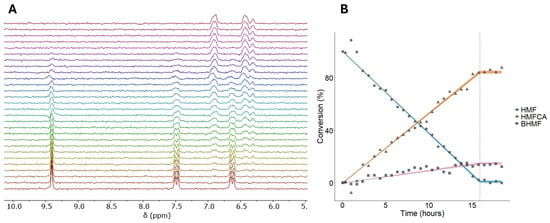
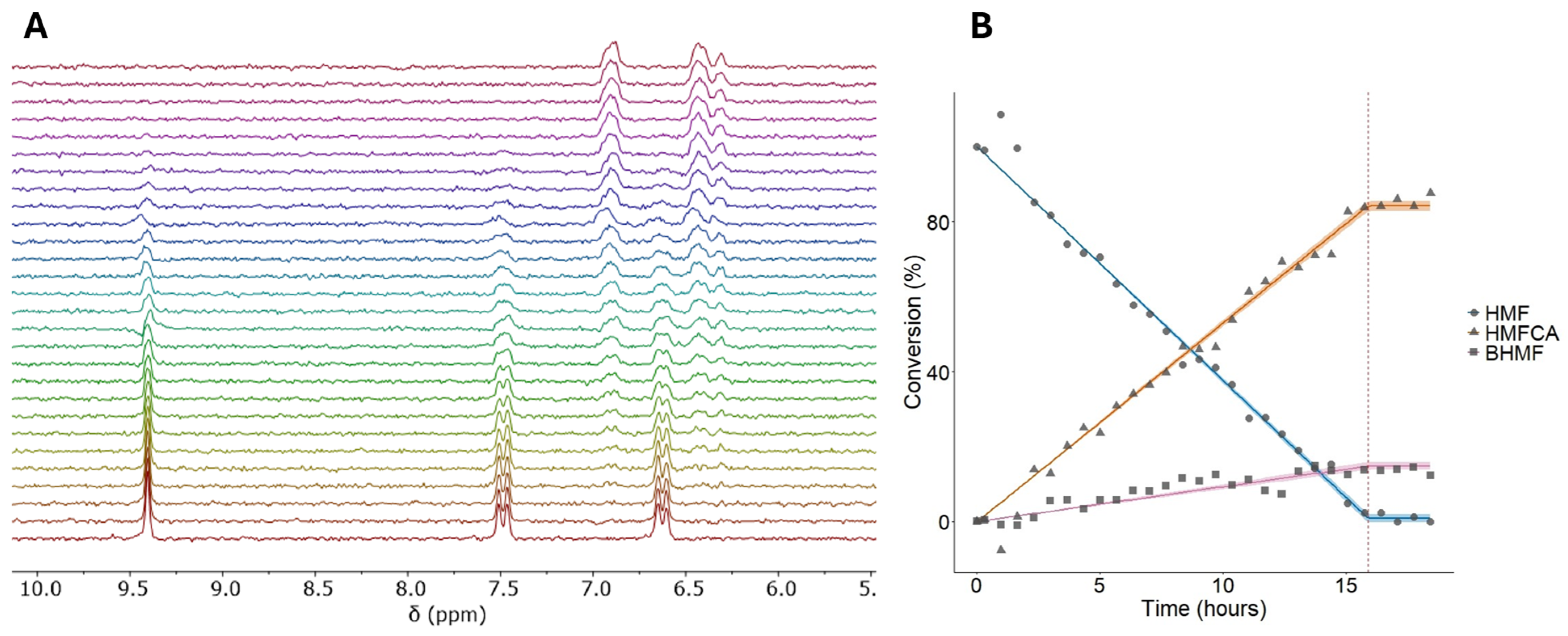
The biotransformation of 5-hydroxymethyl-2-furaldehyde (HMF) by E. oleovorans CECT 5344 R1D was evaluated in M9 minimal medium, demonstrating a highly efficient conversion to 5-hydroxymethyl-2-furancarboxylic acid (HMFCA). Using real-time NMR monitoring, we observed that HMF is quantitatively converted into HMFCA, with 2,5-bis(hydroxymethyl)furan (BHMF) appearing only as a transient intermediate that is subsequently re-oxidised (Figure 1A).
Figure 1.
Real-time monitoring and kinetic profile of HMF biotransformation by E. oleovorans CECT 5344 R1D. (A) Stacked 1H NMR spectra (80 MHz) acquired in-line over 19 h, showing the consumption of HMF and the sequential formation of BHMF and HMFCA; colours are shown only for clarity of the image. (B) Concentration profiles of reaction compounds determined by NMR signal integration; solid lines (blue for HMF, brown for HMFCA, green for BHMF indicate the segmented regression model with fixed initial conditions (100% for HMF; 0% for products). Shaded areas represent the 95% confidence intervals determined by bootstrapping (n = 1000). The vertical dashed line indicates the calculated HMF depletion time.
Kinetic analysis revealed that, within the 10 mM substrate range, the biotransformation follows an apparent zero-order kinetic model, indicating that the enzymatic system operates at saturation (Figure 1B). Under these zero-order conditions, the reaction rates were determined to be k = −0.64 mM·h−1 for HMF consumption, k = 0.55 mM·h−1 for HMFCA formation, and k = 0.09 mM·h−1 for BHMF accumulation. Remarkably, the rate of HMF disappearance precisely matches the combined formation rates of both products. This strict stoichiometric agreement underscores an exceptionally clean and closed mass balance, confirming that no substrate is diverted to alternative or hidden metabolic pathways during this initial phase. Crucially, the absence of biomass accumulation during this process confirms that the strain acts as a selective “cell factory” that does not assimilate the resulting furanic derivatives, preventing the “metabolic dead-end” often encountered in other degradation studies. This robustness allows for fed-batch operations, where successive HMF additions (up to 125 h) maintain high productivity and molar yields (>98%), demonstrating the stability of the biocatalyst over extended operational periods.
3.2. Substrate Scope: Versatility in Aldehyde Oxidation
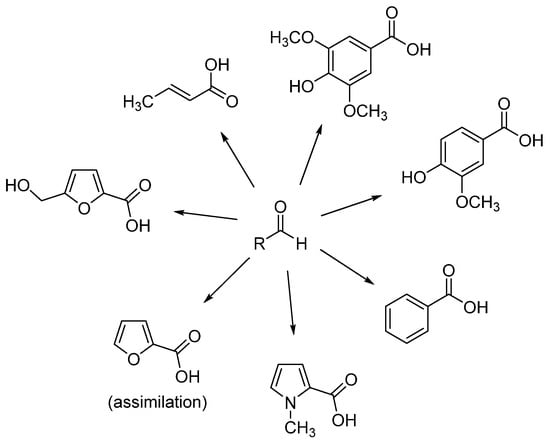
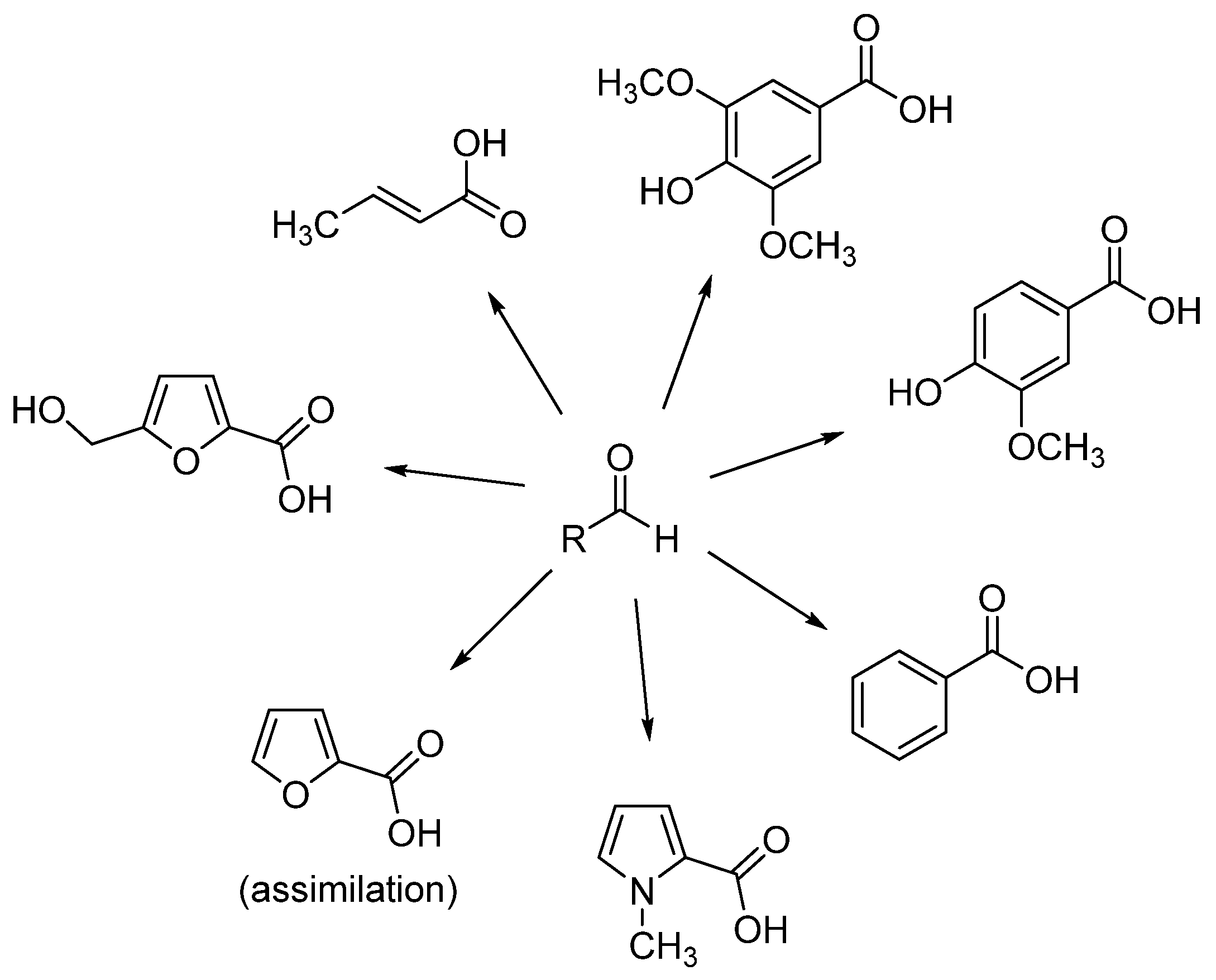
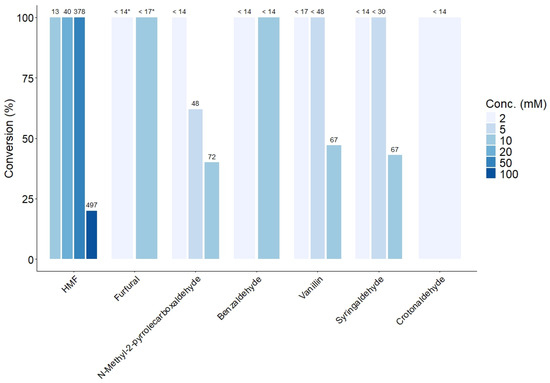
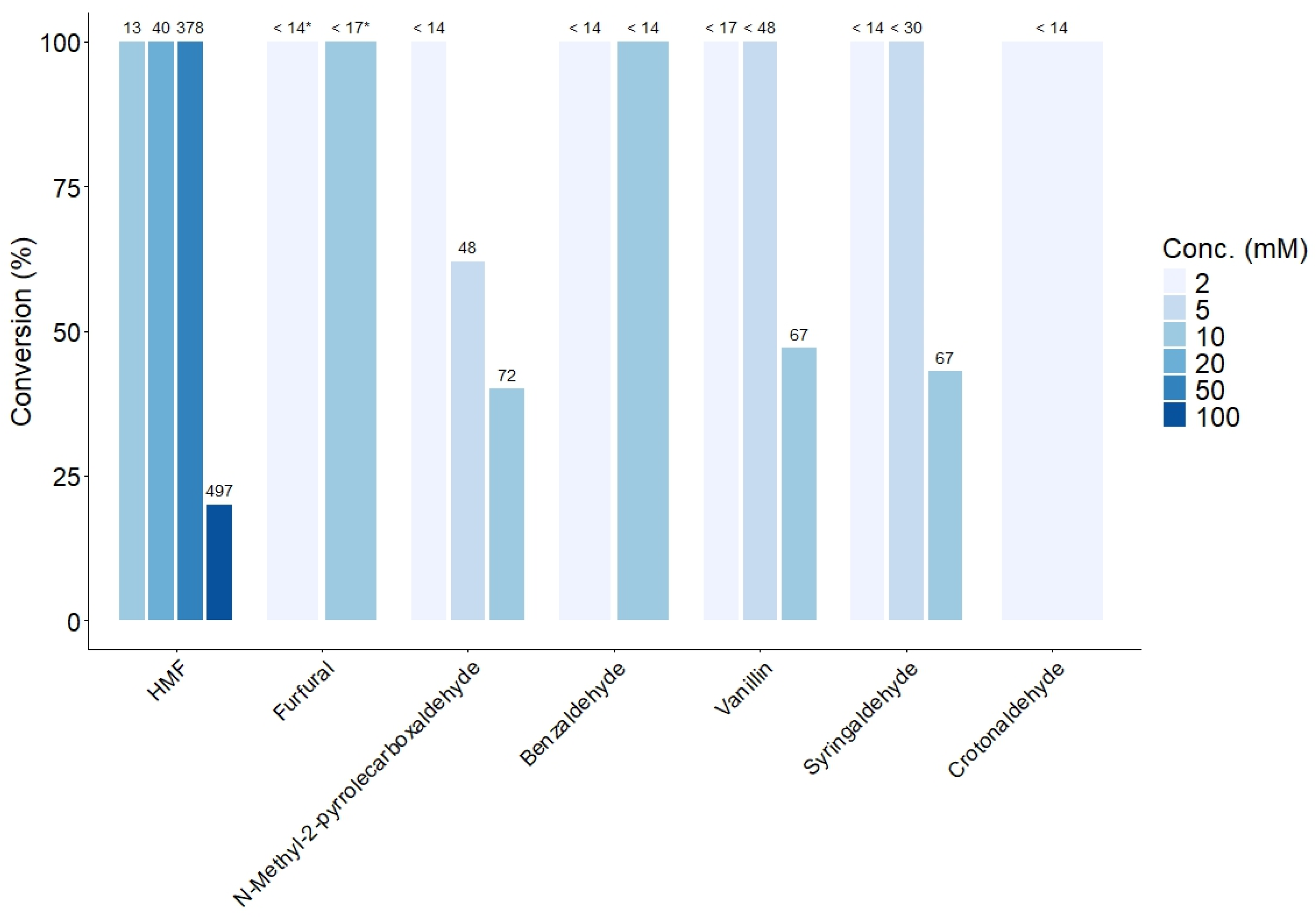
To evaluate the synthetic potential of this system, we tested a panel of structurally diverse aldehydes, including aromatic, unsaturated, and heterocyclic compounds (Figure 2). The results (Figure 3) highlight the significant enzymatic breadth of the strain:
Figure 2.
General reaction scheme for the oxidation of diverse aldehydes to their corresponding carboxylic acids using E. oleovorans CECT 5344 R1D. The biocatalytic system enables the transformation of various aromatic, heterocyclic and unsaturated aldehydes under mild aqueous conditions.
Figure 3.
Substrate scope and tolerance of E. oleovorans CECT 5344 R1D. Conversion yields were determined by 1H NMR analysis at the indicated reaction times. Colour saturation reflects increasing substrate concentrations ([S] = 2–100 mM}). The time (in hours) required for each transformation is represented on top of the bars. * Furfural was fully assimilated by the bacteria within the indicated time. No transformation was observed for the following substrates: p-anisaldehyde, 4-hydroxybenzaldehyde, 4-dimethylaminobenzaldehyde, piperonal, salicylaldehyde, 2-bromobenzaldehyde, 4-nitrobenzaldehyde, coniferaldehyde, 2-naphthaldehyde, fluorenal, 2-imidazolecarboxaldehyde, and n-heptaldehyde.
- Aromatic aldehydes: Benzaldehyde, vanillin, and syringaldehyde were efficiently converted to their corresponding carboxylic acids (benzoic acid, vanillic acid, and syringic acid, respectively), even at 10 mM concentrations.
- Unsaturated and heterocyclic aldehydes: The strain demonstrated the ability to oxidise crotonaldehyde and N-methyl-2-pyrrolecarboxaldehyde, confirming that the dehydrogenase machinery is not limited to furanic substrates.
- Selective detoxification: The system successfully oxidised known inhibitors of fermentation, such as furfural, converting it via an assimilative pathway, thus validating the strain’s potential for pre-treating lignocellulosic hydrolysates.
The high degree of chemo-selectivity observed, where only the aldehyde moiety is targeted, leaving other functional groups intact, positions E. oleovorans CECT 5344 R1D as a powerful tool for green, preparative-scale oxidations. This enzymatic adaptability, characteristic of the Pseudomonas genus, is likely an evolutionary response to environmental chemical challenges, now repurposed here for the sustainable valorisation of industrial aldehydes.
4. Conclusions
In conclusion, this work demonstrates the high efficiency and synthetic versatility of Ectopseudomonas oleovorans CECT 5344 R1D as a whole-cell biocatalyst with exceptional potential for preparative organic synthesis. The strain demonstrates a remarkably broad substrate scope, enabling the chemo- and regioselective oxidation of a diverse library of aromatic, furanic, heterocyclic, and unsaturated aldehydes into high-value carboxylic acids. Operating under mild, aqueous conditions, this sustainable platform completely eliminates the need for hazardous metal catalysts or stoichiometric chemical oxidants.
From a synthetic and preparative standpoint, the primary advantage of this biocatalyst lies in the non-assimilating nature of its oxidative pathway, except for the strategic assimilation of furfural. By preventing product degradation, the system ensures excellent molar balances and simplifies downstream considerations, overcoming a classic bottleneck in whole-cell biotransformations. The scalability and robustness of the process are highlighted by successful extended fed-batch operations, which maintain high productivity and exceptional yields (>98%) over 125 h. additionally, the implementation of benchtop 1H NMR spectroscopy provides an agile analytical tool for real-time kinetic control and rapid substrate screening without requiring complex sample purifications.
Overall, this synergy between a resilient, non-consuming “cell factory” and precise benchtop monitoring offers a scalable, sustainable, and atom-economical strategy for the selective synthesis of value-added carboxylic acids.
Author Contributions
M.G.-O.: Conceptualization, Methodology, Investigation, Writing—original draft. S.D.: Methodology, Investigation, Writing—review & editing. F.M.-D.: Methodology, Investigation, Writing—review & editing. F.M.: Conceptualization, Supervision, Resources, Project administration, Writing—review & editing. R.B.: Conceptualization, Resources, Project administration, Supervision, Writing—review & editing. A.G.N.: Conceptualization, Writing—review & editing. C.F.M.: Conceptualization, Data curation, Supervision, Writing—original draft. All authors have read and agreed to the published version of the manuscript.
Funding
This research was supported by the Ministry of Science Innovation and Universities of Spain (MCIN/AEI/10.13039/501100011033 and TED2021-131700B-I00) and Junta de Extremadura and the European Regional Development Fund (ERDF) (IB20148, GR24103 and GR24026).
Institutional Review Board Statement
Not applicable.
Informed Consent Statement
Not applicable.
Data Availability Statement
The raw data supporting the conclusions of this article will be made available by the authors on request.
Acknowledgments
M.G.-O. and F.M.-D. thank Junta de Extremadura and the European Regional Development Fund (ERDF) for their predoctoral fellowships.
Conflicts of Interest
The authors declare no conflicts of interest.
References
- Steinhäuser, K.G.; Große Ophoff, M. The need for change: A roadmap for the sustainable transformation of the chemical industry. Sustain. Chem. 2025, 6, 16. [Google Scholar] [CrossRef] [Scilit]
- Chioatto, E.; Mancinelli, S.; Mazzanti, M.; Onofrio, F. The chemical sector in transition: Technological developments and green skills towards circularity and decarbonisation. Curr. Opin. Green Sustain. Chem. 2024, 50, 100976. [Google Scholar] [CrossRef] [Scilit]
- Iglesias, J.; Martínez-Salazar, I.; Maireles-Torres, P.; Martin Alonso, D.; Mariscal, R.; López Granados, M. Advances in catalytic routes for the production of carboxylic acids from biomass: A step forward for sustainable polymers. Chem. Soc. Rev. 2020, 49, 5704–5771. [Google Scholar] [CrossRef] [Scilit] [PubMed]
- Yan, W.; Tian, T.; Nishihara, Y. From carboxylic acids or their derivatives to amines and ethers: Modern decarboxylative approaches for sustainable C-N and C-O bond formation. Org. Biomol. Chem. 2025, 23, 7367–7382. [Google Scholar] [CrossRef] [Scilit] [PubMed]
- Patel, M.S. Carboxylic acids as versatile precursors: Advances in decarboxylation strategies for modern organic synthesis. ACS Omega 2026, 11, 11001–11048. [Google Scholar] [CrossRef] [Scilit] [PubMed]
- Wolfe, J.F.; Ogliaruso, M.A. The synthesis of carboxylic acids and esters and their derivatives. In Synthesis of Carboxylic Acids, Esters and Their Derivatives; PATAI’S Chemistry of Functional Groups: Hoboken, NJ, USA, 1991; pp. 1–224. [Google Scholar]
- Spang, J.; Mascia, F.; Kroutil, W. Evolution of methods for the oxidation of primary alcohols to carboxylic acids: From metal oxides to biocatalysis. JACS Au 2026, 6, 659–677. [Google Scholar] [CrossRef] [Scilit] [PubMed]
- Williams, T.J.; Cherepakhin, V. Direct oxidation of primary alcohols to carboxylic acids. Synthesis 2020, 53, 1023–1034. [Google Scholar] [CrossRef] [Scilit]
- Favre-Réguillon, A. N-Heterocyclic carbene-catalysed aerobic oxidation of aromatic aldehydes into carboxylic acids: A critical review. Catalysts 2025, 15, 708. [Google Scholar] [CrossRef] [Scilit]
- Oyegoke, T.; Dumeignil, F.; E.-Yakubu Jibril, B.; Michel, C.; Wojcieszak, R. Exploring catalytic oxidation pathways of furfural and 5-hydroxymethyl furfural into carboxylic acids using Au, Pt, and Pd catalysts: A comprehensive review. Catal. Sci. Technol. 2024, 14, 6761–6774. [Google Scholar] [CrossRef] [Scilit]
- Lin, B.; Tao, Y. Whole-cell biocatalysts by design. Microb. Cell Fact. 2017, 16, 106. [Google Scholar] [CrossRef] [Scilit] [PubMed]
- Sudheer, D.V.N.; Pamidimarri, S.; Chauhan, S.; Velramar, B. (Eds.) Whole-Cell Biocatalysis: Next-Generation Technology for Green Synthesis of Pharmaceutical, Chemicals, and Biofuels, 1st ed.; Apple Academic Press: Burlington, ON, Canada, 2024. [Google Scholar]
- Puiggene, O.; Nikel, P.I. Functional organization and regulatory logic of the ped gene cluster in Pseudomonas species. Appl. Environ. Microbiol. 2026, 92, e0004626. [Google Scholar] [CrossRef] [Scilit] [PubMed]
- Gomez-Ortega, M.; Diego, S.; Morales-Duran, F.; Merchan, F.; Blasco, R.; Neo, A.G.; Marcos, C.F. Real-time NMR monitoring of HMF biotransformation by Ectopseudomonas oleovorans CECT 5344 R1D. Appl. Microbiol. Biotechnol. 2026, 110, 196. [Google Scholar] [CrossRef] [Scilit] [PubMed]
- Crigler, J.; Eiteman, M.A.; Altman, E. Characterization of the furfural and 5-hydroxymethylfurfural (HMF) metabolic pathway in the novel isolate pseudomonas putida ALS1267. Appl. Biochem. Biotechnol. 2020, 190, 918–930. [Google Scholar] [CrossRef] [Scilit] [PubMed]
- Koopman, F.; Wierckx, N.; de Winde, J.H.; Ruijssenaars, H.J. Identification and characterization of the furfural and 5-(hydroxymethyl)furfural degradation pathways of Cupriavidus basilensis HMF14. Proc. Natl. Acad. Sci. USA 2010, 107, 4919–4924. [Google Scholar] [CrossRef] [Scilit] [PubMed]
- Quesada, A.; Guijo, M.I.; Merchan, F.; Blázquez, B.; Igeño, M.I.; Blasco, R. Essential role of cytochrome bd-related oxidase in cyanide resistance of Pseudomonas pseudoalcaligenes CECT5344. Appl. Environ. Microbiol. 2007, 73, 5118–5124. [Google Scholar] [CrossRef] [Scilit] [PubMed]
- Igeño, M.I.; Macias, D.; Blasco, R. A case of adaptive laboratory evolution (ale): Biodegradation of furfural by Pseudomonas pseudoalcaligenes CECT 5344. Genes 2019, 10, 499. [Google Scholar] [CrossRef] [Scilit]
Disclaimer/Publisher’s Note: The statements, opinions and data contained in all publications are solely those of the individual author(s) and contributor(s) and not of MDPI and/or the editor(s). MDPI and/or the editor(s) disclaim responsibility for any injury to people or property resulting from any ideas, methods, instructions or products referred to in the content. |
© 2026 by the authors. Licensee MDPI, Basel, Switzerland. This article is an open access article distributed under the terms and conditions of the Creative Commons Attribution (CC BY) license.