


Abstract
Experimental and molecular modelling data on chemical shifts of 1H and 13C nuclei are presented for the 4-[4-(2-aminoethoxy)phenoxy]aniline (APA) dihydrochloride, which is a new structural analogue of thyronamine T0AM. In our study we treat two structural models of the APA—its protonated form [H-APA-H]2+ and neutral dihydrochloride APA·2HCl. Chemical shifts in the 1H and 13C nuclei were estimated for the basic conformers of [H-APA-H]2+ and APA·2HCl models. Nonspecific solvation with DMSO was taken into account within the polarized continuum model. Calculated chemical shifts in the 1H and 13C nuclei were in good agreement with the experimental ones obtained for 4-[4-(2-aminoethoxy)phenoxy]aniline dihydrochloride in DMSO-d6 solution.
1. Introduction
Thyronamines are interesting organic compounds of practical interest due to their pleiotropic neuro- and cardioprotective effects [1,2,3,4]. Both known endogenous thyronamines and novel synthetic structural analogues are current subjects of active research. The structures of known thyronamines contain at least three key fragments: two aromatic ones separated by a methylene or heteroatomic bridge, and an aliphatic one [5]. The relative orientation of these fragments determines the spatial structure and intramolecular dynamics of thyronamines [6]. Investigating the structure and dynamics of known and novel compounds in the thyronamine series using complementary experimental and theoretical methods makes it possible to obtain fundamental data for elucidating the mechanisms of their bioactivity.
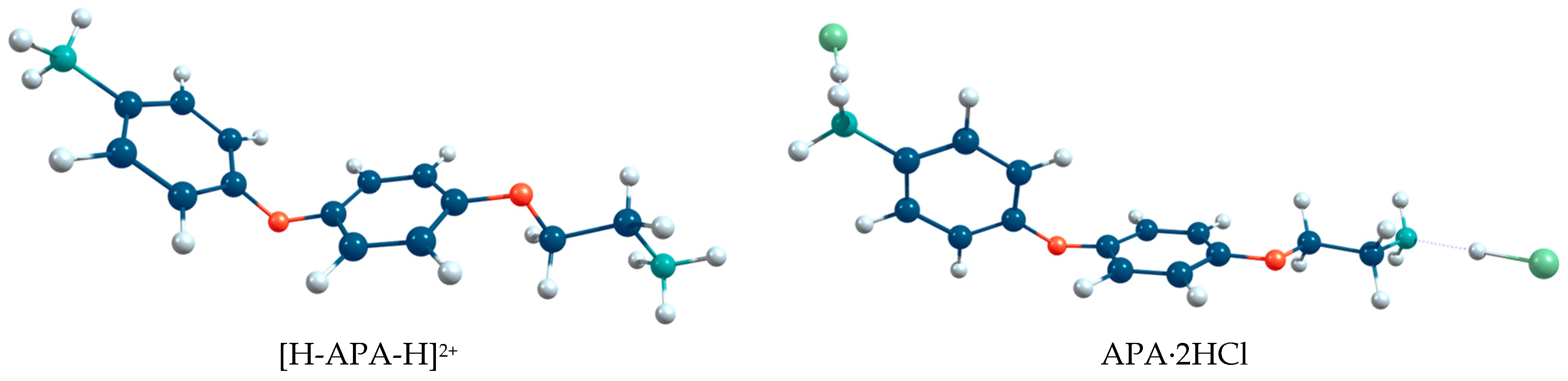
This work is a part of comprehensive, systematic studies on the structure and biological activity of novel structural analogues of thyronamines [1,7]. The objective of the present study is a new structural analogue of T0AM—4-[4-(2-aminoethoxy)phenoxy]aniline (APA). It differs from the compound with a diphenylmethane scaffold that was previously investigated [3,7] by a bridging oxygen atom between two aromatic fragments (Figure 1) in the molecule.
Figure 1.
Chemical structure and molecular models of 4-[4-(2-aminoethoxy)phenoxy]aniline dihydrochloride.
2. Molecular Modelling Methods
2.1. Models of 4-[4-(2-Aminoethoxy)phenoxy]aniline (APA) Dihydrochloride for Calculations
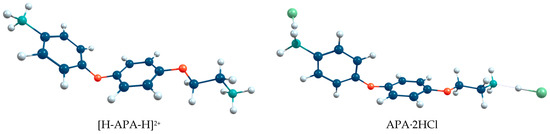
We treat two structural models of the APA—its protonated form [H-APA-H]2+ and neutral dihydrochloride APA·2HCl (Figure 1)—at this step of our study. The neutral particle model APA·2HCl makes it possible—within the framework of the small-cluster interaction approximation—to account for intermolecular interactions that influence the structure as well as the intra- and intermolecular dynamics of key structural fragments of APA. We believe that the model of protonated thyronamine [H-APA-H]2+ will prove useful for further studies of the compound’s properties in condensed media.
2.2. DFT Calculations
The molecular geometry and the electronic structure parameters, as well as thermodynamic characteristics of the protonated [H-APA-H]2+ and neutral dihydrochloride APA·2HCl species were calculated using the Orca 6.1.1 software package [8] (HybriLIT heterogeneous computing platform, LIT, JINR, Dubna [9]). All calculations were performed at the B3LYP [10,11,12] level in combination with the 6-31G(d,p) basis set. The molecular geometries of all species were fully optimized. The influence of the solvent (DMSO) was accounted for within the framework of the PCM model implemented in Orca software. The molecular geometries of all species were fully optimized. For the purpose of comparative analysis, additional calculations were performed that account for dispersion interactions (D3 correction [13]).
Magnetic shielding constants (χ, ppm) were calculated by the GIAO method [14]. Chemical shifts (δ, ppm) of the 1H and 13C nuclei for the APA models considered were estimated. Tetramethylsilane (TMS) was used as a standard, for which full optimization of molecular geometry and calculation of χ were performed using the same level of theory and basis set (B3LYP/6-31G(d,p)/PCM).
2.3. Characterization of 4-[4-(2-Aminoethoxy)phenoxy]aniline Dihydrochloride
4-[4-(2-aminoethoxy)phenoxy]aniline dihydrochloride was obtained in accordance with the procedure reported by Chiellini G. et al. [5]. All reagents were Sigma-Aldrich compounds for synthesis and were used without additional purification. The structure of the obtained compound was confirmed by NMR 1H and 13C spectroscopy. NMR 1H and 13C spectra of the 4-[4-(2-aminoethoxy)phenoxy]aniline dihydrochloride were recorded on a Bruker Avance instrument (400 MHz and 100 MHz) in DMSO-d6 solution.
NMR 1H spectrum (400 MHz, DMSO-d6), δ, ppm: 3.19 t (2H, CH2, J 8.0 Hz), 4.19 t (2H, CH2, J 8.0 Hz), 7.01 d (2H, H 2,6, J 8.0 Hz), 7.04 m (4H, H 3, 5, 2′,6′, J 8.0 Hz), 7.38 d (2H, H 3′, 5′, J 8.0 Hz), 8.38 br. s (3H, -CH2-NH3+), 10.45 br. s (3H, -C6H4-NH3+). NMR 13C spectrum (100 MHz, DMSO-d6), δ, ppm: 38.27, 64.73, 116.17 (2C), 118.25 (2C), 120.87 (2C), 124.87 (2C), 126.53, 149.60, 154.49, 157.27.
3. Results and Discussion
3.1. Molecular Geometry of the 4-[4-(2-Aminoethoxy)phenoxy]aniline Dihydrochloride
The initial molecular geometries of protonated [H-APA-H]2+ and neutral APA·2HCl species for 4-[4-(2-aminoethoxy)phenoxy]aniline dihydrochloride were obtained using the algorithm implemented in the Conformer plugin of the Marvin 5.10.4 software package, which includes all possible geometric and steric factors. The next step was molecular geometry optimization at the B3LYP/6-31G(d,p) level of theory. The calculations were performed with account taken of nonspecific solvation with dimethyl sulfoxide (DMSO). Equilibrium conformations of [H-APA-H]2+ and APA·2HCl obtained are presented in Figure 2. Key parameters of [H-APA-H]2+ and APA·2HCl molecular geometries and electronic structures are listed in Table 1.
Figure 2.
Equilibrium conformations of [H-APA-H]2+ and APA·2HCl at B3LYP/6-31G(d,p)/PCM (atoms: C—dark blue, O—red, H—light grey, N—cyan, Cl—green).
Table 1.
Molecular geometry, electronic structure and global reactivity descriptors of [H-ABA-H]2+, and APA·2HCl at B3LYP/6-31G(d,p)/PCM (1)and B3LYP-D3/6-31G(d,p)/PCM (2) levels.
For the [H-APA-H]2+ and APA·2HCl conformations under consideration, the orientation of key structural fragments (aniline, phenoxyl, and ethylamine) changes weakly upon the transition from the neutral to the protonated form (Table 1). Accounting for the D3 dispersion correction in the calculations leads to minor changes in bond length and Mulliken atomic charges values for both considered models.
3.2. 1H and 13C Chemical Shifts in the 4-[4-(2-Aminoethoxy)phenoxy]aniline: Calculated vs. Experimental Data
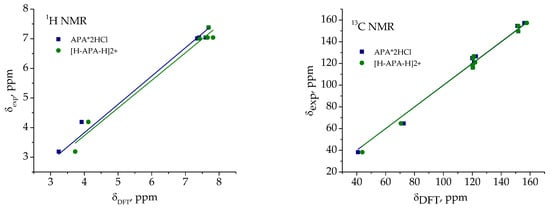
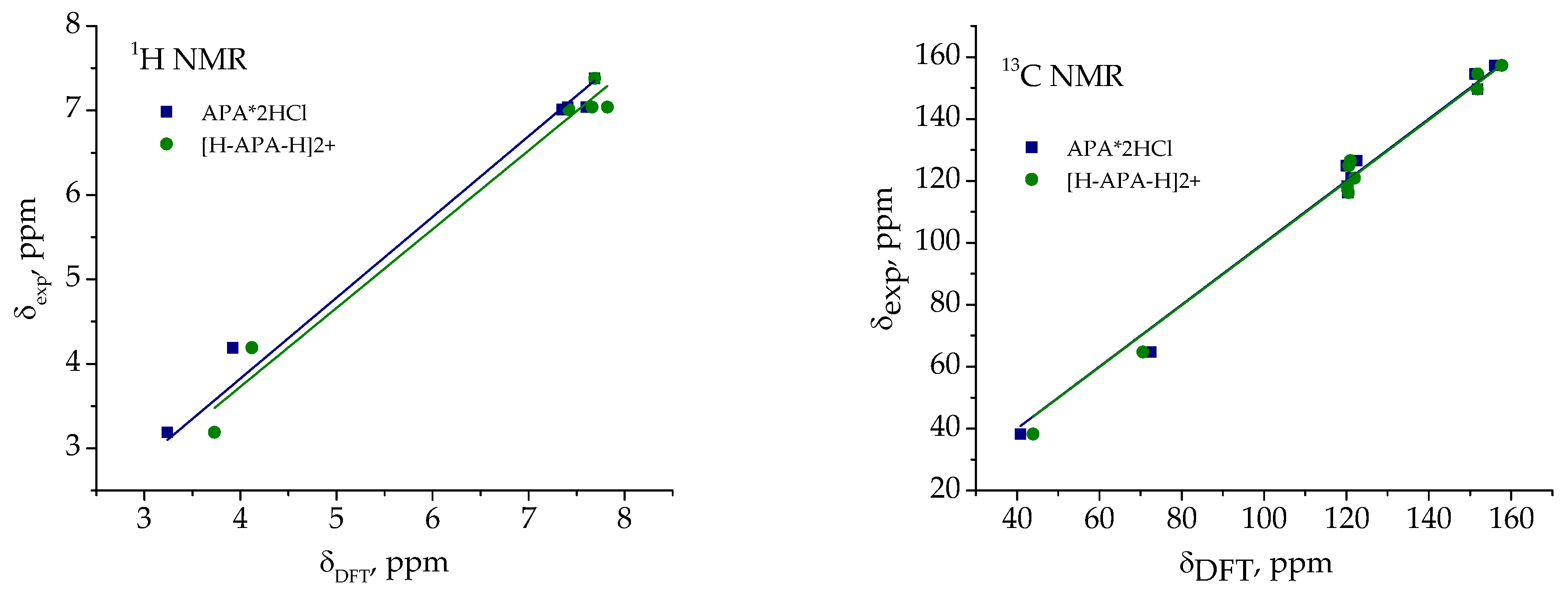
The experimental parameters of the 1H and 13C NMR spectra of 4-[4-(2-aminoethoxy)phenoxy]aniline are reproduced well at the theoretical level considered. Figure 3 shows good correlations (r > 0.998) between the experimental and calculated (with account taken of nonspecific solvation with DMSO) 1H and 13C NMR chemical shifts of 4-[4-(2-aminoethoxy)phenoxy]aniline dihydrochloride in both models.
Figure 3.
Experimental chemical shifts of 4-[4-(2-aminoethoxy)phenoxy]aniline dihydrochloride vs calculated chemical shifts of [H-APA-H]2+ and APA·2HCl at B3LYP/6-31G(d,p)/PCM.
Accounting for the D3 dispersion correction in the calculations of magnetic shielding constants leads to minor changes in chemical shift values of 1H and 13C NMR nuclei. However, neither of the models under consideration yields accurate chemical shift values for the labile protons of the NH3+ groups. Therefore, a further development of this work will involve evaluating these NMR spectral parameters using cluster models that explicitly account for specific solvation.
4. Conclusions
Thus, it is shown that the neutral model is more successful for investigating the structure and properties of the new thyronamine in solution. However, a more accurate description will require accounting for specific solvent solvation. This will be the subject of our future research.
According to the obtained results, the following future research directions can be highlighted:
- –
- Experimental study of the APA intra- and intermolecular dynamics by vibrational spectroscopy;
- –
- Study of the APA structure and reactivity using ab initio or DFT methods.
Author Contributions
Conceptualization, A.B.E., E.V.R. and D.A.F.; methodology, A.B.E., E.V.R. and D.A.F.; software, E.V.R.; validation, E.V.R., Y.V.B., N.N.T. and M.A.B.; formal analysis, E.V.R., N.N.T., M.A.B. and Y.V.B.; investigation, A.B.E., E.V.R. and D.A.F.; resources, A.B.E., R.V.I. and D.A.F.; data curation, E.V.R., Y.V.B. and V.V.T.; writing—original draft preparation, A.B.E., E.V.R. and D.A.F.; writing—review and editing, A.B.E., E.V.R., R.V.I. and D.A.F.; visualization, Y.V.B., V.V.T. and E.V.R.; supervision, A.B.E. and D.A.F.; project administration, A.B.E., E.V.R. and D.A.F.; funding acquisition, A.B.E., R.V.I. and D.A.F. All authors have read and agreed to the published version of the manuscript.
Funding
This work was partially supported by the Russian Science Foundation (Grant 25-25-20601).
Institutional Review Board Statement
Not applicable.
Informed Consent Statement
Not applicable.
Data Availability Statement
The data supporting the findings of this study are available within the paper and from the corresponding author upon request.
Acknowledgments
DFT calculations were carried out using HybriLIT heterogeneous computing platform (LIT, JINR, Dubna).
Conflicts of Interest
The authors declare no conflicts of interest.
Abbreviations
The following abbreviations are used in this manuscript:
| APA | 4-[4-(2-Aminoethoxy)phenoxy]aniline |
| DMSO | Dimethyl Sulfoxide |
| DMSO-d6 | Deuterated Dimethyl Sulfoxide |
| DFT | Density Functional Theory |
| GIAO | Gauge-Independent Atomic Orbital method |
| IS | Ischemic Stroke |
| NMR | Nuclear Magnetic Resonance |
| PCM | Polarizable Continuum Model |
| TMS | Tetramethylsilane |
| T0AM | Thyronamine |
| ZPC | Zero-point Energy Correction |
References
- Kim, B.; Ko, Y.H.; Si, J.; Na, J.; Ortore, G.; Chiellini, G.; Kim, J.H. Thyroxine metabolite-derived 3-iodothyronamine (T1AM) and synthetic analogs as efficient suppressors of transthyretin amyloidosis. Comput. Struct. Biotechnol. J. 2023, 21, 4717–4728. [Google Scholar] [CrossRef] [Scilit] [PubMed]
- Chiellini, G.; Nesi, G.; Sestito, S.; Chiarugi, S.; Runfola, M.; Espinoza, S.; Sabatini, M.; Bellusci, L.; Laurino, A.; Cichero, E.; et al. Hit-to-Lead Optimization of Mouse Trace Amine Associated Receptor 1 (mTAAR1) Agonists with a Diphenylmethane-Scaffold: Design, Synthesis, and Biological Study. J. Med. Chem. 2016, 59, 9825–9836. [Google Scholar] [CrossRef] [Scilit] [PubMed]
- Filimonov, D.A.; Trubnikova, N.N.; Kisilenko, I.A.; Belotserkovskaya, M.A.; Burtseva, A.A.; Glebova, A.E.; Ishchenko, R.V.; Eresko, A.B.; Raksha, E.V.; Diuba, D.S.; et al. Effect of a synthetic analogue of thyronamine on the levels of molecular markers of focal brain damage in an experimental model. Ann. Clin. Exp. Neurol. 2026, 20, 60–69. [Google Scholar] [CrossRef] [Scilit]
- Han, Y.; Han, Z.; Huang, X.; Li, S.; Jin, G.; Feng, J.; Wu, D.; Liu, H. An injectable refrigerated hydrogel for inducing local hypothermia and neuroprotection against traumatic brain injury in mice. J. Nanobiotechnol. 2024, 22, 251. [Google Scholar] [CrossRef] [Scilit] [PubMed]
- Chiellini, G.; Nesi, G.; Digiacomo, M.; Malvasi, R.; Espinoza, S.; Sabatini, M.; Frascarelli, S.; Laurino, A.; Cichero, E.; Macchia, M.; et al. Design, Synthesis, and Evaluation of Thyronamine Analogues as Novel Potent Mouse Trace Amine Associated Receptor 1 (mTAAR1) Agonists. J. Med. Chem. 2015, 58, 5096–5107. [Google Scholar] [CrossRef] [Scilit] [PubMed]
- Mondal, S.; Mugesh, G. Conformational Flexibility and Halogen Bonding in Thyroid Hormones and Their Metabolites. Cryst. Growth Des. 2016, 16, 5896. [Google Scholar] [CrossRef] [Scilit]
- Eresko, A.B.; Raksha, E.V.; Filimonov, D.A.; Muratov, A.V.; Voitash, A.A.; Trubnikova, N.N. Structural Analogues of Thyronamines. Experimental and DFT-Calculated 1H NMR Chemical Shifts of 4-[4-(2-Aminoethoxy)benzyl]aniline. Rus. J. Org. Chem. 2024, 60, 1654–1662. [Google Scholar] [CrossRef] [Scilit]
- Neese, F.; Wennmohs, F.; Becker, U.; Riplinger, C. The ORCA quantum chemistry program package. J. Chem. Phys. 2020, 152, 224108. [Google Scholar] [CrossRef] [Scilit] [PubMed]
- Anikina, A.; Belyakov, D.; Bezhanyan, T.; Kirakosyan, M.; Kokorev, A.; Lyubimova, M.; Matveev, M.; Podgainy, D.; Rahmonova, A.; Shadmehri, S.; et al. Structure and Features of the Software and Information Environment of the HybriLIT Heterogeneous Platform. In Proceedings of the 27th International Conference «Distributed Computer and Communication Networks» (DCCN 2024), Moscow, Russia, 23–27 September 2024; Revised Selected Papers. Lecture Notes in Computer Science; Springer: Cham, Switzerland, 2024; Volume 15460. [Google Scholar] [CrossRef] [Scilit]
- Becke, A.D. Density-Functional Thermochemistry. III. The Role of Exact Exchange. J. Chem. Phys. 1993, 98, 5648–5652. [Google Scholar] [CrossRef] [Scilit]
- Lee, C.; Yang, W.; Parr, R.G. Development of the Colle-Salvetti Correlation-Energy Formula into a Functional of the Electron Density. Phys. Rev. B 1988, 37, 785–789. [Google Scholar] [CrossRef] [Scilit] [PubMed]
- Lee, T.J.; Taylor, P.R. A diagnostic for determining the quality of single-reference electron correlation methods. Int. J. Quantum Chem. Quant. Chem. Symp. 1989, 36, 199–207. [Google Scholar] [CrossRef] [Scilit]
- Grimme, S.; Ehrlich, S.; Goerigk, L. Effect of the damping function in dispersion corrected density functional theory. J. Comput. Chem. 2011, 32, 1456–1465. [Google Scholar] [CrossRef] [Scilit] [PubMed]
- Wolinski, K.; Hilton, J.F.; Pulay, P. Efficient implementation of the gauge-independent atomic orbital method for NMR chemical shift calculations. J. Am. Chem. Soc. 1990, 112, 8251–8260. [Google Scholar] [CrossRef] [Scilit]



Disclaimer/Publisher’s Note: The statements, opinions and data contained in all publications are solely those of the individual author(s) and contributor(s) and not of MDPI and/or the editor(s). MDPI and/or the editor(s) disclaim responsibility for any injury to people or property resulting from any ideas, methods, instructions or products referred to in the content. |
© 2026 by the authors. Licensee MDPI, Basel, Switzerland. This article is an open access article distributed under the terms and conditions of the Creative Commons Attribution (CC BY) license.