


Abstract
A multicomponent protocol for the synthesis of 1,2,5,6-tetrahydropyridines catalyzed by silica-supported phosphomolybdic acid (5PMo@SiO2) prepared by the sol–gel method was optimized. The influence of temperature and solvent was systematically investigated. The optimized conditions afforded the model tetrahydropyridine in 67% isolated yield after 7 h under reflux in methanol. The methodology was subsequently applied to the synthesis of ten structurally diverse tetrahydropyridine derivatives in moderate-to-good yields (67–77%), demonstrating broad substrate compatibility and good reproducibility upon scale-up. These results highlight the efficiency and versatility of the developed catalytic system for the preparation of functionalized tetrahydropyridines with potential antifouling applications.
1. Introduction
Multicomponent reactions (MCRs) have become one of the most efficient synthetic strategies for the rapid assembly of structurally complex molecules from simple starting materials in a single synthetic operation. Their excellent atom economy, operational simplicity, and ability to generate molecular diversity have made them powerful tools in modern organic synthesis, allowing the preparation of highly functionalized compounds while minimizing reaction steps and waste generation [1,2,3].
Among advanced MCRs, five-component reactions are particularly attractive because they enable the simultaneous formation of multiple carbon–carbon and carbon–heteroatom bonds in a one-pot process. However, these transformations often involve several consecutive reaction steps and reactive intermediates, making their efficiency highly dependent on the optimization of the reaction conditions [2,3].
Nitrogen-containing heterocycles are among the most important structural motifs in organic and medicinal chemistry due to their broad occurrence in biologically active compounds. Tetrahydropyridines have attracted considerable attention because of their structural versatility and reported biological activities, including antimicrobial properties, making them valuable scaffolds for the development of new functional molecules [4].
The combination of multicomponent reactions with heterogeneous catalysis constitutes an attractive approach toward more sustainable synthetic methodologies [5]. Heteropolyacids are particularly appealing solid acid catalysts because of their strong Brønsted acidity and high catalytic activity. Among them, phosphomolybdic acid (H3PMo12O40) has been successfully applied as an acid catalyst in several organic transformations, demonstrating its ability to promote a variety of reactions involving carbonyl-containing substrates and other reactive partners [6,7,8]. These precedents, together with its strong acidity, motivated the selection of phosphomolybdic acid as the active catalytic phase in the present study. Furthermore, its immobilization on silica by the sol–gel method provides improved catalyst dispersion, mechanical stability, handling, and ease of recovery [9,10].
Despite the advantages offered by multicomponent reactions and heterogeneous catalysis, the synthesis of highly substituted tetrahydropyridines remains strongly influenced by reaction parameters such as temperature, solvent, reagent stoichiometry, and the sequence of reagent addition. Therefore, systematic optimization is necessary to identify the reaction conditions that most strongly influence the efficiency of tetrahydropyridine formation and to establish a robust set of conditions for the specific multicomponent transformation.
In the present work, the objective was to identify suitable reaction conditions for the multicomponent synthesis of 1,2,5,6-tetrahydropyridines using silica-supported phosphomolybdic acid (5PMo@SiO2), prepared by the sol–gel method. The optimization was performed by systematically evaluating the main experimental variables affecting the reaction, with particular emphasis on their influence on product yield and reaction efficiency. After establishing the optimal conditions, the methodology was extended to different aromatic aldehydes, substituted anilines, and β-ketoesters to evaluate its synthetic scope and versatility. The resulting tetrahydropyridine derivatives constitute promising candidates for future evaluation as antifouling additives in marine coatings.
2. Materials and Methods
2.1. Materials
Commercial aromatic aldehydes, aromatic amines, β-ketoesters, methanol, ethanol, acetonitrile, and other reagents were used as received without further purification. The heterogeneous catalyst (5PMo@SiO2), consisting of 5 wt% commercial phosphomolybdic acid supported on silica, had been previously prepared by the sol–gel method and was used throughout this work [11].
2.2. General Procedure for the Optimization Study
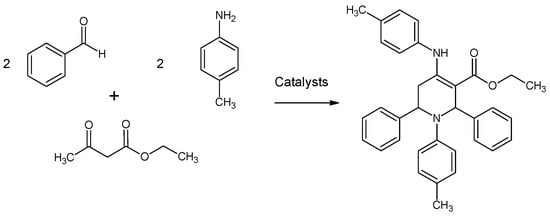
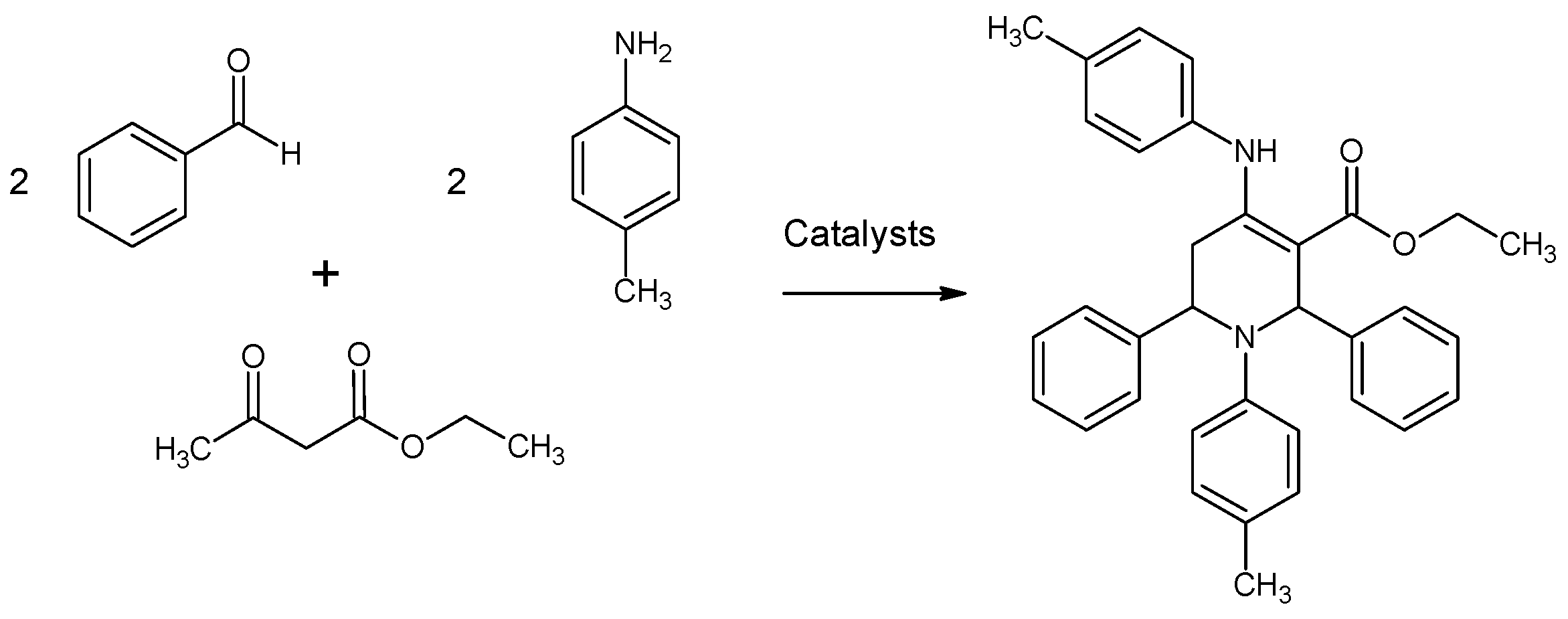
The optimization of the multicomponent reaction was carried out using p-toluidine (2 mmol), benzaldehyde (2 mmol), and ethyl acetoacetate (1 mmol) as model substrates to obtain THP-1 (Appendix A). Unless otherwise stated, reactions were performed in methanol (5 mL) under reflux using 50 mg of 5PMo@SiO2 as catalyst.
Initially, p-toluidine and ethyl acetoacetate were stirred under reflux for 40 min. Benzaldehyde was then added directly to the reaction mixture without isolation of intermediates, and the reaction was continued under the selected conditions until completion (Figure 1). Reaction progress was monitored by thin-layer chromatography (TLC) on silica gel plates using petroleum ether/ethyl acetate (4:1) as the eluent and UV light for visualization. Completion of the reaction was established by the disappearance of the aldehyde.
Figure 1.
General multicomponent synthesis of tetrahydropyridines catalyzed by 5PMo@SiO2.
The influence of several experimental parameters was investigated independently, including reaction temperature, heating mode, and solvent. Product yields, reaction times, and melting points were used to evaluate the performance of each set of conditions.
2.3. Synthesis of Tetrahydropyridines
After establishing the optimum conditions, the methodology was extended to different aromatic aldehydes, substituted anilines, and β-ketoesters. Reactions were carried out using 2 mmol of aromatic amine, 2 mmol of aldehyde, and 1 mmol of β-ketoester in methanol (5 mL) under reflux in the presence of 50 mg of 5PMo@SiO2. The aldehyde was added after 40 min, and the reaction mixture was maintained under reflux until completion as determined by TLC.
The crude products were isolated by filtration and purified by recrystallization to afford the corresponding 1,2,5,6-tetrahydropyridines.
2.4. Product Characterization
THP-1 was characterized by melting point determination and 1H and 13C NMR spectroscopy. Melting points of compounds were measured and compared with the literature values.
3. Results and Discussion
3.1. Optimization of the Multicomponent Reaction
A systematic optimization study was carried out to establish the most suitable conditions for the multicomponent synthesis of tetrahydropyridines catalyzed by 5PMo@SiO2. The influence of reaction temperature, solvent, solvent volume, aldehyde addition time, β-ketoester loading, and reaction scale was independently evaluated while maintaining all other experimental parameters constant. The reaction performance was assessed in terms of reaction time, isolated yield, and melting point of the obtained product. The results are summarized in Table 1.
Table 1.
Optimization of the multicomponent synthesis of tetrahydropyridines catalyzed by 5PMo@SiO2 1.
Temperature. The reaction temperature has a marked influence on the efficiency of the multicomponent process (Table 1, entries 1–3). Increasing the temperature significantly accelerated the transformation, reducing the reaction time from 16 h at 25 °C to 7 h under methanol reflux (64 °C). At the same time, the isolated yield increased from 80% to 99%, demonstrating the beneficial effect of heating on product formation.
Microwave irradiation at 70 °C was also investigated to evaluate whether a faster energy input could accelerate the process (Table 1, entry 4). However, complete conversion was not achieved after more than 7 h, and the desired product could not be isolated in satisfactory yield. This behavior may be attributed to the mechanistic complexity of multicomponent transformation, which likely proceeds through the sequential formation of several intermediates requiring gradual heating and sufficient equilibration time. Moreover, the delayed addition of benzaldehyde represents a key step in the reaction sequence, and rapid heating may adversely affect the formation and consumption of these intermediates. Therefore, conventional reflux at 64 °C was selected as the optimum temperature for the subsequent studies.
Solvent. The nature of the reaction medium strongly influenced the reaction outcome (Table 1, entries 3, 5–7). Among the solvents evaluated, methanol provided the shortest reaction time (7 h) and the highest isolated yield (99%). In contrast, the solvent-free reaction afforded a considerably lower yield, indicating that, unlike many multicomponent transformations, this system benefits from the presence of an appropriate reaction medium. Ethanol and acetonitrile all resulted in substantially longer reaction times and lower yields, suggesting less efficient formation of the reactive intermediates. The superior performance of methanol may be attributed to its ability to provide the effective solvation of both reactants and catalytic species while facilitating the elementary steps involved in the multicomponent process.
After selecting methanol as the most suitable solvent, its volume was also investigated (Table 1, entries 3, 8, 9). A volume of 5 mL afforded the best balance between reaction rate and isolated yield. Reducing the solvent volume to 3 mL resulted in a slight decrease in yield, whereas increasing it to 8 mL significantly diminished the reaction efficiency. This behavior is consistent with a dilution effect, in which lower reactant concentrations decrease the probability of productive molecular collisions.
Aldehyde addition time. The timing of aldehyde addition proved to be a key parameter in the multicomponent reaction (Table 1, entries 3, 10, 11). Introducing benzaldehyde 40 min after the beginning of the reaction afforded the highest yield (99%) and the shortest reaction time (7 h). Earlier addition (20 min) led to lower conversion, whereas delaying the addition to 60 min prolonged the reaction without improving the yield. These results indicate that the reaction does not proceed through the simultaneous interaction of all reactants but rather involves the prior generation of reactive intermediates whose concentration is optimized after 40 min.
Scale-up. Finally, the optimized protocol was evaluated on a two-fold reaction scale while maintaining the same molar ratios (Table 1, entries 3, 12). Although the reaction time increased slightly from 7 to 9 h and the isolated yield decreased from 99% to 90%, the melting point of the isolated product remained essentially unchanged. These results demonstrate the good reproducibility of the optimized methodology and support its potential applicability for the preparation of tetrahydropyridines on a larger scale.
Overall, the optimization study established that the best reaction conditions consist of using 2 mmol of aromatic amine, 2 mmol of aldehyde, and 1 mmol of β-ketoester in 5 mL of methanol under reflux in the presence of 50 mg of 5PMo@SiO2, with the aldehyde being added after 40 min. Under these conditions, the model tetrahydropyridine was obtained in 99% isolated yield after 7 h.
3.2. Substrate Scope
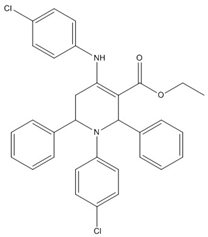
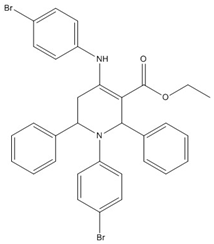
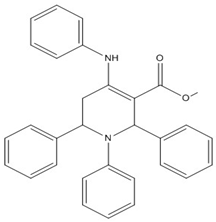
To further demonstrate the generality of the optimized protocol, a series of structurally diverse tetrahydropyridines was synthesized by varying the aromatic amine, aldehyde, and β-ketoester components under the optimized reaction conditions. As shown in Table 2, the catalytic system based on 5PMo@SiO2 tolerated a broad range of substrates, affording the desired products in moderate to excellent isolated yields (67–77%) after reaction times ranging from 7 to 20 h.
Table 2.
Substrate scope of the synthesis of tetrahydropyridines catalyzed by 5PMo@SiO2 1.
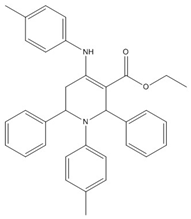
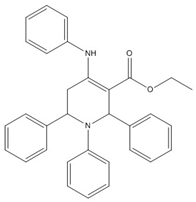
The nature of the aromatic amine also influenced the reaction outcome. When aniline was used instead of p-toluidine, the yield increased to 77% (THP-2). Electron-withdrawing substituents such as chloro and bromo groups were well tolerated, leading moderate yields, as illustrated by THP-3 (57%) and THP-4 (53%).
The influence of the β-ketoester was evident when comparing ethyl and methyl acetoacetates. In general, ethyl acetoacetate provided the most favorable results, as observed for compound THP-1 (67% yield), whereas methyl ester groups led to a decrease in yield, THP-5 (51%). This trend suggests that steric and electronic effects associated with the ester moiety play an important role in the formation of the key intermediates of the multicomponent sequence.
In sum, the results demonstrate that the optimized catalytic system is highly versatile and robust, enabling the efficient synthesis of a structurally diverse library of tetrahydropyridines under mild conditions. The observed tolerance toward different functional groups highlights the synthetic potential of this methodology and supports its applicability for the preparation of biologically relevant heterocyclic scaffolds, including compounds of interest as antifouling additives.
4. Conclusions
An efficient multicomponent methodology for the synthesis of 1,2,5,6-tetrahydropyridines catalyzed by silica-supported phosphomolybdic acid (5PMo@SiO2) was successfully optimized. The systematic evaluation of the main reaction parameters allowed the identification of the optimal experimental conditions, providing the model compound in very good yield within a moderate reaction time. Furthermore, the optimized protocol proved to be compatible with substituted anilines and β-ketoesters, enabling the synthesis of five structurally diverse tetrahydropyridine derivatives in moderate-to-good yields. Overall, the developed methodology represents a simple and efficient approach for the preparation of highly substituted tetrahydropyridines and provides a useful platform for the synthesis of compounds of potential interest as antifouling additives.
Future studies will focus on exploring the applicability of 5PMo@SiO2 to other multicomponent reactions, particularly those involving different combinations of carbonyl compounds, amines, and other suitable reaction partners. Such studies could help determine whether the catalytic performance observed in the present tetrahydropyridine synthesis can be extended to other multicomponent transformations and further assess the potential of this molybdenum-based heterogeneous catalyst.
Author Contributions
Conceptualization, Á.G.S., V.P., G.B., and G.P.R.; methodology, C.V., Á.G.S., V.P., G.B., and G.P.R.; formal analysis, C.V., Á.G.S., V.P., G.B., and G.P.R.; investigation, C.V.; data curation, C.V., Á.G.S., V.P., G.B., and G.P.R.; writing—original draft preparation, C.V.; writing—review and editing, C.V., Á.G.S., V.P., G.B., and G.P.R.; supervision, Á.G.S., V.P., G.B., and G.P.R. All authors have read and agreed to the published version of the manuscript.
Funding
This research was funded by the Consejo Nacional de Investigaciones Científicas y Técnicas (CONICET, PIP 0111); the Agencia Nacional de Promoción Científica y Tecnológica (ANPCyT, PICT 2021-438); the Universidad Nacional de La Plata (UNLP, X941, X1038); and Fundación Williams (No. 101), Argentina.
Institutional Review Board Statement
Not applicable.
Informed Consent Statement
Not applicable.
Data Availability Statement
The data supporting the findings of this study are available within the article.
Acknowledgments
The authors gratefully acknowledge the financial and scientific support provided by Universidad Nacional de La Plata (UNLP), Consejo Nacional de Investigaciones Científicas y Técnicas (CONICET), Agencia Nacional de Promoción Científica y Tecnológica (ANPCyT), Comisión de Investigaciones Científicas de la Provincia de Buenos Aires (CIC-PBA), and Fundación Williams. V.P., Á.G.S., G.B., and G.P.R. are members of CONICET.
Conflicts of Interest
The authors declare no conflicts of interest. The funders had no role in the design of the study; in the collection, analyses, or interpretation of data; in the writing of the manuscript; or in the decision to publish the results.
Abbreviations
The following abbreviations are used in this manuscript:
| MCR | Multicomponent Reaction |
| PMo | Phosphomolybdic Acid |
| 5PMo@SiO2 | Silica-Supported Phosphomolybdic Acid (5 wt%) |
| TLC | Thin-Layer Chromatography |
| NMR | Nuclear Magnetic Resonance |
| 1H NMR | Proton Nuclear Magnetic Resonance |
| 13C NMR | Carbon-13 Nuclear Magnetic Resonance |
Appendix A
THP-1: 1H NMR (300 MHz, CDCl3) δ 10,22 (s, 1H), 7.22 (d, 13H), 6.88 (s, 1H), 6.43 (s, 1H), 6.30 (dd, 4H), 5.11 (s, 1H), 4.39 (dd, 2H), 2.79 (s, 2H), 2.26 (s, 3H), 2.16 (s, 3H), 1.46 (t, 3H); 13C NMR (75 MHz, CDCl3) δ 168.25, 156.40, 144.83, 144.36, 143.01, 135.51, 135.21, 130.05, 129.80, 129.65, 129.38, 129.24, 128.99, 128.57, 128.15, 127.01, 126.64, 126.42, 126.15, 125.90, 125.01, 112.89, 97.68, 59.53, 58.21, 55.17, 33.55, 20.86, 20.11, 14.80.
References
- Dömling, A.; Wang, W.; Wang, K. Chemistry and Biology of Multicomponent Reactions. Chem. Rev. 2012, 112, 3083–3135. [Google Scholar] [CrossRef] [Scilit] [PubMed]
- Zhu, J.; Wang, Q.; Wang, M.-X. Multicomponent Reactions in Organic Synthesis; Wiley-VCH: Weinheim, Germany, 2015. [Google Scholar]
- Ruijter, E.; Scheffelaar, R.; Orru, R.V.A. Multicomponent Reaction Design in the Quest for Molecular Complexity and Diversity. Angew. Chem. Int. Ed. 2011, 50, 6234–6246. [Google Scholar] [CrossRef] [Scilit] [PubMed]
- Ha, H.-J. Recent Advances in Synthesizing and Utilizing Nitrogen-Containing Heterocycles. Front. Chem. 2023, 11, 1279418. [Google Scholar] [CrossRef] [Scilit] [PubMed]
- Kaur, G.; Devi, M.; Kumari, A.; Devi, R.; Banerjee, B. One-Pot Pseudo Five Component Synthesis of Biologically Relevant 1,2,6-Triaryl-4-arylamino-piperidine-3-ene-3- carboxylates: A Decade Update. ChemistrySelect 2018, 3, 9892–9910. [Google Scholar] [CrossRef] [Scilit]
- Yadav, J.S.; Satyanarayana, M.; Balanarsaiah, E.; Raghavendra, S. Phosphomolybdic Acid Supported on Silica Gel: A Mild, Efficient and Reusable Catalyst for the Synthesis of 2,3-Unsaturated Glycopyranosides by Ferrier Rearrangement. Tetrahedron Lett. 2006, 47, 6095–6098. [Google Scholar] [CrossRef] [Scilit]
- Heydari, A.; Khaksar, S.; Sheykhan, M.; Tajbakhsh, M. H3PMo12O40 as a New and Reusable Catalyst for Mukaiyama and Mannich Reactions in Heterogeneous Media. J. Mol. Catal. A Chem. 2008, 287, 5–8. [Google Scholar] [CrossRef] [Scilit]
- Rohaniyan, M.; Davoodnia, A.; Beyramabadi, S.A.; Khojastehnezhad, A. Phosphomolybdic Acid Supported on Schiff Base Functionalized Graphene Oxide Nanosheets: Preparation, Characterization, and First Catalytic Application in the Multi-Component Synthesis of Tetrahydrobenzo[a]xanthene-11-ones. Appl. Organomet. Chem. 2019, 33, e4881. [Google Scholar] [CrossRef] [Scilit]
- Kozhevnikov, I.V. Catalysis by Heteropoly Acids and Multicomponent Polyoxometalates. Chem. Rev. 1998, 98, 171–198. [Google Scholar] [CrossRef] [Scilit] [PubMed]
- Popa, A.; Sasca, V.; Kiss, E.E.; Marinkovic-Neducin, R.; Bokorov, M.T.; Holclajtner-Antunović, I. Studies in Structural Characterization of Silica-Heteropolyacids Composites Prepared by Sol–Gel Method. Mater. Chem. Phys. 2010, 119, 465–470. [Google Scholar] [CrossRef] [Scilit]
- Vazquez, C.; Palermo, V.; Sathicq, A.G.; Romanelli, G.P. Supported acid catalysts for five-component reactions: Structural evaluation, catalytic activity, and potential applications in antifouling paints (Catalizadores ácidos soportados para reacciones pentacomponentes: Evaluacion estructural, actividad catalitica y aplicaciones potenciales en pinturas antiincrustantes). In Proceedings of the VIII Jornadas en Ciencias Aplicadas “Dr. Jorge J. Ronco”, La Plata, Argentina, 15–17 October 2025. (In Spainish) [Google Scholar]
- Yankin, A.N.; Nosova, E.V.; Gein, V.L.; Tomilov, Y.V. Multicomponent synthesis and antimicrobial activity of alkyl 4-arylamino-1,2,6-triaryl-1,2,5,6-tetrahydropyridine-3-carboxylates. Russ. J. Gen. Chem. 2015, 85, 844–850. [Google Scholar] [CrossRef] [Scilit]
- Khan, O.U.R.; Khan, B.A.; Hamdani, S.S.; Jalil, S.; Sidhom, P.A.; Ibrahim, K.E.; Abalkhail, T.; Iqbal, J.; Tallima, H.; Shoeib, T.; et al. Design, Synthesis, Biological Evaluation, and In Silico Study of Tetrahydropyridines as Prospective Monoamine Oxidase Inhibitors. ChemistryOpen 2025, 14, e202400516. [Google Scholar] [CrossRef] [Scilit] [PubMed]
- Abbasi, M.; Seyedi, S.M.; Sadeghian, H.; Akhbari, M.; Enayaty, M.; Shiri, A. TiCl2·2H2O catalyzed one-pot synthesis of highly functionalized tetrahydropiperidines and evaluation of their antimicrobial activities. Heterocycl. Commun. 2016, 22, 117–121. [Google Scholar] [CrossRef] [Scilit]
- Brahmachari, G.; Das, S. Bismuth nitrate-catalyzed multicomponent reaction for efficient and one-pot synthesis of densely functionalized piperidine scaffolds at room temperature. Tetrahedron Lett. 2012, 53, 1479–1484. [Google Scholar] [CrossRef] [Scilit]

Disclaimer/Publisher’s Note: The statements, opinions and data contained in all publications are solely those of the individual author(s) and contributor(s) and not of MDPI and/or the editor(s). MDPI and/or the editor(s) disclaim responsibility for any injury to people or property resulting from any ideas, methods, instructions or products referred to in the content. |
© 2026 by the authors. Licensee MDPI, Basel, Switzerland. This article is an open access article distributed under the terms and conditions of the Creative Commons Attribution (CC BY) license.