


Abstract
Warfarin exhibits a structural equilibrium between an open keto-enol form and two hemiacetal diastereomers. Previous NMR, DFT and DP4+ analyses established that, in DMSO, warfarin exists mainly as (R,S)- and (S,S)-hemiacetals, with the open tautomer present in minor proportion. In this research, density functional theory calculations were used to investigate the intramolecular hemiacetalization mechanism. Open conformations and transition states leading to each hemiacetal were characterized by means of frequency analysis. Intrinsic reaction coordinate calculations confirmed the connections between transition states, reactants and products, supporting the suggested reaction pathways. These results provide a mechanistic description of warfarin cyclization and a computational basis for future studies of its equilibrium.
1. Introduction
Understanding how a molecular system evolves from reactants to products is one of the central challenges in mechanistic studies. Although the structural identification of the species involved provides information about the initial and final states of a chemical process, elucidating the elementary reaction steps and the structures that connect them is essential for describing the transformation at the molecular level. In this context, transition-state localization and the reconstruction of reaction pathways on the potential energy surface constitute fundamental tools for the mechanistic investigation of chemical transformations.
Among the various types of intramolecular reactions, hemiacetalization are of particular interest because they involve a conformational reorganization accompanied by the formation of a new carbon-oxygen bond, leading to cyclic species whose formation depends on closely related structural and electronic factors. In such processes, subtle conformational differences in the reactive precursors may give rise to distinct mechanistic pathways and, consequently, to stereochemically different products. Therefore, the characterization of reactive conformations and the reaction pathways leading to the corresponding products is essential for understanding the cyclization mechanism.
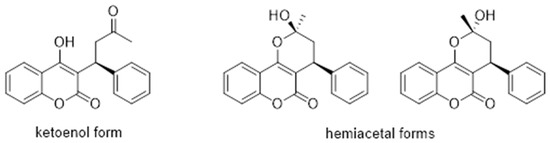
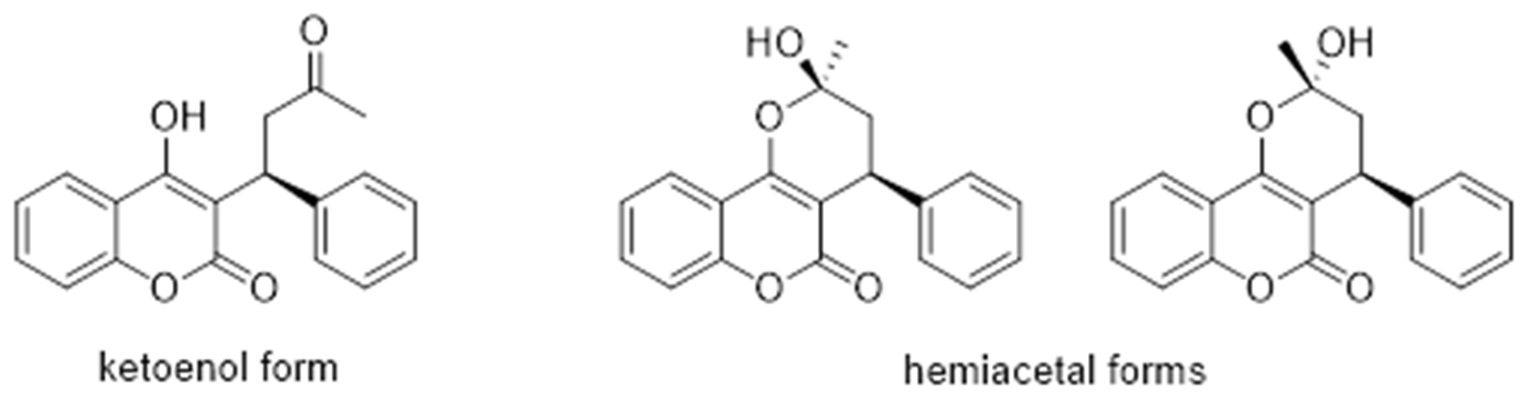
Warfarin (Circuvit, Química Ariston S.A., Argentina) represents a particularly suitable model system for investigating this type of transformation. In solution, it undergoes a reversible intramolecular cyclization between an open keto-enol form and two cyclic diastereomeric hemiacetals (Figure 1). Due to this structural complexity, many experimental and computational studies have been devoted to identifying the species present in solution, determining their relative stability, and evaluating the influence of the solvent on the structural equilibrium [1,2].
Figure 1.
Possible warfarin tautomers derived from the open-chain S enantiomer.
Recently, our research group carried out a detailed structural identification of warfarin in DMSO (Sigma Aldrich, La Plata, Argentina) using multinuclear NMR spectroscopy, two-dimensional NMR experiments, variable-temperature studies, and DFT calculations combined with DP4+ statistical analysis (https://github.com/Sarotti-Lab/DP4plus-App, accessed on 1 July 2025) [3,4]. This study demonstrated that the equilibrium in solution consists mainly of two diastereomeric hemiacetals, assigned to the (R,S)- and (S,S)-configurations, together with a minor proportion of the open keto-enol form. These findings enabled the unambiguous assignment of the experimental signals and provided a consistent structural model for the system.
Once the identity of the species present in solution has been established, a new question naturally arises: how are the structural differences between the open conformers of warfarin related to the mechanistic pathways leading to the experimentally observed hemiacetals? Addressing this question requires identifying the reactive conformations preceding cyclization, locating the transition states associated with each reaction pathway, and verifying the connections between reactants and products. The combination of DFT, vibrational frequency analysis and IRC calculations provides an appropriate computational strategy for reconstructing these mechanistic pathways.
2. Computational Methodology
Theoretical calculations were carried out using the Gaussian 09 software package (Gaussian, Inc., Wallingford, CT, USA) and molecular structures were prepared and visualized using GaussView 6 (Semichem Inc., Shawnee Mission, KS, USA) [5]. The pro-R and pro-S open conformers were considered as the reactive precursors leading to the (R,S) and (S,S) hemiacetal diastereomers, respectively. The geometries of these conformers, together with the corresponding transition-state structures and cyclic products, were fully optimized in the gas phase by means of DFT, employing the B3LYP hybrid exchange-correlation functional [6,7] together with the 6-31+G(d, p) basis set.
All stationary points located along the two reaction pathways were characterized by harmonic vibrational frequency calculations performed at the same level of theory. Local minima were confirmed by the absence of imaginary frequencies, whereas first-order transition states were identified by the presence of a single imaginary frequency. In each case, the corresponding normal vibrational mode was visually inspected to verify that it represented the atomic displacements associated with the intramolecular hemiacetalization process.
IRC calculations [8] were subsequently performed from each transition-state structure in both forward and reverse directions to confirm the connectivity between each reactive open conformer, its corresponding transition state, and the associated hemiacetal product. The resulting IRC profiles established the two mechanistic pathways investigated in this work.
Finally, single-point energy calculations were carried out on the optimized geometries at the B3LYP/6-311G level of theory to obtain improved relative energies for all stationary points. These energies were used to construct the reaction energy profiles and to compare the structural and energetic characteristics of the two intramolecular cyclization pathways.
During the elaboration of this work, we have used AI (artificial intelligence) tools with two specific proposes. On one hand, ChatGPT was applied as an assistance for organization and/or reformulation of text that had been previously discussed, developed and written in our group. In any case AI was used for generating the text, it has been just employed in some passages for correction and for getting suggestions.
On the other hand, Gemini was used for improving the quality of the layout of some images. In the particular case of the energy diagram, AI was used for its elaboration.
3. Results and Discussion
3.1. Open Conformations
Our study began with the optimization of the open-chain conformers involved in the formation of the experimentally observed hemiacetals, designated CApro-R and CApro-S. Both structures are connected through an interconversion transition state (TS inter), whose connectivity to the two minima was confirmed by IRC calculations, as shown in Figure 2.
Figure 2.
Interconversion between the open-chain structures CApro−S (left) and CApro−R (right).
3.2. Reaction Pathway Toward the (R,S) Hemiacetal
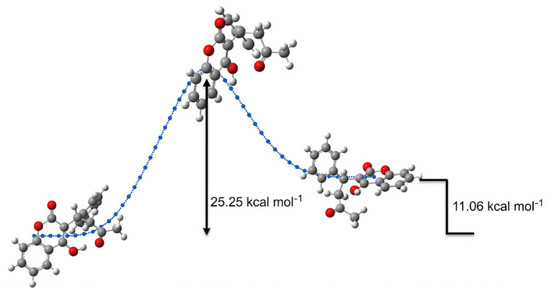
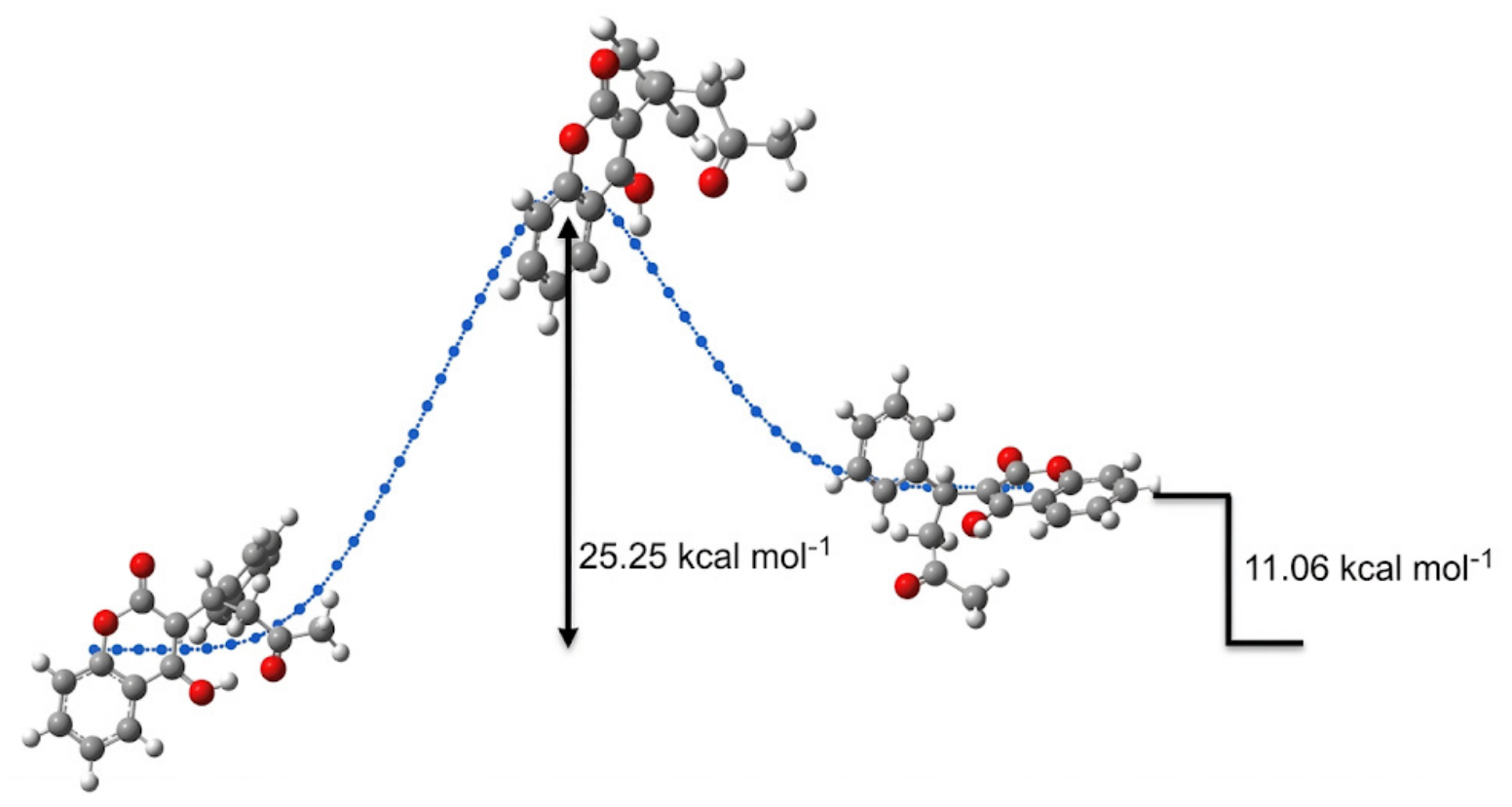
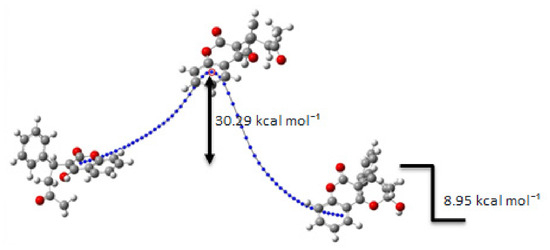
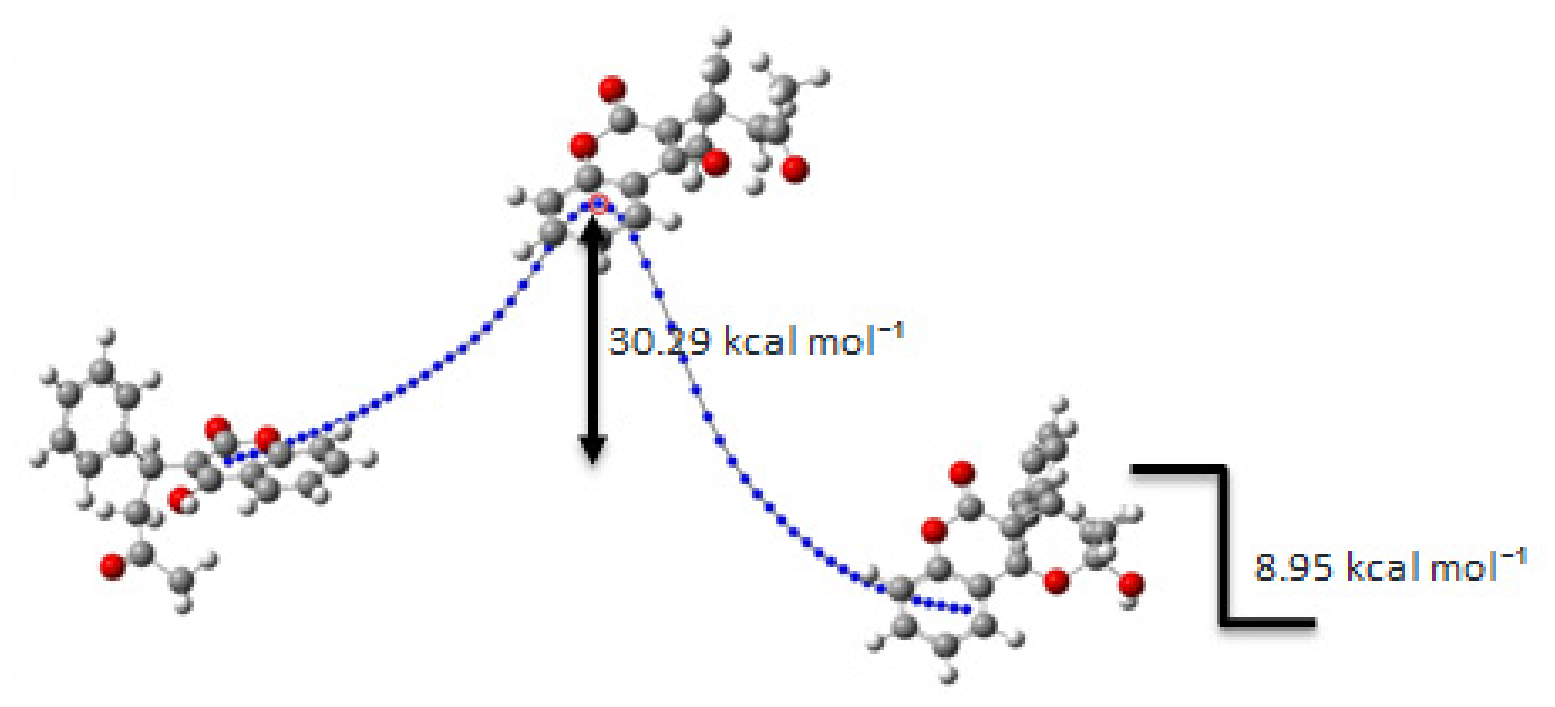
To study the formation of H-RS, a transition state (TS-RS) connecting the open-chain conformer CApro-R with the hemiacetal H-RS was located. The connectivity between the reactant, transition state, and product was confirmed by IRC calculations, revealing the structural evolution associated with the cyclization process, as shown in Figure 3.
Figure 3.
IRC profile of the CApro−R/H−RS system.
3.3. Reaction Pathway Toward the (S,S) Hemiacetal
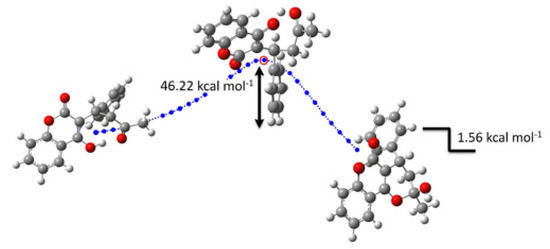
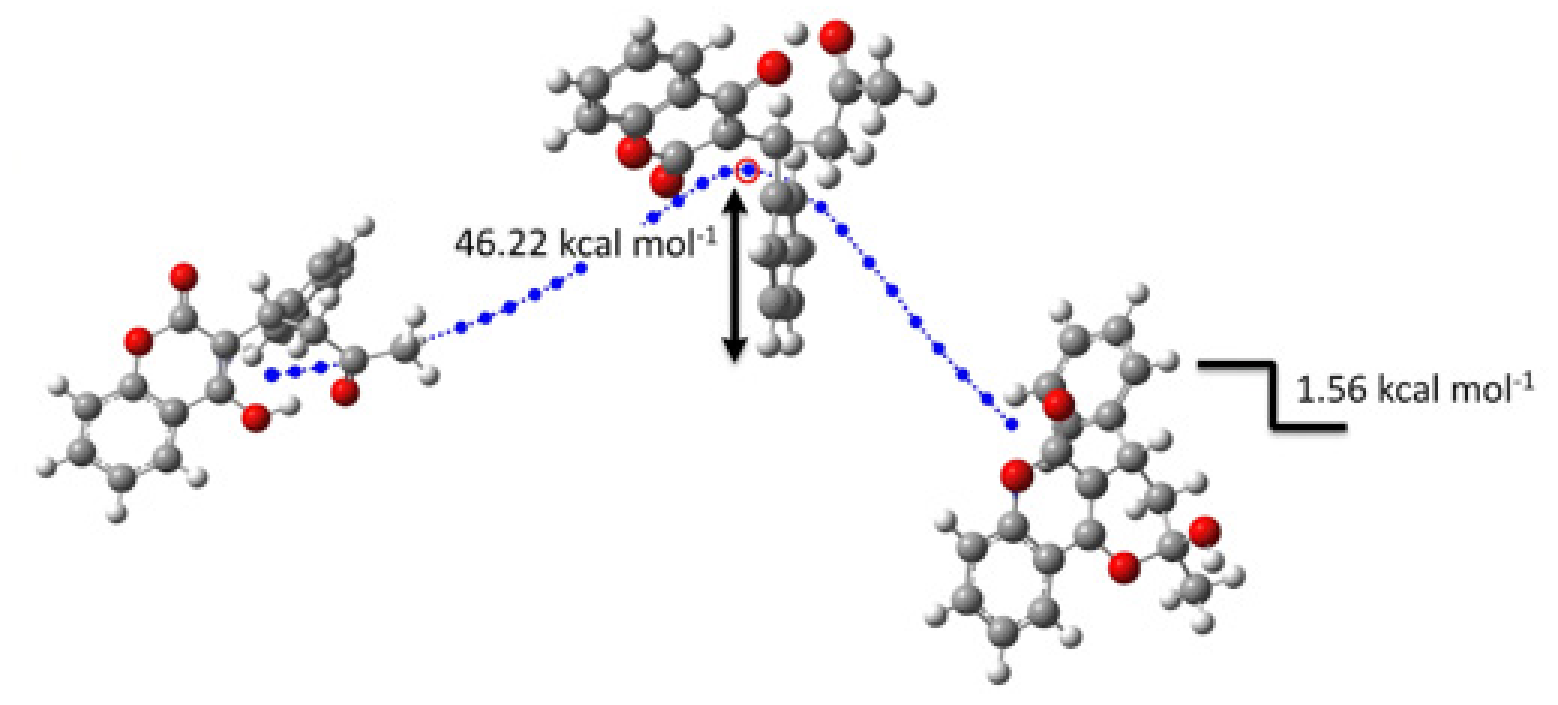
As for the (R,S) diastereomer, the corresponding transition state (TS-SS) for the cyclization of CApro-S to the hemiacetal H-SS was located. The connectivity between the open-chain conformer, the transition state, and the cyclic product was confirmed by IRC calculations, as shown in Figure 4.
Figure 4.
IRC profile of the CApro−S/H−SS system.
3.4. Comparative Mechanistic Analysis
Finally, Table 1 summarizes the main structural and energetic parameters obtained for the stationary points involved in the hemiacetalization mechanism. The O-H, H···O, O···C, and C-O distances allow the evolution of the bonds involved in proton transfer and cyclization to be followed. Along both pathways, a progressive elongation of the O-H bond and the initially carbonyl C-O bond is observed, accompanied by a shortening of the H···O and O···C distances. The IRC profiles and the absence of an intermediate stationary point are consistent with a single-step pathway in which proton transfer and C-O bond formation occur concomitantly. The relative electronic energies, calculated at the B3LYP/6-311G level, are expressed with respect to CApro-S as the reference.
Table 1.
Energies of the species involved and bond distances of the atoms involved in hemiacetalization, using H-SS as the reference for the calculation of ΔE values.
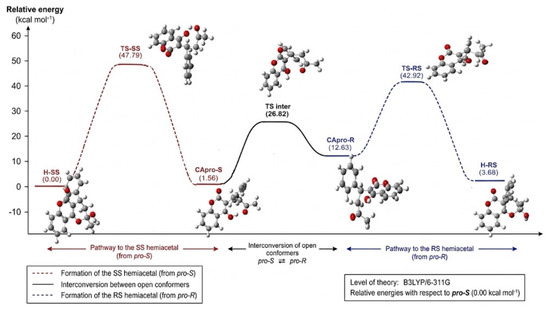
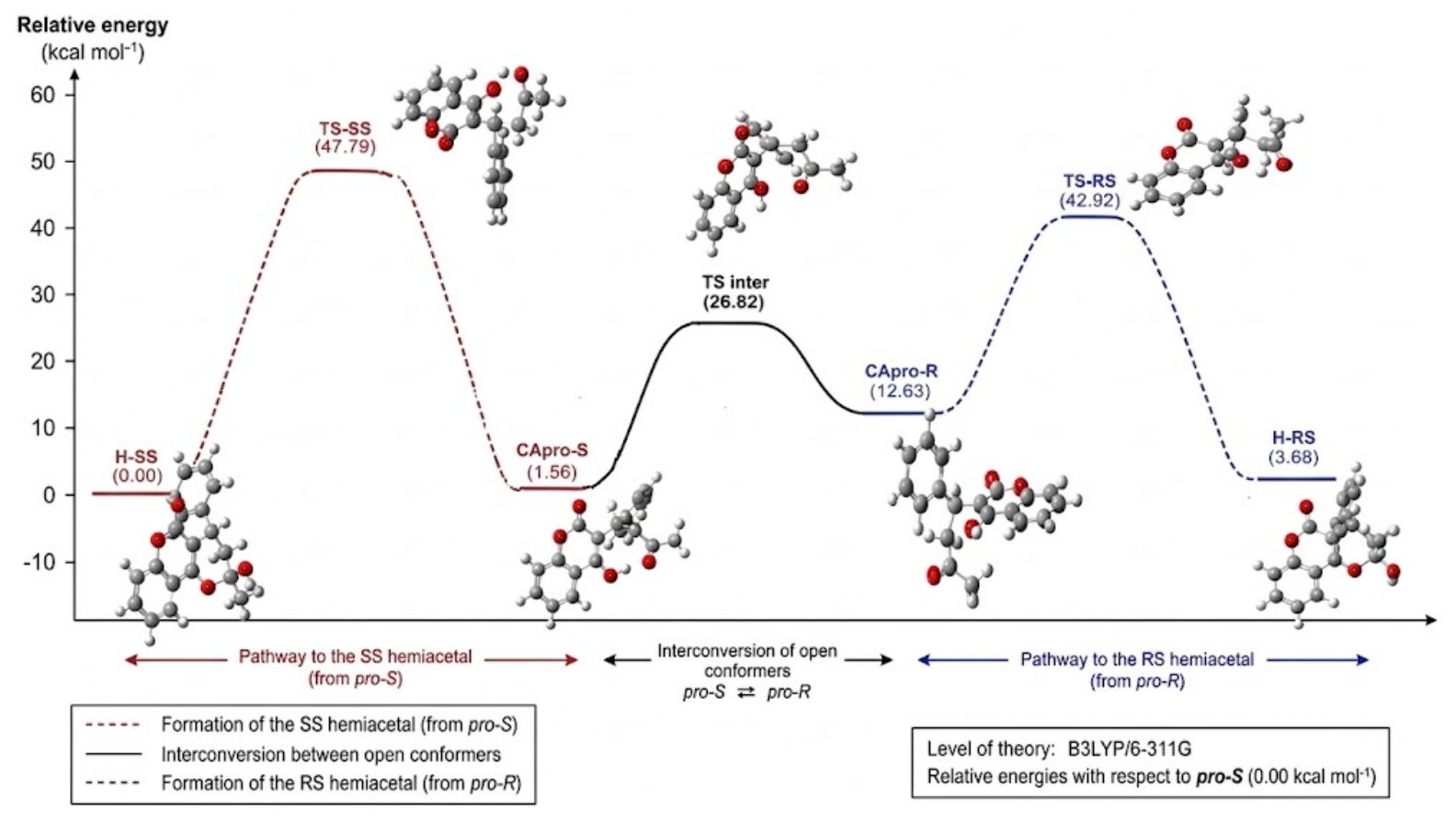
Figure 5 summarizes the proposed hemiacetalization mechanism based on the characterized stationary points. In its open-chain structure, the molecule can interconvert between the CApro-S and CApro-R conformers and, from each of them, follow a different cyclization pathway toward the H-SS and H-RS hemiacetals, respectively. The characterization of the transition states through vibrational analysis, together with the confirmation of their connectivity by IRC calculations, allows these pathways to be established at the molecular level.
Figure 5.
Proposed concerted hemiacetalization mechanism.
4. Conclusions
The present study provides a computational description of the intramolecular hemiacetalization pathways of warfarin leading to the experimentally observed (R,S) and (S,S) hemiacetal diastereomers. The characterization of the stationary points and the corresponding transition states, together with vibrational frequency analysis and IRC calculations, confirmed the connectivity between the open-chain conformers, the transition states, and the cyclic products, allowing the two reaction pathways to be established at the molecular level.
The structural evolution along both pathways, characterized by the simultaneous elongation of the O-H and carbonyl C-O bonds and shortening of the H···O and O···C distances, is consistent with a concerted process involving proton transfer and formation of the new C-O bond. The energetic analysis further indicates that the two pathways are not equivalent. The formation of the (R,S) hemiacetal from CApro-R leads to H-RS, which lies 8.95 kcal mol−1 below its corresponding open-chain conformer. In contrast, the (S,S) hemiacetal H-SS lies 1.56 kcal mol−1 below CApro-S, indicating that its formation is electronically favored relative to the corresponding open-chain conformer at the level of theory employed. H-SS is also the lowest-energy hemiacetal of the two considered, in qualitative agreement with the experimentally observed predominance of the RR/SS hemiacetal in an achiral medium.
Overall, the results demonstrate that the combination of DFT calculations, transition-state analysis, vibrational characterization and IRC calculations is a suitable approach for elucidating the molecular mechanism of warfarin cyclization and provides a basis for further studies aimed at evaluating solvent and thermodynamic effects on this equilibrium.
Author Contributions
Conceptualization, M.N.P. and S.L.L.; methodology, M.N.P.; software, M.N.P., J.G.C., I.B.M. and E.L.; validation, M.N.P. and J.G.C.; investigation, I.B.M.; writing—original draft preparation, M.N.P.; writing—review and editing, S.L.L.; supervision, S.L.L. All authors have read and agreed to the published version of the manuscript.
Funding
This research received no external funding.
Institutional Review Board Statement
Not applicable.
Informed Consent Statement
Not applicable.
Data Availability Statement
Data available under requirement to the corresponding author by e-mail.
Acknowledgments
Financial support is acknowledged to Facultad de Ciencias Exactas-UNLP (Universidad Nacional de La Plata, Buenos Aires, Argentina), CONICET (Consejo Nacional de In-vestigaciones Científicas y Técnicas) and CIC BA (Comisión de Investigaciones Científicas de la Pro-vincia de Buenos Aires). During the preparation of this manuscript, the authors used ChatGPT-6 (OpenAI) to assist with manuscript formatting and Google Gemini 4 Argon for the purposes of improve the visual quality of the figures. The authors have reviewed and edited the output and take full responsibility for the content of this publication.
Conflicts of Interest
The authors declare no conflicts of interest.
Abbreviations
The following abbreviations are used in this manuscript:
| DMSO | Dimethyl sulfoxide. |
| NMR | Nuclear Magnetic Resonance. |
| DFT | Density Functional Theory. |
| IRC | Intrinsic Reaction Coordinate. |
| CApro-S | pro-S open-chain structure. |
| TS inter | interconversion transition state. |
| CApro-R | pro-R open-chain structure. |
| H-RS | (R,S) hemiacetal/diastereomer. |
| TS-RS | transition state for the formation of the (R,S) hemiacetal/diastereomer. |
| H-SS | (S,S) hemiacetal/diastereomer. |
| TS-SS | transition state for the formation of the (S,S) hemiacetal/diastereomer. |
References
- Guasch, L.; Peach, M.L.; Nicklaus, M.C. Tautomerism of Warfarin: Combined Chemoinformatics, Quantum Chemical, and NMR Investigation. J. Org. Chem. 2015, 80, 9900–9909. [Google Scholar] [CrossRef] [Scilit] [PubMed]
- Osborne, D.A.; Danielyan, E.; Hoang, K.; Valente, E.J. Warfarin Tautomers in Solution: A Structural, Computational and Thermodynamic Study. J. Chem. Crystallogr. 2024, 54, 64–83. [Google Scholar] [CrossRef] [Scilit]
- Pila, M.; Morales, I.; Siri, F.; Carreras, J.; Bolla, P.; Ruiz, D.; Laurella, S. On the structure of the anticoagulants acenocoumarol and warfarin: An NMR and theoretical study. J. Mol. Struct. 2026, 1355, 145032. [Google Scholar] [CrossRef] [Scilit]
- Smith, S.G.; Goodman, J.M. Assigning stereochemistry to single diastereoisomers by GIAO NMR calculation: The DP4 probability. J. Am. Chem. Soc. 2010, 132, 12946–12959. [Google Scholar] [CrossRef] [Scilit] [PubMed]
- Frisch, M.J.; Trucks, G.W.; Schlegel, H.B.; Scuseria, G.E.; Robb, M.A.; Cheeseman, J.R.; Scalmani, G.; Barone, V.; Mennucci, B.; Petersson, G.A.; et al. Gaussian 09, Revision D.01; Gaussian, Inc.: Wallingford, CT, USA, 2009. [Google Scholar]
- Becke, A.D. Density-functional exchange-energy approximation with correct asymptotic behavior. Phys. Rev. A 1988, 38, 3098–3100. [Google Scholar] [CrossRef] [Scilit] [PubMed]
- Lee, C.; Yang, W.; Parr, R.G. Development of the Colle–Salvetti correlation-energy formula into a functional of the electron density. Phys. Rev. B 1988, 37, 785–789. [Google Scholar] [CrossRef] [Scilit] [PubMed]
- González, C.; Schlegel, H.B. An improved algorithm for reaction path following. J. Chem. Phys. 1989, 90, 2154–2161. [Google Scholar] [CrossRef] [Scilit]

Disclaimer/Publisher’s Note: The statements, opinions and data contained in all publications are solely those of the individual author(s) and contributor(s) and not of MDPI and/or the editor(s). MDPI and/or the editor(s) disclaim responsibility for any injury to people or property resulting from any ideas, methods, instructions or products referred to in the content. |
© 2026 by the authors. Licensee MDPI, Basel, Switzerland. This article is an open access article distributed under the terms and conditions of the Creative Commons Attribution (CC BY) license.