


Abstract
Coordination polymer particles (CPPs) formed from catechol-based ligands and Fe (III) provide tunable, amorphous functional materials. Here, we present a series of thiohydroximate-functionalized catechol ligands bearing phenyl, 2-hydroxyphenyl, or 2-thiophenyl substituents, designed to probe how the nature of a secondary donor site influences Fe (III) coordination. Density functional theory (DFT) calculations indicate that the coordination mode (monodentate vs. bidentate) depends on the substituent. A computational comparison with a pyridyl analog further rationalizes the weak coordination of the thiophene-based ligand, identifying donor hardness as the key structural factor determining the coordination strength.
1. Introduction
Coordination polymer particles (CPPs) constructed from polydentate organic ligands and transition metals have attracted increasing interest as functional materials for drug delivery and stimuli-responsive systems [1,2]. Among the ligand scaffolds used for this purpose, catechol derivatives are particularly appealing due to the strong pH-dependent affinity of the catecholate moiety for hard high-valent metal ions such as Fe (III) [3].
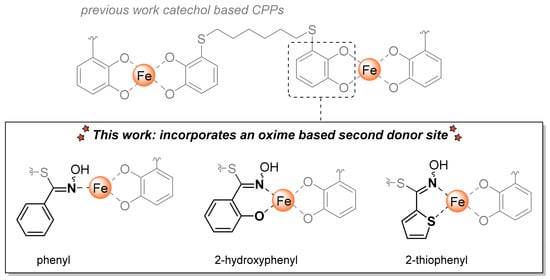
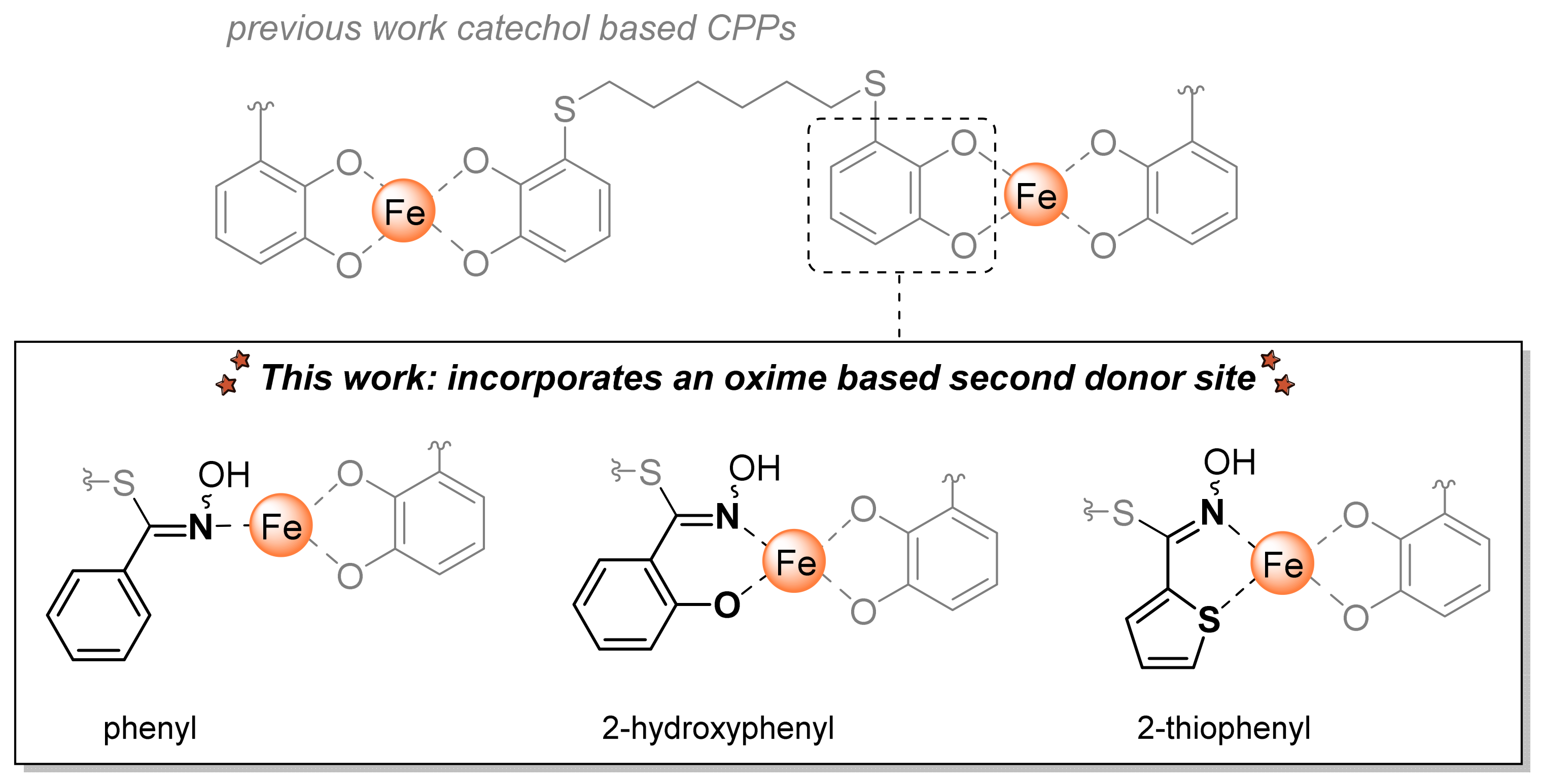
We previously reported a series of Fe (III) CPPs assembled from catechol ligands bearing a second chelating group, namely a second catechol, pyridine, or thiol [4]. The present study extends this modular design strategy to a new class of secondary donor groups derived from thiohydroximates, in which an oxime unit is attached to a catechol–thiol scaffold via a tunable aryl substituent. Thiohydroximates offer a versatile platform for tuning coordination behavior, since the aryl substituent can introduce a donor atom of variable hardness (O, N, or S) adjacent to the oxime nitrogen (Figure 1). This motif raises a specific question: can the aryl substituent supply an extra donor atom, allowing the oxime to act not only as a monodentate ligand but also as part of a bidentate chelate? To address this, we synthesized three ligands bearing phenyl, phenol, or thiophene substituents and prepared the corresponding Fe (III) CPPs. Their preferred coordination modes were determined using DFT calculations.
Figure 1.
Previous catechol-based CPPs (top) and the oxime-based secondary donor motifs explored in this work (bottom), illustrating the range of coordination modes accessible through variation of the aryl substituent.
2. Materials and Methods
2.1. Ligand Synthesis
Thiohydroximate ligands Cat-N, Cat-NO, and Cat-NS were obtained from benzaldehyde, salicylaldehyde, and thiophene-2-carbaldehyde, respectively, following the general procedure described below. All reactions were carried out at room temperature and monitored by TLC.
The corresponding aldehyde (1 mmol) was dissolved in DMF (3 mL), followed by the addition of hydroxylamine hydrochloride (76 mg, 1.1 mmol) and NaHCO3 (92 mg, 1.1 mmol). The reaction mixture was stirred at room temperature until complete conversion of the starting aldehyde to the corresponding oxime was observed (30–60 min). N-chlorosuccinimide (NCS) (147 mg, 1.1 mmol) was then added portionwise, and the reaction mixture was stirred for 2–3 h until complete conversion of the oxime to the corresponding N-hydroxyimidoyl chloride. The catechol–thiol derivative (0.66 mmol) and NaHCO3 (92 mg, 1.1 mmol) were then added, and the resulting mixture was stirred under a nitrogen atmosphere for 3 h. Upon completion of the reaction, the mixture was diluted with water (10 mL) and extracted with EtOAc (3 × 10 mL). The combined organic phases were washed with water (10 mL) and brine (10 mL), dried over Na2SO4, and concentrated under reduced pressure. The crude product was purified by flash column chromatography using hexane/EtOAc as the eluent to afford the desired ligands. The products were obtained as colorless oils or white waxy solids.
Cat-N (97%). 1H NMR (300 MHz, CDCl3) δ: 8.95 (bs, 1H, N-OH), 7.53–7.45 (m, 2H), 7.44–7.36 (m, 3H), 6.96 (dd, J = 7.8, 1.5 Hz, 1H), 6.89 (dd, J = 8.1, 1.5 Hz, 1H), 6.77 (t, J = 7.9 Hz, 1H), 6.74–6.19 (bs, 1H, -OH), 5.56 (bs, 1H, -OH), 2.63 (t, J = 7.4 Hz, 2H, -CH2-S), 2.57 (t, J = 7.4 Hz, 2H, -CH2-S), 1.53–1.33 (m, 4H), 1.31–1.16 (m, 4H).
Cat-NS (95%). 1H NMR (300 MHz, CDCl3) δ: 8.41 (bs, 1H, N-OH), 7.41 (dd, J = 3.6, 1.1 Hz, 1H), 7.35 (dd, J = 5.1, 1.1 Hz, 1H), 7.05 (dd, J = 5.1, 3.7 Hz, 1H), 6.97 (dd, J = 7.7, 1.6 Hz, 1H), 6.90 (dd, J = 8.1, 1.6 Hz, 1H), 6.77 (t, J = 7.9 Hz, 1H), 6.56 (bs, 1H), 5.52 (bs, 1H), 3.00–2.85 (m, 4H), 1.64–1.44 (m, 4H), 1.42–1.29 (m, 4H).
Cat-NO (99%). 1H NMR (300 MHz, CDCl3) δ: 10.15 (bs, 1H, -OH), 8.60 (bs, 1H, N-OH), 7.80 (dd, J = 8.0, 1.6 Hz, 1H), 7.33–7.20 (m, 1H), 7.03–6.88 (m, 4H), 6.77 (t, J = 7.9 Hz, 1H), 6.57 (bs, 1H, -OH), 5.58 (bs, 1H, -OH), 2.91 (t, J = 7.3 Hz, 2H, -CH2-S), 2.65 (t, J = 7.3 Hz, 2H, -CH2-S), 1.61–1.44 (m, 4H), 1.39–1.29 (m, 4H).
2.2. Coordination Polymer Particle Preparation
The corresponding ligand was dissolved in ethanol under magnetic stirring, and an aqueous solution of FeCl3·6H2O was added dropwise. An aqueous solution of NaOH (0.1 M) was then added until the mixture developed a deep blue-violet color, and the reaction mixture was stirred overnight at room temperature. The resulting precipitate was isolated by centrifugation, washed sequentially with water and ethanol, and dried under vacuum. Yields were calculated relative to the theoretical mass of the corresponding complex, using Fe (III) as the limiting reagent according to the stoichiometry for each system.
2.3. Computational Details
All DFT calculations were performed using ORCA 6.1.0 [5]. Geometry optimizations of Fe (III) complex models were carried out at the BP86-D3BJ level using the def2-TZVPP basis set for Fe; def2-TZVP for O, N, and S; and def2-SVP for C and H [6,7,8]. Frequency calculations were subsequently performed, confirming all optimized structures as true minima. All Fe (III) complexes were modeled in the high-spin (sextet) state. Bond order was computed using the Mayer scheme, and atomic charges were computed using the CHELPG scheme.
3. Results and Discussion
3.1. Synthesis of Ligands
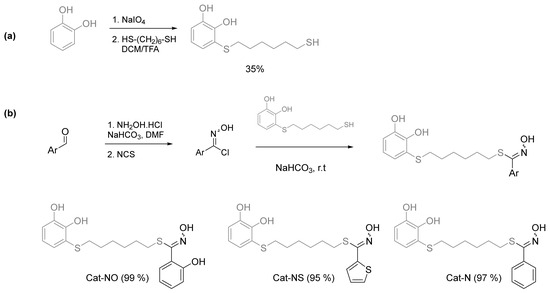
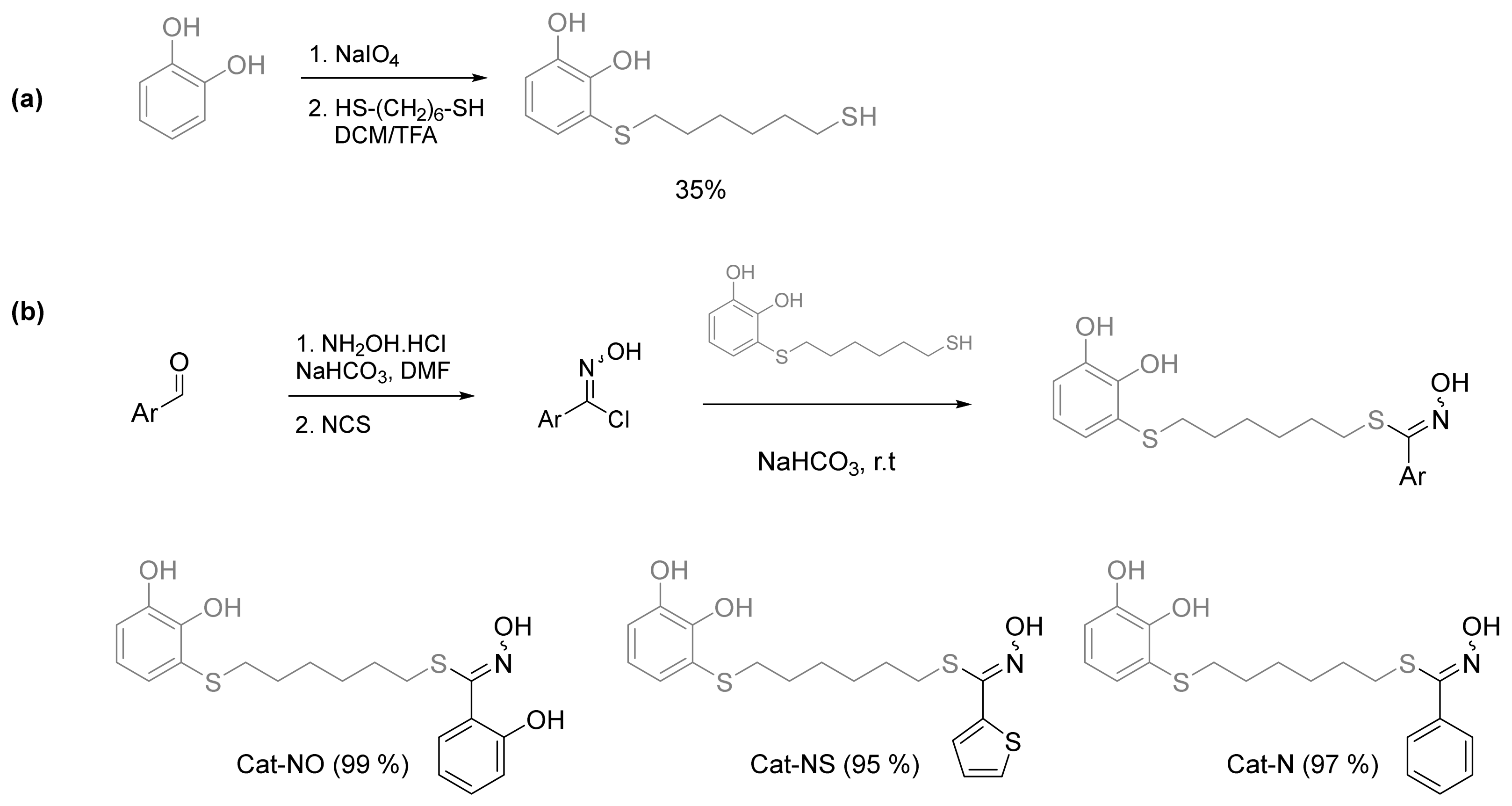
The synthesis of the ligands was carried out in two stages (Scheme 1). First, the catechol–thiol derivative was obtained by controlled oxidation of catechol followed by the addition of hexanedithiol, according to methods previously reported by our research group [9] (Scheme 1a).
Scheme 1.
(a) Preparation of catechol–thiol fragment. (b) Synthesis of ligands Cat-NO, Cat-NS and Cat-N.
Next, three thiohydroximate ligands differing in the aryl substituent adjacent to the oxime carbon, phenyl (Cat-N), 2-hydroxyphenyl (Cat-NO), and thiophen-2-yl (Cat-NS), were generated from the corresponding aldehydes through a one-pot, three-step sequential (telescopic) synthesis (Scheme 1b) consisting of: (i) aldoxime formation, (ii) conversion to the corresponding imidoyl chloride by treatment with NCS, and (iii) base-mediated (NaHCO3) generation of the corresponding nitrile oxide, which was trapped in situ by the catechol–thiol nucleophile to afford the target thiohydroximates. This telescopic approach avoids the isolation of unstable intermediates (imidoyl chloride/nitrile oxide), thereby reducing the number of purification steps and improving the overall yield and reproducibility compared with stepwise protocols [10].
3.2. Structural Assembly and Coordination Modes of CPPs
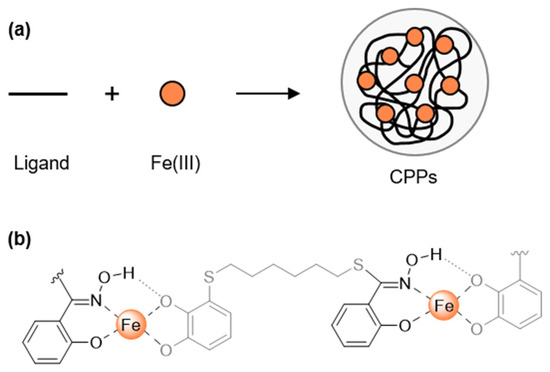
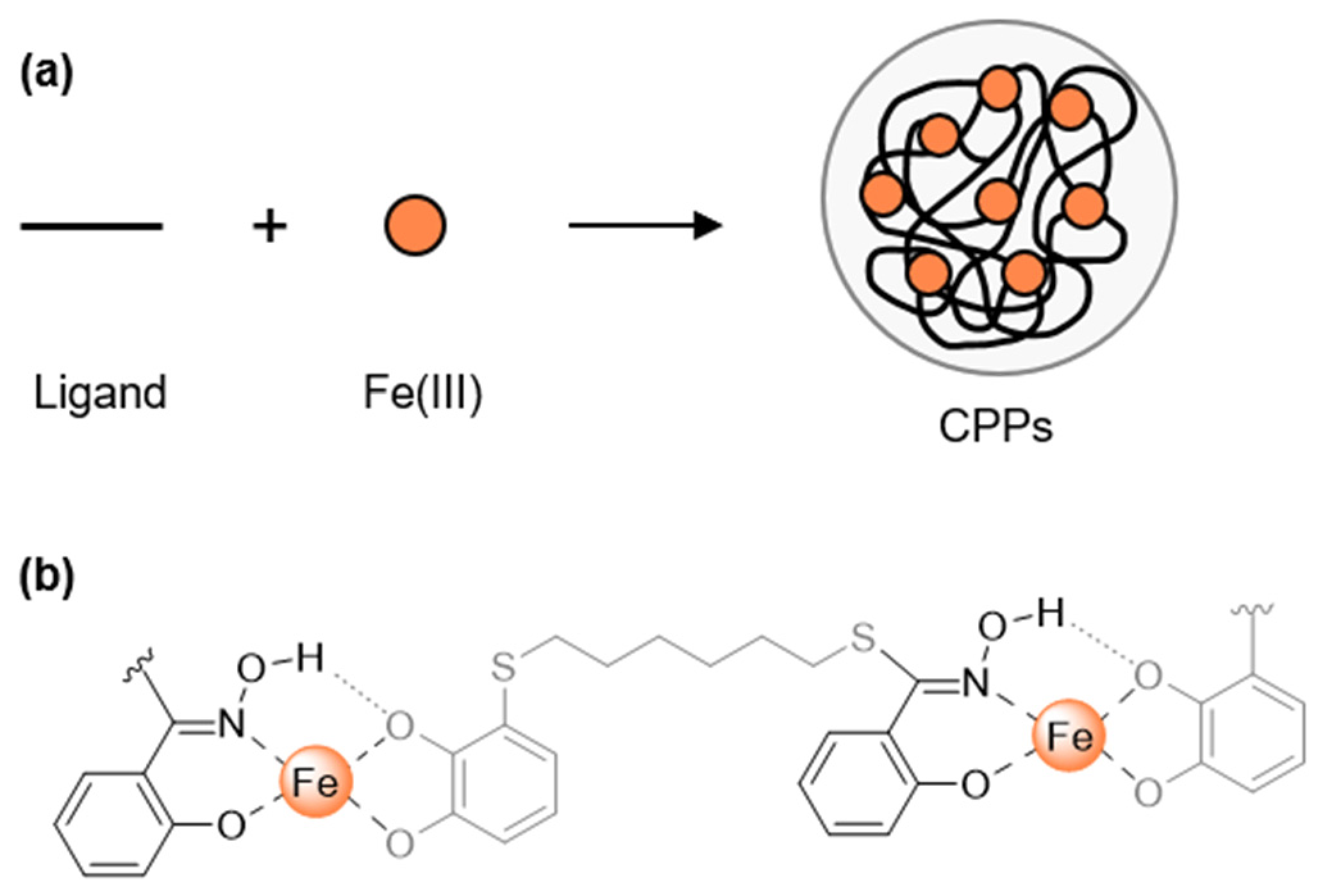
Reaction of Cat-N, Cat-NO, or Cat-NS with FeCl3·6H2O under basic ethanolic conditions gave deep blue-violet precipitates, visually consistent with the catecholate-to-Fe (III) charge-transfer color previously confirmed by UV–Vis spectroscopy for related catechol-based CPPs [4]. Each ditopic ligand is expected to bridge two distinct Fe (III) centers in the resulting amorphous network, with the catechol unit coordinating one metal center and the secondary donor site coordinating a neighboring one (Figure 2). To reduce the computational cost, the DFT models simplify this extended structure by omitting the hexyl dithioether spacer and focusing on the local Fe (III) coordination environment; for Cat-N, the non-coordinating phenyl substituent was also omitted.
Figure 2.
(a) Schematic representation of CPPs formation from a ditopic ligand and Fe (III). (b) Representative ligand (Cat-NO) bridging two distinct Fe (III) centers.
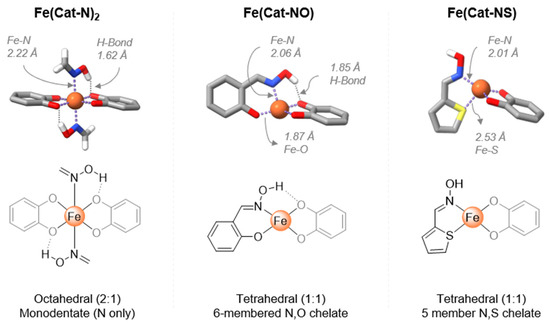
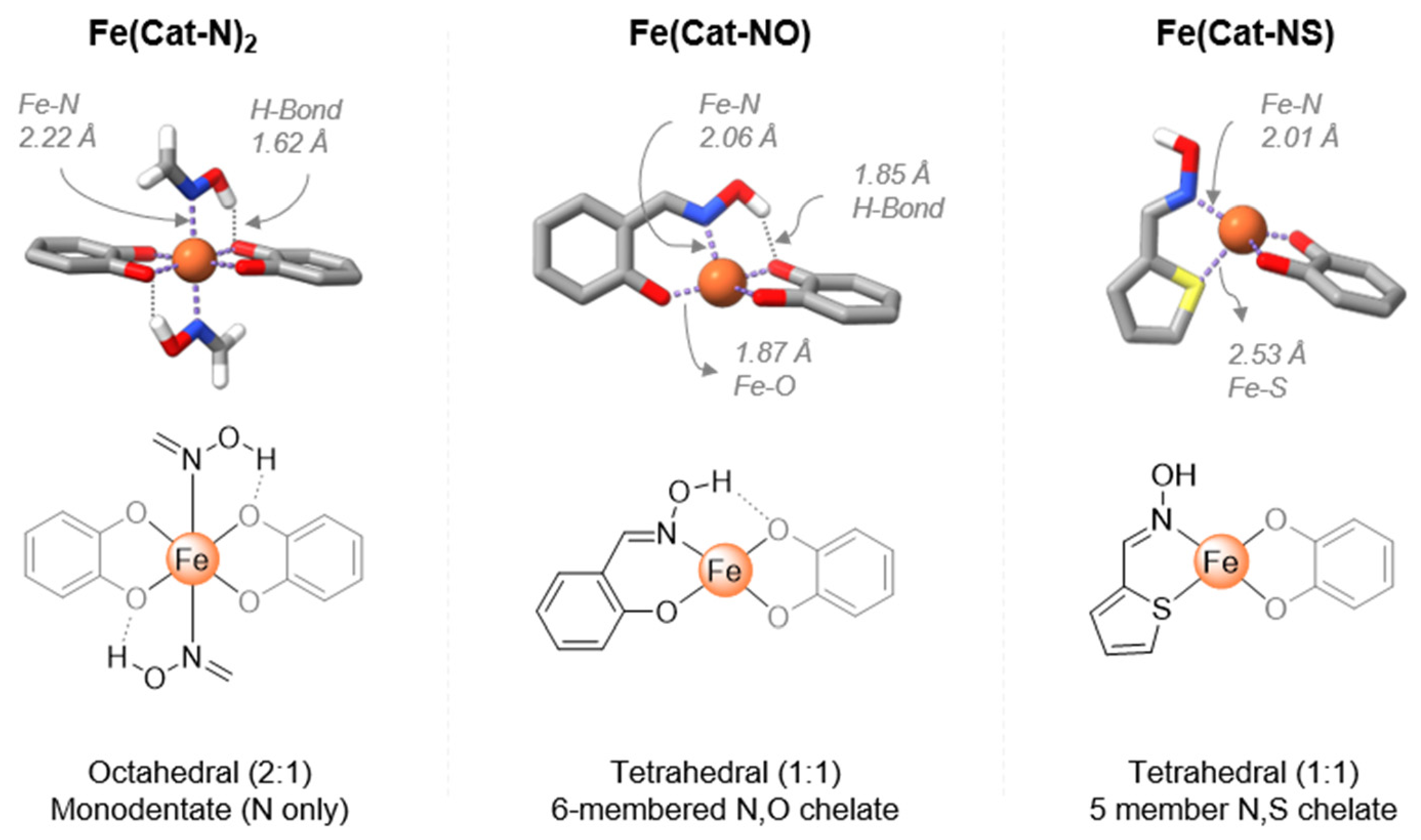
Simplified Fe (III) complexes of Cat-N, Cat-NO, and Cat-NS were optimized at the BP86-D3BJ level and confirmed as true minima by the absence of imaginary frequencies. The resulting geometries, shown in Figure 3, reveal three distinct coordination modes depending on the identity of the aryl substituent.
Figure 3.
DFT-optimized geometries of the Fe (III) complexes for Cat-NO (six-membered chelate), Cat-NS (five-membered chelate) and Cat-N (octahedral) with key bond distances labelled.
For Cat-N, the oxime nitrogen coordinates Fe (III) as a monodentate donor. Considering the donor atoms provided by each ligand, two oxygen atoms from the catecholate and one nitrogen atom from the oxime coordinate the Fe (III) center, giving a 2:1 ligand:Fe stoichiometry, consistent with an octahedral geometry. The optimized structure indeed adopts a trans-octahedral arrangement, with Fe–O(catecholate) distances of 1.99–2.05 Å, an Fe–N(oxime) distance of 2.22 Å, and a catecholate bite angle of ~82.5°, all within the range expected for high-spin Fe (III) complexes.
For Cat-NO, the ortho-hydroxyl group on the aryl ring allows the oxime to act as a bidentate N,O-chelator, analogous to the coordination motif observed in salicylaldoxime [11]. This forms a six-membered chelate ring (Fe–N = C–C–C–O–Fe) with a favorable bite angle of 88.6°. The resulting 1:1 tetrahedral model features a short Fe–O(phenolate) distance of 1.87 Å, consistent with strong phenolate-to-Fe (III) donation.
For Cat-NS, the thiophene sulfur instead forms a five-membered chelate ring (Fe–N = C–C–S–Fe), with an Fe–S distance of 2.53 Å and a bite angle of 80.0°. These values indicate a plausible and geometrically stable interaction, with the sulfur remaining coordinated during optimization, although the interaction appears weaker than the corresponding Fe–O (phenolate) interaction in Cat-NO. In line with this, the Cat-NS chelate ring is non-planar (S–C–C–N dihedral = 20.2°), in contrast to the planar rings in Cat-NO. This distortion may reflect the restricted orientation of the in-plane sulfur lone pair in thiophene, which is not ideally aligned to form a five-membered chelate without strain.
An intramolecular hydrogen bond between the non-coordinating oxime O–H and a catecholate oxygen is present in Cat-N (1.62 Å) and Cat-NO (1.85 Å) but absent in Cat-NS, because the more compact five-membered ring orients the O–H away from the catecholate. This additional stabilization likely contributes to the more rigid local geometries of Cat-N and Cat-NO compared with Cat-NS.
3.3. Donor Strength, Yields, and Solubility: Converging Evidence for Fe (III)-Thiophene Lability
To complement the geometric analysis above, bond orders and atomic charges shifts were used to quantify donor strength at each coordination site (Table 1). The catecholate fragment shows a remarkably consistent charge redistribution upon coordination across the three complexes (Δq = +0.31 to +0.35 relative to the free catecholate), indicating that the primary bidentate binding motif remains electronically similar regardless of the identity of the secondary donor. This provides a useful internal reference for evaluating differences at the secondary coordination site.
Table 1.
Bond orders and atomic charge shifts for the second donor atom in each complex.
The secondary donors, in contrast, display pronounced differences in both charge redistribution and bond order. In Fe (Cat-NO), coordination through the phenolate oxygen is characterized by a relatively large charge shift (Δq = +0.136) and a high Fe-O bond order (0.747), consistent with a strong interaction between Fe(III) and the anionic, hard phenolate donor. The oxime nitrogen undergoes a smaller charge shift (Δq = +0.089), indicating a comparatively limited contribution to the overall metal–ligand interaction.
A different electronic picture emerges for Fe(Cat-NS). Here, the coordinated thiophene sulfur exhibits only a small charge shift (Δq = +0.042) and a low Fe–S bond order (0.320), indicating a substantially weaker interaction with Fe(III). In contrast, the oxime nitrogen shows a much larger charge redistribution (Δq = +0.200), indicating that the nitrogen compensates electronically for a comparatively weak sulfur donor. Overall, the combination of charge shifts and bond orders provides converging evidence that the Fe–S interaction in Fe (Cat-NS) is substantially weaker than the corresponding Fe–O and Fe–N interactions, supporting the assignment of thiophene coordination as the most labile secondary interaction among the complexes examined.
This weaker electronic interaction is also consistent with differences observed experimentally in both the CPP yields (Table 2) and the solubility behavior of the resulting solids. Both bidentate systems gave substantially higher yields (92% for Fe (Cat-NO) and 78% for Fe (Cat-NS)) than the monodentate Fe (Cat-N) (56%), consistent with more efficient chelation-driven assembly overall. Within this trend, however, the lower yield obtained for Cat-NS relative to Cat-NO, despite their identical 1:1 stoichiometry, may be related to the weaker electronic interaction identified at the secondary coordination site.
Table 2.
Yields of the Fe (III) coordination polymers obtained.
A solubility test in acetone provides an independent, qualitative probe of the same behavior. CPPs of this type are generally insoluble due to their extended, cross-linked network structure. Consistent with this, Fe (Cat-N) and Fe (Cat-NO) precipitates remained fully insoluble, whereas Fe (Cat-NS) was the only sample to produce color in the supernatant, which intensified upon sonication, indicating a weak, kinetically labile Fe–S interaction that hinders effective polymerization, favoring soluble discrete complexes over the extended network.
3.4. Computational Assessment of a Pyridyl Analogue as a Potential Fe (III) Ligand
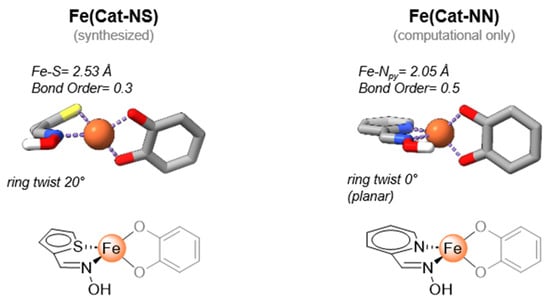
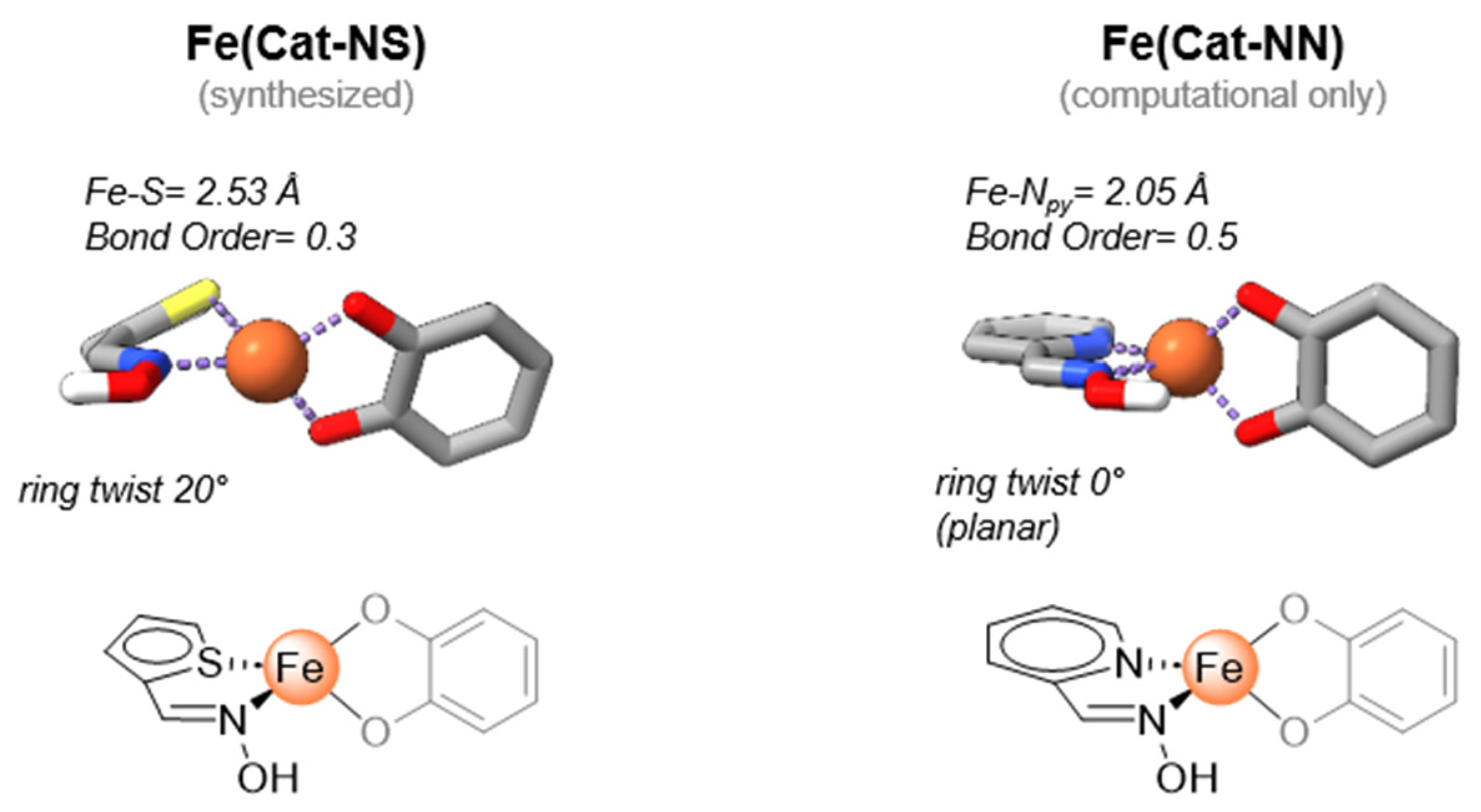
To determine whether the weak Fe–S interaction in Fe (Cat-NS) arises primarily from the intrinsic donor character of thiophene sulfur rather than from the chelate ring geometry, a pyridyl analogue (Cat-NN) was examined computationally, preserving the same five-membered ring topology while replacing sulfur with nitrogen. Despite nearly identical ring topology and bite angles (Figure 4), the Fe–N (pyridine) distance (2.05 Å) is shorter than the Fe–S distance (2.53 Å), and the bond order of Fe–N (pyridine) (0.49) is 53% higher than that of Fe–S (0.32); atomic charges follow the same trend, with the pyridine nitrogen shifting by +0.48 upon coordination compared with only +0.04 for the thiophene sulfur. The Fe (Cat-NN) chelate ring is also planar, matching Fe (Cat-NO), whereas Fe(Cat-NS) shows non-planarity (dihedral = 20°) specific to the thiophene donor. Together, these indicators show that the weak, strained coordination in Fe (Cat-NS) arises from poor compatibility between the soft, aromatic thiophene sulfur and the hard, high-spin Fe (III) center, pointing to pyridyl-functionalized analogues such as Fe (Cat-NN) as promising synthetic targets.
Figure 4.
Comparison between Fe (Cat-NS) and Fe (Cat-NN) coordination.
4. Conclusions
Three thiohydroximate-functionalized catechol ligands were synthesized and used to prepare Fe (III) coordination polymer particles, showing that the aryl substituent on the oxime modulates the secondary donor site’s coordination mode. The phenyl derivative binds Fe (III) as a monodentate nitrogen donor, whereas the phenol and thiophene derivatives form six- and five-membered bidentate chelate rings. Geometric, electronic, gravimetric, and solubility evidence supports this picture and indicates that the Fe–S interaction in the thiophene complex is weak and kinetically labile. Comparison with a computationally modeled pyridyl analogue (Cat-NN) confirmed that this weakness reflects poor hard–soft matching between Fe (III) and aromatic thiophene sulfur, identifying pyridyl-functionalized ligands as promising synthetic targets for future work.
Author Contributions
Conceptualization, V.D. and F.N.; methodology, M.C. and S.S.; writing—original draft preparation, M.C. and S.S.; writing—review and editing, V.D., F.N. and G.R.; funding acquisition, G.R. All authors have read and agreed to the published version of the manuscript.
Funding
This research was funded by the Consejo Nacional de Investigaciones Científicas y Técnicas (CONICET, PIP N° 11220200101665CO), Agencia Nacional de Promoción Científica y Tecnológica (ANPCyT, PICT 2018-2471) and Universidad Nacional del Sur (UNS, PGI 24/Q142) from Argentina.
Institutional Review Board Statement
Not applicable.
Informed Consent Statement
Not applicable.
Data Availability Statement
The raw data supporting the conclusions of this article will be made available by the authors on request.
Acknowledgments
The authors have reviewed and edited the output and take full responsibility for the content of this publication.
Conflicts of Interest
The authors declare no conflicts of interest.
Abbreviations
The following abbreviations are used in this manuscript:
| CPPs | Coordination Polymer Particles |
| DFT | Density Functional Theory |
| NCS | N-Chlorosuccinimide |
References
- Horcajada, P.; Serre, C.; Vallet-Regí, M.; Sebban, M.; Taulelle, F.; Férey, G. Metal–Organic frameworks as efficient materials for drug delivery. Angew. Chem. Int. Ed. 2006, 45, 5974–5978. [Google Scholar] [CrossRef] [Scilit] [PubMed]
- Nador, F.; Novio, F.; Ruiz-Molina, D. Coordination polymer particles with ligand-centred pH-responses and spin transition. Chem. Commun. 2014, 50, 14570–14572. [Google Scholar] [CrossRef] [Scilit] [PubMed]
- Saiz-Poseu, J.; Mancebo-Aracil, J.; Nador, F.; Busqué, F.; Ruiz-Molina, D. The chemistry behind catechol-based adhesion. Angew. Chem. Int. Ed. 2019, 58, 696–714. [Google Scholar] [CrossRef] [Scilit] [PubMed]
- Capurso, M.; Radivoy, G.; Sánchez, M.D.; Nador, F.; Dorn, V. Investigating iron–catechol coordination polymers through computational and spectroscopic methods. J. Mol. Struct. 2026, 1359, 145446. [Google Scholar] [CrossRef] [Scilit]
- Neese, F. Software Update: The ORCA Program System—Version 6.0. Wiley Interdiscip. Rev. Comput. Mol. Sci. 2025, 15, e70019. [Google Scholar] [CrossRef] [Scilit]
- Perdew, J.P. Density-functional approximation for the correlation energy of the inhomogeneous electron gas. Phys. Rev. B 1986, 33, 8822–8824, Erratum in Phys. Rev. B 1986, 34, 7406. [Google Scholar] [CrossRef] [Scilit] [PubMed]
- Grimme, S.; Antony, J.; Ehrlich, S.; Krieg, H. A consistent and accurate ab initio parametrization of density functional dispersion correction (DFT-D) for the 94 elements H-Pu. J. Chem. Phys. 2010, 132, 154104. [Google Scholar] [CrossRef] [Scilit] [PubMed]
- Weigend, F.; Ahlrichs, R. Balanced basis sets of split valence, triple zeta valence and quadruple zeta valence quality for H to Rn: Design and assessment of accuracy. Phys. Chem. Chem. Phys. 2005, 7, 3297. [Google Scholar] [CrossRef] [Scilit] [PubMed]
- Mancebo-Aracil, J.; Casagualda, C.; Angel, M.; Nador, F.G.; García, J.; Franconetti-García, A.; Busqué, F.; Esplandiu, M.J.; Ruiz-Molina, D. Bioinspired functional catechol derivatives through simple thiol conjugate addition. Chem. Eur. J. 2019, 25, 12367–12379. [Google Scholar] [CrossRef] [Scilit] [PubMed]
- Stabile, S.; Bjerg, E.E.; Radivoy, G. Copper Nanoparticles on Montmorillonite K-10: A Versatile Catalyst for the One-Pot Synthesis of 3,5-Disubstituted Isoxazoles Using Various Methodologies. Synthesis 2024, 56, 281–292. [Google Scholar] [CrossRef] [Scilit]
- Raptopoulou, C.P.; Sanakis, Y.; Boudalis, A.K.; Psycharis, V. Salicylaldoxime (H2salox) in iron(III) carboxylate chemistry: Synthesis, X-ray crystal structure, spectroscopic characterization and magnetic behavior of trinuclear oxo-centered complexes. Polyhedron 2005, 24, 711–721. [Google Scholar] [CrossRef] [Scilit]

Disclaimer/Publisher’s Note: The statements, opinions and data contained in all publications are solely those of the individual author(s) and contributor(s) and not of MDPI and/or the editor(s). MDPI and/or the editor(s) disclaim responsibility for any injury to people or property resulting from any ideas, methods, instructions or products referred to in the content. |
© 2026 by the authors. Licensee MDPI, Basel, Switzerland. This article is an open access article distributed under the terms and conditions of the Creative Commons Attribution (CC BY) license.